Hours 3:28 – 6:47, 6/3/25

Item 29: The Dreaded Data Center

First off: apparently there are actually like 7 different companies trying to come to Hays County and put in data centers?!

Out of those seven companies, there are a few specific ones that keep coming up:

  • This one, on Francis Harris Lane
  • John David Carson’s, discussed later on in this meeting.
  • The Cloudburst one, which keeps popping up in the news.

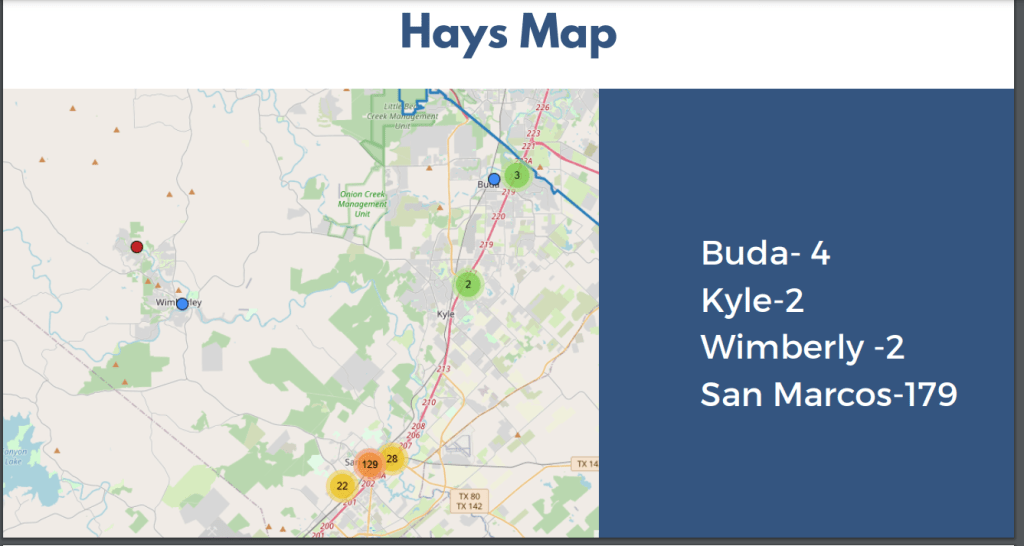
As best I can tell, these are the locations:

I got the address of the Cloudburst site from this article.

So the one we’re talking about now is this one:
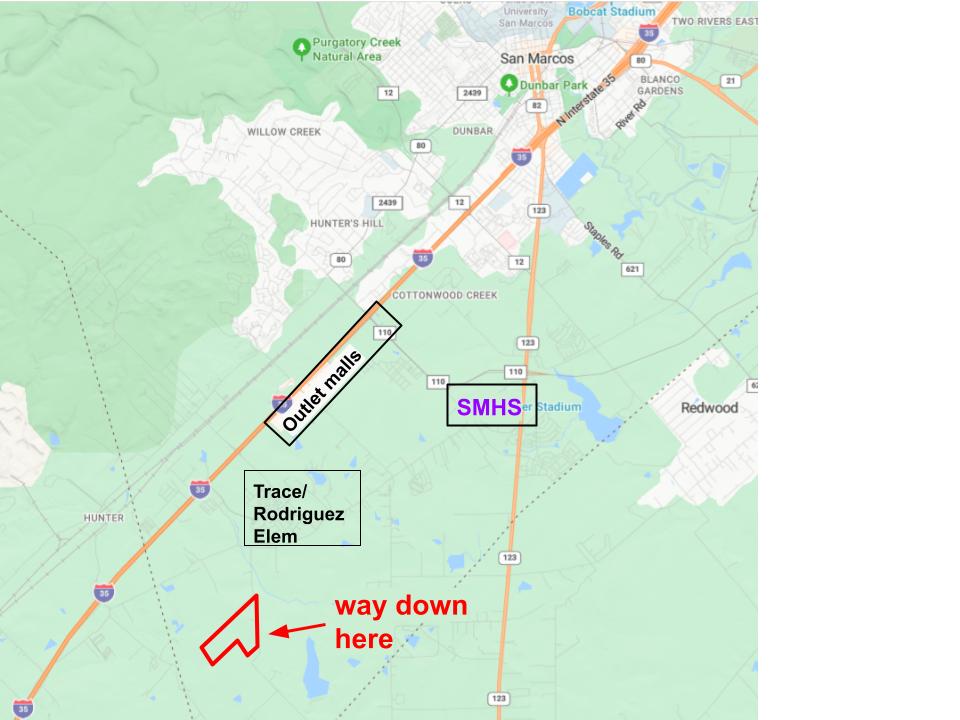
(Discussed previously here.)

A few notes:

  • There is no vote tonight. It is just a discussion item.
  • The vote is scheduled for the July 1st meeting
  • P&Z denied the request. So Council needs a 6-1 supermajority to overturn the P&Z vote.

There are 19 more speakers during the public hearing, along with the 35 from from the top of the meeting. (Some people speak twice, though.)

Here’s the main points that people make against the data center:

  • We’re in a drought, and this will destroy the San Marcos river
  • We’re in a drought, and this will destroy the San Marcos river
  • We’re in a drought, and this will destroy the San Marcos river
  • We’re in a drought, and this will destroy the San Marcos river
  • We’re in a drought, and this will destroy the San Marcos river

This really is the most important point. Climate change is pushing us towards permanent water shortages, and data centers use a massive amount of water for cooling.

And also:

  • This will drive up utility rates
  • There are reports from Granbury that these data centers are unhealthy to live near

Here are the arguments made in favor:

  • We’re going to get a lot of tax revenue
  • This does not cost the city much in terms of roads, utilities, and fire/police/emergency services.
  • These guys are offering to be more environmentally sustainable than the other six data centers. Take the regulated data center over the unregulated one.
  • Specifically, they’re going to use closed-loop cooling instead of open-loop evaporative cooling. This uses much less water.

Here is the developer’s basic pitch: “Data centers are definitely, 100% coming to central Texas. I’m the friendliest and the most cooperative one. I’m willing to do things environmentally and sustainably.”

He’s offering to put a bunch of concessions into a restrictive covenant. This is a contract that stays intact even if he sells the power plant. The next owner will still have to comply with it.

Here’s what he’s offering:

  • Closed loop, non-evaporative water cooling system. (This is very important.)
  • Limiting water use to an amount equivalent to 235 homes
  • Stricter than San Marcos Code on stormwater detention and impervious cover.
  • Sound and light mitigation
  • Getting water from Crystal Clear, not from San Marcos.
  • Getting electricity from Pedernales, not from San Marcos.
  • Only need San Marcos for waste water.

Here’s the obvious rebuttal to the last few points:

  • Who cares if it’s San Marcos city water or Crystal Clear water? It’s all coming from the same water table underground.

One speaker puts it like this: “These are straws pulling on the same water table”. Exactly.

Will this cause the San Marcos River to dry up???

Here’s what the developer said: they’ll need about 400-500K gallons of water to initially fill about 6-7 buildings. But after that, they don’t need much water until the buildings need to be re-filled in maybe 10 years.

I asked Robert Mace how bad that is? He said:

  • 100k of water is about what an average family of three uses in Texas a year (~88k). Won’t make the river run dry!
  • If it was an open loop cooling system (evaporative cooling) and an average system, it would be about 12.5% of San Marcos use. It wouldn’t take many of those to overwhelm local supplies.

So this is a big picture question. Can our river handle this one data center, on a closed loop system? Yes. Can it handle seven data centers on open loop systems? No.

So does ANYONE have control over how many data centers come to central Texas?!

This is an uncomfortable question! There’s only flimsy safeguards.

  • Can San Marcos block them? Only if they’re in city limits, and the developer needs the land to be re-zoned.
  • Can Hays County block them? No, they cannot prevent data centers from coming.
  • Can ERCOT block them? Sort of yes. They have to approve anyone who wants to join the grid.

The rumor is that ERCOT will approve 1-2 data centers in this region, for now.

It sounds like Cloudburst is trying to work around ERCOT by building their own natural gas power plants. I don’t know if ERCOT would still have to approve them or not.

Bottom line:

1. The overall situation is pretty bad for water use.
2. The San Marcos river has some unique legal protections, because of the Edwards Acquifer Authority. They have legal authority to sue if companies go over their allotted amounts. But still, do we need to test this?
3. We’re relying really heavily on ERCOT to gatekeep this situation.

What does Council say?

Everyone’s a little annoyed that the actual restrictive covenant is not already prepared and ready to read. But it’s not.

This is the basic argument that emerges: ERCOT is not going to approve all seven applications. They’ll probably only approve 1-2 applications. So if this data center gets approved by ERCOT, it might prevent an unregulated one from getting approved. That would be a net good.

Jane: It’s better to have these guys, who we can regulate, than the others who we can’t.

Shane: The wastewater from the center goes to the city system. How much extra clean up do we have to do to the wastewater, from the extra chemicals?
Answer: We have a filter standard. They have to clean the wastewater up to our standards before they release it to our system.

Lorenzo: Are there going to be gas turbines or some sort of power plant?
Answer: No, that’s Cloudburst. We’re not going to have a power plant.

Lorenzo: What happens if they violate the restrictive covenant?
Answer: Two things:
– Before we issue city permits, we’ll check to make sure they’ve built it the way they’re supposed to. So they can’t get up and running if they don’t build what they say they’ll build.
– After it’s built, if they violate the covenant, we can get a court injunction. The court will order them to comply.

The developer is trying to be the most accommodating person ever. Would YOU like to talk to him? He’s got a whole website, and a whole shtick about how he’d like to talk to you.

(Honestly, he’s refreshing after the SMART-Axis Terminal jerks.)

Amanda: I’m concerned that we don’t know what company we’re actually talking about.
Answer: I’m not allowed to say who it is yet. I promise I’ll say before the July meeting. They have facilities in Austin, Carrollton, and San Antonio, if you get my drift.

[Gentle reader, I got his drift. This appears to be the only Carrollton data center.]

A lot of citizen comments mentioned how utility and water rates will skyrocket. Alyssa asks about this?
Answer: Council sets water rates. They don’t skyrocket unless you want them to.

[Note: This answer is a little disingenuous. Council sets water and electric rates for everyone on San Marcos utilities. So those won’t skyrocket. But if you live down south by all these proposed data centers, you might not be on San Marcos utilities. Who knows what Crystal Clear water and Pedernales Electric will do.]

Conversation turns to the P&Z denial. Right now, it takes 6 Council votes to overturn P&Z.

Should Council send this back to P&Z, to take another look? If P&Z changes their mind and approves it, then Council would only need 4 votes to pass this data center.

However, sending it back to P&Z will delay everything by 4-5 months. It might hurt their chances with ERCOT. Council does not want to risk the possibility that ERCOT denies this application, in favor of some other yahoo developer who throws up something worse, out in the county.

Bottom line: I think Council will approve this one data center at the July meeting.

We’re in a kinda terrible situation, but this one data center is probably the least-bad option.

Item 7: Flock License Plate Reader Cameras

Flock Cameras are these:

They read all the license plates that go by, and record the date and time. Then if the police are trying to find someone, they can run a search on all that data and see if there’s any record of it.

“LPR” means “License Plate Reader”, and we first got some back in 2017. But we didn’t join the Flock network until 2022, when we bought 14 cameras:

(Also I note that they used seized funds for the first batch. Blech.)

Back in February, SMPD wanted to purchase 19 more Flock cameras. Council delayed approval in order to revisit our privacy policy. In March, we revisited our privacy policy and made some good improvements.

So now it’s time to vote on whether or not to approve the grant for these cameras.

What are the arguments for and against?

In favor: There are lots of examples of how Flock Cameras are used to solve crimes. From the packet:

Arguments against : They are tracking your every move. Do you want to live in a police surveillance state? The data gets merged nationwide to have one big nationwide network. Private companies can have Flock cameras. Neighborhoods can have Flock cameras. The ACLU does not like Flock one bit.

But it’s not just an abstract fear about loss of privacy: ICE has access to Flock data. We’ve got a federal administration that plays out revenge fantasies on brown people, and is in the business of deporting people as recklessly and broadly as possible.

Here’s a particularly chilling recent example: She Got an Abortion. So A Texas Cop Used 83,000 Cameras to Track Her Down. Those would be nationwide Flock cameras that made that possible.

How does the Council conversation go?

Amanda: It’s the times we’re living in. People disappear off the streets because of this technology.
– The policies aren’t strong enough to protect against a subpoena. Austin didn’t know until they did an audit that ICE was accessing their data. (Austin is now ending their license plate reader program.)
Senate Bill 9 would require Texas sheriffs to work with ICE. Our data will definitely get shared. Our policies will not protect us.
– They’re rolling out new technology, like NOVA.
– Please just don’t do this to people.

Saul goes next: I see the pros, but there are not enough safeguards yet. I’m a no.

Council spends the next hour trying to nail down exactly how much control you have over who sees your data. If Dallas PD is looking for a specific red car, can SMPD decide whether or not to release the data on that specific car?

Eventually the answer comes out: no. You do not get to decide on any specific request for data. Once you set up a reciprocal agreement with Dallas, they get access to all your data. Either the faucet is on, or it’s off.

The Flock representative keeps repeating “The city of San Marcos owns the data. Flock does not own the data. They’re just the guardians of the data!”
Alyssa asks: Can you show me where in the contract that exclusive access is guaranteed to San Marcos? Your policy says that you “retain a perpetual, royalty-free license to use aggregated data for your purposes.”
Flock rep answer: We promise that we use it only for anonymized training data.

Lorenzo: Does Flock own the physical servers? Or do you rent servers?
What Lorenzo means is: where are the actual, physical computers where the data is stored? Does Flock have their own computer storage?

Answer: We use Amazon Webservices.
This means, no, Flock does not own large-scale computer storage. Flock sends the data to Amazon for storage on Amazon computers.

Lorenzo: So Amazon is a third party that could also be subpoenaed for the data? You might not even know if they had to hand it over. What if they violate their agreement and fail to delete it?
Answer: It’s in our contract with Amazon that they’d delete the data after 30 days. If they didn’t, they’d have to charge us extra!
[Note: that answer does not make any sense. You didn’t misread it.]
Lorenzo: Amazon is in the business of data collection.
Jane: You’re not in control of that data.

Alyssa: This system is dangerous by design.
– these claims are absurd! Like “license plates aren’t personal information”. You can track a person with it, can’t you? It’s personal information.
– We own the data, but we don’t. They keep it.
– They say ICE can’t access our data, but they do.
– Anyone that we share our data with can then turn around and share it with whoever they want.
– There are many cases of cops using it to stalk people.
Peter Theil is a backer of this, for god’s sake.

Chief Standridge: Look, I can only speak on behalf of what happens locally. In San Marcos, Flock helps solve specific crimes. Locally, I don’t have evidence of any privacy breaches. I am only able to speak to San Marcos.

Amanda:  I have never thought that you all are the bad actors.  We share with 600 agencies. Our policies don’t matter when we’ve already shared with them. Flock would not be in business without this network.

Jane: I was a software manager at the university. Here’s how it goes: you get a new technology, and you hammer out all the rules with the company. Then they get bought. All the rules with the first company go out the window, and the new company puts all new rules down. If Flock gets bought, all these rules go out the window.

Chief Standridge: What about all the safeguards and policies we discussed in March?
Amanda: All we did is require agencies to follow all applicable rules and laws. But there are no federal rules! This technology is not regulated. Your policy ends the moment you share data with them. We share data with Houston! Houston openly says they work with ICE. Therefore we work with ICE.

Shane: What about the first 14 cameras we already bought? We still have those, right?
Jane: Yes. But we could put it on the agenda to get rid of them.
Alyssa: I guess we should revisit this!

Jane shares a little of her thinking:
– Originally I thought these cameras were great. And if Flock were only used like in the examples, then it would be fine. 
– I’ve learned stuff tonight that’s giving me a really hard time saying Flock is good for the US.
– Then I thought, “But there’s cameras everywhere. There’s Ring, etc, toll roads, smart phones, etc.”
– But that’s different. This goes to government agencies. I’m not worried about our department, but I can’t say that about other departments
– Maybe just at major intersections? Nope, nope, that doesn’t work. It’s the other departments.
– We just don’t have enough guard rails for this. The more I learn about how the system is being used, it’s pretty scary.

Something has happened since the last discussion, because Chief Standridge does not seem surprised that it’s unfolding like this.

He makes one last bid: “What if we only share data within Hays County?”

Alyssa: What keeps Hays County from turning around and sharing it?
Amanda: What about the Texas Senate Bill that requires sheriffs to cooperate with ICE?

City Manager Stephanie Reyes weighs in:  It’s clear that you all are worried about where we are as a nation. It’s not an issue about SMPD.  It’s not about our individuals. It’s about the policy decisions that we can control in the national scene.
Everyone’s like: Yes! Correct!

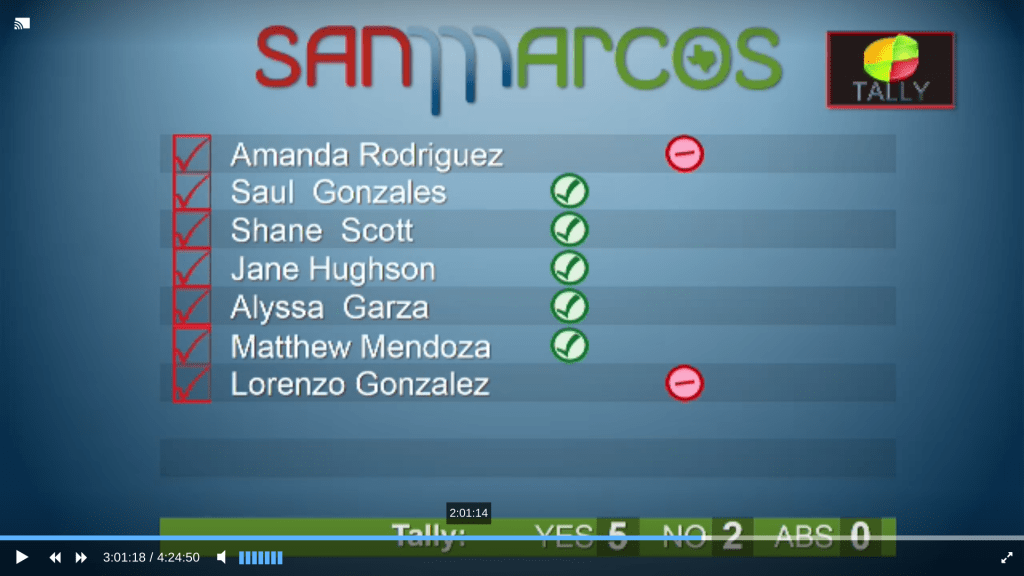
Finally, the vote: The motion is to deny. So a green check means no on the cameras, red dash means “yay Flock!”

Are you a NO on the cameras?
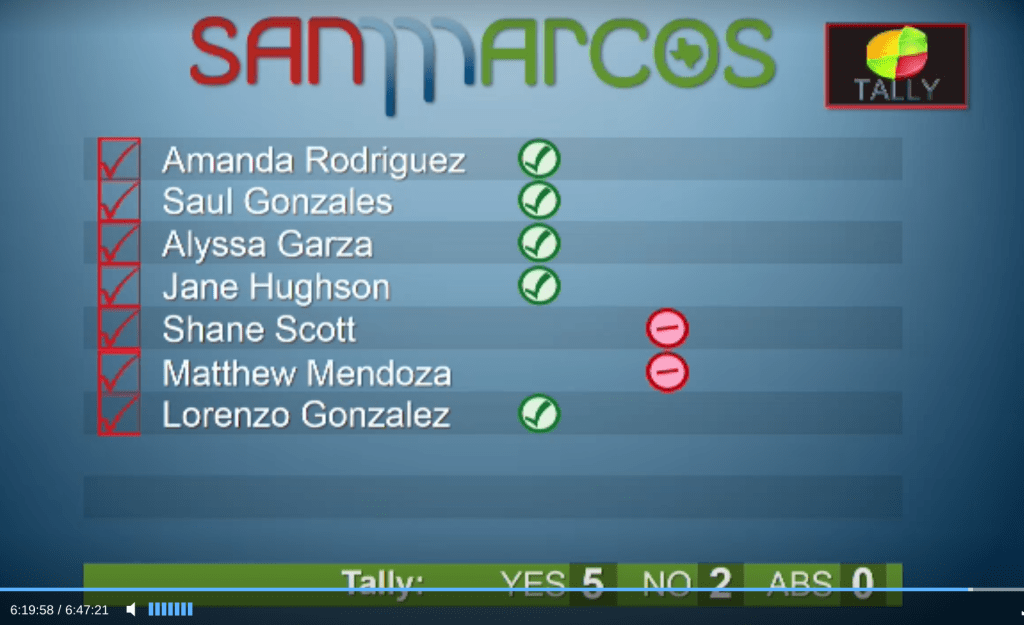
Amazing. Shane and Matthew are the only ones who still want them.

The council conversation was outstanding to listen to. It was just so sharp. Everyone made really great points.

Whew! After all that, we’re not quite done yet…

Item 15: Spin Scooters

You know them, you love them:

(We’ve discussed these before, here and here.)

It turns out they’re breaking up with us? Their contract is up on June 30th, and they don’t want to renew.

The reasons are:

  • Low ridership
  • Tariffs
  • Finding parts

Ouch.

Once they officially break things off, we’ll start looking for a different company who might enjoy our low ridership, tariffs, and lack of parts.

Item 24: More data centers!

So, recall there are seven data centers with applications in at ERCOT.

These are the three that I know about:

So now we’re on the pink one.

Yes, it’s gigantic. The red one from earlier is 200 acres, and this one is 785 acres. They’re saying it would also include housing. Unlike the one in red, the developer wants this one to be on San Marcos water.

It’s past midnight and everyone is exhausted. They decide to just form a council subcommittee to negotiate and discuss the issue further.

Council subcommittee: Jane, Amanda, Lorenzo.

I’m good with that.

Item 32: Proposed Charter Amendments for ballot

Here’s the legal language for everything that will show up in the November Ballot:

Q&A: Max Baker:

  • Matthew Mendoza again! Why do you think it’s appropriate to use swear words during the ceasefire conversation?! C, S, and A words?!
  • Would council consider revisiting EDSM policy and how we award benefits when GSMP knows before Council? Would you bring a discussion item that puts Council knowledge before biz privileges?

Adjourned at 2:35 am.

Hours 0:00 – 3:25, 5/20/25

Citizen Comment

So much quieter than it’s been. Only seven speakers! Only twenty minutes long!

Here are the topics:

  • Four speakers: You should have voted for the Gaza ceasefire resolution!
  • Two speakers: No on the ceasefire! Also we support SMPD and public safety!
  • One speaker (Rob Roark, of KZSM fame): The Charter Review Commission worked hard and has some good recommendations. Hear them out!

….

Item 1: Homeless population PiT Count

“PiT” stands for Point in Time.   Nationwide, everyone picks one day in January where everyone tries to get a physical headcount of how many people are homeless on that one specific day.  This is how you get funding from HUD.  

We did our PiT count on January 23rd this year. This is the report on it. 

….

What counts as unhoused, according to HUD?

What doesn’t?

It’s not a perfect measure!

But it’s not worthless, either.  

Here’s how the numbers have shaken out over the past five years:

The blue is a subset of the orange.  Those are people who appear to be homeless, but we weren’t able to talk with them.

The vast majority of homeless people of Hays County are in San Marcos:

This is partially because the Hays County Women’s Shelter, Southside Shelter, and emergency hotel housing programs are all located here. But also partially because we’re just a much poorer, more precarious community than the rest of Hays County.

What does Council think?

The speaker makes a plea: can you help us get the county to work on its emergency response plan? For example, during the freeze, their plan was “Send everyone to Southside.”

They decide to send the issue to the Homelessness Committee to think about harder.

Item 2: Charter Review Commission

Every four years, we take a fine-tooth comb to the city charter, and look for improvements. Council appointed a commission of residents, back in January. They met weekly all spring, and returned back with a list of recommendations.

Council takes these recommendations, and either rejects them, accepts them, or puts them on the ballot.

Today is just the rough draft. Basically, they’re weeding out anything that they hate. Anything that Council likes will come back in formal, legal language, and then they can argue about the details.

There are 15 total proposed amendments:

  1. Better pronoun use
  2. Notifications on social media
  3. Mayor gets 4 year terms
  4. Tweaking the number of yearly council meetings
  5. Cap on councilmembers zooming in to meetings
  6. Approving council meetings minutes on time
  7. Buying hard copies of city code, grammar tweaks
  8. Auditing anyone who gets public funds
  9. Financial disclosures for referendums and initiatives
  10. More time to file referendum petitions
  11. More time to verify citizen petitions
  12. Change P&Z residency requirement
  13. Review the comprehensive plan a little less often
  14. State budgets using plain, clear language
  15. Tweak some headings
  16. Study single-member districts and launch education and conversation, but don’t take any major action right now.

Warning: This item takes about 2.5 hours to wade through. I’ll do my best to keep it snappy.

Let’s dive in.

Everyone is fine with this.

Everyone like this, too.

This is the first contentious one. This is about election turnout. Presidential elections have the biggest voter turnout. Midterm elections are the next-biggest. The odd years are called off-year elections, and they have the lowest turnouts.

For example, the committee chair read out the mayor vote total for the past four years:

  • 2021: there were 3,800 votes for mayor (off-year)
  • 2022: there were 17,000 for mayor (Midterm election)
  • 2023: there were 3,900 votes (off-year)
  • 2024: there were 23,000 votes (Presidential election)

So the key is those extra 10-20K voters who only show up for big elections: do you think they will vote for your candidate? If so, then you want to align elections to land on presidential years. If not, then you like elections to land on off-years.

The Charter Review Commission is arguing that we should switch to 4 year terms, aligned with Presidential elections. Here are their reasons:

  • It’s very expensive to run for mayor. Lengthening the term may induce more people to decide it’s worth it.
  • Two year terms means you’re always campaigning. This may mean you’re overly beholden to your donors.
  • We should prioritize all voters, not just the well-connected ones.
  • Often times subcommittees take more than two years to get their work done, so a mayor can’t complete their campaign promises in one term.

What does Council think?

Jane goes first:

  • She likes 2 year terms. The mayor should have to earn the votes of the people often.
  • She proposes splitting the difference and going with 3 year terms.
  • It’s easier to run in odd years because there’s less competition for attention.
  • It’s cheaper to run in odd years.

The conversation kind of deteriorates. People keep making opposite assertions that directly contradict each other:

  • Off-year elections are cheap, because there’s less competition!
  • Off-year elections are expensive, because it’s harder to get donations!
  • Off-year elections are easier, because it’s quiet so you can get more engagement!
  • Big years are easier, because you can piggy-back on the extra opportunities and everyone is paying attention!

These things can all be true – it just depends which voters you’re talking about. If you try to get students to turn out, then you like the big years. If you rely on Old San Marcos and personal networks, then off-years are easier.

More contradictions:

  • People may not want to commit to 2 year terms, because they only get a year before they have to start campaigning!
  • People may not want to commit to 4 year terms, because they may feel like it’s too long for something they’re not sure about!
  • Big years are harder, because the ballot gets so long! People don’t want to check all those boxes.
  • Small years are harder, because people don’t want to make a special trip to go vote!

Everyone’s just making random guesses – no one actually knows how these factors play out.

Alyssa: I strongly prefer 4 year terms.
Saul: Two years is better, for accountability.
Lorenzo: 2 or 4 year terms.
Matthew: 2 or 3 year terms.
Shane: 4 years.
Amanda: I have issues with all the choices. But I guess 4 years.

This one will go to the people! You get to vote on this, in November! (Which is admittedly an off-year election.)

Spontaneous side quest: What about the rest of council? Should there be 4 year terms for all council members?

Yes: Shane, Lorenzo, Alyssa
No: Matthew, Jane, Saul, Amanda

So this fails. It will not go on the ballot.

This is not controversial. Sometimes it’s hard to have two meetings in November, because of elections, and in January, because it means staff has to prepare a meeting over the holidays. We’re allowed to have as many extra meetings as we want. Everyone’s fine with this.

SIGH. This is dumb. This is about former council member Max Baker.

During Covid, everyone else came back in person, and he kept zooming in for an extra year or so. He was also a pretty contentious person who argued a lot, and pissed a lot of people off.

Would he have gotten along better with the rest of council if he’d been in person? Who knows. But many people believe that him zooming in made everything worse. Anyway, the voters did not re-elect Max, so the situation resolved itself.

In my opinion, that’s how it should go. Do something that pisses off a lot of people, and let the voters decide whether or not they approve. Democracy!

This recommendation is not that. It’s about micromanaging who zooms in for which kinds of reasons, but simultaneously pretending not to micromanage these things. “We trust you to give honest reasons, but you’re only allowed to give three bad reasons per year before you get an unspecified consequence.”

Look, these things are all true:

  • Meetings go better when people are in person
  • People can have good reasons to zoom in.
  • People can have bad reasons to zoom in, and you can’t tell the difference

Do not get into the business of policing how conscientious someone is at their job. You’ll end up writing a fractal maze of tedious, detailed rules. Extreme cases make bad policy.

Should this be a charter amendment?

Yes: Matthew Mendoza. 
No: Shane, Jane, Amanda, Saul, Alyssa, Lorenzo

Should Council discuss this further as an internal, lowkey rule?

Yes: Lorenzo, Amanda, Jane, Saul, Matthew
No: Shane, Alyssa

Sure, that’s fine. It’s just weird to micromanage from the charter.

Heh. They have not updated City Council minutes since May 2022. Apparently there was some staff turnover, and it fell by the wayside.

This moves forwards.

Everyone is fine with this.

This one is odd. Basically, Council already puts a clause in its contracts that they can request audits like this. In practice, they almost never do.

The question is: do they need extra firm legal footing to do this? Should they put it in the charter, and authorize themselves with extra authority to do this thing we already do?

Yes: Lorenzo, Matthew, Shane
No: Alyssa, Amanda, Jane, Saul

So it fails. I probably would have voted yes, though.

I liked this one, but the lawyer did say that it’s not really a Charter-level thing. The charter is like your constitution – it’s your high-level principles, but not your detailed little laws.

Yes: Saul, Jane, Matthew
No: Alyssa, Shane, Amanda, Lorenzo

So this fails.

Council goes with this one.

Council goes with this one, too.

Keep five year residency: Jane, Saul, Shane, Matthew
Shorten to three years: Alyssa, Lorenzo, Amanda

So this fails, and will not go on the ballot.

This just builds in flexibility, since it takes so many years to review a comprehensive plan.

Everyone on Council likes this! City Staff does not like this. The city manager is worried about how you balance formal legal language with plain, understandable language.

Jane Hughson has an example:

“Hotel occupancy taxes, utility revenues, and public private partnerships agreements currently secure self-supporting debt. In the event such amounts are insufficient to pay debt services, the city will be required to assess an ad valorem tax to pay such obligations.”

Can that be stated more clearly?

Probably the best practice is to keep the formal, legal language, but add in clear little summaries from time to time. This moves forward.

This is fine.

LAST ONE!

In other words, it’s too rushed to put single-member districts on the ballot. We should study and have community conversations about this, instead.

Do we want to have a conversation about this?

Yes to a conversation: Lorenzo, Amanda, Alyssa, Matthew, Jane
No to even a conversation: Shane, Saul

Jane and Amanda are both pretty sure that they’re “No”s on single member districts. But they’re willing to have a conversation.

BUT WAIT! THERE’S ONE MORE!

Jane brings up one last issue: The Texas legislature might eliminate all local elections besides November. If something happens to a council member, you could have a vacancy for 10 or 11 months.

Do we want the option to have council appoint an interim, un-elected councilmember?

It sounds like most of council does not want this, but they decide to at least bring it back for a conversation.

I agree that this is a terrible idea.

Hours 0:00 – 1:19, 4/1/25

Honestly, this was a pretty breezy meeting. 

Citizen Comment: 

Eight speakers. A few main topics:

  • Ceasefire for Palestine (two speakers)
  • The Teacher Re-Use Center, a non-profit that is housed in a city warehouse, and sounds kind of gigantic in scope
  • A potential new neighborhood: The Villages on Posey.

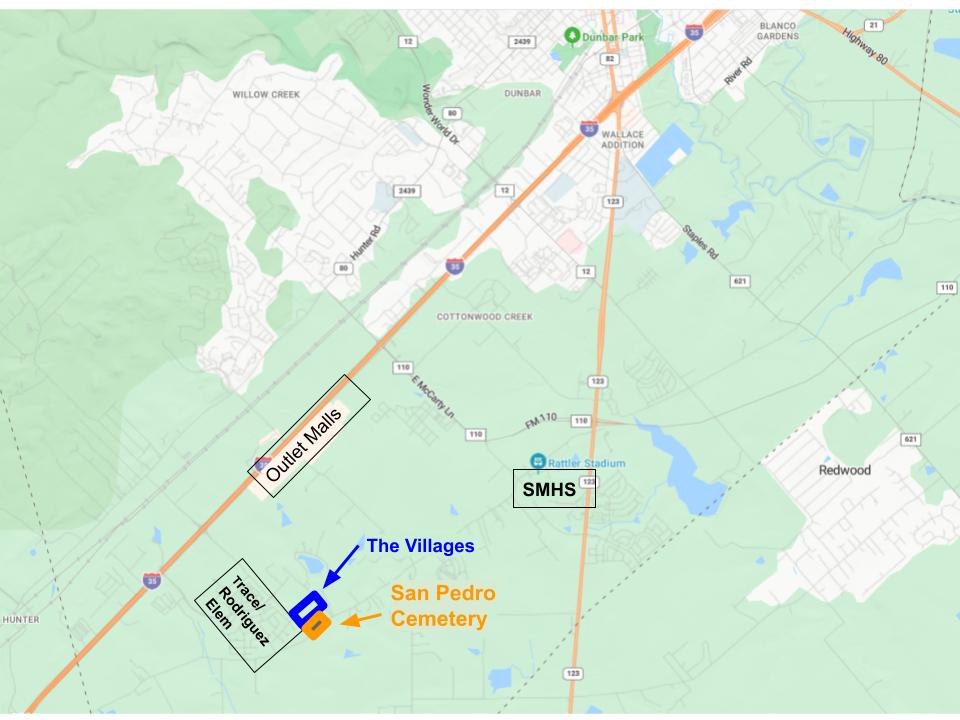
This had the most speakers. So, the San Pedro cemetery is right next to Trace Development. It was vandalized in 2003, possibly out of racism. Following that, some researchers at Texas State (like one of the speakers, Dr. Ana Juarez) started doing community-based research there, and the cemetery was designated historic cemetery a few years later.

Now some developers want to build a neighborhood next to it. But – plot twist! – they were good neighbors! They reached out to the cemetery board and made friends.

The developer has offered $5000 for the cemetery, to pay for restoration and damage from cars. The cemetery would be part of the plans moving forward. So these representatives from the cemetery board are here to speak in favor of the development.

More on this in Item 19!

Item 1: Charter Review Committee

Every four years, we form a Charter Review Committee. They’re supposed to comb through the City Charter with a fine-tooth comb, and offers up suggestions. Then Council decides which suggestions should go to the voters, and which suggestions should get deep-sixed.

The committee was formed in January. They’ve met weekly since then. Today we’re getting a soft launch of their suggestions. (The actual formal suggestions will come in May.)

Note: Jim Garber was the vice-chair of this committee. The chair, John Thomaides, took a moment to say a nice tribute to Garber, about his contributions and the difference he made here. 

The Interesting Recommendations:

1. Mayor Term Length: Right now, the mayor’s term is two years long. They can serve four consecutive terms, and then they have to take a 2-year break before running again.

CRC Recommendation:
– Mayor serves four year terms instead of two year terms.
– After two consecutive terms, they have to sit out a cycle before running again.

      Jane did not like this.  She’s long been on record as saying that the mayor ought to have to get re-approval from the voters every two years.

      2. Single Member Voting Districts.

        CRC Recommendation: Neither yes nor no. Instead they recommend that council studies the issue and educates the public and take some time, instead of throwing it on the ballot.

        This is a good approach. I’m also torn on this issue

        3. Council members attending meetings over zoom. Right now council members can attend by zoom, whenever they want.

        CRC Recommendation: Council members get a max of 3 times to zoom in, per year. (With some excused reasons, but I don’t know what those are.)

          I don’t know. Are council members more effective in person? Absolutely. Is zooming in better than missing the meeting altogether? Also yes.

          Look:

          • If you think council members are punks who sometimes zoom in for bad reasons, then yes, cap it at three.
          • If you think council members are legitimately constrained by second jobs, or kids, or illness, or responsibilities, then you should trust that they’re zooming in for good reasons.

          We already have a lot of barriers to running for office. Parents, people with disabilities, people with difficult schedules: it’s almost impossible to be a council member. I don’t think we need more obstacles.

          Plus, look: if we do have a punk council member who zooms in for funsies, we can vote them out. It’s a democracy. So I think I’m a no on this one.

          4. City Council Meeting Minutes

            CRC Recommendation: Meeting minutes from each council meeting must be approved in the following council meeting.

            Ha.  HA.  HAAAA.  Council has not approved any meeting minutes since May 2022.  It’s been almost three years! (I’ve mentioned this before, and before that.)

            It’s super annoying! Right now, if you want to find out what happened, you have to go listen to the actual meeting. It takes forever.

            (I mean…maybe not having minutes posted has been a little good for this blog? I get to be the sole documentarian, in the absence of minutes.) But anyway, yes to this.

            5. Referendum petitions

            CRC Recommendation:
            – Increase the time allowed to file a referendum petition from 30 days to 90 days.
            – Increase the time for city to verify petitions from 45 to 60 days.
            – Require a form for financial disclosure for referendums and initiatives.

            That last one is AMAZING. Yes, if we’re voting on something, I would love to know who is funding it.

            (The first two are good, too.)

              Less interesting, but still good

              1. Public Notifications: Right now, the city must notify the public by placing a notification in a public newspaper. 
                Recommendation: Let’s also put notifications on the city website and social media.
              2. Council is required to meet at least 22 times per year.
                Recommendation: Reduce the minimum number of council meetings from 22 to 20 per year.
                This just builds in a little extra flexibility for November, December, and January.
              3. Printed copies of city code or ordinance are available for purchase, at cost.  (Or free online.)
              4. Reduce residency requirement for P&Z from 5 years to 3 years.
              5. Shuffle around the naming of sections to gather the ethics-things under an “Ethics” section.

              Those all sound fine with me.

              They only somewhat align with the Council suggestions for the committee:

                But that’s good – it shows the committee was independent. And Thomaides promised that they really did unpack all those suggestions to death. 

                Item 8: Flock License Plate Cameras

                SMPD has 17 license plate scanners.  They wanted to buy 30 more in January.

                “Not so fast!” Council cried.  “This has major privacy implications!”  

                Council decided to hold a review of the privacy policy first, and delay the purchase of the 30 new license plate scanners. Chief Standridge was peeved.

                So in March, council reviewed the privacy policy.  Chief Standridged tightened up a lot of the loose gaps. It’s not perfect, but it’s much better.

                So now the camera purchase has come around again. May SMPD please purchase these 30 license plate scanners now? Pretty please?

                “Not so fast!” cries Amanda.  “We tabled this item until June.  It’s only April.”

                Everyone looks at the lawyer, who says, “Yes. I went and watched the video several times.  You all voted to postpone until June.” 

                Lorenzo: “Who cares? We delayed for the privacy policy, and we got the new privacy policy. Why not just do it now?”

                Amanda: “Well, the media picked it up, and so the public is under the impression that it will come back in June.  If anyone wants to participate in the process, they’re operating under the assumption that they have two more months.”

                Jane concedes that she also cares about this.

                Question: Will the price go up in June?
                Answer: nope, same price.

                The vote:  Re-postpone the cameras until June, like we said we would?

                Yes: Everyone

                No: No one.

                Let’s be frank: Is this really about the people who’ve penciled JUNE in their calendar to show up and protest these cameras? Or is this about slow-playing Chief Standridge?

                Tomato/tomato! ¿Por qué no los dos? 

                Item 19: The Villages At Posey Road

                This doesn’t exist yet, but it will go here:

                (We also saw this property back in 2022.) They want to be a PID.

                What’s a PID?  

                PID stands for Public Improvement District.  The developers want to make this a PID. What that means is that the houses in the PID all pay a little extra tax money, and that money gets used on the roads and infrastructure for that specific neighborhood.

                (This is WAY better than a TIRZ.  Kissing Tree is a TIRZ, not a PID, which is why we are giving  $1,288,406  to Kissing Tree this year. With a TIRZ, the developer basically says, “hey, what if the fanciest, wealthiest neighborhoods were subsidized, too? We could make them even fancier then.” I’m not kidding about how they work.) (TIRZ stands for Tax Increment Reinvestment Zone, if you care.)

                We haven’t had any PIDs in a decade.  Trace, Whisper, and La Cima were all approved for PIDS around 2014.  After that, council decided not to make any new PIDS until two things happened:

                • Update the Comprehensive Plan
                • City decides there is a need for incentives for residential development.

                The comprehensive plan (Vision SMTX) was finally approved last fall.  Tonight they’re deciding if they want to reboot PIDs with these guys.

                So what would this PID be?

                Some sort of planned neighborhood community. The details haven’t been hammered out.

                May I recommend that Council remember our handy five criteria?

                Five Criteria for Evaluating Housing Development

                Price Tag to the City: Will it bring in taxes that pay for itself, over the lifespan of the infrastructure and future repair? How much will it cost to extend roads, utilities, on fire and police coverage, on water and wastewater?

                Housing stock: How long will it take to build? How much housing will it provide? What is the forecasted housing deficit at that point? Is it targeting a price-point that serves what San Marcos needs?

                Environment: Is it on the aquifer? Is it in a flood zone? Will it create run off into the river?Are we looking at sprawl? Is it uniformly single-family homes?

                Social: Is it meaningfully mixed income? Is it near existing SMCISD schools and amenities?

                The San Marxist Special: Is it a mixed-income blend of single family houses, four-plexes, and eight-plexes, all mixed together? With schools, shops, restaurants, and public community space sprinkled throughout? Is it walkable?

                You know what I’d go for.

                What’s this about a cemetery? 

                The San Pedro Cemetery is right next door:

                This is an old cemetery that served the Hispanic community, especially when other cemeteries wouldn’t bury anyone who wasn’t white. Like I mentioned above, it was vandalized in 2003, and then kinda had a renaissance. It got designated as a historic cemetery and people care about it. (Saul has mentioned how most of his family is buried there.)

                The developer wisely reached out to the cemetery board ahead of time.

                Here’s how I imagine the conversation going:

                Developer: “Hey there, San Pedro Cemetery Board! What would it take to get you on our side?”
                San Pedro Cemetery Board: “We’ve got a wish list of maintenance and restoration projects. Would you like to fund some of them?”
                Developer: “We sure would!”

                But that’s good communication and collaboration! This is how you keep friction from developing in your working relationships. (Probably both sides were a little more polite about it.)

                So the San Pedro Cemetery will be included in the PID.

                Council decides to send the whole thing to a PID committee. More to come.

                That’s it! The whole meeting was only 1:19 long.

                Hours 2:25 – 4:24, 1/7/25

                Item 13: Demolition time. 

                This is 734 Valley Street:

                It’s tucked behind Dunbar Park.

                It’s really impossible to see from the street, but it’s this blue L-shaped building:

                At least, it used to be blue. This is what the building looked like in 2019:

                I’m unclear on the following order of events:

                • Squatters moved in and were kinda trashing the place
                • The owners purchased it and began demolition without getting proper permits.

                In some way, we end up with it looking like this now:

                Definitely not blue anymore. Not much left.

                How does demolition work in San Marcos?

                In order to know what’s going on, you have to know a little about demolitions of historic buildings in San Marcos.

                In 2019, the old telephone building was demolished:

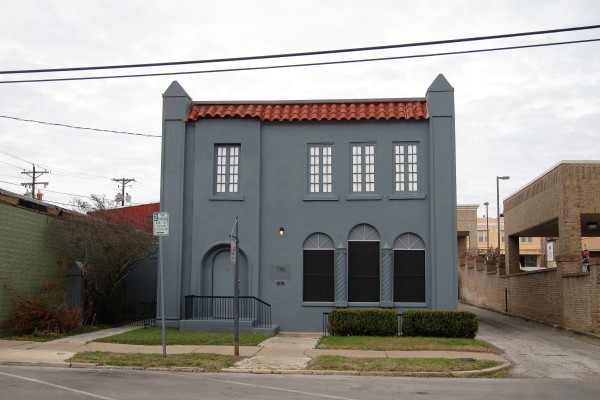
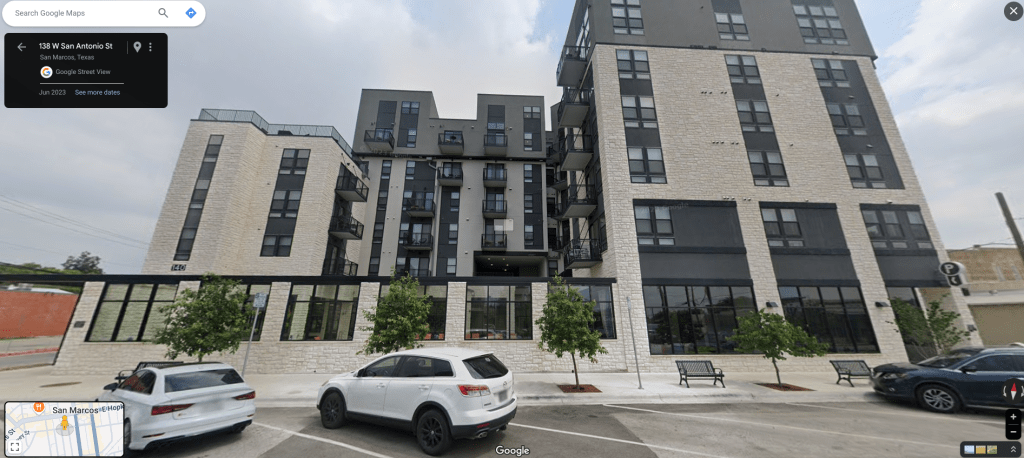
                to make way for The Parlor apartments.

                People were told 3 days ahead of demolition, and they were upset. Protests, etc.

                (I personally think the little telephone building was extremely cute, and felt sad over the whole thing.)

                After that, the city put a demolition ordinance in place. The ordinance builds in delay and notification, but it doesn’t really prevent anything from being demolished:

                • For buildings with potential historical significance, there is now a 90 day demolition delay.  This gives people time to research the building and figure out if it can be moved, or saved somehow.
                • If someone is trying to save the building, the Historical Preservation Commission can delay for another 90 days.  But that’s it. After that, the owner can go through with the demolition.

                “Saving the building” means making a deal with the owner. The owner can say no.

                Basically, Texas state law means the city’s hands are mostly tied. There’s usually not much way to actually prevent a demolition. You can just stall a little bit.

                So the owner applied for demolition, and the first 90 day clock started.

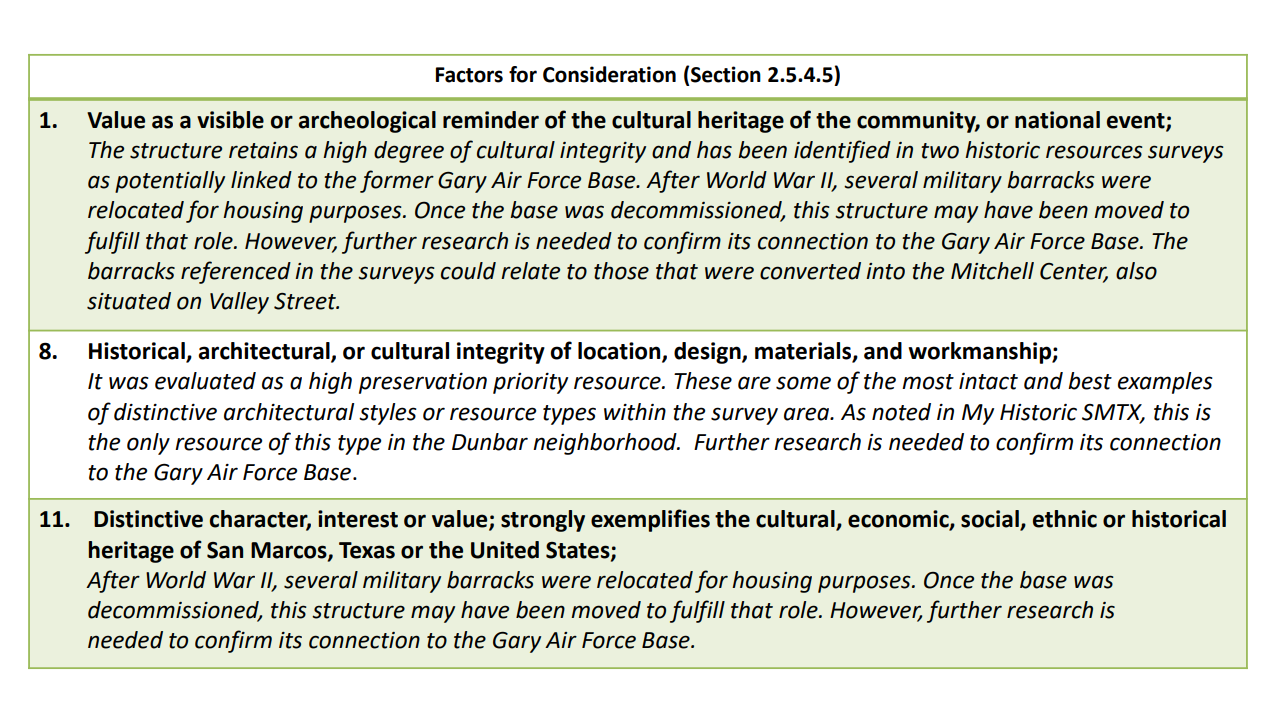
                Here is the historical merit, as far as we know:

                So this blue building was probably barracks from Gary Air Force base? It sounds like it was moved to Dunbar by the Armstead family to rent out as apartments.

                It went to the Historical Preservation Commission, and HPC decided to extend the demo delay for another 90 days.

                Which brings us up to speed!

                The owners are appealing the demolition extension.  They’d like to tear it down now, instead of waiting until April.  They plan on building a small apartment building there, maybe 4 or 8 units. 

                Matthew Mendoza had some useful points. First, he reached out to Ms. Armstead. Apparently her parents are the ones that brought the barracks over from Gary Air Force? He asked her about the historical significance of the building.

                She very clearly told me she does not feel that this particular complex needs to be associated with that family. In the last six years that they were in possession of this, they were only able to rent out a third of the rooms there, because they were so dilapidated…She feels that that her mom and dad bought this property just for making money. She made that very clear. They didn’t purchase it for any historical significance. They bought this because they wanted to make some money off it, and that’s also why they sold it. They got so far into debt as far as being able to replace the flooring, be able to add sprinkler systems, to make it up to code, which is when they said “We can’t do this.” And again, we all know the Armstead family and how strongly respected they are in this city of San Marcos. And for them to say “hey we don’t want this property” and not wanted it associated with their name says a lot. She was insistent that there is no historical value at all to this building and no historical value at all to this property.

                (lightly edited for clarity)

                And then Matthew gets to the best part:

                And I can tell you: I partied in that place for like ten years back in the early 2000s. I fell on my fat ass right through that floor. I’m sorry to say it, but I fell through that bathroom floor in that place, and now I’m not the smallest guy in the world, but I shouldn’t be falling through there.

                Honestly, that’s the most endearing thing I’ve ever heard Matthew say. He even lowered his voice and half-whispered “fat ass”, and I melted a bit.

                He went on for awhile more, but that’s the gist of it. At the end, he said, “I will sit here and say that I am a huge preserver of historical anything here in this city, but this unfortunately this is something the owners are telling me we don’t want it. And that’s the reason why I was on the fence until I spoke with her.”

                Overall, I basically agree with Jane Hughson on this one:

                As much as I like historical preservation, I’m going to vote to not extend and let these folks who are trying to do something with the property move ahead. If this were something with a more historic appearance and in a place that people could actually see and appreciate, but in this particular case, I’m not seeing that there’s an upside to 90 more days. There’s been 90, and you say there’s not been any activity, nobody has come in with the superman cape to save the day, so that’s why I’m going to support not extending the delay.

                The vote:

                The argument for voting no – Amanda and Lorenzo – is that it doesn’t hurt anything to wait three months and let the local community get their due process to save the building.

                In this particular case, I’m with the pro-demolition folks.

                Item 15: Charter Review Commission

                Every four years, council appoints a committee to go over the City Charter with a fine tooth comb.  This is that magical night!

                First off,  do any council members have any pet topics that they want the committee to discuss?

                Note: none of these are guaranteed. Council is just asking the committee to discuss these items.

                1.  Jane: drop the minimum required number of council meetings from 22 per year to 20 per year. 

                Sometimes it gets hairy trying to have meetings working during election week and New Year’s Day – this would build in some flexibility.

                Everyone likes this.

                1. Shane Scott: You should have to be a resident for at least five years to be on council.

                (Saul, Jane, and Matthew are all enthusiastic about this.)

                Look, this is clearly about newbie Lorenzo Gonzalez. Seems a little rude to me!

                But more importantly, it is super undemocratic. The whole point of an election is to let voters choose! If they don’t want a newbie, they don’t have to vote for that person. 

                I do not like this one!

                1. Alyssa: We should have single member council districts.

                This is a complicated topic.  How should voters elect councilmembers? Right now, every council seat is an at-large seat. Should we carve up the city into sections, and have each section vote for its own single representative?

                There are arguments for and against this.

                For:  

                • It takes fewer resources to run a campaign in a district than in the entire city.  This means that more people can afford to run for council.
                • Historically, at-large council districts have been used to block minority groups from having representation on city councils.  If a city is 30% black, for example, and if white people won’t vote for a black candidate, then a black candidate can never win a city-wide election.

                  Historically, single-member districts have been the solution.  Lawsuits would be filed and judges would force towns to switch from at-large seats to single-member seats. (This is what happened to SMCISD in the 90s.) The idea is that you must draw minority-majority districts, and then within that district, minority groups form a majority and can elect a candidate of choice.

                Against:

                • Single-member districts only somewhat solve the problem of underrepresented minority groups.  Drawing the boundaries becomes a politically contentious issue, with people weaponizing it to work in favor of specific groups.
                • At times, there can be issues that pit a district against the whole city. Amanda reports this happening at the state level:  representatives vote against a program that is good for the entire state, because their district doesn’t want to pay the taxes for other people to benefit. Right now, all councilmembers answer to all of San Marcos.

                I’m pretty torn. I wrote a whole thing in favor of single-member districts in San Marcos, back in 2022. But I’m also sympathetic to the idea that single member districts can pit parts of the city against each other.

                Council floats the idea of having a non-binding referendum on the ballot, so that they could find out what people think.

                1.  Amanda: Suppose council passes a shitty ordinance, and you’d like to petition to repeal it. Right now you have 30 days.  Let’s extend this to 60 or 90 days, so that people have a little more time to organize.

                Sounds great!! Would this only apply to ordinances, or also things like Chapter 380 agreements? (I’m thinking of things like the SMART Terminal/Axis developer agreement.)

                5. I think Saul brings up rolling back the drinking hours in San Marcos again.  It’s very hard to hear him.

                Backstory: it used to be that bars closed at midnight in San Marcos. This means that all the kids got drunk here, and then at 11:30, drove up to Austin, and drank for two more hours on 6th Street. Then at 2 am, they all drove home.  This always seemed like a terrible policy for keeping kids alive!

                It got changed in 2009.  Now bars can stay open until 2 am, and hopefully fewer kids are driving drunk on I-35.  Great! (I’m sure the local bars prefer it this way, too.)

                I think Saul wants to change it back to midnight?  What a terrible idea!  Keep kids alive.  Don’t give them reasons to drive drunk.

                This is not a charter item, so it will come back as a discussion item. Stay tuned.

                6. Lorenzo: the language around petitions is inconsistent between initiatives and referendums.

                Jane Hughson reminisces about the Great Fluoride Debacle of 2015, when the good citizens of San Marcos got a little muddled on the science, and voted to stop adding fluoride to the water. 

                The citizen wrote the initiative in a way that made it impossible for the city to carry out. Something like “no fluoride in the water!” when there’s some level of fluoride that occurs naturally in all water. The city had to negotiate in court with the author to get better wording.  (They settled on “no added fluoride”.)

                Basically it’s really difficult to write clear ordinances. This makes things tricky.

                7. Amanda mentions reversing the fluoride charter amendment in passing, but no one stops and weighs in.

                But guys: the ban on adding fluoride to the water is terrible. The science is really clear. We’ve got a lot of people in this town who can’t afford to see the dentist, and we could be helping save their teeth.

                8. Shane: Mayor and council should move to 4 year terms, and council elections should be held in odd years, so that they’re not drowned out by presidential and governor elections.

                This is about who your base is. Are your voters the old guard in town, who will reliably show up to vote when nothing else is on the ballot? These are the voters that have held the power in San Marcos since always.

                Or are your voters less plugged in, because they are younger, or newer, or less well-connected, or generally low-information? These are the voters that generally don’t have power, and are less likely to show up to vote in odd years.

                9. Amanda: Right now, P&Z terms are 3 years long. After two terms, you have to take a year off. Amanda proposes reducing P&Z to 2 year terms, and extending the length of the break before you can come back again. The goal is to increase turnover.

                The rest of council does not buy into this. Part of the problem is that all the boards and commissions are on the same set of rules.

                10. Matthew: zoom and attendance options for all boards and commissions

                This gets ditched due to not being a charter issue. Also, Amanda and Alyssa are hard NOs, due to accessibility issues.

                11. Amanda: Right now, P&Z gets the final vote on plats.  A plat is the paperwork where a developer carves up a neighborhood, and says where the streets will go and where the boundaries of the properties will go. Amanda wants people to be able to appeal the decision to Council.

                We’re kinda stuck with the current system, for a few reasons:

                • State law mandates 30 day approval for plats. If you add in City Council as a second appeals procedure, you’re going to run out of time.
                • There’s not actually any decision or judgement when it comes to platting. Legally, you’re not allowed to deny a plat, if it checks all the boxes. It’s not like zoning, where you’re allowed to make a judgement call. This is more black and white. So it doesn’t matter very much.

                So this did not get traction.

                12. Revoke or suspend CUP may not be appealed: remove this.

                Yes: Shane, Jane, Lorenzo,

                [I wrote this down in my notes, and now I can’t find it in the meeting anymore. So I can’t remember who proposed it or any other details. whoops]

                Final note: These are all just suggestions for the Charter Review Commission. Nothing is binding here.

                Item 16:  Each councilmember picks their special person for the Charter Review Commission.

                The picks: Michelle Burleson, Jim Garber, Rob Roark, Daniel Ayala, John Thomaides, Yancy Arevalo, Amy Meeks

                I will just note that three of those – Michelle Burleson, Jim Garber, and Amy Meeks – are on P&Z. There’s nothing exactly wrong with that, but it’s most likely going to preserve the status quo.

                Item 17: Boards and commissions

                Now that Jude Prather and Mark Gleason are off council, there are a bunch of vacancies to fill. I’m not going to go through this, because it’s tedious and you can find most of the subcomittee memberships here.

                I mostly just want to include this bit:

                Jane: I’m going to volunteer to be on the Alcohol Committee. The reason being that I’ve got more experience with this than probably all y’all put together. I was on one once before, and I think I can provide a lot of benefit to this committee.

                Shane: Plus you’re a solid drinker.

                The room erupted into giggles. Jane didn’t sweat it, and just said mildly quipped “Yeah. That’s the important part.”

                I mostly include it because it made me laugh. The vibe of this new council is much lighter and jokier than the last one. I’m here for it.

                Bonus! 3 pm workshops, 12/3/24

                Workshops were great this week. Per usual.

                1. Texas State University. What’s up with them?

                This is new! I can’t ever recall someone from the university giving this kind of presentation before.

                (That said, the speaker did not supply his slides to the city, and so all I could get were crappy screenshots of the interesting slides. )

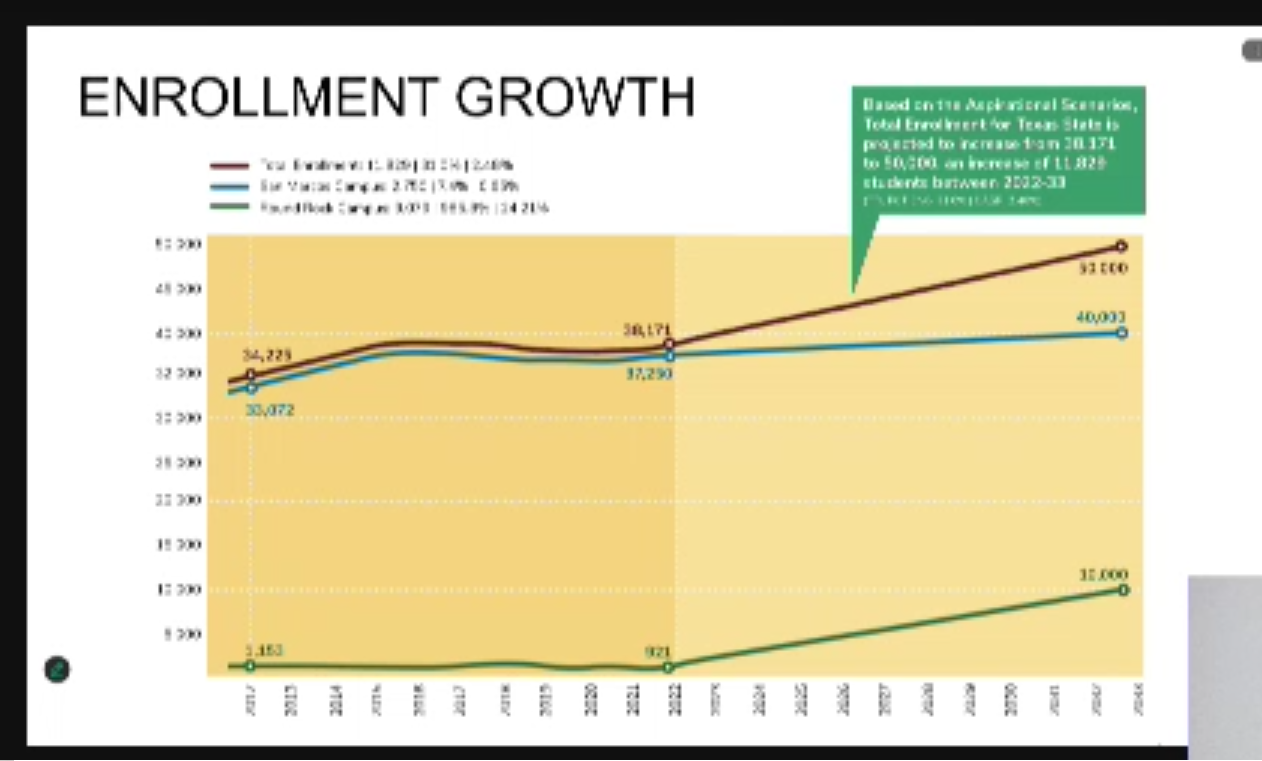
                Enrollment Growth

                Uh, yeah. Sorry about the quality! I bet it looked great in person!

                They’re projecting to grow from 40K to 50K students, but most of that is at the Round Rock campus and online.

                The green line at the bottom is Round Rock. The blue line in the middle is San Marcos. The San Marcos campus is projected to grow from 37K to 40K over the next ten years.

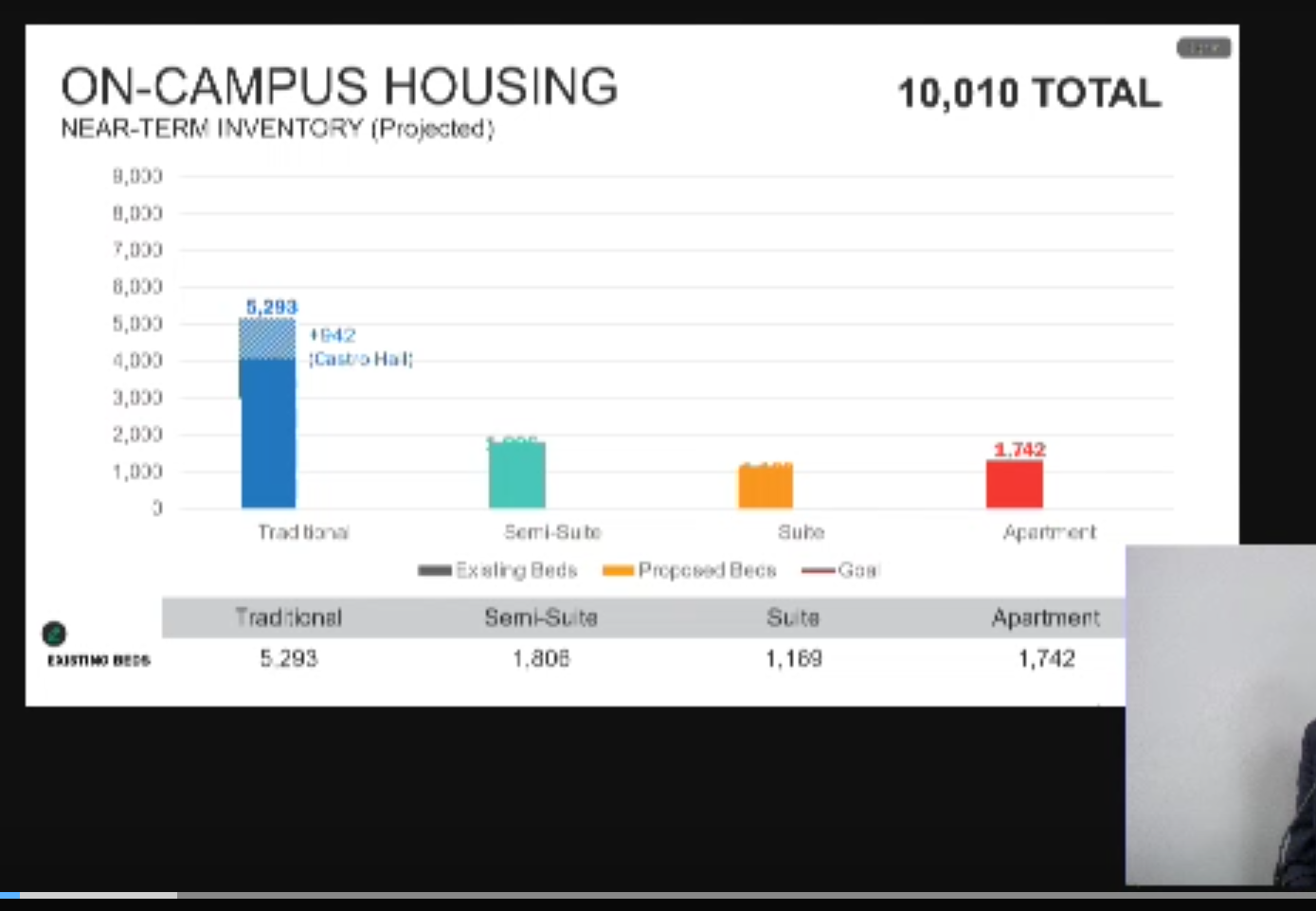
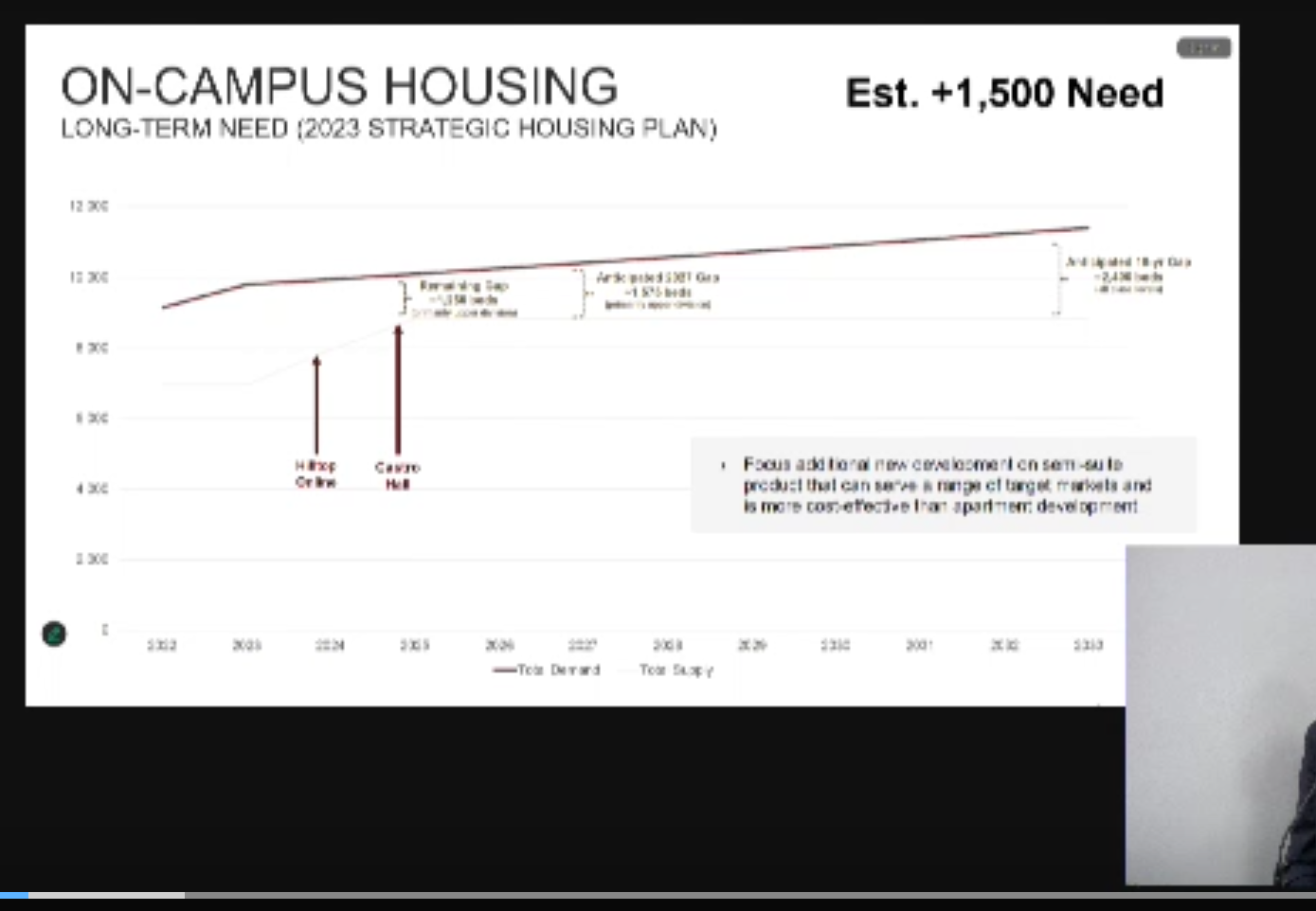
                Housing need

                They’ve got about 10K beds on campus right now.

                They’re going to need about 1500 more beds by 2027. They’re building more dorms to cover that.

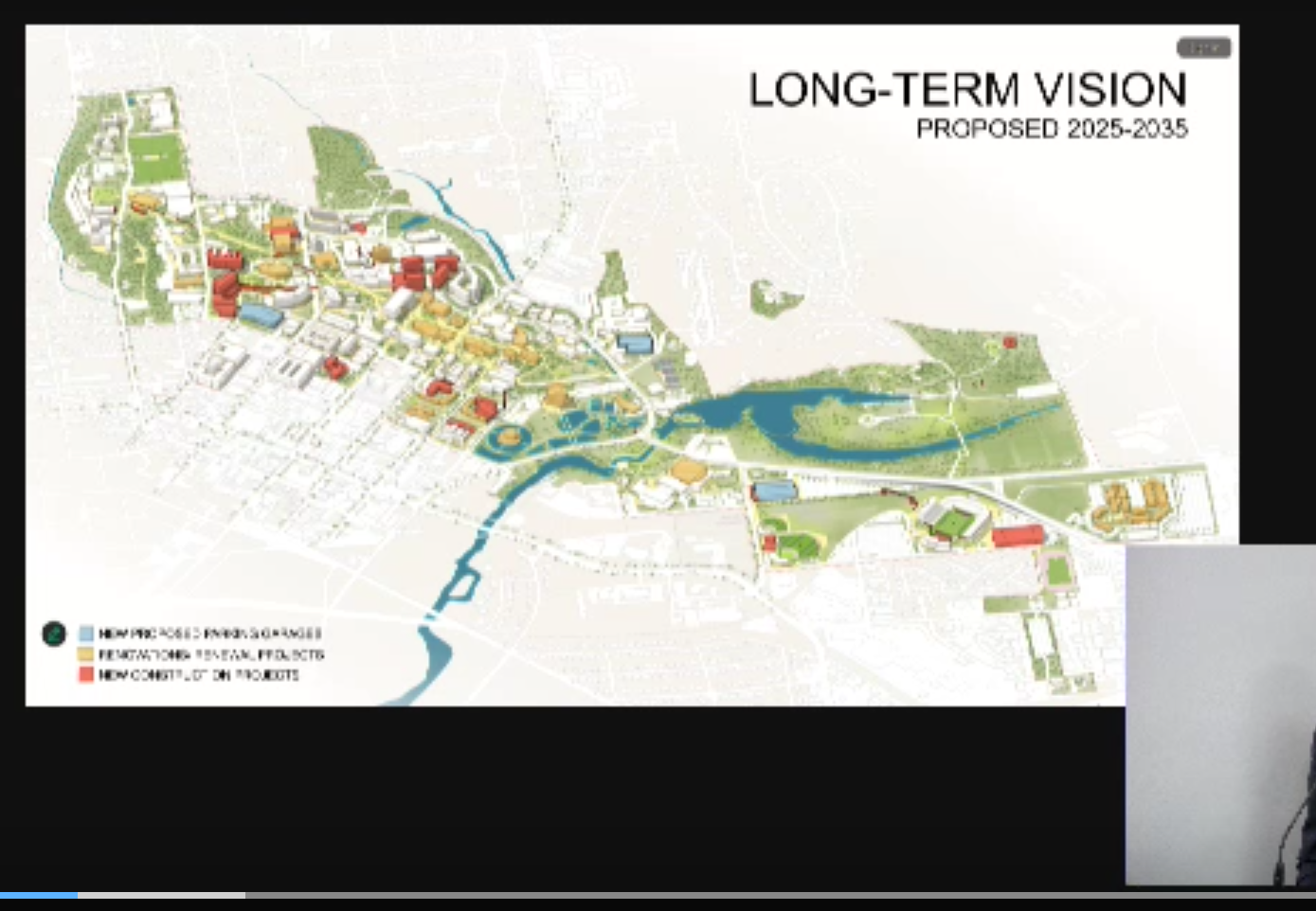
                Construction, etc:

                The dark red are new buildings that are under construction or are planned.

                The light orange are getting major renovations.

                So they’re not really planning to acquire any more land. Aside from those red buildings, they’re mostly going to reconfigure existing buildings to handle more capacity.

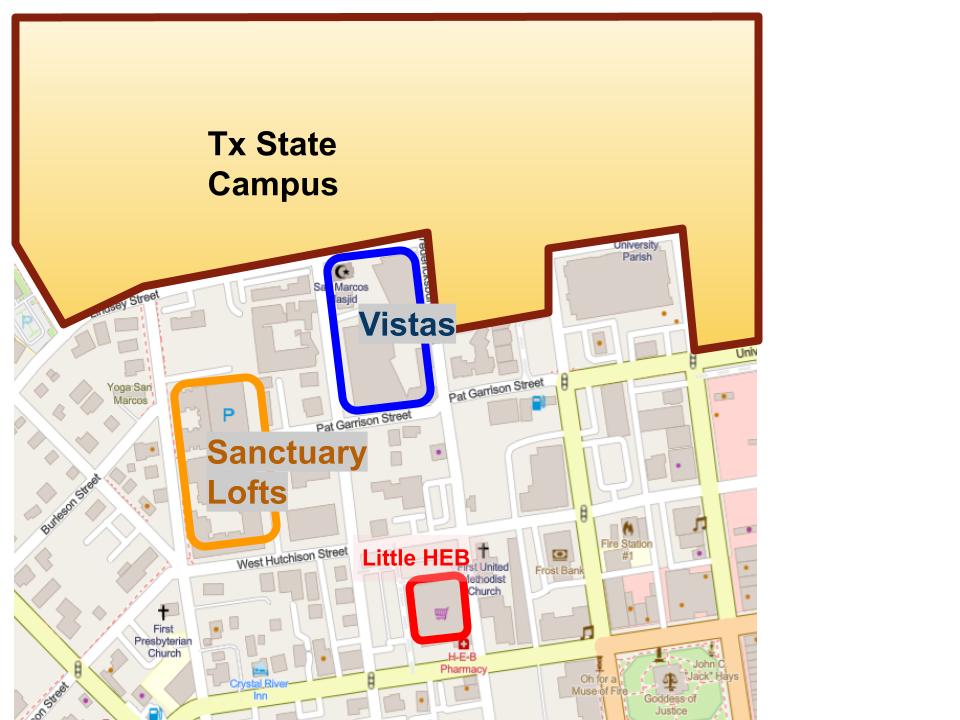
                Note: This is supposed to comfort city council. The city is mad that the university purchased two downtown apartment buildings, in order to convert them into dorms:

                We talked about this last March, when council approved the new Lindsey Street apartments.

                Texas State doesn’t pay local taxes. And downtown apartment buildings are worth a lot of money. So the problem is that when Texas State bought those buildings, San Marcos lost a lot of tax revenue.

                On the super tiny map, I think they’re here:

                Sanctuary Lofts is now called the Balcones Apartments and the Vistas is now called the Cypress Apartments.

                Parking and transportation:

                Light blue boxes might end up being parking garages. Bottom right is Thorpe Lane.

                They’ve got 48 busses, 90,000 weekly ridership. It’s a pressure point for the university.

                The plan is to merge the city and university bus system. This benefits San Marcos hugely. When the university started reporting their ridership to the feds, San Marcos got about $13 million in funding.

                The speaker talks about having an app showing all busses, at any moment, all free for everyone in San Marcos. That sounds amazing!

                Spring Lake:

                There will be a lot more trails and improvements coming to Spring Lake:

                but again, the slides are so murky. It’s hard for me to provide details.

                Council questions:

                Amanda: Is there any talk about capping growth at 40K?

                Answer: That’s as much capacity as we can accommodate. But the regents want to grow all the universities to handle 60% of Texans by 2030. They tell us what they want, and they want to grow.

                This is all taken from the next Master Plan, which will be approved in 2025.

                Affordability: Recently, UT went free for families earning up to 100K. Can we do that?

                Answer: Right now we’re free for families up to 50K. We’re asking to see if we can get funding to be free up to 100K, like UT. We expect that would be similar – 5-10% of our student body would fall in that 50K-100K range. (That is WILD. 85% of their student body comes from families making more than 100K?)

                This plan has not been finalized yet. I think the master plan gets voted on next year.

                Workshop #2:

                Every four years, San Marcos has to review the City Charter.

                Council will appoint seven people to the charter review commission. They only have six months to do a ton of work, because it has to be done in time for the fall election.

                The community can also add charter amendments to the ballot, like when we outlawed fluoride in 2015. (We were RFK junior before RFK junior even had a brainworm.) Maybe we can undo that!

                If you would like to be considered, they will be opening up for applications.

                May 18th City Council Meeting (Part 2)

                The next two most important items are probably the Charter Review Commission and the Cape’s Dam MOU.

                Item 1: Charter Review Commission

                So, the city charter is like our constitution, I gather. It gets reviewed every four years. I think it can only be amended by public vote at the ballot box. A committee was formed, met over six months, and provided their final report to Council. Then Council decides which issues go on the ballot in November. (I might have this wrong, but this is what I inferred.)

                Former Mayor Thomaides chaired the commission. Lots of connected people on there: Esther Garcia, Travis Kelsey, Zach Sambrano, Chance Sparks, Paul Mayhew and [Someone] Taylor. I’m less familiar with Garcia, Sparks and Taylor, but recognize Garcia’s name. Kelsey and Sambrano are on the Planning and Zoning commission, Mayhew used to be on the school board, and Sparks has apparently worked with lots of city managers thoughout Texas. And Thomaides, of course, was mayor until 2016, when he lost to Hughson.

                On the whole, their recommendations did not seem to have any ulterior motive. They seemed genuinely to be thinking about the city as a whole. I haven’t read the charter, so I don’t know what they might have omitted, but at this point I have no qualms with their process.

                Their 13 recommendations, loosely clumped:

                • Term limits: Council members would be able to serve three consecutive 3-year terms, and then they’d have to cycle off for a term. Mayor would be able to serve two 4-year terms, and then cycle off.

                Baker, Scott, Garza, and Gleason were in favor of term limits. First, to limit the power of encumbency. Second, to have time to reflect on your decisions in office and see how they played out.

                Hughson, Derrick, and Gonzalez were opposed – let the voters choose who they want. So that will probably go to the ballot.

                Note: these are limits on consecutive terms, not term limits. Interestingly, Thomaides, Scott, and Hughson all have experience with cycling off. Former Mayor Thom/aides, the chair of the commission, is currently in one of these alleged periods of reflection. Scott also lost his council seat (maybe 5-6 years ago?) and got back on this past November. Has he grown and reflected on his choices back then? You be the judge. Finally, Mayor Hugh/son was on the council in the ’90s. She took 10+ years off before running again, circa 2010.

                Currently the mayor serves two years, not four. The argument for the change was to free up the mayor from campaigning, and to align that election with presidential elections. Four of them opposed this, so it probably won’t be on the ballot.

                (The combination of these two votes is weird: originally it was proposed that the Mayor should have two 4-year terms, and inadvertently they’re now proposing two 2-year terms. I hope that gets cleaned up at the next review session.)

                • Loosening a bunch of residency restrictions and council appointees. These seemed fine. It’s good for city managers and judges to live in town, but it does reduce the applicant pool. Some will be on the ballot, others kept as is.
                • Codifying some current practices around ethics investigations, Citizen Comment procedures, deadline flexibility, and cleaning up inconsistencies. Nothing else seemed momentous.

                That’s all, but it took about two hours for them to get through all that.

                Omissions I might have advocated for:

                • City Council meeting weekly instead of biweekly
                • City Council earning a living wage, to enable a broader portion of the community to be able to run for office

                Next Post: Cape’s Dam.