
Items 10-12: This spot seems to come up a lot at Council and P&Z meetings:
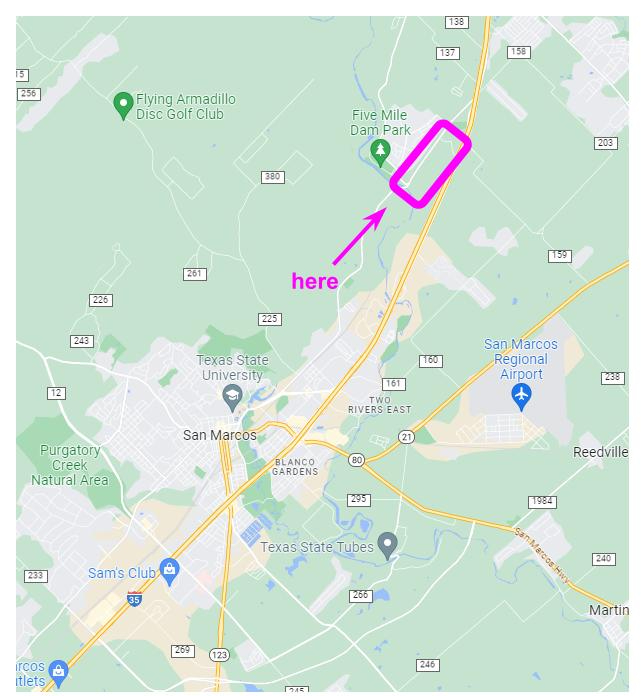
Here’s a close up of the section we mean, today:

In this case, three little roads are being demolished, and a new one being added in:

Now you know.
…
Item 20: Speed Cushions!
You know that phenomenon where you hear something for the first time, and then you hear it a bunch more in quick succession? (I’ve heard this called the plate of shrimp theory, from the movie Repo Man.)
I’m having Plate of Shrimp phenomenon with Horace Howard Drive right now. Here’s Horace Howard Drive:

It’s a little circular road that goes around a tiny lake:

Two weeks ago, a developer wanted to put a bunch of mobile homes on Horace Howard Drive, here:
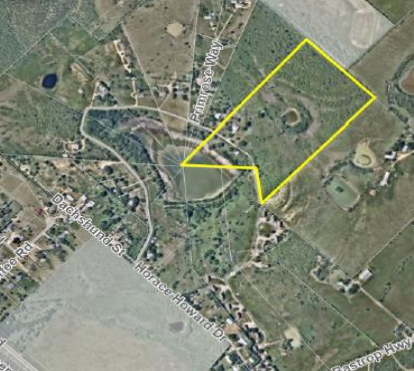
P&Z gave this a very forceful NO, mostly because the neighbors all showed up, fearing the increase in traffic.
Then this week, Horace Howard comes up again! Council granted them some new speed cushions, to complement the old ones:
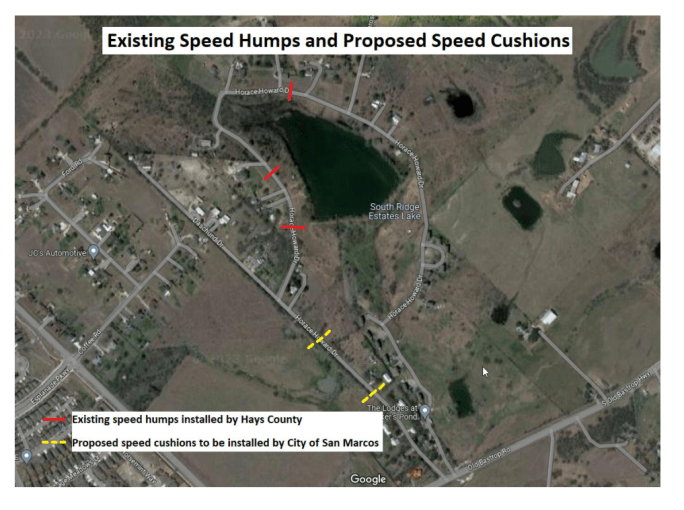
How nice!
Coincidence? Why is Horace Howard showing up twice in two weeks? Is it in the ether? I have no idea.
…
Item 22: Ending the five day hold for cats at the shelter.
This is a big deal, I think, and I almost missed it. (The volume on the recording was really lousy this week.)
Last year, after many meetings and postponements, we banned puppy mills and implemented Trap/Neuter/Release for cats. One of the recommendations from the animal folks was “Do not keep cats in the shelter, unless they are microchipped or have ID on them.” Spay or neuter the cat and then just release them where they’re found, and let them find their way back to their familiar setting.
The problem is that cats without ID are almost never reconnected with their owners, and it’s really stressful for cats to be in shelters, and their health suffers. Whereas they do just fine if you put them back where you found them – they’ll either re-join their cat colony or find their way home. So rather than holding them for five days and then letting someone adopt them, you should just spay or neuter the cat, and then return it to wherever you picked it up. This is Trap/Neuter/Release.
But Council debated this endlessly. Mark Gleason was particularly nervous about lost cats. Ultimately they kept the 5 day hold, and decided to revisit the issue six months later.
Lo and behold, six months passed. And in all of 30 seconds, they ended the 5 day hold and fully implemented Trap/Neuter/Release. What good councilmembers.
…
Item 25: Yearly CARTS contract
It costs $2.26 million to run CARTS for a year. The city of San Marcos pays $515K of that, so a little under a quarter of it. The rest of it gets covered by state and federal funding.
Shane Scott asked the hard-hitting questions: “How well utilized is this? What if we just had everyone take an uber instead? Wouldn’t it create jobs if we had uber drivers? Would that be more cost-effective?”
Jane Hughson says, “Buses have drivers.”
Shane falters and admits that buses do have drivers. He persists: “But would it be cheaper?”
The staff member said, “We have about 90K riders annually. But that would be a whole different transit model. This is a routes-based transit system. That would be on-demand, point-to-point system. We do currently have an on-demand component to our system.”
Shane Scott mumbled thanks.
You know I love public transportation. I believe in public transportation. So it hurts me to point out that the math here looks awful: if CARTS costs $2.26 million for 90K riders, that rings in at $25 per ride. Of that, San Marcos is covering $5.73 of each ride.
I am probably missing something basic here. The actual contract just says we pay $86 per bus-hour of operation, which seems reasonable. (And that all works out if there’s ~15 people on the bus at any point, which also seems reasonable.) Still, I must be missing something.
I am really hoping this partnership with Texas State boosts ridership, and helps get us momentum towards a system which is used by more people. Let’s make my public transit dreams come true.
Update: posted by Rosalie Ray, on FB, in response:
Re: transit. You’re correct that $25 a ride is not great. The issue is that the city operates a coverage model, where we prioritize giving most neighborhoods access to a bus over giving some neighborhoods access to a bus that comes frequently. This approach makes sense if you view transit as a lifeline service and assume that your riders have a lot of spare time and a few essential appointments in their week. We can see the alternative approach with Texas State, where they will deny service to student housing complexes if doing so compromises their ability to maintain 10-15 minute frequencies. Ideally, you want a balance of the two approaches-some level of service to all communities and investment in high frequency service on key corridors. In general, Uber-style service can rarely be provided for less than $15 a ride cost to the city, and it doesn’t have economies of scale-that is, more riders mean more cost, whereas with a bus, more riders (up to a point) means cheaper cost per ride. It’s also currently somewhat unclear if you can use federal funding for an Uber-style service-you can if it’s serving folks who are physically or mentally unable to use buses and live within a quarter mile of a bus route, but beyond that is murky. Tl;dr the CARTS contract is not a bad deal given the current structure, but if we want to build ridership, our next transit plan needs to prioritize certain corridors to improve frequency, while finding a solution for those neighborhoods that might lose coverage.
Including this here because it’s worth sharing, but also so that I’m more likely to retain this information and remember it the next time I’m talking about this stuff.
…
Item 26: More cats! This one is less about five day holds at the shelter, and more about renting your mini-excavator from Holt Cat, LTD.
York Creek Road meets S. Old Bastrop road way down south:

It’s even further south than Horace Howard Drive, by about five miles.
These Holt Cat guys want to do this to it:

That is, turn a bunch of it into heavy industrial.
There’s going to be some sort of development agreement coming around. In the past few years, Council has gotten into hot water with development agreements – La Cinema, SMART – where it passes them quietly and then everyone gets angry when they find out. Some day in the future, the city will send out notifications to residents within a 400 yard radius when a big development agreement is in the works. But that day is not yet here.
Council has not yet signed anything. Council just formed a committee with Jane Hughson, Mark Gleason, and Matthew Mendoza to look into it. So direct your Cat hopes and dreams to them.
 The San Marxist