Bonus! 3 pm workshops, 4/1/25

Three quick ones!

Workshop 1: Bicycle Friendly Communities.

    The League of American Bicyclists hands out awards.  We’re bronze! We’ve been bronze since 2018, actually. But we were renewed!

    Overall, Texas is mid.
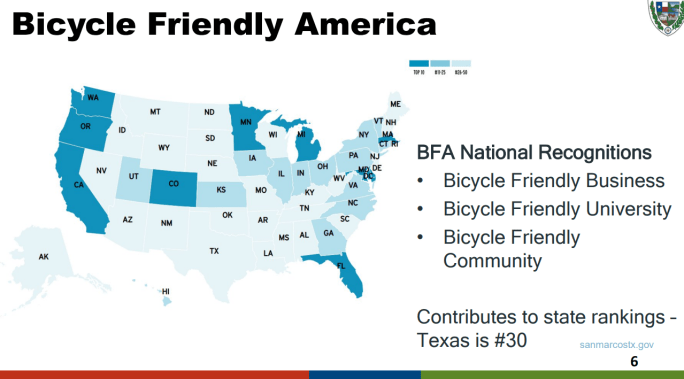
    It takes a fair amount of work to get this designation.  Along the way, we got some survey data:

    They also gave us a report card:

    Ouch. Hmm.  Maybe I don’t know what “bronze” actually means. That we’re trying?

    They included 17 recommendations.  We’re a work in progress.  Read ‘em all here.

    Council asks a few questions:
    – Bike incentives? Access? (no)
    – Do we reach out to businesses? (no)
    – Demographics of survey responses? (no)

    I’m being pretty negative, but the city is doing good work on a shoestring budget.

    Remember: on average, it costs about $1,015/month to own a car, whereas it’s about $29/month to commute by bike. San Marcos is full of people who might prefer to bike – but only if it feels safe, and only if they actually have a bike.

    Workshop 2: Spin Scooters

    These came up before, last July.

    We’re talking about these: 

    They’ve been around since 2021. 

    You download an app, and it tells you where the closest one is, and you can rent it and ride around the Scooter Zone.

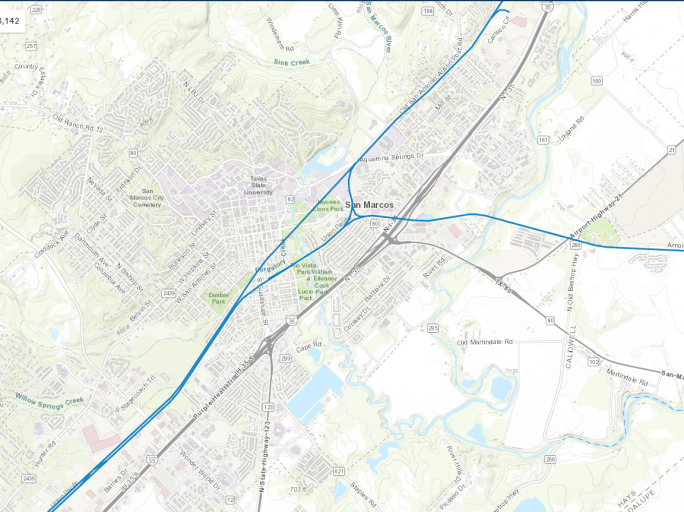
    Originally they were contained to this blue area:

    Last May, the Scooter People asked if they could grow.  So we gave them a 9 month pilot period to extend to this region:

    Also we allowed them to become 24/7. Before, they shut down overnight.

    So how did the pilot program go?
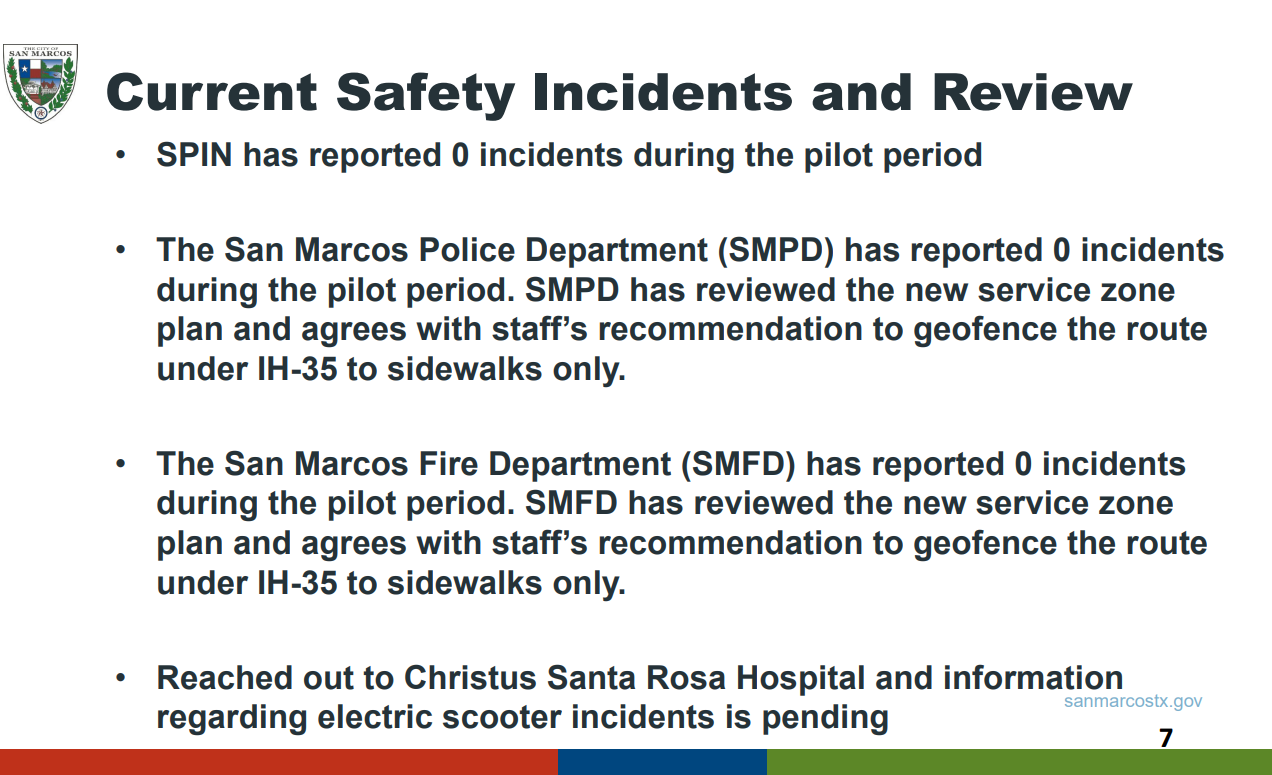
    There haven’t been any incidents!

    Everyone is fine making that region permanent.

    Would we like to fire up a new pilot region, here?

    Sure.

    One final note: Are these actually affordable?

    It costs $1 to unlock, and then $.30 plus taxes per minute. So let’s ballpark that it costs $6 for a 15 minute commute. That means that one daily trip would cost about $360/month.

    That’s actually kinda pricey. Still cheaper than owning a car, but not, like, frugal.

    Workshop 3: Edwards Aquifer Habitat Conservation Plan

    Okay, this topic is always fascinating.

    So back in 1991, there was a lawsuit by the Sierra Club against the U.S. Fish and Wildlife Service. The Sierra Club sued for neglect under the Endangered Species Act. Their case was that if the Edwards Aquifer drops too low, then the endangered species in the Comal and San Marcos rivers could go extinct. And they won!

    So the Edwards Aquifer Authority was created, and they got some legal power. This is important!

    (hey, look at this:
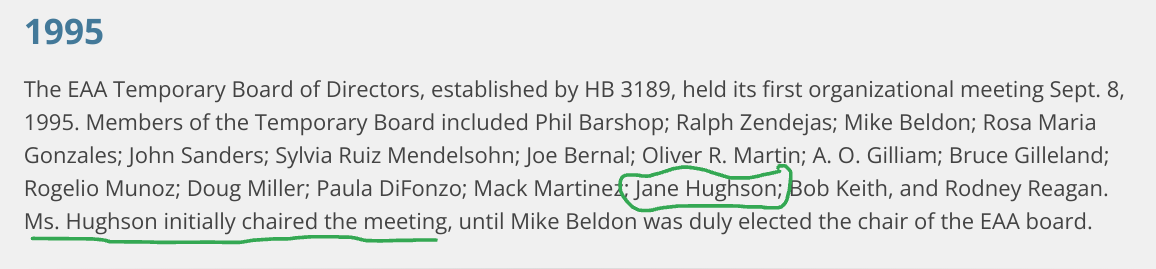
    Probably some of you know all those names, but Jane’s jumped out at me. Good on her.)

    Here’s the key: The EAA is allowed to cap much water gets used, and they are allowed to charge organizations to use the water. They sell credits to San Antonio, New Braunfels, San Marcos, Texas State University, Kyle, and so on. Then they use that revenue to fund conservation measures.

    Today’s presentation is on the Edwards Aquifer Habitat Conservation Plan, or EAHPC. This is how they actual take care of the rivers.

    So what do they do?

    SO MUCH! They spent about $10 million on San Marcos alone.

    They do a bunch of underwater gardening, to make sure there’s enough habitat for the little endangered fishies, and also the endangered wild rice:

    They fence off the spots where the bank is getting eroded and trampled to death, and nurture it back to life:
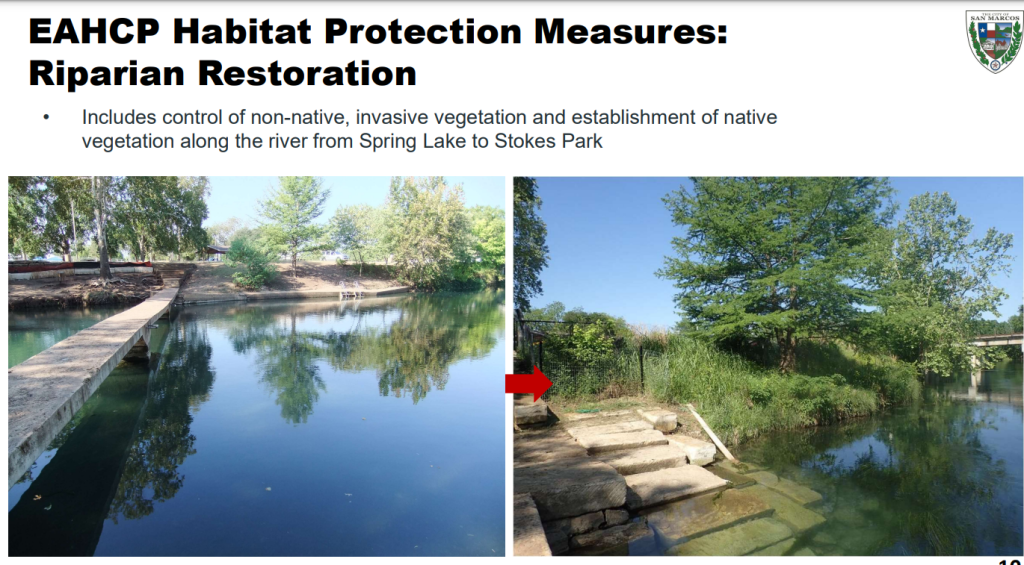
    That photo is just upstream of the falls. It’s as if you’re standing on the island with the big cypress trees, looking back towards the bank.

    They hire people to go spear-fishing for non-native species:

    The one on the left is those little sucker-fishes that people put in their aquariums to eat the algae and keep in clean. The one on the right is tilapia.

    Council asks: what happens to the fish?
    Answer: The guy who does the spear-fishing holds a big fish fry and serves tilapia fish tacos, down at Ivar’s river pub.

    Council: What about the sucker-fish?
    Answer: Don’t eat those. Gross.

    But also: the San Marcos Discovery Center has a fish shelter! Like they’ll take your old fish if you don’t want an aquarium any more, and if you are getting started, you can go adopt fish for free from them.

    Don’t dump your old fish in the river, everybody. Take them to the fish library.

    What else?

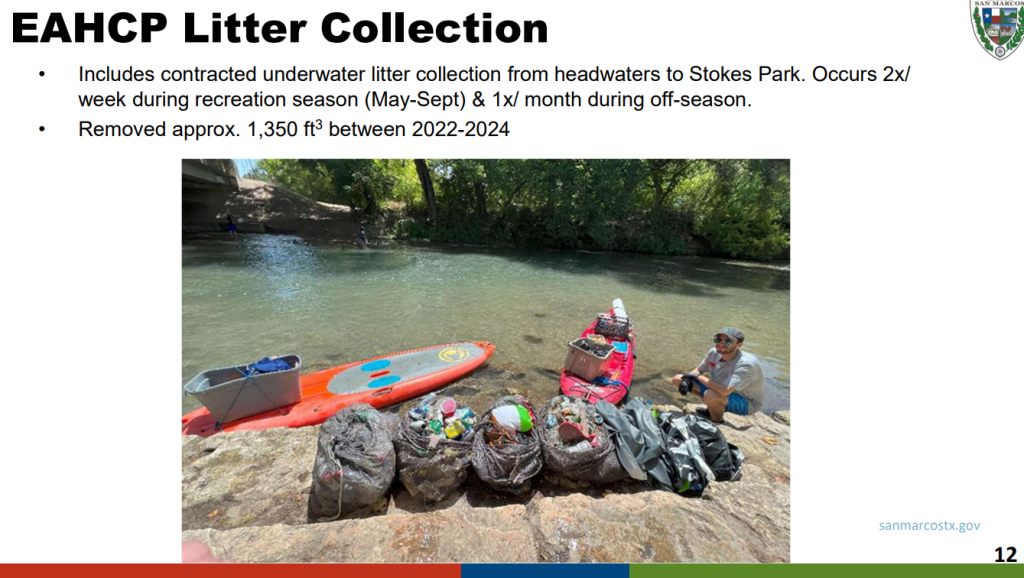
    They pay for scuba divers and snorkelers to collect trash out of the river, twice a week, all summer long:
    They keep those red bobbers around the wild rice and sensitive spots:
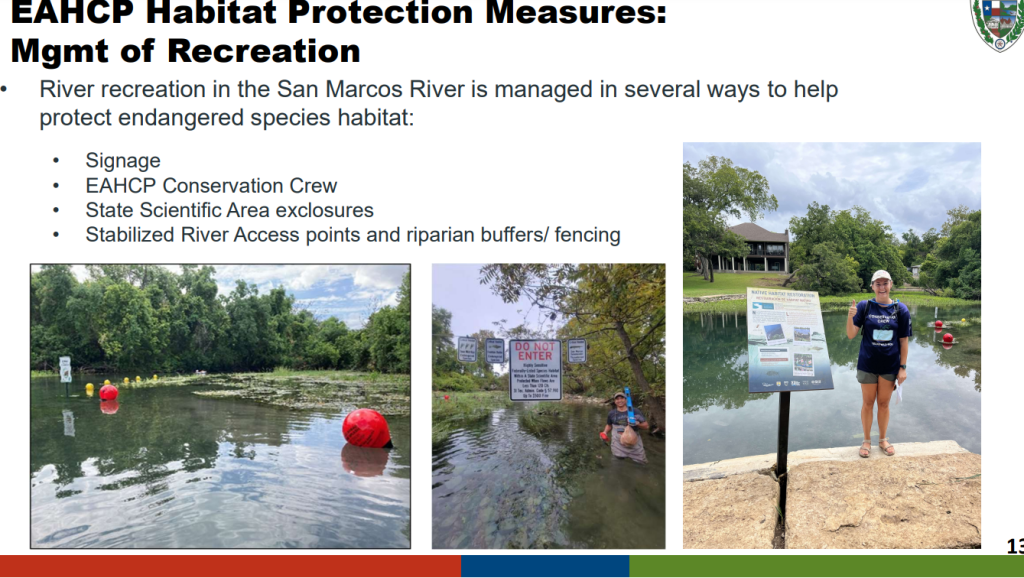
    They put the big limestone rocks in at certain river swim spots, and then fenced off a bunch of the other spots:
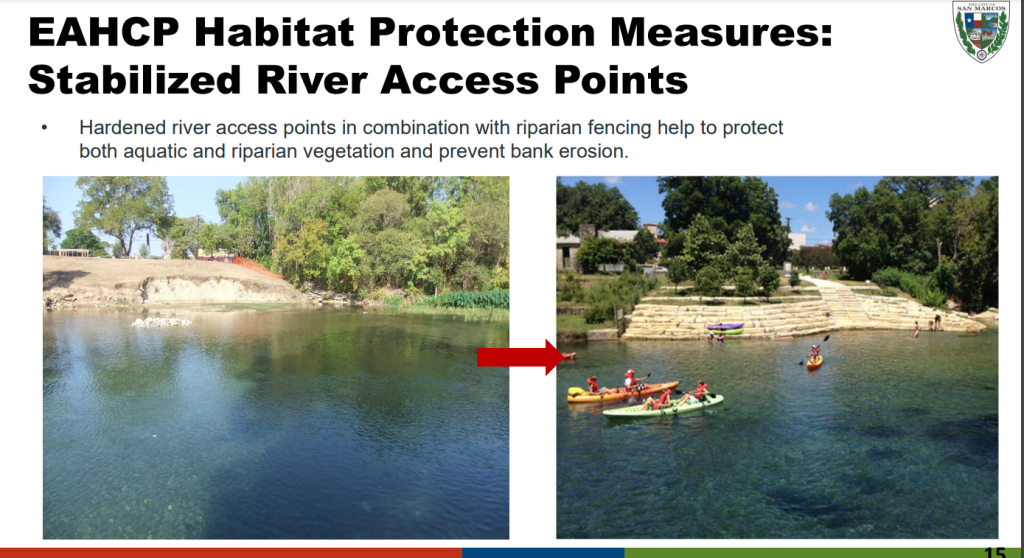
    In other words, they were like “Let’s contain the swimming to a few really great swimming spots, and not worry about vegetation there. Then we’ll protect the rest of the river for vegetation.”

    Also the limestone rocks keep the bank from eroding.

    They did a bunch of stormwater detention that keep the nasty stuff from running into the river:

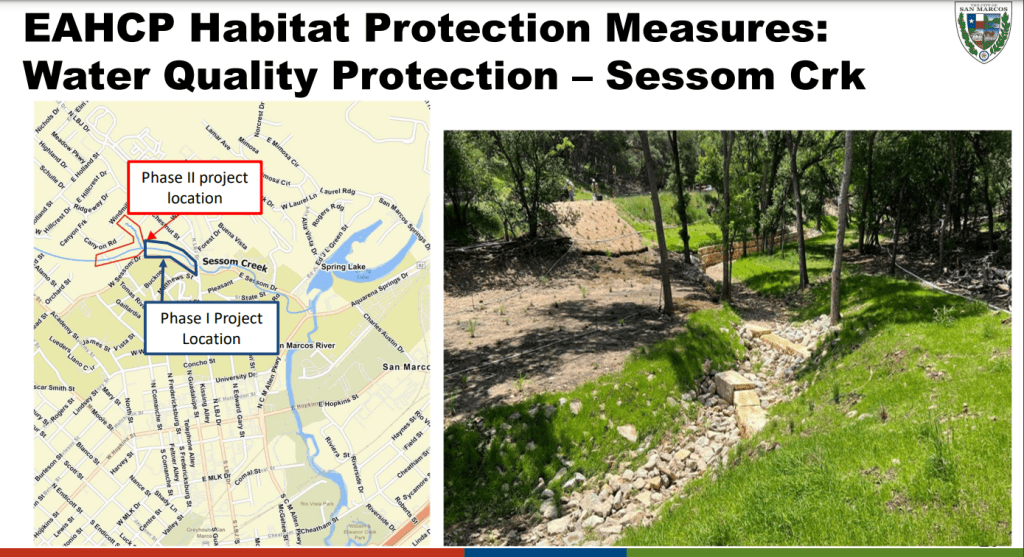
    and they also fixed up Sessom’s Creek:
    I mean, let’s pause here. This is wild, right? This is the Edward’s Aquifer:
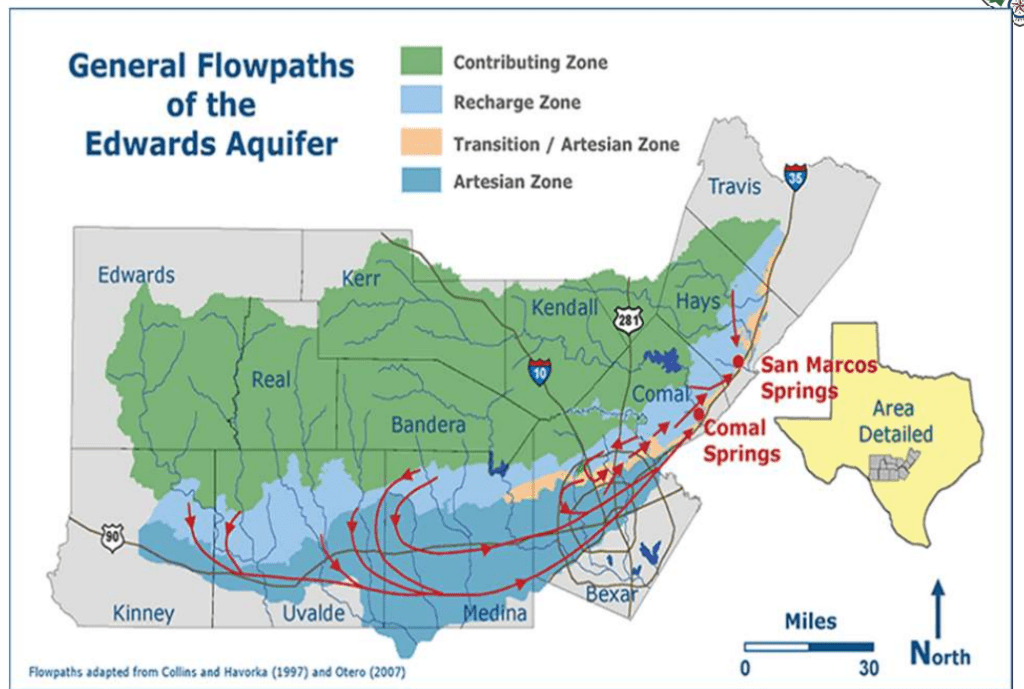
    Everyone in that dark blue region would just be draining the aquifer dry, if the EAA wasn’t around. Instead there’s been this massive coordinated effort, resulting in $10 million worth of projects to protect our river?!

    That’s insane and beautiful. You’ve got to cherish this and really breathe it in.

    (Especially during this larger dark time. I hope this program is not dependent on federal funding.)

    But wait, there’s more! You can’t hold these deals back!

    The scientists study and monitor all the endangered critters:

    They scoop them up and take them on field trips, over to McCarty Lane or down to Uvalde:
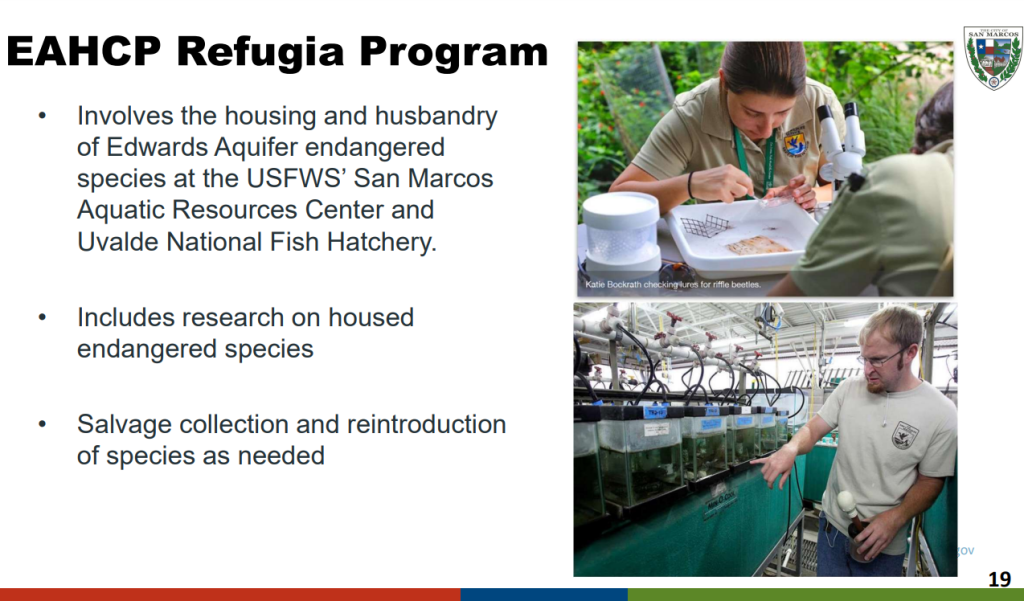
    That way, if there was a massive natural disaster or chemical spill or something, they could re-introduce the species after the river was healthy and cleaned up again.

    What’s next? The current EAHCP plan runs from 2013-2027. So it’s about to expire, and they’re mapping out the next one to run from 2028 – 2058.

    They’ll do a lot of the same stuff – make sure the river stays flowing, make sure the people don’t destroy the environment, make sure the endangered species are still paddling around in healthy numbers. But they’ll also have to respond to a hotter, drier world, which makes this all harder.

    There’s some technical details to the new plan, and honestly, you should just watch the whole presentation here. (Or read all the slides here.) 10/10, no notes.

    Hours 0:00 – 0:55, 11/14/23

    Hello all! Short meeting this week. But still interesting! 

    Item 5: We are purchasing 6.28 acres on the corner of Hunter and Dixon, here:

    This is exactly where Hopkins turns into Hunter, by the way. We’re talking about the field opposite the VFW:

    It sometimes has horses in it.

    This is part of a giant $60 million dollar project to address Purgatory Creek flooding.  (We don’t yet have the $60 million. That part will take a while.)

    It’s hard to find a map of Purgatory Creek, because everything online refers to the natural area at Hunter and Wonderworld:

    via

    But we’re talking here about the actual creek, which starts at Purgatory Creek Natural Area and flows up towards Belvin, then cuts across Hopkins to Dunbar, and then keeps going toward the river, meeting the river near the Children’s Park:

    (This slide wasn’t in the packet, so it’s a low-quality screenshot. Sorry!)

    About a decade ago, I had a random conversation with an old-timer, and they told me that Purgatory Creek was re-routed at some point in history – like some hair-brained engineering scheme conceived in a honky-tonk and made real. The idea was that this had caused some of our current flooding problems.

    They didn’t provide enough details for me to make sense of the whole thing, so consider this an open invitation: can someone fill me in on how we’ve meddled with Purgatory Creek over the years? I am very curious!

    Here’s another view of the whole thing:

    (Also low quality! Sorry.) It’s going from Wonderworld over to Dunbar, and then from Dunbar over to the river.

    So what is the project? What are they doing?

    (More screenshots, sorry.) Basically it’s going to be a giant channel to catch stormwater and take it to the river.

    Phase 1 is supposed to start in 2026, going roughly from Dunbar Park to the river:

    Phase 2 is still 5-10 years out.  (We move slowly.) This part is Phase 2, Dunbar out to Wonderworld:

    It’s also supposed to eventually have some trails and nice features for people to use.

    … 

    It occurs to me that if they put paved bike trails alongside it, this would be an incredibly handy bike path for getting around town safely.  

    Biking directly from the river to Wonderworld, skipping all of downtown and Hopkins? That could be really convenient.

    Along these lines, I’ve long thought that we should put bike paths along the railroads – why should bikes be constrained to car-paths when we’ve already got these giant rail lines cutting directly across the city?   

    Just look at these railroad lines!

    Imagine if there was a little side path that allowed you to use the railroad bridges to get across the river. You could take the future Purgatory Creek path from Wonderworld all the way to the river, and then take the railroad-adjacent path across the river, over to Aquarena, and north up to Blanco Vista. You could avoid all the cars on Post Road, Aquarena, and Hopkins!

    And then you could bike directly from Aquarena Springs down to Target! After all, the trains go right along I-35, behind Target. If you work at the Outlet Malls, it would take you almost all the way there. If you live on the northeast side of town, you could easily get back and forth across I-35!

    (I didn’t make this up! It’s a real thing, called Rails-with-Trails.

    via

    There are a ton of resources at the Rails-with-Trails link.)

    Back to our little patch of land, across from the VFW.

    Saul asks, “Will this help the flooding on Bishop?”

    Answer: Not really, no.  There’s a separate project, the Bishop-Belvin project, that is aiming specifically at that.   

    ….

    Item 6:  Each year, Hays County gives San Marcos $85,000 to provide library services to county residents.  The other local libraries – Wimberly, Buda, Kyle, Dripping Springs – all get $35,000 to serve the county.  

    The per capita funding has gone down dramatically in the past 20 years.  Our funding has grown, but not as fast as the population of Hays County.

    The presenter did mention this: “As the population has grown in Hays County, the percentage of users outside the city has actually gone down.  As these other towns build new libraries, people go to their home library.” But I wasn’t clear if she was referring to the entire 20 year span, or just the past 2-3 years.  

    They also get $120,000 from Friends of the Library each year, which is also helpful. (For comparison, the library gets a little over $2 million from the city budget.)

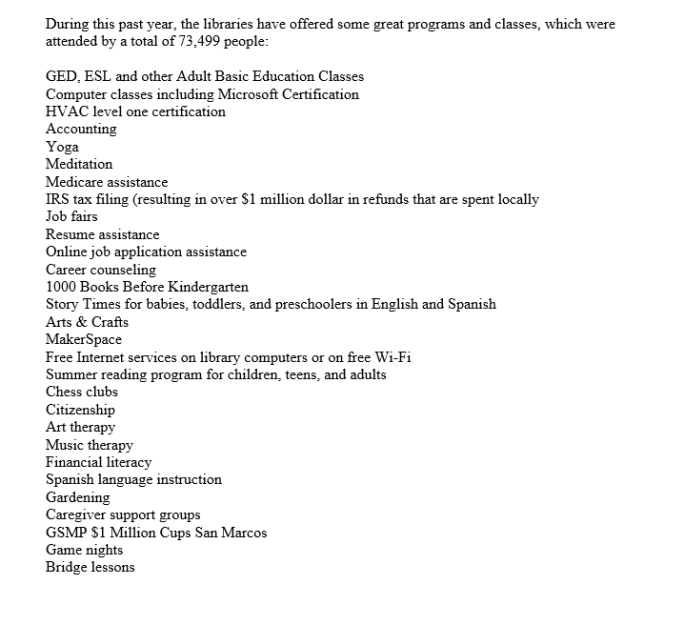
    Let’s just take a moment to appreciate how much our library does:

    It really warms a crabby marxist’s heart.

    Item 12:  We’re going to purchase a Smeal aerial fire apparatus for the Fire Department for $2,300,000.00.

    via

    That’s my best guess as to what we’re getting.  I’m not a fire truck expert.

    Item 17: LIHTC Projects. I feel deeply ambivalent about this item. 

    LIHTC stands for  “Low-Income Housing Tax Credit”.

    Say you’re a developer and you’re going to build some apartment complexes. The city offers some incentives for you to include some low-income housing. LIHTC is a federal program that helps us give tax credits to developers, in exchange for a certain number of below-market-rate apartments being built. (Another one is a density bonus – you can build more apartments per acre – if you agree to keep a certain number at a cheaper price.)

    Here’s what we require from the developer: you have to offer 5 of these 8:

    What kind of tax breaks do you get for doing this? I’m not actually sure. This line is on the LIHTC application:

    So I suppose you get a 4% discount or a 9% discount on your property taxes.

    Here’s the key line for this meeting:

    • A minimum of 25% of all units within the project shall be affordable to households at or below 30% percent of the AMI for the duration of the tax exemption

    What does this mean? First, AMI is Area Median Income.  Now, San Marcos gets lumped in with Austin for this computation, so:

    • Median Income for a 4-person household: $122,300
    • Median Income for a 1-person household: $85,600

    This is obviously a little ridiculous for San Marcos – our single-household median income was $42,500 from 2017-2021. But still, legally we’re going to use Austin’s $122,300 number as the reference point.

    Ok, next: “households at or below 30% percent of the AMI”. In other words:

    • 30% below Austin’s median income for a 4-person household: $35,050
    • 30% below Austin’s median income for a 1-person household: $24,550

    These are the people we’re trying to help with these LIHTC projects. This includes roughly 30% of San Marcos, or 21,512 people.

    Last time with this key sentence again: “ A minimum of 25% of all units within the project shall be affordable to households at or below 30% percent of the AMI for the duration of the tax exemption”

    In other words, if you want the tax breaks, then you need to make 25% percent of your units affordable to people earning less than $35,000.    Let’s say a big apartment complex has 200 units.  So then San Marcos gets 50 units that are affordable to people in poverty, from that one LIHTC project.

    Here’s an important question: what’s the current situation? We say there’s a housing shortage, but by how much exactly? How many more apartments need to exist for those 21,512 people, so that everyone can find affordable housing?

    We did an excellent Housing Needs Assessment, but it’s out of date – it uses 2017 data.  It desperately needs to be updated yearly. But still, in 2017, this was the situation:  

    Adding up the first six rows, we had 9935 total rental households (in 2017) that earned less than $35,000 a year, and we had a shortfall of 4233 rental units.

    Since then:

    • Prices have surged
    • A lot has been built (but at what rental price?)
    • A lot more people have moved to San Marcos

    So it’s really impossible to speculate. But my read is that we have an increasingly severe housing shortage for the poorest third of San Marcos.  Let’s say we need 4,250 rental units for people earning under $35,000, just because it’s the next nice even number.

    To achieve 4,250 affordable units, we only need to build 85 more LIHTC apartment complexes around San Marcos! Right now we have eleven LIHTC projects, and five more that are in the works. This is an excruciatingly slow way to chip away at those 4,250 units.

    One last detail on the 25% number: that number was set in March of 2022. Before that, you only had to set aside 10% of your units. So that 200-unit apartment complex would only bring 20 newly affordable units to the table. Only 212 more apartment complexes needed at this rate!

    [I’m being a teeny bit of a jerk. This one mechanism is not supposed to solve the housing crisis all by itself. It’s just one tool among many. But in practice, we have very few other ways of generating affordable housing.]

    So here was the question being debated on Tuesday: should we stick with requiring that 25% of units be affordable? Should we go back to 10%? Or should we settle somewhere in the middle?

    Council quickly settles on 15%: it should only take 15% of your units to qualify for tax breaks. 

    So what’s the rationale? What’s wrong with 25%?  Basically, developers have stopped applying for the program at all. The tax credits aren’t enough to offset the cost of setting aside 25% of their units for low-income housing. The math doesn’t math, as the kids say.

    Are developers the bad guys? Eh, not really. They’re not here to solve housing affordability.  This is not their problem.

    What does this mean then?  It means that this is a terrible way to create enough affordable housing. 

    The honest truth is that this is too big a problem for San Marcos.  Poor towns and big cities have high needs and rich towns and rich suburbs have very small needs. Making cities solve their own individual housing crises is idiotic.  We actually live in a wealthy state!  Texas could meaningfully reduce housing unaffordability, if this state cared about anything besides outlawing trans kids and punishing refugees.  

    Given that there’s no real solution anywhere in sight, should we:

    1. Require builders provide 25% low-income housing, and have fewer applications? or
    2. Allow builders to only provide 15% low-income housing, and have more applications?

    Answer: poor residents lose either way.

    One final note: Other places build a lot more public housing than we do. For example, Vienna was written up in the NYT recently. (Gifted link – shouldn’t be paywalled).

    Given that the US doesn’t have much appetite for building a lot of high-quality public housing, the best way to bring down housing prices is to build an excess of housing that is close to people’s jobs and schools. Put guardrails on what kind of dense housing developers can build, and then let them build it. (My preference for the guardrails is to allow more condos, duplexes, 4-plexes and 8-plexes in quiet neighborhoods, and then some large scale apartment complexes as their own standalone thing. Clearly the Old Guard in town prefers strictly single family housing and massive apartment complexes. But I digress.)

    This is actually something that Texas has done better than California. It’s easier there for a few people to gum up the process for a developer indefinitely, and so you end up only building out in the middle of nowhere. Hence the enormous sprawl and wild housing prices.