Bonus! 3 pm workshops, 3/4/25

There are two workshops: one very short and one very long.

  1. Evoke Wellness.

Back in December, Council had a lot of questions for these guys.  They offer mental health and addiction treatment for people referred over by the police.  We’ve allocated 150K of Covid money for this. This is a follow up discussion with the director at Evoke.

Amanda: What’s it look like if you’re receiving services?

The director gives an extremely detailed answer!

  • Prescreen for eligibility. Detox? Residential? Intensive Outpatient?
  • Say we’re starting with detox. Then there’s an evaluation and intake process.
  • Then you’re seen by nursing staff to get orders from the medical director on the detox protocol, medication regimen
  • Detox lasts 5-7 days. Completely voluntary. You’re free to leave at any point.
  • Residential: 21-28 days. Could be detox and then residential.
  • In the residential part: first there’s a biopsych-social assessment: trauma history, drug use history, family relationships, everything. You need a full picture to treat the whole person.
  • Clinical team and medical team working together to monitor the patient 24/7.
  • During the day: like school, 6 hours a day. Learn about substance abuse and mental health conditions, tools, coping skills to hopefully achieve longterm sobriety.
  • Breakfast, meds, 9:30-5:30 programming, community involvement with 12-step panels holding meetings with clients.
  • You also get a therapist and case manager. The case manager will help with the discharge process.
  • Therapist meets weekly and as needed.
  • 6 hours/day of group therapy.
  • Longer lengths of stay produce better outcomes. Typically 28-35 days.
  • Discharge plans: typically clients take the clinical recommendation for a sit down placement in a PHP (partial hospital hospitalization) – lower level of care, higher level of freedom, and so own down the levels of care.

Amanda: How often is the intake the first time the person’s ever run through their trauma?
Answer: Depends if they’ve ever had treatment before. Could be first time, could have relapsed.

Amanda: Typical client to staff ratio?
Answer: 8:1 ratio, plus nursing staff and on-call medical director and leadership team.

Amanda: On the discharge plan: If you don’t want to go through everything, can you still get a discharge plan?
Answer: Yes. And if they won’t accept the discharge plan, our case managers will help connect them with resources that work for them.

Amanda: What about people that are indigent? How does medication work upon discharge?
Answer: For all clients, detox meds are covered for free, for 5-7 days. They are responsible for their medications, but if they have no resources, we will keep providing it. The discharge coordinator will work with them to find the community resources to stay on their medications.

Alyssa: Last year, I asked for info about Evoke. They were in the process of getting a mental health license – did that happen?
Answer: We are licensed for co-occuring disorders. There must be substance disorder with a mental health disorder. Actually pretty rare to have a substance issue without a mental health issue, so this is pretty much all our patients. We do not currently serve clients that only have a mental health issue and no substance abuse.

Alyssa: This helps San Marcos?
Chief Standridge: The goal is jail diversion. We’re using funds from both San Marcos and Hays money. If they have insurance, we use that first. If they’re indigent, we try to use our funds. But only if they’re residents of San Marcos.

Everyone is really pleased by the high quality of the answers given by the director.

Alyssa: I’m very hopeful? There’s a lot of structural root causes and obstacles that have to be overcome, and we have to think about those when it’s time to budget. And the public defenders office has been really helpful in locating resources. But I am anxious about the rise in need for support services. We’re setting people up for failure if we don’t supply resources.

Shane: I’m tickled to death! How it all came together, as a team.

(This is Covid money, so we’ll have to figure out how to fund it going forward.)

Workshop 2:  SMPD. This is a 2 hour presentation!

This is SMPD’s opportunity to put their best foot forward.  This is a description of all the trainings and guard rails in place at SMPD.  Everything is couched in really positive terms – “Do we make mistakes? Sure! But we then unpack it and learn from it.”  

This isn’t bad! It’s totally fine. It’s what any other department would do. However, a police department requires an extra level of skepticism, because of the sordid history leading up to this moment in time.  

Usually I’d use Council questions to look for cracks in the presentation. But they ran out of time, because the council meeting starts at 6 pm.

So this is a very glowing presentation, without any opportunity to give a counter-narrative. Anyway, I’m just the messenger. Don’t shoot me.

Chief Standridge came here four years ago. We’re kind of summarizing the internal protocols that he’s implemented over this time.

There are five different speakers.

Speaker #1: Internal changes

“ABLE” stands for Active Bystander for Law Enforcement. This is basically like “Friends Don’t Let Friends Drive Drunk.” How do you create an environment where cops will tattle on each other?

The goal is for the consequences of not intervening to be bigger than the consequences of intervening. They do some training around interventions as well.

Here’s how many internal cases they’ve dealt with:

I mean, it’s absolutely impossible to interpret this. Is this a lot, or a little? How often are incidents going unreported? Would I agree with the outcomes if I knew all the details of the incidents?

There’s no way that PD could answer these questions! But it also means that we can’t really makes sense of this data.

It’s like if five people go to the doctor for measles, and the doctor treats three of them, and diagnoses one with allergies and one with mumps.

  • That doesn’t tell you much about the number of measles cases in the rest of the town
  • It also doesn’t tell you if the doctor is making correct diagnoses

Both those things would be much harder to figure out.

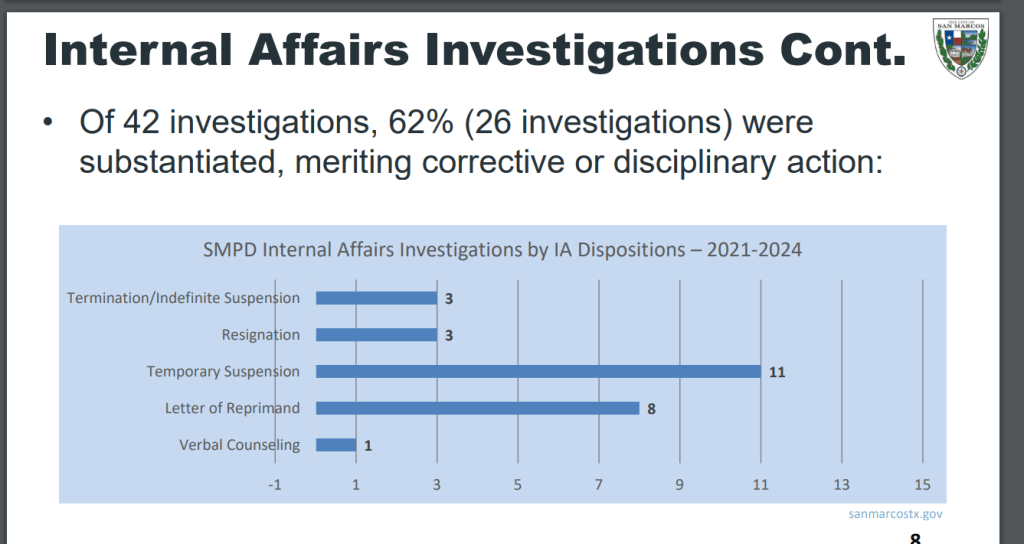
Here are the investigations that were found to be substantiated:

In 2021, we had one IA investigator. Now we have four. So that definitely helps have more eyes looking out for bad behavior.

The Event Review Board

The Event Review Board reviews every incident, use of force, pursuit, and preventable accident. They try to see what the department could change to reduce these events.

It’s a broad group of people and they’re supposed to look at any potential event, no matter how minor.

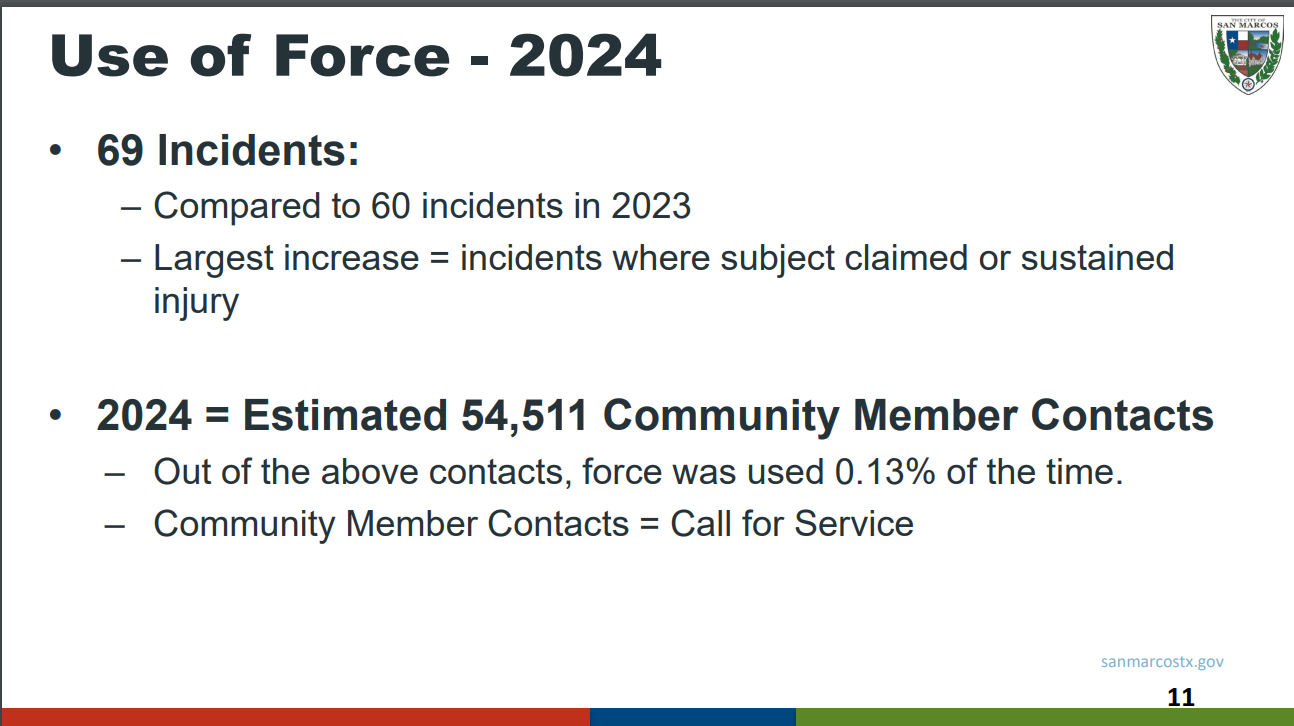
Some data:

Again, I just don’t have enough context to make sense of these numbers.

The speaker might have said given good context! But this was a three hour presentation, and if she did, I didn’t jot it down in my notes.

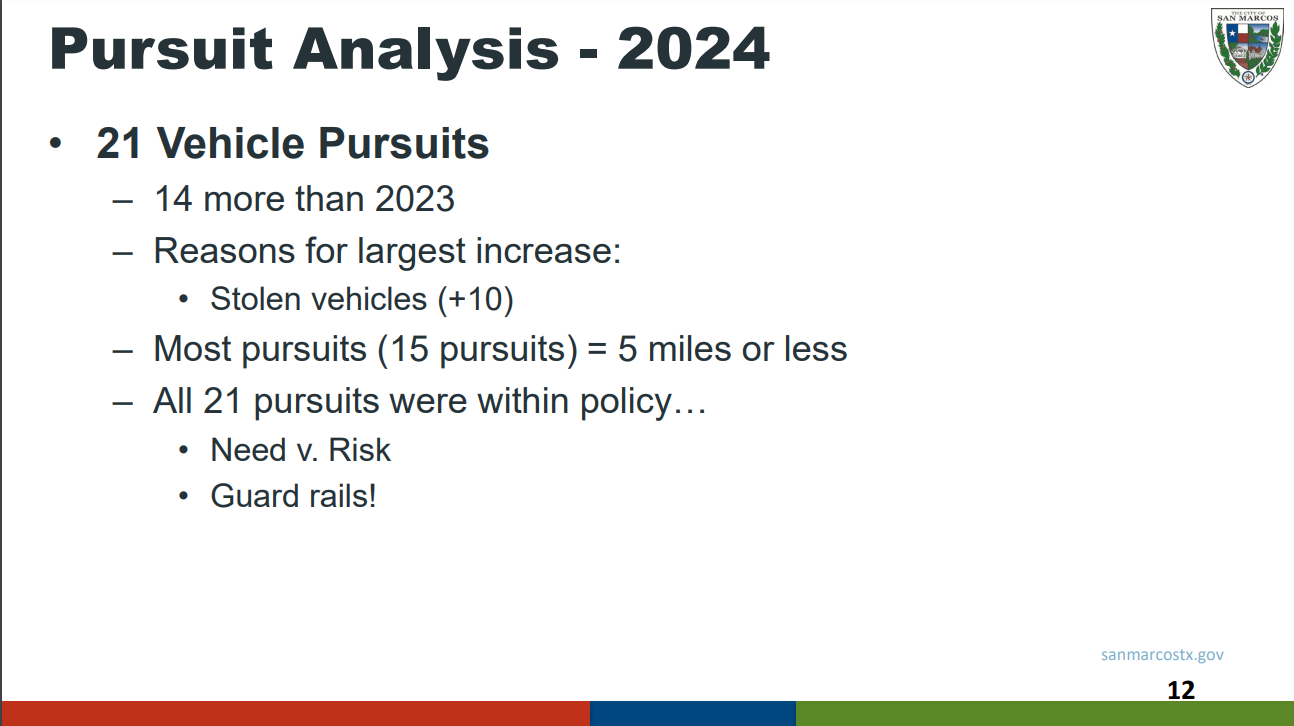
Also:

None of these were available last April, when Malachi Williams was killed. Alyssa brings this up.

Amanda asks about the costs of these?

Taser 10: $343K for 123 officers, or about $2789 per officer, per year. (Includes the Taser 10, body cameras, unlimited video storage, training, and software licensing.)
BolaWrap: $1,299.99 each, and $38.99 each for cartridgets
40 mm foam bullet launcher thing: $1,273.50 each

I don’t know if each officer gets each thing, but that would come to $5362 per officer. With 123 officers, it’s about $660K.

Look, I want the officers to use less lethal force. I’m just pointing out that SMPD spends bigger sums of money, and they do it much more quickly and easily than any other department.

This next thing is actually really great.

Suppose you stop someone and they don’t speak English. You open up this Voyce app, and there’s a live translator. You pay by the minute.

Notice they can provide sign language as well. (But it only works if officers remember that people can be deaf. This would not have helped John Kelley, the deaf man that was tased in 2019 for not responding when SMPD told him to stop.)

The speaker says that there was one time that they needed a Mandarin translater at 3 am. This is pretty invaluable for that. (It was originally designed for the medical community. Seems invaluable there, too.)

This app doesn’t help you figure out what language the other person is speaking though. You have to use google or something.

That was all the first speaker!

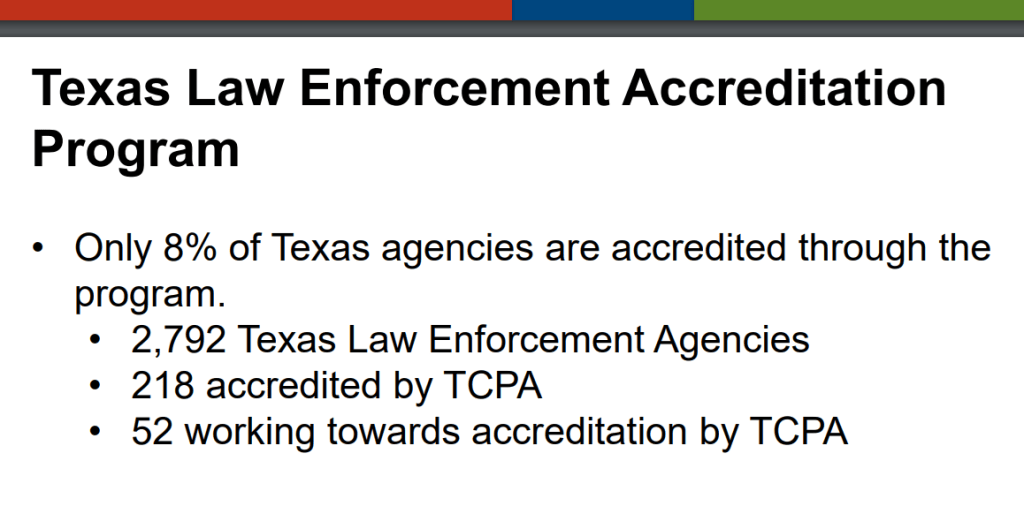
Next speaker: Accreditation

So I guess not all the PDs are accredited, but now we are?

We’re not there yet, but we’re working towards it.

Basically you have to come up with policies that satisfy the agency in these areas:

You have to show compliance with 173 best practices.

(This meeting was the day when it was super windy and there was all the spooky smoke and dust hanging over the city. Everyone’s alarms kept going off for the evacuations up in Kyle.)

Anyway, it sounds like it’s a ton of work:

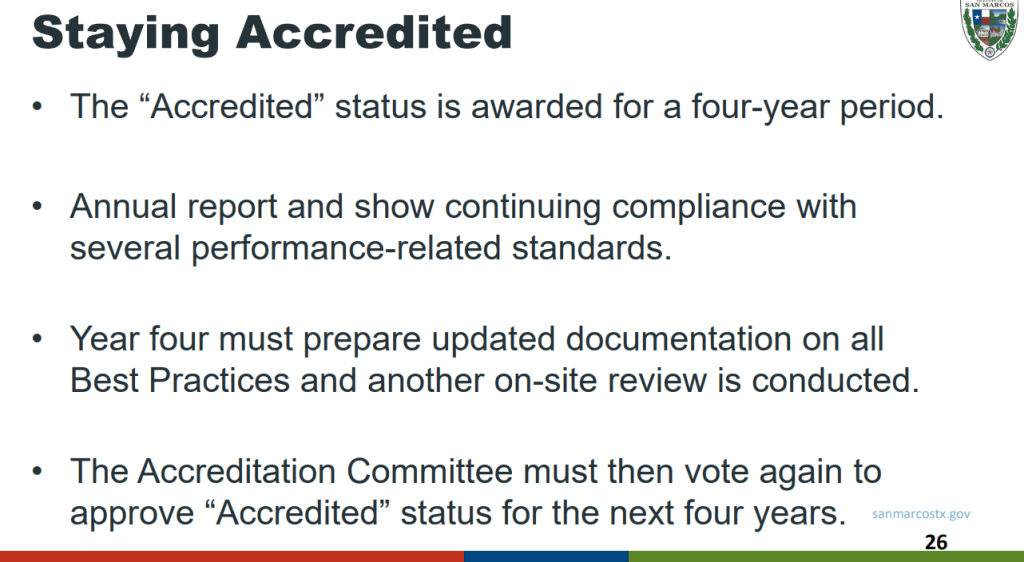
And then you have to stay accredited:

Onto the next speaker!

This one is super interesting – it’s on our 911 call center.

Basically, there’s a nationwide shortage of 911 dispatchers. We used to have 9 vacancies. We filled over half of them, and we’ve got a current batch of highers to fill the rest.

What happened is that we started paying a reasonable salary, and got a reputation as a good place to work. So we’re in a much healthier spot now.

911 callers also have language barriers. Instead of the VOYCE app, they use something called CyraCom:

Alyssa points out that this happened in the original 911 call involving Malachi Williams. The caller only spoke Spanish. While they were connecting with CyraCom, there was just this awful dead silence, where the caller had no idea whether or not they were going to get any help.

Alyssa suggests having a few pre-scripted lines like, “One moment while we connect with a translator” or something. This is a great idea.

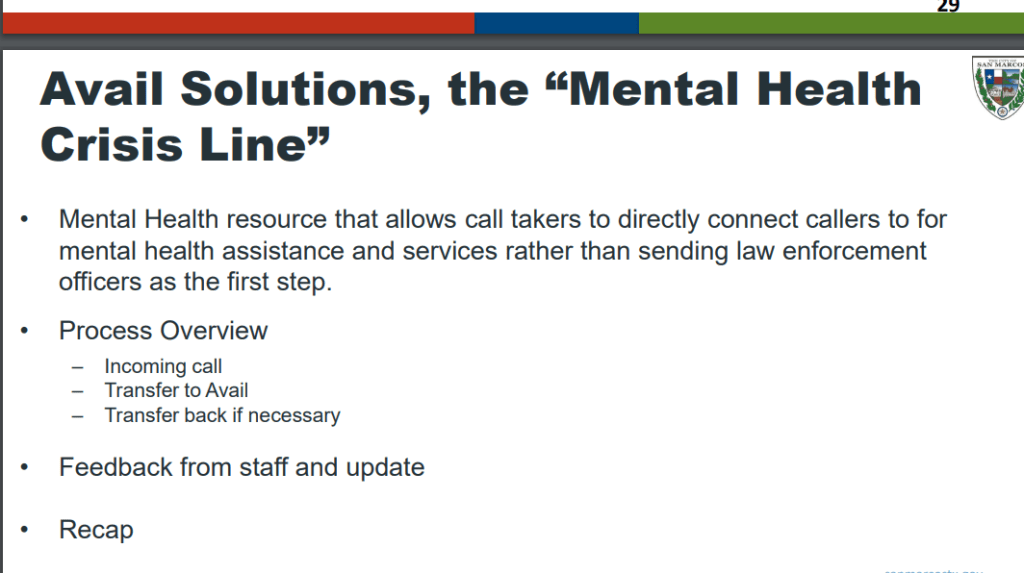
We’re also trying a new program:

This is a program where they transfer mental health calls out to trained mental health providers, who will connect the person with local resources, or stay on the line and talk the person through whatever’s going on.

They can also transfer the call back to 911, if they think we need to send out an emergency response, after all. The responder then goes right out, because the call is already in the system.

They’ve been doing it since November. It turns out that most of the calls do come back to us, after all? And we end up sending someone out. It’s a work in progress!

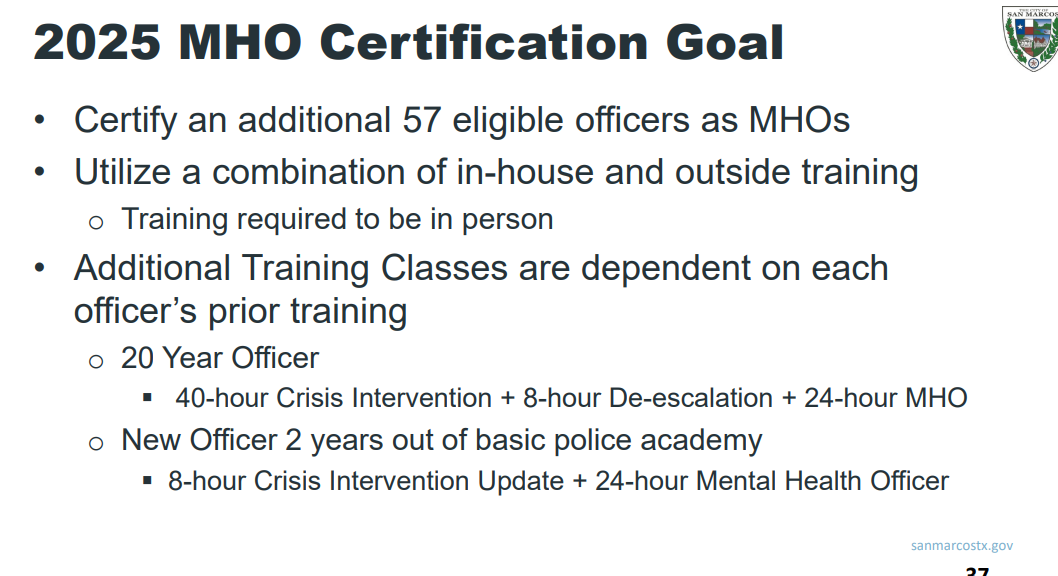
Next speaker! The SMPD Mental Health Unit.

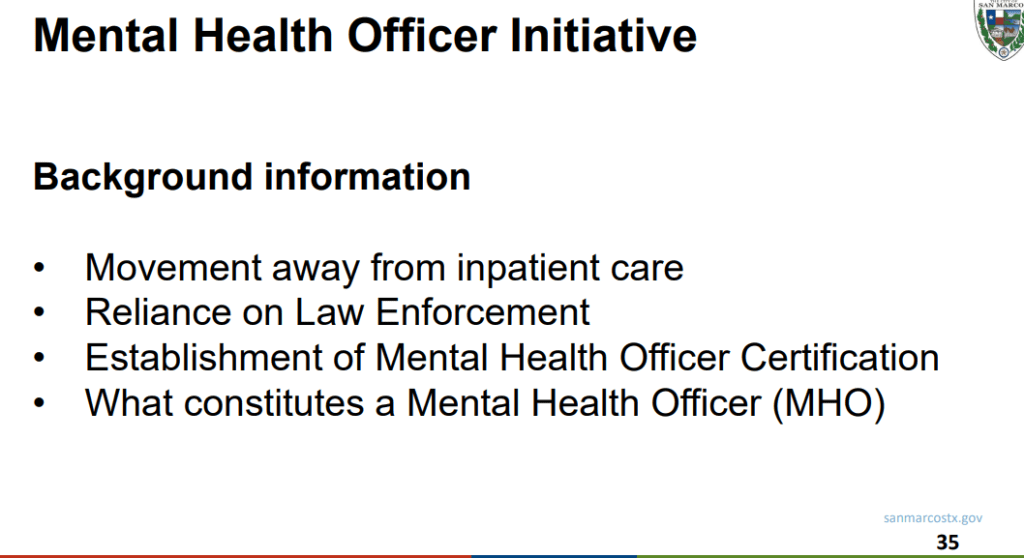
I don’t know what the training to be a Mental Health Officer really means. Is it a course? Is it multiple courses? Is it like a Master’s degree? Are you supervised by a mental health professional?

(I’m sure I could look it up, but I’m just trying to first get this whole entry out on time.)

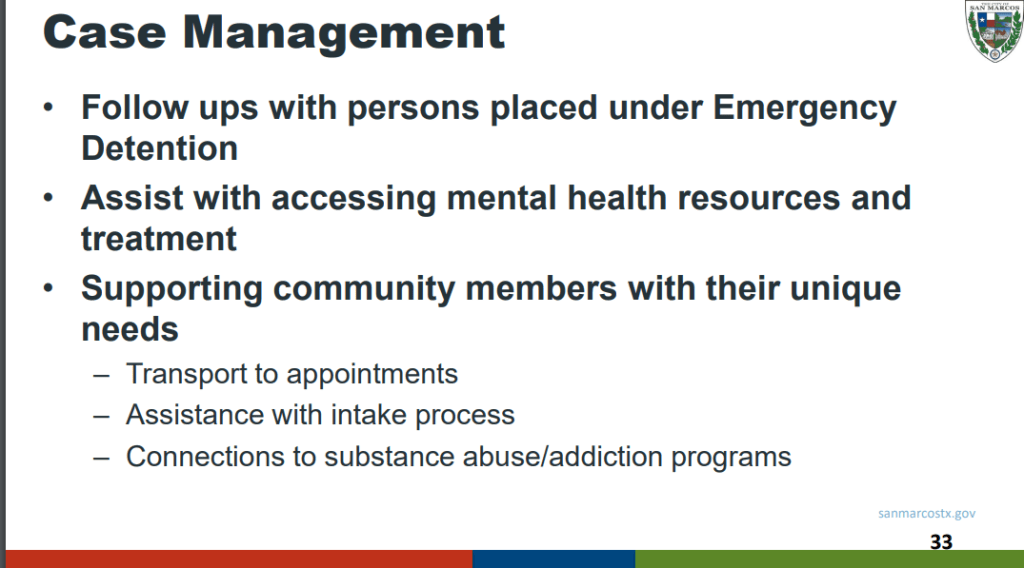
It sounds like they do good things: they sit with people who are scared and nervous before testifying or going to court. They get food boxes from Hays County Food Bank if someone needs it. They’re generally problem-solving and checking in on people’s well-being. They will sometimes stay with someone for months, making regular follow ups to help manage someone’s care.

Here, have some data:

An “emergency detainment” is if someone is an immediate danger to themselves of others. They try to avoid doing that, though. It may mean taking them to an ER or a substance abuse facility. (But not jail.)

Next speaker! What comes next with Mental Health Officers?

Here’s what the state is doing:

It used to be that officers had two options:

  • Take someone to an emergency room
  • Take someone to jail and go through courts.

Now we’ve got more options. The state created a big Mental Health Officer framework in 2015.

Here’s what we’ve got so far:

Here’s what we’re aiming for:

Next speaker! Context of Crime.

We report crime in two ways:

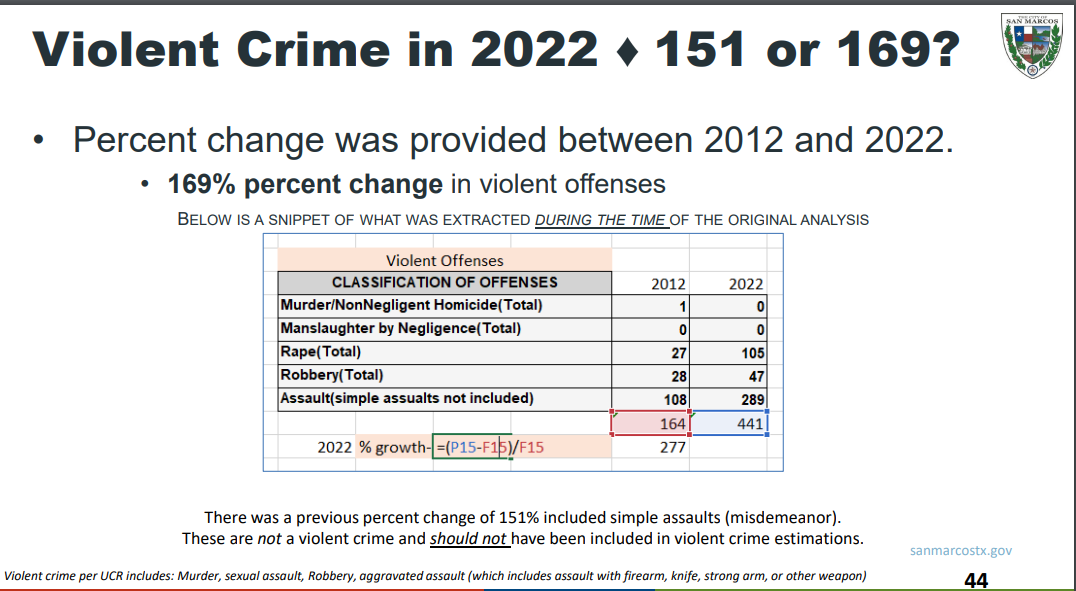
We are transitioned in 2018/2019 from UCR to NIBRS, which is better data. But any longterm comparison requires UCR data.

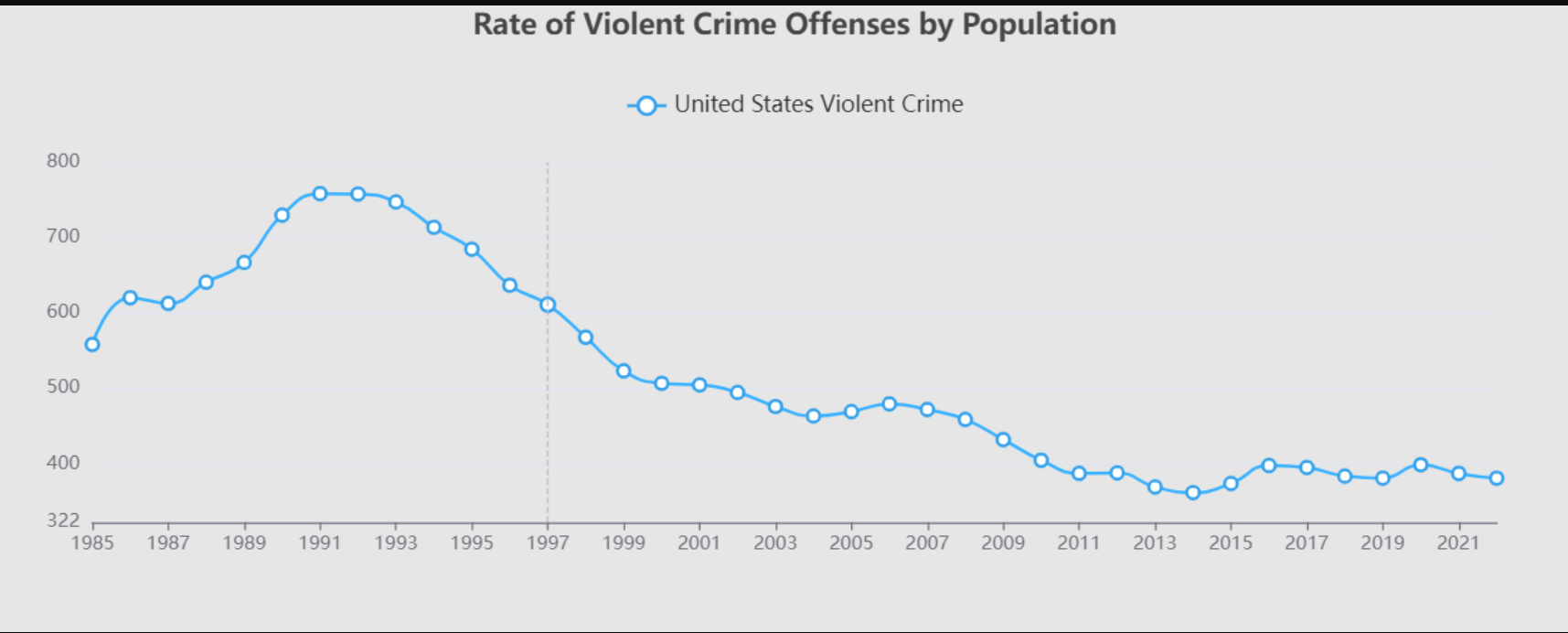
Longterm violent crime:

Short term crime rates:

Note from me: On the motor vehicle theft, this is happening everywhere:

But it’s always worth remembering that crime is way down, overall:

Back to the presentation.

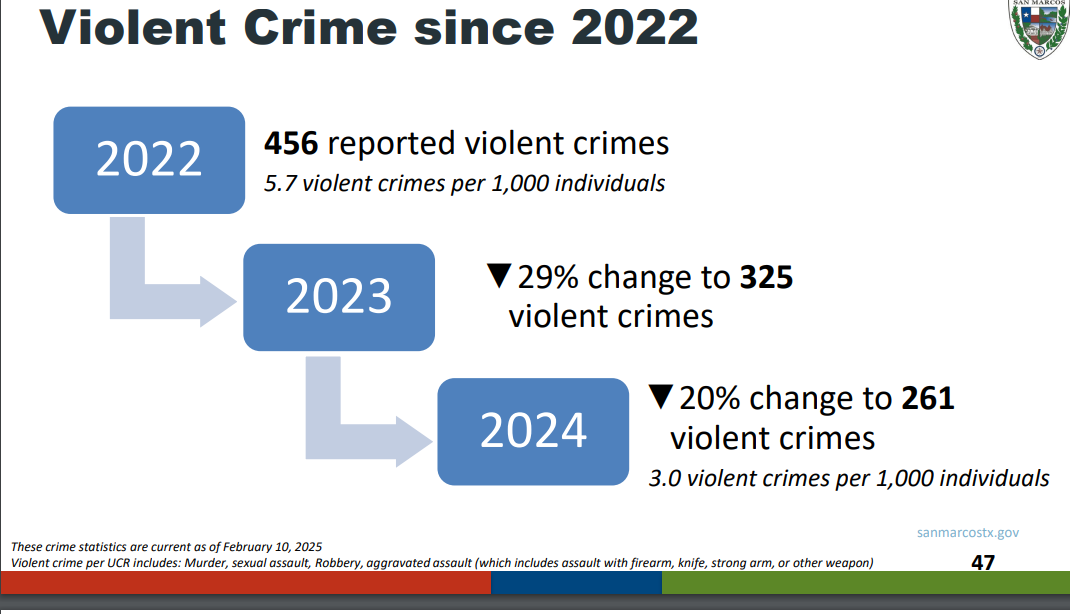
More crime trends:

and specifically violent crimes:

Saul asks a great question – does this include Texas State data?
Answer: No. They have their own police and their data is not included.

Again, this is mostly just following national trend lines, as the nation returns to baseline after Covid:

It’s still a good thing!

And it’s still way, way lower than 30 years ago:

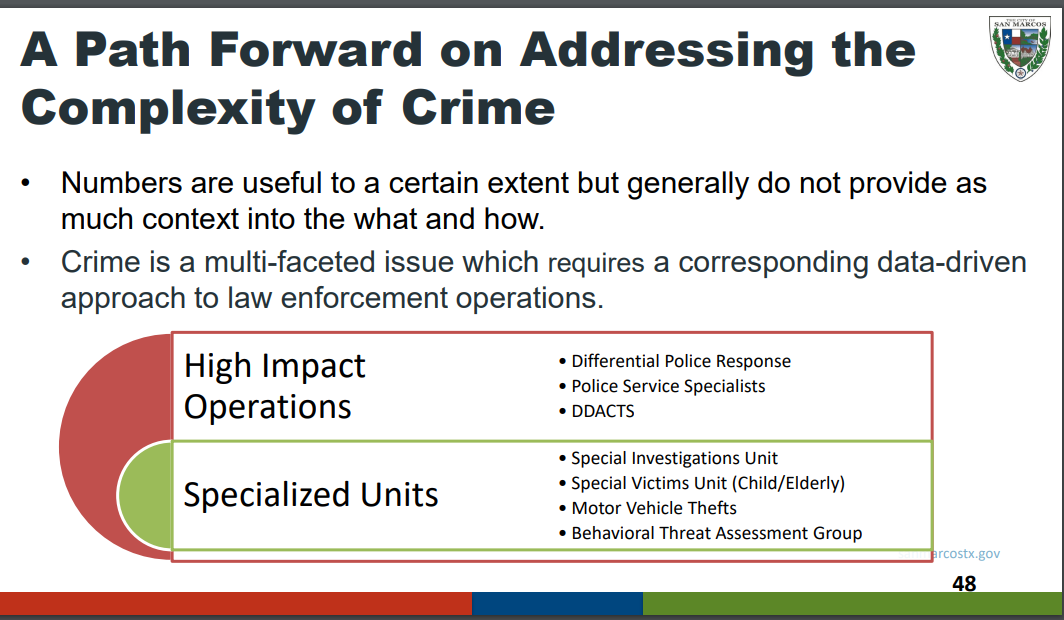
This recent data also corresponds time-wise with Chief Standridge arriving in 2021. So we are simultaneously implementing new strategies:

There’s a special victims unit:

They partner with Hays-Caldwell Women’s Shelter.

Next up is Chief Standridge! He is very apologetic.

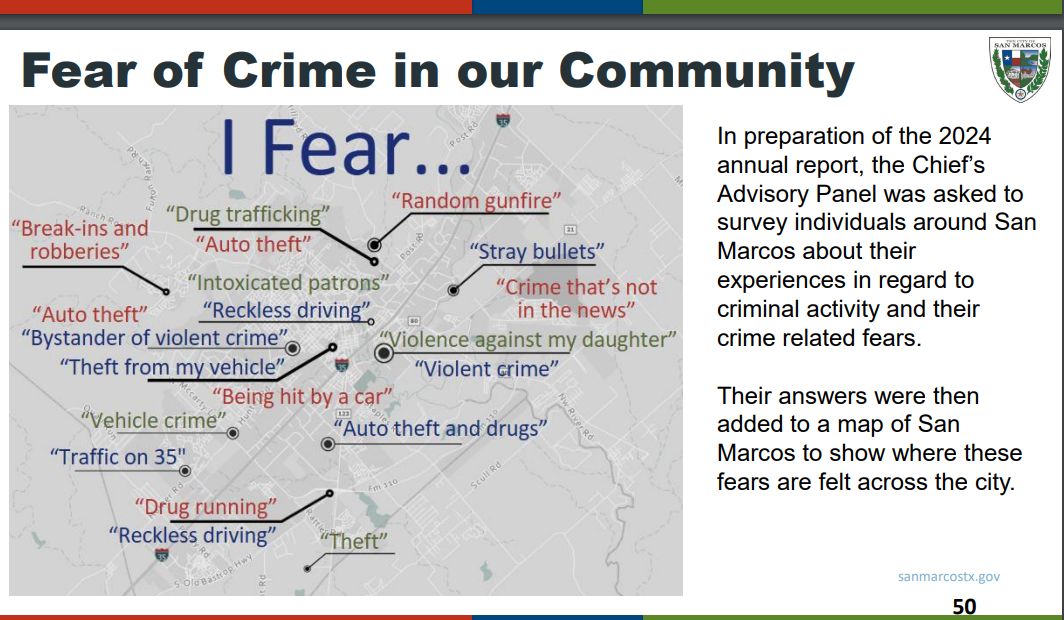
There is a specific Chief’s Advisory Panel. In order to get community feedback, they drew up some questions about the public’s crime-related fears.

The plan was for everyone on the panel to chat up their neighbor and get some informal feedback. Max Baker offered to digitize the survey and share it with the San Marcos Civics Club.

When staff got the responses, they threw out anything that didn’t seem relevant to the question at hand. Chief Standridge is extremely apologetic to this. He apologizes profusely and specifically to Max and the public.

Here are the remaining answers:

He promises to get the full data, including the extra answers, out as quickly as possible.

(My personal answer is car crashes on I-35. That terrifies me.)

By this point, it is 5:30, and the looming 6 pm meeting starts to take over the presentation.

Councilmembers have lots of questions, but there’s not really time for them.

Next presentation! School Resource Officers.

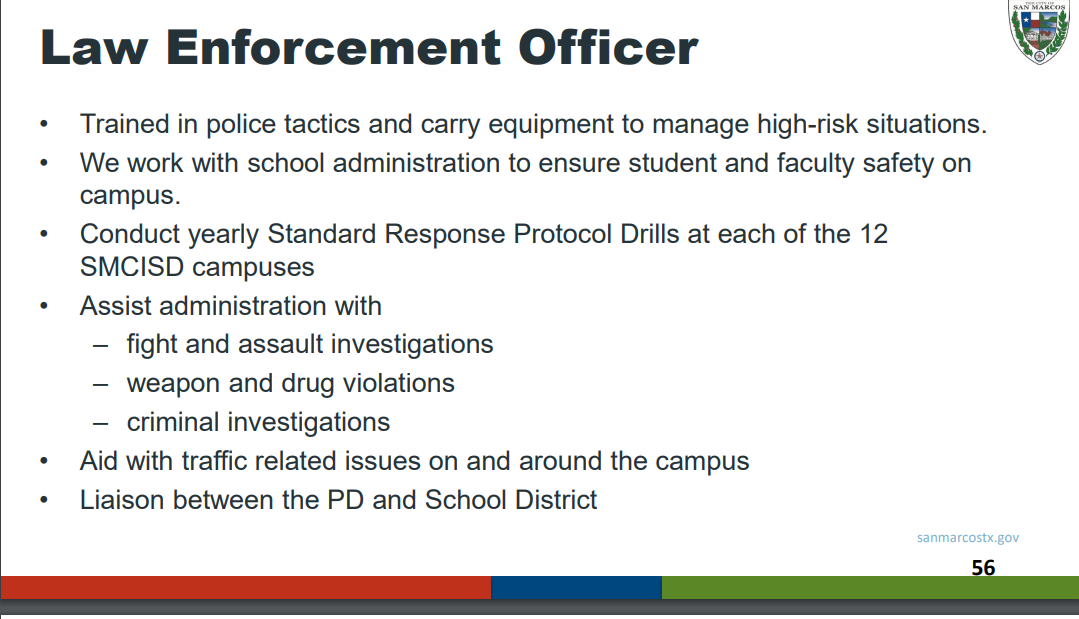
SROs are supposed to be three things: Counselor, educator, and law enforcement:

But not these things:

We have five total:

We’ve been doing this since Columbine, and most of the community is pretty happy with it:

Back to Chief Standridge:

He sums up with this program for the next year:

At this point, they are almost out of time. There are slides on the Marijuana Decriminalization Dashboard, but he doesn’t get to them. But it’s all publicly available here.

The full slide show is also available here.

There’s a very quick Q&A, but it’s rushed and haphazard. Hopefully there will be a real Q&A scheduled in the future.

Holy moly, that was long.

February 18th City Council Meeting

This is a big week! Malachi Williams, that weird Data Center thing you’ve heard about, and Council outlines their hopes and dreams for the next year. Like, how about a Crime Prevention office that is outside of SMPD and the incarceration system? And lots more! It’s very exciting.

Let’s do this!

Hours 0:00 – 2:03:  Citizen comments on Malachi Williams, lots of details on the new Data Center proposal, and a little on Council compensation and travel budgets.

Hours 2:03 – 2:33: Council gets to outline the coming year’s priorities, and they’re dreaming big: A tenant’s bill of rights! A non-police office of crime prevention!  And so much more. 

Bonus! 3 pm Workshops:  Fixing the city utility assistance program, and the last little bit of Covid money.

That’s all I got! Enjoy.

Hours 0:00 – 2:03, 2/18/25

Citizen Comment

Two topics today:

  1. Nine people spoke about Malachi Williams. 
  2. Three people talked about the Data Center that might come to town.

I’ll save the Data Center comments for when we get to that item, and just focus on the Malachi Williams speakers here.

Backstory: Malachi Williams was a 22 year old who was killed by an SMPD officer last April. It was reported that he was carrying knives. Two officers started to detain him at the convenience store on Cheatham and Hopkins. (He was not holding the knives at that point.) He took off running. They chased him over to HEB, and then shot and killed him in pursuit.

Since last April, a number of activists and family members have been pursuing justice for Malachi, and fighting for a fair process for the family and some kind of consequence for the cops.

Last August, a grand jury decided not to press charges against the officer. That basically brings us up to the present day.

Why now?  There was an event recently hosted by Malachi’s family. From what I gather, attendees were able to view some bystander footage for the first time. 

The focus today is on inconsistencies between what Chief Standridge and SMPD have claimed, and what actually happened last April.  

The biggest problem:

Chief Standridge has been asserting that a fire marshall was there and able to administer first aid in under a minute. Officers are trained in first aid, but they didn’t need to jump in, because the fire marshal is a certified paramedic.

The speakers say that is definitely not what the videos show.

Here’s what the speakers describe: Malachi doesn’t get first aid for about three minutes. During that time, SMPD got mad at him for not putting his hands behind his back. They rolled him around, so they could handcuff him. They checked his pockets. In fact, when first responders did arrive, they had to ask the cops to take the handcuffs off the guy they’d shot, who was bleeding out.

Malachi’s grandfather  

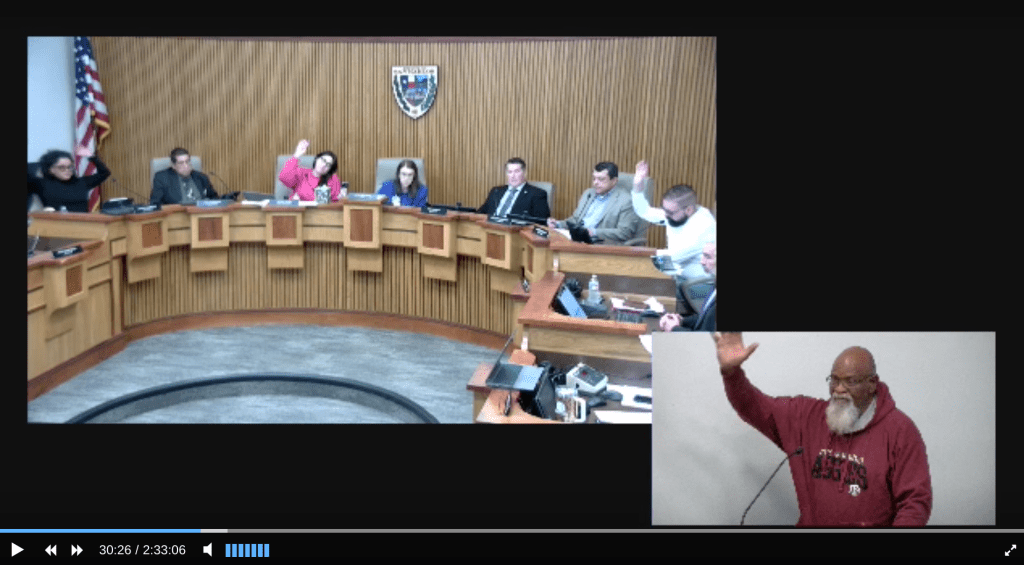
I’ve mentioned before what a compelling speaker he is. In his measured way, he asks council, “Think. If what we’re hearing today is true, are you disgusted? Can I get a show of hands, please?” – and he puts his own hand up – “If we’re telling the truth, if we’re telling the truth, are you disgusted?”

Here’s who raises their hands:

That would be Amanda Rodriguez on the left, with both hands up, Alyssa Garza in pink, and Lorenzo Gonzalez on the right. (I will say that so far, Lorenzo Gonzalez is proving to be a good council member.  I don’t have any complaints.)

Jane, Saul, Matthew, and Shane refuse to go along with the requested show of sympathy. (Is it performative? Sure, but I also think they genuinely just might not care.)

….

Now for an abrupt change in tone:

5.  Fireworks!  We put on a fireworks show every 4th of July.  

The amount we spend fluctuates from year to year:

This is because some years we get donations, and other years we don’t:

For the record, it’s always a 20 minute show.  As they put it, “The more donations we get, the bigger the booms.” 

Jane Hughson wants to know why we have to keep making the shows bigger.  If donations come in, can’t it just free up some city money that we could send over to the parks department?

Answer: People complain when it’s big one year and smaller the next.

Me personally: I’m with Jane here. I’m having a hard time caring about the size of the fireworks.  I’d rather use the donations for fireworks, and free up some money for the parks department.

But then again, I’m a grouchy old tree stump. If other people care, who am I to harsh their mellow?

Item 10:  Data Centers!

You may have seen this KXAN article, “A new AI data center is coming to San Marcos“?

This isn’t that.  In fact, there’s a lot of confusion about what that article exactly is about! We’ll try to unpack it all here.

So if this isn’t that, what is this?

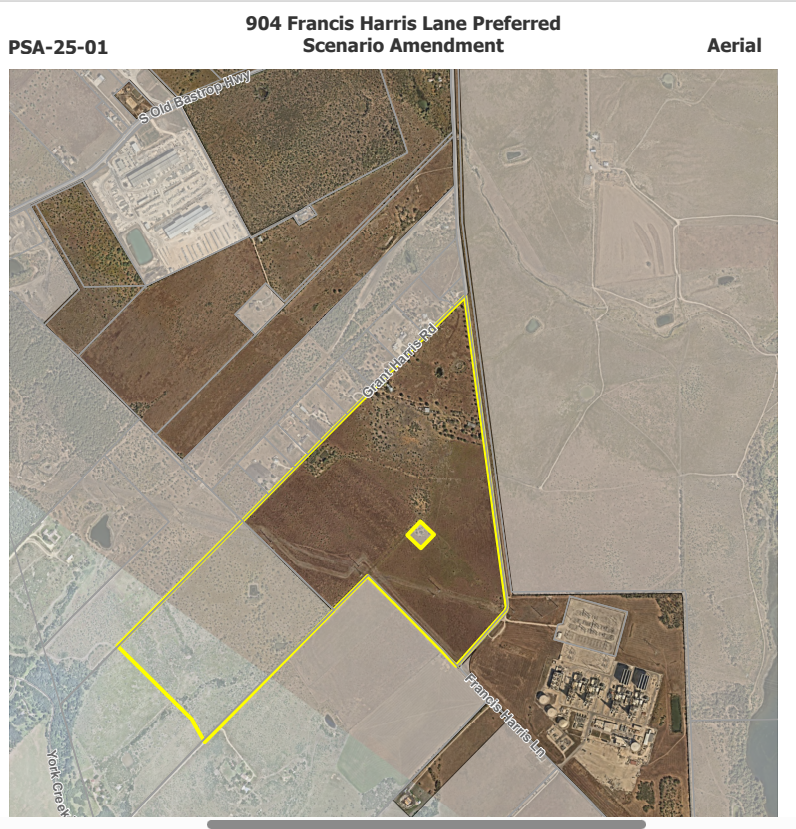
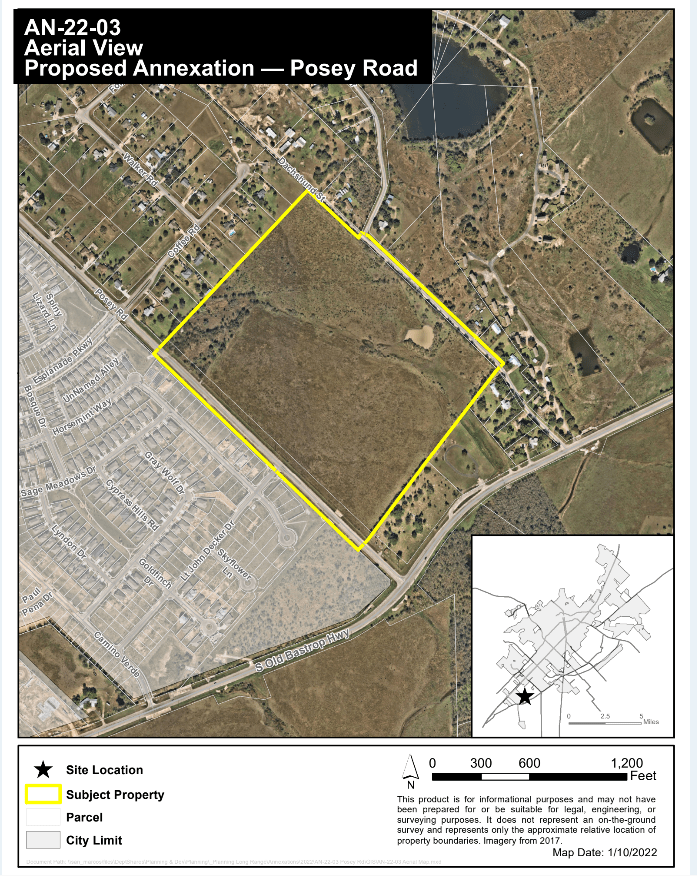
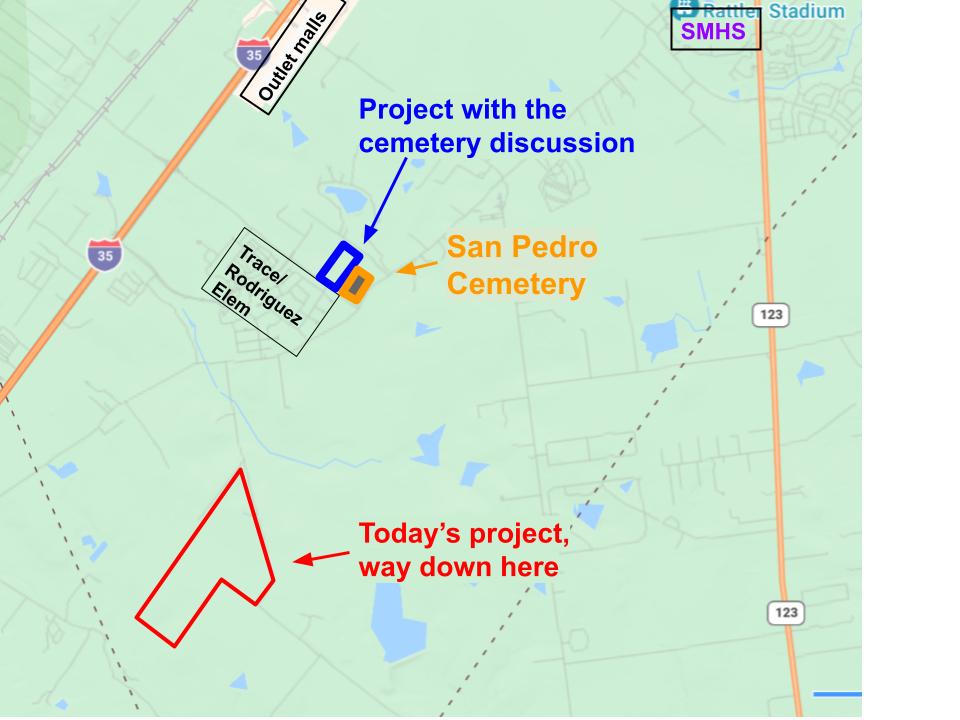
First off, it’s way down here:

(We’ve actually seen this property before, back in August 2nd, 2022.  They wanted to put houses out there.  I thought it sounded like a super terrible idea!)

Here’s a close-up of that property:

See that funny little yellow square?  That’s an old cemetery.  Access to the cemetery will be preserved.

Listen: I have some extremely boring confusion regarding this cemetery. I’m sticking it at the end of this page, because it’s truly too weedy to bore you with. This way you can opt out from the dumbest of my dumb shit.

What’s a data center? 

Basically a giant computer that takes up an entire building, where AI can perform its massive amount of computations.  So there are very few people working here, besides security and some technicians to monitor it.

What are the pros and cons?

The pros:

  • This is in the middle of nowhere, next to a giant power station.
  • The city is not going to have to spend much on infrastructure or maintenance.
  • The city should see some revenue from property taxes.

The cons:

  • Data centers take a massive amount of water.
  • Data centers use a massive amount of electricity.

This particular project would not be on city water or electric. They’d use Crystal Clear Water and Pedernales Electric for power.  (They’d be on San Marcos wastewater, though.)

Here’s the thing:  Crystal Clear Water draws from ARWA, just like we do.  It might not be city water, but it’s the same underlying water table, either way.

Can this be done responsibly?  Maybe!

Water is the biggest problem. The water is needed to cool the data center, because computers generate a lot of heat, which would then make them overheat and shut down otherwise.

The land-owner says that this will be a closed-loop water cooling system, which means less will be lost to evaporation. Matthew Mendoza says Google developed this technology 8 years ago. (I don’t know if this is the same as this technology, which only rolled out last year, but maybe.)

It’s great to implement the latest water-saving technology! But if quantities are still way too big, it doesn’t help you much.

Bottom line:  We can’t make an informed decision unless we have a concrete gallon amount of potable water usage.    

How much water does a data center use? This says an average estimate is 550K gallons per day for a hyperscale data center. (I’m pretty sure AI means a hyperscale data center). This closed-loop Microsoft system coming next year is claiming to only use 99.5K gallons per day. So we’ll probably be somewhere between those two estimates.

How much water do we have? According to the presentation in January, our current capacity is 4.8 million gallons per day.

NOTE: They would be using 550K gallons of Crystal Clear Water, not San Marcos water! But I couldn’t find a total capacity for CCW, so I just used San Marcos as a reference point. Both draw on the same underlying water table, so it’s best to still think about water conservation.

Can data centers use reclaimed water?  Maybe!

This link says yes, they can, but if the water quality is bad enough, it causes corrosion and microbial growth and other problems.

We do actually have a reclaimed water line that goes very close to there.  What’s the quality of the reclaimed water in that pipe? Could they use it?

I think this is the most essential question to answer.

Energy usage:  Honestly, this is probably less of a concern than the water.  Texas may have a shitty grid system, but we have a fairly healthy renewable energy supply, mostly because of all those windfarms out west.  This is a great state for both wind and solar energy, if we’d only stop electing such counterproductive leaders.

On energy, there is something called ASHRAE guidelines for data centers:

So maybe we could ask them to achieve that.

Do we have any leverage? 

Sort of! This is a tricky thing to answer.

First, they’re not asking for tax cuts. If they were, we could come back with all kinds of environmental restrictions. But they aren’t.

Second, they’re asking for a Preferred Scenario Amendment and a rezoning. There are rules around how cities make these decisions. You’re not allowed to base it on one specific project. You have to approve or deny based on all the allowed uses, and whether you like the location or not. And specifically, you can’t attach any requirements to these.

You might be able to require a Planned Development District, but I don’t know if water usage is an allowable reason to trigger one.

My opinion: If we can get them to agree to reclaimed water, then we should do this. Otherwise they’ll find another location that still uses the same water source, but isn’t within San Marcos jurisdiction.

I think many data centers will get built in Central Texas, no matter what.  I would like them to be as tightly regulated as possible. 

Note to Council: An ordinance requiring future data centers to be on reclaimed water might be handy to have!

What do citizen comments say?

Let’s go back to the beginning of the meeting. During citizen comment, one speaker had a list of extremely great questions:

  • What is the current noise ordinance for Light Industrial, within the city of San Marcos?
  • Will Dark Sky Lighting be considered for all outdoor buildings?
  • What will the setbacks be for both Francis Harris Road and the private Grant Harris Road?
  • Do we have a general idea of the size of the buildings?
  • What will be the estimated daily water usage?
  • Will it be public drinking water?
  • Will any measures be taken to lessen the impact of the large amount of impervious cover?
  • Cloudburst has stated on their website that this site will be part of their flagship data center in central Texas, and plans to aggressively grow its data center network. With a large amount of open farmland around the proposed site, should we expect further development from this company?
  • Since Cloudburst has already signed a longterm contract with Energy Transfer, the power plant already located on Francis Harris Lane, and KXAN reported on February 13th an AI data center is coming to San Marcos, should we assume decisions to change zoning and city limit boundaries are already confirmed?
  • Will Cloudburst be responsible for answering any of these questions or have to provide plans for the development, prior to the zoning change and incorporation into the city?

The very next speaker happened to be the land owner. His major points:

  • I’m working with the Data Center company to answer those questions above. The previous speaker submitted the questions to us in writing, after the P&Z meeting.
  • We have confirmed that the Data Center uses a closed loop water system. We are still working to quantify the amount of water lost to evaporation.
  • Hey look, we’re not going to put much wear and tear on the roads, at least!
  • And the biggie: We have no affiliation with Cloudburst or Energy Transfer. That is not us. The first time I ever heard of them is when that KXAN article came out.

What does Council say?

What the hell is going on with the KXAN article about Cloudburst?!

No one knows.  The owner swears up and down that he’s never heard of Cloudburst until that article came out, and has no idea what’s going on.

Amanda Rodriguez has headed over to the Cloudburst website, and they have the same exact timeline posted as this project:

Are there two projects? 

City staff says that it’s extremely unlikely a project of this size would operate on stealth-mode like this.  Companies tend to reach out to either the city for permits, or to the Economic Development Partnership to find out more about working in the area, or whatever.

The city manager Stephanie Reyes does also say that the city has gotten approached by multiple companies about data centers.  But no one else has an active application in progress.

Basically: no one knows what’s up with Cloud Center and they’re going to follow up.

….

What next?  Tonight was just informational. This is going to drag out all the way to April:

So there was no vote today. Stay tuned.

Item 11: Council members don’t get paid much.

Shane Scott wants to double the travel budget and increase the stipend that council members get.

First off: yes, we should pay our council more.  If you don’t pay your council enough, then you only get council members who are either independently wealthy, or who are willing to live in poverty in order to serve in council.  That’s not a recipe for healthy representation. 

Second: yes, we should increase their travel budget.  Inflation has made expenses go up.  We want council members to attend conferences and gain expertise, and make connections.  That’s how you get stronger representation. 

However, this is Shane Scott’s proposal, so it comes with a whiff of ridiculousness. 

Like at 1:18:30:

Shane: “At these conferences that I go to, I even get AWARDS for doing all the classes and stuff.”

Alyssa in the background: “he does, it’s so good.”

Jane: “I don’t really care about the awards. What value have you brought back to this council?”

Shane: “If I were to pass all the writing and stuff that I’ve learned before, I’d have a whoooole book of stuff that I’ve provided to council about doing stuff.”

I am dying to know more about these awards he’s winning for participation.

That’s my blogger dream, that Shane has a whole trophy case of these things.

Back to the proposal

The total increase of his proposal is $90K.

One ridiculous thing he’s doing is saying that he wants to increase amounts halfway through this year, instead of just waiting and budgeting the increases into next year’s budget.  So city staff had to scramble to figure out where to cut $45K from, in case Council approves Shane’s proposal.  

The city manager was not enthusiastic at all about this, back in December, but she managed to find $45K by raiding two budgets, one called “Council- related” and the other is a Contingency fund, for when projects go over their budget.

Here’s how much more money Council members would get, under this proposal:

“Expenses Elected” means your travel budget. This is anything where you have to provide receipts for what you did. So Shane wants to double everyone’s travel budget.

“Compensation” isn’t changing, but “Additional Expenses” is being doubled. “Additional Expenses” is basically extra compensation.  Councilmembers take it as a monthly lump sum for expenses where they don’t have to provide receipts. 

Why not combine “Compensation” and “Additional Expenses”?  Just call it all compensation? 

There’s actually a good reason: you can’t collect two paychecks from the government.  So if you work for the university, or the county, or the state, you can’t collect “Compensation”.  You can still collect “Additional Expenses” though – this is what Jude Prather did, since he works for the county.

Amanda is horrified to learn this – “You mean I could have kept my job?!  I took a huge paycut to accept this position.  I’m struggling.  I live with my mom, y’all.”  

I’m kind of infuriated on her behalf:  there was a better path available and she wasn’t informed?? 

Other council comments:

Alyssa:  Our community members treat us as though we’re fulltime and have staff.  Other cities pay their councilmembers to be fulltime, with staff, and they also slice their cities into districts so that you’re not answering to as many people.

Jane: Austin and Dallas pay their councilmembers fulltime and give them staff.  Not Kyle, Buda, or New Braunfels.  They pay zero.

Note: remember, paying $0 is strategic.  If you require someone to work for free, only wealthy people can do the work.  That’s not aspirational.

In the end, they move to postpone this.  Everyone’s going to come back with amendments and chop it up. 

Ok, back to the cemetery: The owner of the larger land does not own the cemetery. By state law, he will preserve access to that cemetery. At P&Z, Michele Burleson said she appreciates that – she was just there last weekend.

The owner also says, “Last time, there was some concern about the placement of the fence along the cemetery. So we did a fancy x-ray type survey. No folks beyond the perimeter of the cemetery!”

That’s reassuring! Also I remember that exact conversation. It’s here. But that’s not the same property!!

Here’s the property from the cemetery conversation:

That’s a different cemetery altogether:

Everyone is remembering a conversation about the San Pedro Cemetery, not this one! So what cemetery is in the middle of this current patch of land? I think I found it, in this list of all the cemeteries in Hays County.

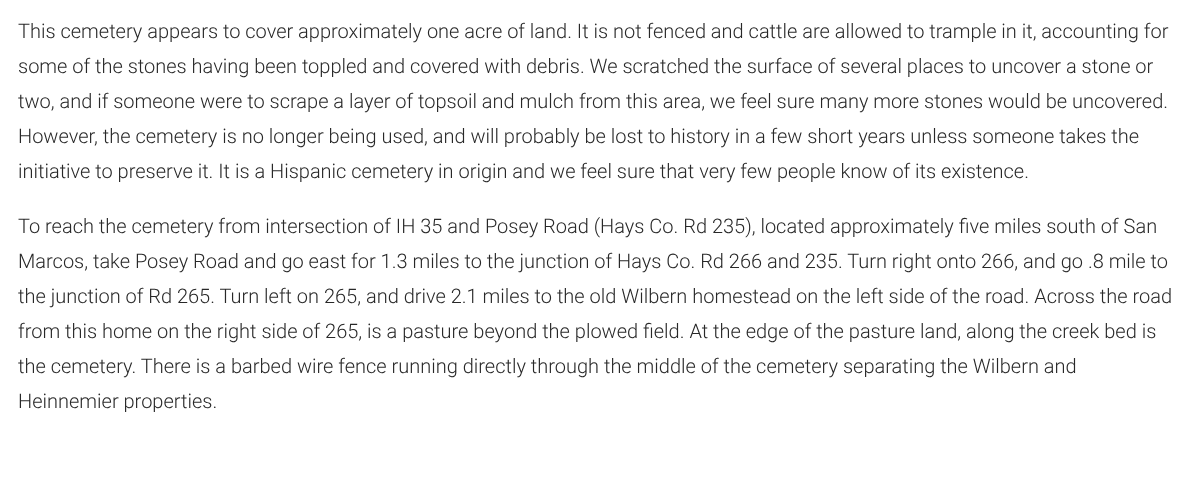
I think it must be the one called York Creek Cemetery. From that link:

Those directions put it squarely in the middle of today’s project, but they also don’t make it sound like a very active cemetery that people are visiting often.

[Updated to add: I’ve been corrected by a reader – thank you! – and the graveyard in the middle of this property is the Nichols-Berry Cemetery.

So that settles one question!]

(Which one did the land owner do the x-ray survey on? Is he confused about his own property? Or did he do surveys on both cemeteries? More unimportant questions I have lingering!)

Thank you all for accompanying me on this edition of Untangling Old Cemeteries of San Marcos.

Hours 2:03 – 2:33, 2/18/25

Item 14: the Strategic Plan

GUYS. Guys. This one is exciting. 

Background

The budget process for 2026 has already started. Back in January, Council had a two day Visioning workshop.  First they listen to about five hours of presentations.  Then they spend about five hours updating the Strategic Plan from last year.  

Usually it’s extremely dull, and filled with mundane wordsmithing.  But this year, it was exciting! Really!

Let’s dive in.

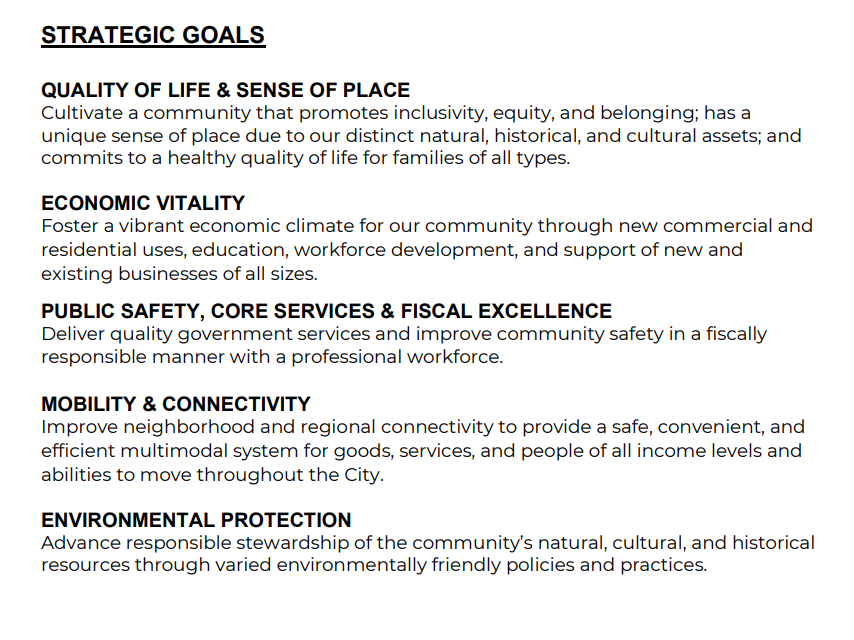
The Strategic Goals

Here are the five goals: 

Each one gets about 3-4 pages of outcomes. So we’ll take them one at a time.

Goal #1: Quality of Life & Sense of Place

    Here are the most exciting changes in this category:

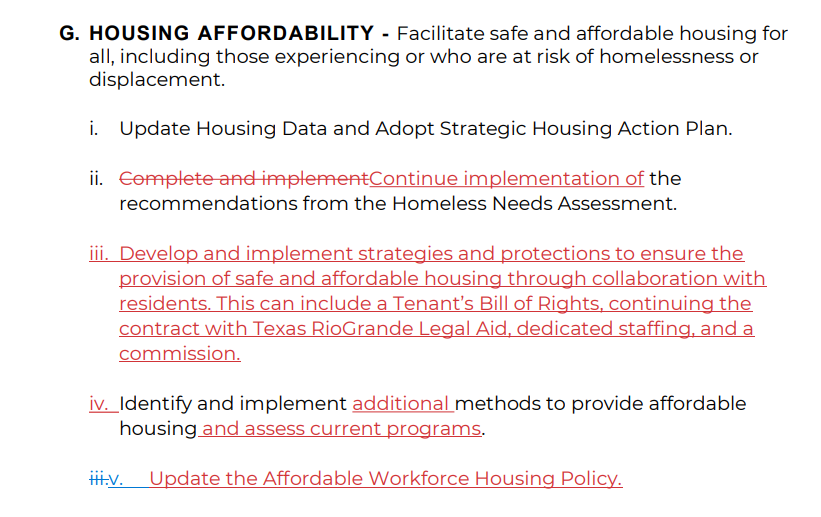
    Part iii: The Tenant’s Bill of Rights!  This is courtesy of the San Marcos Civics Club, who has been meeting monthly for the past year to focus on different issues.  This is great work by them. They are promoting the National Tenant’s Bill of Rights as a model for what Council should adopt.

    (I think this was Lorenzo’s contribution, but everyone was on board with it.)

    Also from that photo, note Part i, “Update housing Data and Adopt the Strategic Housing Action Plan”.

    Back in 2018-2019, we carried out a huge Housing Needs Assessment, and created a Strategic Housing Action Plan. And Council just deep-sixed it. Absolutely nothing came of it. For over five years!

    In 2023, City Staff held a workshop on it and said, “Hey, you should really be thinking about housing! It’s super unaffordable here!”

    Council:

    *Except Alyssa.

    It got put on last year’s Strategic Action Plan last year, and then ignored for all of 2024.

    Until election season came around! Then all the candidates realized that everyone is super broke in San Marcos and can’t afford housing. Every single candidate for every council seat said housing was our biggest issue.

    It seems like it really is going to happen this year, hopefully.

    ….

    Also from this same section:

    Alyssa has been promoting this for years, and Max promoted it back when he was on Council.  So this is great to officially get it in the strategic plan.

    From this link:

    So it’s about giving the community more input on what we prioritize in the budget.

    Goal #2: Economic Vitality:

    Prioritizing the needs and well-being of workers in our economic development?!? This is catnip to my marxist heart.

    (I think this came from Amanda.)

    Goal #3: Public Safety, Core Services, and Fiscal Excellence.

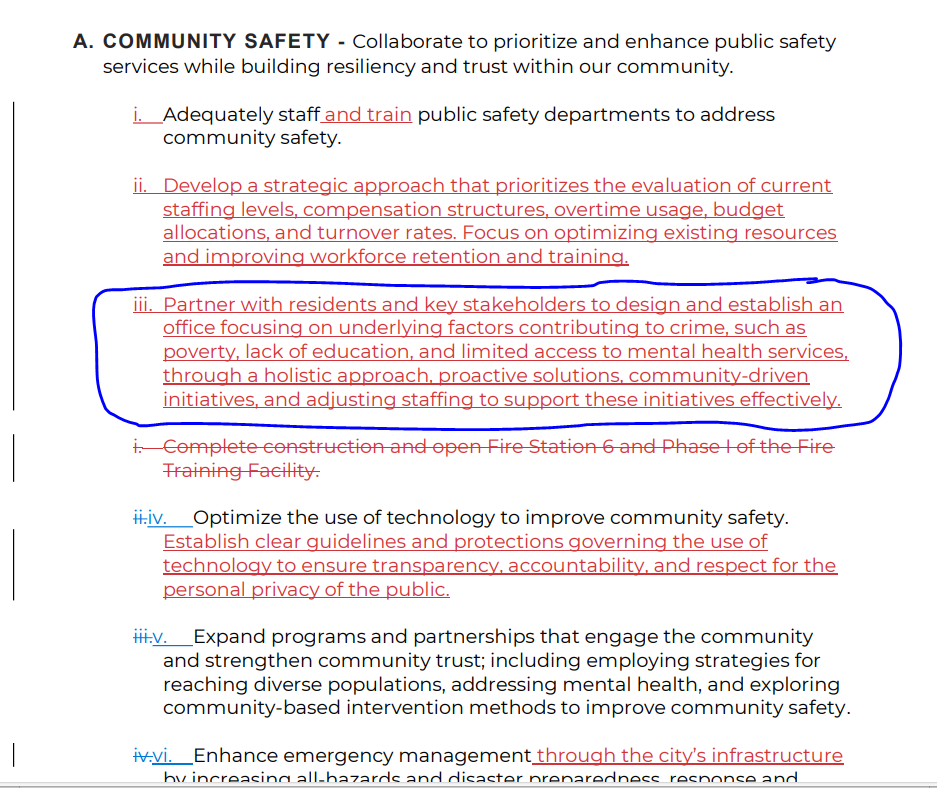
      GUYS. Guys.  Literally squirming in my seat over here, I’m so excited.  Look at this:

      That one in the middle is huge.  This will be an office that is aimed at crime prevention from a non-incarceration perspective.  Dallas has a version of this called the Office of Integrated Public Safety Solutions, and Austin has a version called the Office of Violence Prevention.

      Importantly, this will be housed outside of SMPD.   What are the actual, evidence-based strategies that reduce crime? Here’s a big list. Things like access to jobs that pay a living wage, access to mental health and addiction treatment services, programs for kids and teens, connecting people with opportunities, etc.  

      (You know what doesn’t reduce crime? Locking people up. And it’s super expensive!)

      This definitely came from Amanda.

      (To be fair, Alyssa has brought this up before, but the council then was not interested in giving her ideas any oxygen.)

      ….

      Also, on that same slide:

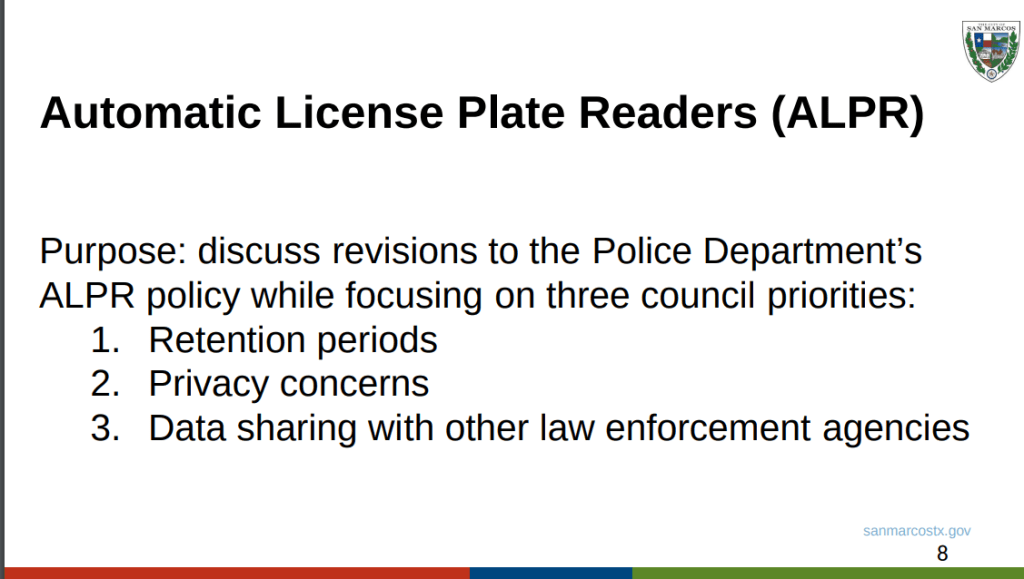
      Also amazing! This is exactly what we discussed last time, when Council voted to postpone the vote on SMPD license plate readers until we could clearly state how we plan on protecting the privacy of the public.

      (Also from Amanda.)

      And further down:

      Part B, iv:  Making all the websites easy to use. This is very hard to do well. But at least we’re trying to get better.

      Part C, iv. This is mostly about HSAB funding.  We outsource most of our social services to local nonprofits, and we should probably double the amount that we’re giving out in grants.

      (I can’t remember who contributed these. Everyone supports them.)

      Hey Council: The budget for HSAB should grow automatically with inflation! You should consider an ordinance to make this happen! Please and thank you.

      Goal #4: Mobility and Connectivity

      Okay, several thoughts on this:

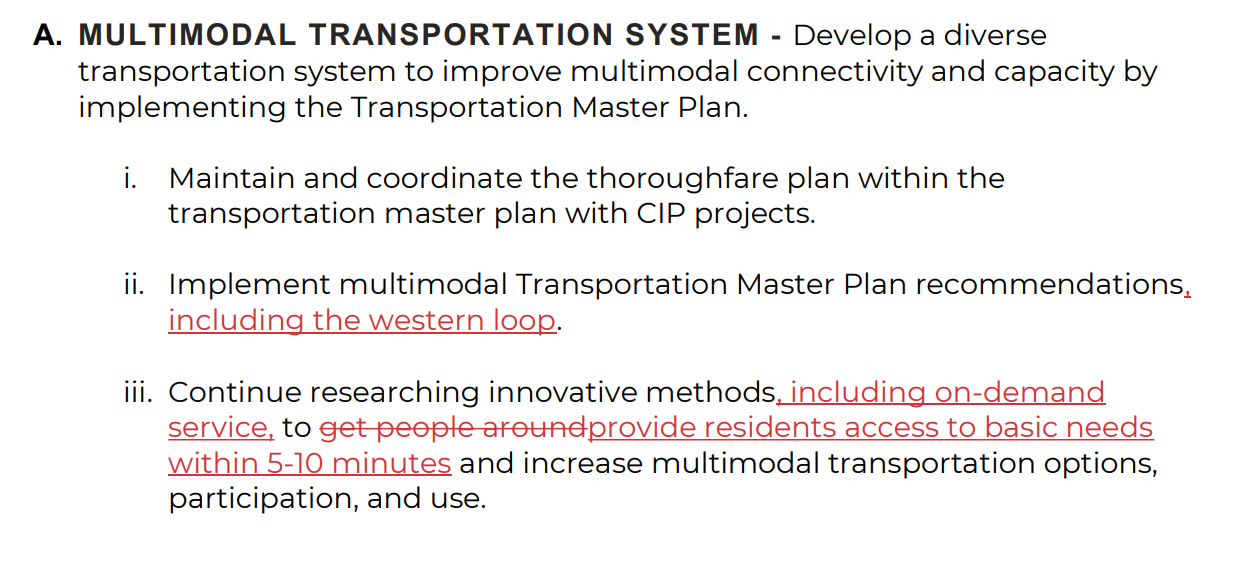
      Section A, ii:  What’s this Western Loop business?  

      Shane Scott wants to bring it back. This is an old topic.

      There is a lot of traffic going out west towards Wimberley on RR 12. Right now it all feeds straight through town, on Wonderworld, to get to I-35. Should there be a northern loop that goes around San Marcos?

      This was a big point of contention when the Transportation Master Plan was adopted in 2018. My memory is that the San Marcos River Foundation came out hard against it, because it will inevitably lead to development over the aquifer.  If you put a road somewhere, it drives development along that road.  If you drive development over the recharge zone, you’re going to get a filthy brown river eventually, instead of a sparkly clean river.  

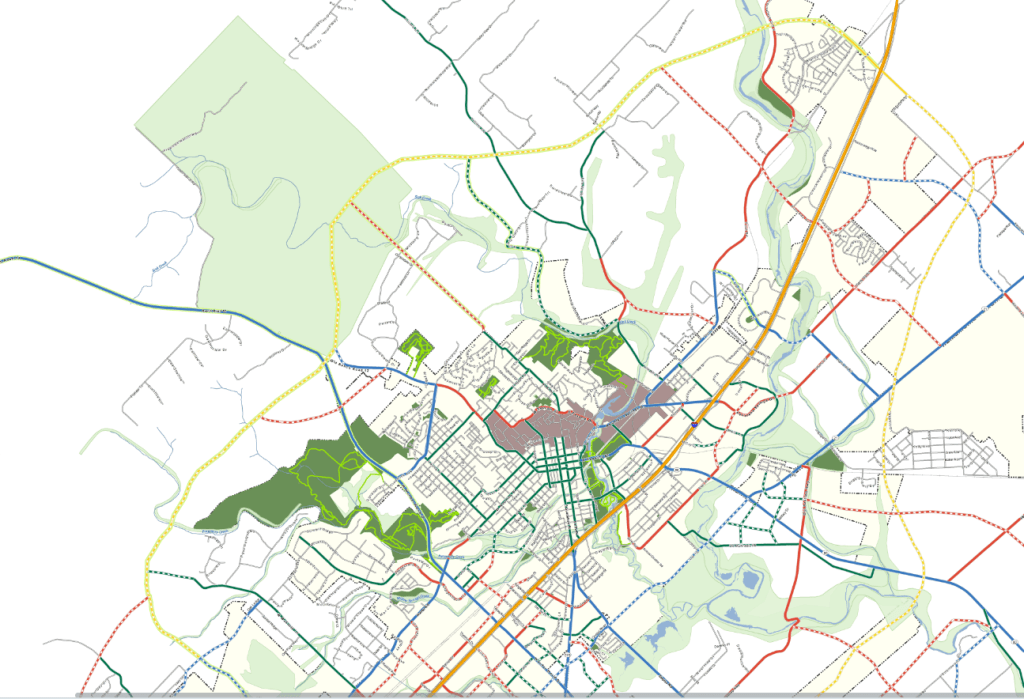
      I thought it got voted down. But you can see it here, on the thoroughfare plan:

      I believe it’s that yellow loop around town.

      Jane Hughson also seems to think it got nixed back then.

      Shane Scott wants to resurrect the issue, and he pictures it being an overhead highway, kind of like the Wonderworld overpass.

      I have a lot of questions!   

      • Do the environmentalists still approve of the deal cut on the wonderworld overpass? Or do they have reservations about reproducing another deal like that?
      • How much would it cost to make a zooming overhead line like that, on a much longer stretch?
      • Who stands to profit from this? What are the various interests?

      Anyway, the Transportation Master Plan is coming back around, so we’ll see this again.

      Section A, iii: Alyssa Garza is interested in on-demand services until we get a better bus system.  What’s this?

      So, Kyle has a 3.14 program. Any uber ride in the city costs $3.14, and the city pays for the rest. Is this something we should do, at least until we get a better bus system?

      I’m a little uneasy about a program like this! I found this, which seems sensible:

      So it’s more expensive, and we don’t want to sabotage progress on developing a functional bus system. At the same time, maybe we can use it for high-needs community members as a temporary stop-gap.

      ( Also, Uber is super-shitty on worker rights, and lobbies aggressively against laws providing benefits and minimum wage to workers in the gig economy, so I kinda hate them.)

      Goal #5: Environmental Protection

      Two additions:

      No issues with either of those!

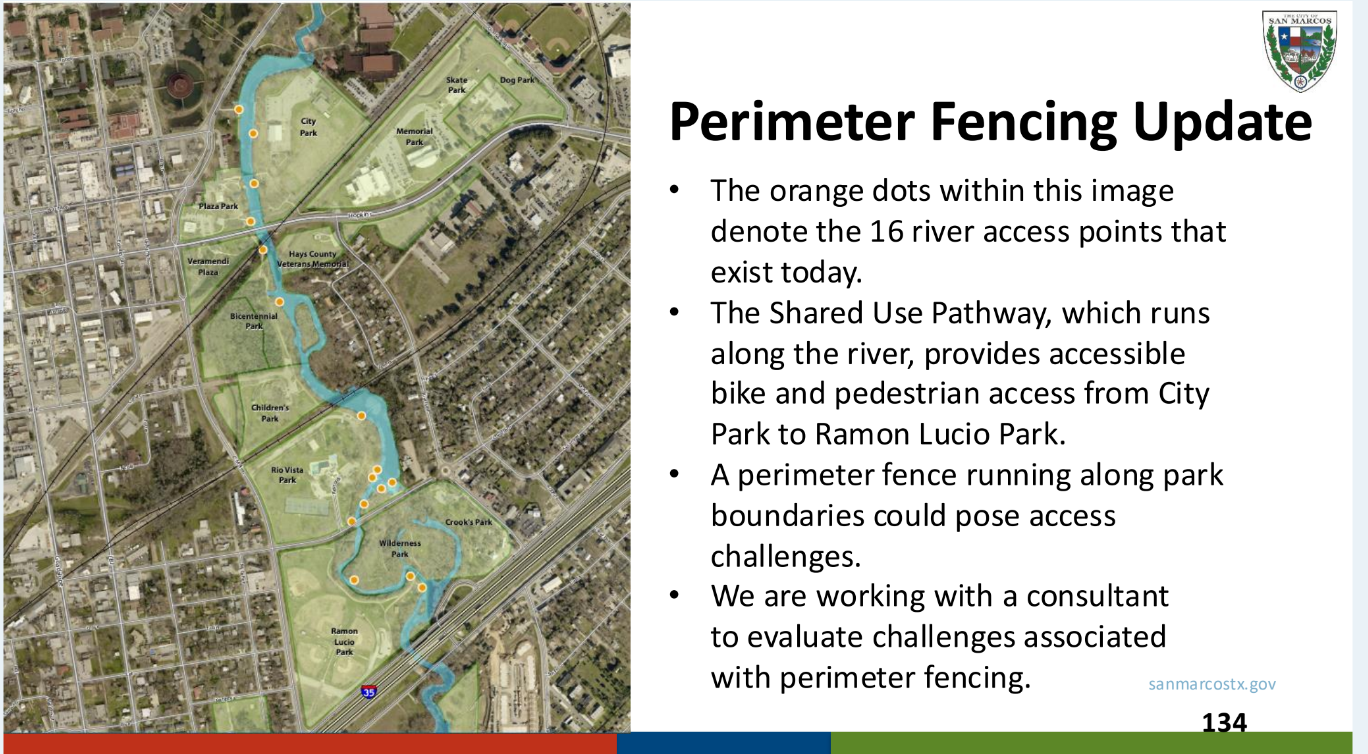
      There isn’t a bullet point about fencing off the rivers. But they did talk about it in the presentations:

      Basically we’ve hired someone to do a feasibility study on fencing the parks.  There’s no way it will be fenced off by this summer, though.

      Which brings us to last Tuesday!

      Amanda offers up one amendment:  Remember the Transportation Equity Cabinet presentation last time? Let’s include their recommendations into Transportation and Traffic Operations.

      Her amendment: “Implement Recommendations from the San Marcos Transportation Equity Cabinet.”

      Jane:  Weren’t we going to workshop the recommendations?  

      City Manager Stephanie Reyes diplomatically says that Council supported putting the suggestions in both the Transit and Transportation Master Plans.

      Jane: Without further inspection?

      Stephanie: Council seemed pretty amenable, yeah.

      Amanda: In fact, one of the questions I posed when it was under discussion was what the next steps were to be taken, if all of us agreed. We all said we agreed.

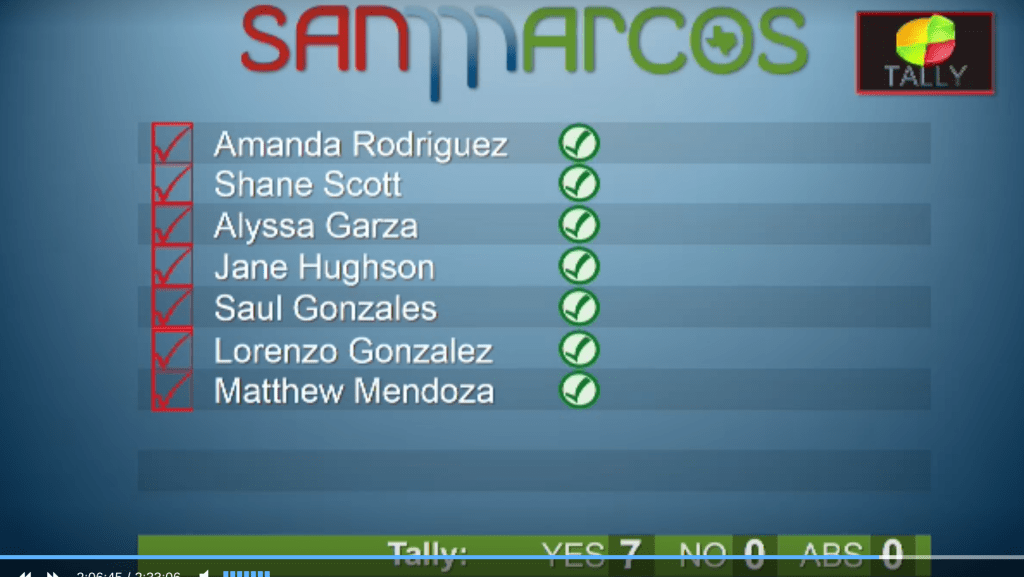
      The vote on Amanda’s amendment:

      Everyone likes it!

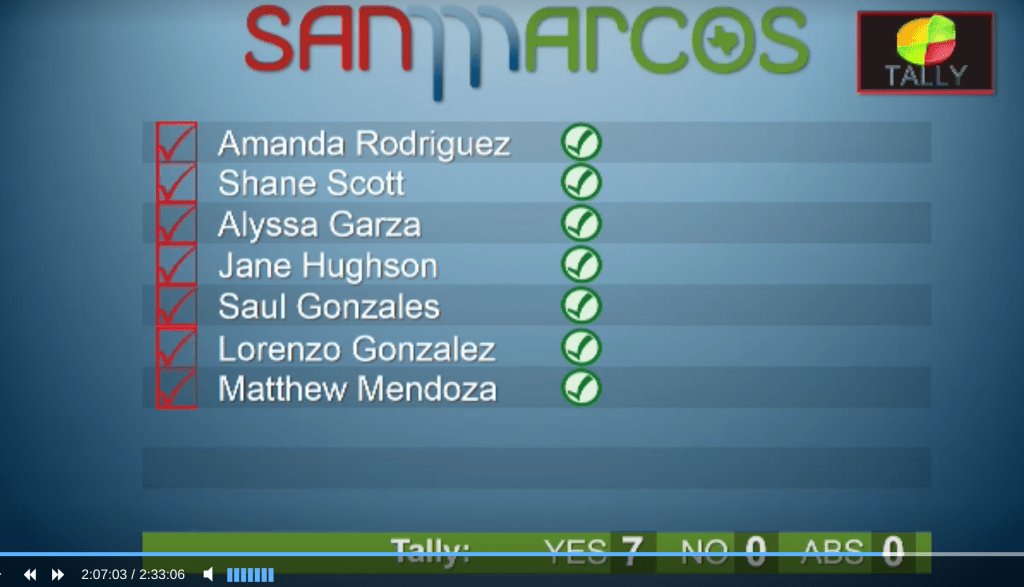
      Finally, the vote on the entire strategic plan:

      Everyone likes it. INCLUDING ME!!

      (Read the whole draft here, if you’re so inclined.)

      There are a few other items:

      • Council appointed a Comp Plan Oversight Committee
      • There’s a bond process for various construction projects around town
      • There are more committee and board appointments

      but this meeting is super long, and we still have the workshops to go. So I’m skipping these.

      Bonus! 3 pm workshops

      Workshop #1: Utility Payment Assistance

      Here’s the situation: We’ve got city-owned water, electric, and wastewater. (Most of the people here are on city utilities, although some people are on Pedernales or Bluebonnet electric.)

      When people can’t pay their utility bills, we offer them a two week delay. But we also give $120K to Community Action, to help pay people’s utility bills when they fall behind and can’t afford to catch up.

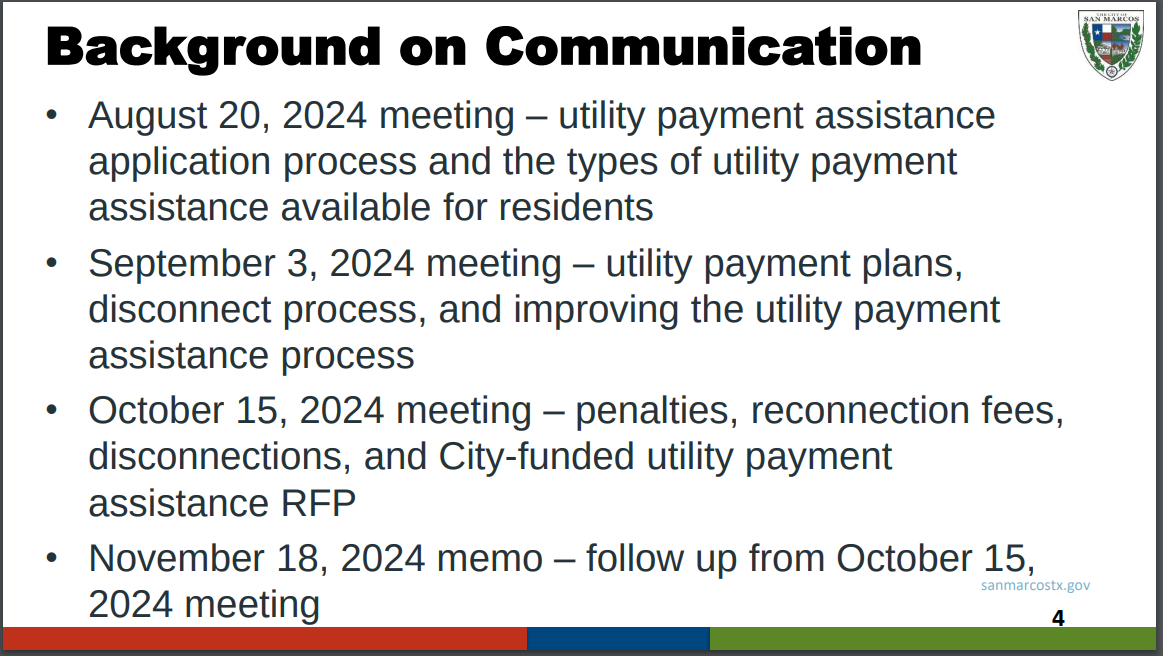
      This has been an ongoing topic of conversation:

      The problem is that most of the $120K we set aside for utility assistance isn’t getting used.  There’s a ton of need out there in the community, and we’re not getting the money to the people that need it.

      Why??

      Community Action gets money from us.  They also get grant money from the state and feds.  So they use that state and federal money first, and then only use the city money if that money’s not available.  That is good!

      The problem is that their application process is long and a giant pain in the butt, because they’re trying to give out federal money.  So people are being asked to provide all kinds of crazy paperwork documenting their employment or residence or whatever, and it takes weeks, and the person just needs their water turned back on so that they can cook dinner. This part is bad.

      So the city is working on how to get the funds out faster.  Would any other organizations like to also hand out utility assistance?  (RFP means “Request for proposals”)

      No one wanted to apply!  They kept advertising and reaching out and extending the deadline. 

      Eventually they got three more applicants. Here’s what’s being recommended:

      The “donated funds” bit means that San Marcos residents have an option to donate when they pay their bill. There’s about $45K in accumulated donations right now.

      (Community Action spoke up on Tuesday and said their capacity is actually $30K, so that extra $10K will get re-distributed.)

      Discussion points:

      Question: How long will the turnaround time be for people needing assistance?

      Answer: Different agencies have estimated 3-5 days. Some a little longer. We’ll nail it down for sure in the contract with each agency.

      City Manager Stephanie Reyes proposes having a universal application that all the agencies could use for city funds. Everyone likes that.

      There’s a lot of discussion about how customers can find out about utility assistance.

      • If your bill is overdue, you get an automatic robo-call on the 16th day.
      • On the 18th day, your bill is delinquent.
      • After that, the delinquency notice goes out.

      Right now, we don’t mention the utility assistance on the phone call or on the delinquency letter. The person has to call into the city first.

      Everyone wants to know, “Why don’t we tell people about the funds earlier?!”

      City Manager Stephanie Reyes says tactfully, “It hasn’t always been the philosophy of Council to make this information available at this stage.”

      What she means is this: Previous councils have been more obsessed with the random person who might cheat the system than they were with actually connecting people in need with assistance.

      This council – thank god – is more obsessed with connecting people to assistance. They want to have the utility assistance mentioned in the robo-call, and put in the delinquency letter.

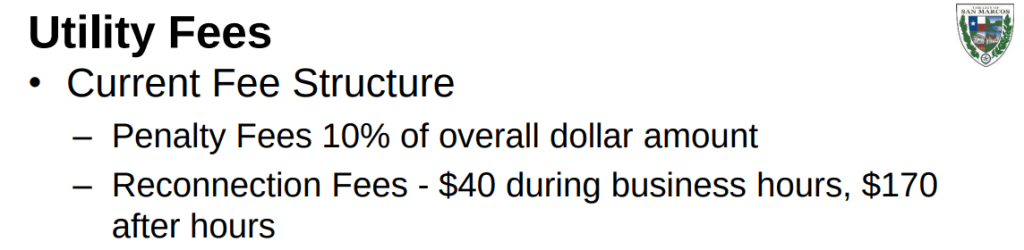
      Late Penalties and Reconnection Fees

      Suppose you can’t pay your utility bill. This would make it even harder:

      In other words, if you’re $140 behind on your utilities, it will cost almost $200 to get everything turned back on. This is pretty typical.

      Council looks at each of these individually.

      Penalty Fees: on average, people pay about $14 in penalties – a little higher for houses, a little lower for apartments.

      They debate capping it at different amounts – $10? $15? $20? – so that you’d pay either 10% or the cap, whichever is less. (This is Lorenzo’s suggestion.)

      (This is for residential, not commercial.)

      Reconnection Fees: This cost is based on a 2013 estimate of fuel plus labor to go to the house and turn it back on.

      Staff is planning on recalculating these fees and see if they can bring it down.

      Question: If we did away with all fees altogether, how much would rates go up?

      Answer: about 0.5 %. Now, we always have rate increases, because costs go up. But if you want to do away with fees, we’ll need to tack on 0.5% on top of that.

      Q: Can we change how many times they can get assistance per year?

      Answer: Right now it’s twice per year. It might be hard to track among different agencies.

      Most councilmembers want to change it to four.

      Bottom line: This will come up at a future council meeting, along with some of the answers to questions that Council asked tonight.

      Workshop #2

      Update on American Rescue Plan dollars:

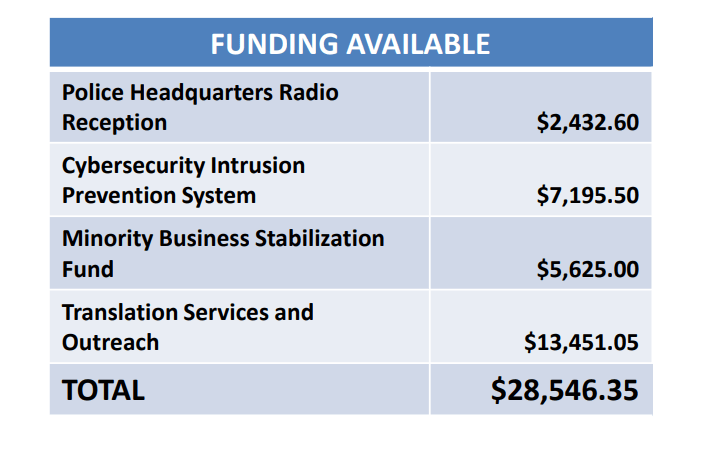
      A few programs have a little money leftover:

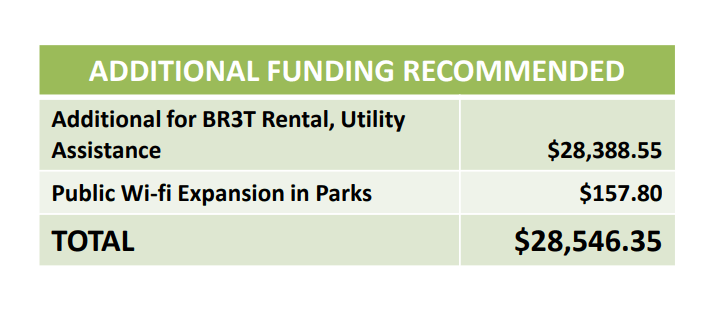
      Here’s where we want to re-allocate it:

      Alyssa fought long and hard for us to provide rental service, and to use an agency that doesn’t take weeks and weeks in turnaround time. (Same issue as with the utility assistance – federal money comes with a wild amount of paperwork.) It’s nice that this is now becoming the norm.

      Any further money that becomes available will also go to Rental Assistance.

      February 4th City Council Meeting

      Is the national news making you spiral into a dark place? Come read about City Council, where things are less grim and you can make a difference. This week we’re taking on civil liberties and police license plate scanners, and some housing on Post Road, and some appointments.

      Here we go!

      Hours 0:00 – 2:73:  Rezoning some land on Post Road,  SMPD license plate scanners, and just a few of the many, many appointments Council made.  

      Bonus! 3 pm workshops:  There was a transportation equity cabinet over the past eight months.  What does that even mean?

      Have a good week, and don’t let the bastards grind you down.

      Hours 0:00 – 2:73, 2/4/25

      Citizen Comment

      No one spoke this week.

      Moving on!

      Item 9: Rezoning some land.

      A developer wants to develop this stretch: 

      and turn it into townhomes.

      Up close, it looks like this:

      It includes the old Bismark filling station: 

      I went hunting for photos of the old Bismark Filling Station back in its heyday, but came up empty handed. I did find this deep dive on the history it, though.

      Q: Are there any concerns about flooding?

      Answer: It’s partially in the floodplain, and it is near the headwaters, which is very sensitive. But the land is actually angled so that the water runs away from the sensitive stuff.  The water runs away from other houses on Post Road, and towards the stadium.

      Q:  Are there any concerns about buried gas tanks?

      Answer: no, the station is too old. They checked the records. They didn’t bury tanks back then.

      Q:  Are you going to preserve the gas station?

      Answer: We are working with the Historical Preservation Committee on this! Hoping to save the facade and columns, and put it somewhere where it can be memorialized.

      Note: This is how you make best friends with Council. Who knows if it will actually happen or not, but Old San Marcos is happy to hear this guy say the right things.

      One other note:  

      The developer is asking for CD-4 zoning.  He’s saying he wants to build townhomes:

      Ok, maybe not quite that beautiful. But maybe like these, near Wonderworld:
      which are also pretty cute. (via)

      But CD-4 zoning can also mean large scale apartment complexes like so:

      When you zone land, you don’t get to pick and choose which use the developer ends up doing.   The developer can do anything included in the zoning.

      Now, this particular lot isn’t very big:

      So my guess is that he will probably build townhomes or condos.  But he is allowed to sell it to someone else, and that other person can do anything allowed under CD-4 zoning.

      The vote:

      Great! That’s how I would have voted, too.

      Item 6: License plate recognition cameras.

      Should the city spend $124K for SMPD to have cameras that read license plates for one year? 

      Maybe! We need to unpack some stuff first.

      Backstory:

      Budgets get approved in September.  But the planning starts nine months earlier.  So at the end of January, Council had a two day workshop where they started laying out big ideas.

      They go into great detail on the strategic goals:

      Under each goal, Council decides what they want to prioritize for the next year.

      On Day 2, they tackled Public Safety. Amanda proposed the following outcome:

      • Establish clear guidelines and protections governing the use of technology to ensure transparency, accountability, and respect for the personal privacy and civil rights of the public.

      (Around 3:05 if you want to watch.)

      Everyone was in favor of this! It sounds great!

      Next: let’s talk about license-plate cameras:

      So these cameras that SMPD wants to buy. They are Automatic License Plate Readers, and they read your license plate when you drive by.

      The ACLU does not like them one bit:

      A little-noticed surveillance technology designed to track the movements of every passing driver is fast proliferating on America’s streets. Automatic license plate readers—mounted on police cars or on objects like road signs and bridges—use small high-speed cameras to photograph thousands of plates per minute.

      The information captured by the readers—including the license plate number and the date, time, and location of every scan—is being collected and sometimes pooled into regional sharing systems. As a result, enormous databases of innocent motorists’ location information are growing rapidly. This information is often retained for years, or even indefinitely, with few or no restrictions to protect privacy rights.

      Although they do say there are some appropriate uses:

      We don’t find every use of ALPRs objectionable. For example, we do not generally object to using them to check license plates against lists of stolen cars, for AMBER Alerts, or for toll collection, provided they are deployed and used fairly and subject to proper checks and balances, such as ensuring devices are not disproportionately deployed in low-income communities and communities of color, and that the “hot lists” they are run against are legitimate and up to date.

      Now, what the ACLU really doesn’t like is this particular company, Flock Safety:

      Unlike a targeted ALPR camera system that is designed to take pictures of license plates, check the plates against local hot lists, and then flush the data if there’s no hit, Flock is building a giant camera network that records people’s comings and goings across the nation, and then makes that data available for search by any of its law enforcement customers. Such a system provides even small-town sheriffs access to a sweeping and powerful mass-surveillance tool, and allows big actors like federal agencies and large urban police departments to access the comings and goings of vehicles in even the smallest of towns.

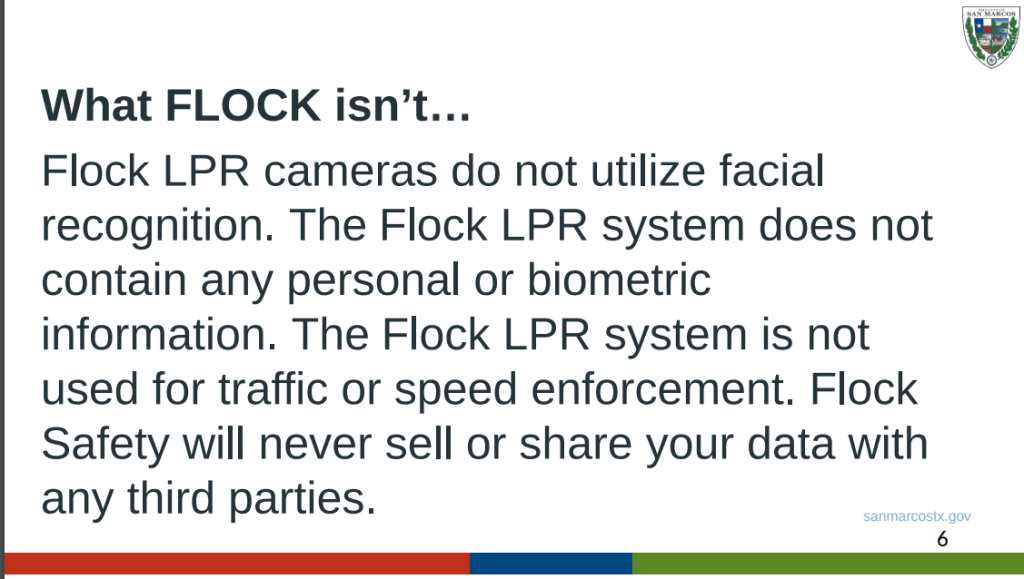
      And yes, Flock is exactly the company we’re buying cameras from. And it’s not just the ACLU: other folks also don’t like Flock Safety one bit.

      Look, ICE raids have already started. (Not as intensely as Trump would like, but they’ve started.) Do we really think this universal surveillance data will be off-limits? It wasn’t off-limits back in 2019.

      Sure might be nice to have a clear policy! Maybe we should “Establish clear guidelines and protections governing the use of technology to ensure transparency, accountability, and respect for the personal privacy and civil rights of the public.”

      This brings us to Tuesday’s meeting

      Amanda makes a motion: Postpone the purchase of the cameras until we’ve established the policy that focuses on privacy and civil rights when it comes to the public. (After all, it was literally five days earlier that Council agreed this is a priority!)

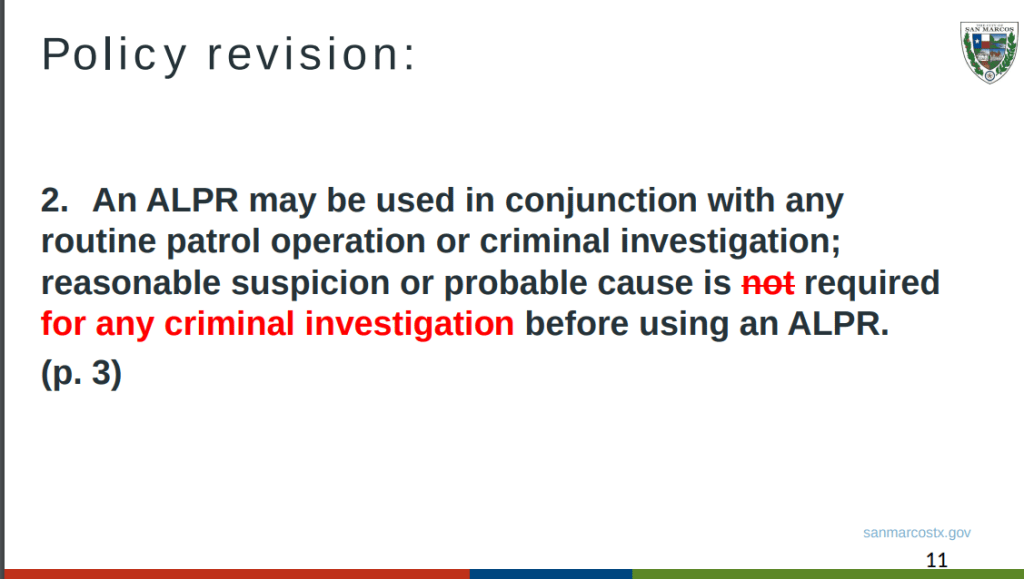
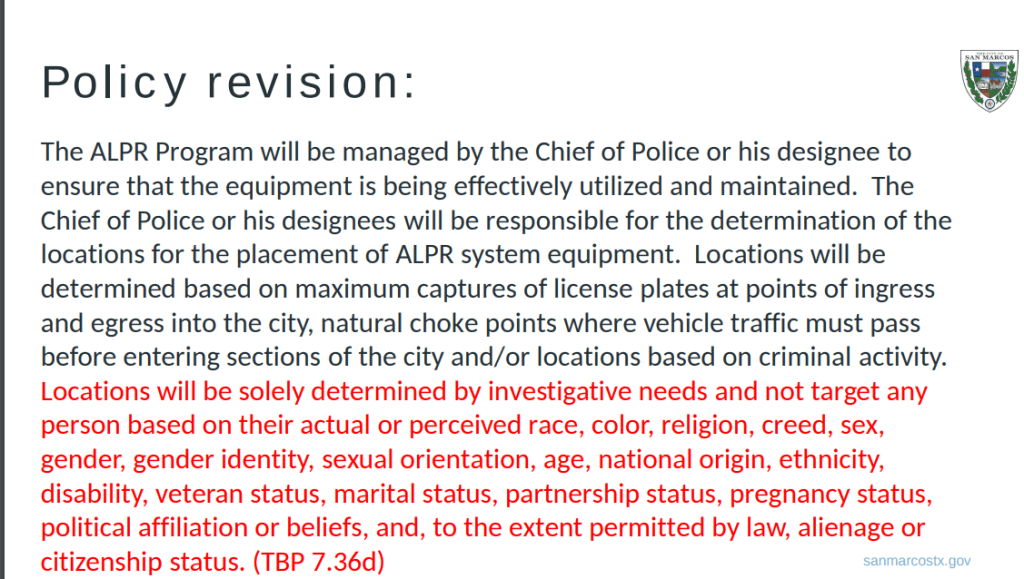
      Chief Standridge says, “No worries! We already have such a policy! It’s four pages long and follows all the best practices in Texas! This is what all the departments across Texas are doing.”

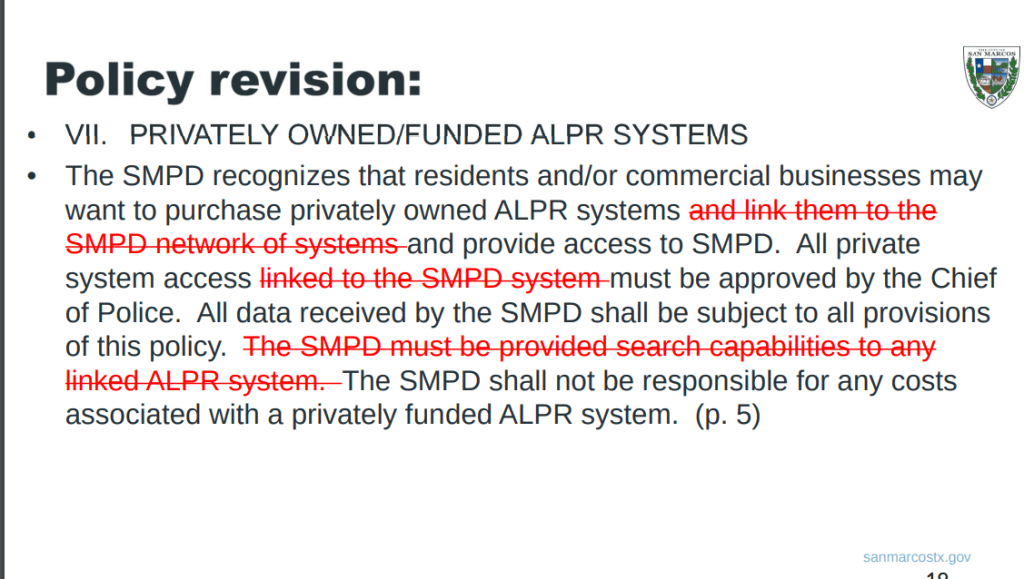
      I think he’s referring to this: Policy 5.4: Automated License Plate Readers.

      Amanda: “I’ve read the policy. Those may be the best practices in Texas, but they’re not the best practices nationwide. Things like data usage, data retention, data sharing – we should address those things, and then we can bring back the vote on the cameras.”

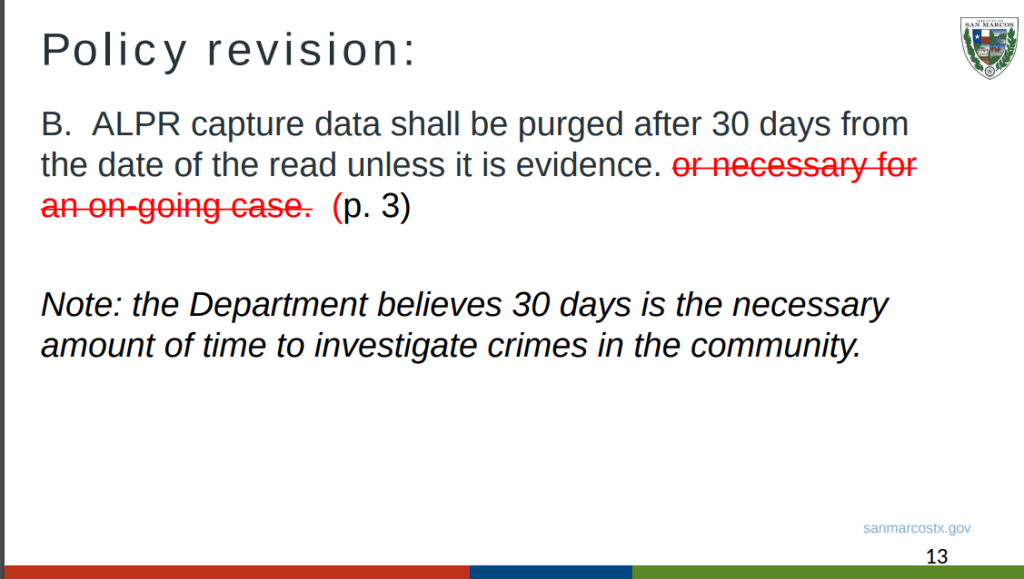
      They get into it a little bit, over how long data should be stored. Is 30 days too long? Just right? (That same article on Flock Safety has recommended legal language specifically for this kind of situation.)

      “Furthermore,” Chief Standridge says, “this is already underway. We got the first batch of cameras in 2022, and then we got a grant for some more…” he kind of trails off.

      Amanda: “The cameras have already been purchased? The cameras that require council approval?”

      Chief Standridge: “The Flock representative is here online, they can confirm or deny if the cameras have been purchased.”

      Jane tries to smooth it over: “It was probably something like it was initiated because they thought they’d be under 100K, and then it turned out to be over 100K, so they need needed approval!”

      Standridge: “Close enough!”

      Note: I think it was because of this:

      The original contract was not discussed when Council approved it, in April, 2022. Later on, SMPD applied for some grants, and Council didn’t discuss those, either. My guess is that since the grants were in motion, SMPD assumed it was fine to move forward with the cameras.

      (This also happened with the Total Bullet Containment System. It had been purchased before Council actually authorized the purchase.)

      Back to the conversation:

      Jane: I’m game to have a work session on this policy, but I don’t want to hold up the purchase of the cameras in the meantime.

      No one else (besides Alyssa) weighs in.

      The Vote: Should we postpone the purchase of these cameras?

      WHOA!   I was not expecting that, but I’m thrilled to see it!

      Items 10-13: An enormous number of appointments. 

      The vast majority of the meeting was spent making appointments:

      Those are all boards where they appoint community members.

      The most public of these is P&Z. P&Z had three open spots. David Case and Maraya Dunn were both re-upped for a second term, and “Rodney” got the last spot.

      No one in the meeting ever used Rodney’s last name, and I don’t have access to the applications, so I guess we’ll all find out which Rodney in a few weeks, when he starts attending the meetings.

      Item 14: Attendance on External Boards

      There are a bunch of committees in the city and county that have a representative from city council.
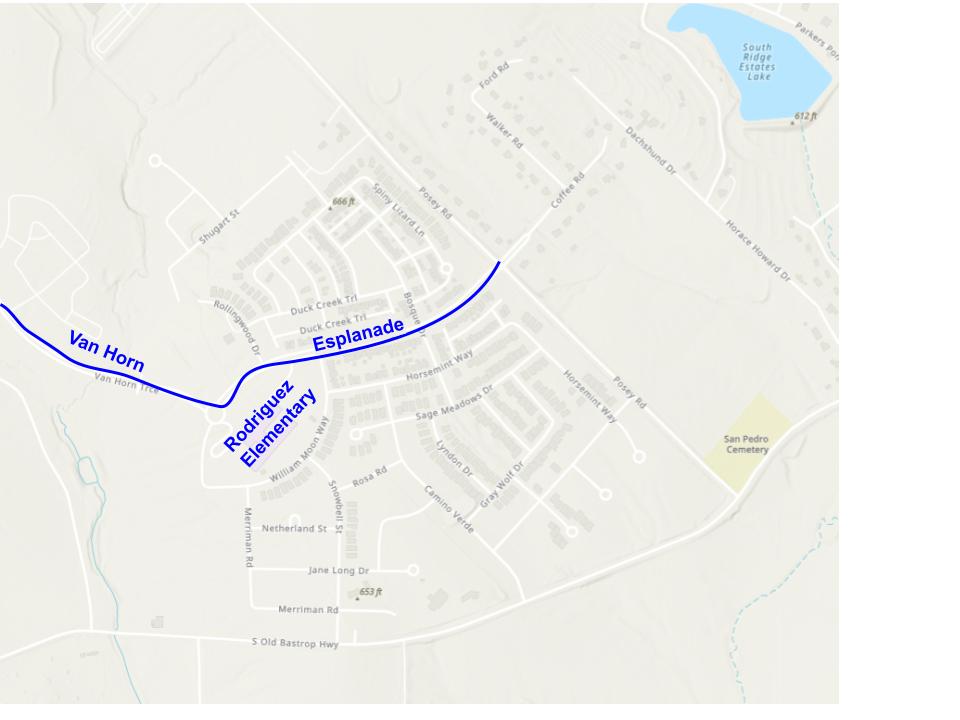
      Sometimes you have one of these external boards with a city council rep, but that council member never shows up to any of the meetings, and sometimes his name is Shane Scott. 
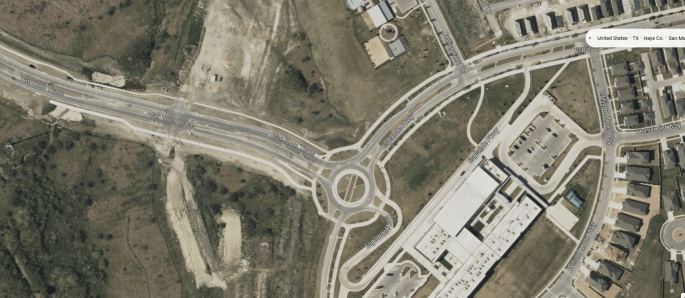
      (Specifically at the January 7th council meeting, where Shane found out that he’s been on the Convention and Visitor’s Bureau Board for the past year, and had missed all of the meetings. Shane was kind of sheepish about the whole thing.)(Around 4:18 in this video. It’s pretty funny.)

      Jane: Do we want some sort of attendance policy for these situations? Like you can’t have more than three unexcused absences in a row? That’s the policy for the rest of our boards and commissions. 

      Everyone is on board. So this will come back around.

      Bonus! 3 pm workshops, 2/4/25

      The first workshop was an update on the budget side of the CIP projects, which is kind of weedy and wonky, so I’m skipping that. But feel free to watch here.

      Workshop #2: Equity Cabinet

      Last summer, the city received a presentation from Dr. Rosalie Ray, at Texas State. She was proposing to run an equity cabinet on Transportation, and report back with her findings.

      So basically, DEI is hard to do well. It takes time, energy, funding, and expertise. An equity cabinet is one model that the research-folk like, as a way to do it well.
      Ours is studying transportation.

      Here’s what I got out of it: there’s a lot of expertise about transportation by city staff, and there’s a lot of lived experience by people who don’t have cars, out in the community.

      If you want to incorporate their experience into city policy, you need to do a lot of things:

      1. Give people rides to meetings and compensate them for their time. The whole point is to focus on people with barriers to participation, so you’d better address the barriers.
      2. Have the cabinet go into detail about what problems they face.
      3. Have city staff give the cabinet a rundown about how city planners organize and work on transportation issues.
      4. At this point, the cabinet has both sides of the equation: lived experience plus expertise. Then the cabinet members can really identify the sources of the problems and understand what it would take to solve them
      5. Eventually they arrive at a set of recommendations, which the city can then incorporate into their plans.

      That’s why it’s a big, drawn out process involving time, money, and energy! But it sounds like it went really well.

      First: You have to know exactly what you’re aiming for, if you want a concrete, productive conversation:

      The participants were giving the presentation, for what it’s worth.

      Here’s their experience:

      Life is really not easy in San Marcos, without a car. Like, Workforce Solutions that’s supposed to help you train and find a job, cover childcare, etc, is located way out on Posey Road.

      This is the participants incorporating the expertise of city planners into their understanding of San Marcos:

      So taking expertise plus lived experience together, they identified some key problems:

      Those are categories.

      Here’s their specific recommendations in each of those five categories:

      Again, it’s a great presentation, so feel free to go listen yourself here.

      Council had a few questions:

      Jane asks about sidewalk priorities and bus shelter status?
      Answer: We have 18 sheltered bus stops already. We want more, but we’re holding off because we’re about to re-do the Transportation Master Plan, and we don’t want to put something in that we immediately have to tear out.

      Amanda: Are other cities doing anything that we should start doing?
      Answer: Sometimes when there’s not enough space for a full shelter, they anchor two seats to the bust stop pole, with a little shade on top.

      As Amanda put it, these recommendations are all so feasible! There’s nothing impractical to any of this.

      There’s two big plans coming up: TXDOT is doing a transit plan, and the city is re-doing our transportation master plan. Both TXDOT and the city were involved in the Equity Cabinet, and want to incorporate the recommendations into their new plans. Hooray!

      January 21st City Council Meeting

      Morning, everyone! This week’s meeting was only 26 minutes long. We’ve got the Blanco Gardens Area Plan, bike lanes on Sessom Drive, and we look at whether or not we have enough water for the next 50 years. That last one is the most interesting, for sure. Dive in!

      The whole meeting was only 24 minutes! But the workshops were great, so those are here, too.

      Hours 0:00 – 0:24: There’s literally just one topic: the Blanco Gardens Area plan. So I stretched it out and went deep. You know how I can be.

      Workshop 1:  Sessom and Academy got a make-over. Let’s check in to see how it’s doing.

      Workshop 2:  Do we have enough water to last us 50 years?  Smart people are thinking hard about this question. I love this topic.

      One last note: the round-ups and deportations have begun. Re-posting this list of organizations who can put your time and/or money to good use:

      Local to San Marcos: 

      Mano Amiga is our homegrown organization. They are accepting donations, and will be able to use volunteers in mid-December. (Or they’ll send you to volunteer with a partnering organization.)

      Regional Austin-San Antonio

      American Gateways: Their mission is “To champion the dignity and human rights of immigrants, refugees, and survivors of persecution, torture, conflict, and human trafficking through exceptional immigration legal services at no or low cost, education and advocacy.”

      Catholic Charities of Central Texas: Has a specific immigration services wing, “Offering affordable immigration legal assistance from experienced attorneys and staff, with a focus on family reunification.”

      Statewide:

      RAICES: From their website: “WE defend the rights of immigrant, refugee, and asylum-seeking people and families, empower communities, and advocate for liberty and justice.”

      Texas Civil Rights Project: Has a specific Beyond Borders program, “From the banks of the Río Grande to the plains of rural Texas, we envision a border state that respects the right to migrate and supports human dignity for all people, no exceptions.”

      Texas Immigration Law Council: “We work across the political spectrum to bring together diverse voices to catalyze consensus on practical immigration solutions for Texas and our nation.”

      ….

      Final note: All of these came recommended to me. If I’ve left something off, let me know and I’ll add it on!

      Hours 0:00 – 0:24, 1/21/25

      Citizen Comment:

      There were ZERO people at Citizen Comment on Tuesday!  Probably because of this:

      and the freezing temperatures.

      Hope you all stayed warm!

      ….

      Item 1: Blanco Gardens Area Plan

      This is basically the only item of the meeting.

      What is an Area Plan?

      An area plan is a big study of your neighborhood. It’s supposed to document what makes your neighborhood feel special, so that it will keep feeling special over the next few decades. This is a really complicated topic, because there are both good reasons and dangers here.

      (We’ve discussed these before, when the Dunbar/Heritage plan got split into two separate plans.)

      Good reasons: Does your neighborhood need more sidewalks? Better safety? Park improvements? Community space? These are great things to put in the plan.

      (Also, historically, developers have seen low-income neighborhoods as cheap real estate to plunder. Low-income neighborhoods get gentrified, or bulldozed for a highway. Area plans can deter this by encoding the current vibe.)

      Bad reasons: Are you trying to micromanage everyone’s home appearance? Are you trying to prevent affordable housing by nixing things like small-scale apartment complexes, small houses, subdividing big houses into smaller rentals, condos, townhomes, 4-plexes, etc? These are bad things to put in a plan!

      (Really, these rules already exist. They’re generally built into a city’s zoning rules and HOAs. An area plan can just lock down the class segregation for another generation.)

      In addition, if you nix all the affordable housing, you’re left with only big, spread-out houses. This is sprawl. It’s bad for traffic, bad for the environment, and makes it way more expensive for the city to maintain pipes and roads and telephone lines.

      So the planners have to thread the needle here: let’s capture what’s special, but without preventing affordable housing from being built in city limits ever again.

      This is a really nice presentation about the San Marcos area plans. It’s got this map that shows how vulnerable each neighborhood is:

      I know that’s tiny, but you can zoom in on the map to anywhere you want:

      (There are a ton of interesting maps in that presentation – maps of rental houses vs. home owners, maps of area of stability vs change, maps of historic districts and maps of environmental sensitivity, etc. It’s worth a scroll.)

      First up is Blanco Gardens!

      Blanco Gardens is a great choice for an area plan, because of The Woods apartments:

      (Now it’s called Redpoint.)

      In 2012 the city had to decide whether to allow this apartment complex to be built. Blanco Gardens was furious.

      In November 2012, there was a non-binding referendum on the issue:

      Wow, 75% of the city wanted us to purchase the park land! Nevertheless, P&Z and Council greenlighted the apartment complex.

      Then Blanco Gardens was massively flooded in 2015. Tons of residents lost their homes. At this point, the apartment complex was half-built. The widespread belief is that the apartments made the flooding much worse. (The flood also destroyed Cape’s Dam, which lead to a whole ‘nother saga.)

      Bottom line: Blanco Gardens has gone through it, and deserves an area plan.

      So how do you do an area plan?

      They form a committee of eight residents, and then also do a ton of outreach:

      One note: At P&Z, one of the commissioners (Lupe Costilla) said, “I live in this neighborhood, and I had no idea that any of this was going on.” And she’s very plugged in to the city.

      This is what I mean when I say that outreach is really, really hard. Even when you do all of those things, even people who are paying attention still fall through the cracks. You’ve got to dedicate time to relationship-building with community leaders.

      ….

      So what’s actually in the plan?

      Here’s the actual plan draft. In the presentation on Tuesday, they gave a few examples of actual Blanco Gardens content, but mostly they talked more generally about what area plans are.

      Examples:

      If you want to read all the recommendations, by each topic, you should go to pages 17-72 here.

      Final notes: There’s not any automatic funding that comes with all these recommendations. It’s just guidelines for the future. So if the city has money, they’ll follow the recommendations, and if a developer wants to build something, it has to be compatible.

      ….

      Here’s the timeline for approval:

      One final note: Who gets an area plan?

      Here are the first five plans:

      In Blanco Gardens, here’s one recommendation under “Building types”:

      I think that’s really great! But notice who does NOT get an area plan:

      Nobody is ever going to go to Willow Creek or La Cima and say, “Consider and support gentle density”. Those neighborhoods have entrenched protections that make sure that affordable housing will not be mixed in. This drives me batty.

      Literally nothing else happened at the 6 pm meeting. It was only 24 minutes long!

      (We were supposed to discuss the Kissing Tree TIRZ and Downtown TIRZ, but those got postponed until February.)

      Keep going for the workshops!