The other item that got some citizen interest was Item 26, approving rules to govern Council committees. In other words, there are Affordable Housing committees, Covid Oversight committees, Criminal Justice Reform committees, etc. Generally these only have two council members, so they don’t trigger quorum rules, and then relevant community members or staff or representation from interested parties. So the city has not formalized rules for these committees regarding agendas, minutes, points of order, etc, and the Mayor decided it was time to do so.
Five people spoke on Item 26 during the Citizen Comment period, all from Mano Am/iga, about transparency of committee meetings. Since Mano Am/iga is very concerned with the criminal justice in general, it gave me the impression that the subtext of these reforms was something to do with the disagreements and feuding over the CJR committee. (In fact, using my crystal ball, it will be the very next May 4th meeting where the CJR committee defends its existence and creates its new mission statement.)
The speakers are all concerned that there is no requirement that committee meetings be open to the public. It’s required to take minutes and make those publicly available, but they can be just the bare minimum of what is being voted on and how it shakes out.
It comes up for discussion at 12:20 am. Everyone is tired. Max Bak/er has a list of amendments. All meetings must be available over zoom, the public must always be invited to participate, that sort of thing.
Melissa Der/rick gives the pivotal speech, roughly “Look, I really support transparency and citizen participation. But we can’t get anything done if we’re never able to speak frankly and compromise. And if we’re always in danger of getting flayed on social media, we can’t speak frankly.” That speech probably didn’t change anyone’s vote, but it gave cover for the centrist position to vote no.
It’s a problem. Councilmembers operating in good faith can be hamstrung by citizens operating in bad faith. In that case, there’s a defensible position for closed committee meetings. Councilmembers operating in bad faith need citizen oversight to mitigate the damage. There’s a reasonable argument for open committee meetings.
Baker’s amendments were all voted down 5-2, and the original proposal passed.
I’m glad Mano Am/iga is scrutinizing these things, and I’m glad Max Bak/er is a squeaky wheel, but it’s probably fine that his amendments didn’t pass. All committees can do is pass policy proposals up to Council, and Council is governed by TOMA, the Texas Open Meetings Act. Bad councilmembers can get voted out of office. Good councilmembers can opt to have open meetings when appropriate. Citizens have to stay engaged and informed. Good governance is hard.
(As a reminder, Council was off last Tuesday, and so I subbed in a previous meeting from a few months ago. I believe Council will be meeting next week, but then taking the subsequent meeting off again.)
Nothing earth-shattering happened at the meeting, in part because it’s anti-climactic to hear the beginning of a public policy debate after you’ve already heard the end of the story. But here goes:
Item 15, rezoning 15 acres on the northern tip of LBJ to SF6. Hugely unpopular: there were 21 people who took the time to speak out against this. P&Z also denied the rezoning, which means it takes a supermajority of Council to overturn them. A supermajority requires 6 out of 7 councilmembers to constitute a supermajority. So from where I sit, this was obviously doomed to failure.
So what was this doomed plan? A developer wants to extend the neighborhood further north. This would be behind Timber/crest. The current neighborhood residents hollered bloody murder.
Some complaints are justified: LBJ really does have a hideous blind turn right there, and can’t be widened due to property lines, and truly can’t handle extra traffic.
Some of the complaints were nebulous NIMBYism – and several of the residents mentioned how their feelings had been hurt when P&Z members had accused them of NIMBYism, in undiplomatic ways. (I don’t have the exact quote. Implying that the neighbors were classist and anti-renter? Only wanting houses just like theirs? Something with a kernel of truth, but phrased in a way that stung.)
Some of the complaints are very complex: the perennial accusation that houses will be snatched up by wealthy out-of-town parents, and then given to wealthy students to live in and throw wild parties in. Does this ever happen? Of course. Does this happen to an extent where it renders quiet neighborhoods unlivable and triggers an exodus and the entire neighborhood deteriorates into squalor? The usual narrative goes, “This happened to Sagewood! The only reason it hasn’t happened anywhere else is due to our relentless vigilance!”
Is this actually why Sagewood is a world of rental houses? Or was something else in play? Are there now new policies on the books that keep this from happening in other places? I don’t know! I’m curious, though.
From where I sit, there is a fundamental cure: code enforcement needs to be well-staffed and carry meaningful penalties, enforced on landlords. There’s no reason that college students shouldn’t be reasonable neighbors, if the penalty falls on the landlord.
It’s less obvious to me how to keep out-of-town parents and landlords from snapping up all the housing stock, when their pockets are so much deeper than local residents. This is a thing that happens. But this isn’t an argument against a new neighborhood being developed. A new neighborhood would help, by providing more shiny house-baubles for fancy out-of-town parents to buy.
Finally, the land is sensitive and probably shouldn’t be developed. This is on the Edward’s Aquifer, right on the river recharge zone. The counterargument is that this is probably the least intensive way this land would ever be developed. Is it inevitable that this land will some day be developed? If so, it’s worth taking this deal. Is it possible that this becomes park land? If so, stick to that.
In the actual meeting, deliberations were short and swift. Mayor Hug/hson recused herself, because she owns land over there, and the rezoning was voted down 6-0.
In my opinion, the wildly dangerous curve of LBJ plus the environmental concerns tips this towards denial. So I think this was correctly decided.
Oh, one footnote: P&Z denied this last fall. It went to council. Council did NOT deny it then, which would have forced the developer to wait a year before trying again. Instead, Council threw the developer a bone and told them to meet with the neighborhood, build some relationships, make some compromises, and go back to P&Z.
The developer totally ignored this explicit roadmap towards approval. He said, roughly, “I tried to meet with one resident but they were angry, and so I figured it would be a waste of everyone’s time to meet with anyone else.” So P&Z denied them a second time, and now they really are DOA.
Dude. That is not how you win hearts and minds. Meet with the damn people. Nod sagely at their concerns. Ask follow up questions and feign polite curiosity. Gently modify your plans in ways that show you were listening. Even if it’s mostly symbolic, you’ll mollify your opponents and they’ll feel like they had some say in their changing neighborhood.
The April 20th meeting was 6 hours and 46 minutes long. With a few 10 minute breaks (with some funny euphemism – nature breaks? body breaks? can’t remember), it lasted until 1:15 am.
WHY are we subjecting anyone to 7 hour meetings regularly?! This is nonsense. Why not meet weekly, for 3-4 hours?
Also, it’s a bit anti-climactic to watch a meeting which serves as a prequel to other recent meetings. We know how things end up turning out. On the other hand, it’s very handy to have the minutes available to refer to.
It took me a week to get through just listening to the dang thing, but I suppose no one is waiting with bated breath for a blog post on an April council meeting, in June, on a n unpublicized website with an extremely tiny audience. I’ll get to it in the next day or two.
Note: City Council is on vacation for the second meeting of June (and the first meeting in July? I think.) Since my goals right now are to 1) establish this habit and 2) build up the archives, I thought I could work backwards and attend some meetings from this past April.
(My schedule is most flexible in the summer, so it doesn’t really help me to take a break right now. Too bad I can’t borrow from later this year, when my schedule is a mess.)
So what did they cover, way back in April?
Presentations
Covid-19 update
Deloitte & Touche is giving a presentation on CBDG grants? Quarterly Internal Audit Report.
Consent Agenda
3. Approval of the minutes 4-5. Annexing and re-zoning Gregson’s Bend/Commercial Loop 64 acres, across I-35 from the Outlet Mall. 6. Utilities water contract 7. Conveyance of city-owned land to build affordable housing 8. Airport master plan 9. County property, along Guadalupe St, at Courthouse, to be used for cycle track 10. Data archiving contract, $285K for five years 11. Environmental Systems Institute change in contract, $96K/year for three years 12. 133K for cemetary improvements 13. Changing police construction contract +$200K
Public Hearings
14. Extending Holt Tract PDD for 5 years (sure) 15. Rezoning 14 acres at North LBJ (terrible idea!) 16-17. Rezone 21 acres, then 15 more at Chuck Nash Loop, up towards Yarrington Road 18. CBDG matters
Non-Consent Agenda
19. Allocating CARES funds 20. Residential Wastewater rates 21. Amendment to CBDG action plan 22. More on CARES funds 23. Low Income Tax Credits for apartment complex on Centerpoint, just west of railroad tracks, towards Kissing Tree. 24. Annexation of 23 acres on Old Bastrop and Redwood (will become Senior Housing because I can see the future) 25. Fill vacancy on Board of Directors for Alliance regional water authority 26. Approve council rules 27. Fill vacancies for five different boards: Construction Board of Appeals, Convention and Visitor Bureau, Econ Development Board, Historic Preservation, Neighborhood Commission, and SM Industrial Development Corporation. 28. Bitty goats discussion!
Work Session that Afternoon:
3 month update on Resource Recovery Request for Proposals
Status reports and updates on Snowvid Winter Storm
Citizen Comment period: several people came to talk about the case of Jennifer Miller. This was not an agenda item so much as a way of generating awareness in the community. Miller was killed a year ago in a car crash in Lockhart. The other driver was a San Marcos police officer, Ryan Hartman.
This is taken from a SM Record article, which I would link if this site were live:
According to Hartman’s deposition, police reports and forensic evidence, Hartman was driving 16 mph over the 30 mph speed limit on a partially gravel road with an open container of alcohol that was ¾ empty, talking on the phone, and he failed to stop at two stop signs before colliding with Watts’ vehicle. Forensic evidence showed that Hartman was not attempting to brake the vehicle when the collision occurred.
According to the incident report, Hartman denied consuming any alcoholic beverages when asked and refused to take a blood alcohol test on scene; he was detained until a search warrant could be obtained on suspicion of driving while intoxicated due to the open container. Hours later no alcohol was detected.
(I’ll slowly go back and put links in over time, once the site is public. Source)
A grand jury only gave him a citation for running a stop sign, and did not find probable cause for criminally negligent homicide. Miller’s spouse is filing a civil suit.
People are basically upset that Hartman is back on the force, and want Council to do something. It’s a horrible tragedy, for sure, and I can see why it looks like a miscarriage of justice.
Item 28: Mexican American and Indigenous Heritage and Cultural District
These will be districts honoring very old neighborhoods – some which have been destroyed – where Mexican-Americans have lived for generations. I imagine some other part besides neighborhoods will be noted to honor the local Indigenous heritage. It doesn’t come with Historical Preservation status, so it’s mostly to raise awareness to the community about the heritage of these areas around town. (Everyone was in favor of this.)
Item 29: Light’s Out, Texas!
Central Texas is a funnel to Mexico for migratory birds, and the lights mess them up. I gather we’re already a Dark Sky city, which means angling lights down and putting shades over them? This would include some additional measures during migratory periods. (Everyone was in favor of this.)
Boring but Important, but Not Controversial
There are several items which are surely important, but didn’t generate much conversation and so I’m unable to evaluate which parts are notable. Maybe these are hiding things I would strongly disagree with! Time will tell.
Items 1 and 2: First quarter financial report and investment report.
Item 23. Texas General Obligation Refunding Bonds up to $75 million I gather that we regularly issue bonds? The only amendment was to remove a category of $1 million for Cape’s Dam. Apparently it was originally set maybe in 2017 or so, and had been deferred ever since. City Staff made it sound just routine to eventually move things from “deferred” to “happening”.
Item 24. $73.6 million for twelve different infrastructure categories
I’m sure this is important. It was also a slide presentation and I was just listening to audio.
I am still getting my sea-legs on this gig, and one thing that is hard to discern right now is what is pro forma, and what is important. Once cue I use is whether or not councilmembers have questions and amendments.
So for example, in the June 1st, 2021 meeting, there were very few questions on the following items:
Items 1-2: Financial and Investment report for the first quarter
Item 23: Texas General Obligation Refunding Bonds up to $75 million
Item 24: $73.6 million for twelve different infrastructure categories
Most likely this means that the details are being hashed out in work sessions, or these are things which don’t change from year to year. Certainly these things are important! I just don’t have much context to evaluate them.
If something has always been done a certain way, but it’s problematic, I don’t yet have any way to detect that. I think time and experience will be the only way to pick up on these things.
For the work sessions, again for now, I’m trying to determine how much time I can commit to this. So for now, those controverseys will also stay off my radar.
This may not be the most important item exactly, but Item 22 was definitely the strangest item of the night. And Mark Gleason was the strangest acting councilmember of the night.
Item 22 is about adding language about lobbyists to the code of Ethics. Lobbyists would have to register with the city, and issue reports every two months. Apparently this has been floating around since 2018. Last December, Council gave direction that a committee should be formed. The commission met for three months and gave tonight’s recommendation to council.
Immediately Gleason made a motion to postpone the measure until the end of August. Everyone was caught by surprise. Baker was obviously annoyed and sparred back and forth with Gleason.
Gleason said:
He was contacted by constituents over the weekend and now he needs more time to research this
He’s worried about unintended consequences
The people need to be here to comment on this, and it should be postponed until they are meeting in person.
He’s worried about the constitutionality of restricting free speech like this
We already passed a campaign finance law, so this is redundant.
The thing is that these five points are easily swatted down, and they were swatted down, and Gleason just stuck to these five points over and over again. It was a bizarre performance and made me wonder what exactly got planted in his ear over the weekend.
The swatting down of these points went roughly like this:
The lawyers and experts are right here! If you have questions, please ask them!
What unintended consequences might you be imagining? The recommended policies are in place in many similar cities. No new language was written for San Marcos.
This has been brewing for 3 years. Citizen have been forced to show up over zoom for the past 15 months – what exactly is making this so unusual that it needs to be postponed, especially since the new election season will be underway by then?
No one is restricting free speech. When money is involved, lobbyists just need to register and report.
Campaign finance laws are just a different thing. Quid pro quos and influence are not exclusive to campaign finance.
Anyway. I’m getting ahead of myself.
Gleason’s motion to postpone until the 2nd August meeting fails. Then he moves to postpone until the 1st August meeting. That also fails. (Baker, Derrick, Garza, and Hughson vote no.)
There are other concerns – who qualifies as a lobbyist and who is exempt? What should the penalty be? etc.
Hughson had quibbles that annoyed me:
Hughson feels like this just doesn’t happen in San Marcos and isn’t needed. This is very naive of her. She says that no one has approached her on council or as mayor. Fine, but perhaps other councilmembers signal a willingness to play ball that makes them more approachable than you?
She wanted to expand the definition of lobbyist to include any instance of influence, and then she was tying herself in knots because it would include citizens and nonprofits.
Shane Scott wonders what the big deal is. It still comes up for a vote. Why does it matter if someone picked up the phone and called you ahead of time? He wins the prize for the most disingenuous councilmember.
Gleason keeps these panicked nonsensical rants going. It feels like this: Someone called him over Memorial Day weekend and convinced him to postpone. That person fed Gleason these reasons, and Gleason can’t maintain a coherent conversation about them because they’re not his real reasons, and he’s unwilling to divulge the real reason. He was like a parody of someone squirming under pressure – practically yanking on his collar and wiping his brow and saying, “Is it me or is it hot in here?”
Gleason hasn’t been on council long, but his general shtick is to be the most earnest person on the block, although a bit repetitive and rambly. I don’t always agree with him, but he usually appears to be operating in good faith. This was like an easily rattled stooge sweating bullets before a mob boss. It was very strange!
Finally, conversation seems to be winding down. Surely they are getting ready to vote on this first reading!
But wait! Saul Gonzalez makes a motion to postpone. Everyone is dumbfounded. Saul’s reasons are that it’s getting late and he’s not thinking clearly anymore. He wants to postpone to the second meeting in August, ie the same as Gleason’s first attempt.
WHAT ON EARTH. The conversation has been had already. It’s now 10:30 pm. This is only the first reading – if you have misgivings, you still have a 2nd reading to bring them up! Nothing is binding here! (Like, did someone also get to Saul? Am I imagining conspiracies here?!)
The amendment to postpone fails. Again. As before, Baker, Derrick, Garza, and Hughson vote no.
They vote on some dates to implement the policy, and then hold the final vote on the first reading. It passes 5-2. Gleason and Scott vote no. Hughson and Gonzalez both qualify their yes-votes with ominous “for now…”s.
Well! Not the most important item necessarily, but definitely the most fun to write up.
1 and 2: First quarter financial report and investment report.
Consent Agenda: All the stuff that has already been hashed out goes here for final votes.
3. Approve old minutes 4. 7 acres to be zoned CD-5 by Centerpoint 5. Miniature goats 6. 1 year injury leave for a specific police officer. 7. Wood grinding contract, $104K 8. Engineering contract for Highway 80, $350K 9. Blanco Vista elevated storage contract, $330k 10. Tx-DOT airport master plan reimbursement 11. Air quality 12. One year airport hangar lease, 12K. (Really, this needs approval by council?) 13. Rejecting a “sole proposal” for CDBG application. Not sure what the story is there, but if it were interesting, it shouldn’t be on the consent agenda, so I assume it’s pro forma for now. 14. LCRA interconnection agreement 15. IT contract $355k
Public Hearings: The hashing out happens here.
16-19. Annexing and rezoning a parcel of land out by Centerpoint 20. Submitting something about CDBG grants to HUD?
Non-consent agenda: And here.
21. Allocate $41K from the State Seized Asset Funds for various police technology and equiqment 22. Code of Ethics: lobbyists have to register and contacts have to be reported 23. Texas General Obligation Refunding Bonds up to $75 million? I don’t know what this means. 24. $73.6 million for twelve different infrastructure categories 25. Parks & Rec applying for county bonds fund. 26. Fill vacancies on various boards and commissions 27. Grant writer position 28. Mexican American and Indigenous Heritage and Cultural District 29. Lights Out, Texas! to turn off or dim non-essential lights during migratory peak periods 30. Parkland fee calculation methodology in the Land Development Code
Executive Session: 31-32: San Marcos Sports/plex purchase and sale
I sat down to write up this item, and got so bogged down in the backstory that it became clear that that had to be its own post. With that out of the way, the story becomes less important.
The foreground issue is a Memorandum of Understanding between the city and the county, about an East side park called the Cape’s Dam Complex. The background issue is whether or not the dam should be rebuilt.
Melissa Derrick moved to strike a clause from the main statement: “whereas the scientific community has pointed out that the flow race of the main channel and the mill race are important for the protection of river wild rice etc etc,”
If you don’t know the background, this clause sounds totally innocuous, and Derrick sounds like an anti-science nut. But this is actually the false environmental propaganda, in my opinion. (I’m basing my opinion on the San Marcos River Foundation.)
Anyway, the amendment passed and the clause was struck.
Max Baker moved to insert SMRF into the groups where communication is a high-priority. This passed.
The county clearly thinks that the dam ought to be rebuilt. I don’t think the city has decided yet. Or rather, they’re split. “Renovate/rehabilitate the dam” may mean different things to different councilmembers.
The MOU passed. Only Baker voted no.
Onto the next-most-interesting items!
Items 19 and 27: Miniature goats! Spear-fishing!
You are now allowed to have miniature goats within city limits. Congrats! You must have a pair, so that they don’t get too lonely and hence noisy. You’re not allowed to sell your goat cheese or goat milk. Your goat shed must meet certain criteria. The billy goats must be neutered, lest ye develop a third goat.
Shane Scott likes to gig fish and doesn’t want to have to get a permit, because it’s not a spear-spear. Can gigging be exempt from the permitting process? Others pointed out that all fishing needs a permit, aside from the special spear-fishing permit. This was just a discussion item, and four voted yes to have city staff research it and bring it back. But it did not appear that four people would actually want to change anything.
Everything else:
Reviewed the process for Community Block Development Grants (CBDG) for the coming year
10% discount for San Marcos residents at the Kissing Tree. Will it be raised to a 25% discount? Probably not.
Purple heart trail, ethics review training, etc.
DONE.
I skipped the work session again, this week. I’m still getting my sea legs on this whole thing, and the Cape’s Dam entry took a long time.
In the early 2010s, City Council was very beholden to developers, and approved a bunch of very controversial apartment complexes. This is when the The Cottages and The Retreat were approved, and most contentiously, The Woods. (Which now has a different name – Redpoint – but everyone still thinks of it as The Woods.)
The Woods was built on property where the San Marcos River meets I-35. It would have made prime, beautiful park land. The city had the opportunity to buy the land a few years before this controversy, and declined. (That makes me angry every time I think about it.) But in 2013, City Council allowed approved The Woods to be built there.
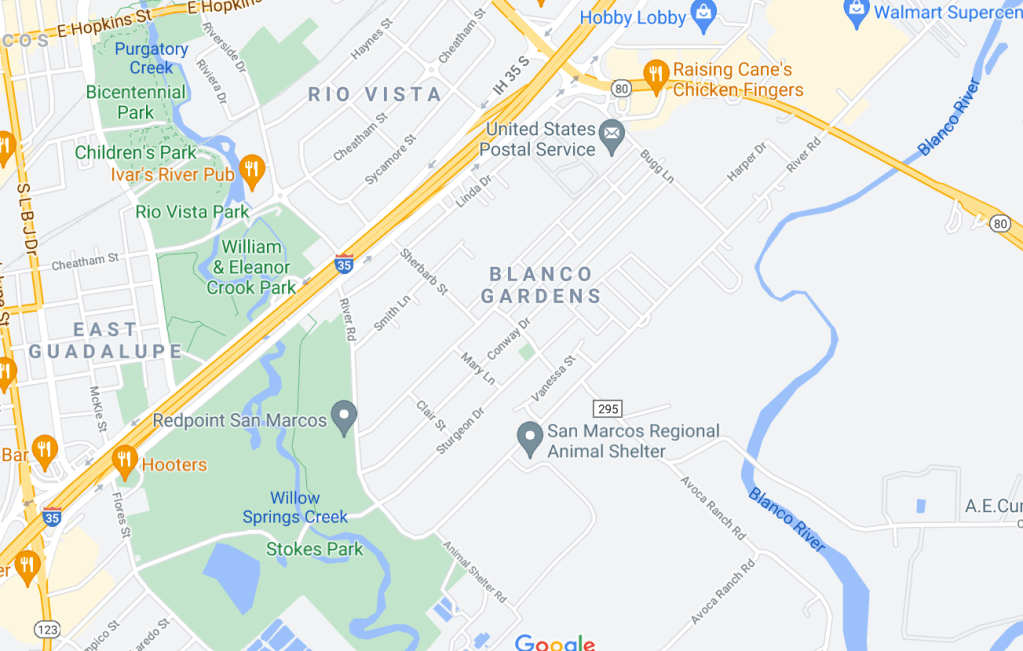
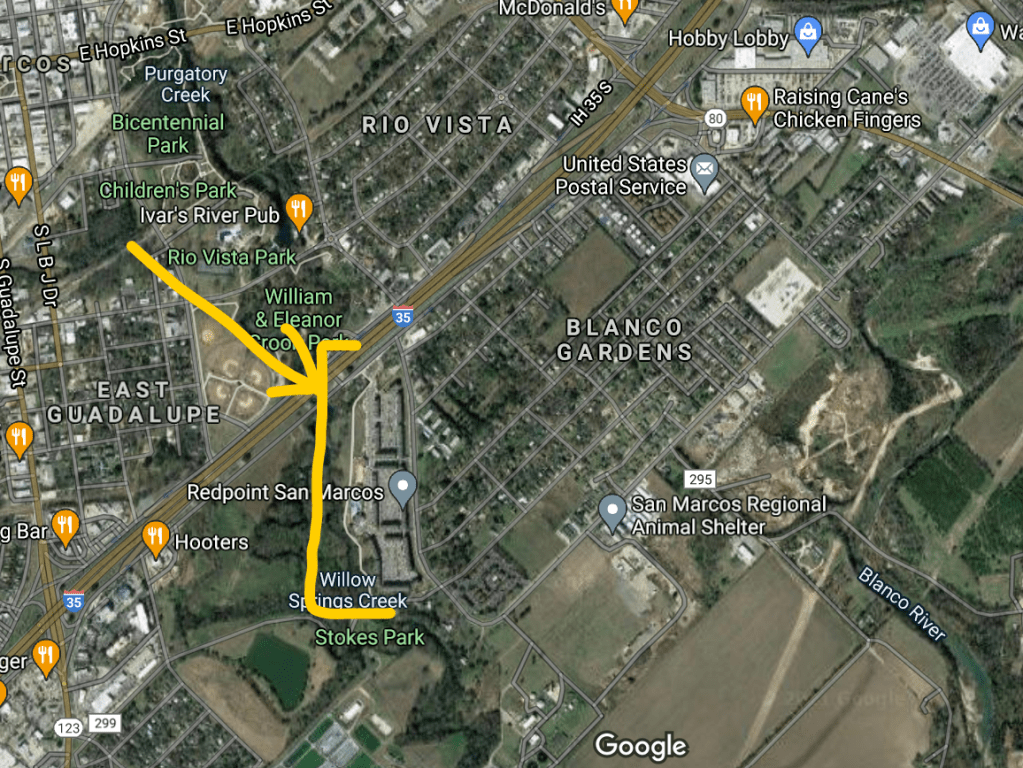
The Woods was to be long and skinny, and was to be placed between the Blanco Gardens neighborhood and the river. It would completely block residents of the neighborhood from being able to walk over and access the river. Blanco Gardens is an old neighborhood – traditionally poor, Hispanic neighborhood, just east of 35, and historically has been neglected due to racism. The Woods was going to be marketed to college students from families who could afford the newest apartment complex. The racism, classism, and riverfront destruction massively angered the city.
Here’s a map of Blanco Gardens, and the addition of the apartment complex.:
There was a huge outcry and wave of activism against the Woods, and council approved it anyway. (There was a second complex right at the headwaters that was barely defeated at roughly the same time.) As a result, that city council was mostly voted out of office and replaced with more progressive councilmembers. (Thomaides and Scott were both voted out in this wave.)
But the apartment complex got built, and currently exists.
2. The Flood
THEN! In 2015, the Woods was partially built when the Memorial Day Floods happened. The Blanco River rose 40 feet. 11 people died in Hays County. Homes and property were destroyed. The community was traumatized. It was a mass natural disaster.
Along with several other neighborhoods, Blanco Gardens had several feet of standing water. The town uniformly believes that The Woods caused Blanco Gardens to flood.
Is that true? It’s hard for me to say.
The flooding came in from The Blanco river primarily, not the San Marcos River.
The San Marcos River does meet up with the Blanco River just past this intersection, so when the Blanco floods, the San Marcos River backs up.
Apparently in four hours, the San Marcos River went from 700 cubic feet of water per second to over 70,000 CFS.
So, the water came in from the north part of the neighborhood, from the Blanco river. The issue is whether or not The Woods prevented Blanco Gardens from draining into the San Marcos river.
I saw an engineer’s presentation to the city claiming that The Woods did not cause Blanco Gardens to flood – and I frankly didn’t buy it. It smelled like computer modelling bullshit to me, with too many simplifying assumptions to be worth anything. Furthermore, he kept trying to use The Woods as if it were already built according to plan, as opposed to a messy construction site with sand bags over the drains to keep construction detritus from entering the waterways. He seemed to feel that the null hypothesis was that The Woods wasn’t a problem, and the analysis was too hard and complex to decisively disprove that.
At the same time, the amount of water that came down on Hays County that day is beyond comprehension, and it’s also true that it would have been a mass catastrophe no matter what. But Blanco Gardens might have had less damage.
The net result: The Woods still exists, but there is a lot of anger that is loosely divided into political camps, focused on this stretch of the river.
3. The damage to Cape’s Dam
What does all this have to do with Cape’s Dam? Behind The Woods, the river splits. This is manmade, dating to 1866. The river was dammed, and a cement channel was built to power a mill. The dam holding the main river is Cape’s dam, and the this cement channel that goes to the left is the Mill Race. The Mill Race is 1/4 mile long, and then they meet up again.
(Honestly, the geography of this thing is difficult to figure out, because it’s so hidden from the public view. And there are other nearby dams and channels that make it tough to figure out from Google WorldView. But I’m pretty sure this is right.)
Before the flood, the Mill Race was used mostly by a private company, Olympic Kayak Company, to rent out kayaks and such for recreation. In theory, it’s public land, but it’s never been publicly accessibly in any way, except via this private company or insider knowledge. I think both parts of the river were used – under the dam on the main river, there’s supposedly a beautiful swimming hole, and the mill race channel was nice and calm for people learning to kayak. But I’ve never seen any of this for myself.
In the 2015 flood, Cape’s Dam was severely damaged and the area was no longer safe for recreation. I remember hearing that it would cost millions to fix it and the Army Corp of Engineers recommends removal of old dams, not repairing them, so that the environment can return to its pre-existing state. At the time, there was federal disaster money available to remove the dam (but not to repair it). In 2016, City Council voted to remove the dam.
That’s when the owner of Olympic Kayak Company, Ben Kvanli, got involved, because of course this might affect his business model, along with another guy, Sam Brannon.
My opinion is that they approached this in bad faith. The legitimate position might have been, “This portion of the river is wonderful for recreation. We are going to advocate that it benefits the community to have these opportunities. Let’s balance the environment and safety with the benefits of recreation.” But they did not. Instead they threw everything but the kitchen sink at the problem. They formed an organization, Save the SMTX River (which you can google and find their link), and launched a campaign. My memory is that they had scientists saying that the science was not so clear cut – that the 100 years of growth had meant that endangered darter fish now thrived and their habitat would be destroyed if the dam were removed. But as of 2021, I can’t find any trace of who this might have been. Links are broken, citations aren’t there, so I don’t know who this counterpoint is.
The other major argument they made is that this dam has meaningful historical significance. Again, what? It’s old, but no one can seem to find any name or any event, or any architectural significance, or anything that merits more than a plaque saying “Here be ruins of ye old mill.”
One thing that clouds this is that Kvanli and Brannon are vocal rightwing Trump-style supporters (although this drama slightly precedes the most aggressive of Trump’s wave). As my URL suggests, I’m positioned on the opposite end, and it’s hard not to let that color my perception of these events. It certainly affected the lens that I saw this through as it was unfolding.
4. The current holding pattern
The federal money to remove the dam expired, and Council caved and agreed to not-decide quite so quickly. Commissions were organized.
The Historical Preservation Society tried to get it designated as a historical landmark, but they were denied at by the Planning & Zoning commission, and my memory is that the meeting was entirely about the subtext: that the designation was a farce in order to force the dam to be rebuilt and privilege recreation above the environmental concerns.
As of 2021, a long slow planning process is playing out. How will we balance recreation and the environment? What are the different options and how much will they cost? This is probably the appropriate way to proceed. “Proposed rehabilitation of the dam” shows up in the vision documents, but I’m not exactly sure what that will end up being.
October 6th 2019, at the Visioning Study Work Session: Rockeymoore supported removing the dam Marquez supported restoring the dam. Saul Gonzalez wanted another opinion Prewitt supported removing the dam Melissa Derrick supported removing the dam Mihalkanin supported restoring the dam Jane Hughson said she was on the fence.
(Gonzalez, Derrick, and Hughson are still on the council.)
My personal opinion is that the recreation is important, the environment is important, and the historical significance is bunk. Remove the dam, and fund a solution that balances public recreation with environmental protection.
One big caveat: going forward, recreational uses need to be available to the public. It’s total bullshit that this one really cool stretch of the river has only been available through a private company, or people with insider knowledge.

 The San Marxist