We are updating our rules about AirBnB type places. We used to require that they be:
Permitted in some places, but not others.
Owner-occupied (where a permit was required)
Parties were prohibited
Somehow in Executive Session, they decided that “owner-occupied” was no longer okay, so we’re trying to find workarounds. Also, a court ruled that you can’t prohibit parties.
So now:
All STRs would need a permit.
Owners can only have one STR.
Only one STR on a block, or at least 600 ft apart.
Short-term tenants can have parties, but not excessively noisy ones, just like any other resident.
Everyone who lives within 400’ gets a postcard with a hotline number to call if you’re having any trouble.
So on that last point, we’re paying Granicus to be a hotline for us. They’ll do a bunch of things:
Watch the websites for any unregistered STRs.
Staff the hotline, 24/7.
If you call the hotline, they’ll track down the contact person for the STR and tell them there’s a problem. If they can’t get ahold of the contact person, they’ll reach out to SMPD.
They’ll keep a running list of which properties are having recurring problems.
If an owner keeps renting to people that cause problems, the owner can have their license suspended or revoked.
This hotline will get paid for out of STR permit fees.
So there you have it. Staff will write all this up, and it will come before council in a regular meeting at some point.
VisionSMTX Survey can be found here. Survey is open until Friday, February 23rd.
CHEAT SHEET OPTION 1: The 30-second version: 1. Go here. 2. Click the blue circle on the left that says “Vision SMTX Poll” 3. Select “Original Draft Plan” and submit.
CHEAT SHEET OPTIONS 2 and 3: The 5-minute version and 30-minute version
Should you trust me? Only if you agree with me!Here’s my basic position:
I do not like economic segregation. Most of the P&Z edits were made to ensure that the only people who live in quiet, residential neighborhoods are people who can afford to rent or own an entire house. I would like small-scale rentals in quiet neighborhoods. The best ways to do this are with Accessory Dwelling Units (ADUs) and little 2, 3, or 4-plexes. You can make them look like houses, even!
I do not like traffic and pollution. People drive less if there are stores and amenities within easy walking or biking distance. Everyone on the east side of 35 has been asking for more commerce for YEARS and YEARS.
A small neighborhood grocery store and restaurant doesn’t fit in the 1980s Suburbs Dream, but can’t we move past that? Wouldn’t it be nice to easily pick up a pack of diapers or some dog food?
I do not like sprawl. The changes above – small-scale rentals and nearby commerce – are both examples of “gentle densification”. The Historic district is the best example of what the goal is.
Sprawl makes for higher taxes, because the city has to cover a very large footprint with utilities, SMPD, and firefighters. Sprawl is expensive and unsustainable. Gentle densification is a sustainable solution.
CHEAT SHEET OPTION 2: the quick version, the biggest topics
1. Go here. 2. Click the blue circle on the left that says “Vision SMTX Poll” 3. Select “Original Draft Plan” 4. In the first comment box, cut and paste the following recommended language:
Topic: Commerce and amenities close to residences (complete communities)
Recommended language: “Please change items #13, 14, 20, 23, 24, 26, 27, 34, 39, 40, 61, 64, 69, 72, 74, and 79 to reflect my preference for having commerce and amenities within walking distance of where people live.”
Topic: Small-scale rentals in quiet neighborhoods
Recommended language: “Please change items #8, 9, 16, 17, 33, 35, 36, 37, 38, 38A, 38B, 66, 72, 74, 79, 81, 87, and 88 to reflect my preference for having compatible, small-scale rentals available in quiet, single family neighborhoods.”
5. Then finish and submit.
CHEAT SHEET OPTION 3: the long version, going item by item.
The two topics above are by far the biggest topics. However, there are a bunch of topics that come up on 1-2 items:
Environment
Sprawl/Traffic
Tenants rights
Equitable growth
Biking and trails
Housing shortage
Walkability
Layout of city
Below, I’ve organized the individual items by topic. I started with the smaller topics, and then put all the items from Commerce and amenities close to residences (complete communities) and Small-scale rentals in quiet neighborhoods at the end.
Feel free to cut and paste any of these, as much as you want!
Environment
Item 6: Yes on adopting a dark skies ordinance. This change is good.
Item 19: Yes on language protecting water quality and preserving recharge of groundwater, and protecting environmentally sensitive areas. This change is good.
Item 47: Yes on language about how parking structures allow for less horizontal surface space dedicated to surface parking. Please include “Explore other ways to reduce the horizontal surface space dedicated to surface parking.”
Sprawl/Traffic
Item 20: Remove “vehicle trip” from first bullet point about 15-minute travel time
Item 45: Revert to original. Put language back in about the drawbacks of existing mixed use low areas.
Item 56: Restore 2nd sentence, about how San Marcos would have housing demands outpacing employment growth under the alternative scenario.
Item 78: Yes on the new language, giving the impact of sprawl on police response times and travel times.
Item 91: Restore definition of Transit Oriented Development
Item 92: Restore definition of Transit Supportive Development
Tenants rights
Item 10: Yes on initiatives to promote programs and provide education on tenant rights and responsibilities.
Equitable growth
Item 21: Put “equitable” back in the sentence where it was removed. (“Provide access to parks” back to “Provide equitable access to parks…”)
Item 27: Restore sentence about the problems of incomplete communities.
Item 28: Restore the clause “and promote a more equitable distribution of mixed use places”
Item 80: This definition is terrible. It uses the word “equitable” but whoever wrote it is not clear on what “equitable” means. Specifically, this definition implies that the goal for equitable growth is to treat everyone equally. This should be scrapped, and the original definition of “equitable” from Item 82 should be restored.
Item 82: Restore the definition of “equitable”.
Biking and trails
Item 21: Restore the phrase “and to encourage active transportation” to the first sentence.
Housing shortage
Item 58: Restore the 2nd sentence, about how higher intensity areas will accommodate a lot of housing and employment needs.
Walkability
Item 20: Remove “vehicle trip” from first bullet point about 15-minute travel time
Item 59: Restore first sentence, about ensuring a high level of walkability with places to walk near most residences.
Layout of city
Item 62: Restore map images – they are helpful for at least some of us.
Item 93: Yes on edits – keep Guadalupe and LBJ as 1-way streets.
The two big topics:
Topic: Commerce and amenities close to residences (complete communities)
Item 13: Revert to original, stronger language.
Item 14: Change “Consider” back to “Allow”.
Item 20: Remove “vehicle trip” from first bullet point about 15-minute travel time
Item 23: Restore “investments and” to the first sentence. Restore the last sentence about complete places and communities.
Item 24: Restore two sentences.
Item 26: Restore first and second sentences to the original. (Edits to 4th sentence are fine.)
Item 27: Restore description of incomplete communities.
Item 34: Restore “To achieve the goal of truly Complete Communities, …”
Item 39: Restore description of Neighbohood Medium Place Type. I don’t see anywhere else with a description this useful.
Item 40: Restore ADUs to Primary Land Use.
Item 59: Restore first sentence, about ensuring a high level of walkability with places to walk near most residences.
Item 61: Restore the deleted clause about complete communities.
Item 64: Restore “and residential”, “that are walkable”, “in or”, and “They should be concentrated to small geographies and distributed throughout the city”.
Item 69: Restore the last deleted clause, “that will contribute to creating more complete communities throughout San Marcos”.
Item 72: Restore the bullet about implementing VisionSMTX goals and policies on a neighborhood scale. Allowing neighborhood plans to shut down city goals can cause NIMBY collective-action problems.
Item 74: Restore the original final sentence on Area Plans.
Item 79: This is a useful definition to include, but there is no definition of 15-minute cities in this table. Include a conventional definition of 15-minute cities, using walking or biking but not vehicles.
Small-scale rentals in quiet neighborhoods
Item 8: Revert 2nd, 3rd, and 4th paragraphs back to original form.
Item 9: Re-included HN 2.2, and restore original language for HN 2.3 and HN 2.4.
Item 16: Keep “and incentivize” and “to accessory dwelling units”. (The edit adding “micro homes” is fine.) Delete the last sentence – I do not want neighborhoods to be able to prevent affordable small-scale housing options from being located in them.
Item 17: The new sentence will be fine if the following language is included: “but this shall not be interpreted to infringe on whether compatible infill can be subdivided into smaller, more affordable units.”
Item 33: Re-include sentence about small scale multiplex and ADUs.
Item 35: the short descriptions are fine, but should not replace the more meaningful descriptions of place types in items 38,38A, 38B, 39, 41, 43, 44, 45, 49, 51, and 53. Please restore originals in those items.
Item 36: Area Plans and Neighborhood Character Studies should not be allowed to prevent affordable small-scale housing options from being located in them. Large-scale, yes. Requiring a compatible exterior is also fine. But not effectively prohibiting them altogether.
Item 37: Graphics for Nbd Low-Existing should include ADUs and small-scale rentals, of the kind of example that exists in the Historic District currently.
Item 38: Include ADUs and small-scale multifamily in Neighborhood Low-Existing.
Item 38A: The deleted paragraph for the old Nbd-Low should be used for Nbd-Low-Existing. The new writing in 38A should be deleted. Small multiplexes should be included under secondary land uses.
Item 38B: Since this is just for new neighborhoods, please be more assertive with what we would like developers to build. Suggested language to insert: “San Marcos recognizes the damage caused by single-family sprawl. New residential neighborhoods should not be homogenous single-family products. Developers should include gentle densification and economic integration by including small scale rental options intermixed with traditional homes. Commerce should also be planned within a 15-minute walk or bike from homes.”
Item 66: Delete this sentence. Instead include, “The single-family nature of traditional neighborhoods was designed to exclude based on race and/or wealth. Renters should have opportunities to live and raise children in quiet neighborhoods. Small-scale rentals can add opportunities for affordable housing, while preserving the quiet nature of traditional single-family neighborhoods.”
Item 72: Restore the bullet about implementing VisionSMTX goals and policies on a neighborhood scale. I do not want neighborhoods to be able to prevent affordable small-scale housing options from being located in them. Allowing neighborhood plans to shut down city goals can cause NIMBY collective-action problems.
Item 74: Restore the original final sentence on Area Plans.
Item 81: Restore the definition of Cottage Cluster. These are great affordable options for renters, especially with children.
Item 87: Restore definition of Middle Density
Item 88: Restore definition of Missing Middle Housing
Welcome back! It’s been awhile! We’ve got new gateway signs and parking ticket fines. Plus VisionSMTX, and we hammer out the details of the coming Can Ban.
It was a short meeting! Jude Prather and Shane Scott were both absent, and no one else was feeling particularly talkative.
Hours 0:00 – 0:52: In which we talk about gateway signs, a bit of re-zoning, and your new parking ticket fines.
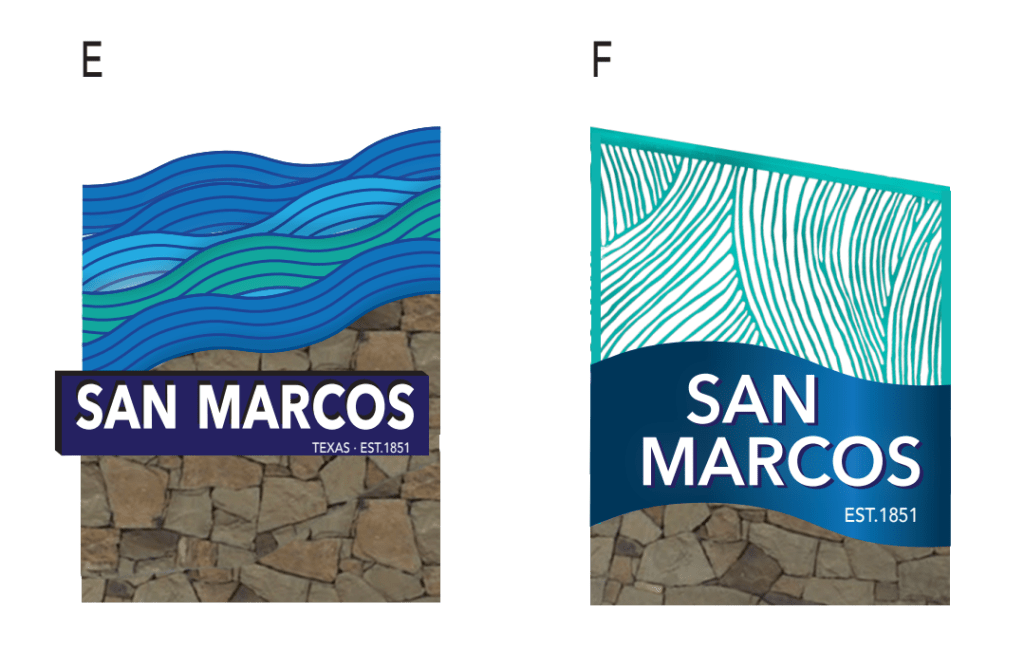
Council hemmed and hawed, and asked staff to bring two more final choices back.
So these are the two finalists:
I like these rocks better! These look like river rocks, not suburban masonry. But the new heron is worse. It was better off-center with the blue outline, I think.
The one on the left reads: “State Park, but make it Business-Professional.” I’m okay with that vibe.
They will be located at these two locations:
I always enjoy it when staff draws the city sideways. Look at that wonky compass in the corner:
What’s reality anyway, man? Time is a construct! North is an illusion! You’re not the boss of me!
What does Council think?
Mayor Hughson, with a pained expression: So these are our only two choices?
Staff: You literally told us to only bring back two.
Mayor, deep sigh, clearly repressing the urge to say, “But I didn’t mean this crap.”
Matthew Mendoza: Maybe it’s because I live in Rio Vista, but I love the heron! It symbolizes conservation and the environment. Option B for Bird.
Alyssa Garza: I like the bird. Ever since I first visited San Marcos, I’ve seen those beautiful white birds. Option B.
Jane Hughson: The bird does not represent the whole city. It could be a neighborhood sign, but I don’t like it here. Option A.
Mark Gleason: The bird is not the mascot of San Marcos. It’s distracting. Option A.
Saul Gonzalez is also for Option A. (Jude and Shane are absent.)
So it’s 3-2. Council argues about whether to wait until Jude and Shane are back, so that one option can get a full four votes. Alyssa weighs in: “I truly don’t care. We are spending way too much time on this. I’ll switch my vote.”
So the State-Park-But-Business sign wins with a clean four votes. And City Council gave the bird to the bird. (Ba dum ching.)
….
Matthew: Can we cycle through different colors for the lighting? Purple on Rattler nights, Maroon on Bobcat nights, holiday colors around the holidays?
Answer: Yes! As long as it’s static. TxDOT just says no moving parts.
So there you have it. At some point this year, these harmless little welcome signs will appear on I-35.
…
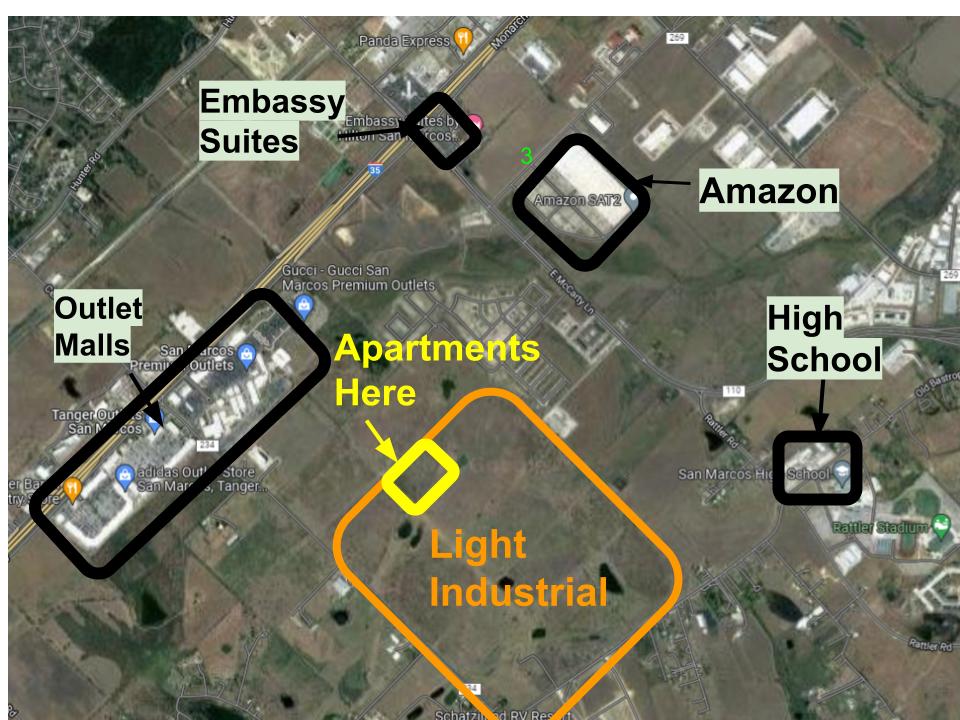
Item 9: Rezoning 18 acres behind the outlet malls.
This has come up before. It’s part of a larger chunk of land:
Mostly light industrial, but with this one little piece for apartments. These were never built, either!
The current owners want to change the yellow square to Light Industrial, to go along with the rest.
Saul is the only one who asks questions:
What is the expected tax revenue for this?
Staff says, “We can’t give an estimate.”
What is the impact on the neighbors?
Answer: They’re all doing the same thing.
It passes 5-0.
…
Item 11: We are fiddling with little parking details, as discussed here.
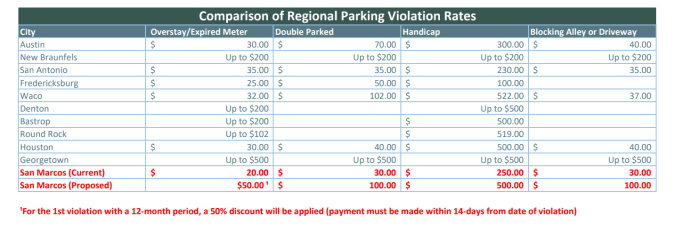
Among other things, we are raising the parking ticket fees, for the first time in 50 years:
I didn’t really know what to make of this. Are the little cities price gouging? Or are the big cities subsidizing bad behavior? So I emailed the chair of the parking committee (Rosalie Ray), who tells me:
– By state law, your fine for illegally parking in a handicap spot must be at least $500. So those cities with cheaper fines in that category just haven’t updated their fees since 2009, when that law was passed. (We hadn’t updated ours since 1974!)
– To avoid price-gouging, the committee has a couple things in place:
you can opt for community service instead of a fine,
you can get a payment plan, and
you can get your fine cut in half by responding within 14 days. (Council could extend the 50% discount to double-parking and blocking alleys, if they want.)
– The main targets are things like FedEx and delivery trucks. They’re the ones blocking alleys and bike lanes or double-parking. So we want them to pay their fair share.
We’re now three years deep in writing the Comprehensive Plan, or VisionSMTX. (Discussed here, here, here, here, and here.) – Years 1-2: a 30 person citizen group meets and a draft is written. – Year 3: A subcommittee from P&Z guts a lot of the important details meant to address suburban sprawl and unaffordable housing. P&Z passed the gutted version.
So how will council go about getting community input?
Basically, a massive outreach campaign. City staff is going to carpet bomb the city with fliers and emails. They’re going to put a little insert in with your utility bills. They’re going to wash social media in links. They’re going all out.
You’ll be able to:
Fill out a survey on paper, or
Fill it out online, or
Leave comments directly on the Summary of Changes table, for other people to read.
The survey opens February 2nd and closes February 23rd.
The problem is that the actual document is long and boring, and the details are fiddly. The summary table is 22 pages long! So it’s going to be hard to get people to wade into it.
Here is my plan: I’m going to try to provide a cheat sheet. If you care about the same things I care about, I’ll have some language that anyone can borrow, to make it easier to fill out the survey.
What did Council think?
Jane Hughson starts, “A common complaint is that this is all about protecting rich neighborhoods. But this is about protecting all neighborhoods! Not just the wealthy ones!”
That is not my complaint. Sure, yes: the changes apply to all the neighborhoods. My complaint is that “protecting all neighborhoods” means locking in sprawl and preventing renters from living in quiet neighborhoods.
There is some bickering over the third survey option, where you’ll be able to write comments directly on the Summary Table. Should comments have a “reply” feature, so that people can go back and forth in a single thread?
Jane and Mark say no. It will disintegrate into fighting, and intimidate people who might not comment out of fear of having their comments shredded. Plus, anyone can leave a new comment and respond to another comment – it just wouldn’t be a “reply” feature on a comment.
Alyssa feels strongly that we should be able to. Adults aren’t kids and you don’t need to be coddling them. Classrooms use this kind of thing all the time. If people can’t handle this level of discourse, they should go to therapy.
Matthew Mendoza says that he’s okay with a little back and forth.
So it’s tied 2-2. Jane says, “Saul, you’re the tie-breaker. What do you want to do?”
Saul says, “I’ll go with the majority.”
Jane: [Eyes bug out.]
Saul: Ok, just comments. No back and forth.
In Saul’s defense, he seems to be feeling really under the weather. Later, when asked for his opinion, he just weakly says, “I took some Advil…”
I’m with Jane, Mark and Saul here: classrooms are heavily moderated by the instructor. Unmoderated spaces deteriorate fast. I personally would not wade into a situation if it felt like a cesspool to me.
…
Q&A with the Press and Public:
LMC asks about the Gateway signs. How much did we pay the consultants? How much staff time? How much will the signs cost?
Answer: The consultants were $63K. The signs will cost $200-250K. It takes staff about 1-2 hours per week.
…
That was the whole meeting! It was short and sweet.
The Can Ban: let’s hammer out some of the details.
First, Texas State has agreed to put can-ban rules in Sewell Park that match whatever the city comes up with for the River Parks. So that’s good!
Next, there was a long bit on enforcement, by the City Marshal’s office. The City Marshal’s office has two sergeants, eight marshals, and two part-time park rangers. It was basically a big pitch on why we need to hire more marshals.
Here’s the main differences between marshals and park rangers:
Marshals can arrest people, park rangers can just give minor citations.
Marshals are hired fulltime, park rangers are just hired for the summer. During the off-peak months (ie during the school year), marshals help out SMPD.
Marshals wear blue uniforms and look like cops, park rangers wear green uniforms and look like nerds. (Kidding! Sorry!)
That last point is the most important one: Marshals wear blue, rangers wear green.
So when it comes to the can ban, why do we need more Blue, instead of more Green? Here’s what it says on the slide:
Park rangers writing citations isn’t enough? We need law enforcement officers who can arrest people? This is ludicrous.
Alyssa asks if we could hire more park rangers, instead of marshals. She points out that we’re not planning on enforcing the can ban via arrests.
The answer given is that it’s very hard to hire park rangers, because they’re part time.
Surely the city can invent some sort of, idk, FULL TIME park ranger? If we are interested in finding ways not to over-police this town, we’d reach for Green Uniforms over Blue Uniforms when they’re equally qualified to do the job at hand.
Here’s the plain truth: the City Marshal’s office already wanted more marshals hired. (They said this explicitly.) They are using the can ban as an opportunity to lobby for the marshals they already wanted. It just rings a little phony to pretend that a can ban is a dangerous crisis that can only be solved with more cops.
Mark Gleason feels very strongly in favor of hiring more marshals, regardless of whether or not we pass the can ban. The whole presentation pulled at his heartstrings.
….
A few decision points for Council:
Should it be a ban on single-use beverages, or all single-use containers?
The consensus is just beverages. I’m okay with this.
Should it be on the river alone, or only in the parks, or should it be both river and parks?
Everyone thinks it must include the river.
One possibility is “go zones and no zones” – little carved out areas where you may have single-use beverages, like inside the playground at the children’s park, or inside the fence of the baseball fields, at the pool, or at picnic tables set back from the river. Everyone is open to the idea of go-zones/no-zones.
Coolers: should we limit cooler size?
No, we shouldn’t. Next question!!
Why would you even? New Braunfels limits cooler size, because they’ve got a tight exit on the river, and giant coolers cause tubing traffic jams. But that’s not our situation. We’ve got large multi-generational families holding large picnics. Are we really going to make Mom/Dad/Aunt/Uncle/Grandma each bring their individual cooler? That seems dumb as shit.
What does council think?
Jane Hughson: This is just another thing to enforce. But why does anyone need a giant cooler?
(See, she’s missing the bit about large groups bringing one big cooler.)
Mark Gleason: Yes on limiting cooler size. 30 quart limit for both river and the parks.
He means this:
So you are not going to be able to bring your big tray of shredded pork for sandwiches, or your tub of potato salad, or much of anything.
Seriously: this is more about shutting down big family gatherings than about controlling litter. Maybe Council doesn’t intend that, but that’s the effect. It’s kinda racist and classist because the river parks are a free way to have large, inter-generational family gatherings.
Matthew Mendoza: 30 quarts on the river, no restrictions for coolers in the parks.
(I’d be okay with that.)
Alyssa Garza: No restrictions anywhere.
(and this.)
Saul Gonzales: 30 quarts in both the river and the parks.
Jane Hughson: If we say 1 cooler per person, can two people bring a 60 quart cooler?
No one answers.
Jane: Okay, I’ll say 30 quarts in both river and parks, too.
So there you have it: 3-2 for banning big coolers, both in the river and in the parks. (Shane Scott and Jude Prather are both absent.)
Note: the amendment that Alyssa or Matt should offer is to tag coolers to the “go zones”. In go-zones, you can have your big cooler. In no-zones, you can’t.
What about jello shots?
The way New Braunfels banned jello shots was by banning containers that hold less than 5 oz.
Everyone likes this, besides Alyssa, who says she needs to go talk to her constituents.
My two cents: sure, ban the jello shots and mini-liquor bottles. These seem like single use beverage containers to me, anyway.
When should this go into effect?
Everyone wants to aim for this summer, instead of waiting for 2025.
The next step is for staff to write up a proposed policy, and bring it to city council for a vote.
Last meeting of the year! Let’s fix the sidewalks, spend the flood money, and not drink the contaminated water under Guadalupe. And we’re going to overthink Citizen Comment and the HSAB grant money, while we’re at it.
We’ve got:
Hours 0:00-1:20: Sidewalk repair, flood money, and toxic chemicals in the ground – let’s talk about how we fix the city. Hours 1:20-2:37: In which which we scrutinize Citizen Comment and the HSAB grant money process. We also push back the final vote on VisionSMTX, date TBD.
That’s it until January 16th! Hope you enjoy a little of whatever refills your cup, between now and then.
People talked about: - Funding for rehabilitating various buildings in Dunbar – Whether we really want to change the name of Citizen Comment to “Community Perspectives” or not. – Concerns over police accountability – How Mark Gleason got a letter of admonishment from the Ethics Review Commission, for voting on items where he should have recused himself. Specifically, he voted on the meet-and-confer contract for the fire fighters union, after receiving several donations of different sorts from them. (Details here but all you can do is watch a video. There are no minutes or documents.) – Max Baker is starting a monthly San Marcos Civics Club, to get the public engaged and hold City Council accountable. (I imagine you could reach out to him on Facebook if you’re interested, and he’d be glad to have you.)
Item 1: We have a Sidewalk Maintenance Program.
Basically, the city looks for places where people are complaining, or there are pedestrian traffic accidents, or underserved areas, or high pedestrian traffic areas.
This is the type of thing they do:
Here’s what’s going on for the next year:
The five year plan is a little more loosey-goosey and responsive to changing needs, but here’s the tentative map:
Jude Prather: there’s been a lot of improvement to our sidewalks. Let’s keep the gas pedal on.
Shane Scott: It happened outside my shop. They were really careful about the tree roots.
Mark Gleason: It happened to me! They laid the sidewalk today. They were very professional and they were careful of my trees. Added convenience and safety.
Mark Gleason does have one suggestion, which is that the city should use goat paths to identify potential places for new sidewalks.
I think he means this kind of thing, where over time people have worn a little path:
Alyssa: Great job. One of my neighbors posted about their really positive interactions with the city.
Jane: We started thinking about sidewalks in 1992, we said “schools and grocery stores.” So we’ve come a long way.
One issue is how to add sidewalks to streets where we don’t have a right-of-way. In other words, how do we build a sidewalk in a high-needs spot, where the city doesn’t own an easement along the road? Jane asks about this.
Answer: It makes it a bigger project than the Sidewalks Maintenance Project. We have to collaborate with Public Works. It goes on the CIP list.
My two cents: We need sidewalks running out to the high school. I know it’s far away, because that’s where land was cheap enough to acquire. Do not put a bike lane that feels like part of the street down 123 – put in a proper sidewalk. All the way to the high school. (And do it now, because a lot of that empty land is zoned for housing and apartments, and putting sidewalks in will get even harder.)
Item 18: Flood money.
After the 2015 floods, we got a big chunk of CBDG money from the federal government. It comes in two flavors:
Housing assistance
Stormwater projects
For Housing Assistance, we built 14 homes and repaired some of the public housing homes on CM Allen. (We discussed a few of these homes last year, being built in Sunset Acres.)
It’s depressing that it took eight years to get these people into safe housing. I think the main reason is that there were five rounds of funding, and so those from the first few rounds got their housing sooner. Plus I’m sure there were Covid delays, and some of it was generic government red tape. The last few houses remaining were finished this past year.
Three applicants withdrew in 2022 and 2023, and at that point it was too late to get new applicants, and so the housing portion came in $1 million under budget.
On the stormwater projects, we’ve got:
Uhland Road Improvements:
This one finished up in the fall.
2. Midtown Drainage – Aquarena Springs and I-35
This one will finish in April 2024.
3. Blanco Riverine: Berm and Floodwall
This one is supposed to finish in June 2024.
We discussed this one briefly back here. It’s a really big project:
and it’s supposed to do this sort of thing:
Basically geo-engineering a place for the water to go when it floods, instead of going into Blanco Gardens.
4. Blanco Gardens Drainage Improvements
This one is supposed to finish in August 2024.
The point of today’s presentation is that as some of the projects wrap up and have a little money leftover, the money gets shuffled around to the other ones that are still ongoing.
There are some other projects that will take a little longer to finish: – Acquiring land for flood prevention – Electronic rain gauges that are tied into the flood warning system – 3 sets of permanent flood gates: Cape Road, McKie Street, and Jackman Street/Gravel Street.
This is all supposed to wrap up by 2027.
What does City Council have to say? Saul: On Barbara Drive: what kind of drainage? Looks different than Conway. Answer: It’s the same as on Conway. They’re both Open Channel.
Saul: Is it dangerous for kids? Answer: Velocities should be slow. Will have gates. Won’t have easy access.
Mark: I was personally affected by all the flooding. We’re still dealing with the ramifications.
Mark has a few questions: – Will the new raingauges be integrated with the WETmap website on the Hays county website? Answer: Yes. – Will emergency info/river flood data be shared with NOA? Answer: I assume so but I don’t know for sure. – When will rain gauges be done? Answer: End of 2023, but they’ll be tinkered with in the Stormwater Master Plan. – What kind of gate are you using for gating off those channels? Answer: Single arm. – So people are losing access to these alleys in Blanco Gardens. Are they aware? Answer: we sent notifications and knocked on some doors.
Shane Scott asks the hard-hitting questions: What about Quiet Zones for trains? Answer: That’s a totally different topic. Different grant money.
Alyssa: I was also in Blanco Gardens during the floods. As projects wrap up, can we get back to the people in these neighborhoods? We need to explain that we’re working through issues and they haven’t been forgotten. Answer: there will be ribbon cuttings, etc.
Saul: A neighbor said they’ll only be allowed to have 1 cable. Is that true? Answer: Yes. There are 3 telecom companies. Time-warner/Spectrum, Astound/Grande, CenturyLink/Brightspeed. Two of these pulled out of Blanco Gardens. So you basically only have Spectrum.
This is just a discussion item, so there’s no vote.
Item 19: There are some toxic chemicals under Guadalupe. (We talked about this here a few months ago.)
Short version: there’s a bunch of groundwater toxic chemicals – PERCs, TCEs, VCs – deep in the ground, leftover from some dry cleaning businesses 40+ years ago. They’re really not good, but the chemicals will break down over the next 100 years into carbon dioxide, a little chlorine, and water, which are not so bad. They’ve basically sunk down way underground, into this stuff called Navarro Clay, which is a super thick gunky layer that just sits there underground, above the water table of the aquifer. So we can’t really clean it up, but they’re also not going to get into the river or the aquifer water table. We mostly need to leave them untouched until they decompose.
Here’s the three properties we bought, at the site of the original contamination:
The official way to let the chemicals sit there is to set up a Municipal Settings Designation, or MSD:
In this region, no one can drill any groundwater wells. You already can’t, because it’s within city limits, but now you EXTRA can’t.
We notified anyone who has a private well within 5 miles of this site. That worked out to 109 well owners. None of them seemed particularly concerned.
Item 4: ”Citizen Comment” vs. “Community Perspectives”
Shane pulled this item from the Consent Agenda.
Backstory
Mayor Hughson decided to clean up the city ordinances on committee meetings. She flagged a bunch of things that were inconsistent or unclear. One thing she noticed is that “Citizen Comment” is a terrible phrase, because you don’t actually have to be a citizen in order to comment. It sends a bad message.
We’ve discussed this here and here. Jane suggested “Community Perspectives” and in the past two months, no one ever protested it.
Here we go:
Shane says that he doesn’t like “Community Perspectives” because it implies that each speaker represents the entire community, instead of their own individual opinion.
Look, clearly “Community Perspectives” is a bit dippy. It sounds like a church bulletin board. But Shane’s complaint is also silly. No one is going to think that some rando speaker is supposed to represent everyone in town. It’s not “Community Spokesperson.”
Jane, wearily: We’ve talked about this on a bunch of occasions.
Shane: I’ll just vote against it.
Jane: The entire list of all the changes?!
Shane: No, just this one.
Jane: You can’t just vote against one.
Shane: Oh right.
So Shane makes a motion: Keep it “Citizen Comment” after all. Alyssa seconds it.
Saul: I’m fine the way it is. Citizen Comment.
Matthew: I don’t care either way.
Jane: Honestly, I was concerned about changing it, because it’s been called “Citizen Comment” for years. Everyone is used to that. But I just don’t want anyone to feel excluded.
Alyssa: I appreciate that. But maybe we can just say something on the website.
Mark: I’m on the fence. Everyone knows it as Citizen Comment.
The vote to amend:
Keep calling it Citizen Comment: All seven councilmembers
Change to Community Perspectives: no one.
On a scale of 1-10 of importance, this is maybe a 2. Nevertheless, they got it wrong! “Citizen Comment” is bad because “citizen” is exclusive. Jane is exactly right here.
Off the top of my head, they could have gone with: – Community Comment – Open Comment – Civic Comment – Citizens-and-Not-Citizens Comment (okay, now I’m getting punchy)
I know they’re worried that changing the name would up-end years of familiarity. But that’s tunnel vision from being in the center of the action for too long. Most of San Marcos is not paying any attention to City Council at all! Those who know the phrase “Citizen Comment” are not emotionally attached to it. You can switch to “Open Comment” and we’ll all be okay.
They didn’t want to go with “Public Comment” because it sounds very similar to “Public Hearing,” which is a specific different thing.
Oh well!
The vote on all the little changes that Jane proposed:
Yes: Everyone. No: No one.
….
Item 21: Gary Softball Sports Complex is getting renovated.
There were no slides or pictures for me to nab for you.
….
Item 23: Human Services Advisory Board (HSAB) Funding Policy
We’re going to spend some time on this item, because it drove me batty.
Backstory
Earlier in December, we allocated $650K in grant money to local nonprofits. There were 34 applications. Each nonprofit got between $5K and $34K, except for the Hays-Caldwell Women’s Shelter and the Hays County Food Bank, which got $50K and $80K respectively.
I griped last time that Council makes these nonprofits jump through a lot of hoops, while we just hand out other money seamlessly and invisibly.
Guys. guys. We are about to get SO MUCH MORE micromanaging of this whole mess. We are going to nitpick this thing to death.
The current issue
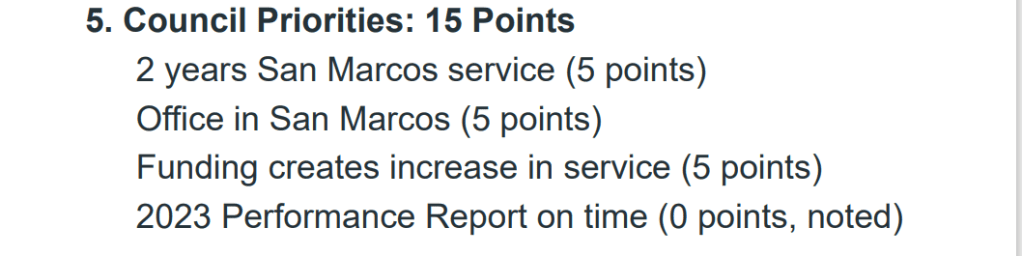
Recall that the HSAB committee assigned points according to this rubric:
Jane is mad about Council Priorities being neglected. It’s only 15 points! Nevermind that people with nonprofit experience developed priorities 1-4, and that Council Priorities are somewhat redundant.
Here are the things that Jane’s mad about:
It’s not punitive enough if performance reports are late.
The Council priorities should add up to 25 or more points!
We want to know where the board members live. Do they live in San Marcos? Do they live in Kyle? In Austin?
They should spell out all acronyms. No unclear abbreviations. (I acknowledge this one. They really should.)
Complaint #1: Those Pesky Performance Reports:
Because last year was so weird, the money wasn’t approved until March. So the whole calendar was up-ended. The nonprofits were supposed to turn in mid-year reports when they re-applied for new funding in August. One nonprofit was late by one day, due to turnover in staffing. One other nonprofit was later, but ended up withdrawing altogether.
So there is not really a problem here: nearly everyone turned in their mid-year reports on time. Final reports will be due at the end of January.
First off, everyone seemed really confused about the calendar. It is legitimately confusing, because it was never spelled out clearly up front.
Here’s the normal situation:
A funding cycle is three years:
Year A: You apply and get your money. (Applications are due in August, money awarded in December.) Year B: You spend your money. (It’s a calendar year, Jan-December) Year C: You turn in your final report. (It’s due by January 31st)
If you are re-applying for funding, you’d apply again in Year B. So your final report from the previous cycle isn’t available yet, because you’re still spending that money.
Jane is acting like it’s a two year cycle, and that it’s just incompetence that keeps nonprofits from having their final report on time. The staff member gently tried to explain, but Jane kept misinterpreting the explanation. (Jane kept acting like the issue was nonprofits that skipped an application cycle, and she’s say things like “If they didn’t apply for a year, then they should just turn in the most recent report.”)
Alyssa: Working for a nonprofit, you are constantly dealing with so many grants, and this is a small amount of money. These are good people, overworked on a shoestring budget, and we’re offering them 50¢. Can’t we have just have grace for our neighbors? Let them work it out on a case-by-case basis with staff?
I’m going to skip about 20 minutes of haggling between councilmembers, but suffice it to say: No. We cannot have grace for our neighbors. Matthew Mendoza is the biggest hard-ass of all, harping on how everything needs to be promptly on time, no exceptions.
Jane: How about this: the report is due in August. We’ll accept late reports, as long as the final report is in before the committee needs to consider applications.
The staff member tries to explain again: this year, only half-year reports were due Oct 15th. The Board considers applications in November. So the nonprofits really can’t get final reports in by decision time. They can submit final reports eventually though.
Jane: We’re going to need to see the final report!
Answer: The final reports are due January 31st. So they could easily submit that for the following cycle, in August?
Jane: Yes. Have them print it out again.Thank you.
Bottom line: if you’re funded in Year A, you’ll submit that report two years later, when you re-apply for funding August of Year C. No one could possibly be late with their final report, because it was due seven months earlier, in January.
Alyssa, “This is really insulting, because it’s not actually a problem. Bigger granting agencies handle extenuating circumstances with grace all the time. We’re the ones treating nonprofits like they can’t handle being professional.”
Alyssa is right. The whole tone of this conversation is that nonprofits are naughty wayward children, and if they carry on, they shan’t have any figgy pudding.
Such naughty, naughty non-profits.
Complaint #2: Council priorities should add up to more points!
We’re talking about this slide again. Jane suggests that the points allocated should be:
2 years San Marcos Service (5 points 10 points) Office in San Marcos (5 points 10 points) Funding creates increase in service (5 points)
Everyone nods compliantly.
Alyssa: What’s the rationale behind increasing the first two and leaving the third the same?
Jane: No reason! We could do 10/10/10, make it 30 total!
This is exactly how haphazard this all is. She’s not actually making a claim about the relative merits of the bullet points. Council just felt neglected, since their priorities were only worth 15 points. (I think they settled on 10/10/10.)
Complaints #s…: Other Things
Jane would like to know which cities the board members live in. She doesn’t need to know their address, but she is interested to know if they live in San Marcos, or Kyle, or Austin, or what.
Jane wants to require them to spell out acronyms. (One application didn’t.)
No one objects to these two criterion, although I assume Alyssa rolled her eyes. I mean, it’s good manners to spell out your acronyms, but I wouldn’t make it a rule.
Matthew: Can we ask them what percentage this grant is of their total budget? Answer: We already know this, based on the information provided.
Jane: Could they could have a coversheet that divided the applications, with the organization’s name and their San Marcos address with their requested amount? Answer: no problem.
(I actually find this one quite reasonable. It’s just about improving the readability of the applications. And staff can implement this without inconveniencing the nonprofits.)
Jane: Will Council be able to review and vote on the final draft of the application and rules? Answer: No problem.
Alyssa has one final comment. “Can we see this level of accountability and reports when we talk about the police department, or the fire department, or public works? We give the police $322 per resident. We give the fire department $218 per resident. And we give public works $141 per resident. Yet we are wasting all of this time over the HSAB board, which works out to… $7 per resident. Can we carry this energy when we talk about budgets in general?”
Jane responds: That’s different. Those are all city departments with department heads that report to us.
Let’s analyze this last bit. Who gets micromanaged, and who doesn’t?
It is true that micromanaging city departments is different than micromanaging contracts and grants to external groups.
However, all of those departments have many external contracts that run between $5K and $35K, and those contracts do not get scrutinized by council. We just trust the department.
In fact, immediately before this item, we approved a contract for $1 million, for improvements at Gary Softball Complex. We did not check whether the contractor was a local company. (They are not local.) We did not ask the private company to explain what all the acronyms meant! We did not second-guess how council priorities were weighted in the selection criteria. We just voted yes, because we trusted the city staff that recommended the construction agency.
Furthermore, there are at least two Very Special Nonprofits that the city negotiates with directly. 1. The Greater San Marcos Partnership, or GSMP.
Back in 2021, we signed a three year contract with them for $400,000 each year. They get $1.2 million dollars! Isn’t that something.
GSMP has to submit a yearly report card. The last – and only! – time they gave an update to City Council was back in May 2022. I can’t find any yearly report cards on on the San Marcos website, so transparency is nonexistent there. From the GSMP website, here’s their yearly report from 2022. It reads more like a promotional brochure than a detailed report, though. Is that the same as a yearly report card? I have no idea!
Things no one on Council cared about:
Where the board members live. Do the GSMP board members live in Wimberly? In Austin? Who knows. Because no one cares.
The exact date that the report was submitted, or whether yearly reports are happening at all. City Council has not hyperventilated about this yet.
Whether all the acronyms were spelled out precisely. In fact, there are a lot of abbreviations!
What percent the San Marcos money is of their total budgets.
What a funny thing, right? (I actually wrote about the contract with GSMP here, but I was a newbie blogger and was still trying to get the hang of it.)
There has not been any discussion that I can see about this money since a work session in 2020. I did not watch the work session, but the powerpoint slides are very vague and uninformative.
Here’s the thing: I don’t think we should micromanage GSMP or Chamber of Commerce, either! We could have a philosophical conversation about how they benefit the community, but I think they basically do what they say they’re doing. (I’m not opposed to the idea supporting small, locally owned businesses. We can quibble about dollar amounts some other time.)
The point is that we treat these groups like professional adults. If they’re late, we pick up the phone and give them a call. If there’s a confusing acronym, we shoot them an email. We don’t act like a grumpy school principal who posts an additional rule on the bulletin board every time someone misbehaves.
Finally: it helps small locally-owned businesses if we lift people out of poverty. Middle class people can eat out downtown more than poor people can! Supporting the most vulnerable members of our community is actually best for everyone.
…
Item 24: Should we postpone VisionSMTX?
Right now, VisionSMTX is supposed to come around on January 16th for a final vote. In the meantime, a subcommittee had been meeting, and they’re recommending that we do more community outreach.
There’s a brief discussion, and Jane checks with everyone informally. It’s really hard to hear who is a “yes” and who is a “no”, but I think this is how it goes:
Check-in on January 16th, but not the final vote: Everyone except Matthew Mendoza Final vote should be Jan 16th: Matthew Mendoza
I’m not sure what Matthew is hung up on. He clearly has some strong opinions about this process, but didn’t quite say what’s bugging him.
Hello everyone! It’s been a whole Thanksgiving and Sights & Sounds since I last saw you. Today’s big topics are HSAB grants to nonprofits, and getting into the details of a can ban on the river.
Here we go:
Hours 0:00 – 1:51: A small apartment complex, a road name change, and we debate how to spend $650,000 of HSAB grant money.
Hours 1:51 – 3:03: New ACC classrooms, electric city vehicles, and how would a potential ban on single-use beverage containers exactly work?
That’s a wrap! See you in two weeks, for the last meeting of the year!








 The San Marxist