Hours 0:00 – 5:18, 4/2/24

Citizen comments:

Let’s organize this by topic.

  1.  Calling for Council to pass a resolution for a ceasefire in Gaza.

There were 9 speakers on this topic.  That’s a LOT!  Especially because different activists have shown up pretty much every meeting since January.

One speaker said she’d met with Mayor Hughson about this. Apparently Jane’s response was, “What good can little old San Marcos do?” and worrying over internal division.  It’s easy to see where Jane is coming from – why bother going out on a limb, when it doesn’t benefit the San Marcos directly? 

But the thing is, it does matter to people who live here – they’re showing up and telling you this, over and over again – and they’re correct that US taxpayers are contributing towards this is a horrific bloodbath. The reason that cities should call for a ceasefire is to amplify the voices of its citizens towards the federal government. (It’s not just San Marcos. 100 cities have done so already and here’s a partial list from February.)

And look: the grassroots pressure is working – Biden’s relations with Netanyahu are getting increasingly frosty.  It’s going extremely slow, but Biden is responding to public pressure. 

Here’s the other thing: ignoring this many speakers is a REALLY bad look.  Why not call for a ceasefire? It’s very easy and respects the voices in your community. 

……

Fast-forward six hours. It’s almost midnight and everyone is tired. At the very end of the meeting, there was one person left for Q&A. She asked Council, “Would you vote yes for a ceasefire resolution, if it were before you right now?”

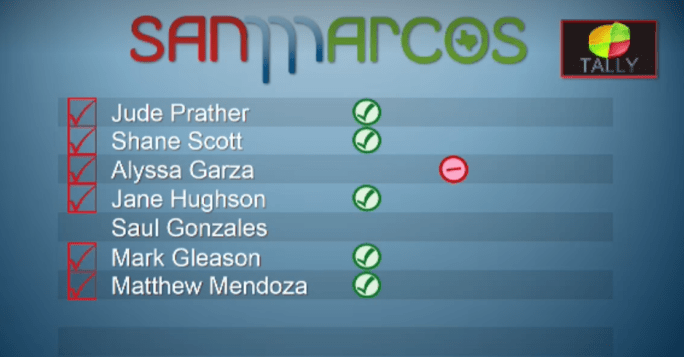
Alyssa Garza said yes, of course.

As the question hung in the air, the lawyer spoke up and said something like, “This item is not on the agenda for discussion, and it’s most likely a violation of the Texas Open Meetings Act if you all discuss it in public, without it being posted with advance notice so that anyone can attend.”

Jane Hughson said she’d wait to discuss it until it is properly on an agenda. (Guess who controls the agenda?)

Shane Scott shrugged and said sure – he’d sign anything that has the word “peace” in it.

Mark Gleason said he’d vote no, this is a local government and it’s a waste of taxpayer money and everyone’s time to weigh in on international matters.

Saul Gonzales, Jude Prather, and Matthew Mendoza just stayed quiet, and let the moment pass.

  1.  One speaker talked about civil discourse, and how it’s deteriorated. The claim was that pre-social media, speakers used to hug and mingle in the hall, and then put their differences aside after they spoke. 

    But now they get skewered ruthlessly online.  It’s very nerve-wracking to talk at City Council, and the rude treatment online doesn’t help. Threat of retaliation, intimidation, vitriol, even from people you might otherwise agree with. We should support the people who speak up at council and respond civilly.

So I am probably part of the online crowd being referred to here? I feel ambivalent about this.  

It does take courage to speak at city council meetings! We need people in the community willing to step up and present their point of view.  If I’m over here jeering and mocking from the cozy sanctity of my blog, it could make people less likely participate.

But on the other hand, speakers are advocating for a particular policy outcome.  They are trying to tip how an issue plays out. That affects other people.  If I think they’re peddling crap, I want to explain this to my readers, because I’m also advocating for particular policy outcomes.

(Ok fine, but do I have to be so mean about it?  I try not to be mean exactly, but it’s kind of lifeless and dull to write a blog without any kidding around. But I do try to stick to ripping on people’s positions and arguments, and never make personal attacks.)

  1. Lindsey Street apartments.  This is what we’re spending nearly all the meeting on. Let’s not make that part even longer than it needs to be.

Items 8-11: Those dang Lindsey Street Apartments. 

Quick backstory:

Should we allow student apartments here?

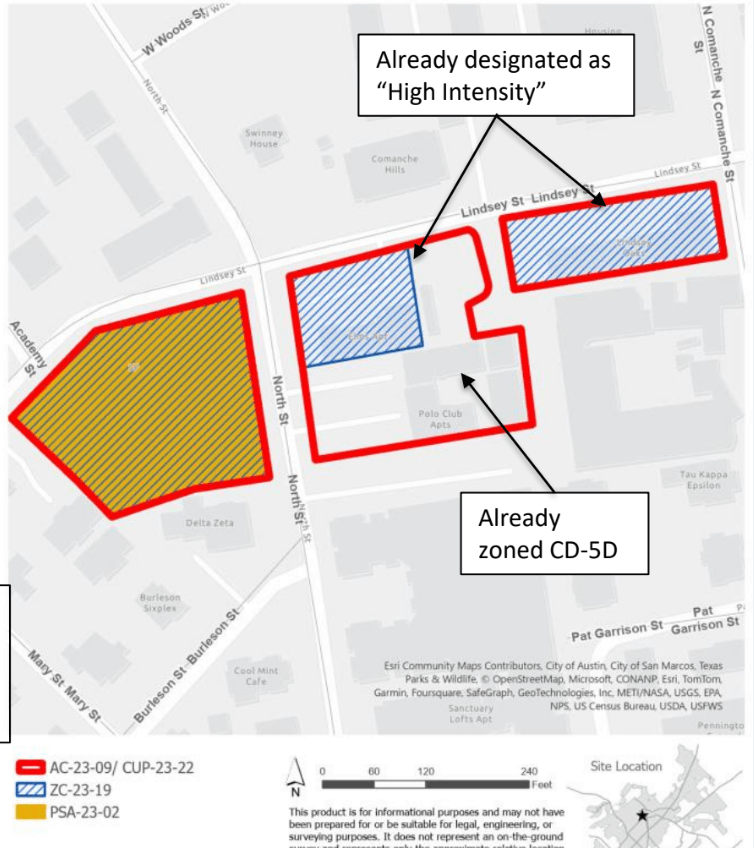
The street dividing the two pink parts  is North Street, and it’s also the official boundary for downtown.

So we end up having separate conversations about the West Half, the pentagon on the left, and the East Half on the right.

What did P&Z say?

For the West Half: P&Z said “Get outta here, ya punk.”  No to everything that the developer asked for. (Discussed here.)

For the East Half, P&Z hedged:

  • They agreed to rezone it CD-5D, instead of the mishmash of antiquated zonings that we don’t use any more.  
  • They agreed to permit it for Purpose-Built Student Housing.
  • They said no to 7 stories of height.  

Last week, Council discussed the property west of North Street, but didn’t vote.

The Citizen Comments:

Look: my whole shtick is that I care about all the little San Marcos issues, right? Every two weeks I get down in the weeds with you. And yet …I just don’t care about these apartments.  At all. I just don’t. I can’t muster any enthusiasm either way. 

But other people do! So let’s get into it. First, public comments:

Arguments that I just don’t get:

  • Student housing is full of mold, foundational issues, pest infestation, water problems, and other maintenance issues. Complexes won’t address these issues.
  • Halt any developments that might worsen gentrification in San Marcos.
  • Do not build more student housing without resolving the existing problems of student housing.
  • RBB leasing process is exploitative because students view an immaculate show apartment and not the actual apartment that they end up leasing. When students move into their actual shitty new digs, they lack recourse. They must document every issue within 48 hours or be held liable. This is predatory and manipulative.
  • RBB undermines student retention at Texas State.
  • 90% of the leasing-related conflicts that go to the attorney for students at Texas State involve RBB. [Note: you can’t evaluate this claim unless you know the percent of Texas State students who live in RBBs.]
  • Roommate matching programs are problematic. Sometimes students get placed with families.
  • Students are asked to sign leases up to 10 months ahead of time. This is predatory.
  • Housing is a human right. Therefore we are calling for a 5 year moratorium on RBB housing. This would allow us to focus on fixing the existing problems.
  • Restart the city subcommittee on student housing.
  • Implement a variety of housing options for low-income residents.
  • Invest in code enforcement.
  • There is a housing shortage for students and rents have risen 40% from pre-pandemic levels.
  • This is a Texas State problem, not a San Marcos problem.
  • We are overbuilt on student housing. There are 45 student complexes in town. If you crunch the numbers, we have 20,000 RBB bedrooms, and only 13,000 students trying to find off-campus housing. The further away from campus you get, the more vacancies there are.
  • There is a housing shortage for students and rents have risen 40% from pre-pandemic levels. (I don’t understand how this is an argument against.)
  • Riding shuttles isn’t that bad.
  • This is just like the Blackland neighborhood in Austin.

Look, I’m not trying to be difficult here. I’m just mystified by the arguments above. A lot of them are legitimate problems that need solving. But voting against this complex doesn’t solve any of them!

I suppose the argument is that Council should vote “no” as a protest vote? But against who, themselves? They already have the power to prioritize these issues. You can just directly advocate for council to tackle these issues.

Here’s our city website on tenant resources. Council could spend a lot more money supporting tenants, enforcing code, and combating delinquent leasing agencies and landlords.

Arguments that at least seem relevant to me:

  • Do not displace residents who are currently living in affordable housing.
  • This will be a domino effect. If this is approved, then next will be the land next it it, then next to that, and eventually it will cross Moore street and eat away the historic neighborhood.
  • There have been occasions when apartments weren’t finished being built, but they’d already leased units to students, and so when August came around, the students had nowhere to live.
  • This will be sold to the University immediately, and we’ll lose the tax revenue, just like we did for Santuary Lofts and Vistas.
  • Historic houses need preservation.
  • Traffic and parking will get worse
  • Flooding will get worse

The city and the developer end up working out conditions that sort of address most of these. We’ll discuss this further below.

Arguments in favor:

  • we have student housing, but not enough within walking distance of campus. All the complexes close to campus are full.
  • Good spot for students
  • Tax money is nice.
  • They’re willing to make concessions on some of those points above.

[Technical note: Jude Prather recused himself last week.  Since then, he checked with the lawyer and with the Ethics Review Committee. Everyone gave him a thumbs’ up to participate with a clean conscience. So he’s back in the game.]

Council dives in:

Jude: I’m all in! What a kind and generous developer! I love it.

Saul: Can you guarantee that you won’t turn around and sell this to the University?

Developer: I talked to the bank.  They won’t guarantee my loan if I sign something that says I won’t sell it. The reason is that if I go bankrupt or die or something, the bank wants to be able to sell to the highest bidder.  But they said that they could give me 5-7 years. For the first 5-7 years, I could sign something agreeing not to sell to any entity that doesn’t pay taxes. 

Saul: I’m worried about traffic.

Developer. We did a traffic study.  Students work weird hours at jobs like serving and bartending, and walk to class, so they’re actually not contributing to rush hour traffic.  They don’t tend to have 9-5 jobs. 

Saul: Is this going to be affordable?

Developer: Not really. But there are about 4-5 families that currently live there, and I could extend affordable leases to them in the new building. 

Matthew: I protect the single-family neighborhoods.  My constituents keep telling me “keep the students way over there!”  And students deserve options!

At one point Matthew says, “I never feel right about denying anybody a place to live.”  Can we put that on a t-shirt for the next time he starts talking about occupancy restrictions?!?


“I never feel right about denying anybody a place to live.”

Matthew Mendoza, 4/2/24, 1:53:55

Mark Gleason: This doesn’t encroach on the historic district. It’s a great place for students. The tax dollars will help.  He’s on board.

He asks if we can improve some of the sidewalk gaps in this area, while we’re at it? This is a good thought!

Finally, Mark’s angry that people invoke “flooding” as a weapon to tear down projects they don’t like, because it cheapens the real experience that he and so many others went through. Flooding is not an issue here, because it’s already completely paved. Making it higher doesn’t change the flood-math. (This is correct.) However, speakers kept bringing up the flood risk throughout the night, and eventually Mark lost his temper and snapped at them.

Jane Hughson: Can’t bring herself to do CD-5D west of North street.  What about a lesser zoning like ND4? CD5?

Answer: ND4 has a lot of restrictions. Their architect couldn’t get more than 55 units in.  CD-5D allows for 100 units.

How about CD5? It’s nearly the same as CD-5D, but it doesn’t have the extra D, which literally stands for “Downtown”. This allows Council to say that technically, they didn’t enlarge downtown. They just switched to the non-downtown kind of high intensity zone.

They settle on CD-5D on the east half and CD-5 on the west half. There are some differences in design standards and parking requirements, which we’ll get to in a moment.

….

For a five hour meeting, remarkably little happened. It was incredibly repetitive. So I don’t want to lay it out chronologically because I’d put myself to sleep. Let’s see if I can boil this down enough.

List of Concessions

Tentatively, here’s what the developer is agreeing to do.

  1. The development would be on the rental registry.

This came from P&Z and gets no discussion. No problem.

  1. There are two moderately old, cute houses and one very cute old house on the west side:

The developer is planning on having them moved elsewhere.  Right now they have two parties that are interested in relocating them. 

If both of those fall through, the developer agrees to a 1 year demolition delay instead of a 6 month demolition delay, to give time for another person to come forward. 

3. All the normal code requirements still apply. This is normal.

4. Parking, part 1.

Should a parking space be included in your rent, or should we allow them to charge an additional fee for parking?

The argument goes like this: in places like The Parlor, students don’t use the garage because they don’t want to pay a monthly parking fee. Then they clog up all the parking spaces that the local businesses need for their customers.  Whereas if the parking garage is already included to residents, then students will use the garage and get out of the street spots.

The developer has a ridiculous argument: we don’t want to disincentivize students who may not want to bring a car to campus!  Because we’re environmentalists!

The actual reason is that it drives up their rates, of course, and gives them a competitive disadvantage. Council votes and lets the developer off the hook on this one.

5. If the place is pre-leased and construction isn’t done, you have to provide housing and let tenants out of the lease.  (This is true for all new construction, a change we implemented because it has happened before.)

6. Parking, Part 2.

How many parking spaces should they be required to build?

The East Half is CD-5D. In that zone, you have to build 1.05 spaces per bedroom. The West half is CD-5, and in that zone, you have to build 1 spot per unit, which is way less.

If you’re building a parking garage, each space costs $30K (according to the developer) so they want to provide as little as possible.  They were already discussing parking breaks, before CD-5 was on the table.

Now everyone’s going to crunch the numbers, and finalize this next time.

  1. The CUP will expire in 3 years if they don’t make progress. (This is also standard)
  1. The complexes will offer both Rent By the Bedroom (RBB) and conventional leases on both sides.

Jane asks: Will the conventional leases be priced less than RBBs?

In other words, if you’re charging $1000 per bedroom, and $3000 for a 3-bedroom apartment, you’re not actually offering a conventional lease that anyone will ever sign.  

Developer: Of course we wouldn’t do that! Of course I am just saying random stuff and who knows what I’ll actually do!

  1. They have to build to the silver level in the LEED green building program.
  1. On displacing current tenants and tearing down affordable housing:

Current tenants will given 6 months advance warning .

Up to 5 families will be given a comparable rent in the new development.  (Of course, they’ll have to find other housing for the 3-4 years, while it’s being built.)

12. West of North Street: 

They will cap it at 4 stories. There will only be 1, 2, and 3 bedroom units. At most 80% impervious cover on the ground.

This is all an effort to make the west half less student-y and more general public.

Typically in student housing, there’s one bathroom per unit. In non-student housing, there isn’t. Jane Hughson asks what bathroom ratio he’s thinking for the west non-student side? The developer admits 1 bathroom per bedroom. (More clues that this is just all going to be student housing. Which is fine with me.)

13. On selling to Texas State:

Developer will not sell the property to a non-tax-paying entity for 7 years. The clock starts running at approval, not occupancy.

14. West of North Street will not be designed and marketed to students. It is not permitted as Purpose Built Student Housing. Students can obviously still live there, but the developer has to pretend that it’s regular housing.

…….

HOWEVER! This list of goody concessions is only available to Council if Council agrees to let him go up to 7 stories on the east side. And P&Z said no to this.

What would this look like? 

Here’s the city staff’s slides, showing the heights nearby:

That first one is if you’re standing at Texas State, looking south.
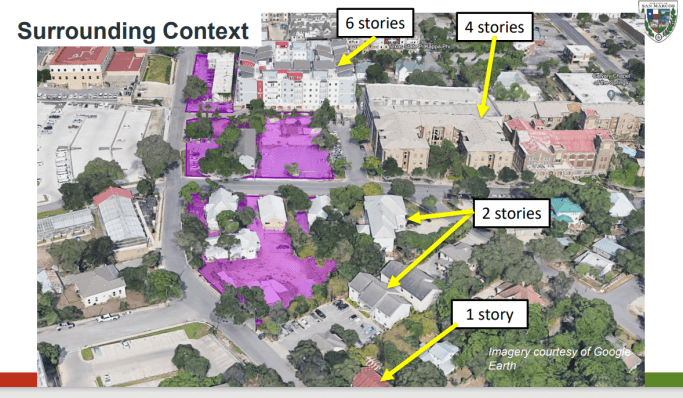
Here you’re standing on the west, looking east. Campus is on the left.

This is similar – you’re standing southwest, looking northeast. Campus is on the top left corner.

Here’s the developer’s mock-up of a 7 story building:

This is the view if you’re standing on the west, looking east, with campus on your left again. Currently the 5 story mock-up in the foreground will actually be 4 stories.

I thought Council would balk at the 7 stories, but they zipped through it and passed it, 5-2.  Of course, it was past 11 pm at that point.  Saul Gonzales and Jane Hughson voted against it.

So here’s where it stands:

  1. The developer got the high intensity PSA they needed on the west side.
  2. The developer got CD-5 on the west, but not CD-5D. This is a meaningless distinction that allows Council to say that they stood firm and refused to extend downtown. 
  3. Council postpones the permit for Purpose Built Student Housing until next time.  This is where everyone agrees to the 14 conditions listed above. Everyone can sleep on it and think it over for an extra week or two before signing off on it.
  4. The developer got their 7 stories on the East half, and 4 stories on the West.

Hours 3:18-3:28, 4/2/24

Only one measly other item worth writing about! (It came during a small break in Lindsey Hill items, if you’re wondering about the time stamps above.)

Item 12: Water conservation.

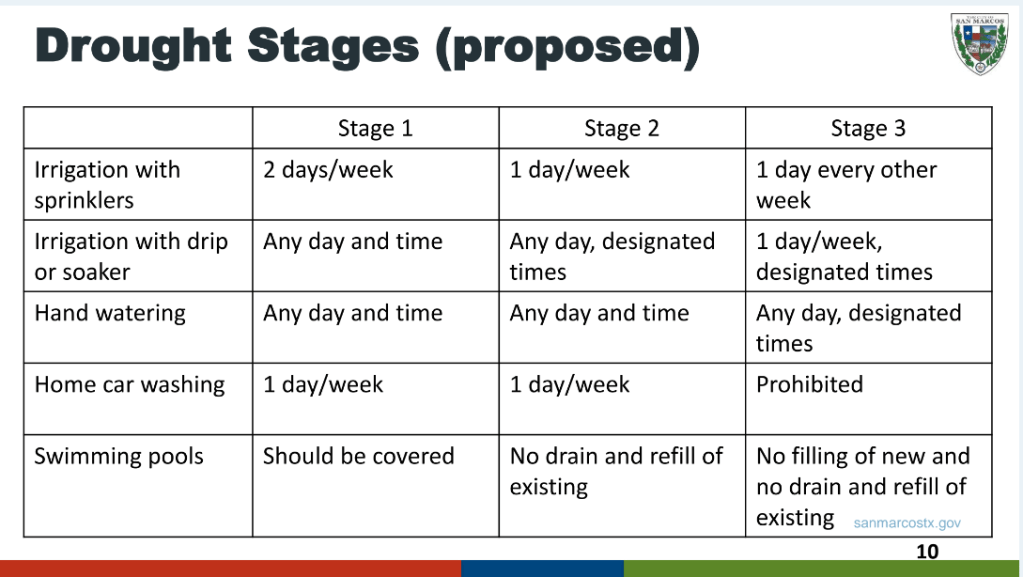
We discussed the new stages at the workshop last time.

We’re going from five stages to three stages.

The director (Virginia Parker) of the San Marcos River Foundation has concerns. Basically, right now, when the Edward’s Aquifer gets low, it triggers drought restrictions. She’s worried that under the new rules, drought restrictions wouldn’t get triggered when the Edward’s Aquifer gets low. The issue is if the new formula for triggering drought restrictions would add together all the water sources (GRBA, ARWA, and Edward’s Aquifer) and use the total as a measure for triggering drought stages. In this case, GRBA and ARWA could compensate if only Edward’s Aquifer is low. Parker’s point is that if Edward’s Aquifer is low, we should go into conservation, regardless of the others, in order to keep the river healthy.

A city staff member addresses this point and says no, Edward’s aquifer will be part of the formula on its own.

It’s not spelled out in the ordinance, and I’m not well-informed enough to know if his answer was sufficient. But I don’t have any reason to doubt him, either.

March 19th City Council Meeting

Hey there, you nut! Are you eager for more City Council details? This week we’ve got the Lindsey Street apartments, some fake low-income housing, our homelessness plan, short term rentals, and we double-check our water supply.

Here we go:

Hours 0:00 – 1:44: your old budget from 2023, your future budget for 2025, the former Quail Creek Country Club, and some proposed low-income housing (which I’m calling shenanigans on).

Hours 1:44 – 3:40: The proposed Lindsey Street apartment complex, our homelessness plan, short term rental rules, and the opioid settlement money.

Bonus! 3 pm Workshop: In which we update our Drought Stages and double-check our water supply.

Enjoy!

Hours 0:00 – 1:44, 3/19/24

Citizen Comment period:

People spoke on:

  • the proposed student housing on Lindsey street (much, much more to come)
  • San Marcos Civics Club, inviting Councilmembers to drop in.
  • In favor of turning the Mitchell Center into an African-American History museum, overseen by the Calaboose board. (This is an item on the Executive Session agenda, so I don’t have any other info on it.)
  • Five people spoke in favor of a council resolution calling for ceasefire in Gaza. (Discussed a bit last time.)

Items 1-3: Financial reports.  All about Q3 2023, which is last June-September.

How did last summer go?

We came in under-budget and over-revenue.  Great.

They also went through the special funds: Electric, Water/Wastewater, Stormwater, Resource Recovery, Airport, and Hotel Tax.  It all seemed like normal fluctuations to me, but knock yourself out if you’re curious to know more.

The auditors gave us a clean bill of health for 2023. You’re welcome to read that, too.

Item 16: We’re knee-deep in next year’s budget. I haven’t watched ANY of the budget planning sessions, because they’re dull as rocks, and I say this as someone who finds council meetings riveting.

I think this is the key part of the Budget Policy Statement:

What does “Eviction Services” mean? We’re helping the tenant and not the landlord, right? We’re not the baddies, are we?

In part A, “Mental Health Diversion” sounds promising. None of this got any discussion at Tuesday’s meeting, though.

I’m not sure what distinguishes As, Bs, and Cs. Funding level? Different departments? Urgency?

Item 17: The city bought Quail Creek back in 2022.

We bought it, but it wasn’t inside city limits. So now we’re annexing it. 

Google maps tells me that it looks like this:

Nothing I enjoy better than the derelict remains of former wealth, as it returns to the common good!

….

Item 18: LIHTC projects are low income housing complexes, where the developer gets some tax breaks in exchange for building affordable housing.  (We talked about LIHTC projects last month.)

These guys want to build affordable housing right behind the high school:

Great!  

How affordable is “affordable”?  

What this means is that there are 348 apartments, and all of them will be priced so that they are affordable for people making $58,401 – $70,080.  

What does “51-60% AMI” mean?

AMI stands for “Area Median Income”. In other words, the AMI is the middle income in the town. So then “51-61% of AMI” means these apartments are for people earning roughly half of the middle income, or a little more. On the poor side of the AMI though, for sure.

Hopefully you’re thinking, “Wait, what? How is $58K-$70K on the poor side, for San Marcos!?”

It’s not! Here’s where the hocus-pocus comes in. San Marcos is part of the Greater Austin-Round Rock Metro statistical area. The median income for a family of four in Austin is $122K. And therefore 51-60% of that gives you $58,401 – $70,080.

Now! What about down in San Marcos? Well, our median income is $47,394.   In San Marcos, 50-61% of $47,394 would be $24,170-$28,436.

People earning $58K-$70K in San Marcos are above the median income. These households are on the richer half of San Marcos. Not actually rich, but relatively well off for San Marcos.   It’s completely absurd to call this apartment complex “affordable” or “low-income”.  These are regular, market rate apartments for regular, old San Martians. 

But here’s the thing: they’re not applying for tax breaks from the city. They’re only applying to state tax breaks. So this isn’t costing the city anything. 

Still, they’re getting tax breaks from the state. Are they at least providing services that go above and beyond?

Eh, not really. Pretty bog-standard. 

City Council is happy with this because we’re not giving away any money. So they give it a thumb’s up.

Look, as far as San Marcos goes, this is fine. It’s housing.

But they’re still jerks! They’re diverting funding that would otherwise subsidize actual low-income housing. They’re getting a subsidy, without helping the people it’s supposed to help. It’s not technically illegal – we’re within the Austin MSA, so officially our median income is $122k. Just kinda shitty of them.

Hours 1:44 – 3:40, 3/19/24

Item 19:  Last time, we dove into the P&Z meeting where they discussed this:

The developer wants to put student housing there. (The developer is Shannon Mattingly, former head of the San Marcos Planning Department, which is pretty shady, yes. She was hired by The Dremer Group out of Austin about two years ago.)

There were actually four decision points at the P&Z meeting:

  1.  Should downtown include that pentagon on the left?  (No.)
  2. Should the mishmash of different zonings all be consolidated to a single zoning?  (Somewhat.)
  3. Should they be allowed to have Purpose Built Student Housing? And is this the same as Rent by the Bedroom?  (Yes.)
  4. Should they be allowed to go to 7 stories?  (No.)

This week, council tackled the first question. The rest of the questions are being saved for next time.

So today, we’re only talking about the yellow, striped pentagon:

Basically, if you start at Zelicks, and walk uphill past North Street, and keep going until you hit the university, we’re talking about the houses on the left when you reach Texas State.

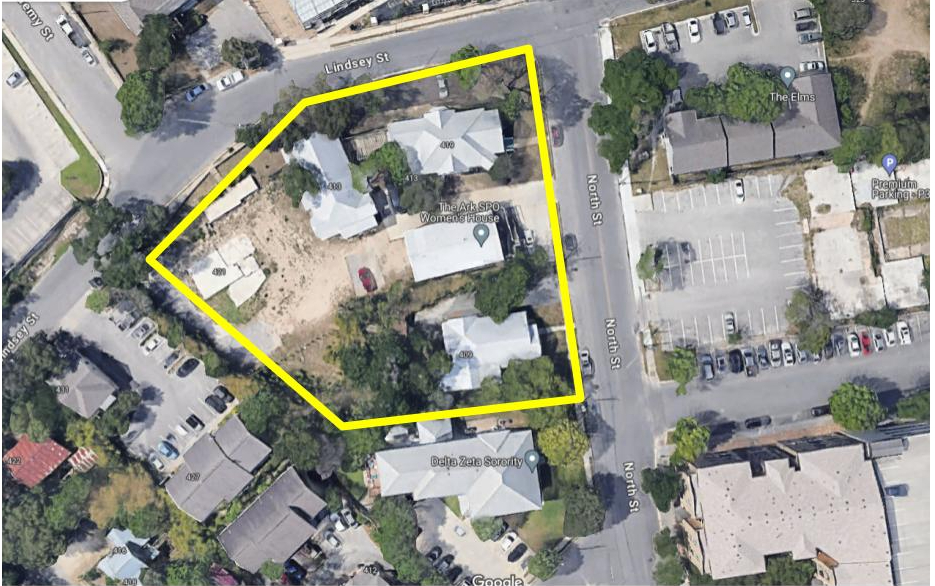
I believe it’s these houses:

One of them burned down maybe five years ago. One of them was transplanted from Riviera Street about ten years ago. Two are bungalows from the 1920s, and one of them is considered a High Priority Historical Resource from around 1900.

This one is the high priority one:

It is very cute!

First off, Jude Prather recuses himself because his wife works for the university, in a building close to this spot.  This is probably a reasonable recusal, but it affects the vote calculation coming up.

Second: today is just discussion. No vote until next time.

So: should downtown include that yellow, striped pentagon to the left?

If Council says yes, then they can apply for a zoning (CD-5D) that lets them build up to 5 stories and have 100% impervious cover.

If Council says no, then the developer might back out, and not buy the property. (Or they could build whatever they’re allowed to under the current zoning, which does allow apartment complexes.)

Public Hearing:

Against: Four speakers.

Similar to the P&Z meeting, they were concerned about student housing, expanding downtown to encroach on neighborhoods, and the preservation of historical buildings.

In favor: 10 speakers.

Some of these speakers made sense to me – the current owner, the developers, etc.

But a bunch were totally ludicrous. Lots of students spoke about how passionate they were about this housing complex. “Simple laws of supply and demand!” they kept saying, as if they’d all been given the same script. One collected 1200 signatures of students who are also super passionate. One of the hardcore Historical Preservation Committee people, who would usually spit on this sort of thing, instead turned up and openly raved about only having heart-eyes for this project.

I mean… come on. The developer must have paid students $15/hour to all read from a script.  “We students are just madly in love with the application of supply and demand curves to the inelasticity of housing supply near campus! Please, ya gotta approve this Preferred Scenario Amendment, mister! For the kids!” Come again?

The developer is offering some new concessions, since the P&Z meeting.  For the left hand yellow-striped pentagon:

  • they’ll cap at 4 stories now,
  • only have 1, 2, and 3 bedroom units, 
  • no Rent by the Bedroom leases,
  • limit impervious cover to 80% instead of 100%. 
  • Have the cute old historic houses relocated elsewhere, instead of demolishing them.

Would that sweeten the pot? 

Matthew Mendoza kicks things off: he talked to constituents in traditionally Latino neighborhoods. They all say, “Keep students away from me. Why aren’t the students by campus? Why aren’t students staying on their side of town?”   

He went over to the proposed neighborhood. The whole character of the neighborhood is university.  This makes sense. Alyssa Garza agrees with him.

Saul Gonzales goes next: 

I see it just a little bit different. I’ve lived here almost 62 years, and I saw the town when I was on P&Z many years back. It was only a few bars, and that’s all we were going to have.  And before you knew it, it spread and it spread and it spread. Now there’s no stopping it.  It’s too late.

With a property like this, I see the same thing.  Where does this stop? This is still a neighborhood, as far as I can see it. People that I talked to tell me, “Saul, what happened to downtown? What happened? Look at all these apartments. Look at this, look at that.” And I’m going to tell them this time “well, we just put another one up.”

I’m just not in favor of it. There’s other reasons – the flooding, the parking, and I just don’t think… It has to stop. I’ll be voting against it, just because it has to start with me voting no.” 

Saul, my good man, what the utter fuck are you talking about.  Are you really trying to tell me that in your adult lifetime, San Marcos didn’t used to have a lot of bars? In the 1980s, this was a sedate little sober town?  Dude, this town has been soaked to the gills since Prohibition.  That is some wishful thinking.

More earnestly: Saul is making a slippery slope argument.  He’s saying he doesn’t mind any one particular development, but over time, the neighborhood will hit a tipping point where it starts to feel like a university student housing neighborhood, instead of a traditional neighborhood of houses.

The problem is that this ship has sailed. This neighborhood is already university housing.

Literally, the university owns Sanctuary Lofts and the Vistas apartments now. Everything north of Lindsey street is campus.

Let’s pause to count the votes:

 P&Z denied this motion.  This means that council must have 6 votes to overturn P&Z.  Since Jude recused himself, that means it has to be unanimous to override the P&Z denial. 

If Saul really is a hard NO, then this whole item is sunk.

(The actual vote is not until next meeting. Today is just discussion.)

Back to Council discussion:

Mark Gleason talks next: I take each case individually. I haven’t made up my mind.  But the bright line between downtown and the neighborhoods is not North Street. That’s absurd. C’mon, you all know that I will fight for the neighborhoods. This isn’t that.  Clearly Moore Street is the bright line.   I will need restrictive covenants to enforce the offer that the developer made, and I haven’t totally made up my mind, but I’m here for it.

Mark Gleason is making the most sense.  He’s entirely right. 

Jane Hughson asks about the flooding? 

Answer: the reason there’s flooding in this area is that it’s coming down from Texas State in waves. This property would have to follow city code, which says you can’t make flooding worse. But you can’t fix flooding from Texas State with this project.

Jane: North Street is a bright line for downtown, for me.  But maybe a lesser zoning?

Quick lesson: all the zonings have confusing names. CD-5D, CD-5, CD-4, ND-4, and many more.

As far as I tell, all anyone cares about (in this situation) is the number of stories and the percent impervious cover. Loosely speaking, the choices are:

  1. Up to 5 stories and 100% impervious cover (CD-5D or CD-5)
  2. Up to 3 stories and 80% impervious cover. (CD-4 or ND-4)

The developer is asking for the Option 1, and offering to only build 4 stories at 80% impervious cover. It sounds like Jane is going to try to build a coalition to get them Option 2 under a lesser zoning.

Maybe Saul will go for that! Maybe the developer won’t! Exciting times.

There’s no vote this time – it’s just discussion. Stay tuned!

….

Item 15:  American Rescue Plan Act (ARPA) money is coming to an end. The first deadline is the end of 2024: you have to have contracted out all your money by the end of 2024, and it must be spent by the end of 2026.

San Marcos put $900K from ARPA money for homelessness initiatives. We then hired Robert Marbut to tell us how to proceed. We discussed it here, and I was not a fan of him.

(It’s not just me:

In 2019, journalists just could not stop writing bad articles about this guy.)

After the study, $800K was left to actually carry out Marbut’s plan. You can read his San Marcos study here. It’s loosely stated enough that it has wiggle room – it all depends on whether it gets implemented humanely or not. The council homelessness committee determined that Southside is the best organization to implement Marbut’s plan.

Southside wants to use $50K of the $800K to hire two part-time people to write the implementation plan. One of them worked under Dr. Marbut before. Southside has to have this implementation plan written by June 2024, and so they’re under the gun to get it done quickly and well. 

Jane Hughson is skeptical about what the city is getting for this $50K. Just an implementation plan? That’s all?

The counterargument is that we are investing in Southside and setting them up for success. Everyone goes with it in the end.

I’m not bothered by the $50K, but I am definitely nervous about whether Marbut’s worst instincts will show up in the details of the implementation.

Item 20: Short Term Rentals (STRs)

We saw this at a council workshop, back in January. Our current regulations are illegal: you can’t outlaw parties and you can’t require that the owner live on site. So we have to pass something new.

The new proposal states:

  • All STRs would need a permit. 
  • Owners can only have one STR.
  • Only one STR on a block, or at least 600 ft apart.
  • Short-term tenants can have parties, but not excessively noisy ones, just like any other resident.
  • Everyone who lives within 400’ gets a postcard with a hotline number to call if you’re having any trouble.

Shane Scott and Alyssa Garza are opposed to the proposal, but they’re extremely cagey about why.  Alyssa says the zones are weird.  Shane is opposed on general libertarian grounds.

Look: hand-wavy arguments like that are lazy. Spell out your reasons. If you can’t spell out your reasons, go think harder about why you’re arguing your case.

Anyway:  Jude Prather gives the impression that probably what’s bothering Shane and Alyssa is the bit about how STRs must be 600 feet apart.

Jane makes the same point as I made – Alyssa and Scott should specify what they don’t like in the ordinance, so that we can modify it instead of throwing the whole thing out.

Alyssa is kinda prickly in her response – she doesn’t have unlimited time or any staff to go work on this ordinance.

Confidential to all council members: you can always consult your friendly Marxist blogger for sound guidance, when you’re short on time! I got you.

….

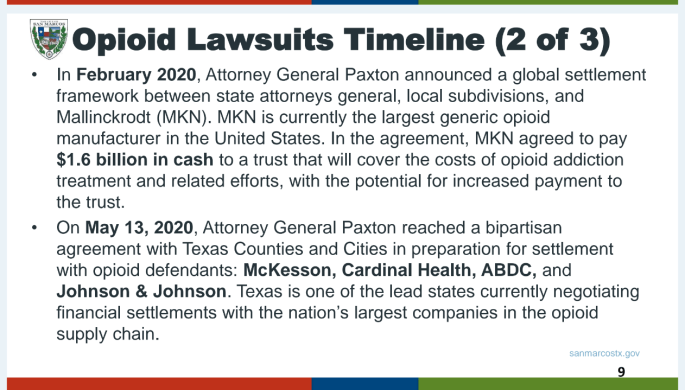
Item 23: There have been a lot of opioid settlements:

We’re contracting with Cenikor to start spending the $325K-ish we’ve got:

That’s running us about $100K. Seems like as good a place to start as any.

Bonus! Workshop, 3/19/24

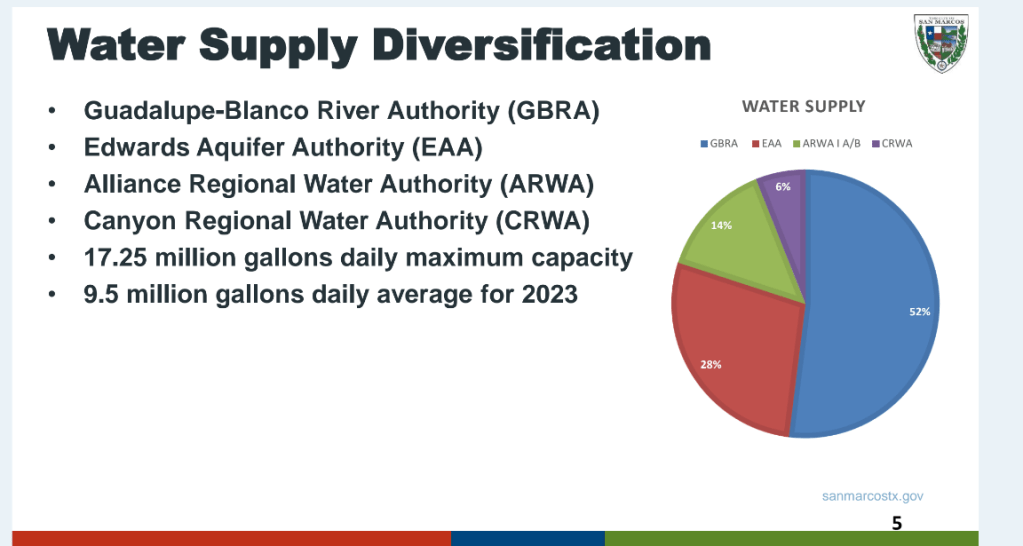
We get our water from a bunch of different sources:

We’re actually in pretty good shape, because we invested in ARWA water about twenty years ago. That is water from the Carrizo-Wilcox aquifer. It took a while to get the drilling and treatment set up, but it’s about to start coming online.

Here’s what our water supply looks like, over the next 50 years:

The main point of the presentation is our drought stages: right now we have five, and life would be simpler if we only had three.

The five:

The three:

Jane Hughson makes an excellent point: it used to be that Stage 2 was mild, and now Stage 2 is serious. It used to be that Stage 3 was Medium, and now Stage 3 is The Worst. It’s hard to get people to update their priors. This is going to require a high degree of messaging.

(Nevertheless, it’s probably simpler to have 3 stages instead of 5.)

Updated to add: Someone pointed out to me that the new proposal never bans sprinkler systems, even during the worst droughts. This seems like a bad move. Even if there’s plenty of ARWA water, it’s still resource-intensive to clean and treat it.

But listen: we can be doing more. Johnson City held an Ugliest Lawn contest, to promote the idea that it’s okay to let your lawn turn yellow. We could have Yellow is the new Green signs, or some other sort of messaging about letting your lawn go fallow.

Traditional green lawns are an environmental disaster, right? Let’s change the discourse around them, and give people permission to quit watering.

City Council! Tell the water guys to include this kind of messaging, stat!

March 5th City Council Meeting

San Marcos! I got your zoning cases, your Buccee’s, and I gripe at the Neighborhood Commission. Also the Lindsey Street Apartments, recycling, and SMPD.

Happy Spring Break to those who celebrate. Here we go!

Hours 0:00 – 1:00:  Gaza ceasefire,  two zoning cases, and some criticisms of Buccee’s.  

Hours 1:00 – 1:42:  Power lines, and the Neighborhood Commission pushes my buttons.  

Bonus! February 27th P&Z meeting:  The winds are changing on P&Z?  And also we look at those Lindsey Street apartments.

Bonus bonus! 3 pm workshops: Updates on the city contract with Green Guy Recycling and SMPD

One final note:

The results of the VisionSMTX survey came out, and were shared here on FB. Some thoughts:

  • There were about 160 responses.
  • 39 voted for the original plan, and 101 voted for the revised SMTX++ version. 5 wrote comments without choosing. 
  • 129 of them own property, 17 are renters, and 4 said neither or left it blank.  So this is not a representative sample of San Marcos whatsoever.

Kind of a bummer.

Hours 0:00 – 1:00, 3/5/24

Citizen comment:

  • Fourl people spoke, calling for City Council to issue a resolution calling for a ceasefire in Gaza.
  • Three people spoke against Buccees.  I’ll save the details for the item on Buccees, below.
  • One landlord speaks against items 17 and 18. These are resolutions from the Neighborhood Commission. We’ll get to those, too.

On the topic of the Gaza ceasefire: clearly, the mass killing of the Palestinian people by the Israeli army is a humanitarian crisis. Now in general, city resolutions on international issues aren’t going to carry much weight. We didn’t issue resolutions when the Rohinga were being killed in Myanmar or the Darfur genocide in Sudan.

But Gaza is more relevant because the US supplies Israel with weapons, and it’s even more local because Governor Abbott actively supports the Israeli army. So you can make the case that cities in Texas should actively and vocally oppose Abbott on this. I support the speakers calling on Council to issue a resolution for a ceasefire.

……

Item 13:  Some folks want to put a hotel on I35.

It would go here:  

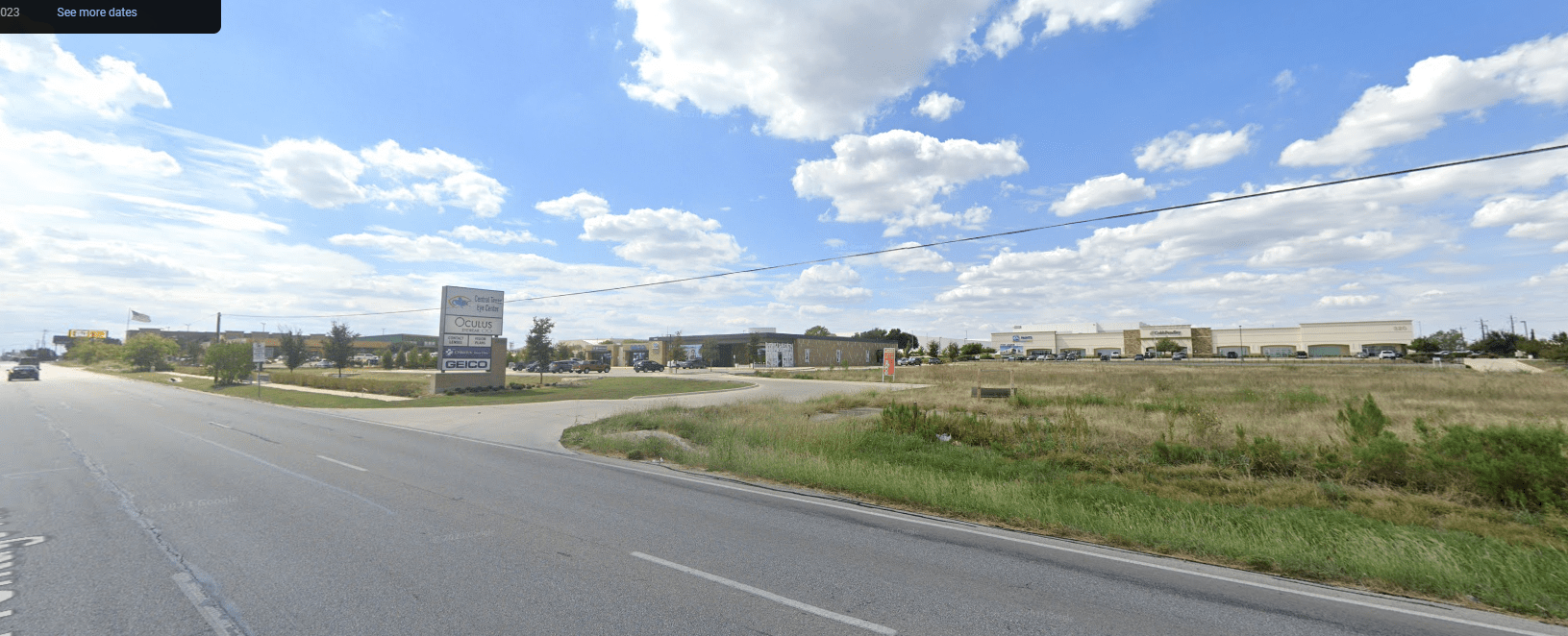
On the street level, it looks like so:

That’s the view from the southbound I35 access road, as you’re heading from Wonderworld towards McCarty.

It had been zoned Heavy Commercial, which does not allow hotels. So the developer is asking for regular commercial, where they can.

What does Council think?

(Saul is absent.) So it passes easily.

Item 14:  Rezoning some land out by Redwood:

There’s a gas station and some senior apartments there already.  

It has been zoned CD-5, which is supposed to feel like a walkable downtown area.  Cute little two-story buildings along a sidewalk, where you can easily dip in and out from store to store.  Zoning that farmland as something “walkable” is a little ambitious?  But sure.

The owner hasn’t been able to get any developers interested in the spot. So he wants to change it to regular commercial.  This is more like your strip malls or dollar generals.  Big parking lot out front.  No longer striving for walkability.  

What does Council think?

Great.

….

Item 2: Buc-ee’s.

At citizen comment, there were several people who spoke against Buccees.   I’m going to organize their concerns:

Concerns that are nonsensical:

  • Buccees doesn’t reflect our values/preserve our unique character/reflect our priorities.
  • Inefficient land use
  • This is not what San Marcos needs. 
  • We cannot handle this. We don’t have the infrastructure to handle this.

Is the problem that Buccee’s is tacky? Do the good people of San Marcos only want serious, dignified gas stations, without cartoon mascots? What are we talking about here?

Concerns that at least make sense to me:

  • Buccee’s promotes oil-dependency and unhealthy food.
  • Keeps travelers from exploring San Marcos
  • Buccees generates less property tax revenue in NB than other I-35 frontage retail.
  • Jobs are closer to Kyle than San Marcos.
  • We should not be subsidizing retail jobs that pay below the median wage.

These are all legitimate drawbacks. Are they drawbacks that outweigh the projected $400K/year that the city will get in taxes? Eh, probably not.

Concerns that I share:

  • Contract is full of green-washing and light on details.
  • The work environment is toxic. They pay well because they work you to death.

I can’t evaluate whether or not the contract is green-washing. It’s certainly incredibly brief on the rainwater collection and oil-and-water runoff separators. I’d be interested to know what an environmental expert says.

On the work environment, I did a quick Reddit search. For example, this long thread from two years ago. Or this shorter thread from three months ago. There are lots of complaints that it is in fact a very toxic environment. Many comments say turnover is super high.

One last piece of evidence came during the February 20th meeting. The Buccee’s representative said multiple times something like, “The job is tough, so we compensate you for it! No one said it’s an easy job!”  That is not a great thing to hear from management.

What does council think? 

Mayor Hughson: I just want to highlight the dollars that this will bring in to the community.

Alyssa Garza asks if there’s any representative here from Buccee’s, who can speak to the accusations of bad labor practices?

Answer: There isn’t. City staff weakly gives some anecdotes about staff retention. But there’s no data on turnover or anything

Matthew Mendoza speaks to the quality of the opportunities and why we need good jobs for people without college educations.

The vote:

Everyone reassures Alyssa that labor violations are a federal matter! Surely the Department of Labor will respond promptly to any issues. 

That is some magical thinking right there. (Also I learned something new: federal law does not require lunch breaks or rest breaks. Unsurprisingly, neither does Texas. We should probably require breaks in our Chapter 380 agreements.) But generally, there is plenty of wiggle room to be an abusive employer without facing consequences from the DoL.

Hours 1:00 – 1:42, 3/5/24

Items 15-16:  Burying power lines

All new developments have to bury their power lines.  

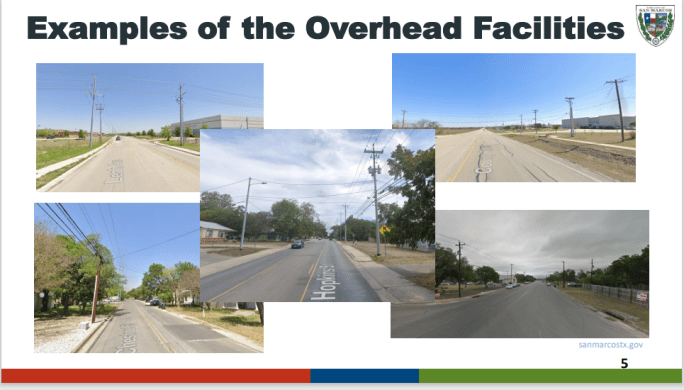
In other words, this is bad:

whereas this is good:

There’s a lot of reasons why this is good practice:

Ok, great.

Whisper South and Whisper South Industrial are here:

Whisper South has requested skipping burying their electrical lines.  Staff denied the request. So they appealed to City Council.  

City Council agreed with staff, and denied the request as well. 

Good job, Council!

Items 17-18:  The Neighborhood Commission 

Maybe the Neighborhood Commission is my arch-nemesis?  I disagree so hard with them that steam is coming out my ears.

They sent Council two resolutions, on Occupancy Restrictions and Purpose Built Student Housing.

  1. Occupancy Restrictions

Back in April 2022, Council voted to loosen occupancy restrictions from a max of 2 unrelated people in a house, to a max of 3 unrelated people in a house. Unfortunately, the code wasn’t updated for another 18 months. By this point, Max Baker was off Council and Matthew Mendoza was on it.

Matthew was in a panic over the idea of 3 unrelated people living together. He tried to get everyone to vote against it, and it failed, and then tried one more time. He clutched his pearls so hard that he’s probably infertile now.

It finally passed, officially, in October. So it has been in effect for six months. But in a sore loser move, a subcommittee was put together “to study the issue further”.

The Neighborhood Commission is pissed off.

They want the rule to revert to a max of two unrelated people.

Listen: a cap of two unrelated people is batshit crazy.  They clearly hate students, but banning students effectively bans poor people as well. (I really don’t care if that’s accidental or on purpose.) This prevents poor people from pooling their resources and being able to afford the rent in a quiet neighborhood.  That’s super gross!   

Who actually thinks City Council should be in the business of policing who is married?  Why are we micro-managing people’s private lives this way?! 

Usually people will say “It’s about parking!” or “It’s about noise!” or “It’s about wild parties!”  But there are other mechanisms for dealing with noise and parties.  (Namely code enforcement and rental registries for landlords.)

What about the extra cars, parking on the street? Listen: your desire to keep street spots empty is less important than other people’s right to affordable housing. I don’t know why we allow “empty street spots” to be a weapon that existing home owners can wield against renters. Home owners do not have a right to keep street spots empty.

But let me be fair: surely the neighborhood commission gave thoughtful reasons, right?

Unless I’m missing something, they’re saying that three friends living together is causing all this:

  • Rising costs of home ownership
  • Impact on residents remaining in their homes
  • Impact of landlords attempting to put 3 unrelated students in a home
  • Negative impact on the neighborhood

Wow. That is high on blame and short on details. If something is going on, spell it out explicitly, because right now it looks unhinged. (Also home prices are currently falling.)

What does Council do?

Remember the subcommittee that was formed? It hasn’t met yet, mostly because it doesn’t have a purpose.

Jane Hughson calls for the subcommittee to meet within 30 days.  The subcommittee is Matthew Mendoza, Mark Gleason, and Alyssa Garza.

Shall they meet?

Yes, they must meet!! Jane, Matthew, Mark
No, it’s over, this is dumb: Alyssa, Shane, Jude

So the informal vote fails. They do not need to meet.

But wait! There’s more from the Neighborhood Commission!

  1. They hate Purpose Built Student Housing and rent-by-the-bedroom leases. 

There is an argument that RBB leases are predatory. (I don’t exactly agree, but we’ll talk about this extensively in the Bonus P&Z section.) But for now, it’s safe to say that the Neighborhood Commission is not upset because students are being exploited.

The Neighborhood Commission is saying this:

They do not want student housing complexes. I think this is clear.

So let’s summarize: they do not want students renting houses in neighborhoods. They also do not want apartment complexes to cater to students.

This is just delusional. Look, we have a university! With a lot of students! They are entitled to live in this town!

If students are throwing obnoxious parties, then we need to properly fund Code Enforcement to shut those down. If you have a problem with rentals, hold landlords accountable. This commission thinks that shutting off the actual supply of housing – this human right that we all deserve – will somehow lead to different behavior by students.

What does Council do?

It’s a little perplexing. Jane Hughson moves to postpone the discussion.

Her explanation is that they didn’t put Rent by the Bedroom (RBB) on the agenda, and so legally Council cannot discuss it. She wants to put both RBB and Purpose Built Student Housing on the agenda, so that Council can have the appropriate discussion.

But this is just wrong. Look at the agenda:

Rent by the bedroom is actually right there, on the agenda! How did no one correct her? They literally read that blurb out loud at 1:30:56, here.

(I mean, I truly don’t care. Let’s postpone. It’s not urgent.)

….

Council or city staff: if you’re reading this, I do have one practical suggestion:  

If you’re going to regulate RBB leases, you should require that leases include an option to rent by semester, for a modest surcharge.   Students need some flexibility to be able to take internships, or graduate in December, or move home for the summer.

Since the complexes are profiting off of being quasi-dorms, they should provide this benefit specific to students, like a dorm would.

Bonus! Feb 27th P&Z meeting

We have to unpack this.  The center of gravity has shifted on P&Z.

Let’s start with the end of the meeting:  the committee voted on their new chair.

Jim Garber has been the chair of P&Z since 2016 (aside from one year when he cycled off P&Z).  He’s literally been elected seven times.  It’s been quite a run.  Jim Garber was the main driving force behind the re-write of VisionSMTX.

But at this meeting, Garber lost re-election to David Case.

David Case is [updated: used to be] on the San Marcos Area Chamber of Commerce, and is the local VP for Schertz Bank. So it’s safe to say he’s pro-business. The pendulum has officially swung from anti-development towards pro-development. 

Is this good or bad?

It depends!

I am Goldilocks! I want us to land in the middle. I want us to have calm quiet neighborhoods, but they must include affordable apartments for lower income folks.  I want us to have gentle densification and to have nearby stores, so that you don’t have to drive a long way for your basic needs. Jim Garber was blocking a lot of this with the VisionSMTX re-write.

However, back in the early 2000s, we were haphazardly approving all kinds of giant apartments complexes. The danger is that P&Z will start recklessly greenlighting every proposal again.

How do I feel about giant apartment complexes? They should be carefully scrutinized on a case-by-case basis. 

There are good parts: they do not contribute to sprawl, they are more environmentally efficient than houses, you get some economy of scale, you can have amenities like pools and exercise rooms, and it’s easier to include wraparound services for low-income housing. 

But they are also a mechanism to enforce segregation by wealth, which makes me very cranky. And the scale matters: it’s jarring to put a giant complex immediately alongside a quiet neighborhood. Location is a major consideration.

Anyway: the NIMBY old guard was voted out, and a new tide has taken hold.  It’s just too early to know exactly how far it’s going to swing.

There was also one big, complicated zoning case:

Should we build student housing here?

This came up back in October. It was memorable because Shannon Mattingly was the director of the San Marcos Planning Department until 2022, and then jumped over to this developer. It’s a pretty clear conflict of interest.
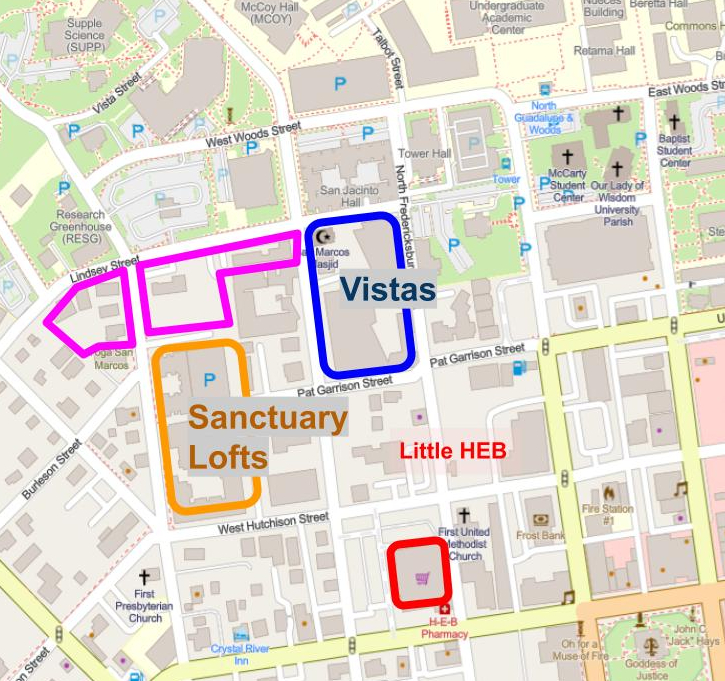
Here is a close-up:

One more background issue:

The university recently purchased Sanctuary Lofts and Vistas Apartments, which are very close to this:

They are going to turn them into dorms. The city is pissed off, because we used to get a lot of property tax from those apartments, and the university doesn’t have to pay local taxes.

So this looms on everyone’s minds: in five years, will the university just buy this, too?

Onto the issues

There were a lot of citizen concerns, which I’ll categorize:

  1. Complaints that student housing is exploitative:
  • Aspire (13 stories) charges $1k/bedroom
  • Rent by the Bedroom (RBB) means inadequate/subpar living conditions
  • Roommate matching is not legally binding
  • All roommates share liability for damages to common areas.
  • RBB is predatory
  • Student housing means subpar construction and craftsmanship

I find these complaints mystifying. Do these people think that the rest of the landlords are glorious noblesmen? All tenants need protection. Plenty of non-student apartment complexes are unsafe and unsanitary. All roommates always share liability for damages to common areas! All landlords will try to extract the highest rent they can.

I just am not clear why student housing is especially bad. Why not build a broader coalition across all renters?

2. Complaints about San Marcos housing in general:

  • We need diverse housing options
  • Downtown housing is solely being built for students, serious lack of other housing.
  • There is plenty of student housing available: 40 RBB complexes in San Marcos, with over 20K bedrooms.

We do need diverse housing options. Developers are not our friends, and they will not build diverse options unless it’s in their financial interests. This means simplifying the approval process and creating incentives for small-scale apartments and condos.

But those are all larger issues than this one complex.

3. Mostly legitimate concerns that are specific to this project:

  • This will make downtown encroach on nearby neighborhoods.
  • This will be a large corporate structure on an already congested street
  • The smalltown feel and skyline is being eaten up by big developments. 
  • They should provide regular leases alongside RBB.
  • We will be tearing down existing affordable housing and displacing people in order to build more expensive housing.

I find most of these compelling.

4. Concerns that I don’t know how to categorize:

  • we should not destroy this town for the convenience of students!

It was a LOT.  

So what did P&Z do? They basically landed somewhere in the middle. I thought they handled it well.

The request has four parts:

  1. Extend “Downtown” to include the west side of their property, that pentagon piece west of North Street.
  2. Change a mishmash of old zonings – multifamily 12, multifamily 18, multifamily 24 – to all match the standard downtown zoning, CD-5D.
  3. Get a permit to have Purpose Built Student Housing.
  4. Get an alternative compliance to go up to 7 stories.

Here we go:

  1. Extend “Downtown” to include the bit west of North Street.

In terms of this picture:

we’re talking about the pentagon on the left hand side. Should that be part of the designated official Downtown District?

The vote: All 9 vote to deny. West of North Street is not downtown.

2. Change a mishmash of old zonings – multifamily 12, multifamily 18, multifamily 24 – to all match the standard downtown zoning, CD-5D.

First, the lefthand pentagon, west of North Street: No. This passes 9-0.

Next, the right and middle bits, east of North Street: there’s some good discussion.

  • Will this make flooding worse? CD-5D zoning is 100% impervious cover, like downtown. Currently they’re allowed up to 75% impervious cover.

Probably not: it’s actually 100% impervious already, because there’s a parking lot covering all the land. It pre-dates the 75% regulation.

  • What about the affordable housing already there? It would be torn down.

The vote: 5-4 in favor of changing the zoning to CD-5D.

(This is the first pro-development vote.)

3. Get a Conditional Use Permit to have Purpose Built Student Housing.

Important: this is not the same as Rent by the Bedroom. They can already do RBB leasing if they want. Purpose Built Student Housing lets them go up to 5 stories and have four bedrooms per unit, instead of 4 stories and up to three bedrooms per unit.

Arguments: We just passed the Downtown Area Plan. The Downtown Area Plan calls for no student housing downtown. We need to set a precedent of respecting the area plans.

The counterargument comes from William Agnew, who says, “I was on the Downtown Area Plan committee. I thought it was absurd to pretend we don’t want student housing downtown. That’s who lives downtown! I’m in favor of this CUP.” I love his bluntness.

The developer says they will offer regular leases alongside RBBs. For what that’s worth.

The vote: 7-2 in favor.

4. Get an alternative compliance to go up to 7 stories.

It gets pointed out that this is already uphill of Sanctuary Lofts, which is 5 stories. So if this were seven stories, it would loom even higher, due to the hill.

The vote: 8-1 opposed. They will have to stop at five stories.

In conclusion…

Approving this apartment complex has its negative trade-offs. It does make the area more congested. It does destroy some cheaper housing in exchange for more expensive housing.

That said, I think that overall, P&Z landed in a reasonable spot on the four items.