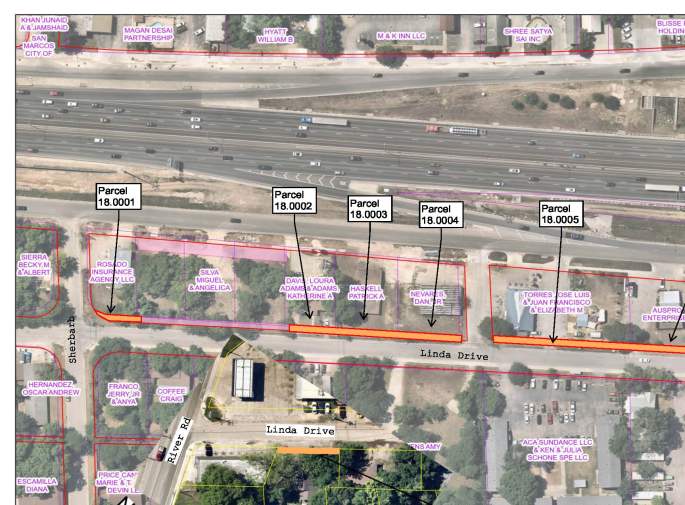
for the Linda Drive project, which you can read about here.
We need this:
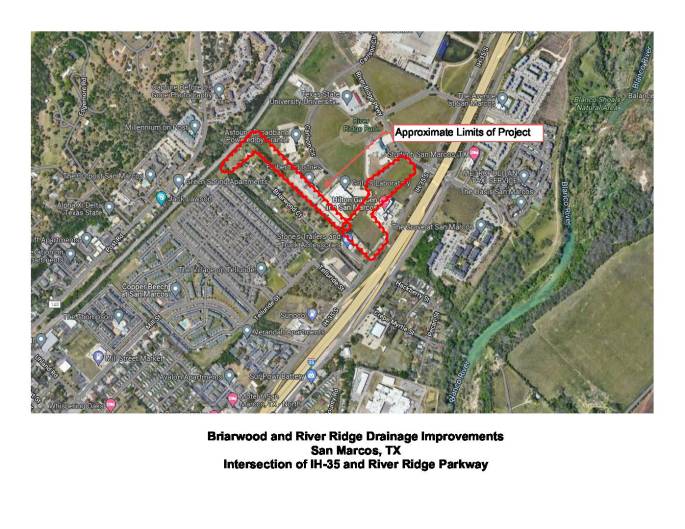
for the River Ridge Drainage Improvements Project, which you can read about at that same link as the Linda Drive project.
We aren’t just going in with guns blazing and taking the land. The plan is to go talk to the land owners and try to buy it. The key phrase for eminent domain is “To the extent that negotiations are unsuccessful.”
So, we’ll try. Otherwise we’ll take.
…
Item 19: That wild storm back on May 9th. (I hope everyone is okay.)
We’re pulling $750,000 out of the general fund to cover the associated costs, like all the extra curbside brush pickup and tree removal.
Here’s the thing: Hays County is requesting a disaster declaration. If we get it, then we can get reimbursed for this expense. Which is good, since our budget is kinda tanking at the moment. (See here)
To get the disaster declaration, we have to report at least $1.1 million in damages. And the more we report, the more federal money we can receive. You get reimbursed in proportion to the damages you report.
So really, the community needs to report whatever happened:
Volunteer hours. Did you and some neighbors spend a few hours using a chainsaw on your neighbor’s fallen tree? Report it.
Did you have to pay for tree removal? Report it.
Did your car or your house get damaged? that really sucks and I’m sorry. But also, report it.
Go here and scroll down to “Reporting Damages” and “Reporting Volunteer Hours”.
There, that’s your good deed for the day.
…
Item 21: Project Snapdragon
Ah, such intrigue.
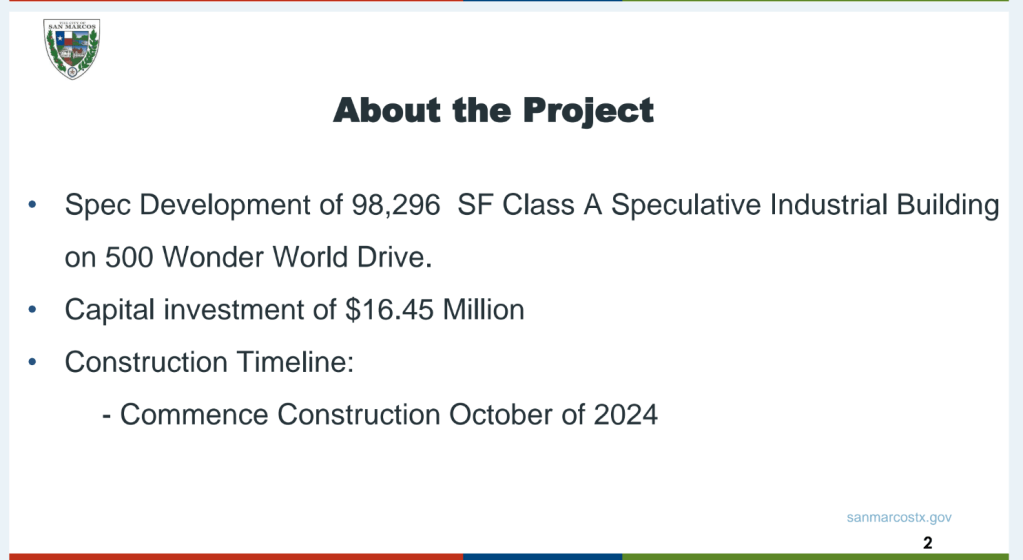
Council approved this with zero discussion and no presentation, so I’m basically winging it here. (There are slides in the packet, but staff didn’t present them during the meeting.)
Let’s see how I do!
A speculative industrial building. So in other words, they don’t know who exactly will lease it yet, but they’ve got a good feeling in their belly.
It’s going to be here:
In other words, if you’re going southbound on the frontage road, it’s behind these buidlings here:
right behind Floor King, Life Storage, and Classic Collision.
Side note: Do we all think “Floorking, I don’t even know how to floork” when we see that place, or just me? (You will now! Sorry!)
What will it look like?
haha, no it won’t. Renderings are just pretty pictures. They’re not promises. They’ll build whatever they want (as long as it fits city code).
How much money are we giving them?
Ok, so we’re giving them $235K. How much do we think we’ll get?
So someone is projecting that we’ll bring in $97K yearly, once it’s up and running.
Side note: You know what would be nice? To go back 5-10 years at old Chapter 380 agreements, and see how they panned out. In 2014, who did we give tax breaks to? What kind of revenue did they pinky swear to generate? How much money are we actually collecting from them?
Anyway, Chapter 380 agreements now take two readings, so if you hate this, you can tell us all about it at the next meeting.
…
Item 22: 5 year lease with Green Guy Recycling
We went over all the details here, in a workshop back in March. So now it’s official. 💍
….
Item 26: Tiny Homes
Mayor Hughson brought this item up. I think what Jane is saying is that you should be able to build Tiny Homes on weird, tiny lots.
We started allowing Tiny Homes under the land development code in 2021. Right now, there are a few ways to have one:
In a single family zoning, you can put one on a lot, just like a non-tiny home.
If you want to put several of them on a lot, it needs to be zoned for mobile homes. So in most neighborhoods, you can’t do this.
If you had a big lot, you could apply for a zoning change to a zone where you could subdivide it into several small lots. This would go to P&Z and Council, where they’d look at it on a case-by-case basis.
Matthew Mendoza says that he doesn’t want someone subdividing a larger lot into several small lots to put tiny homes on them.
Mark Gleason: As long as we’re not doing what Austin did!
What he’s talking about is this: Austin passed a new ordinance that changes the minimum lot size for houses from 5,750 square feet to 1,800 square feet.
Let’s talk about this, because I think it’s really important. Here’s a 6,000 square foot lot:
That’s a listing from San Marcos. If you set Zillow to lot sizes of 5000-75000 square feet, the vast majority of San Marcos options are in the $300K range.
You can have much bigger lots, but you can’t go smaller than that in a traditional Single Family 6 neighborhood. What this means is that your neighborhoods are sprawling and your prices stay high. It’s bad for traffic, bad for the environment, and bad for creating affordable housing. It’s good for keeping poor people away from middle and upper class people.
So last week, the Austin City Council approved a minimum lot size of 1800 square feet for single family neighborhoods. You can still have bigger lots! But you’re allowed to have small lots, in traditional neighborhoods. This is what is blowing San Marcos City Council’s collective minds.
The arguments against these things are usually about “preserving the character of a neighborhood”. But we’re not talking about bulldozing twenty houses and replacing them with a giant apartment complex. We’re talking about gently increasing the affordability and number of people in a neighborhood. I promise it won’t hurt.
These changes really do bring down housing costs, and higher density really does cut down on traffic, sprawl, and the environmental impact.
Presentation 1: Our budget is not doing well. Let’s look at some slides.
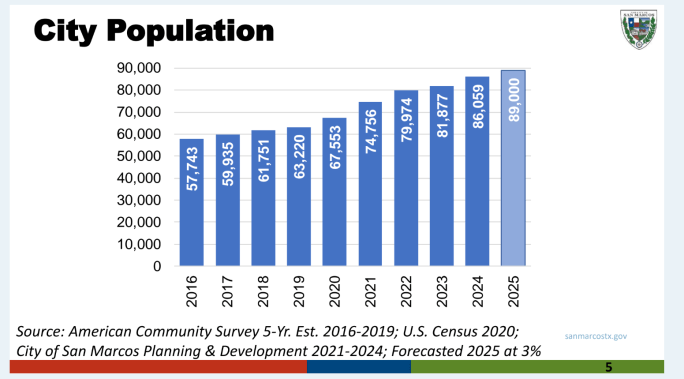
First, San Marcos keeps growing:
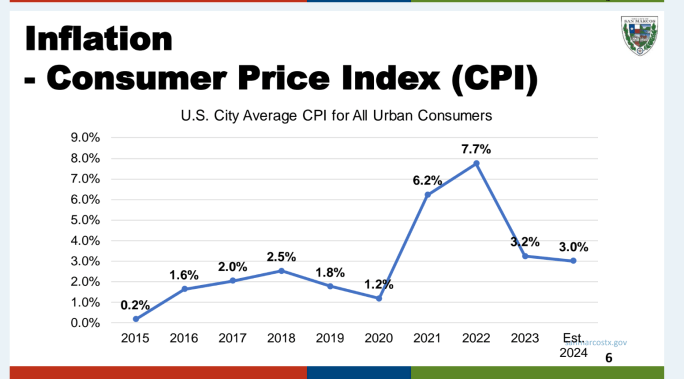
And while inflation is back to a normal healthy amount, it still exists:
So due to a larger population and 3% inflation, it will cost more to run the city more next year, even if we don’t change what we’re doing.
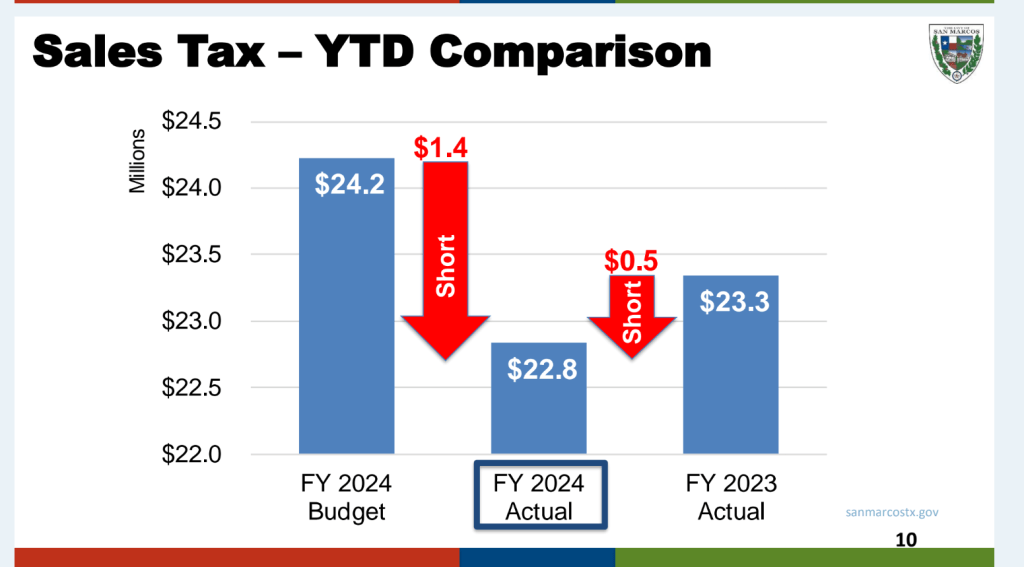
But unfortunately, we took a big hit on sales tax:
This is sort of a cumbersome chart. It’s doing a few things simultaneously.
So you see where it says October 2023 is 6.6%? What that means is:
Average all the sales tax revenue from October 2021 to October 2022.
Average all the sales tax revenue from October 2022 to October 2023.
Work out the percent growth from the first average to the second average. For October, the past 12 months were 6.6% bigger than the previous 12 months. Great!
But you can see how this plays out over 2024 – we kept shrinking and then turned negative. So the average the sales tax income from April 2023 to April 2024 is smaller than it was over April 2022-April 2023. That is not good.
Who’s coughing all this up, anyway?
I would not have guessed that!
(I would say it’s their customers, not the business, but you get the point.)
No one else is having this problem. Just San Marcos:
No one offers up an explanation, because I don’t think anyone has one? Nobody knows if this is a shortterm fluke, or if it’s the beginning of something bad. We can’t know until it plays out a little more.
Anyway, here’s the bottom line:
We do not have the money we thought we’d have this year.
So we have to do two things simultaneously:
Figure out how to tighten our budgets mid-year. There are established contingency plans on how to do this, but it’s not, like, fun to do.
Figure out how to plan for the 2025 budget, if we’ve got more people and slightly higher prices, but less revenue.
Can property taxes make up the difference? Basically no.
First off, sales tax is a bigger chunk of our budget than property taxes:
But second, even though homestead prices are going up:
they’re not going up by as much as they had been going up.
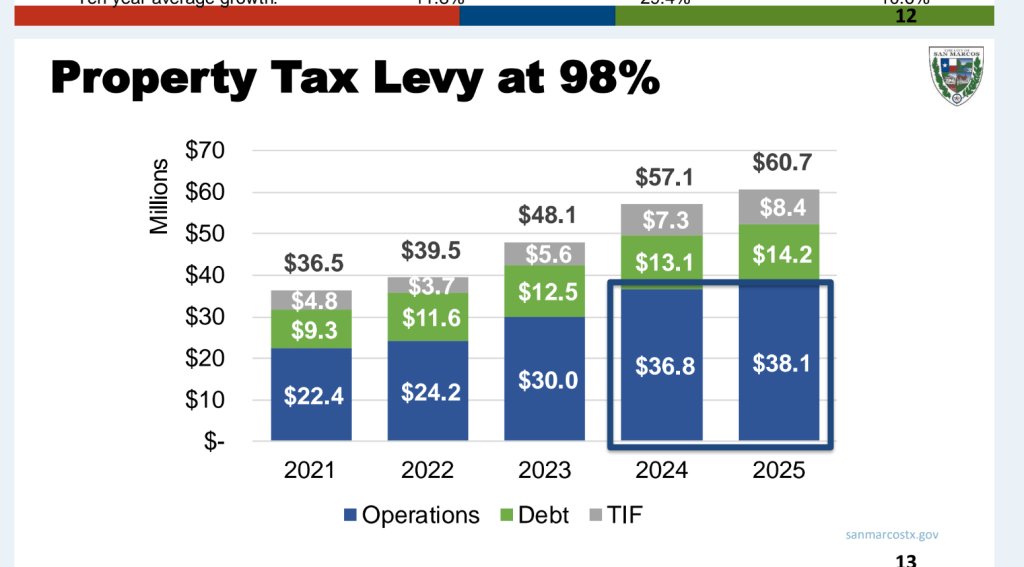
The blue portion is the key amount:
So the city is expecting to collect 1.3 million more dollars next year than this year. It’s growing, but not enough to keep up with inflation and a larger population. Not like the past two jumps: from 2023 to 24, we jumped 6.8 million, and the year before that, an extra 5.8 million dollars.
So here’s the bottom line:
We are looking at being 2.3 million short this year, and 1.12 million short next year, if we don’t do anything different. Ouch.
I mean, we’re going to tighten belts, etc. The city is smart, there are plans to implement. But they involve hard choices and going without good things.
Here’s how we’re handling 2024:
Basically, that’s how they’re handling it. And they’re working on making next year’s budget work on a shoestring, as well.
One last thing:
There’s a new law that caps the how much business property appraisals can increase each year. Any non-homestead can’t grow more than 20% in a year. Or rather, the appraisal can come in higher than that, but you won’t be taxed on the excess.
Now, this only affects businesses appraised under $5 million. The problem is that we have a high number of small rental properties, and they all qualify. So we’ve lost $123 million of taxable land value, which works out to $745K from the budget.
Bottom line: the city has to tighten the budget. Kinda a giant bummer.
…
Presentation 2: There was also a presentation on the 2025 Capital Improvement Plan.
The CIP plan is all the major city projects, like re-doing the drainage for a street so it doesn’t flood anymore, or whatever. Basically it takes a lot of longterm planning. I don’t have much to say about it besides that they emphasized how much they’re trying to apply for lots of grants.
Hey there kiddos! I hope everyone is safe from the storm on Thursday. Big citizen comment time – mostly Malachi Williams and a call for ceasefire resolution – and then lots of little city business topics.
Here we go:
Hours 0:00 – 2:03: Two hours of citizen comments! The biggest topics are the SMPD killing of Malachi Williams and a call for a resolution on a ceasefire of Palestine. (And a bit on Bro-dozers, the resurrection of SMART/Axis Terminal, and some other things.)
Hours 2:03 – 3:58: La Cima, baseball and soccer youth scholarships, selling more water to Kyle, speed cushions, bringing more grocery stores in, concrete, and a new wastewater treatment plant. Lots of little items.
Bonus! 3 pm workshops: Three interesting presentations: Equity Cabinets, the Point-in-Time homeless count, and those orange scooters are spreading. This was my favorite part of the meeting!
Yowza, you guys. Most of this meeting was Citizen Comments. There were two full hours of citizen comments on Tuesday. A total of 40 speakers. Plus an additional 3 speakers at the 3 pm meeting.
So we are going to park it at Citizen Comment and unpack all this.
Topic 1: Malachi Williams.
We’re going to start with the most heartbreaking part, which is that the family of Malachi Williams spoke to council. I cannot do it justice – you should go listen yourself. Here’s the video. – Malachi’s grandfather speaks first, at 1:25:40 – His older sister, at 1:29 – His mother at 1:31 – His younger sister at 1:36 – His aunt at 1:38:30 – His third sister at 1:58 – His grandfather also spoke at the 3 pm workshop, here at 11:30.
You should definitely believe that Malachi Williams came from an incredibly loving, supportive family who is devastated by this loss. They are desperate for some answers.
Take the officer off duty until the investigation is complete
Let the family and their lawyer watch the bodycam videos, as well as gas station and HEB footage.
These are really reasonable. In the video, Chief Standridge has a big long thing about how legally, the videos are evidence, and so they can’t be released publicly until after the grand jury and/or trials play itself out. But the family is not asking him to publicly release the videos – they’re asking for family and a lawyer to see them.
The family’s comments are beautiful and heartbreaking. They’re an extremely close family. They just need answers so that they can begin processing this enormous loss.
The rest of us will not know what happened for a long time. (But look: a knife is not a gun. He was armed with two large kitchen knives. I have questions about how exactly Malachi could be close enough to pose an immediate risk to someone else, and yet it was safe to fire a gun at him.)
About 20 of the other speakers talked about Malachi Williams and called on Council for justice.
Topic 2: Ceasefire in Gaza.
There were 32 speakers calling on Council to pass a resolution calling for a ceasefire in Gaza. (Most of these speakers were also the same ones who talked about about Malachi Williams, and they connected these two topics under the same umbrella of state violence against civilians.)
There’s been some drama, because this appeared on the rough draft of the council agenda:
But then it was not on the final agenda, because Shane Scott withdrew his support. (It takes two council members, or the mayor alone, to put something on the agenda.)
Lots of speakers say that Shane withdrew his support due to a threat of some sort? Maybe! Or maybe he just didn’t feel like being in the hot seat. Who knows.
Anyway, 32 speakers is a LOT of speakers. The resolution for a ceasefire has been coming up for months – here, here, here, here, and here – but not this many speakers. Obviously this connects with the mounting protests at Columbia, University of Texas, USC, and so on.
And look, the protests are actually paying off. Biden has paused two shipments of bombs to Israel over the invasion of Rafah. Biden is slowly hardening on Israel. (He’s going too slowly for me to stomach, but he’s miles away from how Abbot or Trump would handle it. They would escalate the destruction of Palestine to armageddon levels. )
Look, we’ve got a governor who is actively supporting Israel in a number of ways.
This ceasefire resolution is a municipal issue because city councils can amplify the voices of their community. This resolution would send a message to Abbott (which he would ignore) and a smaller message to Biden (which he seems to be responding to). So c’mon, Council, get your act together.
Topic #3: Miscellaneous
Finally, there were a few other topics:
The need for more teen programming in San Marcos
A great comment about “bro-dozers”. I love this one. You know the guys that rev their engines through town and startle you into spilling your drink, if you weren’t expecting it?
The speaker has an apartment on Hopkins, and so he got himself a decibel reader. When the bros rev their engines, it’s 90-95 decibels in his apartment.
But see, it only covers music coming from the vehicle, and not the engine itself.
But consider:
Presto! Look how easy to fix!
City staff! File this away for the next round of code updates, please and thank you.
Remember the SMART Terminal? Oh yes you do. (Brush up on it here, if you don’t.)
It was originally on the agenda for tonight as well:
But it got pushed back to a future meeting. (Franklin Mountain is the SMART/Axis company.)
Noah Brock and Annie Donovan were two of the main activist organizers last time. They’ve submitted a ton of open records requests. Here’s what they’re saying about this upcoming issue:
Franklin-Mountain is apparently getting mad at Caldwell County, because Caldwell County doesn’t let developers do whatever the hell they want. Caldwell County requires all these planning documents up front, such as:
Subdivision plan
Water Protection Plan
Phase Development Plan
Traffic Impact Analysis
and more!
before they’ll process Franklin-Mountain’s application.
Whereas we were all ready to let the developer pinky-swear to be good-hearted, and we’d sign over all rights to do anything they wanted. We didn’t require any of those!
So here, the developer is moving roads around, in ways that seem to violate their good-neighbor promises. This roadway doesn’t match anything they’ve claimed up till now. This annexation seems like it would not benefit San Marcos in any way, but it would off-load costs onto the city.
Stay tuned! This might be on the agenda at the May 21st meeting.
Virginia Parker speaks again about the drought triggers passed last time, and asks if there’s any way to revise it.
One speaker talks about Purpose Built Student Housing, and has a number of recommendations to address tenants’ rights. Things like increased funding for code enforcement, a right to resolve late payments before evictions, a right to a public defender, just cause evictions, and no-net-loss housing ordinances.
Texas is very pro-landlord, so it would take some research to figure out what’s legal to do here, but I generally support all action in this direction!
Items 9-10: It’s been a while since we discussed La Cima. (Quick primer on La Cima development here.)
Basically, it was originally approved in 2013.
In 2014, it looked like this:
As of 2022, it looked like this:
It’s grown! It seems to keep growing, in fact.
The problem is that the entire development is in the Edwards Aquifer Recharge Zone. It’s incredibly sensitive land, but it keeps growing. Anytime there’s an amendment to the Development Agreement, you should sit up straight and take a closer look.
In this meeting, they’re not changing the actual La Cima Development Agreement. So there’s nothing controversial here. Today’s annexation is just following the existing agreement.
The highlighted pink part is what they’re about to start building now:
Have fun with that, you guys!
It’s going to be single-family houses.
….
Items 7-8: We’re giving a bunch of Covid (ARPA) money to youth soccer and youth baseball, for scholarship money.
Alyssa Garza asks: how easy will it be for parents to get these scholarships? There’s been a lot of problems with ARPA funds and all kinds of paperwork that make it too hard for community members to actually get the money.
No one really has an answer, but they say that it should be as simple as having a San Marcos address, since most of San Marcos is located in qualifying census tracts.
Unrelated Note: I heard a rumor once that San Marcos Soccer was going to change their name to Smoccer, but instead they went with Surge Soccer. Truly a missed opportunity, I don’t know how they sleep at night.
…
Item 2: (Items are out of order, because they got pulled off the consent agenda)
We’re selling more Edwards Aquifer water rights to Kyle.
Just like last time, city staff emphasizes that Kyle is going to use this water whether or not we sell our rights, so we might as well collect the $7k – $1.5 million from them, for the proper water rights.
They have to follow or strengthen all our drought restrictions. Currently, they’re running a tighter ship than we are, but then again, we just loosened our drought triggers considerably.
People drive like maniacs on Barbara Drive, and eventually the residents got sick of it. So they filed a petition. There was a survey and some data collection, and everyone agreed that this was a good idea.
Item 13: Let’s woo some grocery stores on the East side of town, eh?
New Braunfels wooed HEB like so:
Kyles wooed Sprouts like so:
So we want to offer up some goodies for new grocery stores in San Marcos.
Here’s some questions for Council to field:
Do we just want offers for the east side, or all over San Marcos?
Do we only want big grocery stores, or are we open to a mix of big and little grocery stores?
Do we want to give them a property tax rebate, or a sales tax rebate, or both?
Do we want to offer them some grant money up front?
We’ll negotiate individually with any retailer. This is just putting something out there to negotiate.
So what does council think?
Do we just want offers for the east side, or all over San Marcos?
Jane Hughson is super enthusiastic that the west side needs more grocery stores. She mentions this several times. Most everyone else says they’re open to offers from all over town.
Alyssa is the one exception: her priorities are strictly the east side of town, and good paying jobs.
My two cents: we should not subsidize grocery stores on the west side. We’ve specifically said that we do not want to encourage growth over the recharge zone, because run-off ends up in the underground springs that feed the river. Rivers only run clear if the recharge zone is kept clean.
Second, the west side residents have higher incomes. This attracts grocery stores, as soon as there are enough people living there. If a grocery store wants to open a location there, they already can. But the lower incomes on the east side mean that even with tons of people, grocery stores won’t open there without subsidies.
Just big grocery stores? (like 120,000 square feet or bigger). Or both big and little grocery stores?
Everyone’s open to a mix of big and little stores. This is my preference, too.
What kind of tax breaks? Jane Hughson makes a strong case for giving sales tax rebates instead of property tax rebates. Basically, with a sales tax rebate, their rebate rises with their performance. It aligns the incentives of the city and the store.
They settle on a 5 year offer. Both property and sales tax would rebate 80% in the first year, and then step down from there.
4. Should we offer grant money up front?
No, we shouldn’t. No one likes this, and we’re not really set up to do it anyway.
Anyway: This is just a preliminary discussion. There will be more to come.
…
Item 15: Concrete
We’re paying for $1,000,000 of concrete.
Honestly, it’s not very clear who we’re paying it to:
but I gather it’s these guys. (They spent about one minute on this item, so I have no details for you.)
Either way, I am amused by the acronym IDIQ, for Indefinite Delivery/Indefinite Quantity. Doing this forever and ever and ever.
….
Item 16: We’re building a Wastewater Treatment Plant!
We spent literally 3 minutes on this during the meeting, and there were no details given.
There is a slide show in the packet, which they did not present during the meeting. So I’m improvising here, with pictures like this:
Maybe the purple areas will be the areas served, and that green corner piece is where the plant will go?
Here’s a close up of that green corner piece from above:
Here’s one of those “I-35 Goes East-West” maps that I am so fond of:
The presentation says this will address all of San Marcos’s waste water needs through 2063.
That’s about all I can get out of that slide show!
Item 18: Purpose Built Student Housing
Back in January, there was a recommendation from the Neighborhood Commission that we end Rent-by-the-Bedroom leasing practices, or RBB. (Discussed previously here – they also wanted to re-instate the ban on 3 unrelated people living together.)
One problem is that the city does not regulate RBB. The city regulates Purpose-Built Student Housing, but these aren’t the same thing. You can have either one without the other.
Council decides that this topic is big enough that it needs a workshop discussion. So stay tuned on this.
(Jude Prather recused himself from the discussion, due to his wife’s employment at Texas State. As far as I can tell, there’s nothing remotely conflict-of-interest about this – but sure, why not.)
I learned that there’s something called an “equity cabinet”. You pull together a bunch of people who represent traditionally underrepresented groups in your community, and have them thoroughly study a problem in the community, and make policy recommendations. (Here is the example from the presentation of where it’s been done before.)
Dr. Rosie Ray is a researcher at Texas State (and we’ve seen her before: here and here and here and here and here). She got some funding to partner with the city of San Marcos – if the city is interested – to put together an equity cabinet to study all things transportation-related.
Who exactly are the traditionally underrepresented groups? Biden defines it like so:
Who are the local partners who can put forth good candidates for this cabinet?
What would they be focusing on?
So about 10 people would be chosen to work closely together over five months. They’d get paid, it would be structured and well-planned, etc etc. The cabinet would have to get up to speed on the challenges that the city faces and what we’re currently doing.
So what does council think?
Everyone’s on board! Sounds like it’s a go.
Here’s the timeline:
I look forward to hearing the recommendations from the cabinet!
….
Item 2: PIT Count
How many homeless people are there? It’s not an easy question to answer, for obvious reasons.
One way you do it is with a “Point in Time” count (ie, a PIT count). You pick one day (in January, per HUD requirements) and get as many volunteers as possible to go out into your county and try to lay eyes on as many homeless people as possible. But also, you talk to the people and try to get a snapshot of the people who are homeless that night.
Homeless Coalition of Hays County conducted ours on January 25th this year. They’re part of the Texas Homeless Network. It took 50 volunteers that day, and 17 more doing background work.
It’s not perfect:
But it’s still useful!
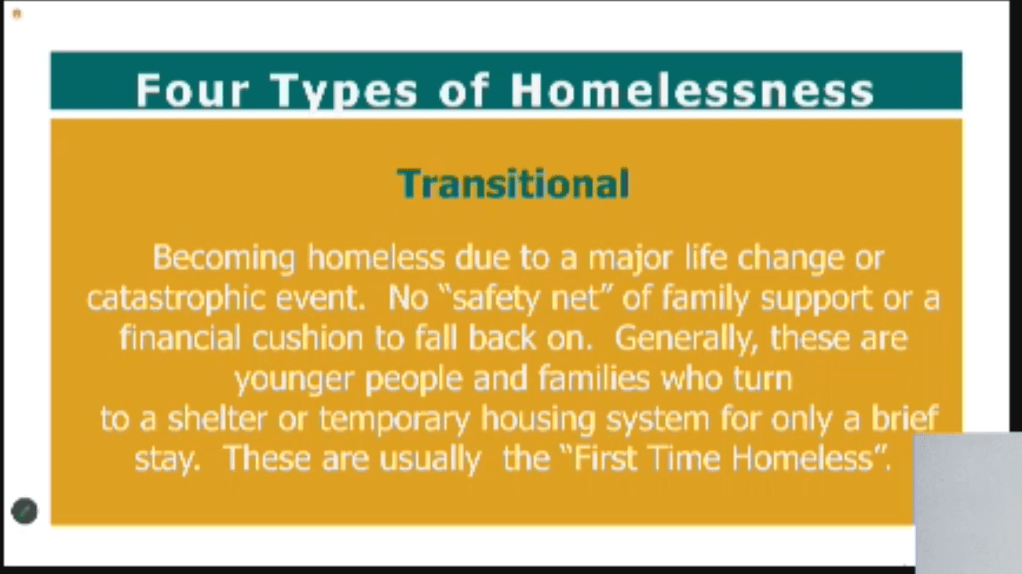
Keep in mind that homelessness is complicated:
The chronically homeless people are the most visible. These are the people you see along I-35 or in public areas. These are the people most likely to get counted in the PIT count.
The hidden or transitional homeless people are much harder to count. Who knows if you’re couch-surfing, or living in your car? Especially if it’s on-again, off-again? A lot of these people are holding jobs and functioning in society, but can’t afford housing.
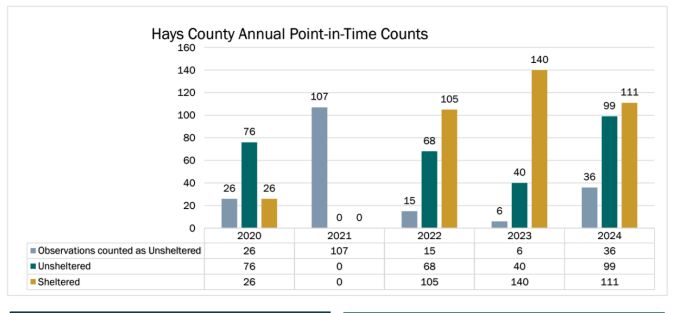
Results:
“Sheltered” means Hays County Women’s Shelter or Southside Community Center/BR3T program with motels.
So why is the number of unsheltered people going up? Most likely, it’s two things:
we’re getting better at locating and counting homeless people, and
rising housing costs are displacing more people, so there are actually more homeless people.
Where are the homeless people in Hays County?
Mostly in San Marcos.
This also has a couple reasons! We’ve got most of the resources here. But also, the people conducting the PIT count know San Marcos mostly thoroughly. They know where to check in town. We need cooperation from people with deep knowledge of Dripping Springs and Wimberly homeless communities, if we’re going to find and locate people there.
On that day, the PIT Count volunteers make 4 sweeps, but all during daylight, for safety reasons. They also chat with the homeless people, if the person is interested in chatting. So we get some informal survey data.
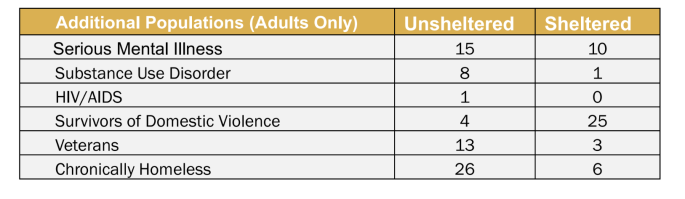
Survey results:
So what good is this? First, it allows us to apply for lots of funding.
Quick Detour: Remember Robert Marbut, from here and here? He was Trump’s homelessness expert, and then we tapped him to write a Homeless Action Plan for San Marcos.
Marbut advocates for “Treatment First” programs. You do not house someone until they’re stable enough to keep the housing. (If this seems cruel, you might have spotted the fly in the ointment.)
Under the Biden Administration, HUD funds “Housing First” programs. You get someone off the streets, first. Once they have some basic safety and security, then you can work on mental health and addiction issues. (The main argument against this is, “If you offer housing with no strings attached, you’re threatening capitalism! Workers won’t hustle and turn a profit if they’re not scared of having their life crumble!” Mm-hmm.)
Presidents matter. They install people to run all the major organizations, like HUD, the EPA, Dept of Education, DoE, etc. Under Biden, you will have sane people implementing humane policies. Those policies affect things like how cities help homeless people. It really matters.
Anyway, here are the slides from the presentation on why Housing First is more effective than Treatment First:
It’s more effective and less cruel! Win-win.
The PIT count is not the only measure of homelessness. There’s also the McKinney-Vento report for kids enrolled in public schools:
The McKinney-Vento report measures things slightly differently than the PIT Count. They try to record how many kids are couch-surfing, which is the “doubled up” category, and who is temporarily living in a hotel or motel. Whereas the PIT count doesn’t catch either of those unless Southside is paying for the hotel room.
One last note: Jude Prather volunteered at the PIT count, and works in his job to get vets housed, and he deserves some kudos for that hard work.
He also made a point of advocating for increased funding for organizations that provide individual case work for homeless people, which I think is a reference to H.O.M.E. Center.
I agree! They do great work.
…
Item 3: Spin Cycles
You might recognize these scooters from such hits as:
“I’m abandoned, blocking a sidewalk” or “I hope you didn’t need to use a wheelchair on this sidewalk”.
All kidding aside, they popped up in San Marcos back in 2021.
(It’s kind of weird – there’s no history about these scooters on the blog. Council did not discuss them when they were approved in 2021, nor when they were re-upped in 2022. No workshop, no discussion, nada. Did they go straight from Executive Session to the Consent Agenda, with zero public discourse? I think so!)
I’m actually in favor of this kind of thing! I mostly think the program is great (aside from blocking sidewalks).
This is my best guess as to how it works: you download an app. It shows you where the nearest scooter is. You can activate the scooter and ride it within a certain zone. The company is supposed to maintain and insure the scooters, and make sure they get tidied up on a regular basis so that they don’t prevent people in wheelchairs from using the sidewalk once they’re discarded.
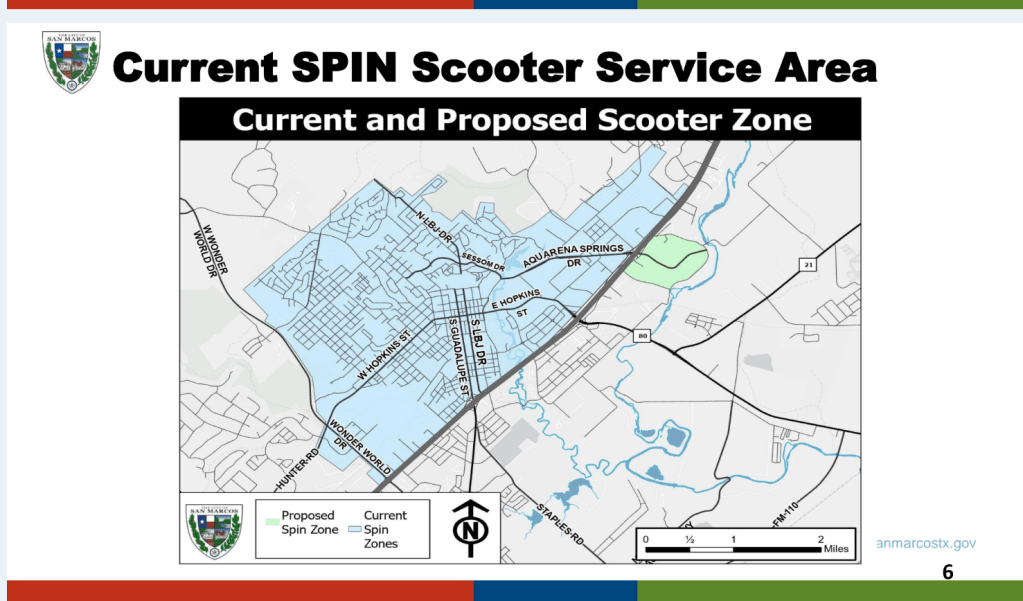
Here’s the current boundary of where they work:
I assume when you hit a boundary, they just deactivate, like a sad ghost who hit the wall of their haunting-perimeter.
They max out at 15 mph, and the company has slow-zones where they max out at 10 mph.
Overall, the program is successful!
They’re heavily used.
They’re significantly cheaper than owning a car
They’re better for the environment.
They’ve had 1 reported safety incident in 2022-2023.
They’re great at preventing people in wheelchairs from using the sidewalk. (Kidding. But this is my one major gripe.)
The company is asking for a two things:
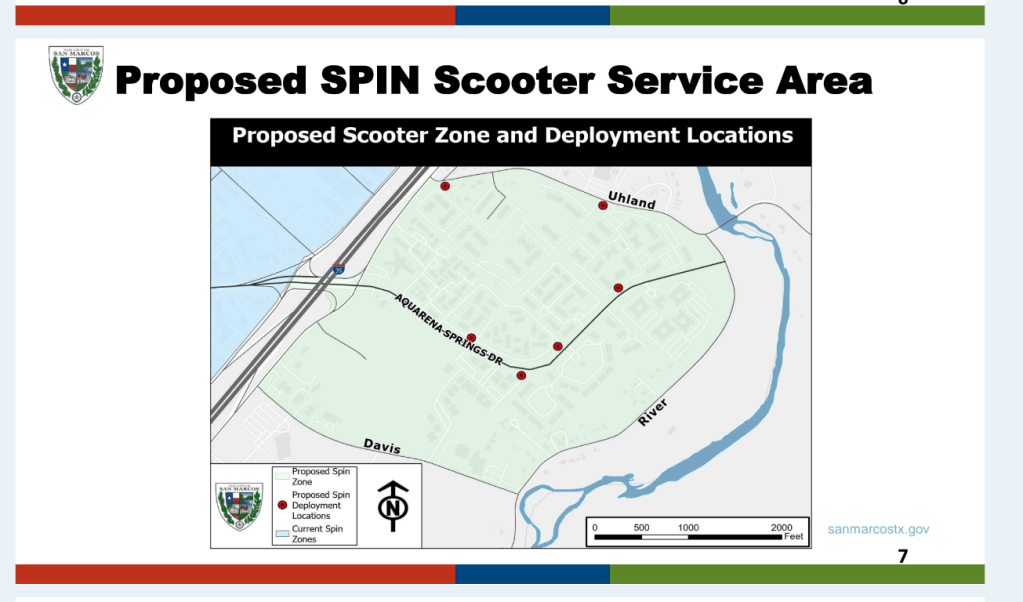
Bigger service area. They want to cross I-35, at Aquarena Springs Road:
This is a great area to include. There are tons and tons of students there, going back and forth to campus.
The big issue is I-35, of course. (I sometimes fantasize about what it would be like if I-35 had never split this town in half.)
Here’s what they’ll have to navigate safely:
The intersection of Aquarena and I-35 does technically have a sidewalk path that riders can take the entire way, to navigate it.
[Confidential to anyone who drives a car, truck or SUV: People are fragile. Please drive your 2000 lb vehicle timidly.]
2. Their second ask is to operate 24/7.
Right now, the scooters only work 5 am-midnight. So they’re not restricted to daylight hours, but they’re not available when the bars close at 2 am, either. But they’d like to be!
They have some safety options to mitigate things:
So I guess you can’t be so drunk that your vision is blurring? This seems like a low bar to clear, but at least they’re not getting behind the wheel of a car?
They can also throttle the max speed, and cap them all at 10 mph during overnight hours.
What does Council think?
Jane Hughson is a little wary of the I-35 exchange, and asks if we can put up some signs or markers directing scooters to take that specific sidewalk path.
Answer: sure.
Mark Gleason has some reservations about I-35 as well, but is mostly enthusiastic about looping in the east side and connecting them across 35. He asks if they can extend the zone to Walmart.
(I agree that stretching it to Walmart is a great idea.)
Saul Gonzales asks if you can get a DUI on one of these.
Answer: Yes you can!
In the end, everyone’s on board with this. Also, it’s a pilot program that will come back in 6 months, so we can see how it’s doing.
This week! Short term rentals, drought conservation triggers, childcare tax exemptions, and way too much detail on the tedious Lindsey Street negotiations. I’m very sorry about this.
Let’s get into it:
Hours 0:00 – 2:08: A little bit of fiscal reports, a little bit more on short term rentals, and some arguing about water conservation and drought triggers.
Hours 2:08 – 5:07: Sorry about all the tedious machinations of the Lindsey Street apartments. Also an important bit on childcare costs and daycare tax exemptions.
Just a note: “2024 YTD” is weird and confusing! Just to be clear, we’re talking about October, November, and December of 2023. It’s Q1 of Fiscal Year 2024. And “2023 YTD” means the last three months of 2022.
Anyway: The green bar is a little low. This is because property tax payments are coming in more slowly than last year. The speaker didn’t say why, but I assume it’s because Prop 4 passed in November, and so people got their tax bill later than usual. But the guy reassured us that it’s fine.
There’s also six Enterprise Funds: electric, water/wastewater, stormwater, resource recovery, airport, and hotel. They’re all fine! Everything’s fine!
Item 4: Short Term Rentals
We discussed short term rentals here and here already. We used to ban parties and require that STRs be owner-occupied, but (I think) the courts struck this down and so we had to rewrite our rules?
Loosely speaking, here’s what’s being proposed:
All STRs would need a permit.
Owners can only have one STR.
Only one STR on a block, or at least 600 ft apart.
Short-term tenants can have parties, but not excessively noisy ones, just like any other resident.
Everyone who lives within 400’ gets a postcard with a hotline number to call if you’re having any trouble.
At the March meeting, both Shane Scott and Alyssa Garza voted no, but they didn’t exactly say why. Jane Hughson chided them to come back with amendments that make it work for them.
To his credit, Jude Prather did come back with amendments to make it work. This is good governance! Let’s problem-solve!
Jude proposes that we strike the limit per block. In other words, anyone can have an STR wherever they want. His reasoning goes that everyone should be able to rent out their own home, regardless of whoever pulled a permit on your street already.
Matthew Mendoza doesn’t like it. You could have whole blocks which are full of STRs! It’s happened before, like on Riviera Street!
This is Riviera Street:
You might recognize this backyard from the river:
right when you’re floating here:
I got those two images from the VRBO listing, so feel free to rent it yourself if you want.
Riviera’s probably the only place in central San Marcos where backyards open up right on the river, so yeah, I can believe Matthew when he says that they’re all STRs. (And he also says they each have different owners – it’s not a case of one outside developer buying up the whole block.)
What do I think? Eh, I think it’s fine. I don’t think entire blocks are going to get bought up, in general. The other rule – “1 rental per owner” – is really much stricter than the “1 per block” rule, as far as preserving your housing supply.
And it seems reasonable to allow everyone to at least rent out their own homestead. If I had an ADU and I couldn’t rent it out because someone down the block was already renting theirs out, I’d be annoyed.
The vote to strike the “1 per block” rule:
Yes: Alyssa Garza, Jane Hughson, Mark Gleason, Jude Prather, Shane Scott No: Saul Gonzales, Matthew Mendoza
The vote on the whole set of STR rules, all together:
Yes: Alyssa Garza, Jane Hughson, Mark Gleason, Jude Prather, Shane Scott No: Saul Gonzales, Matthew Mendoza
So there you have it. Done.
…
Item 7: Water Restrictions:
We’re writing new water stages. Twenty years ago, we got a bunch of money from the state to start up ARWA, which drills from the Carrizo-Wilcox aquifer and requires a little more treatment before you drink it.
(Confidential to city staff who deal with water stuff: your slide is a few years out of date and it’s throwing me off, because I thought we weren’t getting ARWA water until later this year?)
Now:
The main thing that’s happening is that we’re going from 5 drought stages to 3 drought stages. This is supposed to make it simpler for everyone.
But there’s one other thing I want to discuss.
Last time, Virginia Parker from SMRF spoke about how the drought stage triggers were being recalculated. The staff person said hey, no worries! We look at all the sources! The details aren’t in the ordinance, but it’s department policy. No worries! So I didn’t worry.
This time, Virginia Parker spoke again and made the same point. However, this time it was a different staff member, and his answer was VERY different. So let’s dive in.
Background for Parker’s concern:
There are triggers that cause you to go from one drought conservation stage to the next. Under the old rules, we checked the Edward’s Aquifer level, the Comal level, and the San Marcos Springs level. If any of those were low, we moved to the next stage.
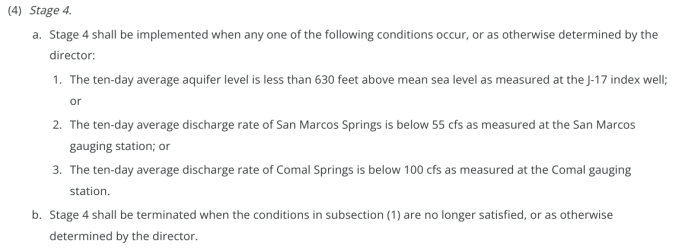
For example these were the triggers for stage 4:
(Full text here. ) The J-17 well is the Edward’s Aquifer. So we measured three sources, and if any of them were low enough, it would trigger stage 4.
Under the new rules, the drought triggers are very different. What we do now is combine all the sources first, and then check how much of the total we’re using. So if one source is running low, another source can compensate, and we don’t enter drought restrictions.
Here’s the specific text:
It’s way less detailed than the old triggers. Take Stage 2: “The average daily water consumption reaches approximately 75% of the rated available water production capacity for a seven-day period.”
In other words, now we take Edward’s Aquifer, Comal, and our new water source Carrizo, and we add all those together. Any one of them can be really low, but maybe the others compensate. If we’re using 75% of the combined total, then we’ll go into Stage 2.
You can see the scenario that Parker is worried about: The Edwards Aquifer could be way down, and our river is super low, but we’re not under any drought restrictions because the supply from Carrizo.
Here’s the answer we were given this time:
We’re allowed to use a certain fixed amount of Edward’s Aquifer water until the Edwards Aquifer Authority says otherwise. And dagnabbit, we’re going to use it, because it’s the cheapest water we’ve got, and the way our pipes are set up means that we can’t easily switch from one source to another. The EA water keeps our system pressurized.
When the Edwards Aquifer Authority tells us we have to cut back, we cut back. But otherwise we just take the same amount every week.
Jane Hughson: Would it be possible that Edwards Aquifer is in severe drought, like stage 3 or 4, and we’re still in stage 1?
Answer: Yes! That could happen.
Jane: What about people in San Marcos on well water that comes exclusively from the aquifer? We’d be telling them that San Marcos is Stage 1, but they’d need to know that Edward’s Aquifer is in Stage 3.
Answer: We’ll have to publicize both stages. But we include the usage of people on well-water in our budgeted Edward Aquifer totals.
Jane does not like this. Neither does Jude Prather or Matthew Mendoza. Neither do I! It just feels icky to say that “haha, we’re going to use all this LUSH PLENTIFUL WATER no holds barred” in the middle of a drought, because we’re shipping it in from another part of the state.
I see what the city staff guy is saying, too – our Edwards Aquifer usage doesn’t fluctuate. End of story. Conservation doesn’t help the aquifer and being wasteful doesn’t hurt it. But he’s being a cold engineer about how real people internalize drought stages. Drought stages are also about setting people’s expectations and communicating to people that we need to be good stewards of our environments.
Yes, we’ve planned well and gotten into a healthy water supply situation. But if you zoom out, the entire state needs clean drinking water for decades to come, so let’s not be all “WE GOT OURS, SUCKS TO SUCK!” to everyone else.
In the end, everyone votes to approve the plan, 7-0. As Jane puts it, “I have concerns, but I’m willing to see where this goes.”
You guys. These numbskulls spent ANOTHER 2.5 HOURS on these apartments. At one point, Mayor Hughson called it the most difficult zoning case that’s come before her in all her time in city government.
We’re still talking about these:
I dug this new visual from city staff:
(She comes in colors everywhere. She combs her hair. She’s like a rainbow!)
Anyway: that’s the view if you’re standing on Moore Street looking east towards campus. Project Site 1 is called “The West Half” by everyone, and Project Site 2 is called “The East Half”.
Remember we’ve got this list of 14 concessions from the developer already:
In exchange for all this, the developer wants 7 stories and a permit for Purpose Built Student Housing on the East Half, and 4 stories on the West Half.
Let’s see if he gets it!
Recomendation 7: How much advance notice should tenants get? How many tenants will get guaranteed leases at the new place, at a similar rent, when it gets built eventually?
In Citizen Comment, a speaker asked for 12 month advance notice for all tenants instead of 6 months. The developer says great, no problem.
Also in Citizen Comment, TAG (Tenants Advocacy Group) says that they went door-to-door, and most tenants did not know this was going on, and there were way more families and seniors who were going to be displaced than previously claimed.
Jude Prather makes a motion include up to 10 families and all seniors in the guaranteed cheap leases, in the new apartments.
What this means is that the families and seniors will have still have to find housing while the new complex gets built. That should be 2-3 years. After that, they’re guaranteed a lease in the new building, at a price that’s similar to what they pay right now.
By the way: what do they pay now? Apparently the current apartments go for $850/month. I gotta say, that’s shockingly affordable.
Jane Hughson points out that we missed our chance – we could have required a certain number of housing units to be set aside as permanent affordable housing, when we gave them 7 stories. (This is a normal deal to cut with a developer.) But no one thought of that at the time, and now it’s too late.
(Was it actually too late? I wondered about that. But no one takes the conversation in that direction.)
The developer says that he’s fine extending affordable leases to those current families. But for how long? Would 7 years be okay?
Shane Scott cries, “7 years! That’s way too long! How is the developer going to pay back his loans?” (I don’t know Shane, but the developer is literally the one who suggested 7 years. I bet he’s going to be okay.)
Jude originally suggests families and seniors over 60. Later on, he changes it to be seniors over 57, which is oddly specific. (Those born in March? Under a full moon and a high tide? Or just the regular kind of senior?) But everyone is fine with that. Great.
The Vote: It’s actually three separate votes.
12 months advance notice for current tenants? Yes, great: Everyone No: No one.
Affordable leases for ten families and seniors over 57 years old? Yes, great: Everyone No: No one
The affordable rent lasts for seven years? Yes, great: Almost everyone. How dare you, hell fucking no: Shane Scott
Recommendation 10: The developer won’t sell to any entity that doesn’t pay taxes for seven years.
This is because the university recently bought Sanctuary Lofts and The Vistas, and San Marcos lost a bunch of tax revenue.
Shane gives me whiplash. Now Shane makes a motion to amend this recommendation so that the developer can’t sell to ANYONE for seven years. Not just non-tax-paying entities, but also flipping it to another owner. Shane just doesn’t want the developer to flip the property, period.
Look, I am still totally indifferent to this whole thing. But Shane is being weird. Of the hours of complaints we’ve sat through, no one has complained about the developer flipping the property for flipping’s sake.
The developer says “The bank wouldn’t lend to me if they can’t unload the property if something happens to me. This would kill the whole project.”
Shane withdraws his motion.
Recommendation 5: PARKING. After P&Z, the developer was going to provide 0.85 parking spaces per bedroom.
Originally the developer asked for CD-5D zoning on the whole project. Jane is the one who got everyone on board to change the zoning on the West Half to be CD-5 instead. What’s the difference? The extra “D” stands for “Downtown” and she didn’t want to increase downtown.
But here’s the problem: CD-5 doesn’t require as many parking spaces as CD-5D.
So Jane has kind of gotten herself in a pickle! She was the only one who cared about CD-5, but she’s also the only one who cares a lot about parking. So her move to CD-5 worked against her own goals on parking. Now she has to convince everyone to re-raise the parking back to the old levels.
(Well, Saul cares too. But he’s just a plain no on everything.)
The developer offers 0.78 parking spaces per bedroom. Jane wants 0.85 spaces per bedroom.
Briefly:
Arguments in favor: if there’s not enough parking, students will park on the street.
Arguments against: it’s super expensive to build a parking garage. Each space is $30,000.
The vote after a very long, tedious discussion: Should parking be 0.85 per bedroom, overall?
Yes: Jane Hughson, Saul Gonzales, Matthew Mendoza
No: Alyssa Garza, Mark Gleason, Jude Prather, Shane Scott
So it fails, 4-3. The developer will provide 0.78 spaces per bedroom.
Recommendation 8: How many stories high should the west side be?
Jane does not like the 4 stories on the west side.
She does not like the height, specifically because it’s too close to Moore Street, which is too close to neighborhoods.
But she also does not like the sheer quantity of people who will be living there. She was okay with the 4 stories on the west side until the last meeting when Council approved 7 stories on the east side. That made the whole project too big for her.
Everybody argues with her. Here’s the thing:
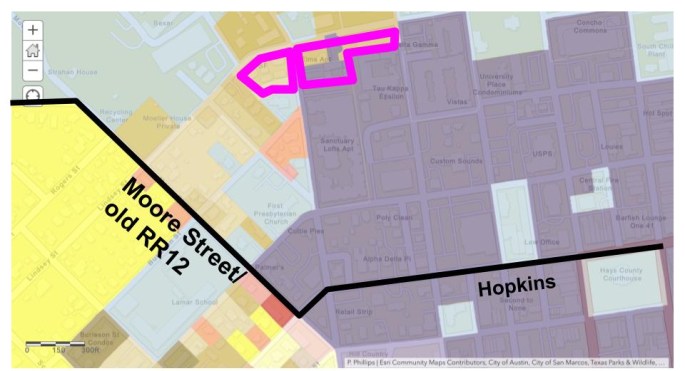
This is the zoning map of the region. You see all those tan regions to the left of the bright pink building I drew in? Those are all zoned multifamily. Any developer can build a 4 story multifamily building on any of those parcels right now, without getting any special permits.
Nobody is doing that because they’re zoned Multifamily 12, MF 18, and MF 24. That means sure, build your 4 stories, but you can only put 12 apartments in it. (Or 18, or 24). Whereas this developer is claiming he’s going to put 60 apartments on the 4th floor alone of the West Half.
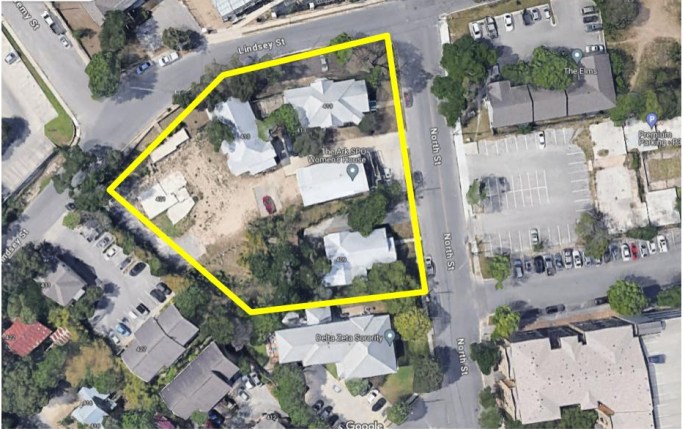
(Side note: How the hell are you going to fit 60 apartments into a single floor, on the west half of that lot? Ie just this piece:
There’s no way. But the developer definitely claimed 60 units per story. Are these apartments going to be tiny shoe box sized little space-savers? Is that because it’s going to end up as a Texas State dorm at some point?)
[New thought: I just realized that those tenants who are going to be offered affordable leases in three years? I bet the new apartments are half the size of their current apartments. They really are getting screwed by this deal, even if the damage was mitigated.
Of course, we urgently need to deal with affordable housing on a meaningful scale, not just this one pocket of renters.]
Anyway: you can already build 4 stories to Moore Street, but you can’t pack in very many apartments per acre.
Jane finally makes it clear: she doesn’t like the height AND she also doesn’t like the density. The area can’t support this much traffic, she says.
The developer says, “We had a traffic study done! By the main San Marcos traffic study dudes! You saw it! They said it wouldn’t add any traffic.”
Jane says, “I’m talking about pedestrian traffic! There will be too many people walking.” (Literally she says this, at 3:56:40. Go listen if you want.)
Let’s just repeat this for the folks in the back rows: the literal problem Jane Hughson has with this project is that there will be too many students walking down Comanche Street to get to class.
MAYOR HUGHSON!! I implore you to stop making up stupid shit to worry about! That is not a real problem!
Jane also says there are a whole lot of other issues, too many for her to get into.
Enough of this. Let’s vote.
The Vote: shall it be restricted to three stories?
Yes: Saul Gonzales, Jane Hughson, Matthew Mendoza
No: Mark Gleason, Jude Prather, Shane Scott, Alyssa Garza
So it fails, 3-4. It can still be four stories high.
But there’s a plot twist: later on there’s a vote that requires a supermajority. The developer must win over six council members in order to clear that vote. So Jane can still tank this whole project. (Saul has that one “no” vote locked down tight.)
So here is the developer’s final offer: hey look, the ground is sloped. What if it’s three stories on the corner with the highest elevation, and then there’s a extra partial story on the part with lower elevation? From the one highest corner, it will look like it’s 3 stories high.
Jane begrudgingly agrees to this.
The re-vote: Shall it be 3 stories with a secret 4th story where the ground slopes down?
Yes: Everyone except for Saul Gonzales
No: Saul.
And with that, the wheeling and dealing comes to a close.
Oh it’s not over! the whole thing goes on for another 40 minutes – there’s the final vote on the permit for Purpose Built Student Housing, there’s a PSA amendment, and there’s the final re-zoning vote.
I’ll pull one last quote, and then be done with it. This is Alyssa Garza, at 4:24:
It’s important for me to share how complicated it was for me to form my stance on this development. Distinguishing genuine community concern from personal interest has been exceptionally difficult in this situation.
I’m going to ultimately support the development. It’s with frustration and reservation because my perception is that our failure to prioritize honest dialogue on affordable housing leaves us feeling like we’re settling for concessions from developers. I also think it makes it seem like elected officials are guided by fear of backlash from their base, rather than genuine community needs.
And we’re going to end up in this situation again, and it’s fueled by elected officials and city leadership who have historically have failed to confront the issue of affordable housing critically and with imagination.
This whole process is super frustrating to me. The university, developers, and others take advantage of structures that we created, right? Until we address that, we’re going to keep ending up in situations like this. Personally, I think we can’t claim to prioritize community wellness and housing until we start funding initiatives like tenant’s advocacy, making participation in planning and zoning conversations more accessible, and directing our very well-paid state and federal lobbyist to push for policy recommendations by entities like The Housing Playbook Project, Texas Houses and so on.
All our neighbors concerns were super valid. But denying this project doesn’t address any of them. I think it’s important for me to name that before we go into voting. If we want to have a real conversation about that, we can, but I just don’t see the interconnectedness with this development. That’s all I got.
Lightly edited for clarity, but not much.
I basically agree. We need to do real work on affordable housing and tenant protection. This isn’t that.
Can we be done with this now?
…
Item 17: Childcare Tax Exemptions
Texas used American Rescue Plan money to subsidize childcare in 2021 and 2022, to the tune of $34.6 billion dollars. So when it ran out last year, we had a childcare crisis in the state. Apparently 44% of the childcare facilities were predicted to close with the end of the funding, and 300,000 children in Texas stood to be affected.
Look: you can’t do free market childcare. It’s too expensive. You have to heavily subsidize it. Right now, we barely subsidize it, and so the average salary for daycare workers is $12/hour. For one of the most exhausting jobs on the planet! Insane. So daycares have trouble finding workers, and are starting to close in large numbers.
According to this, Texas needed to invest $1.13 billion dollars in order to shore up our childcare. That seems like a bargain, compared to the $34.6 billion of ARPA money we just spent! And good news! We had a massive $32.7 billion budget surplus in 2023. Easy-peasy? Nope, sorry.
To be clear, the state spent $0 on this solution. Cities foot the bill.
Each city gets to vote individually if they want to implement the tax break or not. So we voted this meeting to give the tax break to qualifying daycares in San Marcos.
This is good! This is the right thing to do. It is good to give a tax break to these entities.
It’s just nowhere near enough. We’re a wealthy state! We could be doing so much more.
…
Items 23-26: We then punted on a bunch of items, because it was nearing midnight.
Economic incentives for a new grocery store? POSTPONE.
Bylaws for commissions? POSTPONE.
Paid Parking at the Lion’s Club? Sure, staff can start putting together a plan.
Appointments to Boards and Commissions? POSTPONE.
This is all fine. People don’t do their best work at midnight.
….
One last thing
This is my highlighting:
I just love how everyone’s gotta be a Soviet Cold War Era spy when it comes to code names for your secret business plan.
This week, Council basically talked about the Lindsey Street apartments for 5 long hours. Straight talk here: I just don’t care about these apartments! At all! I’ll still tell you about them, but this post may be a little lackluster. I’ll bring the blather, you can be the judge.
Here we go:
Hours 0:00 – 5:18: Citizens call for a council resolution for a ceasefire. But mostly just five hours of those Lindsey Street Apartments.
Hours 3:18-3:28: A teeny little bit about water restrictions!























 The San Marxist