Hours 0:00 – 2:39, 12/3/24

Citizen comment

Comments are a hodge-podge this week:

  • Salvation Army was denied some grant funding, they’d like it restored.
  • Demolition notices on Valley Street
  • Rio Vista incident with SMPD that we heard about last time
  • One person in favor of the Purgatory Creek rezoning, and one person opposed.
  • Ok, this last one is fun. This guy wants to build a Glidescape in town, which is a solar powered roller rink, with vertical farms that grow fresh food, immersive STEM workshops, virtual reality tournaments, and planetarium, which can transform into a disaster-resistant facility when the community needs a shelter. He wants a Chapter 380 agreement and maybe some tax breaks to bring this vision to San Marcos.

I honestly assumed the speaker was maybe someone on a manic phase. But he seems to be an active person with a lot going on on this website and also this one? I still am not sure if San Marcos can support a planetarium-vertical-farm-roller rink, but we can’t know for sure until we try.

Item 1: San Marcos got a bunch of federal money after the 2015 floods, to help with recovery.

As of December 2024, the grants are all done. We’re officially done with flood recovery funds, and hopefully the community feels restored.

Items 2-3: Fiscal reports for April-May-June 2024 and July-August-September 2024.

We had ample warning that sales tax was coming in low, and we adjusted and pulled things back.

This is April-June:

The striped green and blue is what we thought we’d have. But then the solid green and blue are what we ended up having. But the solid blue is still less than the solid green, so our budget stayed balanced.

Then July-September looks even more back to normal:

Our sales tax was down because one specific business had their revenue way down. That’s supposed to go back to normal next year.

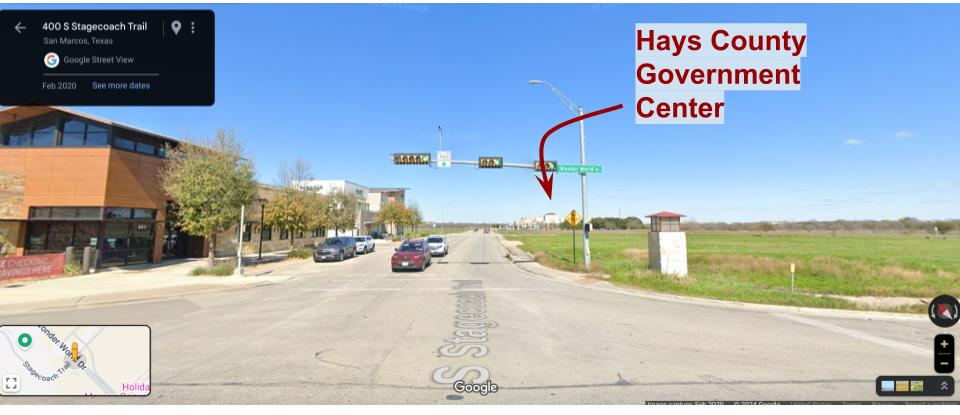
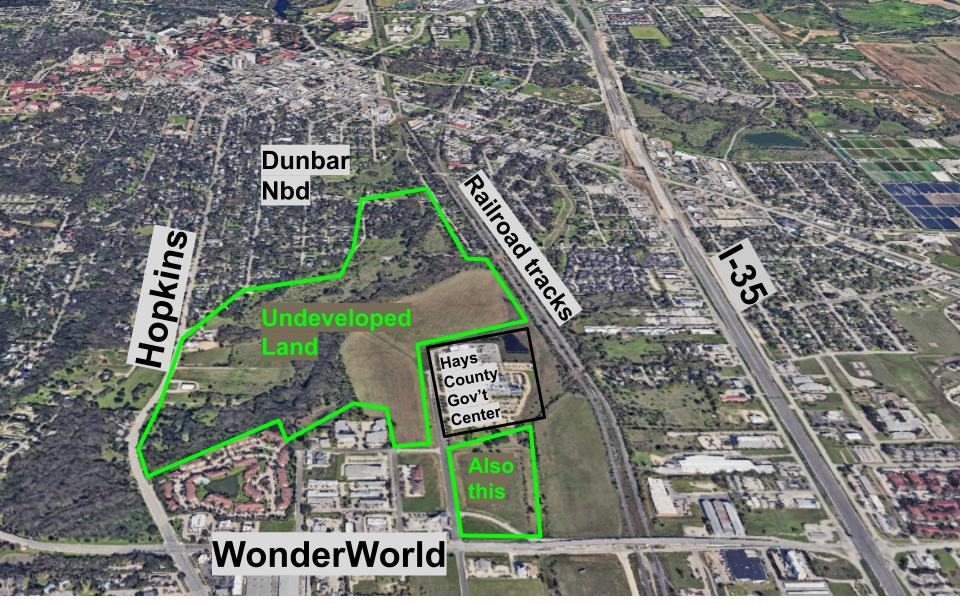
Items 19-21: The Hays Government Center is off Wonderworld, on Stagecoach:

All around it is a big chunk of undeveloped natural land:

It separates the Dunbar neighborhood from Wonderworld.

It’s never been developed, mostly because Purgatory Creek and Willow Springs Creek both run through it:

So it can get very wet and marshy in there.

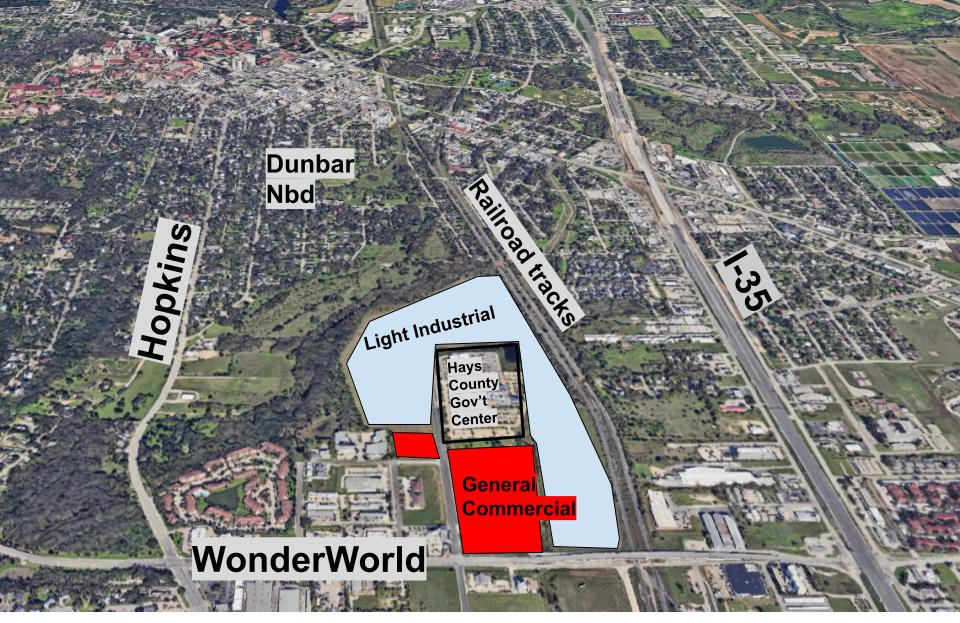
Way back in the 1980s, this land was all zoned Light Industrial and General Commercial:

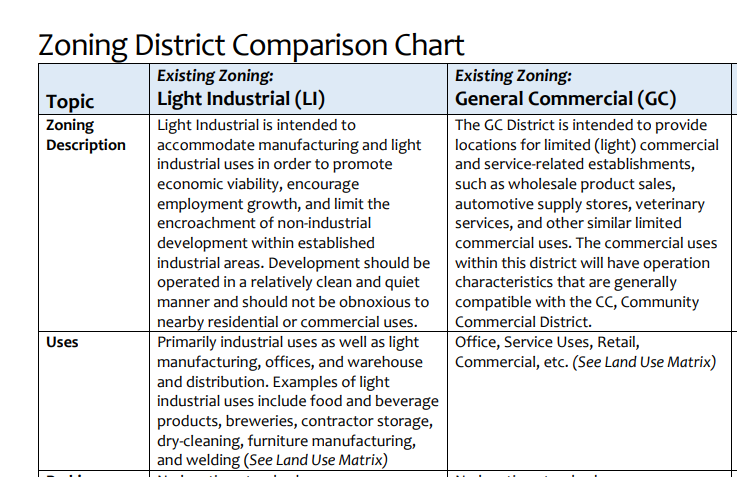
Here’s what General Commercial and Light Industrial mean:

So the owner, currently, is allowed to build anything in that chart, without getting permission from the city.

Honestly, back in the 1980s, this area was basically outside of town. And the people in charge did not worry about Dunbar neighborhood flooding.  

Fastforward to 2024

Now we do care about Dunbar flooding! How we’ve grown.

The city is working on the Purgatory Creek Mitigation Project, stretching from the river out to Purgatory:

(That’s my kludged-together map, joining Phase 1 and Phase 2.)

It’s going to be a big trench to help with flooding, with a big hike-and-bike trail running through it:

and the trail will connect the the river, through Dunbar, and over to Purgatory Creek Natural Area on Hunter and Wonderworld.

This trail cuts across the land that we’re talking about:

They’re calling this part of the trail “Hun-Dun” because it connects Hunter Road and Dunbar. Very cute, you all.

So the city approached the owner and asked about acquiring this land for that part of the trail: 

The owner of the land said, “Well, as long as we’re looking at this land, what if we change it all around?” He is proposing the following zonings:

The green part will contain the Hun-Dun trail.

So what about the pink and blue parts?

First off, both are down-zoning. They are less intensive than Light Industrial and General Commercial. So that’s good, but it’s also pretty weak, because the old zonings were kind of ridiculous.

Blue will be CD-5. Mostly this means large apartment complexes.   Pink will be CD-4, which usually means slightly smaller complexes, or things like townhomes.  

What did Council say?

There are two main themes to the conversation: flooding and new roads.

  1. Flooding.  If all this housing is built, will it increase flooding in Dunbar? After all, it’s going to displace a bunch of water. That’s basically why this area hasn’t been built out yet.

Answer:  According to our Land Development Code, you aren’t allowed to build something that makes flooding worse for people downstream.

Jane Hughson kind of laughs darkly, saying “We know how well that works.”

Amanda Rodriguez asks exactly how this gets enforced?

Answer: It’s prepared and checked by engineers.

Note: “Prepared and checked by engineers” is all well and good, but that’s not enforcement.  What happens if the builder cuts a bunch of corners? Enforcement has to come after that. Will city staff actually withhold their building permit and require them to fix it? Or will we just good-naturedly punch them on the shoulder and say, “Bro! You know better! Try not to do this again, but here’s your permit.” 

The answer is: who knows! That step is invisible. 

The second enforcement comes with maintenance: if you have a retention pond, do you check the drain and pumps regularly? Does the city? What happens if the drains get clogged and no one pays to have them cleaned? Will the city actually remove your permit? Or will they just wring their hands and say, “I hope this gets fixed!”

2.   The roads

Which roads should connect into this new neighborhood?

Councilmembers talk in particular about Gravel Road and Bintu road:

Gravel Road is a sleepy little dead-end with some houses on it. Bintu is a sleepy little road with a Holiday Inn on it.

Here’s the Transportation Master Plan:

So you can see that in theory, MLK and Gravel are both going to be extended across Purgatory Creek, into this new neighborhood. And Bintu is supposed to be extended across the tracks, to connect the I-35 frontage road into the neighborhood.

Is this a good idea?

It depends!!

Bintu Road extension: Yes, I think this is a great idea. No one lives there. Another way to get across the tracks would be great. Let’s do it.

Gravel Road and MLK extensions:

If you have two sleepy neighborhoods that are back-to-back, it is generally a good idea to connect them.  You want the people in these neighborhoods to have multiple ways to leave in case of flooding, for example.  Connectivity is good.

However! If you connect two sleepy neighborhoods and Gravel Road becomes the New I-35 Workaround, then that’s a whole lot of traffic that these neighbors didn’t bargain for.  All of a sudden, cars are zooming down Gravel Road at 50 mph.  

At the same time, the city does need more roads running parallel to I-35, aside from just Hopkins.  Maybe MLK? (My vote is also for Leah Drive, on the east side, and to extend the road that runs by Target, Barnes Drive, all the way to Wonderworld.)

Answer: Stay tuned! This will be a fiery debate when the Transportation Master Plan comes up for revision in the next 1-2 years!

Here’s the bottom line: currently, the developer is allowed to build all kinds of nasty things.  Our hands are tied here.  We’re not zoning new, rural land.  We’re re-zoning land where the owner has current rights to build all sorts of things.  This is a least-bad-decision.

Each part – blue, pink, green – gets its own vote:

The Blue Vote: Should the blue part be big apartment complexes?

The Pink Vote: Should the pink part be smaller scale dense housing, like townhomes?

I probably would have voted yes. It’s a good place for town homes and moderately dense housing. We just have to be thoughtful about the Transportation Master Plan.

The Green Vote: Should the green part be set aside for the trail?

That last one is easy. 

One final note: The developer says he doesn’t actually have any plans right now. This is not going to be immediately developed in the next 2-3 years.

Hours 2:39 – 4:58, 12/3/24

Now we get into the weeds. These next five items are pulled from the Consent Agenda by Amanda Rodridguez. This means that Staff guessed that no one would want to discuss anything, and Amanda said, “Not so fast!”.

(Alyssa and Jane also pulled items, but just had a quick question on each one.)

The five items are:
– Mailing parking tickets directly to people
– New bathrooms at Dunbar park
– Covid money for mental health collaboration between SMPD and a mental health treatment center.
– SMPD buying seven new Tahoes for $350K
– SMPD applying for a grant to start a Motor Vehicle Crime Prevention Unit

A few observations:

First, Amanda is thorough. Holy moly. She is reading everything with a fine tooth comb.

Second, what is Amanda’s point?

Her larger point is that these are the kinds of things we approve automatically. Taken together, these five items add up to $709K. (For perspective, keep in mind that we budget $550K yearly on social services.)

We just aren’t this generous – both in dollars and spirit – in other areas. Recall how it took Alyssa years of banging on about it to get $115K extra Covid money set up for emergency housing. Why is $350K for police cars so easy, and $115K for emergency housing so difficult? What Amanda is doing in these next five items is scrutinizing items that usually pass uninspected.

Honestly, I would vote in favor of all five items. I don’t actually think they are abusing city dollars.

It’s just that this level of generosity should be the standard, and it’s not. When it comes to my pet issues – homelessness, holding landlords accountable, transit, the parks department, etc – we should be as quick and gracious to fully fund them, as we are when it’s time to spend $350K on new police cars.

“BUT WAIT!” you cry, “We can’t afford to spend a million dollars all over the place like that! We’re broke!”

Gentle Reader: never forget that we spend $1.2 million on Kissing Tree each year. And it’s gated, and you’re not allowed in. Sorry.

….

Anyway! Onto the weedy details.  Brace yourself.

Item 4: Mailing parking tickets

The parking lot next to the Lion’s Club is going to become a pay lot. Supposedly it’s going to be free for residents (but the details are murky). Out-of-towners will get their parking tickets mailed to them. (We discussed this last time.)

The first issue: In general, there’s an Early Bird discount – 50% off! – if you pay your tickets off early. You get 14 days to get the discount.

But if you’re mailing tickets out, you’d want to extend that window to account for the mail. Staff said 17 days. Amanda wants 30 days.

This is a little tricky because there’s also a late fee that kicks in at 30 days. Council decides to extend the Early Bird discount to 29 days on tickets-by-mail. The very next day, the late fee deadline will kick in.

Amanda Rodriguez has a number of other notes:

  • She wants to fully fund the parks department, but not through fees and fines.  (This is a big issue, nationwide. Map here showing that San Marcos is not a big offender, though.)
  • There’s a bunch of murkiness in the policy language: operators versus car owner? Standing vs parking?  Are robots writing tickets here?

They clean up the ordinance a little bit.  Robots are only scanning license plates as you enter or exit the parking lot.  The rest of tickets are being written by people, and the system mails them automatically.

You’re supposed to be allowed to load and unload for up to 30 minutes in this lot. But right now, the ordinance is ambiguous:

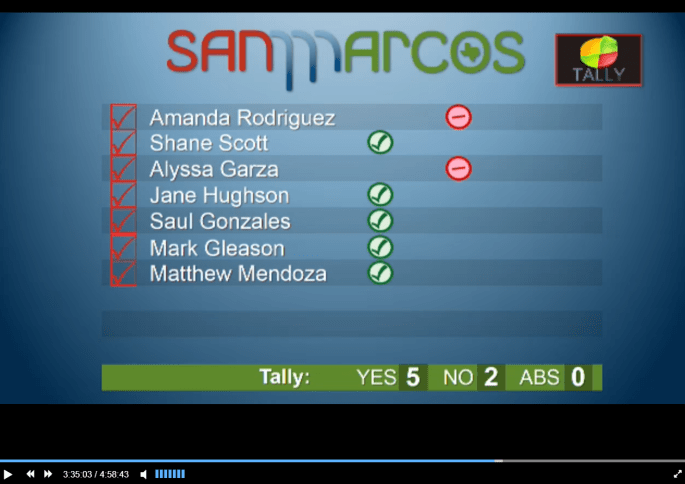
The Vote: Should we clean up language to allow for lawful loading and unloading?

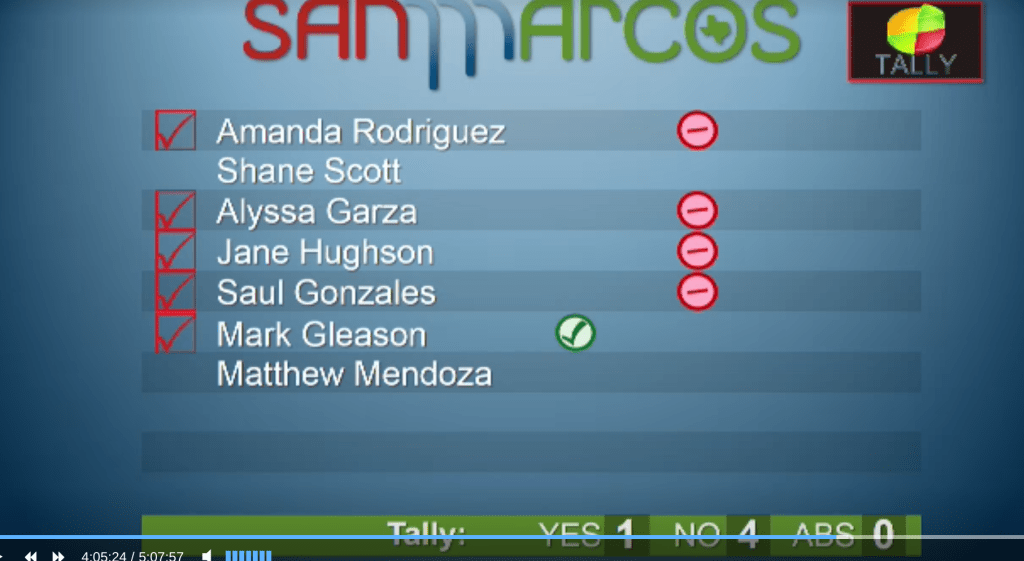
Yes, of course:  Jane, Amanda, Alyssa, Saul, and Mark
HELL NO! Ticket them to smithereens:  Matthew Mendoza. 

Okay Matthew, if you think that’s best.

Amanda’s next point: Paid parking for out-of-town residents reflects an “Us vs. them” mentality. We should welcome our visitors, not shake them down. 

The counter argument to this is put forth by Mark Gleason and the city manager, Stephanie Reyes:

  • San Marcos residents don’t use the river, because they’re too full of out-of-towners.
  • The out-of-towners aren’t spending money in our downtown, or hotels, or restaurants. They pack in a cooler and leave town after they get out of the river.
  • The parks and river are getting trashed and destroyed, and there’s a lot of drunken fights and medical problems.  San Marcos is stuck paying for this unless we can collect some money from the out-of-towners.

Jane also has a good point: why is this ordinance so narrow?  Right now, it’s only city park.  Why not write it to include future paid parking lots?  (This does not get fixed.)

More points from Amanda:

  • This is 6 am – 11 pm every day.  No free parking after 5 pm? Holidays or something?
  • Registration process for San Marcos residents – how will that work? It’s supposed to be free for them.

Answer: there will be a big education campaign! We’ll hold events at the library.

Alyssa chimes in: San Marcos has a big problem with roll outs. How many people have microchipped their pets? How many people have signed up for the Enhanced ID at the library? How did the can ban PSA go?

All of those public information campaigns sounded great in paper, but in practice, we just don’t connect with people.

(Note: good public outreach is extremely time-intensive. It’s not enough just to translate everything into Spanish and promote things on social media. You basically need to maintain close and healthy relationships with a lot of community leaders who are in close contact with your hard-to-reach populations. What church does your population go to? What barbershop? Etc.)

Finally: This is just a pilot program. If Council wants to shut this down next year, there will be an opportunity.

As Parks and Rec director Jamie Lee Case says, “City Council will have a chance to decide if the juice is worth the squeeze.” She wins my most-favorite line of the night, hands down.

The final vote: Should we mail parking tickets from the City Park parking lot?

Amanda and Alyssa are both no, mostly due to lack of details on how the registration process will work.

I probably would have voted for it? It seems like a pretty cautious step.

Note: The vast majority of conversation these days is between Alyssa Garza, Amanda Rodriguez, and Jane Hughson.   Just because I’m a shit-stirrer and this made me laugh:  

At 3:01: Shane Scott, Mark Gleason, and Matthew Mendoza are all clearly on their phones.  I guess someone does not find the intricacies of parking violations as thrilling as I do?  Talk about a violation of Municode Chapter 23.46, Section 3.0045, paragraph 8.243. 

Item 6:  We’re spending some Covid money on installing new bathrooms at Dunbar.

Amanda Rodriguez is thorough.  Like thorough

She catches that the contract does not include baby changing tables nor little trashcans for used period products, and asks that those be added in.  

Everyone agrees that this is a good idea.

….

Item 8: Oh, so confusing. 

Here’s the caption:

But here’s what was originally posted, back in November:

The problem is that there’s no such thing as “the City Mental Health Court Program”.  So they changed it on the agenda to SMPD. (Currently this is how the program works: SMPD mental health unit identifies people who need mental health or substance abuse treatment, and refers them out to Evoke Wellness for treatment. Then Evoke Wellness provides in-patient and out-patient substance abuse and mental health treatment.)

What Amanda brings up, though, is that there’s an entire contract in the packet between the City, the treatment center, and the non-existent City Mental Health Court Program. 

No one seems to know what’s going on.

This gets postponed. However, this is Covid money, which expires on December 31st. So it absolutely has to get squared away at the next council meeting.

Item 9: SMPD wants $371K to buy seven new shiny Chevy Tahoes.

Ideally they like to replace police cars every five years. But due to Covid shortages, these are more like 7-8 years old.

Amanda Rodriguez points out that plenty of people drive cars much longer than that.

Chief Standridge explains that the game is to optimize resale value. The Tahoes we’re selling are 7-8 years old, have about 80-85K miles on them, and about 6500 idle hours. (Reddit tells me each idle hour is equivalent to 25 miles driven.) If they wait any longer, repair costs go up and resale costs go down, and everyone gets bummed out.

Each car is $52K, plus each car gets its own fancy Police costume. Installing the costume on the Tahoe, inside and out, is about $20K per car.

Alyssa Garza follows up: SMPD officers use police cars to do their off-duty work. So they’re putting wear and tear on these cars. Can the private companies pay to offset the cost of the vehicles?

(Max Baker and Alyssa actually first brought this up back in 2021. )

Chief Standridge says he actually just met with someone about this just last month! Nothing happened. One of the off-duty employers is SMCISD, and we don’t want to spring it on them.

(I mean, it’s been over three years.)

They also say that we should be leasing SMPD vehicles instead of buying them. This is cheaper in the long run. But because of the tax shortfall this summer, we couldn’t budget for an ongoing expense, so we have to use special one-time money to purchase them.

The vote:

I warned you that these items were weedy! There’s still one more to go.

Item 14: Autocrimes Unit

SMPD is applying for a state grant for $177K. This would pay for establishing a Motor Vehicle Crime Prevention Unit, with one full-time officer and a bunch of license plate cameras.

It’s not free – the city pays $35K in matching funds.

Amanda points out that there were 157 stolen cars last year. Out of 70,000 residents, that’s 2.2 vehicles per 1000 people. Her point is that this is inflated in people’s minds. Everyone acts like it’s a giant issue, but that’s actually fairly small.

Here are some other problems, for perspective:

  • 27.7% of San Marcos residents live under the poverty line. That is 277 per 1000 people.
  • I don’t know how many jobs pay minimum wage, but it is definitely more than 2.2 per 1000 people. We could raise the minimum wage.
  • As of 2017, we needed almost 6000 more low-income housing units. Obviously housing prices have gone up, but let’s use the 6000: that works out to 85 units needed per 1000 people.
  • The uninsured rate in San Marcos is 16.1%. That works out to 161 uninsured people per 1000 people.

Chief Standridge is a hard no on any mitigating context! He wants zero crime!

Amanda grills him on the value of education, and why is it deprioritized in this grant application?

Chief Standridge argues that they do tons of other education! Also, out-of-towners come in to take cars. We can’t educate out-of-towners. Education is only one piece of the larger approach.

Mark Gleason is furious. This is an epidemic! There is a 50% increase in stolen vehicles from 2023 to 2024! These stolen vehicles get used for crimes!

(Repo man)

Mark and Amanda have an angry exchange. If you want to listen, it goes from 4:30:49 – 4:34:15.

Mark is furious that others aren’t taking car theft seriously. He sees a stolen car as derailing someone’s livelihood, and he’s furious that Amanda is challenging Chief Standridge’s plan to reduce this epidemic.

Amanda is furious that we don’t take other problems as seriously as we take car theft. Yes, it’s super shitty if your car gets stolen. But here we are, prepared to drop $35K to match a grant without any discussion, and we don’t apply this same eagerness and dollar amounts to issues that affect a lot more people. As policy makers, council’s job is to figure out how to compare apples and oranges and apply some consistency across many different issues. Right now it’s wildly inconsistent.

Alyssa and Matthew Mendoza also get snippy with each other – if you want to listen, it’s at 4:29-4:30.

Saul doesn’t get snippy with anyone! But he does ask: How do we pay for this two years from now, when the grant runs out?

Answer: It’s a recurring grant. We expect to get it again.

The vote:

Phew! That’s it for the items pulled from the consent agenda.

The rest of the meeting is extremely short.

Item 24: Tantra is going to get reimbursed the $750 fee for appealing the noise violation. Yay!

Item 25: Right now each councilmember gets $12K to travel to conferences.

Shane Scott wants to double this to $24K. City Manager Stephanie Reyes gets a little faint at the notion of magically locating $84K extra dollars in the budget for this.

This will come back around, with more details. Like do all the council members even spend all their money? Maybe they can share the pool a little bit amongst themselves.

Bonus! 3 pm workshops, 12/3/24

Workshops were great this week. Per usual.

  1. Texas State University. What’s up with them?

This is new! I can’t ever recall someone from the university giving this kind of presentation before.

(That said, the speaker did not supply his slides to the city, and so all I could get were crappy screenshots of the interesting slides. )

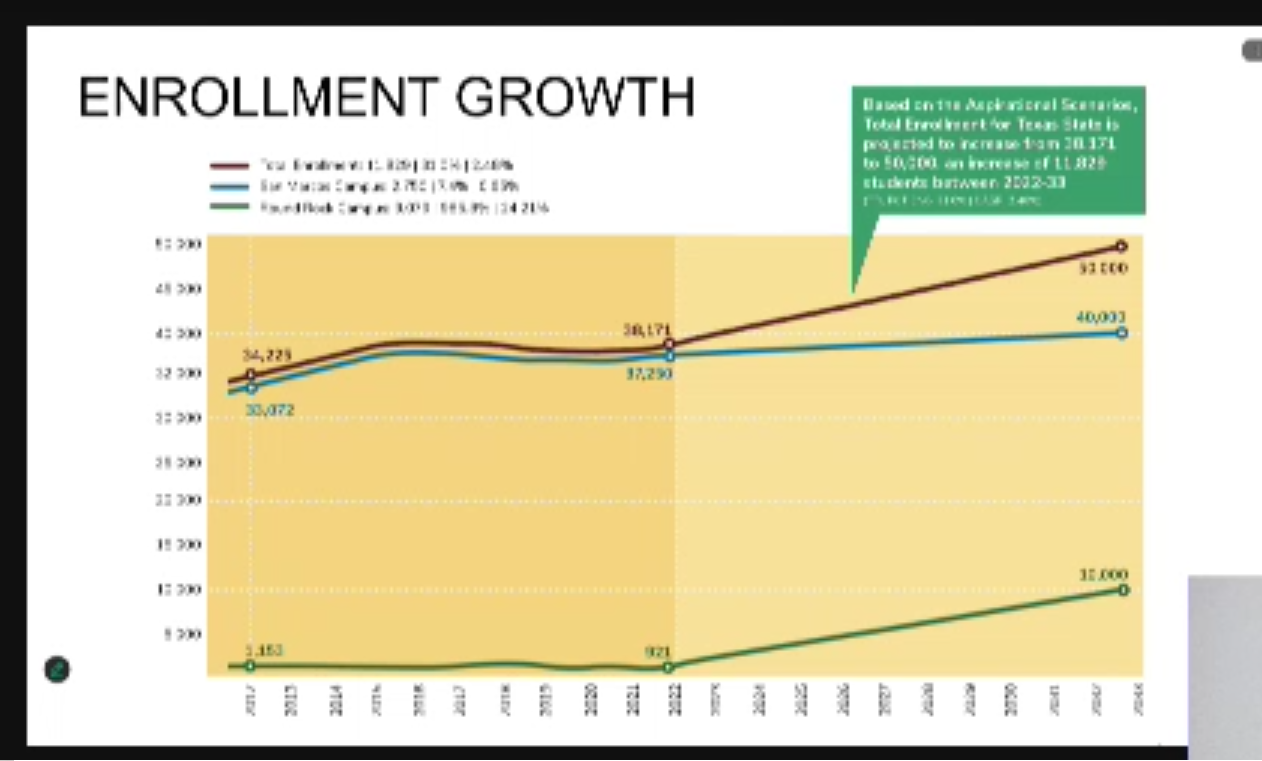
Enrollment Growth

Uh, yeah. Sorry about the quality! I bet it looked great in person!

They’re projecting to grow from 40K to 50K students, but most of that is at the Round Rock campus and online.

The green line at the bottom is Round Rock. The blue line in the middle is San Marcos. The San Marcos campus is projected to grow from 37K to 40K over the next ten years.

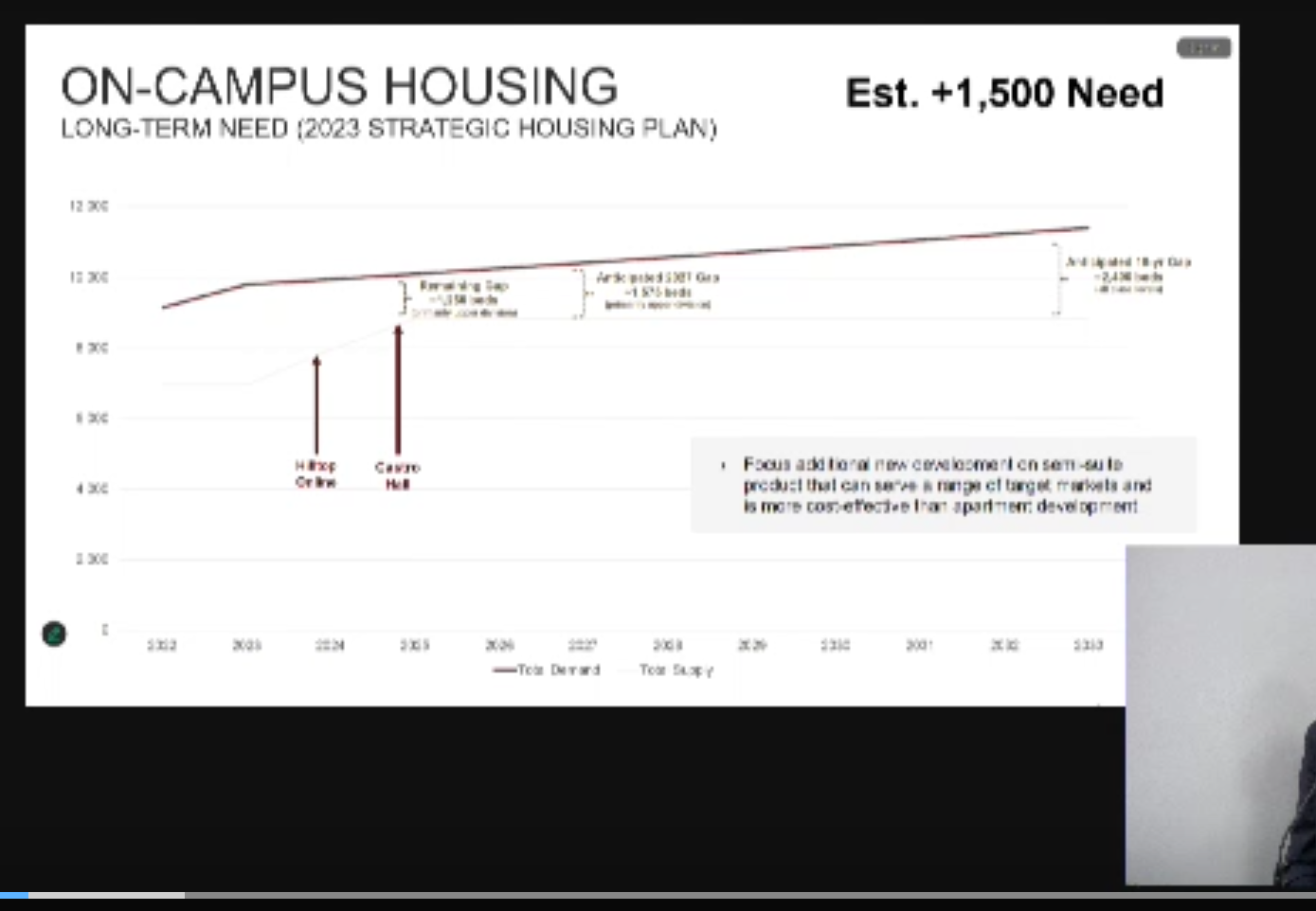
Housing need

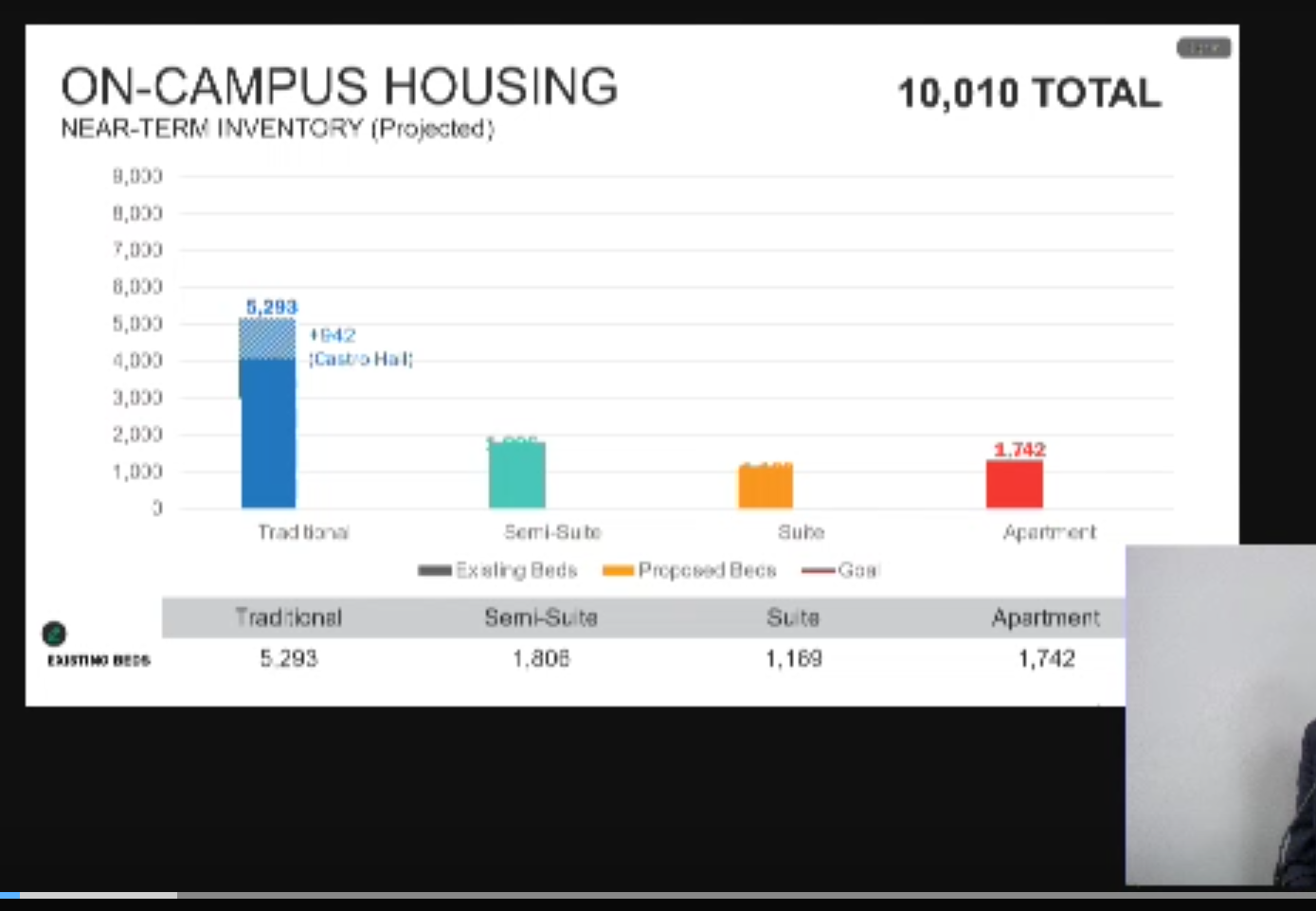
They’ve got about 10K beds on campus right now.

They’re going to need about 1500 more beds by 2027. They’re building more dorms to cover that.

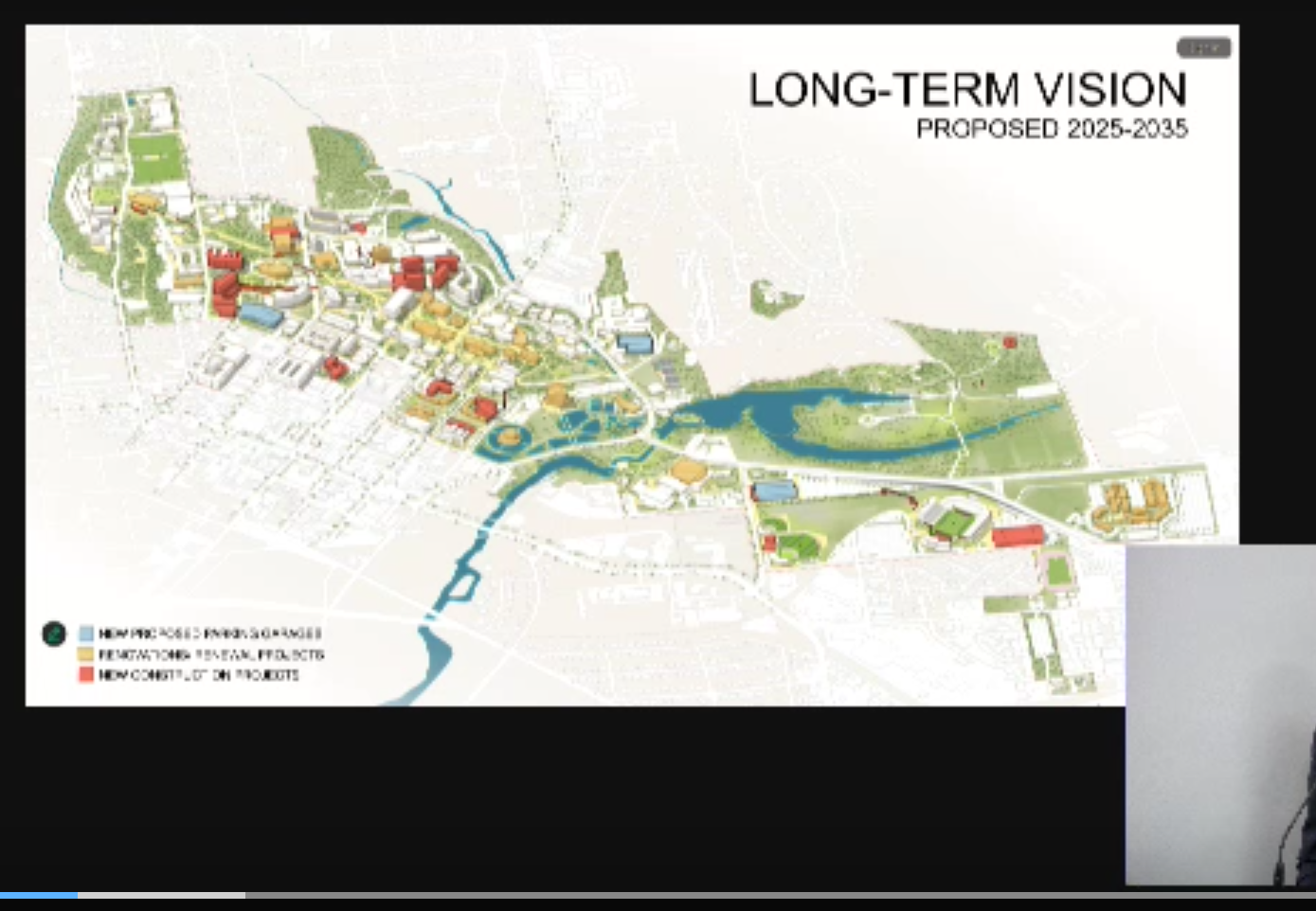
Construction, etc:

The dark red are new buildings that are under construction or are planned.

The light orange are getting major renovations.

So they’re not really planning to acquire any more land. Aside from those red buildings, they’re mostly going to reconfigure existing buildings to handle more capacity.

Note: This is supposed to comfort city council. The city is mad that the university purchased two downtown apartment buildings, in order to convert them into dorms:

We talked about this last March, when council approved the new Lindsey Street apartments.

Texas State doesn’t pay local taxes. And downtown apartment buildings are worth a lot of money. So the problem is that when Texas State bought those buildings, San Marcos lost a lot of tax revenue.

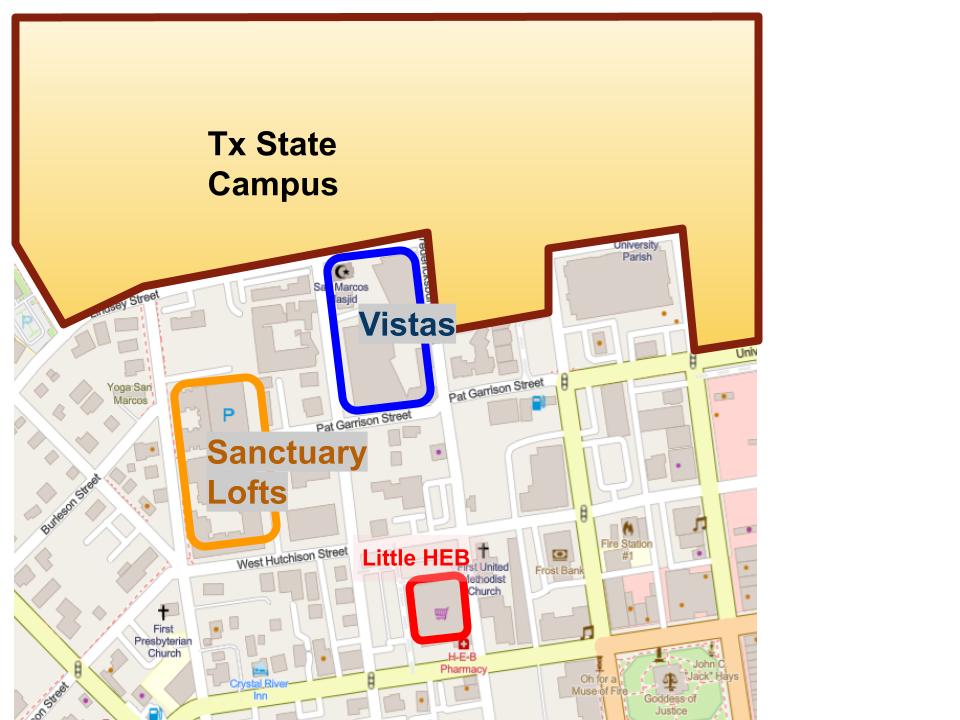
On the super tiny map, I think they’re here:

Sanctuary Lofts is now called the Balcones Apartments and the Vistas is now called the Cypress Apartments.

Parking and transportation:

Light blue boxes might end up being parking garages. Bottom right is Thorpe Lane.

They’ve got 48 busses, 90,000 weekly ridership. It’s a pressure point for the university.

The plan is to merge the city and university bus system. This benefits San Marcos hugely. When the university started reporting their ridership to the feds, San Marcos got about $13 million in funding.

The speaker talks about having an app showing all busses, at any moment, all free for everyone in San Marcos. That sounds amazing!

Spring Lake:

There will be a lot more trails and improvements coming to Spring Lake:

but again, the slides are so murky. It’s hard for me to provide details.

Council questions:

Amanda: Is there any talk about capping growth at 40K?

Answer: That’s as much capacity as we can accommodate. But the regents want to grow all the universities to handle 60% of Texans by 2030. They tell us what they want, and they want to grow.

This is all taken from the next Master Plan, which will be approved in 2025.

Affordability: Recently, UT went free for families earning up to 100K. Can we do that?

Answer: Right now we’re free for families up to 50K. We’re asking to see if we can get funding to be free up to 100K, like UT. We expect that would be similar – 5-10% of our student body would fall in that 50K-100K range. (That is WILD. 85% of their student body comes from families making more than 100K?)

This plan has not been finalized yet. I think the master plan gets voted on next year.

Workshop #2:

Every four years, San Marcos has to review the City Charter.

Council will appoint seven people to the charter review commission. They only have six months to do a ton of work, because it has to be done in time for the fall election.

The community can also add charter amendments to the ballot, like when we outlawed fluoride in 2015. (We were RFK junior before RFK junior even had a brainworm.) Maybe we can undo that!

If you would like to be considered, they will be opening up for applications.

November 19th City Council Meeting

Big long meeting this week! All the details on the Tantra saga, a lot on housing, and a little on Five Mile Dam, parking tickets, water towers, and deer. And more. A lot going on here!

Seven hours of meetings and workshops! Let’s dig in.

The 6 pm meeting:
Hours 0:00 – 3:21: All the exciting details about how Tantra got its groove back.
Hours 3:21 – 5:07:   Low-income housing, Covid money, parking tickets, Five Mile Dam, some deer, and more!

Bonus! 3 pm workshops:  GUYS. Guys. These were so interesting, I can’t stand it. I am being 100% sincere here.
Part 1:  Rent-by-the-Bedroom corporations are the worst!
Part 2: Low-income Housing in San Marcos.  Are we spending too much money on them??? (no.)

Say, if you’re like me

You might be feeling a little vertigo and panic over the looming threat of mass deportations? 

If so, let’s channel that energy!  Here’s a list of organizations that can use your time and/or money, and are already planning how to best protect immigrants and refugees.

Local to San Marcos: 

Mano Amiga is our homegrown organization. They are accepting donations, and will be able to use volunteers in mid-December. (Or they’ll send you to volunteer with a partnering organization.)

Regional Austin-San Antonio: 

American Gateways: Their mission is “To champion the dignity and human rights of immigrants, refugees, and survivors of persecution, torture, conflict, and human trafficking through exceptional immigration legal services at no or low cost, education and advocacy.”

Catholic Charities of Central Texas: Has a specific immigration services wing, “Offering affordable immigration legal assistance from experienced attorneys and staff, with a focus on family reunification.”

Statewide:

RAICES: From their website: “WE defend the rights of immigrant, refugee, and asylum-seeking people and families, empower communities, and advocate for liberty and justice.”

Texas Civil Rights Project: Has a specific Beyond Borders program, “From the banks of the Río Grande to the plains of rural Texas, we envision a border state that respects the right to migrate and supports human dignity for all people, no exceptions.”

Texas Immigration Law Council: “We work across the political spectrum to bring together diverse voices to catalyze consensus on practical immigration solutions for Texas and our nation.”

….

Final note: All of these came recommended to me. If I’ve left something off, let me know and I’ll add it on!

Hours 0:00 – 3:21, 11/19/24

Citizen comment:

  1. Live music at Tantra Coffee Shop. 
    P&Z killed their live music back in September.  The community is livid! We’ll hash it out in Item 9, below.
  1. One speaker talks about deer. (Item 17, at the end of the meeting.)
    – Urban deer are responsible for more deaths than any other animal. 
    – In 2010, Council thought hard about this, and decided to do nothing.  Now we’ve got an even bigger problem.
    – Also, stop feeding the deer, even though they’re cutie-patooties, with their big eyes and spritely tails.
  1. November 10th, in Rio Vista.  Two speakers talk about this. 
    – Apparently there was a violent dispute, and a shot was fired, and the cops were called.  The guy with the gun left the scene.
    – The cops showed up with 8 cop cars, SWAT teams, set off 6 flash bombs from neighbor’s yard, blared megaphones, and generally acted like the circus-military was setting up camp in Rio Vista for a night of revelry, from midnight to 3 am. 
    – The suspect was not at home, this entire time.
    – This police response did not make the speakers feel safer, whatsoever. It felt like an untrained, reckless mess.

4. At the 3 pm workshops, Virginia Parker talked about Cape’s Dam. She is the director of the San Marcos River Foundation, aka SMRF. (Cape’s Dam explainer here. Warning: I wrote that when I was a baby blogger. I did my best.)

Here’s what Virginia Parker says: SMRF owns the high bank at Cape’s Dam. For ten years, SMRF has been saying that removal of the dam is the best thing for the environment. The city has been dragging their feet, and saying they’re going to hire a project manager to run a feasibility study on rebuilding the dam. There’s no money to hire this person. This study is not coming anytime soon.

Virginia Parker says: Cut the bullshit. (My words. She is far more polite about it.) SMRF will never agree to rebuilding the dam, and they own the high bank. The city would have to take it under eminent domain.

So (she says): Dissolve the agreement with the county. Reallocate the money. Dams are not safe – a teenager just lost his life there recently.

Plus, there are federal grants available for dam removal. It’s free. It’s the fastest and cheapest way to deal with this situation.

I totally agree! Listen to Virginia Parker!

Onto the meeting!

Item 9: Tantra Coffee Shop

You know you love Tantra:

photo credit

Back in September, Tantra went to renew their alcohol permit. This is where our story starts – at that Planning and Zoning meeting.

The P&Z Meeting: September 24th

There was one speaker (LMC) who was mad about the music.  “They’re blasting profanities and obscenities into the HEB parking lot!!”   She’s called the cops on them two or three times, but nothing ever came of it. Because there was no actual violation taking place.  

Now, LMC talks at almost every meeting. She’s prolific. P&Z and Council are used to taking her comments in stride.

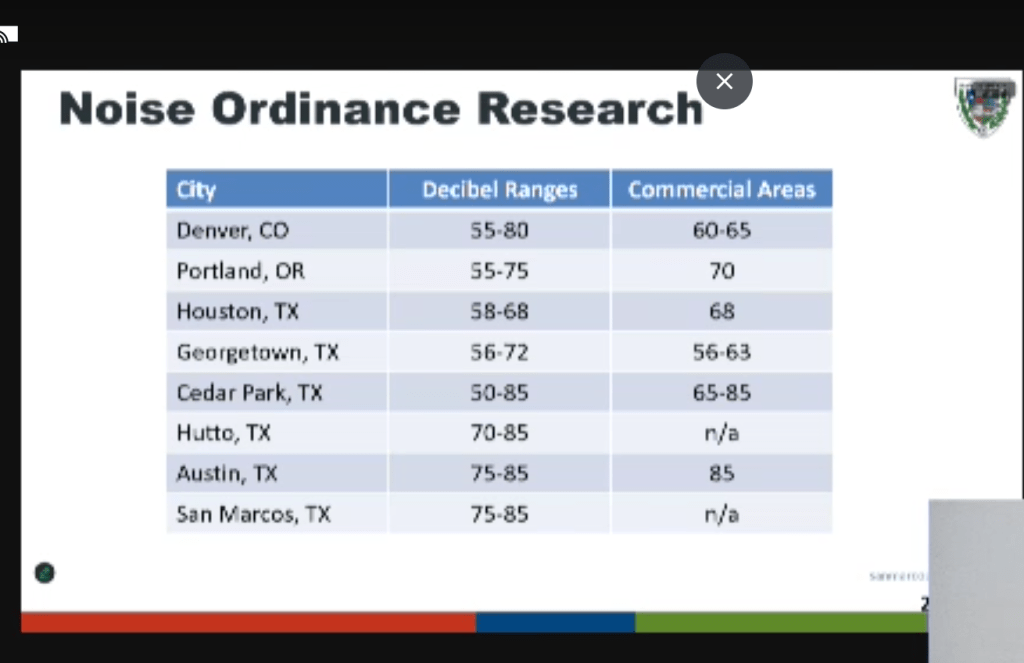
But P&Z kicked things off with guns blazing.  Jim Garber had a well-prepared speech.  First he compares the decibel levels allowed at a bunch of other towns, but he mostly cherry-picks residential areas.  (More on this below.)

This is the most absurd part of the speech, and I’m quoting verbatim here:

“Frank Sinatra tells us that New York City is the city that doesn’t sleep at night. He’s wrong. Because in residential areas, in various boroughs, [the noise cap] varies in daytime 45-55 decibels. We allow 85.  At night, 35-45.   So New York does sleep at night! The city that doesn’t sleep at night is San Marcos! You experience more noise in downtown San Marcos than you will in New York City.  Something to think about.”

You guys: no.  San Marcos is not louder than Manhattan.  I promise. New York is such a dense, stacked place that small noises quickly amplify.  So they have to control the noise output of things like air conditioners, ventilation, bars, construction sites, and garbage trucks.  You get this ambient background noise level, and then all other sounds ratchet up, in competition. 

New York City is not remotely parallel to live music at Tantra, with the occasional naughty word floating over to HEB.

Garber wraps up his speech with the 60 decibel limit for Tantra.  There’s one single other comment from a P&Z commissioner, about how un-family-friendly it is to have vulgar music blasting into a grocery store. 

The owner of Tantra is attending the meeting! He’s there on the zoom! But no one asks him a question, so he can’t say anything.

The P&Z vote is unanimous: Tantra’s alcohol permit comes with a 60 decibel cap.

The whole discussion takes just over five minutes.

How bad is 60 decibels?

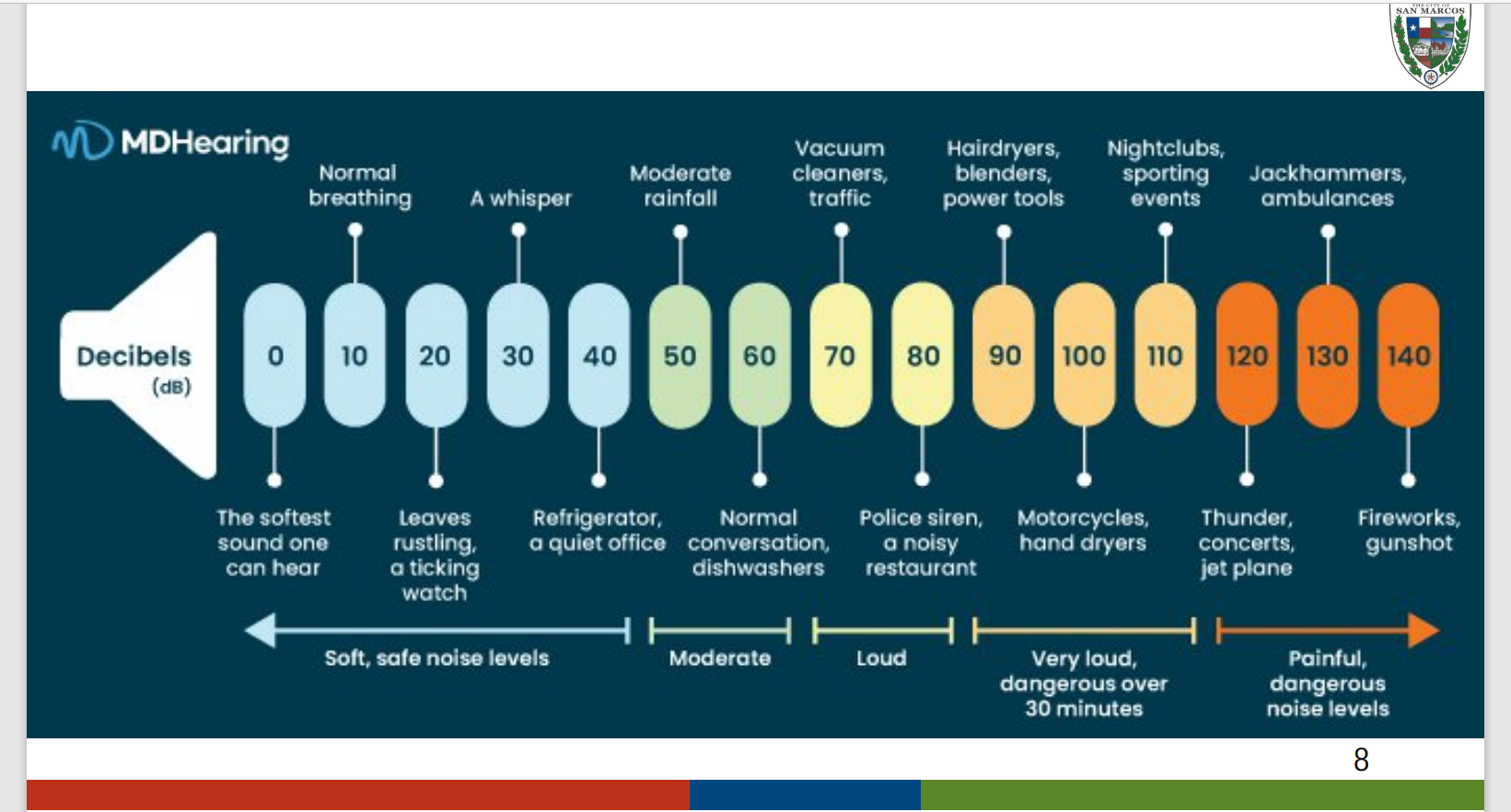
The problem is that 60 decibels is actually very quiet:

So P&Z has effectively killed live music at Tantra with this decision.

So Tantra appealed P&Z’s decision at City Council this week.

The stakes are high! It takes 6 votes to overturn a P&Z decision.

First off, Council is absolutely flooded with emails and speakers. They got over 200 emails. Between Citizen Comment and the public hearing, there are over 50 people speaking in person. The major themes are “This place is community. This place is love. This place makes me happy when life gets hard.” It’s a pretty amazing testimony.

Everyone’s favorite speaker is a kid who plays the harmonica for council, and explains that they’ll be playing at Tantra on Friday, because Tantra is the only family-friendly music establishment that allows kids to perform. It was adorable.

My favorite written comment – hilarious, but maybe less adorable:

I love a straight-talker. I laughed.

 Basically, Council listens to 2.5 hours of people pleading them not to kill their happy place.  

Several people have decibel readers with them, and point out that this very city council meeting has ranged from about 70-90 decibels!

(Staff also provided this corrective to the specific noise ordinances mentioned at P&Z:

So San Marcos is not an outlier.)

Council discussion

Right off the bat, it’s clear that it’s going to be reversed.  No one is defending the ridiculous 60 decibel cap. 

Mark Gleason proposes:

  • 1 year permit instead of a 3 year permit
  • 75 decibels after 7 pm on Sundays

No one goes for either of these propositions.  

Amanda Rodriguez – our new, shiny councilmember! – asks about getting the owner reimbursed for the $750 appeals fee.  Everyone is on board with this, but it’s a whole process.   So yes, but not tonight.

Both Alyssa Garza and Mark Gleason say, “This is why the community has to show up at P&Z meetings!” 

I think that’s wrong! This should have been an easy case at P&Z. It would be exhausting if you had to rally all your clientele every time an ordinary alcohol permit needed to be renewed. Tantra was in good standing and had not violated any conditions of their permit.

Really, P&Z made a mangled mess of this permit. No one could have seen this coming. They should have spent more than five minutes on this discussion (and perhaps staff should have encouraged them to postpone when they felt it was going off the rails.) 

THE VOTE TO REVERSE THE DECIBEL BAN: 

Council knows which side its bread is buttered on.

Finally, let’s talk about swear words. 

Some band was playing Rage Against the Machine songs on a Sunday night.  There was profanity. You could hear it at HEB.

But listen:  Can we stop pretending that bad words make little childrens’ ears bleed?

You can say a  really kind, nice sentence with the word “shit” in it, and you can cruelly eviscerate someone without using any bad words at all.  The absolute deference that this country pays to naughty words is mind-boggling. 

One last nerdy note:

Decibels are a logarithmic scale. If you increase by ten units, you’ve multiplied the sound by a factor of 10. So Garber’s proposal to go from 85 db to 60 db was gigantic: he actually scaled the cap by 1/500th.

If he had only dropped the cap to 82 db, he could have cut the sound in half, without anyone being the wiser. (Nice chart here.)

Hours 3:21 – 5:07, 11/19/24

Item 10:  LIHTC Housing (LIHTC = Low Income Housing Tax Credits)

Back in May, we approved this LIHTC Complex:

It’s for senior citizens. Right around the corner from Target.

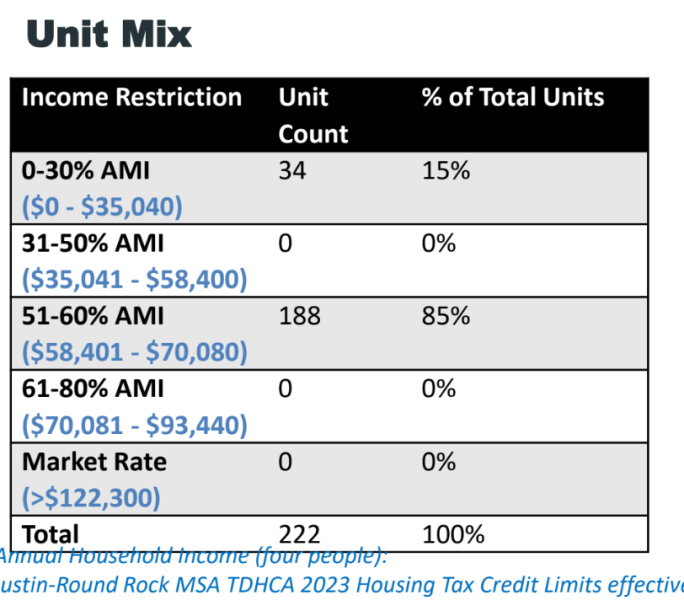
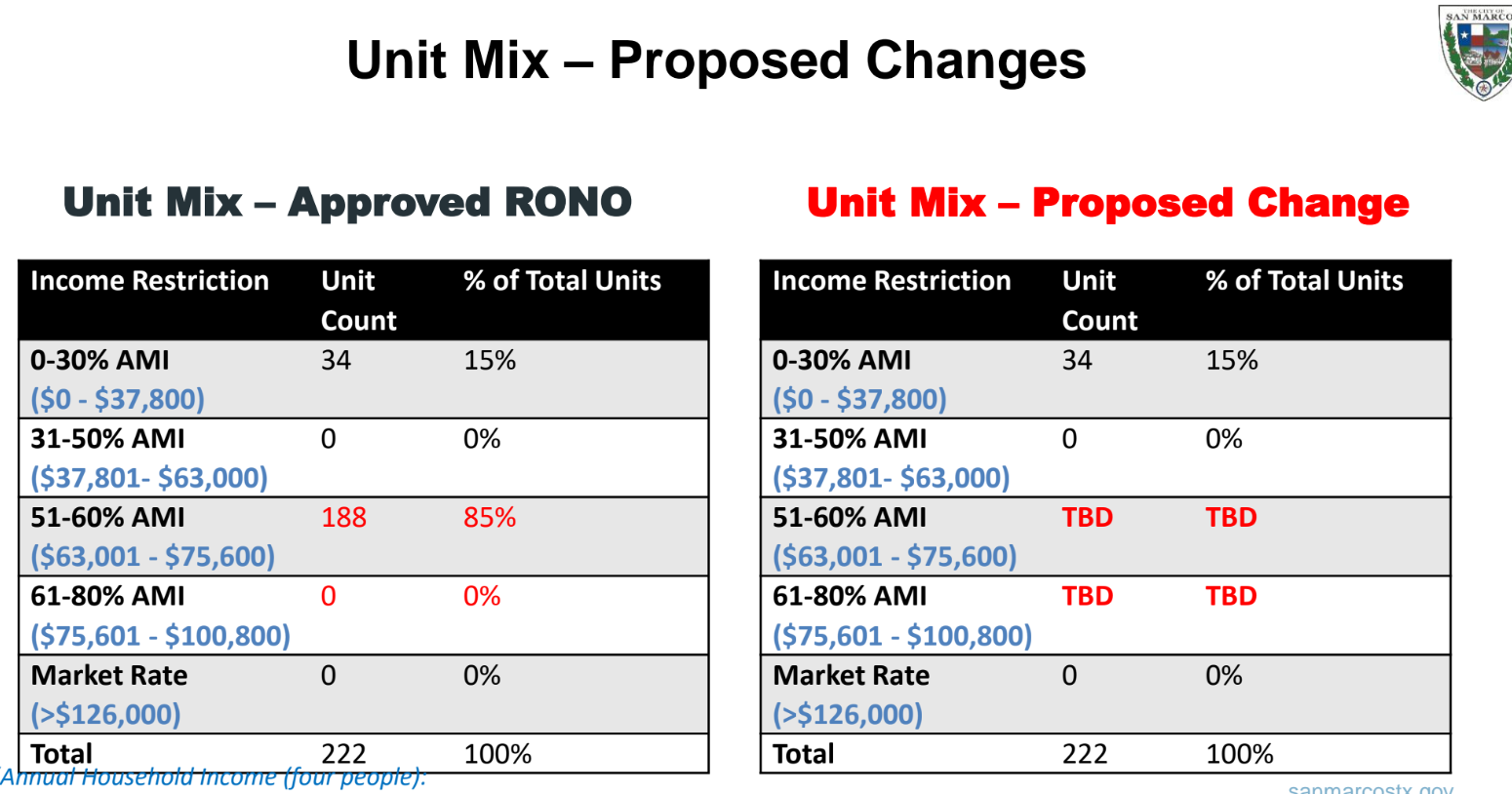
How affordable will these units be? The developer agreed to set aside a certain number of affordable units:

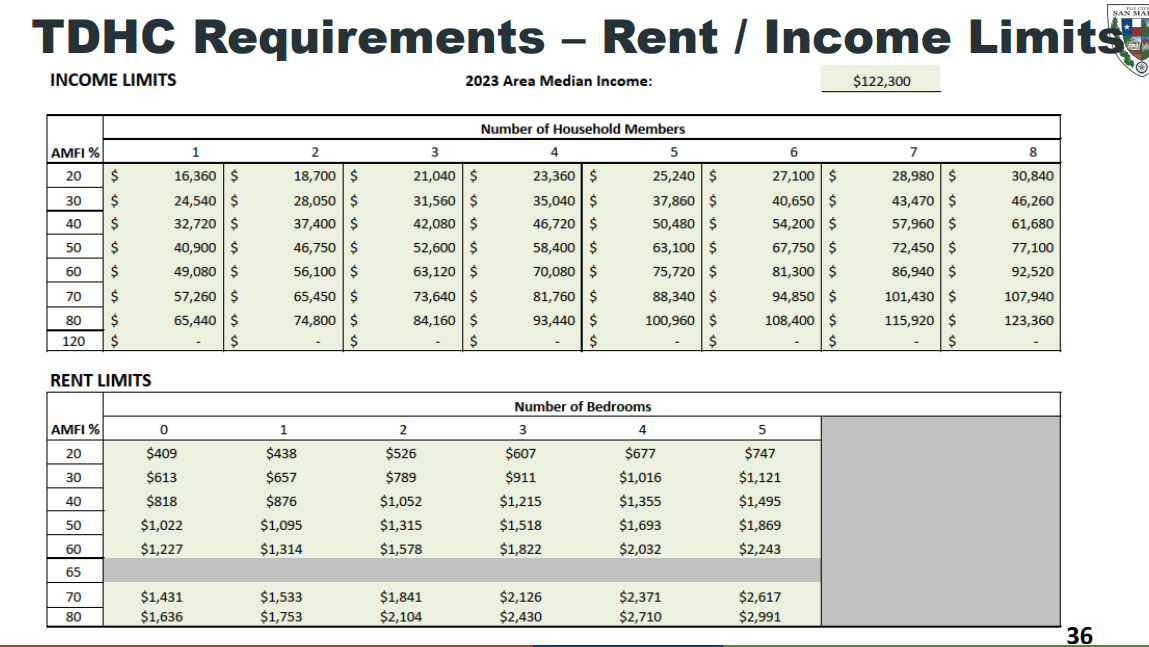
AMI means the Austin Area Median Income. So 30% AMI means your family’s yearly income is 30% of the median Austin income. But the Austin median income is $86K, whereas the San Marcos median household income is $47K.

So the categories are a little weird. Those 188 units at 51-60% AMI? That’s low income for Austin, but pretty normal for San Marcos.

….

The developer is back, and wants permission to change some things.  First, they want to loosen the ranges of incomes:

So he wants to take the 188 units for families earning $63-$75K, and spread them out for incomes earning $63K-$100K.

Side note: You can live in an apartment intended for a higher income than yours. However, you would not get a fully reduced rent:

The guy also changed his mind on BBQ grills and picnic tables, due to space concerns.  He wants to swap them out for two horseshoe pits.

Jane, Alyssa, and Amanda are all not happy about this. 

The developer says he’s got a market study. There’s just not demand for the under 60% AMI group! If he can extend to the 80% range, he’ll be able to find more residents. 

Jane is open to this, but she doesn’t like the unspecified numbers.  She proposes this:

0-30% AMI: 34 units
51-60% AMI: 86 units
61-80 % AMI: 102 units

Her reasoning goes like this: Seniors get a yearly 3% cost of living increase on Social Security. If you were earning 60% AMI and you get that bump, you could get priced out. Suddenly you’re making 61% of the AMI.  You don’t qualify for your apartment anymore. If there’s not a tier above you, you have to pay market rate, or move.

Alyssa and Amanda call bullshit on the whole market study.  (ME TOO.)  It just doesn’t pass the sniff test that San Marcos has run out of families earning less than $75K, and you have to subsidize families earning up to $100K.  Our median household income is $47K, for pete’s sake! 

The developer does not have the actual market study on hand, to show council.

Amanda calls him out on this: Does this market study even reflect the people we’re trying to help? We don’t know, because we haven’t seen it.

The vote on Jane’s amendment: (86 units under 60%, 102 units under 80%)

Yes:  Jane Hughson, Saul Gonzales, Mark Gleason
No:  Alyssa Garza, Amanda Rodriguez

But!! It takes four votes to pass.  Since Matthew and Shane are absent, this fails. 

The developer pleads that it’s not a complete blank check! The subsidized apartments still have to average out to 60%! 

The final vote:

Should the developer get to split up the Under 60% category however he wants?

Sorry, dude! 

Item 7:  We’re down to the final dregs of Covid money.

Last time, we discussed this funding:

Alyssa Garza basically chewed everyone out for never, ever prioritizing rental assistance. I mean, she was nice about it. But she has said this one million times.

And lo! They made it work! New funding plan:

Staff thinks we can give this rental assistance out with fewer strings attached than CDBG money.   This is very good, too.

Item 12:  Getting ticketed at the Lion’s Club.

Paid Parking is coming next summer to the City Park parking lot.  (Ie the Lions Club parking lot.)  Instead of paying someone to write tickets, they want to use cameras and mail the tickets out.  

Some extra details:

  • The lot will free for San Marcos residents, but you have to go online and sign up somehow.
  • If you pay within 14 days, you get a discount.

Council asks good questions:

Amanda: How does the 14 days work? From the day of the ticket? What if they’ve got some situation and their mail isn’t coming promptly?
Answer: We could change that. What about if it’s 14 days from when the ticket arrives at the house?
Amanda: ?? How would you know?  Let’s just make it 30 days.

Saul: Is there a warrant if this isn’t paid?
Answer: San Marcos parking tickets are a civil offense, so no.  Hays County, though: those are criminal offenses. They’ll getcha.

Amanda: What happens if someone’s car breaks down?
Answer: There is an appeals process.

Amanda: What’s the resident registry process like?
Answer: It’s online.  We are also going to do some library outreach to help people sign up. 

Alyssa: I can’t actually find the appeals process online. 
Answer: Yep.  We’re going to put the link on the actual citation that you get in the mail.

The vote: 5-0

Item 13: NEW FIRE TRUCK!

We’re getting an ERV010 Star Side Mount Pumper Truck with a 500-gallon tank and 1500 GPM pump.

I’m guessing that it looks something like this

Item 14:  Five Mile Dam

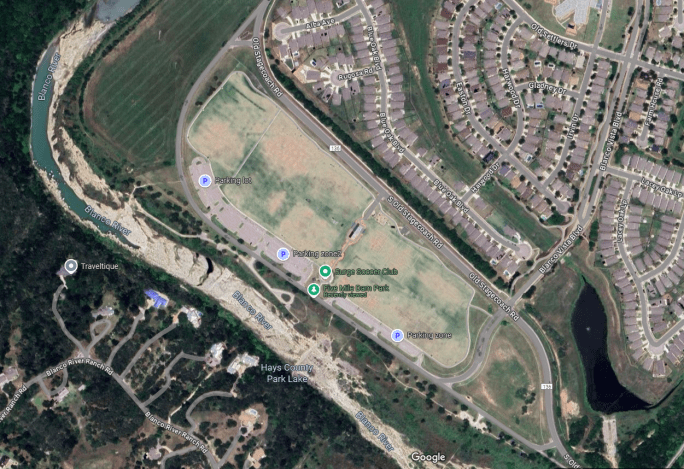
If you know the youth soccer league, you know that it all happens at Five Mile Dam:

image source

Which is located here:

The soccer fields opened in 2010.  They’re owned by the county, but maintained by the city.  So the city pays for the lighting, playground, sprinklers, etc.

This photo makes it look like maybe the sprinklers aren’t working? Idk.

Surge Soccer uses the fields for free.  (Surge used to be called SMAYSO, changed their name, missed their opportunity to call themselves Smoccer.)  This helps keep prices cheap for San Marcos families. Surge is good about this.

Hays County is selling us the Five Mile Dam parks. But Hays County doesn’t actually care about the soccer fields.

What Hays County cares about are these two other parks:

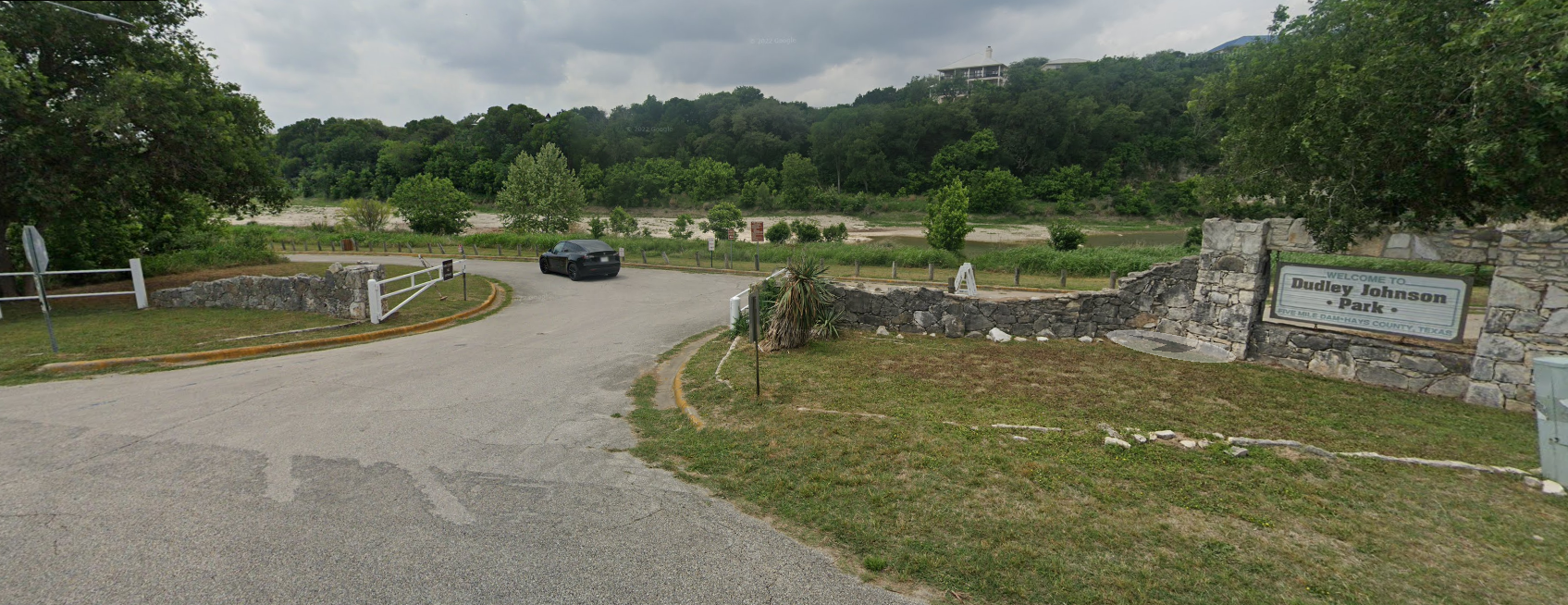
  1. Dudley Johnson Park:

2. Randall Wade Vetter Park:

Let’s zoom in on that sign:

Yep! That’s the right place!

Those are here:

At least, that’s my best guess.

So these three properties are a package deal. You want the soccer fields? You have to take Dudley Johnson and Randall Wade Vetter.

How much is Hays charging us? 

Zero! It’s free!   Wow, they must really want to get rid of those parks. 

The last dam report was in 2016, and at that point, the dam was in good condition.   And the county will help with maintenance on the parks for the next year.

Is this good for us? 

Yes. We want those soccer fields, or else Surge Soccer won’t stay cheap for local kids.

The danger is that Kyle or some private company would buy the fields.  They can make a lot of money renting them out.  But it would end Surge soccer.  Or at least, the affordable, community-focused version of Surge. 

Soccer is the biggest youth sport in San Marcos, by far. It’s important to secure these fields. 

Council votes unanimously for this deal.

….

Item 16: Blanco Vista Water Tower

Same neighborhood as Five Mile Dam! They’re getting a water tower, as part of all this ARWA stuff.  There is $50K in the ARWA budget set aside to paint the water towers. 

How would we like to paint it?

Here’s what our other towers look like:

Here’s what some neighbors do:

Here’s what some fancier cities do:

We could either keep it simple, or pay $100K+ to go all out. 

Council: keep it simple. 

Item 17:  The Deer

Deer are a big problem.  Mostly they cause a lot of car crashes, but they can also get impaled on your fences. (Ewwwwww.)  

A speaker came from Texas Parks & Wildlife, and talked to the neighborhood commission.  Basically, the first step is to get people to stop feeding the deer.  

Should we ban feeding the deer?

  • Pros: deer are a big problem.  
  • Cons: have you seen how cute they are, with their big eyes and fluffy tails???

The Neighborhood Commission decides on an education campaign, instead of an outright ban, because of all those people who love the big-eyed-fluffy-tailed-deer.

What does Council think?

MARK GLEASON HAS VERY STRONG FEELINGS! 

  • First, even if you ban feeding, it won’t help.  Too much available food.
  • Deer have no natural predators.
  • You must hunt! Open up the parks to hunting!
  • We could make a whole weekend of it! Have drawn hunts! 

This is a thing – see here and here.  And Texas does allow hunting at its state parks.

The problem is that Mark is bringing a huge energy here – It must be discussed! It works! Cutting people off. It’s the only thing that works! – and everyone is a little taken aback. 

Jane: They’ve been hunting on my land for 20 years, and it doesn’t keep the deer away.

Mark: IT WORKS! You just need to hunt a few. After a few generations, the mothers keep their babies away!

Alyssa: I dunno, doesn’t work on my dad’s ranch either.

Eventually Jane shushes him, and everyone goes back to talking about corn. 

 Don’t feed the deer, everyone, but really don’t feed them corn.

Item 18: Animal Shelter Vacancy

We finally got it filled.  The new person talks about how much they love animals, and how they’ve fostered and volunteered before. 

(I still have a lingering weird feeling about the other person who was jerked around by Council for months, but this person seems fine.)

Bonus! 3 pm workshops, 11/19/24

Two fantastic workshops. For real. It’s my favorite thing in the world, to be spoonfed these amazing presentations.

First up: Rent by the Bedroom

Backstory: this became a flashpoint last spring, when a developer wanted to tear down some small complexes here:

and put in a big rent-by-the-bedroom student housing complex.

There was a pretty big community outcry.

Council approved it, but vowed to look at the predatory leasing practices and see what could be done. So here we are!

For what it’s worth, I think Council handled this correctly.
– We need physical housing to be built.
– We need landlord reform.

You shouldn’t hold the former hostage in order to accomplish the second, but the second is also urgently needed.

So let’s dive in! The speaker was Shannon Fitzpatrick (and these are her slides). She’s been a lawyer for Texas State, working with students, for the past 25 years or so. (Go listen here! I’m not doing it justice. It’s so interesting.)

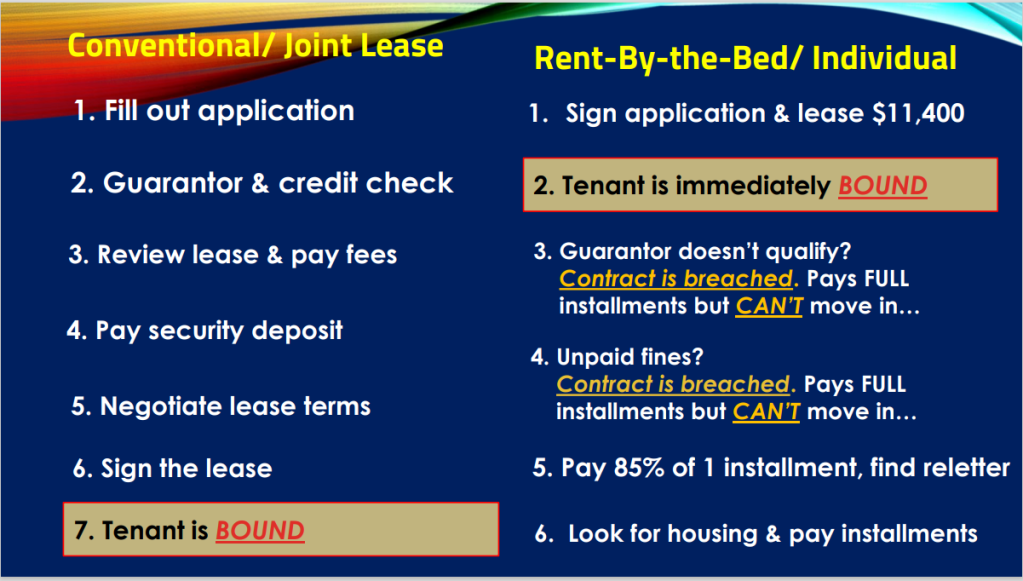
Here’s what we’re basically comparing:

This part isn’t that bad. A student might not want to be on the hook for their roommates’ share of the rent.

Installment Contracts

This is where things start to get sleazy:

First, this “installments” contract.

The point is that it’s a different legal concept than a regular lease. This lets landlords skip out on the state laws that protect renters. And listen: Texas barely has any renter protections, so if you’re finding ways to cheat those, you are seriously trying to slumlord your way to profit.

Okay, so this installments contract. The basic idea is that you could sign a contract for $11,400, and then they break it into 12 monthly payments.

They show up on campus in October, and sell students hard on these apartments:

  • They’re going fast! You’re not going to have a place to live next year!
  • Your mom will be so proud that you’re making a grown up decision by yourself!
  • No security deposit if you sign right now! (We’ll come back to this.)

So the kid flips through some pages (OF A 60 PAGE LEASE!) and signs.

Already, things are rotten and different than normal:

In general, you have to qualify to lease an apartment. If your income is too low to qualify, or your guarantor’s (parent, aunt, etc) income is too low to qualify, then you can’t rent the apartment.

BUT HERE, YOU’VE ALREADY SIGNED! So you can’t live there and you still owe $11K!

Next: regular leases have a “mitigation” clause. If you break your lease, you have to cover the rent until they re-rent the apartment. The landlord has to attempt to rent out the apartment.

Installment contracts do not have this clause. You break your lease, the company still gets their $11k. They can re-rent the apartment, and now they’re getting another $11K for the same room.

Also: They don’t pro-rate partial months. So you would owe rent on August 1st, even if you can’t move in until August 20th.

Next: “As-Is” Clauses

So the kid signed the lease in October.

Usually when you sign a lease, you look at the apartment. You say things like, “Are there any apartments on the second or third floor?” The leaser says, “Sure” and shows you one. You say something like, “Nah, I don’t want to be this close to the dumpster, I’ll go with the first floor apartment, after all.”

The point is that you’ve seen the actual apartment, and you know if it has mushrooms sprouting in the closets.

“As-is” clauses mean “You get the apartment in its current state, not in a pristine state.” But those are only valid if the tenant can inspect the premises. Since these kids are signing in October without seeing the actual apartment, they’ve signed all kinds of rights away.

They show up in August, see the mold, mushrooms, broken furniture, broken locks, etc, and they have no recourse. They’re not able to request a different apartment, because of the “as-is” clause.

Security Deposits

“Sign now and we’ll waive your Security Deposit! You’d be a fool not to sign!” – me, pretending to be a sleazy landlord.

So this is another scam. They waive the security deposit, and tenants lose some rights. Texas has specific laws that state that if you put down a security deposit, you’re entitled to some protections.

For example, you lose your right to a 30-day move out inspection. So they can come after you for up to four years for damages to your apartment. And they sometimes do! The speaker said that what happens is these complexes get sold every three or four years. Sometimes the new owners look at the past few years of tenants and shake them down for damages.

Also: #notallcollegekids but some college kids are little shits. Since they didn’t pay a security deposit, they don’t think they’re on the hook for damages. Chairs in the pool, trash the place, etc.

Roommate matching

In theory, this is fine. This is what happens in a conventional dorm.

But here, it’s done… maliciously? it’s pretty surreal. Here’s the understated tone from the speaker:

In practice it means that they don’t give a shit if you have allergies and the roommate has a cat, or if you are a quiet person and the roommate throws keggers.

But then it gets worse!

  • You can’t move to a different apartment if you need to. She told a story of a kid who found his roommate, killed, gory, awful, in the living room. They made him stay in that unit.
  • You can be moved even if you don’t want to! You dared to complain? Fine, you’re being moved. Pack up.

The companies are generally retaliatory and vindictive. You called us in for having cockroaches? We’re going to try to charge you for fumigating the building. Etc.

Just straight up being illegal:

For example:

Legally, they have to tell tenants who the owner is. But they don’t.

The very few protections that Texas law does offer, they can just skip out on doing them. Nobody holds them accountable. (Of course, this applies to all of San Marcos rentals! Not just students!)

What about the rest of San Marcos?

It is really important that we don’t limit this to college students! All renters need protections. San Marcos is mostly renters!

Many, many landlords are vindictive and retaliatory, or don’t provide a safe, clean environment. There’s a huge power imbalance between landlords and tenants. Tenants get exploited.

So what can be done?

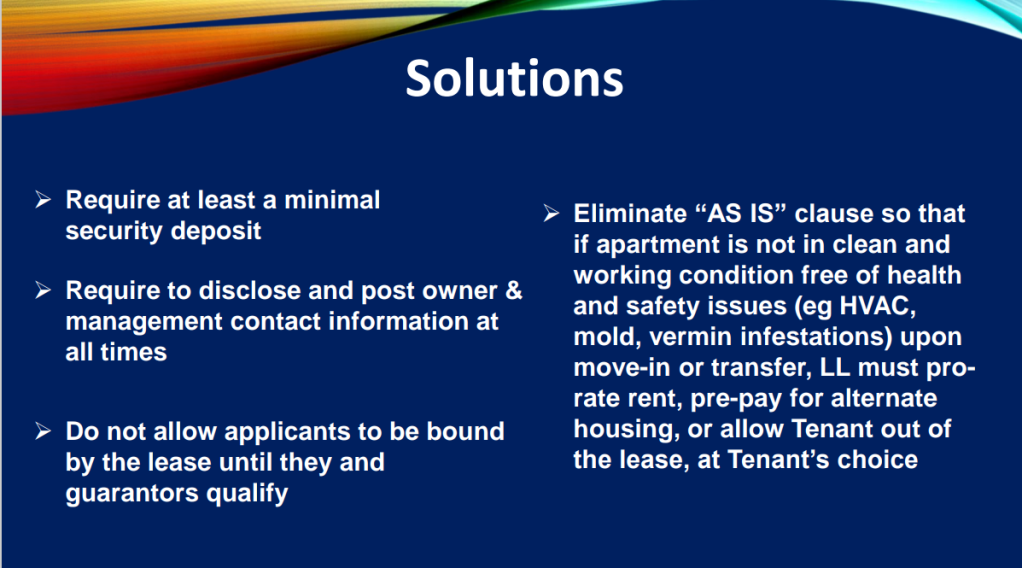
Here’s what the speaker suggests:

and

The city lawyer is quick to mention that these are all uncharted territory. Most cities are not in this situation. We can research and explore these ideas further, but there’s not much in the way of precedents.

Council also discusses:

  • Capping security deposits so they don’t get exploitative
  • Publishing a list of complexes and grade them, based on complaints to Code Compliance
  • Making a central complaint spot, where tenants can then get directed to one of the legal aid resources or code compliance, or whatever
  • Requiring three months notice before forcing someone to move, or forcing companies to give choices (break your lease, stay, or move to this other unit)

Finally, Texas State is trying to do some stuff too.

Council decides that they want to look into all these ideas. This will come back around!

Bonus! Even more 3 pm workshops! 11/19/24

Workshop #2: LIHTC projects: This stands for Low Income Housing Tax Credits.

There are two kinds:

  • Developers can get tax credits from the state
  • Sometimes they get tax credits from both the city and the state.

Both kinds have to get approved by Council.

Backstory:

Blue are the developments that get just state tax breaks. Green gets both state and local:

This past spring we approved five developments (2 blue, 3 green) and Mark Gleason panicked that we were being too generous. We can’t help this many people! It’s fiscally irresponsible!

Hence this workshop! Let’s find out if we can afford to help vulnerable residents. (Spoiler: we can.)

More Background:

San Marcos is booming!

So we’ll end up somewhere between the purple and the orange, most likely.

You can look at it this way:

The blue parts are our new sprawl.

San Marcos has a good employment rate, but high poverty rate:

This means that our jobs are not good jobs. The cure for this is raising the minimum wage. (Raising the minimum wage does not cause inflation. Paying a living wage turns a bad job into a good one!)

Anyway!

Here’s where the jobs are:

This is fascinating:

In other words:

  • Only 6700 of us actually live and work in San Marcos
  • 18K of us live in San Marcos, but we work outside of town.
  • 28K people commute into San Marcos, but live elsewhere.

In my humble opinion, this is two things:

  • people who live here can’t find good jobs here, and
  • the University has good jobs, but parents who work for Tx state are scared of SMCISD for problematic reasons. (I have lots of opinions on that. Support SMCISD!)

Anyway, those are my own conclusions. City staff did not lob those accusations.

So are LIHTC projects breaking our budget?

The city gets both sales tax and property tax.

When it comes to property tax, there’s a lot of tax-exempt property:

So some LIHTC projects don’t pay city taxes, but neither does city land, Texas State land, SMCISD, County land, Churches, Housing Authority, and others.

(One difference is that most of those are nonprofits. LIHTC developments aren’t necessarily nonprofits.)

So how bad is the dent in our budget??

Not very bad!

You are allowed to ask for a lump sum payout. (Payment In Lieu of Taxes = PILOT). So we do this sometimes:

LIHTC apartments are still full of people, so you still have some fire and SMPD costs. But not particularly different than any other apartment complex.

In general, apartments are much cheaper infrastructure for the city than single family housing.

This is a great illustration of why:

I want to love this graphic, but I can’t. The scale is all off.

  • A 3-4 story apartment building is about 20-30 units per acre. The diagram on the left should be 7-10 acres.
  • Single Family (ND-3/CD-3) are things like town homes and smaller lots – at most 10 units per acre. So that middle diagram is 20 acres big.
  • Single Family (SF-6/SF-4.5) are big traditional lots – at most 7 houses per acre. So that right hand diagram is over 28 acres big. That’s three times as big as the one on the left!

Fixed it:

(I am so smug and insufferable. It’s a miracle you all put up with me.)

Anyway: there are also some city costs for things like libraries and transit. Same as for any residents.

How much need is there in San Marcos?

More than elsewhere:

Onto the state requirements for their tax credits.

The state organization is TDHCA. (Texas Department of Housing and Community Affairs.)

They care about:

  • Location. You can’t put your low income housing in a crappy location.
  • Clustering – you can’t put them too close together
  • Flood plain – nope
  • They must have at least 15 hours each week of an after-school learning center
  • They must supply a shuttle if they’re not on a bus route
  • Free support services, a mix of amenities
  • ADA apartments

How cheap are these apartments?

First off, “AMI” is Area Median Income. We’re in the Austin Metropolitan area, so we use Austin incomes, even though San Marcos incomes are roughly half of Austin’s. (San Marcos median household income is $47K, whereas Austin median household income is $86K.)

Here’s the key feature:

The state also monitors the complexes:

San Marcos does not get those reports, currently. It would be nice if we did.

If you’ll recall, we did a big Housing Needs Assessment back in 2019, and came up with a housing plan to work on housing affordability. This is great! And…. council then buried it six feet underground.

Housing affordability has not been a major priority of this council for the past five years. (Except Alyssa Garza.) In the budget we passed in October – two months ago! – our Strategic Plan Goals were:

None of those are affordable housing.

Council did not care until this election cycle, when it became clear that you could lose your election if you didn’t hear the clamor for affordable housing. It was suddenly the #1 issue.

Anyway: We’re finally doing it, five years late. The first step is updating the data for the Housing Needs Assessment, which is almost ten years out of date.

Listen: this workshop was fascinating, and councilmembers asked good questions. I’m not doing it justice. But it was a 5 hour meeting and a 2 hour workshop, and your poor little marxist is tired.

November 6th City Council Meeting

Hoo-boy. We’ve had a big election and a little council meeting.  Let’s dig in.

The Little Meeting: It was only 50 minutes long.

Hours 0:00 – 0:50: Parking bans by the river, the new HEB, and more.

Bonus! 3 pm workshops: We’ve got $250K of Covid money left, and time is running out.

The Big Election:

Nationally: I’ve got the same grim despair as you do.  There are a lot of people whose lives will be harder, sicker, poorer, and more abused because of this shit-for-brains president-elect. 

I feel hopeless, but not helpless.  American voters have revealed what they are, but there’s still work to be done. So as shitty as it is out there, we can compartmentalize and work on San Marcos. 

Onto the local scene: 

  • Mayor: As you’ve probably heard, Jane Hughson won re-election.  This will be her 4th term – she’s won in 2018, 2020, 2022, and now in 2024.  This means she’s term-limited, and the mayor will be an open seat in 2026.
  • Place 6: Amanda Rodriguez won Place 6!  I’m so glad.  We’re starting to get a progressive bloc up there that can actually win votes.
  • Place 5: Lorenzo Gonzalez and Roland Saucedo are headed to a run-off. Here’s how it shook out: 

That is extremely close. All you can conclude is:
– Lorenzo did a little better than the rest, and Atom did a little worse.
– Roland got a little lucky. and Griffin got a little unlucky.

The run-off: Saturday, December 14th.

I’m backing Lorenzo Gonzalez in the run-off election! His main message has been to be available and responsive to people, redirect more money towards mental health, and focus on housing.

Listen: After I posted my candidate write-up, people came out of the woodwork to warn me that Roland Saucedo is super problematic.  The formal documentation is limited – mostly this and this – but sufficiently many people are telling me a consistent story about his disregard for others. It’s troubling.

If you ever wanted your vote to count extra, a local runoff election is your sweet spot. Barely anyone will show up, and it can easily be decided by 50 votes. Or 15 votes. Or even 5!

Hours 0:00 – 0:50, 11/6/24

Onto the little meeting!   

Just one citizen comment, from a community member about the Dunbar Heritage buildings that are under renovation.

Item 12: The good people of Riverside Drive want to ban parking on their street.

The issue is that the street fills up with river-goers in the summer. Since there is not enough proper parking around the falls, people park on Riverside Drive during the summer, and walk over. 

Look, I’m not in a great mood.  I didn’t like it last month on Sturgeon, and I don’t like it now.

  1. This is exclusionary.  The street does not belong to you.  

  2. It’s counter-productive! Street parking is a traffic-calming measure. It makes drivers go more slowly, instead of tearing through your neighborhood at 40 mph.

  3. I might be sympathetic if local residents did not have driveways, and were forced to park away from their houses and walk to get home.  But that is not what is happening. The residents of this street put out orange traffic cones to block river-users from parking in front of their houses.  They’re not putting their own cars out on the street. 

  4. The parking ban is year round. (Holidays and weekends.) There is no reason for the ban to exist during the winter.  Does it matter? No, but it’s overreach.  

Living near the river is a privilege.  The streets belong to the public, and that includes those who want to visit the river.  I’m just not in the mood for territoriality and exclusion at the moment. 

The Vote:

Yes, parking bans are great: everybody
No, parking bans are the worst: nobody

Oh well. At least I can rant on the blog.

Item 4:  The new HEB.

Everyone cheered and quickly voted on this, in about 30 seconds.

Here were my concerns last time:

  • Would all HEB employees get the $15/hour as required by local ordinance, even at the existing stores?
  • Can we include something about wage and benefits, to make sure our workers are given good jobs?
  • Is it in writing that Little HEB will stay open for a certain number of years? 
  • Can we ask HEB about purchasing that little triangle of land next to Purgatory Creek from them?

Here’s what council said about these questions:

[Nothing.] 

I know, we were all consumed with the election. But I still wish we’d fought on behalf of employees.

The vote:

YAY HEB 4-EVAH: Everybody, unanimous, etc. 
I hate everyone’s favorite grocery store:  nobody.

Item 10: The Mitchell Center

We mentioned this last time at the workshop: it’s being handed over to the Calaboose African American History Museum. 

It’s located here, tucked in the back corner of Dunbar park:

Apparently there is a covenant that runs with the land that requires the land be used for a public, non-profit purpose.   This seems like a good choice.

Item 13:  Naming the alleys

This also came up last time:

Those seven alleys with names in white are getting officially named. 

The remaining alleys are driving Jane crazy.  She wants to pair them up with movies or anything, and get them named.  No one else seems to be in that big a hurry.

Item 14:  Municipal Court

I guess we’re getting a new spot for our municipal court?

I don’t know if this is where the public will go for court, or if it’s administrative type stuff.

Here’s the building, according to Google Maps:

We signed a 20 year lease.

Item 17: River Bridge Ranch is this giant future subdivision:

It’s located here:

(That bit above is actually two closely related developments: River Bend Ranch and River Bridge Ranch. But the details are murky to me.)

This development makes me cranky:

  1.  In 2022, they wanted to put an industrial plant on the southern corner, which would have required an insane cut-and-fill.   This would have increased flooding in Redwood. Huge numbers of residents from Redwood turned out to argue against it, given the flooding and infrastructure.  The permit was denied.

  2. Originally, River Bridge Ranch was approved to be both housing and commerce. After all, it’s huge! And we have this long-standing issue where there isn’t any commerce on the east.  They waited for a polite amount of time to pass. Then they came back and asked if Council would just forget about the pesky commerce bit. 

    Council said “You betcha!  This way you’ll make more money!” And lo, no more commerce.

This meeting, Council forms a subcommittee on it: Saul Gonzales, Matthew Mendoza, and Jane Hughson.

So this means it’s going to be coming back around again. Fingers crossed!

Items 16 and 18: The New City Hall

We’re designing a new city hall.

Council has this grand idea that the new city hall should replace the dog park and skate park, and the current location should be housing:

I am not convinced! Why should we develop our parks? Why not re-build where you are?

Anyway, Council appointed a 23-person steering committee:
– The mayor and two councilmembers
– These groups all get to pick a member: P&Z, Library, Downtown Association, River Foundation, University representative, Chamber of Commerce
– Each councilmember picked two community members.
In total there are 23 people.

SO! After multiple meetings and lots of discussion, what did the DEI Coordinator say about the end result? Did we achieve diversity, equity, and inclusion? Moment of truth!

…Nothing. The DEI coordinator wasn’t there. Status quo was upheld.

This would have been the moment to verify that “business as usual” had produced a diverse committee that matches San Marcos.  We did not verify this!