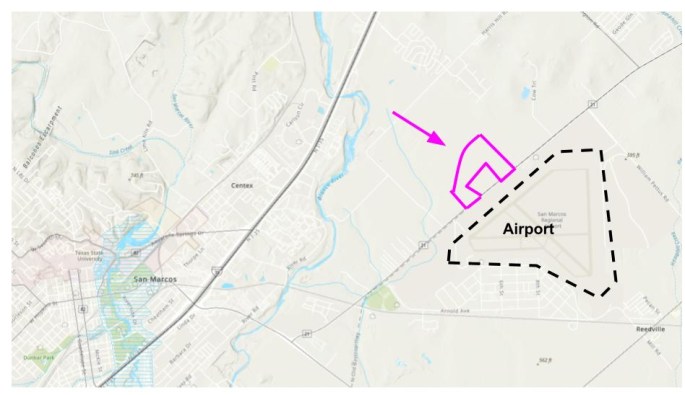
We just picked land for the fire station that is supposed to cover the SMART Terminal land. Why did we go with the only choice that is outside San Marcos ETJ, and in the Martindale ETJ?
Hooray for can ban
Hooray for the can ban, but take a closer look at the No Zones and Go Zones please. On a windy day, all that trash is going to blow from the Go Zones into the No Zones.
Hooray for bringing back PDDs. Consider charging fees to cover staff time.
I’m also surprised that we’re moving forward with the fire station, although I guess you want to pick out land long before anything gets built. There have not been any public updates on the SMART/Axis Terminal since last summer.
…
Items 3-5: This little triangle at the corner of East McCarty and Rattler Road:
was annexed and zoned.
The plan is for it to be a gas station with car wash along the part facing McCarty, and then a strip mall along the back part that opens onto Rattler Road. The developer is hoping for things like restaurants, medical offices, some commerce, etc.
There’s a larger context:
this whole dead spot between the high school and the city is supposed to someday turn into a thriving East Village city center. (According to the Area Plans, which are in progress. This is supposed to accompany VisionSMTX.)
Point being: this is a good spot for a gas station and some commerce. You have my blessing, Young Developer.
No one really has any questions, and the vote is 6-0. (Mark Gleason is absent for this part.)
…
Item 6: Here comes your can ban!
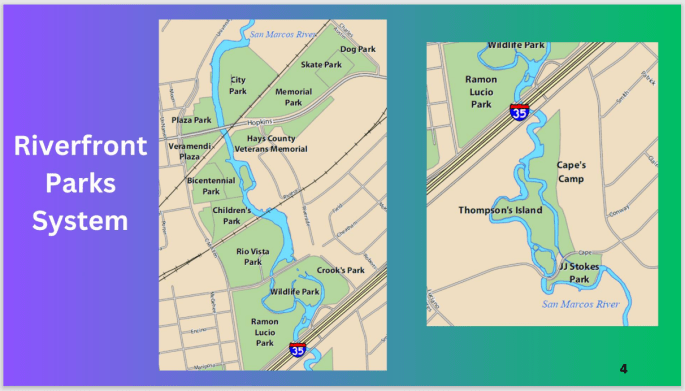
So first, here are the Riverfront Parks that we’re talking about:
The plan is to carve out “No Zones” and “Go Zones”.
In a No Zone: – Only reusable beverage containers – Only coolers under 30 qts in size – No containers under 5 oz, which is a little redundant, but we’re just doubling down on jello shots and mini-liquor bottles.
In a Go Zone: – Go nuts. Have all the single-use beverage containers and giant coolers you want. – Still no glass or alcohol or charcoal grills, but that’s not new.
So what are the boundaries?
It’s fuzzy! I thought there’d be a big conversation about it, but nope. None of the councilmembers had anything to say about these boundaries.
Here’s what was provided:
There are some trails to the right of Ramon Lucio park, in the map above. Those would all be No Zones, because there are so many river access points throughout.
Loosely speaking, it sounds like the big trails along the river will be the boundary of the No Zones. If you’re beyond the trails, you can pop that tab. If you’re closer to the river, you can’t.
My 2 cents? This is probably as good a starting point as any. It allows for plenty of big family picnics. The paths are already a big, visible feature, so it makes sense to use them as a boundary.
If we do a great job with the signs and communicate this boundary loud and clear, it’ll probably work. If we half-ass it, it’ll take a lot more effort to get people to change their behavior.
More details: – It’ll kick in on May 1st – The first year will be focused on education. Citations, etc won’t really kick in hard until 2025.
At the January workshop, there was a lot of conversation about hiring more staffing. Specifically, are we going to hire city marshals (who dress like cops), or will we hire park rangers (who dress like park rangers)? Nobody discussed this on Tuesday. So it’s still an open question.
Jane Hughson had a few questions, but they were extremely detail oriented – definition of banks of the river, clarity of exemptions for people cleaning up the river, that kind of thing.
The vote:
YAY for the can ban: everyone Screw the river: no one.
This was a first vote, so it will come back around next meeting. But most likely, it’ll be here this summer!
Last meeting of the year! Let’s fix the sidewalks, spend the flood money, and not drink the contaminated water under Guadalupe. And we’re going to overthink Citizen Comment and the HSAB grant money, while we’re at it.
We’ve got:
Hours 0:00-1:20: Sidewalk repair, flood money, and toxic chemicals in the ground – let’s talk about how we fix the city. Hours 1:20-2:37: In which which we scrutinize Citizen Comment and the HSAB grant money process. We also push back the final vote on VisionSMTX, date TBD.
That’s it until January 16th! Hope you enjoy a little of whatever refills your cup, between now and then.
VisionSMTX++ is supposed to be approved tonight. The public has opinions:
Go back to the original. The new version constrains the housing market, forces sprawl, and jacks up prices!
Keep the new version! We love sprawl and jacked up housing prices.
Renters need protection!
We live in a cottage court. Stop pretending these don’t exist in existing neighborhoods.
Downtown Area Plan is also supposed to be approved tonight.
Protect the river!
Protect against flooding!
Too much asphalt!
We’re going to become Baltimore!
The water table is very shallow under CM Allen. And there are a bunch of endangered species in the river here.
If you plan for development, you can specify environmental improvements you want. If you plan for parks, you’ll get stuck with the land owner’s choices when they develop it anyway.
…
But before we get to all that, we have a zoning case.
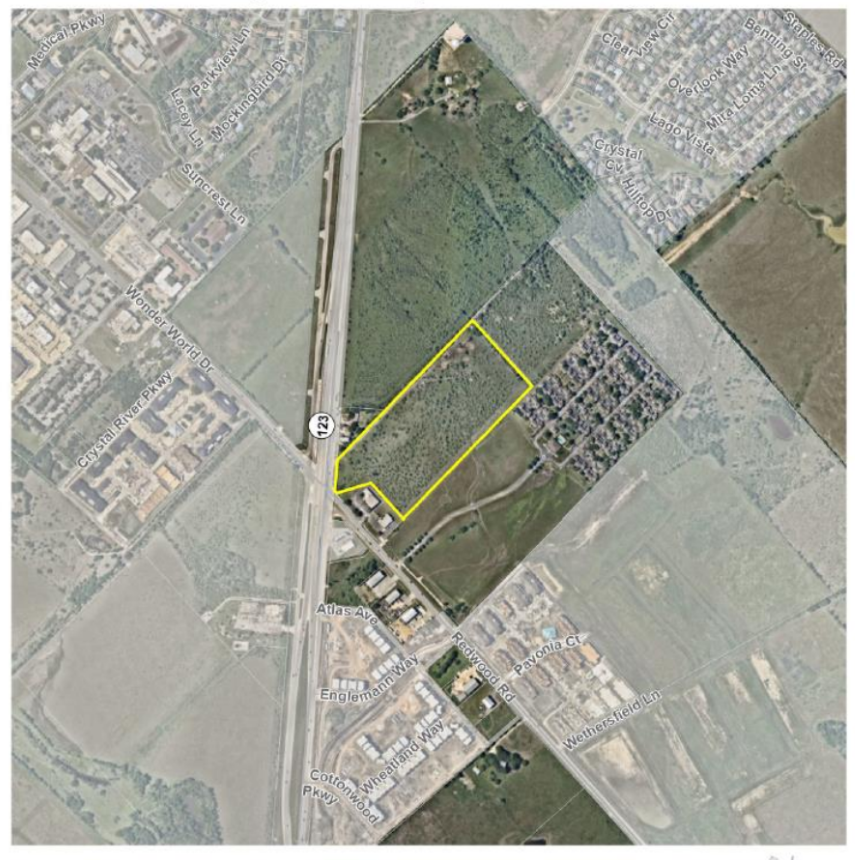
Items 8-9: This is an 18-acre patch at the corner of 123 and Wonderworld:
It’s right behind this little strip:
It sounds like they want to put a little retirement village there.
Saul Gonzales definitely had something on his mind, but I couldn’t figure out what. Here’s how the conversation goes:
First, Saul asks about the cost and tax revenue of the future plot.
Staff answers: 1. the cost to the city is $0! They’re responsible for any extensions of water, sewer, and electricity. 2. We can’t know the tax revenue until it’s built!
This is not a good answer. It evades what Saul is getting at. What Saul wants to know is, “Will this help or hurt the budget, in the future after it’s built?” Right now the costs are extensions of water, sewer, and electricity, but once it’s built, there will be ongoing services, namely police and firefighters.
Here’s my guess at the real answer: 1. Cost: This will not require much from future city budgets. We’re already providing police and fire department coverage to things that are further out than this development – this is infill. 2. Revenue: Since this will be apartments, it should bring in more tax revenue than we spend on it.
So my expectation is that this will be good for the budget.
Next, Saul asks about flooding. He’s told that it’s not in a flood plain, they’ll do an environmental analysis, and everything looks fine.
The Vote: Yes: Everyone but Saul No: Saul
Clearly the answers that Saul got didn’t resolve whatever he’s worried about. So either:
He doesn’t believe the answers, in which case I’m interested to know why.
There’s another reason he’s voting against it, in which case I’m interested to know why.
Price Tag to the City: Will it bring in taxes that pay for itself, over the lifespan of the infrastructure and future repair? How much will it cost to extend roads, utilities, on fire and police coverage, on water and wastewater?
Per Saul’s questions, I’m guessing that it will pay for itself, yes.
Housing stock: How long will it take to build? How much housing will it provide? What is the forecasted housing deficit at that point? Is it targeting a price-point that serves what San Marcos needs?
As always, we need a regularly updated housing report. It sounds like the city has picked back up on the one they dropped in 2019, so maybe this will materialize?
Environment: Is it on the aquifer? Is it in a flood zone? Will it create run off into the river?Are we looking at sprawl? Is it uniformly single-family homes?
Not in a flood zone. Not environmentally sensitive. It’s supposed to be one-story apartments for seniors, which doesn’t sound like sprawl.
Social: Is it meaningfully mixed income? Is it near existing SMCISD schools and amenities?
No idea on the mixed income part. Potentially it’s near some future retail, but currently not much.
The San Marxist Special: Is it a mixed-income blend of single family houses, four-plexes, and eight-plexes, all mixed together? With schools, shops, restaurants, and public community space sprinkled throughout?
It never is.
But on the whole, it’s more good than bad, in my opinion.
….
After items 8 and 9, we doubled back to Items 1, 2, and 5. These were pulled off the consent agenda for discussion.
Item 1: VisionSMTX++
Your two-second summary: Original community plan: weakly opposed to sprawl and jacked up housing costs. P&Z rewrite: we LOVE sprawl and jacked up housing costs!
Alyssa: Too many people are expressing frustration with the process. She’s gotten a flood of feedback in the past two days. There are too many barriers for people to engage.
Saul agrees: he’s getting input, more time won’t hurt.
Jude says he doesn’t want to postpone. He thinks just a few tweaks are needed to get it done. He’s got some amendments proposed for some of the missing middle stuff: cottage courts, multiplexes, etc.
I would be very interested to know what these amendments were going to be! But legally, they can only discuss the postponement. Since there’s a motion to postpone, you can’t discuss amendments to the actual plan.
Eventually they settle on January 16th, with a committee to discuss the matter. The committee will be Shane Scott, Alyssa Garza, and Matthew Mendoza.
The vote to postpone to January: 6-0. (Mark Gleason is absent.)
My $0.02:
Yes, the procedure was total garbage. The P&Z-plus-Jane subcommittee rewrote a document that had reflected the input from the town.
But also, the new content is total garbage. It’s not just a problem of procedure. The subcommittee inserted a ton of NIMBYism that made the comprehensive plan worse.
Yes, I would like us to fix the procedure and solicit a bunch more input from the community. But I’m nervous about it all being performative. If nothing actually changes in the comprehensive plan, then we’re just playing a game called Let’s All Perform Community Input. If the garbage content stays, then this was an empty exercise.
Item 2: The Downtown Plan
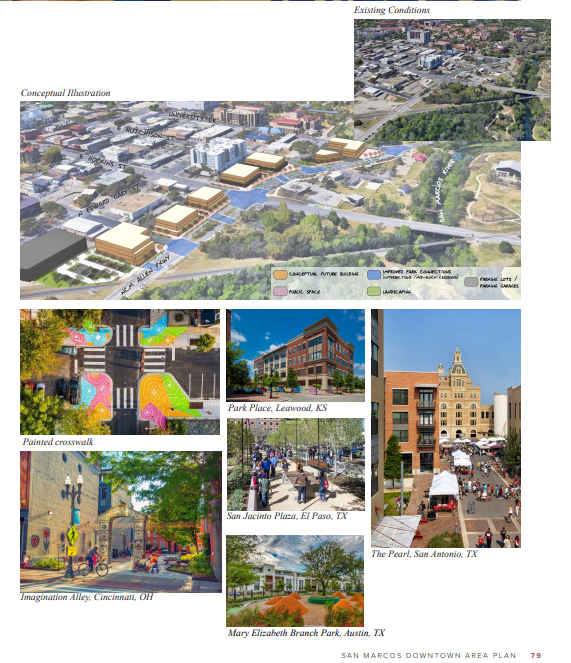
Your two-second summary: (Discussed previously here and here.) There are four properties along CM Allen.
Right now they’re owned by private citizens who can do whatever they want. But would we really like those to be parks, instead?
Options 1, 2, and 3:
This choice sort of landed like a bomb out of nowhere, and conversation has been intense and emotional.
The Final Approval:
Everyone wants to postpone this, as well. Clearly the community is all worked up over Options 1, 2, and 3. This whole thing unfolded in just one month, unlike VisionSMTX++, which has taken three years, so everyone feels panicked and rushed to weigh in. Taking a beat is a good idea.
Jude wants to nail down specific environmental benefits to Option 3.
Jane wants us to land somewhere between Options 2 and 3.
Staff comes forward with a proposal to break off the CM Allen district from the rest of the downtown plan, and pass the remaining bit. Everyone is glad about this, and it passes 6-0.
So what’s next?
The CM Allen District will then become its own area plan, possibly combined with the rest of the riverfront properties along CM Allen to make a River District. But there are six area plans queued up ahead of it, so it’s not going to happen for another year or two.
There was a big turnout tonight! 21 speakers total, and more speaking at public hearings later during the meeting. The whole citizen comment lasted over an hour.
The main topics were:
The can ban, by far. People who do the work of pulling trash out of the river have a lot to tell you about why we need to ban single use containers. 16 of the speakers talked about this, including the mayor and some councilmembers from Martindale.
Some notes:
It would actually be a ban on all single-use containers.
New Braunfels and Martindale both have bans, and they’ve made a huge difference. Plus you save money on trash clean up.
The key is to educate and get buy-in from residents. Not just ticketing people.
2. Selling our water from the Edward’s Aquifer to Kyle
For the second year in a row, Kyle has run out of water and wants to buy some from us.
Virginia Parker, from the San Marcos River Foundation, talks a lot about this: their conservation efforts are shoddy. Sell them the water, but make it contingent on tighter water conservation.
The city doesn’t agree with SMRF’s criticism. We’ll talk about this when we get there.
3. The taxes are too dang high
There weren’t actually a ton of people who showed up in person, but council comments give the impression that they’ve been swamped with complaints behind the scenes.
4. Notification radius for development agreements – it should be appropriately large
This is mostly about the SMART Terminal, and how no one knew ahead of time that it was a thing, until it was too late. But it’s also happened with other issues, too.
The city is going to start sending notifications to neighbors in these situations. They’re offering a 400′ notification radius. The problem is that the SMART Terminal is supposed to be 2000 acres, which is 87,120,000 ft2. The 400′ notification is the tiniest sliver around something that big.
As we’ve said before, the notification radius should be proportional to the size of the project.
Finally, Dr. Rosie Ray offers some good improvements for the Comp Plan, but I’m going to save those for the VisionSMTX discussion so that I can put them in context.
…
Items 5-8, 16-18: The budget, the tax rate, and the rate hikes.
We talked a lot about the budget here last time, and I was an insufferable blowhard about the virtues of paying your taxes. (I still am! Sorry!) So I don’t think we need to recap all of that.
The short version: the tax rate is steady, but housing prices went up, and so the amount everyone pays is going up. Also utilities are going up.
Clearly councilmembers got an earful about property taxes and the appraisal process. I can’t tell if people are mad that appraisals are so high, or that appraisals are done poorly. If it’s incompetence, that’s a different problem than skyrocketing costs.
This is a useful slide, which is totally illegible:
Would you like it to be clearer? ME TOO. Unfortunately, this slide is not in the packet, and so I had to take a shitty screenshot.
If you promise that I’m your favorite blogger, I’ll transcribe the damn thing for you:
2022-2023: Average monthly bill
2023-2024: Avg monthly bill
Monthly increase
Electric
$93.01
$94.72
$1.71
Water
$56.47
$59.29
$2.82
Wastewater
$48.26
$50.67
$2.62
Stormwater
$14.90
$14.90
0
Resource Recovery (ie trash and recycling)
$28.80
$29.55
$0
Community Enhancement
$1.50
$2.35
$0.85
Property Tax
$160.53
$182.42
$21.89
Total
$383.47
$414.01
$30.54
All of those are based on a $338K house and average usage.
Listen: $414 is a lot of money per month. I don’t want to be flippant about that. In addition, you’re paying SMCISD and Hays county taxes, at a rate of $1.133782 and $0.3125, respectively. So that’s another $3832.18 to SMCISD and $1056.25 to Hays County, which works out to a monthly total of $821.38 per month.
That stings! BUT.
1. The first problem is that we’re bringing the sting of paying $821.38 to a conversation which is really only about the property taxes part, which is $182.42.
2. The next problem: there’s actually not much to cut. Core services are really important. The city actually runs a lean budget. You are getting mostly-maintained roads. You are getting smart people with degrees to make sure that the buildings are safe and conform to what we have all agreed that we want buildings to do. You’re getting libraries and librarians. You’re getting a phenomenal park system and park staff that work there. You’ve got cops that will (mostly) show up if you’re in danger and (hopefully) arrest the right person (that’s a conversation for a different day.) You’ve got firefighters to show up if you have a fire. And you’ve got to pay all these people fairly. That $182 is going to really important stuff, and I’m sorry that it’s invisible, but it’s as important as keeping the lights on in your house.
3. We can reduce the tax burden through city planning – increase density in gentle ways.
Listen: single family neighborhoods do not bring in enough tax revenue to pay for themselves. Cities compensate by taxing apartments and business at a higher rate. If you live in a house, you are already being subsidized by apartments and businesses.
We’ll talk about this a LOT later.
4. You should absolutely be angry, because the rich should be paying so much more.
Both locally and statewide, taxes are super regressive – 2nd worst in the country, in fact! The poorest 20% of Texans pay 13% of their income in taxes. The middle 60% pay 9.7% of their income, and the wealthiest 20% of Texans pay only 3% of their income in taxes. This is utter bullshit.
This is because the main tax at the state level is a sales tax. Sales taxes are the most unfair taxes. If you live paycheck to paycheck, you get taxed on your entire paycheck because you spend everything you earn. But the wealthier you are, the more buffer you have between the money you spend (and get taxed on), and the money you put in investments, tax free.
San Marcos also has a 2% sales tax. Obviously this is in order to cash in on the outlet malls, but it’s also another flat tax hitting our poorest residents the hardest. In fact, we actually bring in more money from the sales tax than property taxes: the sales tax brings in $42 million, the property tax brings in $37 million.
Remember the part about how poor people pay 13% of their income in state and local taxes? They are only earning $14,556 a year. The state makes $2037.84 off that poor guy.
Whereas the top quintile paying 3% of their income? They earn $228,924 on average. The state makes $6,867.72 off the rich guy.
If you taxed the rich guy at 13%, Texas would get $29,760, and he’d still have almost $200K left! We could do so much more to alleviate poverty and help communities, if we taxed the rich fairly.
5. Property taxes are not as unfair as sales taxes. They’re not great, but they’re not the worst. But you know what’s the ACTUAL WORST? The state proposal to use a surplus from sales tax to refund property taxes. Texas is literally going to redistribute money from the poor to the rich. This makes me lose my goddamn mind.
(If you think that landlords will lower rents with that money, you are high on your own supply.)
And the state needs that money! Might I suggest using it to REPAIR THE GODDAMN FOSTER CARE SYSTEM?
You guys, this conversation is making me sweaty. I need to bring it back to local issues again.
…
Sorry. I got really shouty. Ahem.
…
Let’s start from the beginning.
Utility rate hikes: water, wastewater, trash/recycling, and community enhancement are all going up a little. On average, you’ll pay $8/month more.
The Vote (tucked inside the consent agenda)
Raise them rates! Jane Hughson, Shane Scott, Jude Prather, Matthew Mendoza, and Mark Gleason Don’t you dare: Saul Gonzales and Alyssa Garza
I strongly disagree with Saul and Alyssa on this vote. These are four areas where responsible use can drive down costs. We need to be mindful when we’re taking a long shower, or lowering the AC, or watering the lawn. Don’t subsidize people being wasteful.
These rates should be priced so that each fund is self-sustaining. Separately, we should fund utility assistance for those who can’t afford the cost. In other words, we should keep doing exactly what we’re doing.
…
Next, the budget conversation.
The public hearing:
City staff made some 3 minute videos to explain the budget process to the public. They got like 50 views total. [Scroll down here if you want to see them.] That’s not successful. None of you shared those videos on social media or anything. None of you held town halls.
We pay money to contractors to do big surveys and we don’t use the results.
City staff is paid too much under this budget.
We’re taxing people out of their homes!
There’s no transparency and no environmental accountability!
Let me single out one speaker, Noah Brock, who is making a very different, specific point:
The Highway 80 Utility project only connects to two properties: some city property and the SMART Terminal property
The water and wastewater funds directed to this project have spiked hugely: – It’s going to use $10 million /60% of the water fund. This was 1.5 million last year. – It’s going to use $15 million /49% of wastewater.
Why are you raising rates 5%, and then directing $25 million for the SMART Terminal?
I have no answers.
Council discussion
Saul Gonzalez asks about freezing property taxes for anyone over age 65. He brings this up several times throughout the night. Do other cities do this?
Answer: Yes, cities like Killeen do this.
Saul asks how they make up the revenue?
Answer: their tax rate is higher.
(I don’t think Saul likes this answer.)
Next up is Alyssa: She is a no on this budget. We’re not fixing our problems. Incremental change is not meaningful change. There’s a lack of transparency and participation. We need a more equitable process and we need to provide tax relief. We’ve got big problems – we need good paying jobs, we need affordable housing, we need to help the homeless. We’re doing nothing on those problems.
Jude Prather: This budget achieves those five goals we laid out! It’s great.
Mark Gleason: I wouldn’t be voting for this budget if we weren’t going to get all this property tax relief from the state.
(Yes – that sales tax surplus from all Texans that will go to just property owners. How nice for some.)
Shane Scott is totally in campaign mode. He hasn’t given a speech all year. But here we go:
Since he was first on council, the budget has gone from 1.5 million to 3.5 million
He fights for the lowest costs.
“They should be paying for OUR lifestyle – we were here first!” I have no idea who he has in mind with this, but sure.
Cost of food, single moms
He doesn’t want to risk lowering our bond rating.
Safety, hooray!
Participation, hooray!
And my favorite part: voting on this budget literally makes Shane Scott puke… but he’s a yes.
Jane Hughson: Look, the property taxes are going up $22/month. I’m a yes.
Matthew Mendoza: I want to puke too, just like Shane! But I’m a yes.
So everyone has staked out their basic positions on the budget.
…
The conversation then turns meta
What went wrong that everyone is so unhappy at the final stage? We’re going to have a big conversation on this. Here’s the positions that everyone stakes out:
There’s an 9 month process and we’ve given you tons of opportunities to share why you’re unhappy. This is bullshit to bring it up now. (Jane, City Manager Stephanie Reyes)
We’ve said that we’re unhappy at every step of the process! And we have an obligation to represent the unhappiness of the community, and the community is freaked out by property taxes. (Saul, Alyssa)
It’s no one’s fault – it’s the appraisal calendar and the tight turnaround, and how difficult it is to communicate with the public. We feel great shame. (Mark Gleason, Matthew Mendoza)
Wait, I thought we agreed that everything was great. (Jude)
I already gave my one speech, why are we still doing this (Shane)
Here is how the conversation unfolds:
Jane Hughson says to council, “Save these speeches for January, when the next budget process starts up again. Voice these issues during the Visioning Process.”
In other words, if you all are mad about different things, use the budget process. Bring this up from day one.
Alyssa counters, “The Visioning Process does not work. It has nothing to do with the actual needs of San Marcos. It’s tone-deaf. Stop romanticizing the strategic goals and using them to accept the status quo.”
This is true – the budget process takes last year’s budget, and tweaks it incrementally, according to Council direction. It cements the status quo for another year. It’s never going to produce transformational change, which is what Alyssa is here for.
Alyssa believes sincerely and deeply in citizen participation – this is how she’d fix the budget process. This is where I disagree. First, I’m a little more cynical: everyone’s busy. I don’t think there’s an outreach effort on the planet that will engage a real number of citizens until they see the price tag, at the very last minute. (And frankly, people can be idiots about how to run a town when they do show up.)
But note: Alyssa is not proposing a concrete, alternative budget with different priorities that she can point to. This is why I’m interpreting her vote as a protest vote against a complacent status quo, and not a counter-proposal for a realistic alternative.
This next exchange is really crucial:
City Manager Stephanie Reyes:
“This is disheartening. This did not happen in a vacuum. We rely on each of you, as elected officials, to talk with our neighbors. You represent your constituents within the community. We expect to hear a diverse set of thoughts and ideas at every meeting. Every budget meeting has been in an open forum, with citizen comment and Q&A afterwards.
“You hear a lot about the things that city staff does not-so-good, and there’s not a lot about the things that we are doing that are going very well within our city. And that is very frustrating, because that is what staff hears. Staff gets a lot of bad raps, but they’re carrying out Council direction that you all make as a group.
“I also hear “hey, we can’t tax our neighbor out of their home” but I also hear “oh we don’t want commercial development” or “oh we don’t want these things”. We can’t have more and more and more and not have anybody to pay for it. Somebody’s got to pay for it. So either expectations need to come down, and what gets asked of city staff to do more, or we need to temper our expectations in a way that is within what we can afford.
“Staff is not formulating this budget in a vacuum. It’s a conversation, it’s been a dialogue, there have been different junctures, we’ve gotten direction from each one of you, every step of the way. And now at the end to make it look like it’s just our budget? I just don’t think that’s necessarily a fair way to portray that.”
(I shortened and edited her words, but I don’t think I misrepresented her. It’s at 1:53 if you want to listen for yourself.)
Alyssa replies:
“I hope you’re not trying to imply that my discontent is news to you or anybody else. I hear your frustrations. Let me take a second to share mine. I feel that staff feelings are constantly weaponized to foster this sense of guilt about speaking up. That’s my perception. I think the way I treat staff every day speaks to the fact that I value staff. I try to give kudos whenever kudos are merited, I try to have grace, I try to advocate for better things for them. Staff works hard, strides have been made on this process. That’s a fact.
“But multiple truths can exist at once. They don’t have to be in contradiction of each other. All that’s true. But it’s also true that it’s very little and these concerns from our community are not new. It sucks that you guys inherited this. I’ll just share this: when you know the caliber of what you’re working with and you know the possibility of what could be delivered , you just have really high expectations, and I think that’s what our neighbors are expecting with this whole new leadership and leadership style.
“So if it’s coming across as being dismissive or trying to intentionally hurt staff’s feelings, that’s not my intention. It’s my responsibility to echo my constituents’ frustrations. And it’s not just the ones I see, it’s decades worth of historical frustrations. And again, it sucks that you guys inherited this, but that’s just the way it is.”
(Not really edited at all. Alyssa’s very eloquent.)
They really are both right, and it’s not a contradiction. Staff solicits council input. Council ignores Saul and Alyssa and votes to stick with the status quo. Staff takes council direction and implements it. The community gets mad and blames staff.
[Here is one more truth: you will never escape “the community gets mad and blames staff.” No matter how amazing your process is, that’s how it will always end.]
Their exchange was so powerful and raw. It kind of cracked me up to hear everyone else chime in after for a piece of it:
Mark: omg omg! I’m so sorry. It’s just the calendar of when numbers become available! You guys get so many kudos. Covid AND inflation! Huge kudos. Teams. It’s just communication.
Jane Hughson: hooray for staff!
Saul: I too heart the staff! My constituents are broke. Let’s freeze taxes for those over 65.
Matthew Mendoza: We all failed. We didn’t fight hard enough. I blame me.
The vote on the budget:
Yes: Jane Hughson, Jude Prather, Shane Scott, Matthew Mendoza, Mark Gleason No: Saul Gonalez and Alyssa Garza
…
But wait! There’s more!
Next, they have to vote specifically on the property tax increase. By Texas state law, this has to pass by 5 votes. (Last year, Saul, Alyssa and Max all voted against it, and almost blew up the process. In the end, Saul switched his vote. Alyssa and Max were protesting all the extra cops.)
More public hearings Max Baker packed 50 ideas into three minutes. LMC channeled Milli Vanili. Former councilmember Lisa Prewitt and former school board member Juan Miguel Arredondo both showed up to talk.
I don’t know how to boil it down, so I’m just writing it out.
Max Baker: – We don’t have it’s own economic development person. We rely on GSMP. – Maybe there are technology solutions! Why don’t we fight for those solutions to the budget? – Why wait for January? Start now. – Community blames staff because staff are the experts. We’re stuck with what you give us, and you get defensive. – People also ask for FEWER Cops. The Cops are the ones that ask for more cops. Other conceptualizations of safety. – when do we stop giving big corporations all these tax breaks? – Appraisal problem, cover for “not raising taxes” – why don’t we make sure people get their appraisals, and why don’t we help people protest their appraisals? – Y no accountability? Burt Lumbreras said we should stop giving tax breaks, because it will blow a hole in the budget, but GSMP said we need it, so we did it. – year after year, you claim you’ll fix it next year.
(This is generally what I mean when I say Max puts 50 ideas into 3 minutes. It’s a lot.)
LMC – Sings Milli Vanilli. Staff uses a big city consultant to give themselves a 5.5% raise. And we have to cut costs. Waste in the budget. You all don’t read your packets.
Juan Miguel Arredondo – Tax rate: I represent people who live on the margins. Those who have trouble fixing their car and buying groceries. They don’t get to decide that they are going to get pay raises to keep up with inflation. There’s no fund balance. They just have to do more with less. That’s what you have to do, too. Your choice will cause poor people to make hard choices.
Lisa Prewitt – ditto everything. everyone is right from their own perspective and we can’t judge. But I did the Visioning workshop for six years and we did talk about freezing seniors. We’re all in this together. We’re all trying to budget ourselves at home. Medical, medicine, groceries, utilities. Our seniors are vulnerable. They can’t get a second job or come out of retirement. When do people get a break? Another 5-10K per year? You can’t tax people out of their homes!
…
Look: clearly I disagree with these speakers. I don’t think that we should slash the budget to give people a tax break.
I know times are tight. But you absolutely cannot lift someone out of poverty with a tax break. You can break poverty by raising the minimum wage to keep up with inflation, and implementing well-designed social programs, affordable healthcare and housing, and wealth redistribution. But not with a $500 tax cut.
City staff deserve to be paid fairly. The budget is lean. Nevertheless, we’ll talk in the next section about how to reduce the tax burden.
Spoiler: no one wants to do it.
Council conversation
It’s more of the same:
Saul
Saul goes back to his thing about freezing taxes for seniors: I want to ask Juan Miguel Arredondo about how the school board freezing taxes for seniors. Did you all do that? JMA: I wasn’t there, and it’s complicated, and we went into debt.
Saul: How do appraisals work, anyway?
Answer: Houses are appraised on January 1st. And remember, there’s a 10% cap. And remember, you can protest your appraisal and get it adjusted downward.
Saul: All my appraisals went up and I had to raise all my rents.
Jude
Jude: Look at all these good things! Tax rate is steady, homestead exemptions, state tax relief will be retrospective!
Alyssa
Alyssa: What should I say to our neighbors when they say that we should use the general fund to close the shortfall? Answer: Tell them it’s not sustainable. The general fund is for one time expenses, not recurring expenses.
Alyssa: How are we helping renters? I’m concerned about utility increases, which disproportionately impact renters.
Note: this is not entirely true. Living in an apartment is much more environmentally efficient than a house. You get some savings on heat and AC because you’re insulated by other apartments. You’re not playing dumb games trying to keep your yard green in a historic drought. You’re presumably sharing the trash/recycling bill in some form.
Mayor Hughson
Jane: Appraisals are legally required to rise and fall with what people are actually paying for houses. The sales prices skyrocketed last year. Nothing sneaky happened. They seem to be cooling, they could come back down.
Mark
Mark Gleason, being smart: I’m not in favor of freezing property taxes for those over 65. Instead, we can increase their homestead exemption on a regular basis. That helps the poorest homeowners more than it helps the wealthiest homeowners.
Note: I agree 100% with this. Some seniors are rich and have million dollar homes, and you don’t need to freeze their taxes. Homestead exemptions help house-poor home owners more than wealthy home owners.
The Exciting Conclusion
Alyssa: Can we change the tax rate?
Answer: Yes. It would blow a hole in our budget. But we’re under a time crunch – if we don’t pass a budget by September 30th, we automatically revert to the 0.503 tax rate. This would cost us $6 million.
Stephanie Reyes: THE TIMELINE. THIS DID NOT HAPPEN IN A VACUUM!
Alyssa: OUR NEIGHBORS. THEY ONLY JUST HEARD ABOUT THIS AND ARE VERY MAD!
Shane Scott: Can we make it up in sales tax?
Answer: We’ve gotten a $1.6 million surplus recently, but we really can’t use that for recurring expenses.
Alyssa: I’m a no. I’d take vacation and do whatever it takes to rework the budget by October.
Mark Gleason: The time for this was two months ago. I know the public doesn’t become aware until the 11th hour. When we have overages, it goes to public safety, like I wanted. We just literally can’t change it at this late an hour.
Saul: My constituents want more services for less tax.
Jude: Political instability is bad for fiscal stability! This should be a 7-0 vote. We should have hammered this out all year.
Alyssa: I’ve been saying this ALL YEAR. And these are my neighbor’s concerns, not mine.
Matthew: How would not-passing the tax rate work?
City Manager Stephanie: DON’T YOU DARE. Please.
The vote: Set the tax rate to pay for the budget we already passed: Mayor Jane, Shane, Mark, Matthew, and Jude Blow it up to smithereens! Saul and Alyssa
…
One Final Note
The thing that kills me about this conversation is that no one connects it with the VisionSMTX conversation. Single family housing sprawl is a wildly expensive way to run your city!! Every single aspect of your city costs more! Running infrastructure down to Trace, out to La Cima, up to Whisper, and out east to the new Riverbend Ranch is what’s stretching our resources so thin.
You must put more people in these areas. Gently densify things – allow duplexes and triplexes, allow ADUs – you share the tax burden among more people, and tax rates can go down.
(Also, quit just putting giant apartment complexes on the edge of single family sprawl. Economic integration is important.)
Hello everybody from the dregs of summer! Who wants to talk shop about your friendly city council reps over at city hall?
The meeting was unexpectedly short, and so I added in some extras: the P&Z Comprehensive Plan Workshop, and the City Council workshop. You know how I like to do that.
Hours 0:00-1:21: The whole city council meeting. From the end of the SMART chapter, to La Cinema, to some gas company talk.
I’ve never blogged the opening prayer before! I usually just skip past it.
If you’re going to have prayers in your public space, you’d better allow any church, or else you’re definitely opening yourself up for a lawsuit. Which is how we found ourselves in the delightful position of having Mayor Hughson introducing Lanzifer Longinus, co-congregation head of the Satanic Temple, and I hope he doesn’t mind me borrowing this photo from his facebook post:
Here’s a transcription of what he said:
Let us stand now, unbowed, and unfettered by arcane doctrines, borne of fearful mind and darkened times. Let us embrace the Luciferian impulse to eat of the tree of knowledge, and dissipate our blissful and conforming delusions of old. Let us demand that individuals be judged for their concrete actions, not their fealty to arbitrary social norms and illusory categorizations. Let us reason our solutions with agnosticisms in all things, holding fast to only that which is demonstrably true. Let us stand firm against any and all arbitrary authority that threatens the personal sovereignty of one or all. That which will not bend must break, and that which can be destroyed by truth should never be spared its demise. It is done. Hail Satan.
The sharp-eyed reader will note that everything he said is entirely sensible and reasonable. (The Satanic Temple generally fights for a lot of great political causes. If you haven’t yet, you should familiarize yourself with them.)
Crushing thy head! That seems like a disproportionately violent response – he only asked that we be judged by concrete actions and reason our solutions. Gee.
(PSA for the kids: there was once a wonderful sketch show called Kids In the Hall, which had a relevant Crushing Your Head skit. If you’re so inclined.)
There were several fire & brimstone prayers during Citizen Comment. I wanted to cherrypick extreme lines from the most frantic prayers, but I started to feel bad. I think these guys honestly are picturing slithering little oily shadows emanating from an air conditioning grate, like 90s era Buffy animation, spreading all over the room and maybe even getting in your nostrils. Must be stressful; let’s just let them be.
Next! Several speakers have some serious conspiracy theories going about Mano Amiga. These speakers were not just pro-police or pro-Meet and Confer contract, but genuinely deranged about Mano Amiga specifically.
A few themes:
Why do they all say “Mano Amigas”, with an extra “s” on the end?! Why pluralize “amiga”? (And wouldn’t the plural be “manos amiga”?)
They are convinced that Mano Amiga is getting millions of dollars, and one of them specifically cited George Soros. (As well as the VERA institute and the Institute of Justice, which are both good organizations, incidentally.)
Several of them mentioned the Marxist agenda. Aw, shucks, guys! I couldn’t help but feel flattered. Now, I’m not actually affiliated with Mano Amiga, but… [bats eyes invitingly in all directions]
Finally we had some regulars: a number of members of Mano Amiga and other pro-transparency speakers spoke up against the current Meet-and-Confer contract. The Meet-and-Confer contract gets voted on tonight. Other speakers are pro-police and pro-contract. And several regular anti-SMART Terminal speakers to give updates.
SMART doesn’t really come up on the agenda tonight, so let me give some updates:
Last time, Council reopened the development agreement and said, “let’s send the entire citizen list of requests over to the negotiation table!”
The developers wrote back a short letter: “Fuck off. PS: You signed a contract, dumbass.” (You can read it here.)
The developers announced that they were changing their name to Axis Logistics and also that they are now open for business.
(Keep in mind that they haven’t actually gotten their zoning for Heavy Industrial passed yet.)
To summarize: Council worked on this project secretly for years, and totally lost track of the fact that the public had no idea this was coming. They then announced and passed the development agreement before the community had had their first cup of coffee that morning. The community is absolutely furious, and Council is shocked, shocked that it played out like this.
…
Item 15: Rezone 104 acres of a giant parcel, out on 123.
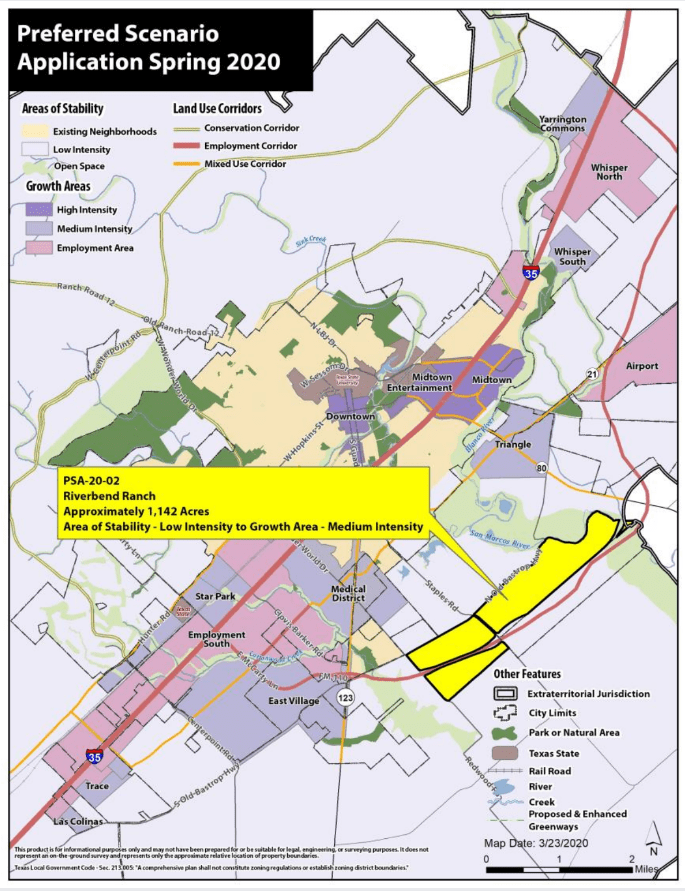
This is weird and infuriating. So there is a giant housing development that’s been approved, called Riverbend Ranch. It won’t materialize for a while. We’ve discussed it here and here.
It’s very big – 1,142 acres. It runs adjacent to Redwood on the southern end, which is a concern, but possibly there’s an opportunity to get some sewer infrastructure to the good people there.
The plan has always been for it to be mostly housing, above the red line. (McCarty extension/Loop 110) (The part south of the red line is zoned industrial, which is the concern for the people of Redwood.)
Here’s how it’s currently zoned:
What do those letters mean? CD-3 is single family sprawl.
ie the charming mixed use downtown from Sesame Street. Or picture San Antonio street.
But in reality it usually looks like so:
Large scale apartment complexes. This is because our land development code lumps together those two types of zonings. So you can’t approve charming Sesame Street-scapes without giving developers the right to build large scale complexes. This is an unforced error – no one made us lump those together in the code.
Anyway, back to this picture:
The striped bits are supposed to be apartments and commercial. The developer is asking to change them the CD4 and CD5 bits to also be CD3. In other words, instead of having pockets of commercial and apartments, the whole thing should be single family sprawl.
THIS IS 1200 ACRES! It will now be 1200 acres of relentless single use housing! This is really shitty! The planning department knows better, because when Riverbend Ranch originally came up for zoning, they had to offer up certain percents at denser amounts, and they had to talk about amenities and commercial areas.
It turns out that you just have to wait a few years until everyone forgets, and then politely ask to get it rezoned into the cheapest and most profitable suburban sprawlscape.
THIS MADE ME SO MAD. This is why we need the comprehensive plan already in place. This should never have been allowed.
This has come up before. They’re building a fancy new campus here:
Those two red highlighter marks are future roads, according to the Transportation Master Plan.
But if McCoy’s wants their campus, the roads are in the way.
So the hypothetical roads must go. DONE!
(The vote was unanimous and this really isn’t a very big deal.)
…
Item 11: 67 acres here:
They want to turn it into apartments that feel like houses. It will be a complex, with the clubhouse and pool and all of that kind of stuff, but each apartment is a standalone house. I went hunting on the company’s website but I couldn’t find a sample photo.
The part I found mildly delusional was that they expect wealthy renters. Their typical renter has an $85K annual salary and wants a multi-year lease. That sounds like a pleasant fantasy version of San Marcos.
Shall we play The Six Criteria For Housing Developments game? YES!
Price Tag to the City: Will it bring in taxes that pay for itself, over the lifespan of the infrastructure and future repair? How much will it cost to extend roads, utilities, on fire and police coverage, on water and wastewater?
Good location. This is infill.
Housing stock: How long will it take to build? How much housing will it provide? What is the forecasted housing deficit at that point? Is it targeting a price-point that serves what San Marcos needs?
We need an ongoing housing needs assessment. We need to know this.
Environment: Is it on the aquifer? Is it in a flood zone? Will it create run off into the river?Are we looking at sprawl? Is it uniformly single-family homes?
Not on the aquifer. Environmentally reasonable.
While I haven’t seen photos, I get the picture that the units have smaller yards than a house. So denser than single family housing, but less dense than apartments. Not the worst.
Social: Is it meaningfully mixed income? Is it near existing SMCISD schools and amenities?
I can’t imagine their target clientele is going to materialize. They’re imagining something wealthy-ish, though, which is not mixed income. It’s sort of near Hernandez and Rodriguez elementary school, and sort of near Miller middle school. (The developer is imagining adults without kids, though.)
The San Marxist Special: Is it a mixed-income blend of single family houses, four-plexes, and eight-plexes, all mixed together? With schools, shops, restaurants, and public community space sprinkled throughout?
Not really. I suppose you have the outlet mall right there, but they’re not exactly a charming little public gathering space.
(Remember when you used to be able to ride a gondola back and forth for about 100 yards? Good times.
My overall opinion: This is a reasonably good use of space. It’s hard to put housing in between I-35 and some railroad tracks.
The vote: Yes: everyone except Matthew Mendoza No: Matthew Mendoza
I am not sure what he was opposed to!
…
Item 12: 169 acres at the end of the airport:
It’s got a weird cut out due to an airport runway easement, and there are some FAA height restrictions also because of the runway. The developer wants it zoned Light Industrial.
Max Baker spoke during the public hearing, and raised issues of pollution. He kept mentioning the future airport expansion. I don’t think this particular item is the airport expansion? But maybe it’s in the pipeline?
Anyway, apparently it’s easy to measure pollution, but hard to determine the source, and usually it’s vehicle traffic. (Maybe we should reconsider all this sprawl!)
The vote: Yes: Matthew Mendoza, Jude Prather, Shane Scott, Mark Gleason, Jane Hughson No: Alyssa Garza, Saul Gonzales
One last thing:
You can speak during the public hearing, but not during council discussion, unless a council member specifically calls you up to the podium to answer a question.
Which brings me to my favorite moment of the night: Alyssa Garza saying – very deadpan but not mean – “Is it possible for Mr. Baker to tell us what he has ants in his pants about?” I’ve been laughing about that ever since.
(Max was glad to comply, and went to the podium to talk further about CAPCOG and purple machines and air quality.)
This week was a doozy. I may have yelled at my monitor once or twice. Let’s dive in.
Hours 0:00 – 1:18: In which the SMART Terminal gets its day, and Mayor Hughson is weirdly rude to Max Baker.
Hours 1:18-2:21: Fire code updates, and Mayor Hughson is weird and unpleasant for a second time, advocating for some decorum rules, which again appear to target Max.
Hours 2:21-3:58: Riverbend Ranch, paid parking at the Lion’s Club, and Mayor Hughson is pretty rigid and counterproductive for a third time! What the hell.
Jane Hughson was really kind of a disaster this evening. The rest of the councilmembers were mostly complacent yes-men. (Besides Alyssa, who was continuously trying to be her diplomatic self, fighting losing battles. And besides Shane Scott, who was absent.)
Citizen comment: equally split among a few topics: – a smattering of anti-curfew advocates, – representatives from nonprofits who are upset about the allocations this year.
We’ll get to both in due time.
Item 1: Free electric cabs downtown! The pilot program is underway. You can call them, or hail them just by waving your arm when you see one, or you can use the app.
They’re kinda cute!
The cabs have a fixed route, but they’re allowed to go off route to pick someone up or drop them off, and then they just return back to the route.
And since you asked:
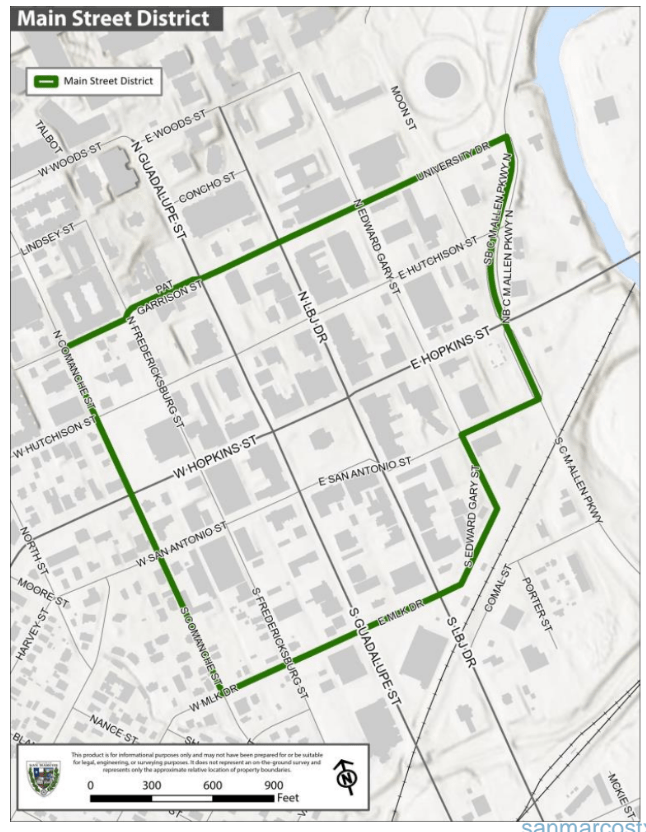
Okay, I think the route is kind of weird. – It doesn’t go through the actual town square. – It’s all kind of peripheral – There aren’t any designated park-and-ride parking lots, from what I can tell.
The more I stare at it, the more convinced I am that that can’t possibly be the route. That has to just be the boundary of the Main Street district. There’s nothing on the website that can plausibly be the route, though, either. I give up.
But I’m strongly in favor of free public transit, so hopefully this will stay and grow! I would most like to use it during July/August/September, when being outside feels like Satan’s butt.
The pilot program is supposed to stay under $500K, and last for another six months. Then hopefully it will become a permanent thing.
As long as this is turning into a full-fledged PSA, I may as well post the flyer:
Ok, I tested out that QR code above. It just goes to the same San Marcos website that I linked to above. There’s just a phone number to call the cab. No link to an app, no route, just a phone number. (The presentation definitely claimed there is an app.) Oh San Marcos: so many great ideas, so many terrible websites.
Nevertheless: test it out, why dontcha? Public transportation is a great thing!
…
Items 2,3, and 4: Several financial reports. – the quarterly CBDG audit, – the quarterly investment report, and – the quarterly financial report.
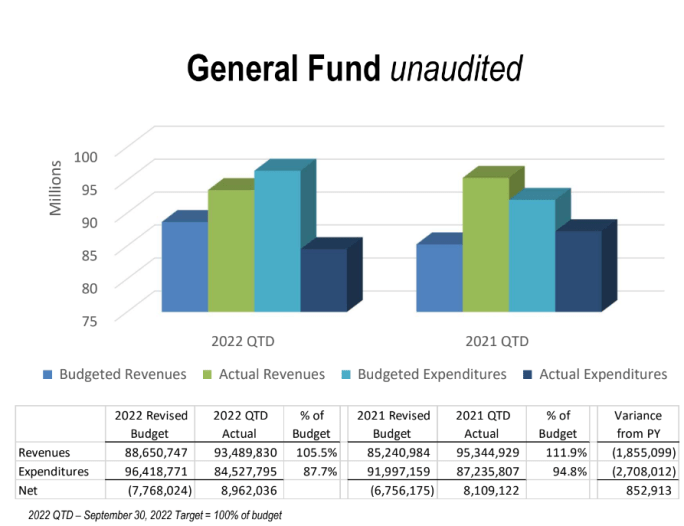
On that last one, we’re making bank. This is the most striking graph:
In other words, we planned to spend light-blue-money, but we actually spent dark-blue-money. And we thought we’d bring in medium-blue-revenue, but we actually brought in green-revenue. Wowza. Across the board, we’ve come in under budget and over revenue, in almost every category.
On the one hand, this is good: we operated under prudent expectations and it worked out. On the other hand, we have a community with needs, and we should not sit on a windfall of money. (Nor should we return it via tax breaks.) We should spend it thoughtfully, on high quality programs.
Mark Gleason moves to approve, and Jude Prather seconds it.
Alyssa Garza wants everyone to please explain why they’re acting against the boatload of emails, calls, and petition signatures they’ve received.
No one really answers.
Jude Prather wants the CJR committee to look at the severity of the crime. He makes several points: – Government should protect civil liberty, but also safety. – he had an awful experience as a teenager, when he was strip-searched at a mall, under accusation of shop-lifting. So he understands how negative police interactions can alter someone’s point of view. – But this is not 1998 or 1999, which was a simpler time. This is a more dangerous time with greater public safety concerns. So he’s siding with the curfew.
Jude gave the same line at the last meeting, “This is not 1999, a simpler time,” which I ignored for being dumb and bland. But the second time he says it, we have to take it more seriously, because it’s mostly wrong:
So homicides did spike during Covid, but it’s absolutely in no way true that 1999 was significantly safer than, say, 2019.
Furthermore: on the murder spike, Chief Standridge specifically said that there have not been any murders in 2022 in San Marcos, for the first time in forever. So things are really not grim today!
(I’m guessing that Jude Prather graduated high school in 1999, and he imprinted on 1999 as a kind of The Most Generic Year yardstick for America.)
Back to Council discussion
Shane Scott brings up Max’s question from two meetings ago: How many encounters do young people have with police? In the last few months?
Chief Standridge answers, (at 1:42): “We don’t capture data associated with nonenforcement. And contrary to anything that’s been heard before, I never said that to do so would be “draconion”. I never used that word.” He basically says it’s complicated and expensive to get that data.
Why is Chief Standridge fixated on the word “draconian”? Shane didn’t use the word. No, it’s because Max Baker has been using it, during citizen comment, and attributing it to Chief Standridge. Max has been claiming that Chief Standridge said it would be draconian to record every instance of police interactions with community members.
So what did Chief Standridge actually say? Let’s go back to November 15th. At 1:22, Max says: “There’s presumably some other data set that says this is how many times we stopped and talked to people, with this as the reason, and is that data that you all keep? Your officers presumably should be tracking every time they stop somebody, to talk to them, right?”
Chief Standridge answers, “I would hope not! I hope we don’t ever live in a police state or a police city, where we document every time we speak to a person.”
I am pretty sure that’s the line that Max refers to. Max has substituted in the word “draconian” for “police state”. So Chief Standridge is right that he never used “draconian,” but what he actually said has roughly the same meaning.
Goddamnit, I’ve got to stop getting off-track on these dumb tangents.
Back to Council discussion:
Shane Scott, continuing in good faith: “When I was a kid, the PD made friends with me and I got a degree in CJ. Most kids are good kids, and it’s hard for me to do curfews based on my experiences.”
Shane Scott moves to postpone until after it goes to CJR. This is, of course, the same thing they voted on last week. But sounds good to me!
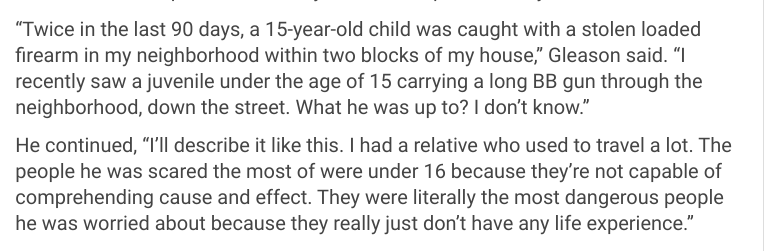
Also, his relative is scared of 16-year-olds because he doesn’t know about drunk people yet. Don’t you dare tell him and ruin his innocence!
But more seriously: Mark is very worried about 15-year-olds with guns, but not at all worried about this:
It sort of makes curfews just seem quaint.
Back to Council Discussion
I’m getting bored of this whole discussion.
Alyssa makes a case for tabling it: Tabling this will bring a sense of haste to the CJR. Otherwise it will join the endless, non-urgent queue.
Jane says that over the years, she’s voted on this 4 times before with no issue. No need to postpone.
Chief Standridge answers the racial data coding question from last time: SMCISD uses racial data as provided by parents.
Saul asks Alyssa’s question from two meetings ago: What percent of violent crimes is coming from teenagers? Unfortunately, Chief Standridge explains that the answer involves queries into several databases, and will take a little bit of time. They’ll give it to the CJR committee when they have it.
The vote to postpone:
Fails yet again.
Final vote on the whole damn thing:
So that’s that.
It will go to Criminal Justice Reform committee, and they will do whatever they do. In the meantime, the curfew is in effect.





















 The San Marxist