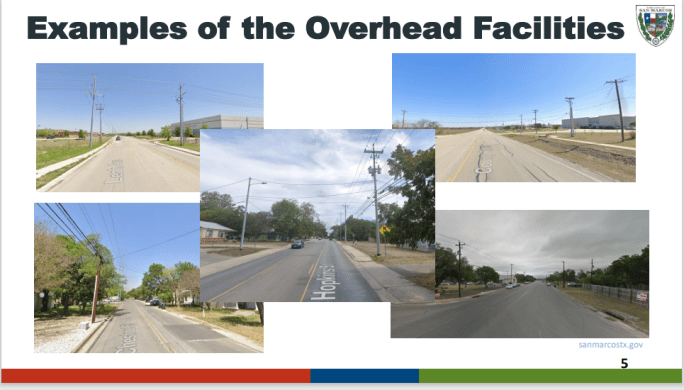
This might feel a bit like insider baseball, but it’s insider baseball that makes me happy.
Here’s the issue: say a developer applies to get their land zoned. The developer says, “You’re gonna love it! I’m going to put in some cute condos, a great restaurant, and some retail.” They show us some charming sketches of what they have planned. We think it looks great and give them the zoning they want.
Then they change their mind and sell it. The new owner gets the zoning, but decides that they really want to build something that pisses everyone off. As long as the new plan is legal under the zoning, there’s no mechanism to stop them.
(To be fair, Council and P&Z know not to trust charming sketches. But in general, there are a lot of hard calls on zoning when you’re okay with some uses and not others.)
Enter PDDs. PDD stands for Planned Development District. This means you get to micromanage the developer. You get to see the actual plans and say, “A few more trees over there, how about an awning on this little store, etc.” You can be extremely heavy-handed and rigid. Everybody signs the PDD contract and the city gets exactly what it signs up for.
There are bad parts, too: it’s an enormous amount of work for city staff. Sometimes it has meant sweetheart deals for developers who don’t feel like following the code. Sometimes PDDs haven’t been enforced. PDDs are only as good as the council that approves them.
Here’s the frustrating thing: we used to have PDDs, but in 2018, we threw them out! I never understood this. Why not just use them less? You’re allowed to have tools that you don’t use very often. But no: we went Marie Kondo on our tool set and completely cut them out. (There are plenty of PDDs that are still around – Trace, La Cima, etc, but we eliminated our ability to write new ones.)
Since then, there’ve been a number of occasions when it would have been nice to have them! The most obvious example is the SMART Terminal. We were on the verge of handing over 2000 acres and saying, “Have fun with all that! Let us know what you decide to do with all that heavy industrial zoning!!” Only for massive public activism did we back away at the 11th hour.
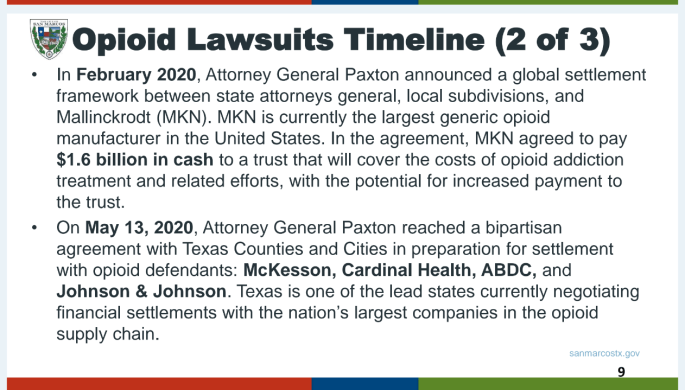
So now we’re bringing PDDs back!
Jane Hughson’s main motivation is to hold developers’ feet to the fire. If they promise beautiful things, then they can put it in writing and be held accountable. I agree – that’s a great reason to have PDDs.
Everyone else is on board. What’s not to love about micromanaging developers?
…
Item 8: Emergency Sirens
There are emergency sirens throughout town. We occasionally have emergencies – floods, tornados, snow-vid, etc. (Now, I can’t recall ever actually hearing them during different emergencies we’ve had? but surely they did their job.)
If we’re going to have massive sprawl, maybe the developers should include sirens in their new developments. Everyone agrees this sounds reasonable.
Shane Scott asks about GMRS systems? Apparently these are fancy walkie-talkies, somewhere in between CBs and ham radios, in terms of watts of power.
Answer: they require really tall towers, so they wouldn’t piggyback on the siren towers. But maybe someday!
10-4, good buddy.
…
Item 9: Boards and Commissions appointments.
There are 19 different city boards and commissions with open slots. It’s appointment time.
Last year, Alyssa Garza was super frustrated by the perpetual Oldness and Whiteness of the applicant pool. It was never shared with the public if anything came of that? Maybe the DEI coordinator worked with the communications outreach team to get the word out more effectively?
Jane Hughson applauded this applicant pool for being the most diverse yet. Maybe it is! I have no idea. Alyssa did not say anything good or bad either way about it.
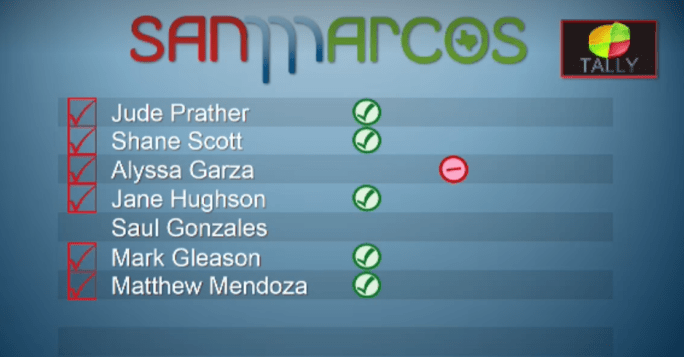
On P&Z, there were three open slots. All three current members – Lupe Costilla, Jim Garber, and William Agnew – were re-appointed for a second term. Jane Hughson, Saul Gonzalez, Mark Gleason, and Matthew Mendoza voted for those three reappointments. Jude Prather, Shane Scott, and Alyssa Garza all voted for some new and some returning people.
All three of those P&Z members work hard and in good faith. I’m totally annoyed with how P&Z handled VisionSMTX, but that’s just one part of many things they do, and they do other things well. (New appointments keep it fresh and interesting, though.)
One last thought: I recognized so many of the names from people who are friends with me on social media! You’re good people. Everyone who submits an application to be on these commissions deserves a hearty thank you.
Mission Able, a nonprofit that offers home repairs for low-income residents of San Marcos
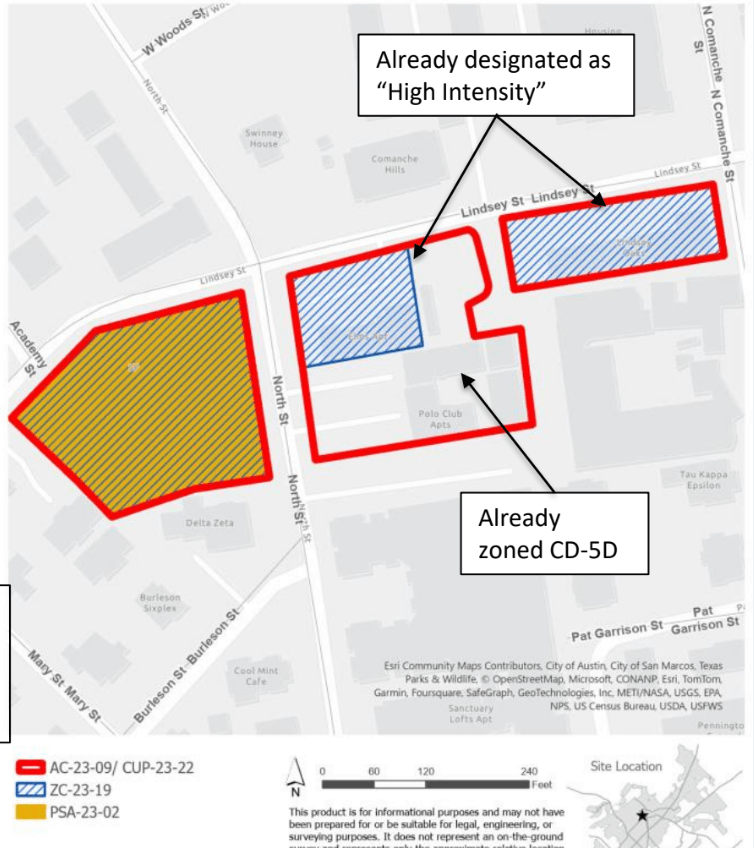
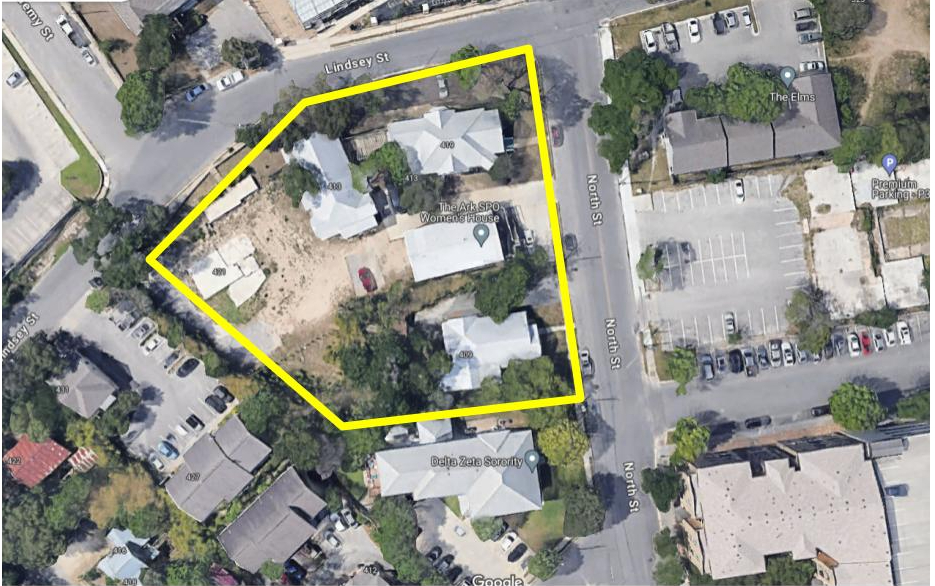
Being opposed to the potential Lindsey Street high rise
How some people online are blaming the historic district and unprotected neighborhoods for sprawl. Watch out for AI. It’s not rich vs. poor, it’s protected neighborhoods vs. unprotected neighborhoods.
Obviously that last comment is catnip to me! I’m so excited to take it apart.
“People online are blaming the historic district and unprotected neighborhoods for sprawl.”
I hope the speaker doesn’t mean me! I don’t blame the historic district for sprawl. I blame the neighborhoods that aren’t like the historic district. I want all single-family neighborhoods to have the interesting housing options that the historic district has, like ADUs, and 3- and 4-plexes.
I blame neighborhoods that are uniformly single-family homes for sprawl.
“Watch out for AI.”
I think this means for the VisionSMTX survey – the speaker doesn’t want someone programming a bot to bombard the survey with 2000 responses against her.
I also don’t want that! However, I’m publishing a cheat sheet, in case any people out there want a shortcut to sharing their opinions. But listen: I only want people. No bots.
“It’s not rich vs. poor, it’s protected neighborhoods vs. unprotected neighborhoods.”
I have definitely phrased the VisionSMTX fight as “haves vs. the have-nots”, which amounts to the same thing as rich v poor. So my ears perked up.
What does “protected neighborhoods vs. unprotected neighborhoods” mean? My best guest is that the speaker is referring to HOAs. I think they are saying that HOA neighborhoods are protected and non-HOA neighborhoods are unprotected.
As luck would have it, I’ve been thinking a lot about HOAs as well! They’re fucking wild. There’s a kernel of truth to what the speaker is saying. HOAs can ban things – like ADUs – even if the city says they’re allowed everywhere.
However, I don’t want to extend HOA protections to non-HOA neighborhoods. I’d rather level the playing field by de-fanging the HOAs. HOAs operate under the pretense that nothing they do affects anyone outside the neighborhood. But when it comes to collective action problems like sprawl and density, opting out of the solution does affect others. And so it should be banned.
Will we take bold action on HOAs? Ha. ha. No. Sorry.
…
Usually I don’t mention the Consent Agenda, because it’s a formality. But it’s important this time, because:
CLICKERS ARE BACK!
But just for that one vote! Then they stopped working. 🙁
Mayor Hughson has an amendment: it will be a $50 fine if you park a non-EV vehicle in an EV spot. Seems reasonable. The amendment passes 7-0.
The vote on all the parking updates: 6-1.
Alyssa Garza was a “no”, but didn’t say why. ¯\_(ツ)_/¯
…
Item 5: Taking $800K of ARPA money and giving it to Mission Able and Operation Triage.
ARPA money is Covid money, and it has to be fully spent soon. So we’re giving $400K to Mission Able, and $400K to Operation Triage.
Mission Able is these guys. They come in and repair people’s homes. For various reasons, they can make the application process much less painful than the CBDG application process.
Operation Triage is these guys. They do something similar, except they focus on veterans.
…
Item 6: We’re also shuffling around CBDG money. It’s not a surprise – it’s a continuation of this plan for flood mitigation.
…
That was literally the whole meeting. It was surreal!
Council hemmed and hawed, and asked staff to bring two more final choices back.
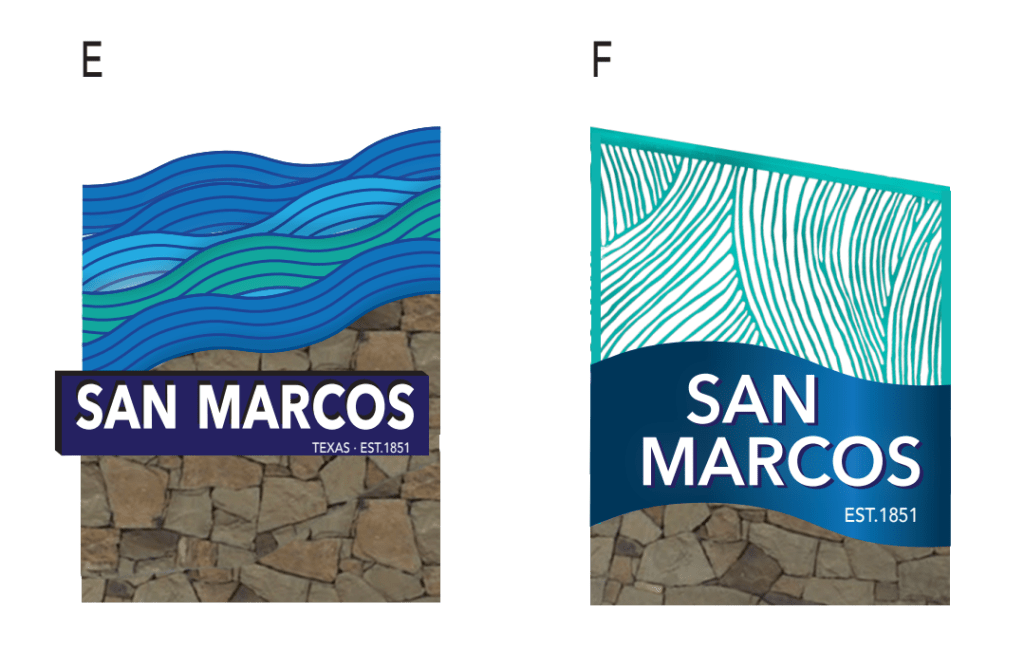
So these are the two finalists:
I like these rocks better! These look like river rocks, not suburban masonry. But the new heron is worse. It was better off-center with the blue outline, I think.
The one on the left reads: “State Park, but make it Business-Professional.” I’m okay with that vibe.
They will be located at these two locations:
I always enjoy it when staff draws the city sideways. Look at that wonky compass in the corner:
What’s reality anyway, man? Time is a construct! North is an illusion! You’re not the boss of me!
What does Council think?
Mayor Hughson, with a pained expression: So these are our only two choices?
Staff: You literally told us to only bring back two.
Mayor, deep sigh, clearly repressing the urge to say, “But I didn’t mean this crap.”
Matthew Mendoza: Maybe it’s because I live in Rio Vista, but I love the heron! It symbolizes conservation and the environment. Option B for Bird.
Alyssa Garza: I like the bird. Ever since I first visited San Marcos, I’ve seen those beautiful white birds. Option B.
Jane Hughson: The bird does not represent the whole city. It could be a neighborhood sign, but I don’t like it here. Option A.
Mark Gleason: The bird is not the mascot of San Marcos. It’s distracting. Option A.
Saul Gonzalez is also for Option A. (Jude and Shane are absent.)
So it’s 3-2. Council argues about whether to wait until Jude and Shane are back, so that one option can get a full four votes. Alyssa weighs in: “I truly don’t care. We are spending way too much time on this. I’ll switch my vote.”
So the State-Park-But-Business sign wins with a clean four votes. And City Council gave the bird to the bird. (Ba dum ching.)
….
Matthew: Can we cycle through different colors for the lighting? Purple on Rattler nights, Maroon on Bobcat nights, holiday colors around the holidays?
Answer: Yes! As long as it’s static. TxDOT just says no moving parts.
So there you have it. At some point this year, these harmless little welcome signs will appear on I-35.
…
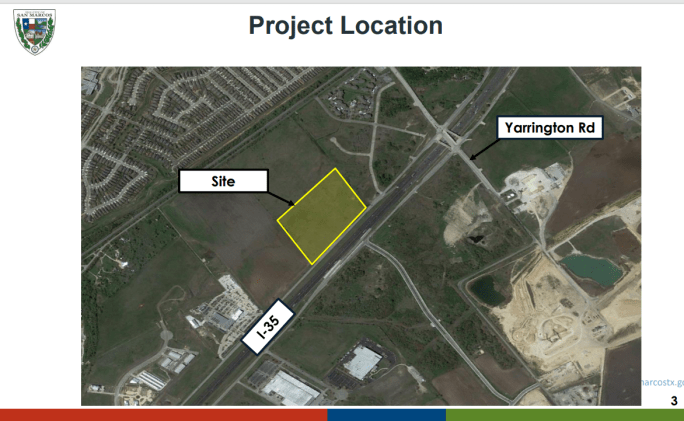
Item 9: Rezoning 18 acres behind the outlet malls.
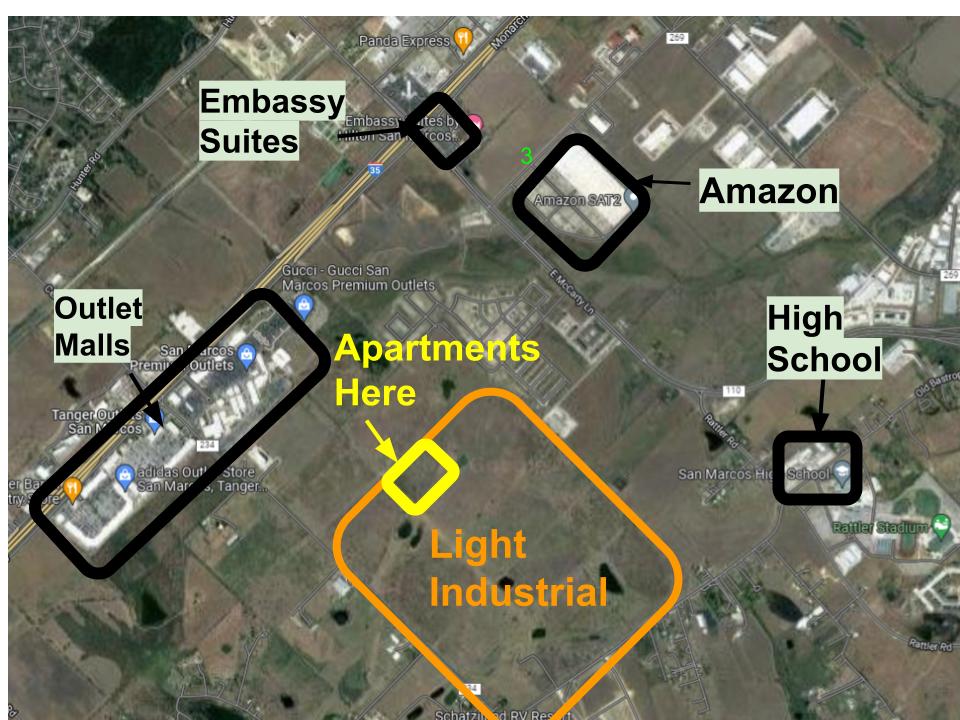
This has come up before. It’s part of a larger chunk of land:
Mostly light industrial, but with this one little piece for apartments. These were never built, either!
The current owners want to change the yellow square to Light Industrial, to go along with the rest.
Saul is the only one who asks questions:
What is the expected tax revenue for this?
Staff says, “We can’t give an estimate.”
What is the impact on the neighbors?
Answer: They’re all doing the same thing.
It passes 5-0.
…
Item 11: We are fiddling with little parking details, as discussed here.
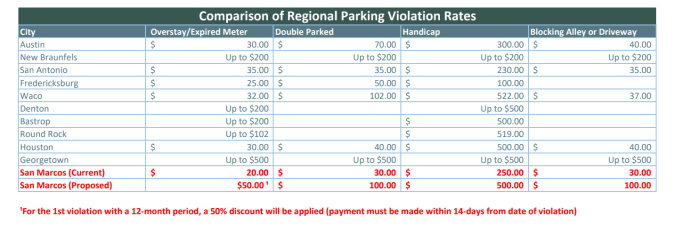
Among other things, we are raising the parking ticket fees, for the first time in 50 years:
I didn’t really know what to make of this. Are the little cities price gouging? Or are the big cities subsidizing bad behavior? So I emailed the chair of the parking committee (Rosalie Ray), who tells me:
– By state law, your fine for illegally parking in a handicap spot must be at least $500. So those cities with cheaper fines in that category just haven’t updated their fees since 2009, when that law was passed. (We hadn’t updated ours since 1974!)
– To avoid price-gouging, the committee has a couple things in place:
you can opt for community service instead of a fine,
you can get a payment plan, and
you can get your fine cut in half by responding within 14 days. (Council could extend the 50% discount to double-parking and blocking alleys, if they want.)
– The main targets are things like FedEx and delivery trucks. They’re the ones blocking alleys and bike lanes or double-parking. So we want them to pay their fair share.
We’re now three years deep in writing the Comprehensive Plan, or VisionSMTX. (Discussed here, here, here, here, and here.) – Years 1-2: a 30 person citizen group meets and a draft is written. – Year 3: A subcommittee from P&Z guts a lot of the important details meant to address suburban sprawl and unaffordable housing. P&Z passed the gutted version.
So how will council go about getting community input?
Basically, a massive outreach campaign. City staff is going to carpet bomb the city with fliers and emails. They’re going to put a little insert in with your utility bills. They’re going to wash social media in links. They’re going all out.
You’ll be able to:
Fill out a survey on paper, or
Fill it out online, or
Leave comments directly on the Summary of Changes table, for other people to read.
The survey opens February 2nd and closes February 23rd.
The problem is that the actual document is long and boring, and the details are fiddly. The summary table is 22 pages long! So it’s going to be hard to get people to wade into it.
Here is my plan: I’m going to try to provide a cheat sheet. If you care about the same things I care about, I’ll have some language that anyone can borrow, to make it easier to fill out the survey.
What did Council think?
Jane Hughson starts, “A common complaint is that this is all about protecting rich neighborhoods. But this is about protecting all neighborhoods! Not just the wealthy ones!”
That is not my complaint. Sure, yes: the changes apply to all the neighborhoods. My complaint is that “protecting all neighborhoods” means locking in sprawl and preventing renters from living in quiet neighborhoods.
There is some bickering over the third survey option, where you’ll be able to write comments directly on the Summary Table. Should comments have a “reply” feature, so that people can go back and forth in a single thread?
Jane and Mark say no. It will disintegrate into fighting, and intimidate people who might not comment out of fear of having their comments shredded. Plus, anyone can leave a new comment and respond to another comment – it just wouldn’t be a “reply” feature on a comment.
Alyssa feels strongly that we should be able to. Adults aren’t kids and you don’t need to be coddling them. Classrooms use this kind of thing all the time. If people can’t handle this level of discourse, they should go to therapy.
Matthew Mendoza says that he’s okay with a little back and forth.
So it’s tied 2-2. Jane says, “Saul, you’re the tie-breaker. What do you want to do?”
Saul says, “I’ll go with the majority.”
Jane: [Eyes bug out.]
Saul: Ok, just comments. No back and forth.
In Saul’s defense, he seems to be feeling really under the weather. Later, when asked for his opinion, he just weakly says, “I took some Advil…”
I’m with Jane, Mark and Saul here: classrooms are heavily moderated by the instructor. Unmoderated spaces deteriorate fast. I personally would not wade into a situation if it felt like a cesspool to me.
…
Q&A with the Press and Public:
LMC asks about the Gateway signs. How much did we pay the consultants? How much staff time? How much will the signs cost?
Answer: The consultants were $63K. The signs will cost $200-250K. It takes staff about 1-2 hours per week.
…
That was the whole meeting! It was short and sweet.
People talked about: - Funding for rehabilitating various buildings in Dunbar – Whether we really want to change the name of Citizen Comment to “Community Perspectives” or not. – Concerns over police accountability – How Mark Gleason got a letter of admonishment from the Ethics Review Commission, for voting on items where he should have recused himself. Specifically, he voted on the meet-and-confer contract for the fire fighters union, after receiving several donations of different sorts from them. (Details here but all you can do is watch a video. There are no minutes or documents.) – Max Baker is starting a monthly San Marcos Civics Club, to get the public engaged and hold City Council accountable. (I imagine you could reach out to him on Facebook if you’re interested, and he’d be glad to have you.)
Item 1: We have a Sidewalk Maintenance Program.
Basically, the city looks for places where people are complaining, or there are pedestrian traffic accidents, or underserved areas, or high pedestrian traffic areas.
This is the type of thing they do:
Here’s what’s going on for the next year:
The five year plan is a little more loosey-goosey and responsive to changing needs, but here’s the tentative map:
Jude Prather: there’s been a lot of improvement to our sidewalks. Let’s keep the gas pedal on.
Shane Scott: It happened outside my shop. They were really careful about the tree roots.
Mark Gleason: It happened to me! They laid the sidewalk today. They were very professional and they were careful of my trees. Added convenience and safety.
Mark Gleason does have one suggestion, which is that the city should use goat paths to identify potential places for new sidewalks.
I think he means this kind of thing, where over time people have worn a little path:
Alyssa: Great job. One of my neighbors posted about their really positive interactions with the city.
Jane: We started thinking about sidewalks in 1992, we said “schools and grocery stores.” So we’ve come a long way.
One issue is how to add sidewalks to streets where we don’t have a right-of-way. In other words, how do we build a sidewalk in a high-needs spot, where the city doesn’t own an easement along the road? Jane asks about this.
Answer: It makes it a bigger project than the Sidewalks Maintenance Project. We have to collaborate with Public Works. It goes on the CIP list.
My two cents: We need sidewalks running out to the high school. I know it’s far away, because that’s where land was cheap enough to acquire. Do not put a bike lane that feels like part of the street down 123 – put in a proper sidewalk. All the way to the high school. (And do it now, because a lot of that empty land is zoned for housing and apartments, and putting sidewalks in will get even harder.)
Item 18: Flood money.
After the 2015 floods, we got a big chunk of CBDG money from the federal government. It comes in two flavors:
Housing assistance
Stormwater projects
For Housing Assistance, we built 14 homes and repaired some of the public housing homes on CM Allen. (We discussed a few of these homes last year, being built in Sunset Acres.)
It’s depressing that it took eight years to get these people into safe housing. I think the main reason is that there were five rounds of funding, and so those from the first few rounds got their housing sooner. Plus I’m sure there were Covid delays, and some of it was generic government red tape. The last few houses remaining were finished this past year.
Three applicants withdrew in 2022 and 2023, and at that point it was too late to get new applicants, and so the housing portion came in $1 million under budget.
On the stormwater projects, we’ve got:
Uhland Road Improvements:
This one finished up in the fall.
2. Midtown Drainage – Aquarena Springs and I-35
This one will finish in April 2024.
3. Blanco Riverine: Berm and Floodwall
This one is supposed to finish in June 2024.
We discussed this one briefly back here. It’s a really big project:
and it’s supposed to do this sort of thing:
Basically geo-engineering a place for the water to go when it floods, instead of going into Blanco Gardens.
4. Blanco Gardens Drainage Improvements
This one is supposed to finish in August 2024.
The point of today’s presentation is that as some of the projects wrap up and have a little money leftover, the money gets shuffled around to the other ones that are still ongoing.
There are some other projects that will take a little longer to finish: – Acquiring land for flood prevention – Electronic rain gauges that are tied into the flood warning system – 3 sets of permanent flood gates: Cape Road, McKie Street, and Jackman Street/Gravel Street.
This is all supposed to wrap up by 2027.
What does City Council have to say? Saul: On Barbara Drive: what kind of drainage? Looks different than Conway. Answer: It’s the same as on Conway. They’re both Open Channel.
Saul: Is it dangerous for kids? Answer: Velocities should be slow. Will have gates. Won’t have easy access.
Mark: I was personally affected by all the flooding. We’re still dealing with the ramifications.
Mark has a few questions: – Will the new raingauges be integrated with the WETmap website on the Hays county website? Answer: Yes. – Will emergency info/river flood data be shared with NOA? Answer: I assume so but I don’t know for sure. – When will rain gauges be done? Answer: End of 2023, but they’ll be tinkered with in the Stormwater Master Plan. – What kind of gate are you using for gating off those channels? Answer: Single arm. – So people are losing access to these alleys in Blanco Gardens. Are they aware? Answer: we sent notifications and knocked on some doors.
Shane Scott asks the hard-hitting questions: What about Quiet Zones for trains? Answer: That’s a totally different topic. Different grant money.
Alyssa: I was also in Blanco Gardens during the floods. As projects wrap up, can we get back to the people in these neighborhoods? We need to explain that we’re working through issues and they haven’t been forgotten. Answer: there will be ribbon cuttings, etc.
Saul: A neighbor said they’ll only be allowed to have 1 cable. Is that true? Answer: Yes. There are 3 telecom companies. Time-warner/Spectrum, Astound/Grande, CenturyLink/Brightspeed. Two of these pulled out of Blanco Gardens. So you basically only have Spectrum.
This is just a discussion item, so there’s no vote.
Item 19: There are some toxic chemicals under Guadalupe. (We talked about this here a few months ago.)
Short version: there’s a bunch of groundwater toxic chemicals – PERCs, TCEs, VCs – deep in the ground, leftover from some dry cleaning businesses 40+ years ago. They’re really not good, but the chemicals will break down over the next 100 years into carbon dioxide, a little chlorine, and water, which are not so bad. They’ve basically sunk down way underground, into this stuff called Navarro Clay, which is a super thick gunky layer that just sits there underground, above the water table of the aquifer. So we can’t really clean it up, but they’re also not going to get into the river or the aquifer water table. We mostly need to leave them untouched until they decompose.
Here’s the three properties we bought, at the site of the original contamination:
The official way to let the chemicals sit there is to set up a Municipal Settings Designation, or MSD:
In this region, no one can drill any groundwater wells. You already can’t, because it’s within city limits, but now you EXTRA can’t.
We notified anyone who has a private well within 5 miles of this site. That worked out to 109 well owners. None of them seemed particularly concerned.
Item 4: ”Citizen Comment” vs. “Community Perspectives”
Shane pulled this item from the Consent Agenda.
Backstory
Mayor Hughson decided to clean up the city ordinances on committee meetings. She flagged a bunch of things that were inconsistent or unclear. One thing she noticed is that “Citizen Comment” is a terrible phrase, because you don’t actually have to be a citizen in order to comment. It sends a bad message.
We’ve discussed this here and here. Jane suggested “Community Perspectives” and in the past two months, no one ever protested it.
Here we go:
Shane says that he doesn’t like “Community Perspectives” because it implies that each speaker represents the entire community, instead of their own individual opinion.
Look, clearly “Community Perspectives” is a bit dippy. It sounds like a church bulletin board. But Shane’s complaint is also silly. No one is going to think that some rando speaker is supposed to represent everyone in town. It’s not “Community Spokesperson.”
Jane, wearily: We’ve talked about this on a bunch of occasions.
Shane: I’ll just vote against it.
Jane: The entire list of all the changes?!
Shane: No, just this one.
Jane: You can’t just vote against one.
Shane: Oh right.
So Shane makes a motion: Keep it “Citizen Comment” after all. Alyssa seconds it.
Saul: I’m fine the way it is. Citizen Comment.
Matthew: I don’t care either way.
Jane: Honestly, I was concerned about changing it, because it’s been called “Citizen Comment” for years. Everyone is used to that. But I just don’t want anyone to feel excluded.
Alyssa: I appreciate that. But maybe we can just say something on the website.
Mark: I’m on the fence. Everyone knows it as Citizen Comment.
The vote to amend:
Keep calling it Citizen Comment: All seven councilmembers
Change to Community Perspectives: no one.
On a scale of 1-10 of importance, this is maybe a 2. Nevertheless, they got it wrong! “Citizen Comment” is bad because “citizen” is exclusive. Jane is exactly right here.
Off the top of my head, they could have gone with: – Community Comment – Open Comment – Civic Comment – Citizens-and-Not-Citizens Comment (okay, now I’m getting punchy)
I know they’re worried that changing the name would up-end years of familiarity. But that’s tunnel vision from being in the center of the action for too long. Most of San Marcos is not paying any attention to City Council at all! Those who know the phrase “Citizen Comment” are not emotionally attached to it. You can switch to “Open Comment” and we’ll all be okay.
They didn’t want to go with “Public Comment” because it sounds very similar to “Public Hearing,” which is a specific different thing.
Oh well!
The vote on all the little changes that Jane proposed:
Yes: Everyone. No: No one.
….
Item 21: Gary Softball Sports Complex is getting renovated.
There were no slides or pictures for me to nab for you.
….
Item 23: Human Services Advisory Board (HSAB) Funding Policy
We’re going to spend some time on this item, because it drove me batty.
Backstory
Earlier in December, we allocated $650K in grant money to local nonprofits. There were 34 applications. Each nonprofit got between $5K and $34K, except for the Hays-Caldwell Women’s Shelter and the Hays County Food Bank, which got $50K and $80K respectively.
I griped last time that Council makes these nonprofits jump through a lot of hoops, while we just hand out other money seamlessly and invisibly.
Guys. guys. We are about to get SO MUCH MORE micromanaging of this whole mess. We are going to nitpick this thing to death.
The current issue
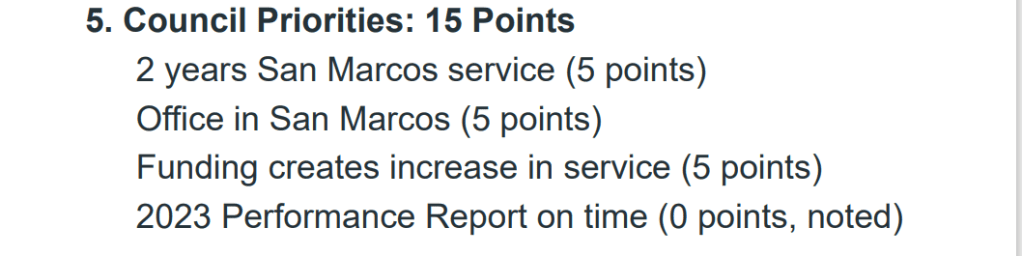
Recall that the HSAB committee assigned points according to this rubric:
Jane is mad about Council Priorities being neglected. It’s only 15 points! Nevermind that people with nonprofit experience developed priorities 1-4, and that Council Priorities are somewhat redundant.
Here are the things that Jane’s mad about:
It’s not punitive enough if performance reports are late.
The Council priorities should add up to 25 or more points!
We want to know where the board members live. Do they live in San Marcos? Do they live in Kyle? In Austin?
They should spell out all acronyms. No unclear abbreviations. (I acknowledge this one. They really should.)
Complaint #1: Those Pesky Performance Reports:
Because last year was so weird, the money wasn’t approved until March. So the whole calendar was up-ended. The nonprofits were supposed to turn in mid-year reports when they re-applied for new funding in August. One nonprofit was late by one day, due to turnover in staffing. One other nonprofit was later, but ended up withdrawing altogether.
So there is not really a problem here: nearly everyone turned in their mid-year reports on time. Final reports will be due at the end of January.
First off, everyone seemed really confused about the calendar. It is legitimately confusing, because it was never spelled out clearly up front.
Here’s the normal situation:
A funding cycle is three years:
Year A: You apply and get your money. (Applications are due in August, money awarded in December.) Year B: You spend your money. (It’s a calendar year, Jan-December) Year C: You turn in your final report. (It’s due by January 31st)
If you are re-applying for funding, you’d apply again in Year B. So your final report from the previous cycle isn’t available yet, because you’re still spending that money.
Jane is acting like it’s a two year cycle, and that it’s just incompetence that keeps nonprofits from having their final report on time. The staff member gently tried to explain, but Jane kept misinterpreting the explanation. (Jane kept acting like the issue was nonprofits that skipped an application cycle, and she’s say things like “If they didn’t apply for a year, then they should just turn in the most recent report.”)
Alyssa: Working for a nonprofit, you are constantly dealing with so many grants, and this is a small amount of money. These are good people, overworked on a shoestring budget, and we’re offering them 50¢. Can’t we have just have grace for our neighbors? Let them work it out on a case-by-case basis with staff?
I’m going to skip about 20 minutes of haggling between councilmembers, but suffice it to say: No. We cannot have grace for our neighbors. Matthew Mendoza is the biggest hard-ass of all, harping on how everything needs to be promptly on time, no exceptions.
Jane: How about this: the report is due in August. We’ll accept late reports, as long as the final report is in before the committee needs to consider applications.
The staff member tries to explain again: this year, only half-year reports were due Oct 15th. The Board considers applications in November. So the nonprofits really can’t get final reports in by decision time. They can submit final reports eventually though.
Jane: We’re going to need to see the final report!
Answer: The final reports are due January 31st. So they could easily submit that for the following cycle, in August?
Jane: Yes. Have them print it out again.Thank you.
Bottom line: if you’re funded in Year A, you’ll submit that report two years later, when you re-apply for funding August of Year C. No one could possibly be late with their final report, because it was due seven months earlier, in January.
Alyssa, “This is really insulting, because it’s not actually a problem. Bigger granting agencies handle extenuating circumstances with grace all the time. We’re the ones treating nonprofits like they can’t handle being professional.”
Alyssa is right. The whole tone of this conversation is that nonprofits are naughty wayward children, and if they carry on, they shan’t have any figgy pudding.
Such naughty, naughty non-profits.
Complaint #2: Council priorities should add up to more points!
We’re talking about this slide again. Jane suggests that the points allocated should be:
2 years San Marcos Service (5 points 10 points) Office in San Marcos (5 points 10 points) Funding creates increase in service (5 points)
Everyone nods compliantly.
Alyssa: What’s the rationale behind increasing the first two and leaving the third the same?
Jane: No reason! We could do 10/10/10, make it 30 total!
This is exactly how haphazard this all is. She’s not actually making a claim about the relative merits of the bullet points. Council just felt neglected, since their priorities were only worth 15 points. (I think they settled on 10/10/10.)
Complaints #s…: Other Things
Jane would like to know which cities the board members live in. She doesn’t need to know their address, but she is interested to know if they live in San Marcos, or Kyle, or Austin, or what.
Jane wants to require them to spell out acronyms. (One application didn’t.)
No one objects to these two criterion, although I assume Alyssa rolled her eyes. I mean, it’s good manners to spell out your acronyms, but I wouldn’t make it a rule.
Matthew: Can we ask them what percentage this grant is of their total budget? Answer: We already know this, based on the information provided.
Jane: Could they could have a coversheet that divided the applications, with the organization’s name and their San Marcos address with their requested amount? Answer: no problem.
(I actually find this one quite reasonable. It’s just about improving the readability of the applications. And staff can implement this without inconveniencing the nonprofits.)
Jane: Will Council be able to review and vote on the final draft of the application and rules? Answer: No problem.
Alyssa has one final comment. “Can we see this level of accountability and reports when we talk about the police department, or the fire department, or public works? We give the police $322 per resident. We give the fire department $218 per resident. And we give public works $141 per resident. Yet we are wasting all of this time over the HSAB board, which works out to… $7 per resident. Can we carry this energy when we talk about budgets in general?”
Jane responds: That’s different. Those are all city departments with department heads that report to us.
Let’s analyze this last bit. Who gets micromanaged, and who doesn’t?
It is true that micromanaging city departments is different than micromanaging contracts and grants to external groups.
However, all of those departments have many external contracts that run between $5K and $35K, and those contracts do not get scrutinized by council. We just trust the department.
In fact, immediately before this item, we approved a contract for $1 million, for improvements at Gary Softball Complex. We did not check whether the contractor was a local company. (They are not local.) We did not ask the private company to explain what all the acronyms meant! We did not second-guess how council priorities were weighted in the selection criteria. We just voted yes, because we trusted the city staff that recommended the construction agency.
Furthermore, there are at least two Very Special Nonprofits that the city negotiates with directly. 1. The Greater San Marcos Partnership, or GSMP.
Back in 2021, we signed a three year contract with them for $400,000 each year. They get $1.2 million dollars! Isn’t that something.
GSMP has to submit a yearly report card. The last – and only! – time they gave an update to City Council was back in May 2022. I can’t find any yearly report cards on on the San Marcos website, so transparency is nonexistent there. From the GSMP website, here’s their yearly report from 2022. It reads more like a promotional brochure than a detailed report, though. Is that the same as a yearly report card? I have no idea!
Things no one on Council cared about:
Where the board members live. Do the GSMP board members live in Wimberly? In Austin? Who knows. Because no one cares.
The exact date that the report was submitted, or whether yearly reports are happening at all. City Council has not hyperventilated about this yet.
Whether all the acronyms were spelled out precisely. In fact, there are a lot of abbreviations!
What percent the San Marcos money is of their total budgets.
What a funny thing, right? (I actually wrote about the contract with GSMP here, but I was a newbie blogger and was still trying to get the hang of it.)
There has not been any discussion that I can see about this money since a work session in 2020. I did not watch the work session, but the powerpoint slides are very vague and uninformative.
Here’s the thing: I don’t think we should micromanage GSMP or Chamber of Commerce, either! We could have a philosophical conversation about how they benefit the community, but I think they basically do what they say they’re doing. (I’m not opposed to the idea supporting small, locally owned businesses. We can quibble about dollar amounts some other time.)
The point is that we treat these groups like professional adults. If they’re late, we pick up the phone and give them a call. If there’s a confusing acronym, we shoot them an email. We don’t act like a grumpy school principal who posts an additional rule on the bulletin board every time someone misbehaves.
Finally: it helps small locally-owned businesses if we lift people out of poverty. Middle class people can eat out downtown more than poor people can! Supporting the most vulnerable members of our community is actually best for everyone.
…
Item 24: Should we postpone VisionSMTX?
Right now, VisionSMTX is supposed to come around on January 16th for a final vote. In the meantime, a subcommittee had been meeting, and they’re recommending that we do more community outreach.
There’s a brief discussion, and Jane checks with everyone informally. It’s really hard to hear who is a “yes” and who is a “no”, but I think this is how it goes:
Check-in on January 16th, but not the final vote: Everyone except Matthew Mendoza Final vote should be Jan 16th: Matthew Mendoza
I’m not sure what Matthew is hung up on. He clearly has some strong opinions about this process, but didn’t quite say what’s bugging him.
Citizen comment: The two main topics are the Can Ban and HSAB grants.
Can Ban: – A bunch of people speak in favor, many who have spent years cleaning up the river – Can it be a restriction on single-use beverages but not single-use food containers? Texas Water Safari folks need some single-use food containers, – City Council member from Martindale describes how well their can ban has worked. – The Eyes of the San Marcos River does regular clean ups just past where city contractors stop picking up trash. It’s a lot.
Speakers promoting their nonprofits for HSAB Grants: – Outsiders Anonymous representative describes their free addiction recovery program. – PALS for free spay/neutering and low cost pet care
All these things in due time!
…
Item 9: We are rezoning about 1 acre here:
Currently it looks like this:
That is the restaurant Sakura.
Sakura is staying, but it’s gaining a bunch of little apartments behind it. They can put up to 9 apartments there. This seems like a good place for apartments! Infill does not need to be scary.
…
Item 10: There’s a little road you’ve never heard of here:
called Flustern Road. It’s up in Whisper Tract:
Whisper tract is gigantic, and slowly getting built out.
Flustern Road has exactly one resident, a company called Manifest Commerce. They asked if they could get the name changed from Flustern Road to Manifest Way.
However, Flustern Road will eventually cross Opportunity Blvd, and connect with Celebration Way:
From the POV of the fire department and EMS, it’s better to have roads that don’t change names. So as long as we’re changing the name anyway, we’re going to go with Celebration way.
Also, don’t the names all sound like someone from the 1960s was dreaming of a brighter tomorrow? Celebration Way, Opportunity Blvd, Technology Way, Manifest Way… Flustern never really fit in, did it.
Nevertheless: would you like to know what Flustern means? [drum roll] ….it means “to whisper.” And it was in Whisper Tract. Aww, very cute. But over!
…
Item 11: Consolidated CBDG funding report.
All of our CBDG money originates with the Federal Housing and Urban Development (HUD) department. We have to regularly write reports to them, documenting that we’re using the money according to the rules.
Alyssa Garza feels like the report isn’t widely circulated enough. Maybe fewer neighbors would harass her about wasting money if they saw how meticulously nonprofits have to account for every last nickel.
I’m more cynical than she is. People just like to gripe.
…
Item 5: We’re buying a generator, for $445K:
Technically, we’re buying a 600-kilowatt diesel generator, automatic transfer switch, electrical installation, and associated engineering services.
Technically, it’s Covid money that’s paying for it.
And technically, it will be located in San Marcos High School, so that the high school can serve as an emergency shelter in the future.
…
Item 12: Citizen Comment will now be called Community Perspectives. (Mentioned before here.)
We’re getting rid of “Citizen” because you do not have to be a citizen to have a comment. This is good!
We didn’t want to name it “Public comment” because we already have “public hearings”, and those might sound too similar.
Not sure why we didn’t go with “Community Comment”. “Community Perspectives” sounds a little bit like a hokey small town newspaper op-ed column, but hey, sometimes we are a hokey small town. Did you have a chance to stop by Sights & Sounds this weekend?
…
Item 13: Human Services Advisory Board (HSAB) Grants.
We put $550,000 of our city budget towards grants to nonprofits. This year, we also have $100,000 of the last bit of Covid money to distribute as well. HSAB is the committee that meets, looks over applications, and recommends to council who should get money.
It seems everyone likes the new process! You can read all the applications yourself here, as well as a bunch of other reports and information.
So this year:
34 nonprofits applied.
5 board members rated them independently on a huge matrix of things:
All the nonprofits pass the Risk Assessment
One nonprofit needed to get their nonprofit status back
They were ranked according to some evaluation criteria
Here’s the evaluation criteria:
The committee met weekly, all fall long, and discussed all of the nonprofits individually. They heard presentations from all the nonprofits. It sounds like a massive amount of work.
Here’s the full scoring matrix on the Evaluation Criteria, if you’re so inclined:
Alyssa Garza: Last year, Council deviated from the recommended HSAB funding in a really haphazard way. I’m glad to see a really systematic process. This is good work, I support the recommendations.
Matthew Mendoza: Great job! But I want to tinker with it. Any Baby Can is centered out of Austin. Let’s deduct $7K from them and give it to the San Marcos Youth Services Board, because that’s centered in San Marcos.
Jane Hughson: Any Baby Can has an office here in San Marcos. Make it $5K and I’ll support it.
The Vote: Should we take $5K from Any Baby Can and give it to SMYSB?
Yes: Shane Scott, Mark Gleason, Jane Hughson, Matthew Mendoza No: Alyssa Garza (who explains that she just wants to stick with HSAB process)
Abstain: Jude Prather, because his wife serves on the board of the food bank.
So now: – Any Baby Can requested $30K, recommended $25K, and will get $20,000. – SMYSB requested $39K, was recommended $20K, and will get $25,000.
This is a good example of haphazard meddling. They’re both good organizations!
But let’s take a moment anyway:
Any Baby Can is providing early childhood intervention for birth-3 year olds, for kids with medical diagnoses, developmental delays, or any impairments. (Getting interventions in early is huge. This majorly redirects the trajectory of kids’ lives.) According to their application, they served 159 children and families in San Marcos last year, over 29,600 hours. They expect to serve 165 children in San Marcos this next year.
SMYSB is an afterschool program for 11-17 year olds in San Marcos. They’re asking for rent for their new facilities, which is $2700/month. Their application doesn’t say how many kids they’ve served, but looking at their progress report from last year, SMYSB got $10,000, and served 16 kids in the spring and summer. They used to be located at Southside Community center, so I’m guessing that they’re working with kids dealing with housing instability or homelessness. This is a super vulnerable population! They need this kind of one-on-one care to navigate what they’ve gotten handed to them.
Both are good programs, staffed by hard-working, underfunded organizations! But the committee took their job seriously when they evaluated the benefit to San Marcos.
I guess I’m harping on this because it’s, well, haphazard. It didn’t feel like Matthew Mendoza read all the applications super closely and then felt compelled to shift this money around. It felt like someone from SMYSB picked up the phone and asked him if he couldn’t find a few more dollars for them. He did, but it comes out of someone else’s funding.
The vote on the entire thing: Yes: Everyone but Jude No: No one Abstain: Jude Prather
…
Because I’m an insufferable prig, may I make a comparison?
Just now, we generously gave out HSAB grants which cost the city $550,000.
We also give all homeowners a $15,000 homestead exemption on their property tax.
How much does that cost the city?
Basically, the city is donating of $1,100,000 towards the worthy charity of home owners.
The elderly and disabled people get a tax exemption of $35,000. This works out to a $211 discount on their tax bill.
Everyone else gets a $15,000 tax exemption. This works out to a $90 discount on their tax bill.
This is fine! I’m not mad about this. But it’s invisible. And we don’t call it “charity”, we call it a tax break.
Bear with me for a moment more:
We’ve got about 7000 owner-occupied houses (as of 2021) who get to share that $1.1 million. There’s a tiny bit of paperwork, but that’s it. Each person gets either $211 or $90, no strings attached.
There are 22,219 people below the poverty line (as of 2021). The HSAB money isn’t exclusively for poor people, but it’s a good place to start. That works out to $25 per person.
And there are SO MANY STRINGS attached. Thirty-four nonprofits fill out extensive paperwork. A six person committee meets for weeks and scrutinizes the applications. Council scrutinizes the recommendations further. Afterwards, each nonprofit writes ongoing grant reports on each person they helped. It’s an extremely labor-intensive, highly visible process. Someone has to maintain the website charting all these details.
To recap:
$1,100,000 on charity for 7000 homeowners.
$550,000 on charity for at least 22,000 people in poverty.
Item 14: We’re converting some of City Hall to be ACC classrooms. (Discussed here before.)
This will be where the classrooms go:
I love city staff. But they are crap at selecting useful maps. Like, would it kill you to include Hopkins as a reference point, on a map of City Hall?
Here’s my supplemental map:
[smugly waits for applause. You’re welcome.]
The idea is that ACC will provide workforce training. Some people will get free tuition, but they didn’t give much details about who.
…
Item 15: $2 million dollars on vehicles.
You know how I like to try to find photos of the fire trucks or back hoes that we’re buying. But this was a little vague:
“Consider approval of Resolution 2023-198R, approving an agreement with Enterprise Fleet Management, Inc., through the Texas Interlocal Purchasing System (TIPS), to provide for the lease and maintenance of one hundred and eight (108) vehicles for use by several city departments and the purchase of miscellaneous equipment in the estimated amount of $2,115,083.00; authorizing the City Manager, or her designee, to execute the agreement; and declaring an effective date.”
This is 108 vehicles, across a bunch of departments.
Jane Hughson said, “I hadn’t been on board with this, but I suppose I’ve come around.” But she never said what it is!
Good thing I’ve got mad reading skills. In the packet there’s a link to “Feasibility and Implications of Electric Vehicle (EV) Deployment and Infrastructure Development”. So I guess we’re upgrading a bunch of city vehicles to be electric. That’s good!
…
One day over the summer, I had some friends down from Austin. They needed to charge their electric car while they were in San Marcos.
Let me tell you: it was a royal pain in the ass to find a working charger. We tried the library chargers, we tried some near the town square, and finally ended up at Embassy Suites an hour later.
So maybe increasing the number of electric vehicles in San Marcos will spur investment in some charging stations? That would also be a good thing.
…
Item 16: IPAWS: Integratred Public Alert & Warning System
This is FEMA’s emergency alert system. Hays County is on it. We’re joining in onto their system.
…
Item 19: CAN BAN TIME! Or rather, SINGLE USE CONTAINER BAN TIME!
Council discussed a possible can ban back here, or rather a ban on single-use containers, because there’s so much trash in the river.
Limit cooler size to one 30 quart cooler per person.
Council discussion:
First, Jude Prather weighs in: San Marcos should adopt rules that match New Braunfel’s single-use container ban. It’s really important that the central Texas rivers all have uniform policies. (At the beginning, Jude’s position seems totally reasonable. By the end, his uniformity shtick starts to seem a little silly.)
Shane Scott: Can we use the endangered species somehow? Like to get federal protection to regulate containers on the river?
Matthew Mendoza: I was thinking that too! Also we can charge out of town users to use the river.
Alyssa Garza: – The river is big with large working-class Hispanic families. There are not a lot of free ways to get your family together in San Marcos and cool off, in the summer. – Public buy-in is going to be very important. – The equity coordinator needs to be involved in this. The cultural piece needs to be handled well. – I know what la gente will say: “First they came for our charcoal grills, and now the giant coolers?”
A word on the giant coolers, because I also found it odd. This is a 30 quart cooler:
So the proposed rule is that each person can bring in one of those.
Why is it better for a big family to bring four of those, instead of one of these:
?
It did not make sense to me, and we’ll get back to this point. Sit tight.
Jane Hughson: There are a few questions that we need consensus on. 1. Should this be just beverage containers, or also include single-use food containers? 2. Should this be enforced on the river, in the parks, or both?
Let’s take these one at a time.
Should we also ban single-use food containers?
The parks board didn’t want to stomp on birthday parties and the Texas Water Safari, where people are going to bring plastic forks and plates and so on.
Anecdotally, the vast amount of trash is beverage-related
So that’s why they recommended only beverage containers.
Shane Scott: What about vape cartridges? Can we ban those?
Answer: We already ban vaping in the parks, so there’s no good way to make it even MORE not allowed.
Mark Gleason: Could single-use food containers only be allowed on rented pavilions? Maybe with a permit?
Alyssa: Come on, parents are tired. No one wants to do the dishes after a park hang. You all should come down for some carne asadas, though.
Jane: I’m also not on board with restricting single-use food items to permitted uses. That’s just a barrier to many. And the logistics of enforcement would be impossible.
Staff says again that the majority of trash is beverage-related – beer cans, straw wrappers from Capri Suns, etc. So even just ban on single-use beverages alone would reduce a lot of litter from the river.
The consensus seems to be tipping towards just beverage containers.
Should the ban be enforced on the river, or in the parks, or both?
As I mentioned above, there’s legal concerns that the state will override a river ban.
Everyone agrees that without the river, it will be a little futile. So we want to regulate what happens on the river.
Does anyone want it to be just the river? And not the parks?
Jude does! Because of uniformity.
Jude Prather: You know how passionate I am about UNIFORMITY!! New Braunfels only regulates the river and not the park. So we should do that, too. Also, New Braunfels charges $25 per picnic space, and there’s a waiver for residents. UNIFORMITY!!
Jane Hughson: Yes, but they have restricted river access.
Jude’s being silly, and fortunately no one else agrees with him.
Here’s the thing: New Braunfels parks are used very differently from San Marcos parks. In New Braunfels, there are a ton of businesses making money off tubers. (In fact, the business owners were the ones who took it to court to get the ban overturned.) Tubing is more separated from hanging out in the parks. (Honestly, I haven’t spent a ton of time in the New Braunfels parks, but this is my impression.)
Whereas here, it’s much more blurred. There’s the Lion’s Club, but tubing the San Marcos river just doesn’t take very long, unlike the New Braunfels rivers. Large families set up giant day-long picnics, and everyone is in and out of the water to cool off. Lots of people skip tubing altogether.
Regulating big family picnics on the bank of the San Marcos river is very different than regulating the massive tubing industry of New Braunfels.
Which brings us to the coolers issue. What’s wrong with these?
It turns out that New Braunfels bans them, so we’re proposing to ban them, out of UNIFORMITY!! Jude must be so pleased.
The reasons that New Braunfels bans coolers over 30 quarts:
They cause traffic jams of tubers when it’s time to get in and out of the river, because they’re big and awkward.
They capsize sometimes and make a giant mess.
And that’s why uniformity is stupid. We don’t have river traffic jams the way New Braunfels does. And basically no one takes giant coolers like that on the river, because the tube ride isn’t long enough to need it.
Anyone who is tubing and has a cooler that size has some family or friends camped out by the falls who is hanging out with the coolers, the babies, and grilling the food. You just don’t need a giant cooler on the river. In San Marcos, a ban on giant coolers would be nonsensical.
Some final thoughts:
New Braunfels only bans the river and not the parks. We really need to contemplate Alyssa’s point about what it means to ban single-use beverage containers on the river banks, and how a large family spending the day on the river is going to avoid single-use beverages containers. It’s a really big ask for them, much bigger than asking college kids to switch from beer to a hydroflask of spiked Hawaiian Punch.
If I’m planning an all-day picnic for a big family, without using single-use beverages…I guess one of those giant Gatorade dispenser things with water or juice for kids? It means keeping track of a bunch of water bottles, though, because you can’t use dixie cups. But the adults are presumably going to want a beer at some point, and I’m not sure how that part works. A little party ball keg? Into what kind of cup? You’re not bringing Solo cups.
It’s just tricky to ask people to incorporate a lot of changes into their life.
But at the same time:
(photo by Christopher Paul Cardoza, taken from here)
You can’t destroy your only river. There are not infinite resources. Anyone who wants to use the river needs to do their part not to destroy it.
Finally: everyone wants to collaborate with Texas State on this, and get Sewell Park operating under the same rules. We have no power over Texas State, so it can only happen by building relationships and goodwill.
Here’s what happens from here:
Council is going to have a workshop in January, to hammer out some details, and the legality of regulating what happens in the river.
Council passes a policy
Staff figures out funding and enforcement
Finally, implementation, hopefully by summer 2024.
Hello all! Short meeting this week. But still interesting!
Item 5: We are purchasing 6.28 acres on the corner of Hunter and Dixon, here:
This is exactly where Hopkins turns into Hunter, by the way. We’re talking about the field opposite the VFW:
It sometimes has horses in it.
This is part of a giant $60 million dollar project to address Purgatory Creek flooding. (We don’t yet have the $60 million. That part will take a while.)
It’s hard to find a map of Purgatory Creek, because everything online refers to the natural area at Hunter and Wonderworld:
But we’re talking here about the actual creek, which starts at Purgatory Creek Natural Area and flows up towards Belvin, then cuts across Hopkins to Dunbar, and then keeps going toward the river, meeting the river near the Children’s Park:
(This slide wasn’t in the packet, so it’s a low-quality screenshot. Sorry!)
About a decade ago, I had a random conversation with an old-timer, and they told me that Purgatory Creek was re-routed at some point in history – like some hair-brained engineering scheme conceived in a honky-tonk and made real. The idea was that this had caused some of our current flooding problems.
They didn’t provide enough details for me to make sense of the whole thing, so consider this an open invitation: can someone fill me in on how we’ve meddled with Purgatory Creek over the years? I am very curious!
Here’s another view of the whole thing:
(Also low quality! Sorry.) It’s going from Wonderworld over to Dunbar, and then from Dunbar over to the river.
So what is the project? What are they doing?
(More screenshots, sorry.) Basically it’s going to be a giant channel to catch stormwater and take it to the river.
Phase 1 is supposed to start in 2026, going roughly from Dunbar Park to the river:
Phase 2 is still 5-10 years out. (We move slowly.) This part is Phase 2, Dunbar out to Wonderworld:
It’s also supposed to eventually have some trails and nice features for people to use.
…
It occurs to me that if they put paved bike trails alongside it, this would be an incredibly handy bike path for getting around town safely.
Biking directly from the river to Wonderworld, skipping all of downtown and Hopkins? That could be really convenient.
Along these lines, I’ve long thought that we should put bike paths along the railroads – why should bikes be constrained to car-paths when we’ve already got these giant rail lines cutting directly across the city?
Just look at these railroad lines!
Imagine if there was a little side path that allowed you to use the railroad bridges to get across the river. You could take the future Purgatory Creek path from Wonderworld all the way to the river, and then take the railroad-adjacent path across the river, over to Aquarena, and north up to Blanco Vista. You could avoid all the cars on Post Road, Aquarena, and Hopkins!
And then you could bike directly from Aquarena Springs down to Target! After all, the trains go right along I-35, behind Target. If you work at the Outlet Malls, it would take you almost all the way there. If you live on the northeast side of town, you could easily get back and forth across I-35!
(I didn’t make this up! It’s a real thing, called Rails-with-Trails.
There are a ton of resources at the Rails-with-Trails link.)
…
Back to our little patch of land, across from the VFW.
Saul asks, “Will this help the flooding on Bishop?”
Answer: Not really, no. There’s a separate project, the Bishop-Belvin project, that is aiming specifically at that.
….
Item 6: Each year, Hays County gives San Marcos $85,000 to provide library services to county residents. The other local libraries – Wimberly, Buda, Kyle, Dripping Springs – all get $35,000 to serve the county.
The per capita funding has gone down dramatically in the past 20 years. Our funding has grown, but not as fast as the population of Hays County.
The presenter did mention this: “As the population has grown in Hays County, the percentage of users outside the city has actually gone down. As these other towns build new libraries, people go to their home library.” But I wasn’t clear if she was referring to the entire 20 year span, or just the past 2-3 years.
They also get $120,000 from Friends of the Library each year, which is also helpful. (For comparison, the library gets a little over $2 million from the city budget.)
Let’s just take a moment to appreciate how much our library does:
It really warms a crabby marxist’s heart.
…
Item 12: We’re going to purchase a Smeal aerial fire apparatus for the Fire Department for $2,300,000.00.
That’s my best guess as to what we’re getting. I’m not a fire truck expert.
…
Item 17: LIHTC Projects. I feel deeply ambivalent about this item.
LIHTC stands for “Low-Income Housing Tax Credit”.
Say you’re a developer and you’re going to build some apartment complexes. The city offers some incentives for you to include some low-income housing. LIHTC is a federal program that helps us give tax credits to developers, in exchange for a certain number of below-market-rate apartments being built. (Another one is a density bonus – you can build more apartments per acre – if you agree to keep a certain number at a cheaper price.)
Here’s what we require from the developer: you have to offer 5 of these 8:
So I suppose you get a 4% discount or a 9% discount on your property taxes.
Here’s the key line for this meeting:
A minimum of 25% of all units within the project shall be affordable to households at or below 30% percent of the AMI for the duration of the tax exemption
What does this mean? First, AMI is Area Median Income. Now, San Marcos gets lumped in with Austin for this computation, so:
Median Income for a 4-person household: $122,300
Median Income for a 1-person household: $85,600
This is obviously a little ridiculous for San Marcos – our single-household median income was $42,500 from 2017-2021. But still, legally we’re going to use Austin’s $122,300 number as the reference point.
Ok, next: “households at or below 30% percent of the AMI”. In other words:
30% below Austin’s median income for a 4-person household: $35,050
30% below Austin’s median income for a 1-person household: $24,550
These are the people we’re trying to help with these LIHTC projects. This includes roughly 30% of San Marcos, or 21,512 people.
Last time with this key sentence again: “ A minimum of 25% of all units within the project shall be affordable to households at or below 30% percent of the AMI for the duration of the tax exemption”
In other words, if you want the tax breaks, then you need to make 25% percent of your units affordable to people earning less than $35,000. Let’s say a big apartment complex has 200 units. So then San Marcos gets 50 units that are affordable to people in poverty, from that one LIHTC project.
Here’s an important question: what’s the current situation? We say there’s a housing shortage, but by how much exactly? How many more apartments need to exist for those 21,512 people, so that everyone can find affordable housing?
We did an excellent Housing Needs Assessment, but it’s out of date – it uses 2017 data. It desperately needs to be updated yearly. But still, in 2017, this was the situation:
Adding up the first six rows, we had 9935 total rental households (in 2017) that earned less than $35,000 a year, and we had a shortfall of 4233 rental units.
Since then:
Prices have surged
A lot has been built (but at what rental price?)
A lot more people have moved to San Marcos
So it’s really impossible to speculate. But my read is that we have an increasingly severe housing shortage for the poorest third of San Marcos. Let’s say we need 4,250 rental units for people earning under $35,000, just because it’s the next nice even number.
To achieve 4,250 affordable units, we only need to build 85 more LIHTC apartment complexes around San Marcos! Right now we have eleven LIHTC projects, and five more that are in the works. This is an excruciatingly slow way to chip away at those 4,250 units.
One last detail on the 25% number: that number was set in March of 2022. Before that, you only had to set aside 10% of your units. So that 200-unit apartment complex would only bring 20 newly affordable units to the table. Only 212 more apartment complexes needed at this rate!
[I’m being a teeny bit of a jerk. This one mechanism is not supposed to solve the housing crisis all by itself. It’s just one tool among many. But in practice, we have very few other ways of generating affordable housing.]
So here was the question being debated on Tuesday: should we stick with requiring that 25% of units be affordable? Should we go back to 10%? Or should we settle somewhere in the middle?
Council quickly settles on 15%: it should only take 15% of your units to qualify for tax breaks.
So what’s the rationale? What’s wrong with 25%? Basically, developers have stopped applying for the program at all. The tax credits aren’t enough to offset the cost of setting aside 25% of their units for low-income housing. The math doesn’t math, as the kids say.
Are developers the bad guys? Eh, not really. They’re not here to solve housing affordability. This is not their problem.
What does this mean then? It means that this is a terrible way to create enough affordable housing.
The honest truth is that this is too big a problem for San Marcos. Poor towns and big cities have high needs and rich towns and rich suburbs have very small needs. Making cities solve their own individual housing crises is idiotic. We actually live in a wealthy state! Texas could meaningfully reduce housing unaffordability, if this state cared about anything besides outlawing trans kids and punishing refugees.
Given that there’s no real solution anywhere in sight, should we:
Require builders provide 25% low-income housing, and have fewer applications? or
Allow builders to only provide 15% low-income housing, and have more applications?
Answer: poor residents lose either way.
…
One final note: Other places build a lot more public housing than we do. For example, Vienna was written up in the NYT recently. (Gifted link – shouldn’t be paywalled).
Given that the US doesn’t have much appetite for building a lot of high-quality public housing, the best way to bring down housing prices is to build an excess of housing that is close to people’s jobs and schools. Put guardrails on what kind of dense housing developers can build, and then let them build it. (My preference for the guardrails is to allow more condos, duplexes, 4-plexes and 8-plexes in quiet neighborhoods, and then some large scale apartment complexes as their own standalone thing. Clearly the Old Guard in town prefers strictly single family housing and massive apartment complexes. But I digress.)
This is actually something that Texas has done better than California. It’s easier there for a few people to gum up the process for a developer indefinitely, and so you end up only building out in the middle of nowhere. Hence the enormous sprawl and wild housing prices.
You may have heard that we carried out a compensation study? I think it’s a good idea to pay people a healthy salary, so this seems fine to me.
First off: not everyone is included. Specifically, appointees, SMPD, and Firefighters are not excluded. (SMPD and firefighters are the only public employees that Texas allows to have unions that negotiate for higher salaries.)
So for everyone else, we brought in some consultants. Here’s the process:
So when you get to that pentagon in the middle, you need some way to quantify the importance of a job. Here’s how they do it:
Magically, those factors turn into some number of points between 0 and 3000.
So are we currently paying people fairly?
The thing about this graphic is that all those dots hug the line fairly closely. That means that roughly speaking, if two people are doing comparable jobs, they’re getting paid a comparable amount. This is good!
If you trust the point system, then we’re internally consistent with that.
So how do we compare to other cities? We picked 107 of our job descriptions to compare.
So Austin pays much better than we do, and we pay a little better than New Braunfels.
Sidenote: this slide is total gibberish. First off, “variance” is how spread out your data is. I’m pretty sure they’re not trying to convey that Austin is 20% less spread out than San Marcos, and New Braunfels is 4% more spread out, because that would be a silly thing to emphasize. So I think they’re actually comparing the averages, or maybe the average trend line.
Second, the left hand side is an even bigger mess. Did they actually measure different things in 2023 and 2024? how did they measure 2024 anyway? And then for total variance… they added together 2023 and 2024? What would that even mean?!
Back to the presentation.
Finally, they took seven of those cities, and inferred what their scatter plot lines would be. Then they compared our trend line to these other cities:
This means we pay a little better for anyone earning up to $50,000, and we pay a little worse if you’re earning 50K-200K.
They tactfully didn’t specify how much the folks on the top will be getting, and I actually don’t care. None of this is the kind of obscene amounts of wealth that actually offends me.
On the lower end, increasing the hourly pay from $16 to $17.42 translates into a yearly income going from $32,000 to $34,840.
Still living in poverty! Still eligible for those low-income LIHTC apartments we just talked about. But moving in the right direction, I suppose.
…
There was also a nice presentation on our grants development process and grant activity. The grants coordinator seems to be coordinating a lot. It seems like an awfully wonky topic even for a blog like this, though, so I’m letting it go.