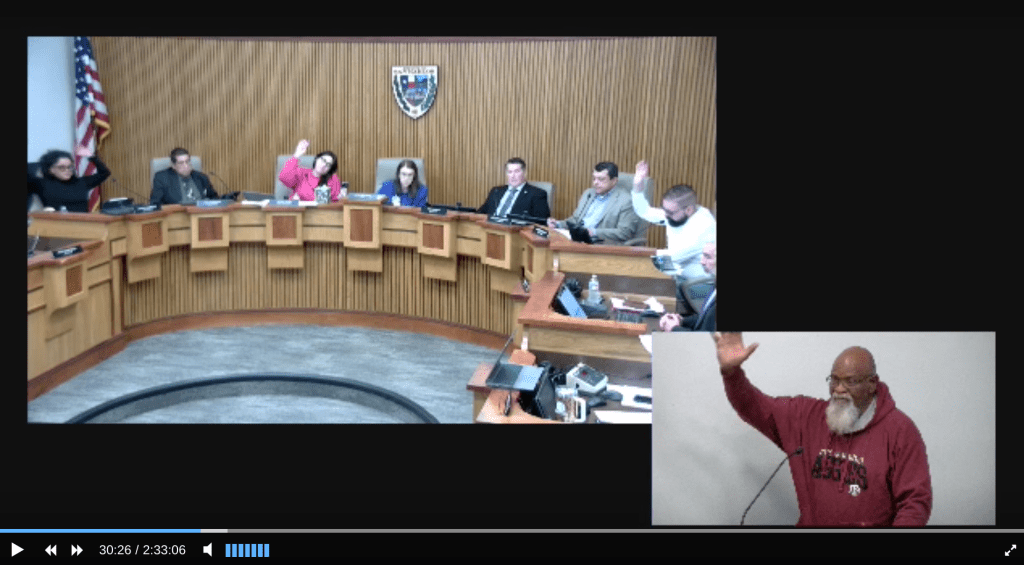
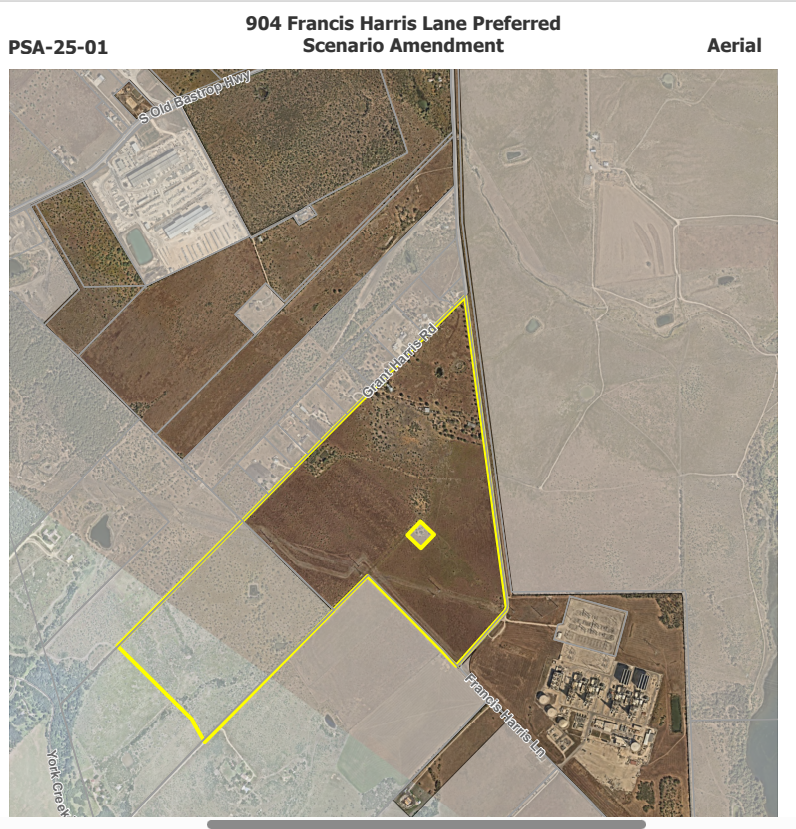
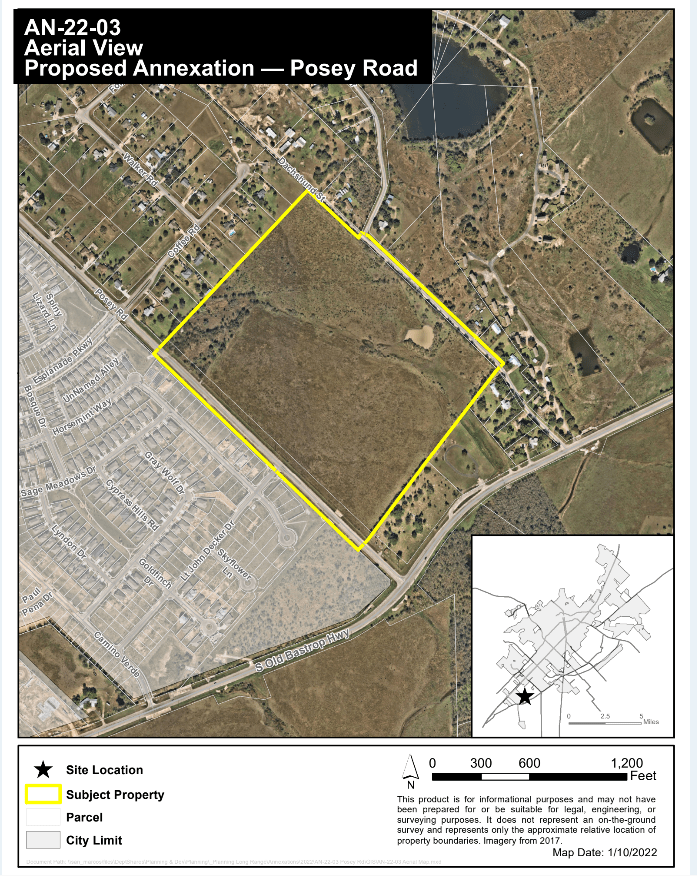
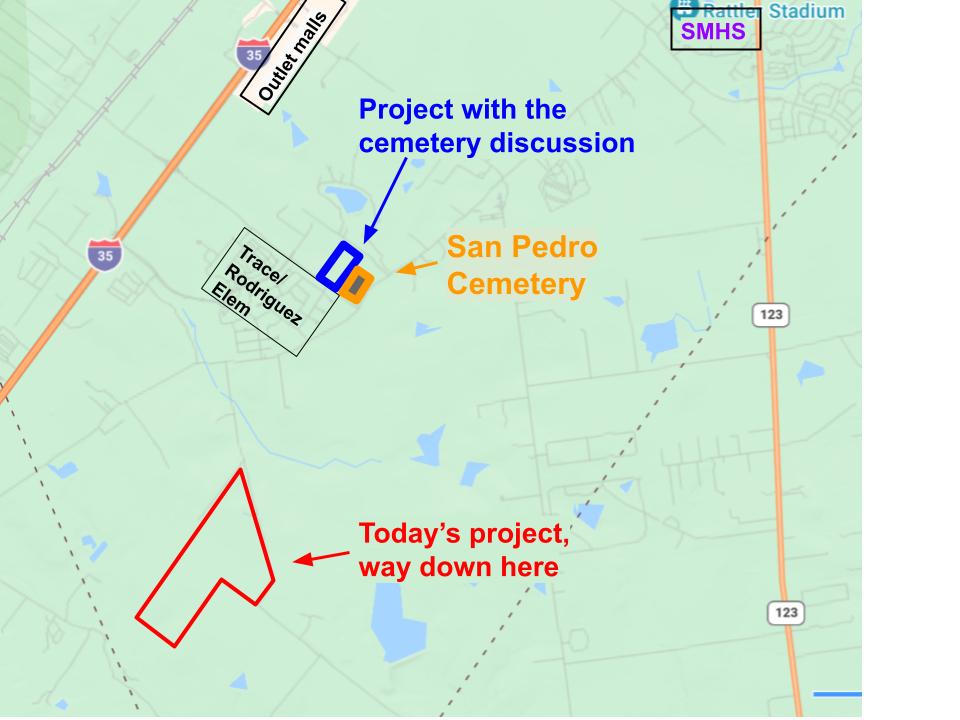
Hours 2:25 – 4:24, 1/7/25

Item 13: Demolition time. 

This is 734 Valley Street:

It’s tucked behind Dunbar Park.

It’s really impossible to see from the street, but it’s this blue L-shaped building:

At least, it used to be blue. This is what the building looked like in 2019:

I’m unclear on the following order of events:

  • Squatters moved in and were kinda trashing the place
  • The owners purchased it and began demolition without getting proper permits.

In some way, we end up with it looking like this now:

Definitely not blue anymore. Not much left.

How does demolition work in San Marcos?

In order to know what’s going on, you have to know a little about demolitions of historic buildings in San Marcos.

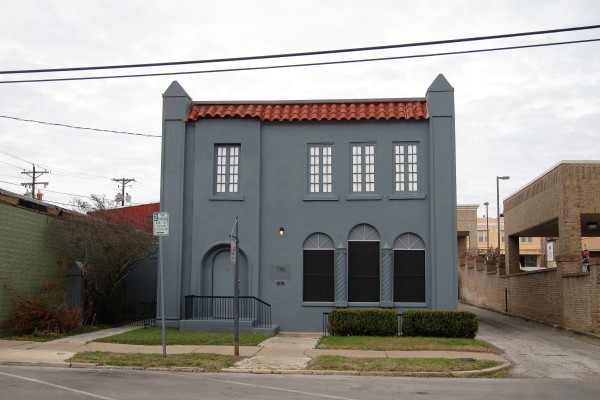
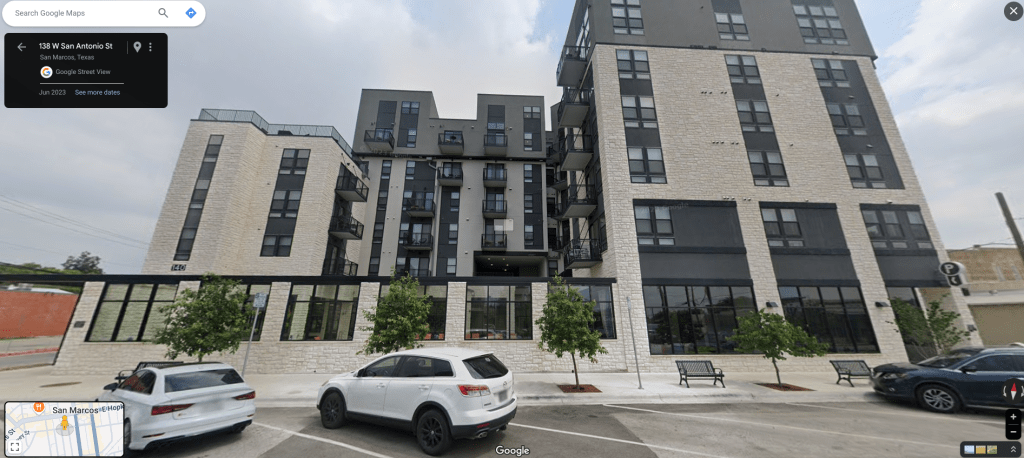
In 2019, the old telephone building was demolished:

to make way for The Parlor apartments.

People were told 3 days ahead of demolition, and they were upset. Protests, etc.

(I personally think the little telephone building was extremely cute, and felt sad over the whole thing.)

After that, the city put a demolition ordinance in place. The ordinance builds in delay and notification, but it doesn’t really prevent anything from being demolished:

  • For buildings with potential historical significance, there is now a 90 day demolition delay.  This gives people time to research the building and figure out if it can be moved, or saved somehow.
  • If someone is trying to save the building, the Historical Preservation Commission can delay for another 90 days.  But that’s it. After that, the owner can go through with the demolition.

“Saving the building” means making a deal with the owner. The owner can say no.

Basically, Texas state law means the city’s hands are mostly tied. There’s usually not much way to actually prevent a demolition. You can just stall a little bit.

So the owner applied for demolition, and the first 90 day clock started.

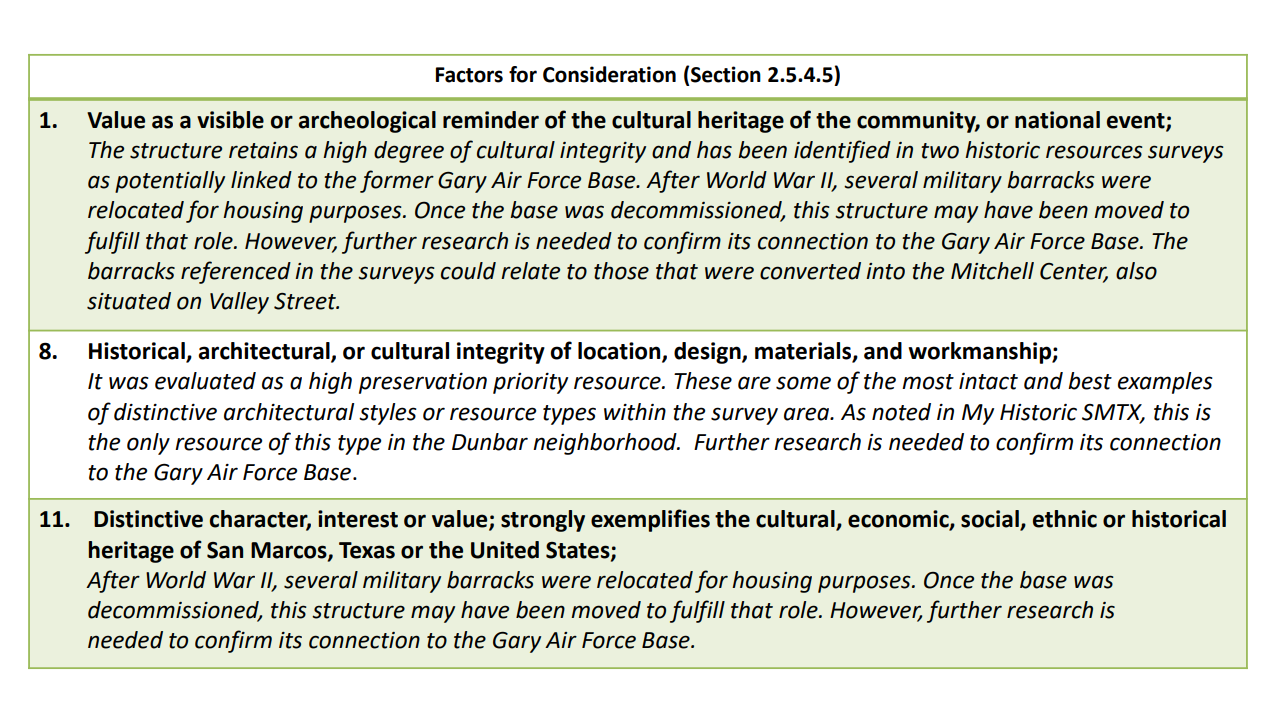
Here is the historical merit, as far as we know:

So this blue building was probably barracks from Gary Air Force base? It sounds like it was moved to Dunbar by the Armstead family to rent out as apartments.

It went to the Historical Preservation Commission, and HPC decided to extend the demo delay for another 90 days.

Which brings us up to speed!

The owners are appealing the demolition extension.  They’d like to tear it down now, instead of waiting until April.  They plan on building a small apartment building there, maybe 4 or 8 units. 

Matthew Mendoza had some useful points. First, he reached out to Ms. Armstead. Apparently her parents are the ones that brought the barracks over from Gary Air Force? He asked her about the historical significance of the building.

She very clearly told me she does not feel that this particular complex needs to be associated with that family. In the last six years that they were in possession of this, they were only able to rent out a third of the rooms there, because they were so dilapidated…She feels that that her mom and dad bought this property just for making money. She made that very clear. They didn’t purchase it for any historical significance. They bought this because they wanted to make some money off it, and that’s also why they sold it. They got so far into debt as far as being able to replace the flooring, be able to add sprinkler systems, to make it up to code, which is when they said “We can’t do this.” And again, we all know the Armstead family and how strongly respected they are in this city of San Marcos. And for them to say “hey we don’t want this property” and not wanted it associated with their name says a lot. She was insistent that there is no historical value at all to this building and no historical value at all to this property.

(lightly edited for clarity)

And then Matthew gets to the best part:

And I can tell you: I partied in that place for like ten years back in the early 2000s. I fell on my fat ass right through that floor. I’m sorry to say it, but I fell through that bathroom floor in that place, and now I’m not the smallest guy in the world, but I shouldn’t be falling through there.

Honestly, that’s the most endearing thing I’ve ever heard Matthew say. He even lowered his voice and half-whispered “fat ass”, and I melted a bit.

He went on for awhile more, but that’s the gist of it. At the end, he said, “I will sit here and say that I am a huge preserver of historical anything here in this city, but this unfortunately this is something the owners are telling me we don’t want it. And that’s the reason why I was on the fence until I spoke with her.”

Overall, I basically agree with Jane Hughson on this one:

As much as I like historical preservation, I’m going to vote to not extend and let these folks who are trying to do something with the property move ahead. If this were something with a more historic appearance and in a place that people could actually see and appreciate, but in this particular case, I’m not seeing that there’s an upside to 90 more days. There’s been 90, and you say there’s not been any activity, nobody has come in with the superman cape to save the day, so that’s why I’m going to support not extending the delay.

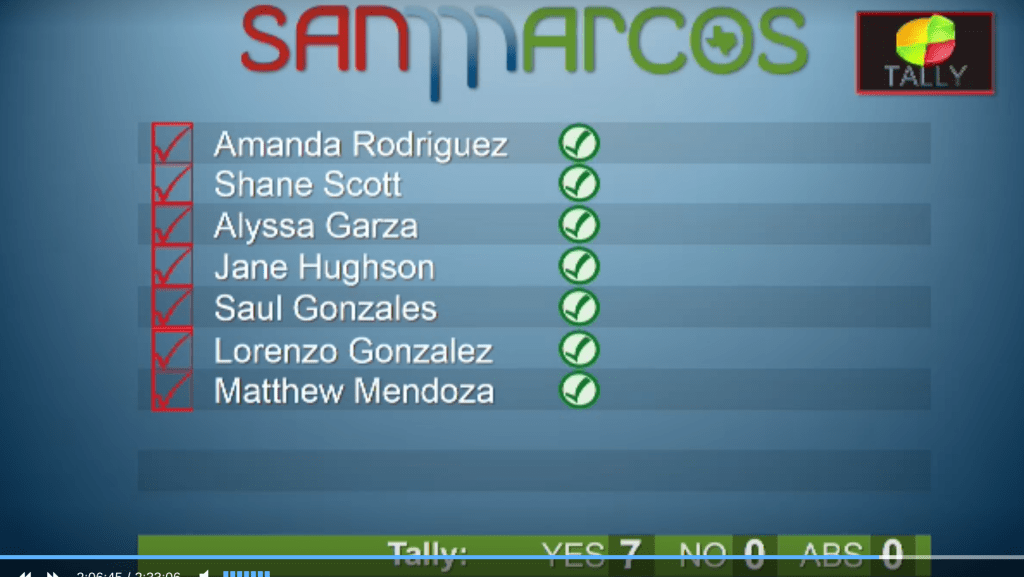
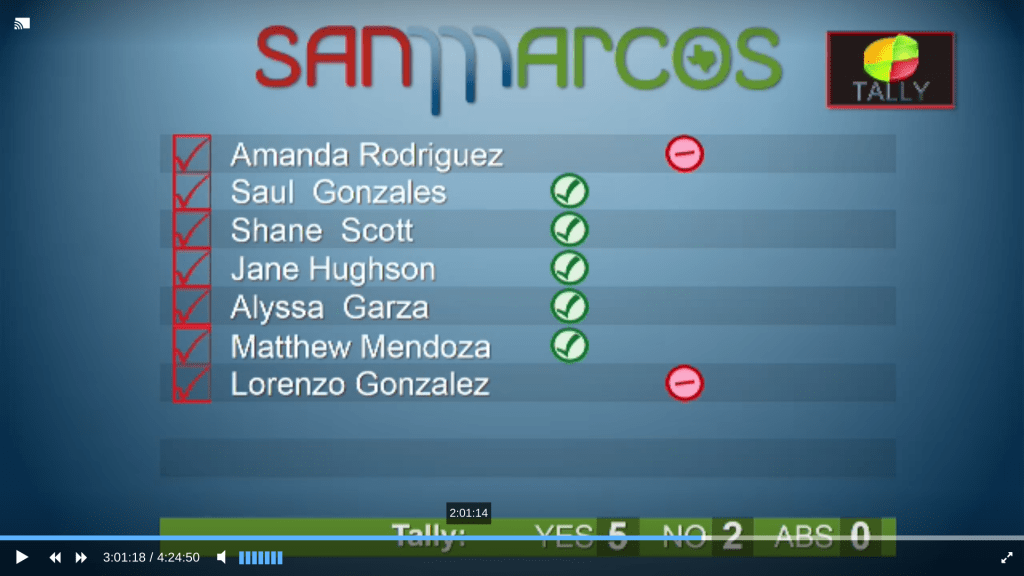
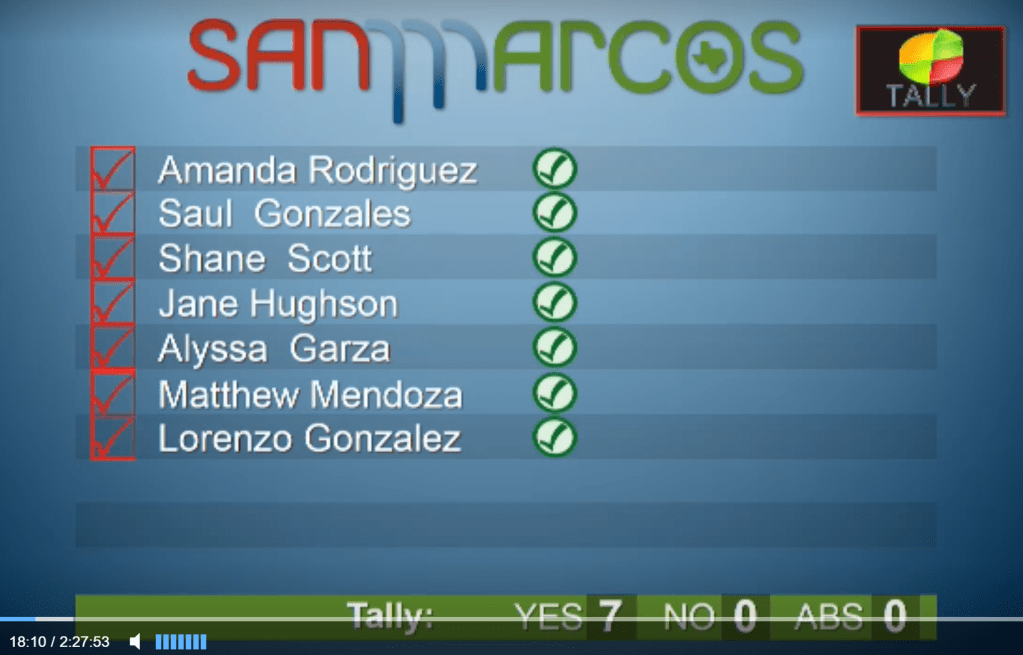
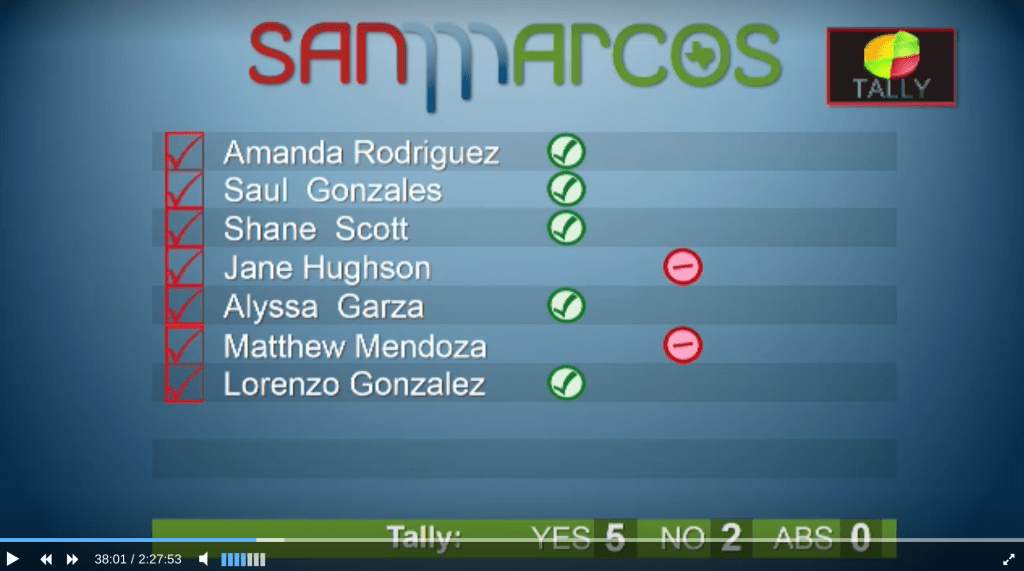
The vote:

The argument for voting no – Amanda and Lorenzo – is that it doesn’t hurt anything to wait three months and let the local community get their due process to save the building.

In this particular case, I’m with the pro-demolition folks.

Item 15: Charter Review Commission

Every four years, council appoints a committee to go over the City Charter with a fine tooth comb.  This is that magical night!

First off,  do any council members have any pet topics that they want the committee to discuss?

Note: none of these are guaranteed. Council is just asking the committee to discuss these items.

  1.  Jane: drop the minimum required number of council meetings from 22 per year to 20 per year. 

Sometimes it gets hairy trying to have meetings working during election week and New Year’s Day – this would build in some flexibility.

Everyone likes this.

  1. Shane Scott: You should have to be a resident for at least five years to be on council.

(Saul, Jane, and Matthew are all enthusiastic about this.)

Look, this is clearly about newbie Lorenzo Gonzalez. Seems a little rude to me!

But more importantly, it is super undemocratic. The whole point of an election is to let voters choose! If they don’t want a newbie, they don’t have to vote for that person. 

I do not like this one!

  1. Alyssa: We should have single member council districts.

This is a complicated topic.  How should voters elect councilmembers? Right now, every council seat is an at-large seat. Should we carve up the city into sections, and have each section vote for its own single representative?

There are arguments for and against this.

For:  

  • It takes fewer resources to run a campaign in a district than in the entire city.  This means that more people can afford to run for council.
  • Historically, at-large council districts have been used to block minority groups from having representation on city councils.  If a city is 30% black, for example, and if white people won’t vote for a black candidate, then a black candidate can never win a city-wide election.

    Historically, single-member districts have been the solution.  Lawsuits would be filed and judges would force towns to switch from at-large seats to single-member seats. (This is what happened to SMCISD in the 90s.) The idea is that you must draw minority-majority districts, and then within that district, minority groups form a majority and can elect a candidate of choice.

Against:

  • Single-member districts only somewhat solve the problem of underrepresented minority groups.  Drawing the boundaries becomes a politically contentious issue, with people weaponizing it to work in favor of specific groups.
  • At times, there can be issues that pit a district against the whole city. Amanda reports this happening at the state level:  representatives vote against a program that is good for the entire state, because their district doesn’t want to pay the taxes for other people to benefit. Right now, all councilmembers answer to all of San Marcos.
I’m pretty torn. I wrote a whole thing in favor of single-member districts in San Marcos, back in 2022. But I’m also sympathetic to the idea that single member districts can pit parts of the city against each other.

Council floats the idea of having a non-binding referendum on the ballot, so that they could find out what people think.

  1.  Amanda: Suppose council passes a shitty ordinance, and you’d like to petition to repeal it. Right now you have 30 days.  Let’s extend this to 60 or 90 days, so that people have a little more time to organize.

Sounds great!! Would this only apply to ordinances, or also things like Chapter 380 agreements? (I’m thinking of things like the SMART Terminal/Axis developer agreement.)

5. I think Saul brings up rolling back the drinking hours in San Marcos again.  It’s very hard to hear him.

Backstory: it used to be that bars closed at midnight in San Marcos. This means that all the kids got drunk here, and then at 11:30, drove up to Austin, and drank for two more hours on 6th Street. Then at 2 am, they all drove home.  This always seemed like a terrible policy for keeping kids alive!

It got changed in 2009.  Now bars can stay open until 2 am, and hopefully fewer kids are driving drunk on I-35.  Great! (I’m sure the local bars prefer it this way, too.)

I think Saul wants to change it back to midnight?  What a terrible idea!  Keep kids alive.  Don’t give them reasons to drive drunk.

This is not a charter item, so it will come back as a discussion item. Stay tuned.

6. Lorenzo: the language around petitions is inconsistent between initiatives and referendums.

Jane Hughson reminisces about the Great Fluoride Debacle of 2015, when the good citizens of San Marcos got a little muddled on the science, and voted to stop adding fluoride to the water. 

The citizen wrote the initiative in a way that made it impossible for the city to carry out. Something like “no fluoride in the water!” when there’s some level of fluoride that occurs naturally in all water. The city had to negotiate in court with the author to get better wording.  (They settled on “no added fluoride”.)

Basically it’s really difficult to write clear ordinances. This makes things tricky.

7. Amanda mentions reversing the fluoride charter amendment in passing, but no one stops and weighs in.

But guys: the ban on adding fluoride to the water is terrible. The science is really clear. We’ve got a lot of people in this town who can’t afford to see the dentist, and we could be helping save their teeth.

8. Shane: Mayor and council should move to 4 year terms, and council elections should be held in odd years, so that they’re not drowned out by presidential and governor elections.

This is about who your base is. Are your voters the old guard in town, who will reliably show up to vote when nothing else is on the ballot? These are the voters that have held the power in San Marcos since always.

Or are your voters less plugged in, because they are younger, or newer, or less well-connected, or generally low-information? These are the voters that generally don’t have power, and are less likely to show up to vote in odd years.

9. Amanda: Right now, P&Z terms are 3 years long. After two terms, you have to take a year off. Amanda proposes reducing P&Z to 2 year terms, and extending the length of the break before you can come back again. The goal is to increase turnover.

The rest of council does not buy into this. Part of the problem is that all the boards and commissions are on the same set of rules.

10. Matthew: zoom and attendance options for all boards and commissions

This gets ditched due to not being a charter issue. Also, Amanda and Alyssa are hard NOs, due to accessibility issues.

11. Amanda: Right now, P&Z gets the final vote on plats.  A plat is the paperwork where a developer carves up a neighborhood, and says where the streets will go and where the boundaries of the properties will go. Amanda wants people to be able to appeal the decision to Council.

We’re kinda stuck with the current system, for a few reasons:

  • State law mandates 30 day approval for plats. If you add in City Council as a second appeals procedure, you’re going to run out of time.
  • There’s not actually any decision or judgement when it comes to platting. Legally, you’re not allowed to deny a plat, if it checks all the boxes. It’s not like zoning, where you’re allowed to make a judgement call. This is more black and white. So it doesn’t matter very much.

So this did not get traction.

12. Revoke or suspend CUP may not be appealed: remove this.

Yes: Shane, Jane, Lorenzo,

[I wrote this down in my notes, and now I can’t find it in the meeting anymore. So I can’t remember who proposed it or any other details. whoops]

Final note: These are all just suggestions for the Charter Review Commission. Nothing is binding here.

Item 16:  Each councilmember picks their special person for the Charter Review Commission.

The picks: Michelle Burleson, Jim Garber, Rob Roark, Daniel Ayala, John Thomaides, Yancy Arevalo, Amy Meeks

I will just note that three of those – Michelle Burleson, Jim Garber, and Amy Meeks – are on P&Z. There’s nothing exactly wrong with that, but it’s most likely going to preserve the status quo.

Item 17: Boards and commissions

Now that Jude Prather and Mark Gleason are off council, there are a bunch of vacancies to fill. I’m not going to go through this, because it’s tedious and you can find most of the subcomittee memberships here.

I mostly just want to include this bit:

Jane: I’m going to volunteer to be on the Alcohol Committee. The reason being that I’ve got more experience with this than probably all y’all put together. I was on one once before, and I think I can provide a lot of benefit to this committee.

Shane: Plus you’re a solid drinker.

The room erupted into giggles. Jane didn’t sweat it, and just said mildly quipped “Yeah. That’s the important part.”

I mostly include it because it made me laugh. The vibe of this new council is much lighter and jokier than the last one. I’m here for it.

Hours 0:00 – 1:56, 12/17/24

Citizen Comment

These were very interesting! 

Topic 1: Two speakers (Noah Brock and Annie Donovan) unpack part of Item #16 for us. 

Item #16 is about the Texas State Legislature. San Marcos lobbies the state government on various municipal issues. So we have a list of guiding principles.  

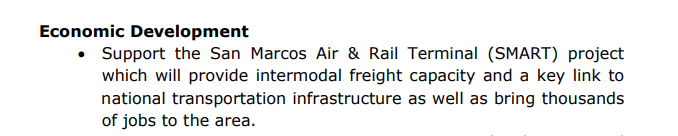
Here’s one of those items on the list:

I’m going to start with quoting Noah, because this is gold. First he reads that bullet point above. Then he says:

“This is a very specific location that’s called out in this guiding document.  The wording sounded familiar.  So I looked up what the last principles document said, in November 2022:

link

“They just replaced the words “SMART Terminal” with the location. So I went a little bit further, back to 2020. The document said the following:

link

“Then I went even further, to 2018, where I found the origin statement:

link

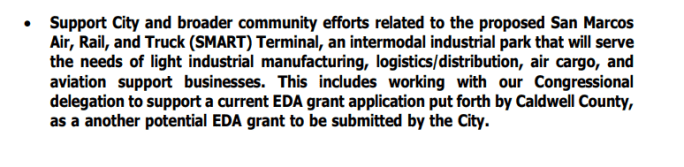
“Is it the city’s goal to develop an intermodal freight facility at this location? It appears that the original idea was to support light industrial manufacturing with a connection to the airport. Now we have a heavy industrial park that can stack containers 80 ft high, with no connection to the airport. 

Why does the wording keep changing to fit a developer’s current project? Isn’t a guiding principle supposed to come from the city, and not a developer?  

Do you remember when the city council voted unanimously to approach the developer of this project and change the development agreement, because the people did not support it, on May 2, 2023?   I would like to see a motion to remove this item from the document in its entirety. Thank you.”

So yes! In our packet of “what’s best for the city” we have a line item which is carved out specifically to be “what’s best for SMART/Axis Logistics”.  Verrrrrrry interesting. Stay tuned.

Topic 2: HSAB is the Human Services Advisory Board. The city allocates $550K in grants to nonprofits, and the HSAB awards the amounts.  There are a few comments here:
– The chair of the HSAB pleading that this amount of money is nowhere close to the need in the community
– A speaker on behalf of the Salvation Army, about how they weren’t funded as they’ve been in the past.

This will be unpacked in Item 15.

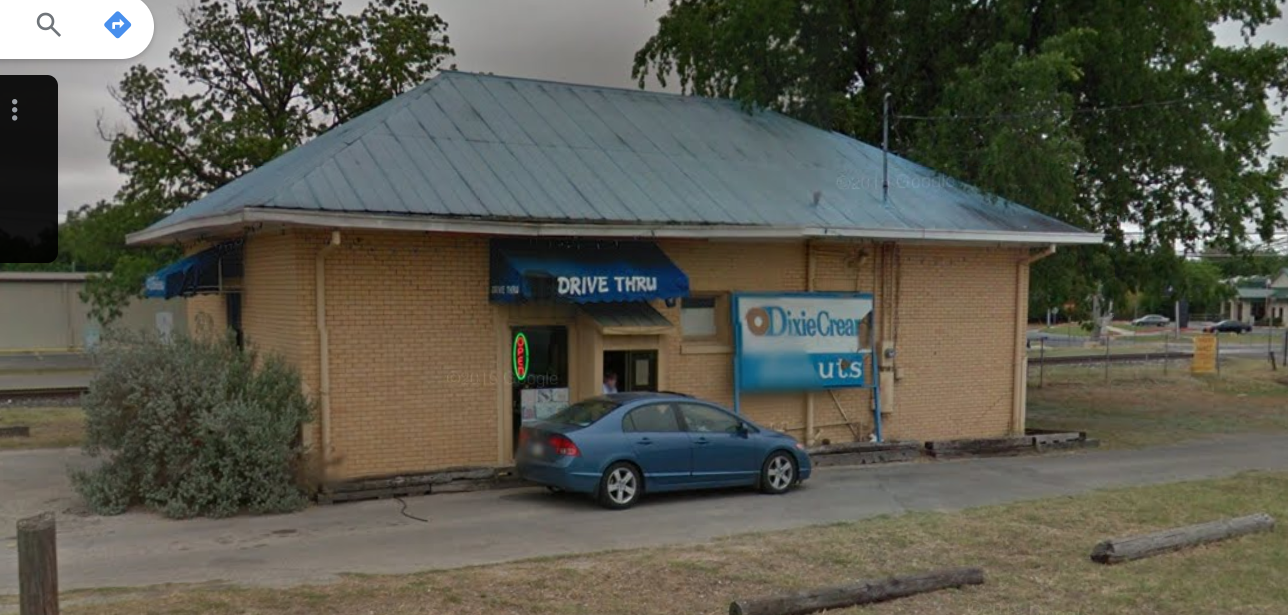
Topic 3: This place:

It’s on LBJ, at the train tracks, across from Toma Taco.

The city leases the property to Ruben Becerra, the Hays County Judge (which is not a “judge” so much as being like the mayor of Hays County.)  This speaker is super angry about this! 

We’ll get to the backstory on this property – Item 10 – but I still have questions.

Item 5:  Return of Evoke Wellness, for the final $50K of Covid Money.

This last bit of Covid money is going to the mental health program partnership between SMPD and Evoke Wellness, for people needing substance abuse treatment. (The county also works with Evoke Wellness.  This is part of a larger, semi-coordinated program to keep people with mental health crises and/or substance abuse out of jail.) We discussed this last time, too.

Amanda: How does this program work? Walk me through it. 

She basically wants to know all three parts:
1. how do people in crisis end up at Evoke Wellness?
2. What happens when you’re there?
3. What happens after discharge?

Part 1: how do people in crisis end up at Evoke Wellness?

First, SMPD responds to a call for someone in crisis. First, if they need medical help, SMPD will take them to the hospital. (Probably Christa Rosa).

If the person is stabilized but having a mental health crisis, SMPD tries to try to find out if the person has insurance or not. If so, then we try to find a facility that accepts their insurance. They’ll take the person to the treatment facility.  It might not be in San Marcos – could be Austin or San Antonio.

If they have no insurance or financial means, then once they’re stabilized, we give a mental health evaluation, and figure out what they need. Then we take the person to Evoke Wellness (for substance abuse) or Hill Country Mental Health.

Part 2: They’re at Evoke Wellness

No one from Evoke Wellness was on the line at the meeting, to talk about the services they offer there.  Amanda asked if we could have a workshop from them to hear about what their services are.  Everyone is on board with this.

Part 3: Discharge after Evoke Wellness

When they get to the treatment center, they start meeting with a case manager. They’re working on a discharge plan from day 1.

There are a few options for after they’re discharged:

  • Reconnect with safe support system, if that exists. Either the center, family, or mental health officer will give them a ride there.
  • Longterm treatment: may discharge to Sober Living, they may go to partial in-patient, several different places to go.

Amanda asks: What if someone has zero support services and zero resources? 

Answer: Then the case manager has to get to work.  Find shelters available. For example, Hill Country has an in-patient crisis stabilization unit in Kerrville. They’re in-house and have a big list of resources.  We make sure there’s a bed available at a destination shelter. The case manager is going to put together a plan to try to make sure the person does not end up homeless.

How many people are we helping?

Total, San Marcos is putting $150K towards Evoke Wellness, and Evoke Wellness is also providing 5 scholarships this year.

Chief Standridge says that costs vary wildly, depending if the person needs in-patient or out-patient treatment. But on average, $17K/person is a reasonable estimate.

So we can ballpark this: $150K plus the 5 scholarships helps about 10-15 people per year.

Alyssa asks: What kind of metrics do we have to assess how this is working?

Answer: We’ve got tons of internal statistics, but we’re not yet coordinating well on the county level, in order to get stats on the full scope of the issue. This is one of our big goals, though.

….

Just a quick soapbox: It is a moral obligation to help the most vulnerable people in society.  It does not matter if they made bad choices. Someone living on the streets with mental illness and/or substance abuse problems is being failed by society. And big problems cost a lot. 

But big problems can also be prevented! If we invested more heavily in prevention – early childhood support, family support, increase the living wage, increase housing, effective addiction prevention programs – it would be cheaper than working to solve big problems once they take root, on an individual basis. (And that’s not even counting the value added to people’s lives, for not being derailed by catastrophe.)

Can San Marcos afford to do all this properly on our own? Of course not.  But the state could! Texas had a $33 billion dollar surplus in 2023, and we’re projected to have a $20 billion surplus this coming year.  

Will Texas spend it on making a fair and just society??? (no.) Stay tuned!

Item 10:  We’re back to this cutie little place:

I think right now it’s called Las Dos Fridas.

Before that, it was Katz’s On the Go Cafe:

Before that, it was Santi’s Tacos:

And before that, Dixie Cream Donuts:

Ok.  Back in 2013, Union Pacific railroad offered to sell San Marcos four properties:

We agreed. (We hoped this property might someday be a good train station on the Lonestar Light Rail connecting San Antonio to Austin.  That’s what I dream about at night, at least.)

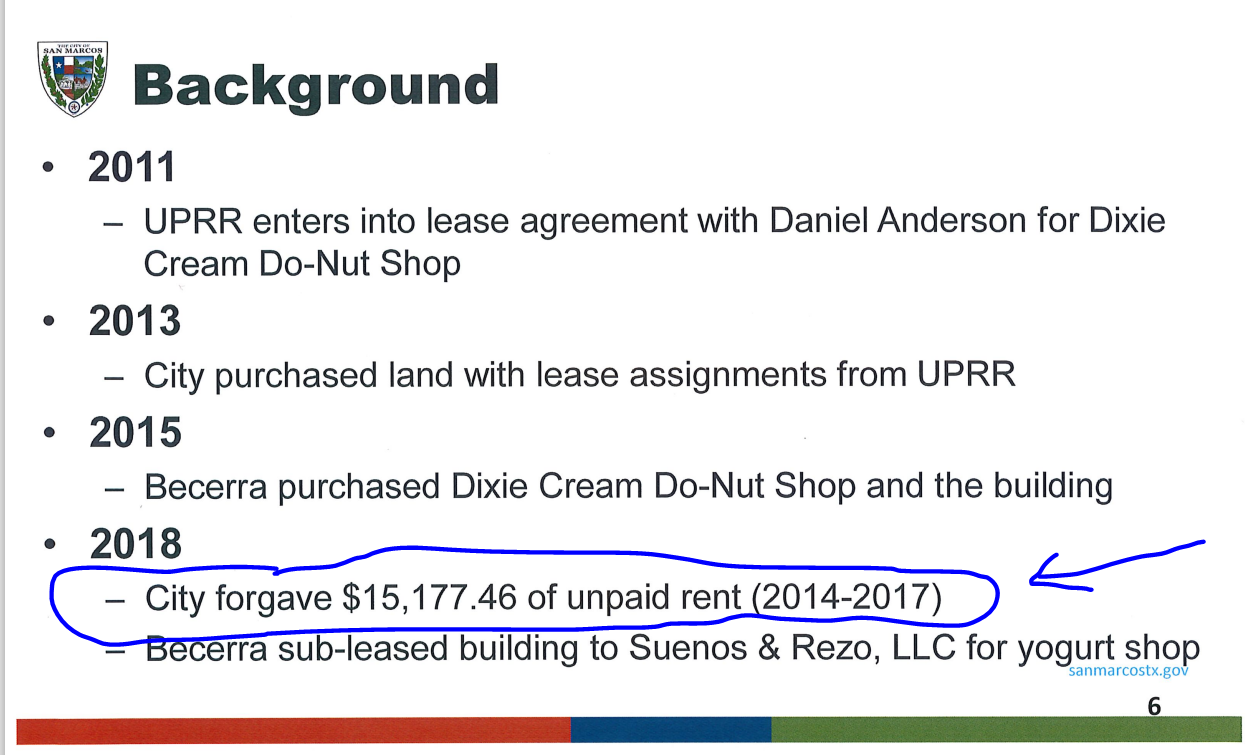
Now, Union Pacific sold the land to San Marcos in 2013, but not the physical little building.  The building was owned by Dixie Cream Donuts.  

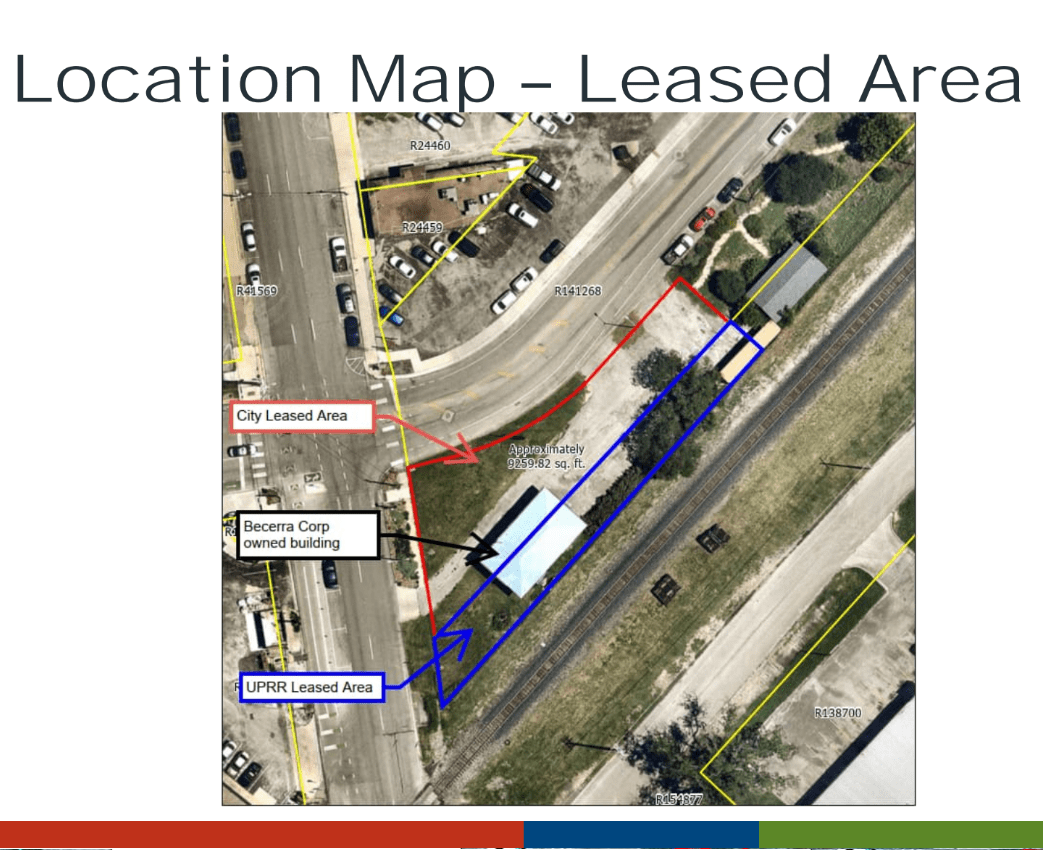
Furthermore, look at that red border – the border runs right through the building!  So weird. They carved the Dixie Cream Donuts building, half on Union Pacific land, and half on San Marcos land.   (We even asked them about it at the time: “why not run the border around the building? It can be all UP, or all SM. We don’t care.”  

Union Pacific said, “nope.  We do this all the time.”  Okay then!)

At some point, Dixie Cream Donuts sold the building to Ruben Becerra.  So Becerra now owns the building, and leases the land underneath it from both Union Pacific and San Marcos.  He then sublets it to Las Dos Fridas.
No one is very excited about extending this lease to Becerra. This would just be a mini-extension, to match the sublease to Las Dos Fridas. It would expire in January 2026.

Council decides this is very thorny, what with Becerra being the Hays County Judge and all.  Council says cryptic things like, “I need to be able to give an answer when my constituents ask me what on earth is going on.” 

They decide to postpone until January. 

What happens if we don’t renew this lease? It’s not clear! Becerra still owns the building, he could in theory move it, although it’s probably not structurally sound.

The vote:

Yes, postpone until January: Everyone except Matthew Mendoza.

No! Let’s settle this now! Matthew.

I have no idea why Matthew wanted to settle it now. I don’t even know which way he wants it to go!

Item 14: New flood maps.

Ok, FEMA has been working on our flood maps since the 2015 floods. The old flood maps were based on 1990 data, so this is very much needed. The new maps are called Atlas 14.

Here’s how much city land is now in a flood plain:

So about 800 new acres of San Marcos are now in the floodplain. We don’t know how many homes and businesses that is, though.

So if you’re now in the floodplain, what changes? There are two main things:

  1. Building codes: the city has stricter ordinances if you’re building in a flood plain.

Old buildings don’t have to be retrofitted, but any new buildings or additions have to meet flood plain standards. (Like being raised off the ground.)

This isn’t actually a new change – the city has been using the Atlas-14 data since 2017 in our ordinances.

2. Flood insurance rates for home owners.

This is part of a much bigger, larger problem. “Flooding is the most frequent severe weather threat and the costliest natural disaster facing the nation.” Even when insurance providers pull out of high risk places like Florida and California, everyone can get insurance because there’s a federal program called the National Flood Insurance Program.

The problem is that floods are really, really expensive. So flood insurance rates for people in a flood plain are very expensive. Many people can’t afford it, and go without. This causes two more problems:

  • Rates go up even more for everyone else
  • NFIP still doesn’t have enough money to give out in case of flooding.

It’s a giant mess. It’s even worse when you think of the historical context in a place like San Marcos: wealthy people built their homes uphill, and left the downhill places for poorer neighborhoods. So it’s the people in Blanco Gardens and Victor Gardens and Dunbar that live in floodplains and have to debate flood insurance, not the University or the Historic District.

So how much are rates going up?

Amanda Rodriguez cites a study from Rice University about flood rates rising.  (I think it’s this one.)

So rates in Hays County are projected to go up 137% increase. (Legally, the increase is capped at 18% per year. So over the next 5-10 years, your premiums would step up to cover the increased risk.)

Mark Gleason weighs in.  He has a lot of lived experience with floods, particularly because he got hit hard in Blanco Gardens in 2015.  

His main points:

  1. The National Flood Insurance Program is broken.
    • San Marcos is a member. This gets us a 15% discount, but subjects us to FEMA rules about rebuilding.
    • Premiums are unaffordable so people go without. Then disaster hits and they can’t afford to rebuild, and sell at low prices, and fancier housing gets built. (Yes.)
  2. If you’re in the floodplain now, you don’t have to retrofit your current home or business. But anything new, or an addition, has to conform to floodplain development standards
  3. If you own your home outright, you’re not required to purchase flood insurance. 
  4. But everybody SHOULD get flood insurance. It’s very cheap if you’re not in the flood zone

Mark’s solution: Feds need to come in and fix the Blanco River. It needs some sort of flood control. It’s cheaper to fix the Blanco than it is to raise homes. 

Jane: What about the San Marcos river and Purgatory Creek? Historically, those flood, too. It’s not just the Blanco.

Basically, no one could possibly have any good answers. Mark certainly doesn’t know what it might take to fix the Blanco. None of us know what it would take to fix the flooding. None of us know the extent to which climate change will make things worse. We are all just kind of holding our breath and hoping.

Hours 1:56 – 3:47, 12/17/24

Item 15: The Human Services Advisory Board (HSAB)

Every year, we give money to nonprofits. The HSAB sorts through the applications and gives out money.

This year, they are giving out $550K.

HSAB has a tumultuous past.  In addition, they used to have a bunch of Covid money to give away in 2022 and 2023, and now they don’t.   So this is a tough spot to be in.

This year, they got 37 applications for a total of $1.1 million dollars requested. So that’s also a tough spot to be in!

The HSAB Process

First, some useful guiding principles:

The whole decision process takes months. 

Here’s how they evaluate the applications:

(“Council priorities” always drives me fucking nuts.  It’s all about Council ego, and not what’s best for those in need.)

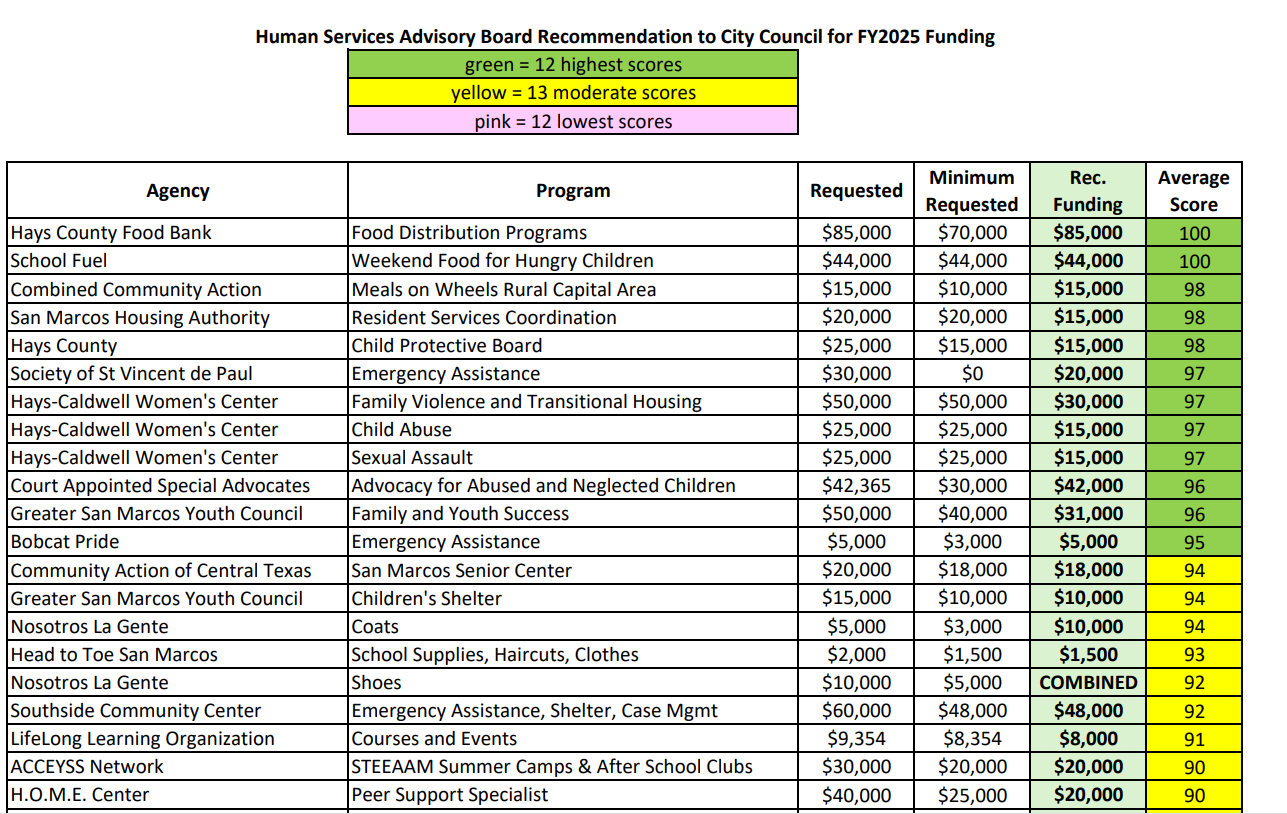
Here’s how HSAB ranked the applications:

(I know that’s tiny, but I think you can click on it and make it bigger.) Green is highest score, yellow is medium, pink is lowest.

Then the board discusses each application individually.  They consider:

  1. Rankings
  2. Amount of money requested
  3. Need in San Marcos

At the end of all that, here’s what the board recommends:

They talk a little bit about why they chose not to fund the agencies at the bottom. Some of them are hard to measure, and they wanted programs that can measure results. Some of them were not aligned with which needs the board wanted to focus on this year. Some are not local.

Summary by category:

What does Council have to say?

OH LORD, YOU GUYS, THIS WILL GET INTERESTING.

Matthew Mendoza kicks things off. He wants to remove $10K from ACCEYSS, and give it to the Salvation Army. 

What is ACCEYSS?

Ok, summer camps and after school programming in Dunbar. They were awarded $20,000 to do this.

Here’s what the Salvation Army wants to do:

They were awarded no money.

Jane asks why? The answer is that one of Council’s priorities is to support locally grown organizations. Since Salvation Army isn’t local, they lost points for that. [Jane deeply sighed, “Ok.”]

Jane explains this away: this is a local chapter of the Salvation Army. They are extremely local.

Note: Roland Saucedo – the council candidate that Jane campaigned for and supports – shows up to speak on behalf of the Salvation Army. That’s how local they are!

Council talks to the Salvation Army representative for a long time, about the Salvation Army budget, and whether or not we could partner with the Salvation Army on utility assistance, which is also an ongoing conversation. Maybe we could direct some utility assistance money over to them?

The vote:

Move $10K from ACCEYSS to Salvation Army: everyone

Keep things as they are: No one

So that money is shifted over.

Next, Jane brings up the HOME Center.

HOME Center is these guys. They do individual case management with homeless people to get them into stable, longterm housing. It is exceedingly difficult work and they do an outstanding job.

I frankly don’t know how to sugarcoat this: the city has a history of being vindictive and retaliatory towards HOME Center. This is because historically, the city has not always been on the up-and-up regarding the homeless community, and HOME Center advocates on behalf of the homeless people who have gotten the raw end of things.

Jane proposes moving $15K from HOME Center, and giving $10K to Salvation Army, $5K to Nosotros La Gente. This would bring the Salvation Army up to $20K, and put HOME Center down to $5k. (Actually, her first proposal is to bring HOME down to zero. Matthew gently chides her to leave HOME Center with $5K.)

Keep in mind that Jane openly endorsed and campaigned for Roland Saucedo, who is loosely affiliated with the Salvation Army. He was present at Tuesday’s meeting and advocated for the Salvation Army.

I like to stick to cut-and-dried facts, but you absolutely have to know that this is a very tense topic. Jane is not a neutral party here, and her proposal feels like a shot across the bow.

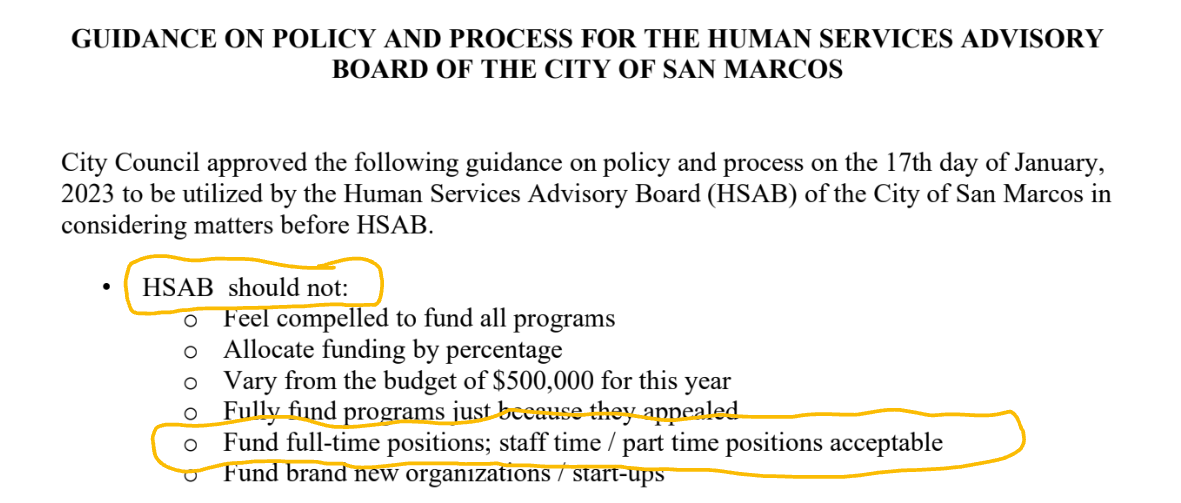
Jane’s stated reason is that HOME Center is requesting money for a case manager salary. She says, “We don’t want to fund salaries, because we don’t want someone to be laid off if we don’t fund them.”

The staff member says, “In the application, we said Board can allocate up to 20% of a fulltime position or fully fund a part-time app.”

Jane argues this point, but she is wrong here. Here is the policy from January 2023:

And in the actual discussion, they settled on 20% of a fulltime position is okay, and funding a parttime position is okay.

So first, Jane is technically wrong. But more important, she’s morally wrong. The staff, Alyssa, and Amanda all point out to her that many of these applications asked for staff funding, and yet she’s singling out HOME Center to slash.

Jane: We have given a LOT of money to Southside. They are hiring.  So that’s an issue that I have with HOME Center in particular.  

She is referring to the $800k of Covid money that the city recently gave Southside Community Center, to implement our Homeless Action Plan. She is somehow making the case that Southside’s funding works against HOME Center?

Alyssa comes in hard: Absolutely not.  We gave Southside an obscene amount of money. Initially, there were community concerns and Council concerns about Southside’s capacity. We had grace and did a trust fall.   We need to extend that to HOME Center.  They do boots on the ground hard work. The service and case management they do is unmatched.

She continues: “I know this is not your intention, Mayor, but I need to name this.  Within different groups that do homeless outreach, there is a perception that HOME Center continues to face retaliation because they use their platform to bring to light some historic concerns and trends regarding homeless outreach in general in our community.  And so I  know that’s not your intention, but the community had a very thorough process with feedback and open meetings. It is not a good look, without any process or notification, to be making these moves.”

There’s some continued hectoring from Mark and Jane – they could have asked for money for different costs! They could have shown up to this meeting and defended themselves!

Amanda is furious: “This is not the only organization that asked for staff funding! So many of these organizations are funding staff! I’ll be honest: I’m losing my patience, because as someone who has volunteered with HOME center, as someone who has spoken to the clients that receive what they do: our community benefits in ways that we will never understand…. The reasons you’re giving are not strong enough for me, and this just feels wrong.”

Jane, sweetly, “Then you can vote against it!” 

Amanda, coldly: “I will.”

Jane: “I just wish they’d asked for money for something else!”

Alyssa, “Well, I wish you weren’t nitpicking, but sometimes we don’t get our wishes granted. We need to meet the moment where it’s at.”

(I’m abbreviating all this hugely. Feel free to listen yourself. HSAB item starts at 2:00, and Council discussion starts at 2:19ish.)

Eventually Alyssa makes a motion to postpone. She says, “We need space for community feedback.  We’re overstepping and moving things around without rhyme or reason.  We need to let our neighbors know.” 

The vote to postpone:

Yes: Alyssa, Amanda, Shane, Saul
No: Mark, Jane, Matthew

So the postponement squeaks through. This will come back around in January.

Let’s zoom out for a moment on the HSAB funding:

The committee spends months on these applications. All of the agencies provide metrics and ample documentation of how they spent previous money – literally over 2000 pages of applications in the Council packet this week. Council argues passionately about whether $5000 is better spent on kids in Dunbar, or emergency funding from the Salvation Army.

Here is a list of things that received zero discussion on Tuesday:

  • $45,000.00 to McKimm & Creed, for Leak Detection Services
  • $241,036.36 to Cunningham Recreation, for various playground and outdoor fitness equipment
  • $573,458.79 to Nueces Power Equipment, for the purchase of a Wirtgen Asphalt Milling Machine
  • $2 million (annually) for McCoy Tree Surgery Company, for tree trimming
  • $6 million for Techline, Inc, for materials and supplies for San Marcos Electric Utility
  • $8.6 million for the Lower Colorado River Authority, for various goods and services concerning electrical transmission, control and substation facilities
  • $765 reimbursement to Tantra

Was Jane Hughson worried about us paying someone’s whole salary at McKimm & Creed? Was she worried that the company might become too dependent on us?

Did a committee meet for months, and have a scoring system? Why do we scrutinize $20,000 to HOME Center, and not $6 million to Techline, Inc?

We also give homestead exemptions of $15,000 to all homeowners, and $35,000 to seniors and people with disabilities. We have an estimated 10,295 owner-occupied homes in San Marcos. The tax rate is 60.3 cents per $100. So ballpark, we’re giving homeowners $904,500 yearly in homestead exemptions.

Why don’t we include this $900K in an application to HSAB? We could call it “Subsidies to Home-owners Program” and see if it scores higher than ACCEYSS on the evaluation criteria. We don’t think of this as charity, but we should. And we don’t even make the home owners provide metrics, measurable outcomes, nor turn in performance reports for how they spend their extra charity dollars each year. Isn’t that nice?

(And finally, I will never get sick of reminding you that we’re giving $1.2 million yearly to Kissing Tree. No metrics, no scrutiny, no gnashing of teeth. Just a nice, gated community that’s not for you.)

Item 16: Guiding Principles to lobby the Texas Legislature.

The Texas legislature only meets once every two years, for 140 days. This is to minimize the damage that they can do. 

Or as Molly Ivins put it, “The Texas Legislature consists of 181 people who meet for 140 days every two years. This catastrophe has now occurred 63 times.”

Or, as the old joke goes: “The Texas legislature meets every two years for 140 days. Many citizens believe that the law was incorrectly transcribed and that the legislature was meant to meet for two days every 140 years.”

Anyway! San Marcos lobbies the state legislature on behalf of our interests. So we have a Guiding Principles document, to determine what we’ll lobby.

Amanda comes in with a ton of amendments.  Keep in mind that she’s worked with the state legislature for the past few years. It quickly becomes clear how much expertise she’s bringing to the table.

The first batch is all under the mental health section. Here’s the original:

Amanda #1: Suggested add: Support legislative action to establish a school mental health allotment fund. 

Why? The Legislature passed a School Safety Bill last time, but it doesn’t fund mental health. So this asks the state to create line item funding to address mental health funding. 

Everyone loves this. The vote:  7-0

Amanda #2:  Support legislative action to increase in funding for Local Mental Health Authorities (LMHAs) to provide early intervention services to prevent crises.

The vote: 7-0

Matthew Mendoza is so happy. He says, “Yes, because it will go to SMPD!!” when he casts his vote.

Amanda #3:  Support legislative action to expand access to maternal mental health support throughout pregnancy and the post-partum period. 

The vote:  7-0

Amanda’s on a roll! Everyone loves these!

Amanda #4:  Support legislative action that expands eligibility for Medicaid.

Texas turns down $5 billion in federal money every year for Medicaid. About 19% of Texans are uninsured, which is far and beyond the worst in the country. This is because we never expanded Medicaid under the Affordable Care Act.

Mark has finally had enough of this nonsense! “I’m going to be a no on this. Those are conversations for the state and federal government to have.”

He has a deep moral conviction about staying neutral on healthcare coverage. Should uninsured diabetics die for lack of insulin? Mark refuses to have an opinion, and you can’t make him!

The vote:

Yes, the state should accept Medicaid funding: Everyone but Mark
No, this is none of my business: Mark

Amanda #5: Support legislative action to increase funding for permanent supportive housing programs.  (Housing First programs.)

There is a fake-debate among homelessness experts. Should you provide housing and then treat the mental illness and/or substance abuse? This is Housing First. Or, should you withhold permanent housing until the person gets their issues solved? This is Treatment First.

I’ll give you a hint: in Trump’s first term, his housing guy was a strong Treatment First guy. (And then we hired him as a consultant.)

Mark: I’m a no. Housing First isn’t always the best! 

Mark is wrong. (If that link gets scrubbed under Trump, then we can use this one.) Housing First works better, and it’s more humane. It’s better all around.

The vote:

We support Housing First: Amanda, Alyssa, Jane, Shane, Saul

We don’t: Mark, Matthew

Amanda #6: There is no section on Housing in our Guiding Principles.  We should have a Housing section.

In the Housing Section, Amanda recommends:

  • That we support legislative action that prevents unnecessary evictions
  • To promote housing stability and protecting tenants from undue hardships

The vote: 7-0

Mark is deeply suspicious, though.

Amanda #7: Support legislative action that seals a tenants eviction records in the event that a court rules in their favor

Mark and Matthew are both gobsmacked that this is not already the case. A tenant can win in court, but landlords can still use their eviction against them? Yes, currently.

The vote: 7-0

Mark is so suspicious! He literally says, “How is this not already the case?! WHATEVER. Yes.”

Amanda #8:  Support budgetary measures to increase state funding for low income housing in Texas, especially for the most cost-burdened households that are at or below 50% of the AMI. 

The vote: 7-0.

Amanda #9: Remove the whole carve-out for SMART/Axis. 

This brings us back around to the Citizen Comment, four hours ago! (Backstory on the SMART/Axis development here.)

Mark: Hard no. We have to increase and diversify our tax base! People don’t realize what that development could mean to this community! All the jobs! This is PRIME for development! I-10, Toll road, railroad, and airport!  JOBS! JOBS! Major mistake! In 50 years, this will be the most important bullet point in this whole document!

Matthew: We just postponed due to second-guessing HSAB board and here we are, second-guessing this board!  There aren’t smokestacks. This is environmental protection! Do you really want SMART/Axis to go to Caldwell county?  Plus Gary Job Corp is right there.

(This is the weakest argument I’ve ever heard.)

Amanda: I’m not opposed to diversifying and growing our tax base. This is a very specific major development that arose through shady means. The entire city is not behind this development. Nowhere else in this document are we so specific.

Mark: Because it’s 3000 acres! Nowhere else in the COUNTRY has this opportunity! DC wants to hear how we’re diversifying. This is amazeballs! 

The vote:

Remove the carve-out for SMART/Axis:  Alyssa, Amanda
Keep it:  Jane, Shane, Mark, Matthew, and Saul

So that stays.

That’s all of the amendments!

After this, we have a series of little items:

  • the $2 million on tree-trimming
  • the $6 million to the LCRA
  • we officially the money back to Tantra
  • an appointment to the Animal Shelter Advisory Committee

But Council zips through these, and so will I.

Hours 0:00 – 2:39, 12/3/24

Citizen comment

Comments are a hodge-podge this week:

  • Salvation Army was denied some grant funding, they’d like it restored.
  • Demolition notices on Valley Street
  • Rio Vista incident with SMPD that we heard about last time
  • One person in favor of the Purgatory Creek rezoning, and one person opposed.
  • Ok, this last one is fun. This guy wants to build a Glidescape in town, which is a solar powered roller rink, with vertical farms that grow fresh food, immersive STEM workshops, virtual reality tournaments, and planetarium, which can transform into a disaster-resistant facility when the community needs a shelter. He wants a Chapter 380 agreement and maybe some tax breaks to bring this vision to San Marcos.

I honestly assumed the speaker was maybe someone on a manic phase. But he seems to be an active person with a lot going on on this website and also this one? I still am not sure if San Marcos can support a planetarium-vertical-farm-roller rink, but we can’t know for sure until we try.

Item 1: San Marcos got a bunch of federal money after the 2015 floods, to help with recovery.

As of December 2024, the grants are all done. We’re officially done with flood recovery funds, and hopefully the community feels restored.

Items 2-3: Fiscal reports for April-May-June 2024 and July-August-September 2024.

We had ample warning that sales tax was coming in low, and we adjusted and pulled things back.

This is April-June:

The striped green and blue is what we thought we’d have. But then the solid green and blue are what we ended up having. But the solid blue is still less than the solid green, so our budget stayed balanced.

Then July-September looks even more back to normal:

Our sales tax was down because one specific business had their revenue way down. That’s supposed to go back to normal next year.

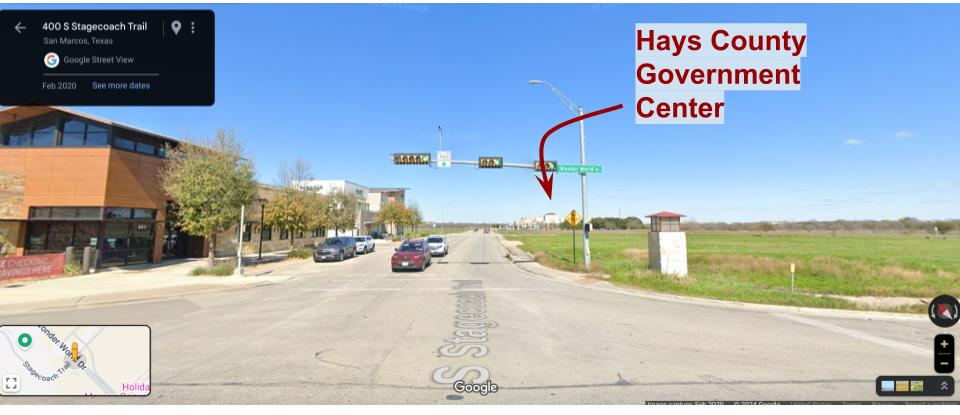
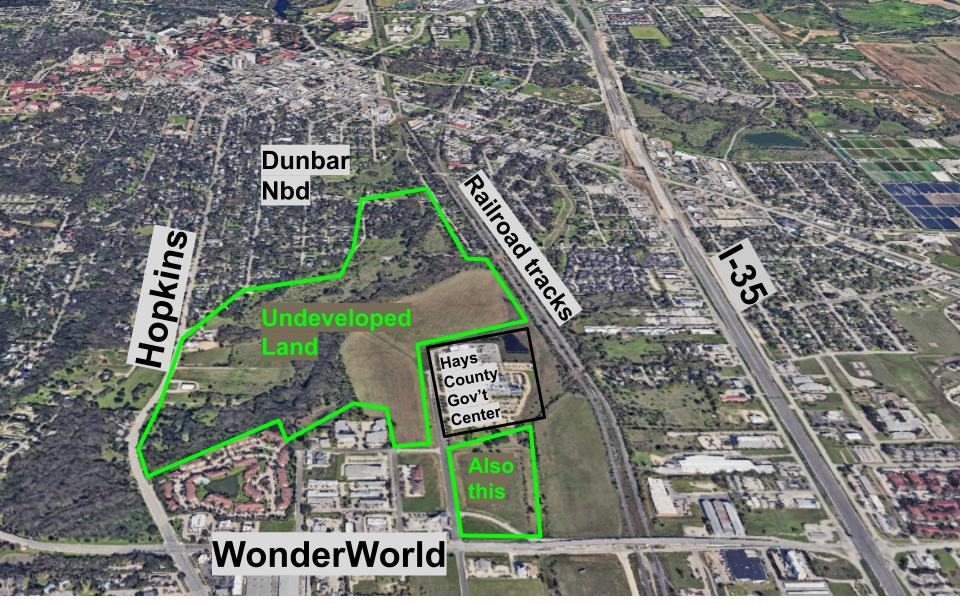
Items 19-21: The Hays Government Center is off Wonderworld, on Stagecoach:

All around it is a big chunk of undeveloped natural land:

It separates the Dunbar neighborhood from Wonderworld.

It’s never been developed, mostly because Purgatory Creek and Willow Springs Creek both run through it:

So it can get very wet and marshy in there.

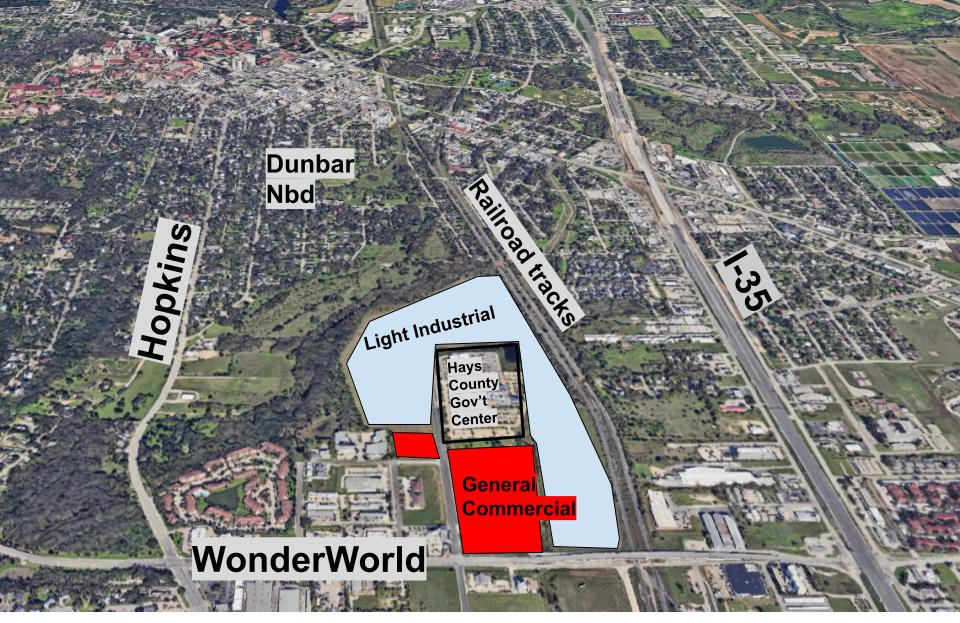
Way back in the 1980s, this land was all zoned Light Industrial and General Commercial:

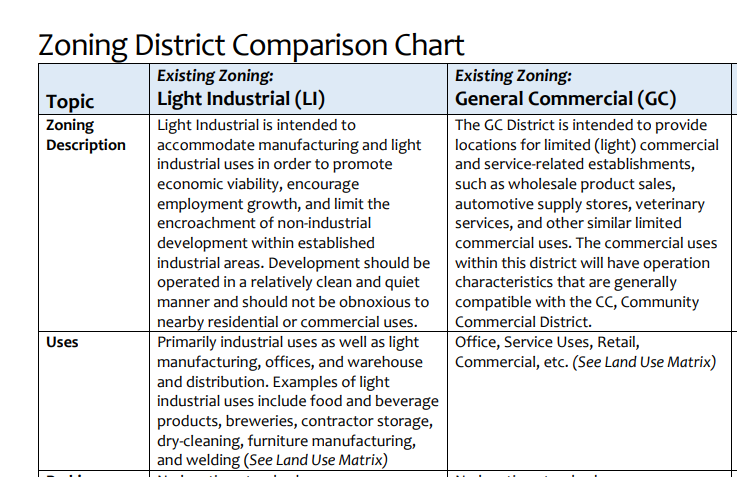
Here’s what General Commercial and Light Industrial mean:

So the owner, currently, is allowed to build anything in that chart, without getting permission from the city.

Honestly, back in the 1980s, this area was basically outside of town. And the people in charge did not worry about Dunbar neighborhood flooding.  

Fastforward to 2024

Now we do care about Dunbar flooding! How we’ve grown.

The city is working on the Purgatory Creek Mitigation Project, stretching from the river out to Purgatory:

(That’s my kludged-together map, joining Phase 1 and Phase 2.)

It’s going to be a big trench to help with flooding, with a big hike-and-bike trail running through it:

and the trail will connect the the river, through Dunbar, and over to Purgatory Creek Natural Area on Hunter and Wonderworld.

This trail cuts across the land that we’re talking about:

They’re calling this part of the trail “Hun-Dun” because it connects Hunter Road and Dunbar. Very cute, you all.

So the city approached the owner and asked about acquiring this land for that part of the trail: 

The owner of the land said, “Well, as long as we’re looking at this land, what if we change it all around?” He is proposing the following zonings:

The green part will contain the Hun-Dun trail.

So what about the pink and blue parts?

First off, both are down-zoning. They are less intensive than Light Industrial and General Commercial. So that’s good, but it’s also pretty weak, because the old zonings were kind of ridiculous.

Blue will be CD-5. Mostly this means large apartment complexes.   Pink will be CD-4, which usually means slightly smaller complexes, or things like townhomes.  

What did Council say?

There are two main themes to the conversation: flooding and new roads.

  1. Flooding.  If all this housing is built, will it increase flooding in Dunbar? After all, it’s going to displace a bunch of water. That’s basically why this area hasn’t been built out yet.

Answer:  According to our Land Development Code, you aren’t allowed to build something that makes flooding worse for people downstream.

Jane Hughson kind of laughs darkly, saying “We know how well that works.”

Amanda Rodriguez asks exactly how this gets enforced?

Answer: It’s prepared and checked by engineers.

Note: “Prepared and checked by engineers” is all well and good, but that’s not enforcement.  What happens if the builder cuts a bunch of corners? Enforcement has to come after that. Will city staff actually withhold their building permit and require them to fix it? Or will we just good-naturedly punch them on the shoulder and say, “Bro! You know better! Try not to do this again, but here’s your permit.” 

The answer is: who knows! That step is invisible. 

The second enforcement comes with maintenance: if you have a retention pond, do you check the drain and pumps regularly? Does the city? What happens if the drains get clogged and no one pays to have them cleaned? Will the city actually remove your permit? Or will they just wring their hands and say, “I hope this gets fixed!”

2.   The roads

Which roads should connect into this new neighborhood?

Councilmembers talk in particular about Gravel Road and Bintu road:

Gravel Road is a sleepy little dead-end with some houses on it. Bintu is a sleepy little road with a Holiday Inn on it.

Here’s the Transportation Master Plan:

So you can see that in theory, MLK and Gravel are both going to be extended across Purgatory Creek, into this new neighborhood. And Bintu is supposed to be extended across the tracks, to connect the I-35 frontage road into the neighborhood.

Is this a good idea?

It depends!!

Bintu Road extension: Yes, I think this is a great idea. No one lives there. Another way to get across the tracks would be great. Let’s do it.

Gravel Road and MLK extensions:

If you have two sleepy neighborhoods that are back-to-back, it is generally a good idea to connect them.  You want the people in these neighborhoods to have multiple ways to leave in case of flooding, for example.  Connectivity is good.

However! If you connect two sleepy neighborhoods and Gravel Road becomes the New I-35 Workaround, then that’s a whole lot of traffic that these neighbors didn’t bargain for.  All of a sudden, cars are zooming down Gravel Road at 50 mph.  

At the same time, the city does need more roads running parallel to I-35, aside from just Hopkins.  Maybe MLK? (My vote is also for Leah Drive, on the east side, and to extend the road that runs by Target, Barnes Drive, all the way to Wonderworld.)

Answer: Stay tuned! This will be a fiery debate when the Transportation Master Plan comes up for revision in the next 1-2 years!

Here’s the bottom line: currently, the developer is allowed to build all kinds of nasty things.  Our hands are tied here.  We’re not zoning new, rural land.  We’re re-zoning land where the owner has current rights to build all sorts of things.  This is a least-bad-decision.

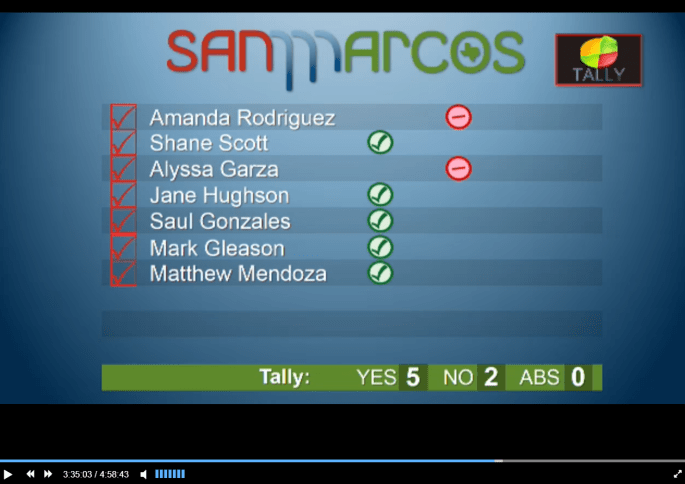
Each part – blue, pink, green – gets its own vote:

The Blue Vote: Should the blue part be big apartment complexes?

The Pink Vote: Should the pink part be smaller scale dense housing, like townhomes?

I probably would have voted yes. It’s a good place for town homes and moderately dense housing. We just have to be thoughtful about the Transportation Master Plan.

The Green Vote: Should the green part be set aside for the trail?

That last one is easy. 

One final note: The developer says he doesn’t actually have any plans right now. This is not going to be immediately developed in the next 2-3 years.

Hours 2:39 – 4:58, 12/3/24

Now we get into the weeds. These next five items are pulled from the Consent Agenda by Amanda Rodridguez. This means that Staff guessed that no one would want to discuss anything, and Amanda said, “Not so fast!”.

(Alyssa and Jane also pulled items, but just had a quick question on each one.)

The five items are:
– Mailing parking tickets directly to people
– New bathrooms at Dunbar park
– Covid money for mental health collaboration between SMPD and a mental health treatment center.
– SMPD buying seven new Tahoes for $350K
– SMPD applying for a grant to start a Motor Vehicle Crime Prevention Unit

A few observations:

First, Amanda is thorough. Holy moly. She is reading everything with a fine tooth comb.

Second, what is Amanda’s point?

Her larger point is that these are the kinds of things we approve automatically. Taken together, these five items add up to $709K. (For perspective, keep in mind that we budget $550K yearly on social services.)

We just aren’t this generous – both in dollars and spirit – in other areas. Recall how it took Alyssa years of banging on about it to get $115K extra Covid money set up for emergency housing. Why is $350K for police cars so easy, and $115K for emergency housing so difficult? What Amanda is doing in these next five items is scrutinizing items that usually pass uninspected.

Honestly, I would vote in favor of all five items. I don’t actually think they are abusing city dollars.

It’s just that this level of generosity should be the standard, and it’s not. When it comes to my pet issues – homelessness, holding landlords accountable, transit, the parks department, etc – we should be as quick and gracious to fully fund them, as we are when it’s time to spend $350K on new police cars.

“BUT WAIT!” you cry, “We can’t afford to spend a million dollars all over the place like that! We’re broke!”

Gentle Reader: never forget that we spend $1.2 million on Kissing Tree each year. And it’s gated, and you’re not allowed in. Sorry.

….

Anyway! Onto the weedy details.  Brace yourself.

Item 4: Mailing parking tickets

The parking lot next to the Lion’s Club is going to become a pay lot. Supposedly it’s going to be free for residents (but the details are murky). Out-of-towners will get their parking tickets mailed to them. (We discussed this last time.)

The first issue: In general, there’s an Early Bird discount – 50% off! – if you pay your tickets off early. You get 14 days to get the discount.

But if you’re mailing tickets out, you’d want to extend that window to account for the mail. Staff said 17 days. Amanda wants 30 days.

This is a little tricky because there’s also a late fee that kicks in at 30 days. Council decides to extend the Early Bird discount to 29 days on tickets-by-mail. The very next day, the late fee deadline will kick in.

Amanda Rodriguez has a number of other notes:

  • She wants to fully fund the parks department, but not through fees and fines.  (This is a big issue, nationwide. Map here showing that San Marcos is not a big offender, though.)
  • There’s a bunch of murkiness in the policy language: operators versus car owner? Standing vs parking?  Are robots writing tickets here?

They clean up the ordinance a little bit.  Robots are only scanning license plates as you enter or exit the parking lot.  The rest of tickets are being written by people, and the system mails them automatically.

You’re supposed to be allowed to load and unload for up to 30 minutes in this lot. But right now, the ordinance is ambiguous:

The Vote: Should we clean up language to allow for lawful loading and unloading?

Yes, of course:  Jane, Amanda, Alyssa, Saul, and Mark
HELL NO! Ticket them to smithereens:  Matthew Mendoza. 

Okay Matthew, if you think that’s best.

Amanda’s next point: Paid parking for out-of-town residents reflects an “Us vs. them” mentality. We should welcome our visitors, not shake them down. 

The counter argument to this is put forth by Mark Gleason and the city manager, Stephanie Reyes:

  • San Marcos residents don’t use the river, because they’re too full of out-of-towners.
  • The out-of-towners aren’t spending money in our downtown, or hotels, or restaurants. They pack in a cooler and leave town after they get out of the river.
  • The parks and river are getting trashed and destroyed, and there’s a lot of drunken fights and medical problems.  San Marcos is stuck paying for this unless we can collect some money from the out-of-towners.

Jane also has a good point: why is this ordinance so narrow?  Right now, it’s only city park.  Why not write it to include future paid parking lots?  (This does not get fixed.)

More points from Amanda:

  • This is 6 am – 11 pm every day.  No free parking after 5 pm? Holidays or something?
  • Registration process for San Marcos residents – how will that work? It’s supposed to be free for them.

Answer: there will be a big education campaign! We’ll hold events at the library.

Alyssa chimes in: San Marcos has a big problem with roll outs. How many people have microchipped their pets? How many people have signed up for the Enhanced ID at the library? How did the can ban PSA go?

All of those public information campaigns sounded great in paper, but in practice, we just don’t connect with people.

(Note: good public outreach is extremely time-intensive. It’s not enough just to translate everything into Spanish and promote things on social media. You basically need to maintain close and healthy relationships with a lot of community leaders who are in close contact with your hard-to-reach populations. What church does your population go to? What barbershop? Etc.)

Finally: This is just a pilot program. If Council wants to shut this down next year, there will be an opportunity.

As Parks and Rec director Jamie Lee Case says, “City Council will have a chance to decide if the juice is worth the squeeze.” She wins my most-favorite line of the night, hands down.

The final vote: Should we mail parking tickets from the City Park parking lot?

Amanda and Alyssa are both no, mostly due to lack of details on how the registration process will work.

I probably would have voted for it? It seems like a pretty cautious step.

Note: The vast majority of conversation these days is between Alyssa Garza, Amanda Rodriguez, and Jane Hughson.   Just because I’m a shit-stirrer and this made me laugh:  

At 3:01: Shane Scott, Mark Gleason, and Matthew Mendoza are all clearly on their phones.  I guess someone does not find the intricacies of parking violations as thrilling as I do?  Talk about a violation of Municode Chapter 23.46, Section 3.0045, paragraph 8.243. 

Item 6:  We’re spending some Covid money on installing new bathrooms at Dunbar.

Amanda Rodriguez is thorough.  Like thorough

She catches that the contract does not include baby changing tables nor little trashcans for used period products, and asks that those be added in.  

Everyone agrees that this is a good idea.

….

Item 8: Oh, so confusing. 

Here’s the caption:

But here’s what was originally posted, back in November:

The problem is that there’s no such thing as “the City Mental Health Court Program”.  So they changed it on the agenda to SMPD. (Currently this is how the program works: SMPD mental health unit identifies people who need mental health or substance abuse treatment, and refers them out to Evoke Wellness for treatment. Then Evoke Wellness provides in-patient and out-patient substance abuse and mental health treatment.)

What Amanda brings up, though, is that there’s an entire contract in the packet between the City, the treatment center, and the non-existent City Mental Health Court Program. 

No one seems to know what’s going on.

This gets postponed. However, this is Covid money, which expires on December 31st. So it absolutely has to get squared away at the next council meeting.

Item 9: SMPD wants $371K to buy seven new shiny Chevy Tahoes.

Ideally they like to replace police cars every five years. But due to Covid shortages, these are more like 7-8 years old.

Amanda Rodriguez points out that plenty of people drive cars much longer than that.

Chief Standridge explains that the game is to optimize resale value. The Tahoes we’re selling are 7-8 years old, have about 80-85K miles on them, and about 6500 idle hours. (Reddit tells me each idle hour is equivalent to 25 miles driven.) If they wait any longer, repair costs go up and resale costs go down, and everyone gets bummed out.

Each car is $52K, plus each car gets its own fancy Police costume. Installing the costume on the Tahoe, inside and out, is about $20K per car.

Alyssa Garza follows up: SMPD officers use police cars to do their off-duty work. So they’re putting wear and tear on these cars. Can the private companies pay to offset the cost of the vehicles?

(Max Baker and Alyssa actually first brought this up back in 2021. )

Chief Standridge says he actually just met with someone about this just last month! Nothing happened. One of the off-duty employers is SMCISD, and we don’t want to spring it on them.

(I mean, it’s been over three years.)

They also say that we should be leasing SMPD vehicles instead of buying them. This is cheaper in the long run. But because of the tax shortfall this summer, we couldn’t budget for an ongoing expense, so we have to use special one-time money to purchase them.

The vote:

I warned you that these items were weedy! There’s still one more to go.

Item 14: Autocrimes Unit

SMPD is applying for a state grant for $177K. This would pay for establishing a Motor Vehicle Crime Prevention Unit, with one full-time officer and a bunch of license plate cameras.

It’s not free – the city pays $35K in matching funds.

Amanda points out that there were 157 stolen cars last year. Out of 70,000 residents, that’s 2.2 vehicles per 1000 people. Her point is that this is inflated in people’s minds. Everyone acts like it’s a giant issue, but that’s actually fairly small.

Here are some other problems, for perspective:

  • 27.7% of San Marcos residents live under the poverty line. That is 277 per 1000 people.
  • I don’t know how many jobs pay minimum wage, but it is definitely more than 2.2 per 1000 people. We could raise the minimum wage.
  • As of 2017, we needed almost 6000 more low-income housing units. Obviously housing prices have gone up, but let’s use the 6000: that works out to 85 units needed per 1000 people.
  • The uninsured rate in San Marcos is 16.1%. That works out to 161 uninsured people per 1000 people.

Chief Standridge is a hard no on any mitigating context! He wants zero crime!

Amanda grills him on the value of education, and why is it deprioritized in this grant application?

Chief Standridge argues that they do tons of other education! Also, out-of-towners come in to take cars. We can’t educate out-of-towners. Education is only one piece of the larger approach.

Mark Gleason is furious. This is an epidemic! There is a 50% increase in stolen vehicles from 2023 to 2024! These stolen vehicles get used for crimes!

(Repo man)

Mark and Amanda have an angry exchange. If you want to listen, it goes from 4:30:49 – 4:34:15.

Mark is furious that others aren’t taking car theft seriously. He sees a stolen car as derailing someone’s livelihood, and he’s furious that Amanda is challenging Chief Standridge’s plan to reduce this epidemic.

Amanda is furious that we don’t take other problems as seriously as we take car theft. Yes, it’s super shitty if your car gets stolen. But here we are, prepared to drop $35K to match a grant without any discussion, and we don’t apply this same eagerness and dollar amounts to issues that affect a lot more people. As policy makers, council’s job is to figure out how to compare apples and oranges and apply some consistency across many different issues. Right now it’s wildly inconsistent.

Alyssa and Matthew Mendoza also get snippy with each other – if you want to listen, it’s at 4:29-4:30.

Saul doesn’t get snippy with anyone! But he does ask: How do we pay for this two years from now, when the grant runs out?

Answer: It’s a recurring grant. We expect to get it again.

The vote:

Phew! That’s it for the items pulled from the consent agenda.

The rest of the meeting is extremely short.

Item 24: Tantra is going to get reimbursed the $750 fee for appealing the noise violation. Yay!

Item 25: Right now each councilmember gets $12K to travel to conferences.

Shane Scott wants to double this to $24K. City Manager Stephanie Reyes gets a little faint at the notion of magically locating $84K extra dollars in the budget for this.

This will come back around, with more details. Like do all the council members even spend all their money? Maybe they can share the pool a little bit amongst themselves.

Hours 0:00 – 3:21, 11/19/24

Citizen comment:

  1. Live music at Tantra Coffee Shop. 
    P&Z killed their live music back in September.  The community is livid! We’ll hash it out in Item 9, below.
  1. One speaker talks about deer. (Item 17, at the end of the meeting.)
    – Urban deer are responsible for more deaths than any other animal. 
    – In 2010, Council thought hard about this, and decided to do nothing.  Now we’ve got an even bigger problem.
    – Also, stop feeding the deer, even though they’re cutie-patooties, with their big eyes and spritely tails.
  1. November 10th, in Rio Vista.  Two speakers talk about this. 
    – Apparently there was a violent dispute, and a shot was fired, and the cops were called.  The guy with the gun left the scene.
    – The cops showed up with 8 cop cars, SWAT teams, set off 6 flash bombs from neighbor’s yard, blared megaphones, and generally acted like the circus-military was setting up camp in Rio Vista for a night of revelry, from midnight to 3 am. 
    – The suspect was not at home, this entire time.
    – This police response did not make the speakers feel safer, whatsoever. It felt like an untrained, reckless mess.

4. At the 3 pm workshops, Virginia Parker talked about Cape’s Dam. She is the director of the San Marcos River Foundation, aka SMRF. (Cape’s Dam explainer here. Warning: I wrote that when I was a baby blogger. I did my best.)

Here’s what Virginia Parker says: SMRF owns the high bank at Cape’s Dam. For ten years, SMRF has been saying that removal of the dam is the best thing for the environment. The city has been dragging their feet, and saying they’re going to hire a project manager to run a feasibility study on rebuilding the dam. There’s no money to hire this person. This study is not coming anytime soon.

Virginia Parker says: Cut the bullshit. (My words. She is far more polite about it.) SMRF will never agree to rebuilding the dam, and they own the high bank. The city would have to take it under eminent domain.

So (she says): Dissolve the agreement with the county. Reallocate the money. Dams are not safe – a teenager just lost his life there recently.

Plus, there are federal grants available for dam removal. It’s free. It’s the fastest and cheapest way to deal with this situation.

I totally agree! Listen to Virginia Parker!

Onto the meeting!

Item 9: Tantra Coffee Shop

You know you love Tantra:

photo credit

Back in September, Tantra went to renew their alcohol permit. This is where our story starts – at that Planning and Zoning meeting.

The P&Z Meeting: September 24th

There was one speaker (LMC) who was mad about the music.  “They’re blasting profanities and obscenities into the HEB parking lot!!”   She’s called the cops on them two or three times, but nothing ever came of it. Because there was no actual violation taking place.  

Now, LMC talks at almost every meeting. She’s prolific. P&Z and Council are used to taking her comments in stride.

But P&Z kicked things off with guns blazing.  Jim Garber had a well-prepared speech.  First he compares the decibel levels allowed at a bunch of other towns, but he mostly cherry-picks residential areas.  (More on this below.)

This is the most absurd part of the speech, and I’m quoting verbatim here:

“Frank Sinatra tells us that New York City is the city that doesn’t sleep at night. He’s wrong. Because in residential areas, in various boroughs, [the noise cap] varies in daytime 45-55 decibels. We allow 85.  At night, 35-45.   So New York does sleep at night! The city that doesn’t sleep at night is San Marcos! You experience more noise in downtown San Marcos than you will in New York City.  Something to think about.”

You guys: no.  San Marcos is not louder than Manhattan.  I promise. New York is such a dense, stacked place that small noises quickly amplify.  So they have to control the noise output of things like air conditioners, ventilation, bars, construction sites, and garbage trucks.  You get this ambient background noise level, and then all other sounds ratchet up, in competition. 

New York City is not remotely parallel to live music at Tantra, with the occasional naughty word floating over to HEB.

Garber wraps up his speech with the 60 decibel limit for Tantra.  There’s one single other comment from a P&Z commissioner, about how un-family-friendly it is to have vulgar music blasting into a grocery store. 

The owner of Tantra is attending the meeting! He’s there on the zoom! But no one asks him a question, so he can’t say anything.

The P&Z vote is unanimous: Tantra’s alcohol permit comes with a 60 decibel cap.

The whole discussion takes just over five minutes.

How bad is 60 decibels?

The problem is that 60 decibels is actually very quiet:

So P&Z has effectively killed live music at Tantra with this decision.

So Tantra appealed P&Z’s decision at City Council this week.

The stakes are high! It takes 6 votes to overturn a P&Z decision.

First off, Council is absolutely flooded with emails and speakers. They got over 200 emails. Between Citizen Comment and the public hearing, there are over 50 people speaking in person. The major themes are “This place is community. This place is love. This place makes me happy when life gets hard.” It’s a pretty amazing testimony.

Everyone’s favorite speaker is a kid who plays the harmonica for council, and explains that they’ll be playing at Tantra on Friday, because Tantra is the only family-friendly music establishment that allows kids to perform. It was adorable.

My favorite written comment – hilarious, but maybe less adorable:

I love a straight-talker. I laughed.

 Basically, Council listens to 2.5 hours of people pleading them not to kill their happy place.  

Several people have decibel readers with them, and point out that this very city council meeting has ranged from about 70-90 decibels!

(Staff also provided this corrective to the specific noise ordinances mentioned at P&Z:

So San Marcos is not an outlier.)

Council discussion

Right off the bat, it’s clear that it’s going to be reversed.  No one is defending the ridiculous 60 decibel cap. 

Mark Gleason proposes:

  • 1 year permit instead of a 3 year permit
  • 75 decibels after 7 pm on Sundays

No one goes for either of these propositions.  

Amanda Rodriguez – our new, shiny councilmember! – asks about getting the owner reimbursed for the $750 appeals fee.  Everyone is on board with this, but it’s a whole process.   So yes, but not tonight.

Both Alyssa Garza and Mark Gleason say, “This is why the community has to show up at P&Z meetings!” 

I think that’s wrong! This should have been an easy case at P&Z. It would be exhausting if you had to rally all your clientele every time an ordinary alcohol permit needed to be renewed. Tantra was in good standing and had not violated any conditions of their permit.

Really, P&Z made a mangled mess of this permit. No one could have seen this coming. They should have spent more than five minutes on this discussion (and perhaps staff should have encouraged them to postpone when they felt it was going off the rails.) 

THE VOTE TO REVERSE THE DECIBEL BAN: 

Council knows which side its bread is buttered on.

Finally, let’s talk about swear words. 

Some band was playing Rage Against the Machine songs on a Sunday night.  There was profanity. You could hear it at HEB.

But listen:  Can we stop pretending that bad words make little childrens’ ears bleed?

You can say a  really kind, nice sentence with the word “shit” in it, and you can cruelly eviscerate someone without using any bad words at all.  The absolute deference that this country pays to naughty words is mind-boggling. 

One last nerdy note:

Decibels are a logarithmic scale. If you increase by ten units, you’ve multiplied the sound by a factor of 10. So Garber’s proposal to go from 85 db to 60 db was gigantic: he actually scaled the cap by 1/500th.

If he had only dropped the cap to 82 db, he could have cut the sound in half, without anyone being the wiser. (Nice chart here.)

Hours 3:21 – 5:07, 11/19/24

Item 10:  LIHTC Housing (LIHTC = Low Income Housing Tax Credits)

Back in May, we approved this LIHTC Complex:

It’s for senior citizens. Right around the corner from Target.

How affordable will these units be? The developer agreed to set aside a certain number of affordable units:

AMI means the Austin Area Median Income. So 30% AMI means your family’s yearly income is 30% of the median Austin income. But the Austin median income is $86K, whereas the San Marcos median household income is $47K.

So the categories are a little weird. Those 188 units at 51-60% AMI? That’s low income for Austin, but pretty normal for San Marcos.
….

The developer is back, and wants permission to change some things.  First, they want to loosen the ranges of incomes:

So he wants to take the 188 units for families earning $63-$75K, and spread them out for incomes earning $63K-$100K.

Side note: You can live in an apartment intended for a higher income than yours. However, you would not get a fully reduced rent:

The guy also changed his mind on BBQ grills and picnic tables, due to space concerns.  He wants to swap them out for two horseshoe pits.

Jane, Alyssa, and Amanda are all not happy about this. 

The developer says he’s got a market study. There’s just not demand for the under 60% AMI group! If he can extend to the 80% range, he’ll be able to find more residents. 

Jane is open to this, but she doesn’t like the unspecified numbers.  She proposes this:

0-30% AMI: 34 units
51-60% AMI: 86 units
61-80 % AMI: 102 units

Her reasoning goes like this: Seniors get a yearly 3% cost of living increase on Social Security. If you were earning 60% AMI and you get that bump, you could get priced out. Suddenly you’re making 61% of the AMI.  You don’t qualify for your apartment anymore. If there’s not a tier above you, you have to pay market rate, or move.

Alyssa and Amanda call bullshit on the whole market study.  (ME TOO.)  It just doesn’t pass the sniff test that San Marcos has run out of families earning less than $75K, and you have to subsidize families earning up to $100K.  Our median household income is $47K, for pete’s sake! 

The developer does not have the actual market study on hand, to show council.

Amanda calls him out on this: Does this market study even reflect the people we’re trying to help? We don’t know, because we haven’t seen it.

The vote on Jane’s amendment: (86 units under 60%, 102 units under 80%)

Yes:  Jane Hughson, Saul Gonzales, Mark Gleason
No:  Alyssa Garza, Amanda Rodriguez

But!! It takes four votes to pass.  Since Matthew and Shane are absent, this fails. 

The developer pleads that it’s not a complete blank check! The subsidized apartments still have to average out to 60%! 

The final vote:

Should the developer get to split up the Under 60% category however he wants?

Sorry, dude! 

Item 7:  We’re down to the final dregs of Covid money.

Last time, we discussed this funding:

Alyssa Garza basically chewed everyone out for never, ever prioritizing rental assistance. I mean, she was nice about it. But she has said this one million times.

And lo! They made it work! New funding plan:

Staff thinks we can give this rental assistance out with fewer strings attached than CDBG money.   This is very good, too.

Item 12:  Getting ticketed at the Lion’s Club.

Paid Parking is coming next summer to the City Park parking lot.  (Ie the Lions Club parking lot.)  Instead of paying someone to write tickets, they want to use cameras and mail the tickets out.  

Some extra details:

  • The lot will free for San Marcos residents, but you have to go online and sign up somehow.
  • If you pay within 14 days, you get a discount.

Council asks good questions:

Amanda: How does the 14 days work? From the day of the ticket? What if they’ve got some situation and their mail isn’t coming promptly?
Answer: We could change that. What about if it’s 14 days from when the ticket arrives at the house?
Amanda: ?? How would you know?  Let’s just make it 30 days.

Saul: Is there a warrant if this isn’t paid?
Answer: San Marcos parking tickets are a civil offense, so no.  Hays County, though: those are criminal offenses. They’ll getcha.

Amanda: What happens if someone’s car breaks down?
Answer: There is an appeals process.

Amanda: What’s the resident registry process like?
Answer: It’s online.  We are also going to do some library outreach to help people sign up. 

Alyssa: I can’t actually find the appeals process online. 
Answer: Yep.  We’re going to put the link on the actual citation that you get in the mail.

The vote: 5-0

Item 13: NEW FIRE TRUCK!

We’re getting an ERV010 Star Side Mount Pumper Truck with a 500-gallon tank and 1500 GPM pump.

I’m guessing that it looks something like this

Item 14:  Five Mile Dam

If you know the youth soccer league, you know that it all happens at Five Mile Dam:

image source

Which is located here:

The soccer fields opened in 2010.  They’re owned by the county, but maintained by the city.  So the city pays for the lighting, playground, sprinklers, etc.

This photo makes it look like maybe the sprinklers aren’t working? Idk.

Surge Soccer uses the fields for free.  (Surge used to be called SMAYSO, changed their name, missed their opportunity to call themselves Smoccer.)  This helps keep prices cheap for San Marcos families. Surge is good about this.

Hays County is selling us the Five Mile Dam parks. But Hays County doesn’t actually care about the soccer fields.

What Hays County cares about are these two other parks:

  1. Dudley Johnson Park:

2. Randall Wade Vetter Park:

Let’s zoom in on that sign:

Yep! That’s the right place!

Those are here:

At least, that’s my best guess.

So these three properties are a package deal. You want the soccer fields? You have to take Dudley Johnson and Randall Wade Vetter.

How much is Hays charging us? 

Zero! It’s free!   Wow, they must really want to get rid of those parks. 

The last dam report was in 2016, and at that point, the dam was in good condition.   And the county will help with maintenance on the parks for the next year.

Is this good for us? 

Yes. We want those soccer fields, or else Surge Soccer won’t stay cheap for local kids.

The danger is that Kyle or some private company would buy the fields.  They can make a lot of money renting them out.  But it would end Surge soccer.  Or at least, the affordable, community-focused version of Surge. 

Soccer is the biggest youth sport in San Marcos, by far. It’s important to secure these fields. 

Council votes unanimously for this deal.

….

Item 16: Blanco Vista Water Tower

Same neighborhood as Five Mile Dam! They’re getting a water tower, as part of all this ARWA stuff.  There is $50K in the ARWA budget set aside to paint the water towers. 

How would we like to paint it?

Here’s what our other towers look like:

Here’s what some neighbors do:

Here’s what some fancier cities do:

We could either keep it simple, or pay $100K+ to go all out. 

Council: keep it simple. 

Item 17:  The Deer

Deer are a big problem.  Mostly they cause a lot of car crashes, but they can also get impaled on your fences. (Ewwwwww.)  

A speaker came from Texas Parks & Wildlife, and talked to the neighborhood commission.  Basically, the first step is to get people to stop feeding the deer.  

Should we ban feeding the deer?

  • Pros: deer are a big problem.  
  • Cons: have you seen how cute they are, with their big eyes and fluffy tails???

The Neighborhood Commission decides on an education campaign, instead of an outright ban, because of all those people who love the big-eyed-fluffy-tailed-deer.

What does Council think?

MARK GLEASON HAS VERY STRONG FEELINGS! 

  • First, even if you ban feeding, it won’t help.  Too much available food.
  • Deer have no natural predators.
  • You must hunt! Open up the parks to hunting!
  • We could make a whole weekend of it! Have drawn hunts! 

This is a thing – see here and here.  And Texas does allow hunting at its state parks.

The problem is that Mark is bringing a huge energy here – It must be discussed! It works! Cutting people off. It’s the only thing that works! – and everyone is a little taken aback. 

Jane: They’ve been hunting on my land for 20 years, and it doesn’t keep the deer away.

Mark: IT WORKS! You just need to hunt a few. After a few generations, the mothers keep their babies away!

Alyssa: I dunno, doesn’t work on my dad’s ranch either.

Eventually Jane shushes him, and everyone goes back to talking about corn. 

 Don’t feed the deer, everyone, but really don’t feed them corn.

Item 18: Animal Shelter Vacancy

We finally got it filled.  The new person talks about how much they love animals, and how they’ve fostered and volunteered before. 

(I still have a lingering weird feeling about the other person who was jerked around by Council for months, but this person seems fine.)

Hours 0:00 – 0:50, 11/6/24

Onto the little meeting!   

Just one citizen comment, from a community member about the Dunbar Heritage buildings that are under renovation.

Item 12: The good people of Riverside Drive want to ban parking on their street.

The issue is that the street fills up with river-goers in the summer. Since there is not enough proper parking around the falls, people park on Riverside Drive during the summer, and walk over. 

Look, I’m not in a great mood.  I didn’t like it last month on Sturgeon, and I don’t like it now.

  1. This is exclusionary.  The street does not belong to you.  

  2. It’s counter-productive! Street parking is a traffic-calming measure. It makes drivers go more slowly, instead of tearing through your neighborhood at 40 mph.

  3. I might be sympathetic if local residents did not have driveways, and were forced to park away from their houses and walk to get home.  But that is not what is happening. The residents of this street put out orange traffic cones to block river-users from parking in front of their houses.  They’re not putting their own cars out on the street. 

  4. The parking ban is year round. (Holidays and weekends.) There is no reason for the ban to exist during the winter.  Does it matter? No, but it’s overreach.  

Living near the river is a privilege.  The streets belong to the public, and that includes those who want to visit the river.  I’m just not in the mood for territoriality and exclusion at the moment. 

The Vote:

Yes, parking bans are great: everybody
No, parking bans are the worst: nobody

Oh well. At least I can rant on the blog.

Item 4:  The new HEB.

Everyone cheered and quickly voted on this, in about 30 seconds.

Here were my concerns last time:

  • Would all HEB employees get the $15/hour as required by local ordinance, even at the existing stores?
  • Can we include something about wage and benefits, to make sure our workers are given good jobs?
  • Is it in writing that Little HEB will stay open for a certain number of years? 
  • Can we ask HEB about purchasing that little triangle of land next to Purgatory Creek from them?

Here’s what council said about these questions:

[Nothing.] 

I know, we were all consumed with the election. But I still wish we’d fought on behalf of employees.

The vote:

YAY HEB 4-EVAH: Everybody, unanimous, etc. 
I hate everyone’s favorite grocery store:  nobody.

Item 10: The Mitchell Center

We mentioned this last time at the workshop: it’s being handed over to the Calaboose African American History Museum. 

It’s located here, tucked in the back corner of Dunbar park:

Apparently there is a covenant that runs with the land that requires the land be used for a public, non-profit purpose.   This seems like a good choice.

Item 13:  Naming the alleys

This also came up last time:

Those seven alleys with names in white are getting officially named. 

The remaining alleys are driving Jane crazy.  She wants to pair them up with movies or anything, and get them named.  No one else seems to be in that big a hurry.

Item 14:  Municipal Court

I guess we’re getting a new spot for our municipal court?

I don’t know if this is where the public will go for court, or if it’s administrative type stuff.

Here’s the building, according to Google Maps:

We signed a 20 year lease.

Item 17: River Bridge Ranch is this giant future subdivision:

It’s located here:

(That bit above is actually two closely related developments: River Bend Ranch and River Bridge Ranch. But the details are murky to me.)

This development makes me cranky:

  1.  In 2022, they wanted to put an industrial plant on the southern corner, which would have required an insane cut-and-fill.   This would have increased flooding in Redwood. Huge numbers of residents from Redwood turned out to argue against it, given the flooding and infrastructure.  The permit was denied.

  2. Originally, River Bridge Ranch was approved to be both housing and commerce. After all, it’s huge! And we have this long-standing issue where there isn’t any commerce on the east.  They waited for a polite amount of time to pass. Then they came back and asked if Council would just forget about the pesky commerce bit. 

    Council said “You betcha!  This way you’ll make more money!” And lo, no more commerce.

This meeting, Council forms a subcommittee on it: Saul Gonzales, Matthew Mendoza, and Jane Hughson.

So this means it’s going to be coming back around again. Fingers crossed!

Items 16 and 18: The New City Hall

We’re designing a new city hall.

Council has this grand idea that the new city hall should replace the dog park and skate park, and the current location should be housing:

I am not convinced! Why should we develop our parks? Why not re-build where you are?

Anyway, Council appointed a 23-person steering committee:
– The mayor and two councilmembers
– These groups all get to pick a member: P&Z, Library, Downtown Association, River Foundation, University representative, Chamber of Commerce
– Each councilmember picked two community members.
In total there are 23 people.

SO! After multiple meetings and lots of discussion, what did the DEI Coordinator say about the end result? Did we achieve diversity, equity, and inclusion? Moment of truth!

…Nothing. The DEI coordinator wasn’t there. Status quo was upheld.

This would have been the moment to verify that “business as usual” had produced a diverse committee that matches San Marcos.  We did not verify this!

Hours 0:00 – 1:24, 10/15/24

Citizen Comment:

  • Texas Disposal Systems is the trash/recycling company. They’re up for a five year contract renewal tonight. This topic had the most speakers.
    – There were people saying what an amazing job TDS has done, and how we must renew with them.
    – There were people from other waste systems saying that they can also do a great job, and if we’d just open up bids, they could show us.
  • One speaker made an interesting point about HEB: as long as we’re getting a new HEB, why don’t we revisit the almost-HEB, and see if we can acquire that land?

Here’s what he means:

There was almost an HEB here, back in 2016:

That is when HEB was the controversy of the day. HEB applied for a rezoning to put a grocery store on that corner.

The community was furious. Purgatory Creek had flooded just one year earlier, and it’s very environmentally sensitive. Traffic is already mess at that intersection. The WonderWorld extension was new, and part of the deal struck was that no new curb cuts would occur on WonderWorld. People were worried that HEB would close Little HEB.

But Council approved the rezoning anyway. (Jane Hughson and Jude Prather were two of the yeses.)

Zipping along to 2024: clearly HEB never built the grocery store there. This week’s big announcement is the new HEB on McCarty and I35 instead.  (See item 10.)

So… can we buy this old land from them?  Can we at least approach them for this land? It’s right there, where we’re putting all these trails down. Why don’t we at least ask?  

Great question! 

….

Onto the meeting!

Item 12:  Rezoning a little over an acre, out on Hunter Road:

in other words, just to the right of this Shell station:

as you’re headed south on Hunter.

It got zoned Neighborhood Commercial, so it will definitely not be apartments. Some kind of office or store.

Item 2: After four years, we have a new Comprehensive Plan! VisionSMTX is now officially approved.

Backstory here. There are lots of big thank yous, and no major changes.

So how exactly did the committee thread the needle?  If I had to summarize, they:

  • Added back in the language about walking, biking, and transit. How close are you to parks, schools, and stores, without needing to drive?
  • Added ADUs, duplexes, and triplexes back into low intensity areas.
  • But kept one of the major P&Z changes, which was to split “Neighborhood Low” place types into two sub-types: Neighborhood Low-Existing and Neighborhood Low-New.

They did a great job of carving out a compromise position.

Item 4: We lease land to the Chamber of Commerce for $1/year:

On CM Allen, on the edge of the river parks.

They’ve been there since 1977. They are raising money to build an extension, but for the time being, they want to extend this contract until 2031.

Here’s what Jane says at 58:00 minutes in:

“Whenever the Chamber got ready to expand, the city discovered that there were a lot of back lease payments that we had never advised the Chamber to pay.  And the Chamber didn’t know they needed to pay, and the Chamber president came to me and said, ‘If you add all this up, and the penalties and interest, the money that we just raised for the expansion kinda goes up in smoke.’ So I brought it to the council and we forgave all of that, so that the Chamber could use the dollars they’d raised for the expansion.”

I can’t find any Council discussion of this, so I assume it happened in top secret executive session?

This bit was boxed red in the packet, so I assume this is the Forgotten Lease Payments:

Look how cute that 1978 typewriter font is.

Here’s the thing: Sure, forgive Chamber’s debt – it got lost to the sands of time. Just be sure that we are equally charitable to other nonprofit organizations that may need a bit of grace.

(We did cover a bunch of debt from Together for a Cause a few years ago. One of the Place 5 candidates is involved, at that link.)

Just for funsies: Remember the time that we rented that land to Chamber of Commerce for $1/year, and they turned around and rented office space back to us for $28,760/year? And everyone – besides Alyssa Garza and Max Baker – voted to approve this!

Item 5: We finalized the gateway signs business.  It’s going to look like this:

And go here:

and

This was not discussed. I just wanted to wrap up the topic.

….

Item 10: Texas Disposal Systems

Staff did a pretty good job writing up the backstory, so I’m just going to cut-and-paste from the packet:

Council is kind of split. Everyone definitely loves TDS.

  • Jane, Shane, Jude and Alyssa are all fine with going with TDS now, and opening up bids for the 2030 contract.
  • Matthew, Saul, and Mark are all a little more uneasy about not going through the process of soliciting bids, and seeing what other companies can put out there. 

The vote:

TDS it is!

.

Hours 1:24 – 2:05, 10/15/24

Item 13: Remember that time we didn’t have any commerce on the east side?

Will anybody save us from this food desert??

OH YEAH! It’s all very exciting. 

Back in May, Council approved a call for bids, saying “hey Grocery stores! We’ll work with you on tax breaks if you hit up the east side!”  HEB was listening loud and clear, and reached out to us in August.

Here’s where it will be: 

So right next to Embassy Suites, on NB I-35. 

They’ve owned this land for a long time, but HEB likes to do that: purchase potential land and then just chill with it for awhile. 

It’s a pretty ideal location: Between McCarty and I-35, you can zip pretty much all over the place. 

(This would be a great time to connect the two Leah Drives! Which are disconnected for reasons that are still murky to me:

Idk!)

So what are the terms?

Those rebates are pretty much exactly what Council proposed last May.

What kind of dollar amounts are we talking about?

I’m mildly skeptical about these sales tax numbers. Or rather, it’s not all new tax revenue to the city. Some of that money would have been spent at the existing Big and Little HEBs, and is just being diverted to the 3rd HEB. Now, a lot of folks on the east side currently drive down to HEB in New Braunfels, and so that will bring in new tax dollars if they switch to this new store. But not everyone!

What about jobs and such?

Ok, but what kind of pay and benefits? When we negotiated with Buccee’s, the company specified that they will pay $18/hour and get full benefits.

As far as I can tell, we entirely skipped this part of the negotiation. HEB will have to abide by the 2016 San Marcos law requiring companies to pay $15/hour, in exchange for tax breaks.   Does this mean that all HEB stores have to pay at least $15 an hour?

I believe HEB is pretty good to their employees, but this is poor work by Council and staff. We should always be negotiating on behalf of employees.

Sidebar: When we passed the 2016 (partial) minimum wage law, we did not include automatic inflation adjustments, the way we do for other contracts. If we had, $15/hour in 2016 would have automatically risen to $19.96 in 2024.

Hey council: Let’s update the 2016 ordinance and include automatic inflation adjustments! Like we do for so many things?

Back to HEB. What did Council say?   Mostly everyone gave a victory lap of thank yous. 

Mark Gleason added: “To other grocery stores, our economic incentive offer still stands! The east side can have more than just one grocery store!”  That’s great to hear.

Also: Mark is hearing from the community that lots of people are worried that Little HEB will close. During the meeting, councilmembers say “It’s great that they’ll keep Little HEB open” but I can’t find this actually written down anywhere. It would be good to have that in writing.

So here are my questions:

  • Would all HEB employees get the $15/hour as required by local ordinance, even at the existing stores?
  • Language about elevated minimum wage and benefits should always automatically be in these agreements.
  • Is it in writing that Little HEB will stay open for a certain number of years? 
  • Will Council please update the 2016 ordinance to peg the minimum wage to inflation???
  • Can we ask HEB about purchasing that little triangle of land next to Purgatory Creek?

The vote: 6-0.  Everyone hams it up in really cheesy ways: “Absolutely yes!” “Finally…yes!”  Fist pump. Etc.

Item 14: Alliance Regional Water Authority (ARWA)

ARWA is our big plan to shore up our water supply for the next 50 years. We originally signed onto it in 2008.  Instead of getting our water from Canyon Lake and the Edwards Aquifer, we’re piping it in from the Carrizo-Wilcox Aquifer. 

(image via)

It’s just about time to start drinking that sweet, sweet Carrizo-Wilcox water! 

These are slides from the packet, but no one actually gave a presentation on it.

so I’m just winging it here.

Tonight is about extending a bond for the next part of the project.  Everyone celebrated it, but I’m not sure what the special significance was. 

Item 16: Renaming downtown alleys

A couple years ago, Council dipped its toe in the exciting world of naming downtown alleys.  First up was Kissing Alley, in 2017.  It came with a whole revitalization effort – Kissing Alley concerts, etc.  It’s been great!

Next up came Boyhood Alley, to commemorate the movie Boyhood, which has an iconic scene shot there. This council conversation was kinda hilarious, because some councilmembers thought it sounded like Pervert Alley.

In order to dilute the pervy-sounding Boyhood Alley, Jane proposed that the rest of the unnamed alleys to be named after other movies. 

So the Convention and Visitor Bureau Advisory Board and the Main Street Advisory Board took up the charge. Tonight they’re back with their recommendations:

Four of the alleys have names already used:

That’s kinda cute about the dog.

A few others have informal names:

  • Music Alley
  • Imagine Alley
  • Railroad Alley

The committee is proposing two new ones:

  1. Getaway Alley, because some scenes from The Getaway were filmed near there:

Steve McQueen! Ali McGraw! Haven’t seen it, but it seems like a fun romp.

2. Telephone Alley, after the old Telephone building that got torn down in 2019:

Isn’t that a very cute building? I was bummed that it got torn down. (Photo from here.) It was demolished to make room for The Parlor apartments.

That’s on San Antonio. Here’s a before and after, according to Google Maps:

I’m not actually opposed to the apartments, but I wish we could have spared the cute Telephone building.

… 

There are still more alleys without names. Jane wants to pair up the rest of the unnamed alleys with old movies, but other councilmembers want to roll it out more slowly – maybe Main Street can pick one or two per year, and figure out a good name for it. Sounds like that’s how it will go.