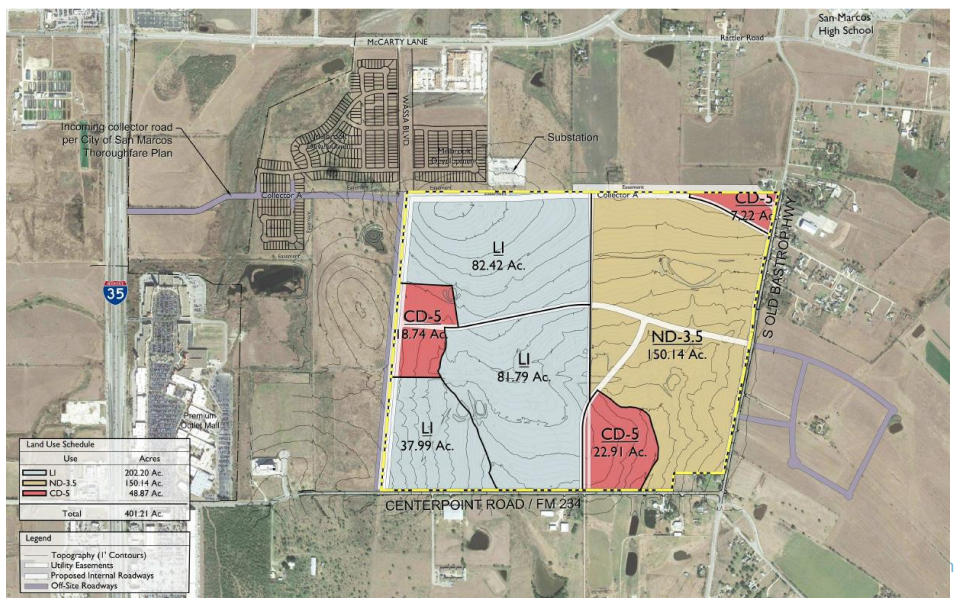
If you turn that orange square so that it lays flat, it breaks down like this:
The light blue section is “Light Industrial”. Council is voting on a giant package of tax breaks for a developer to build a bunch of light-but-industrial buildings there.
There’s so much that happens in top-secret Executive Session. As far as we plebes know, this land was just zoned during this very meeting, and now there’s a near-instantaneous agreement with someone calling themselves Majestic Reality Co. The project was code-named “Project Thin Mint,” in case you like code names, and thin mints.
Basically, they’ll get a bunch of tax breaks for a while, and then we’ll start to collect taxes on the buildings and businesses that eventually move in. That’s the plan.
Is this good for San Marcos? I have no idea! It depends what gets built and what businesses move in. Ultimately, we lose a ton of control when we approve things like this, and we have very little information about how it will go. (And this is standard, for Texas at least. Texas is set up to let private developers shape cities, instead of elected officials, all the time, because we value their profit so much.)
Max Baker does grill the developer a bit, and comments on how secretive the Chapter 380 process is.
The vote: Yes: Mayor Hughson, Shane Scott, Alyssa Garza, Mark Gleason, Saul Gonzalez No: Max Baker Absent: Jude Prather
….
Item 28: Blanco Riverine Flood Mitigation Project
Today they’re awarding some contract to some builder, and it is given all of 15 seconds during the meeting. However, I wanted to give some background to this, because it’s interesting.
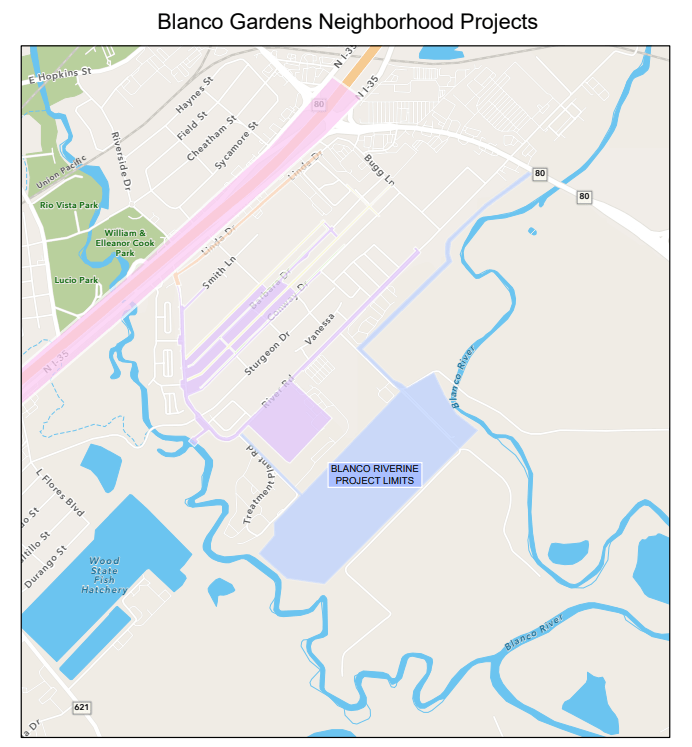
In 2015, we had the deadly Memorial Day floods, of course. (More detail here, if you’re new to town.) The Blanco Riverine Flood Mitigation project is supposed to create some extra channels for flood waters to go, instead of running into Blanco Gardens.
Here’s where it will be:
I don’t really know what’s involved, but this picture comes up a lot:
So I picture a massive drainage ditch through that periwinkle-colored rectangle, designed to catch the flood water, and then also, a long earthen hill that makes a wall between the ditch and the neighborhood. So that’s coming.
Presumably when it’s not flooding, this should have trails and green space on it.
It’s not big enough and there are problems with that street. So we’re moving it.
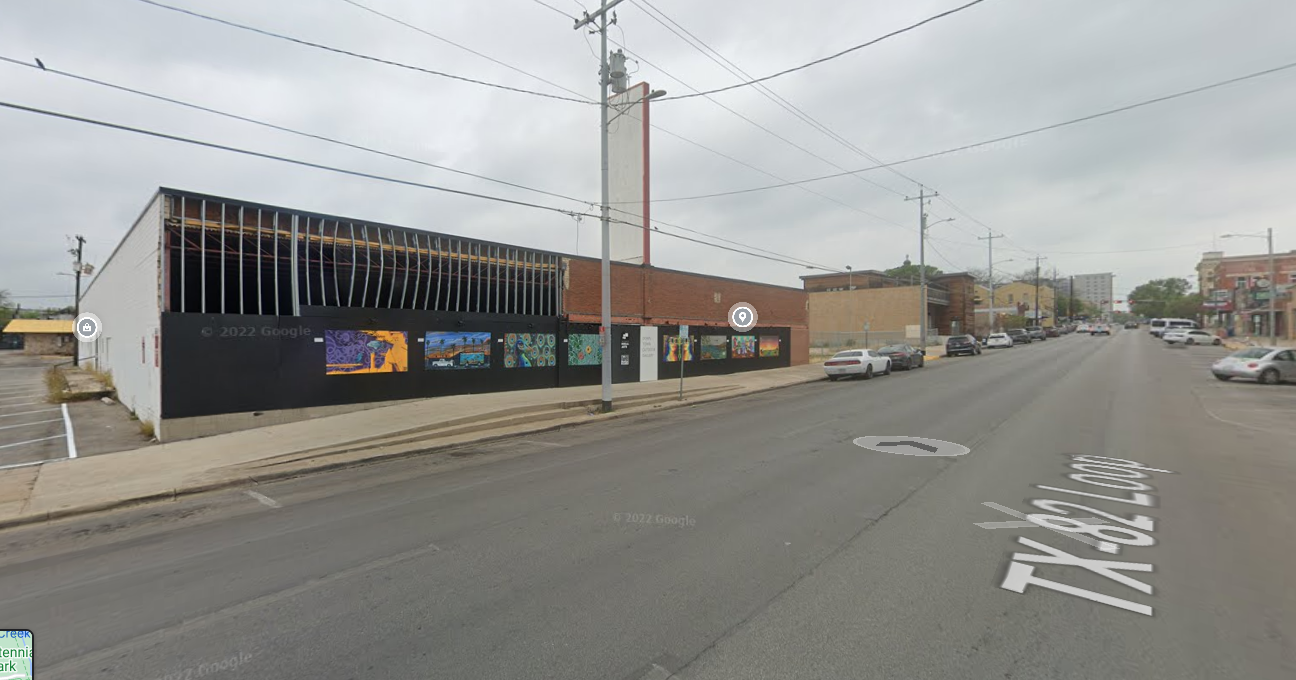
The new one will someday be here, in this building:
That is the old Diaz Martial Arts center, right across from Toma Taco. Industry is to the left of that photo, and in the background is the old Golden Chick. You’re on LBJ, heading west towards the town square.
The SMPD has a union, SMPOA, which negotiates contracts for cops with the city.
No one else gets to do this, because unions have been undermined in Texas. First, it’s a right-to-work state, which means you can’t be forced to join a union, even though you may benefit from the outcomes. (This is bad, in my book.) Second, unions aren’t allowed collective bargaining powers. If you’re not allowed to bargain for contracts and legal matters, then you’re basically an advocacy group. Underfunded advocacy groups don’t generally have much power.
The exceptions is police and fire fighters (and Houston municipal employees?) Meet and Confer is how the city of San Marcos negotiates contracts with the police and fire fighter unions.
The Ryan Hartman issue: Ryan Hartman was a police officer with SMPD. In 2020, he was in off-duty in Lockhart. He was speeding, ran a stop sign, probably under the influence, and crashed into Pamela Watts and Jennifer Miller, and Miller was killed in the crash. He had an open container in his car, but refused a breathalyzer for a few hours.
He wasn’t indicted in Lockhart, and Chief Standridge was brand new, and dithered on the issue until the 180 day time frame expired, and Hartman was put back on the force. Somewhere in here, Mano Amiga takes up the cause on behalf of Miller’s partner, Pam Watts. Mano Amiga begins a full press assault on Hartman. Back on the force, Ryan Hartman tazes someone under sketchy circumstances, and is suspended again this past January. Finally he’s terminated, this past June.
Mano Amiga has a list of five “Hartman Reforms” that they want implemented (and that are incredibly hard to find online.) Based on this article, I’m pretty sure they are:
End the 180-Day Rule
repeal of the statute of limitations on investigating wrongdoing by officers
“End Delay of Interviews for Misconduct,” due to officers being allowed 48 hours to prepare answers and review materials before giving an official statement.
Public Transparency for Personnel Files
End Third-Party Arbitration.
(I’m not really sure how 1 and 2 are different from each other.) In the Meet and Confer agreement, they are proposing to extend the 180 day rule to a 360 day rule. The other reforms are all ignored.
Max Baker asks about the rest of the Hartman Reforms.
City staff says that the Hartman Reforms were announced on June 15th, but the negotiation meetings had already run from April-May 27th. Max Baker says that the Hartman Reforms overlap with reforms he’s brought up in the past, but he hadn’t gotten the support of council on those.
In Citizen Comment, Mano Amiga made it clear that they do not think this contract holds officers accountable. They’re going to collect signatures to get a repeal of this agreement on a future ballot. Stay tuned!
What do I think? Here are some reforms that I think are important:
Reviews of police misconduct need to be done by independent, external investigators
End qualified immunity for police officers (Currently, officers can’t be sued for violating someone’s civil liberties. San Marcos can’t just unilaterally change this, but it’s important)
Ongoing de-escalation training (this may already be happening, I don’t know) and cops need to be immersed in neighborhoods and build positive relationships with young adults.
Prioritizing mental health of police officers, keeping ongoing relationships with therapists or counselors
Redirect mental illness emergencies to first responders with social work or mental health backgrounds
On one slide in the presentation of the Meet and Confer contract, it says, “Applicants with degree in social work, sociology, psychology, human services, or human relations will receive additional points.” This is good! You want officers with backgrounds in areas that humanize people.
By all appearances, Chief Standridge is implementing progressive principles into SMPD. This seems like an opportunity to collaborate and make progress.
….
Item 32: Chris Cardoza is voted onto the Arts Commission.
Item 33: Should renters get notified when there’s a proposed zoning change? This is sent to a committee.
A few people speak on renaming an alley as Boyhood Alley, in homage to the movie Boyhood, which was filmed in San Marcos.
However, the comment I want to focus in on is from a person from Rancho Vista/Redwood. She also spoke at P&Z last week, along with probably ~30 residents who wrote letters in. This deserves some extra attention. She raised two separate issues:
The proposed industrial development immediately adjacent to Redwood
The intractable health problems facing Redwood
As best I can tell, these only somewhat connected, insofar as Redwood gets generally neglected and ignored.
The proposed industrial development immediately adjacent to Redwood
Last week at P&Z, probably 30 residents from Redwood wrote letters against a developer who’s trying to put an industrial development in the bottom half of this:
It was an astonishing turnout. (Quick note: City council doesn’t read letters outloud at meetings. P&Z does. This is annoying – the public should know who took the time to communicate.)
The Development Agreement had been approved last December, which put an industrial zoning right here:
But no one noticed. (I even blogged it, and didn’t notice.)
So why didn’t anyone turn out from Redwood, last December? Because Development Agreements don’t trigger notifications the way that zoning changes do. This is insane. The community in Redwood had no way of knowing that they were now downhill of a massive industrial complex, until just before the P&Z meeting.
(I went back and watched the December meeting again. There was barely any public discussion about it, although clearly a lot had happened in Double Secret Executive Session. Max Baker and Alyssa Garza voted against it.)
So the Development Agreement is already in effect. Two weeks ago, at P&Z, the developer came forth asking for two exemptions – a block perimeter exemption and a cut-and-fill exemption. Basically, this would allow them to build a gigantic thing instead of a normal-sized thing.
But like I said, there was a giant turnout by the Redwood/Rancho Vista residents, describing the current flooding and sewage problems, and how this would exacerbate them. P&Z voted both down. This is great!
Either the developer will appeal to council, or they’ll go back and reconfigure their plans. Either way, this needs to stay on the radar of San Marcos residents who live inside city limits, because we can hold council accountable more easily than Redwood residents can.
Although it can be symptomless, Strongyloides is the deadliest of soil-transmitted parasites. If an infected person takes immune-suppressing drugs such as steroids or chemotherapeutics, or has a lowered immune system because of a disease like leukemia, the worm can rapidly multiply throughout the body and cause death.
In Rancho Vista, the 16 positive blood tests from a group of 97 residents is the highest percentage of positive blood samples found in a non-refugee population in the US, according to Singer, though the sample is relatively small. (A positive blood test can also occur in someone who was previously infected but no longer is.)
Apparently the problem is that we just should never have put septic tanks in this location – they leak and are impossible to maintain. However, the residents can’t really afford to deal with and fix the raw sewage.
There’s two things that need to happen: 1. funding needs to be acquired ( but from where? federal, state, local?), and 2. the neighborhood needs to tie in to San Marcos city sewage.
I don’t know exactly how this all will unfold, but this would be a good issue to ask about during the debates and the campaign season. It’s not okay for vulnerable community members to lack basic health and sanitation provisions.
The Riverbend Development should be structured with an eye to getting San Marcos city sewage access to Redwood. That’s not profitable, and so it won’t happen without some activism.
Items 15-18: This little development, the blue rectangle in the lower left, is up for debate:
The developers want to zone it in three parts: – the dark gray part along the railroad tracks would be heavy industrial, – the tan middle part would be light industrial, – the front pink part along I-35, heavy commercial:
I don’t know how to evaluate the merit of a project like this. To be honest, I’m not even sure what kind of information I’d want to know, in order to evaluate it.
Mark Gleason had a dumb rant about how everyone keeps shitting on the working man, and he knows dozens of people at Amazon and the HEB warehouses, and they like their jobs and deserve your respect.
Alyssa Garza responded correctly that no one is disrespecting the worker. You can support the worker and also fight for better working conditions. (In fact, some – like me – might say that’s how you support the workers! And I might also say that until he fights for specific labor reforms, Mark’s support is empty lip service.)
We have no way of ascertaining the labor conditions in these hypothetical future industrial complexes, so this is all made-up anyway.
The vote: Yes: Jane Hughson, Shane Scott, Saul Gonzalez, Jude Prather, Mark Gleason No: Max & Alyssa
Item 4: City Council pay raises
This was discussed last time. City councilmembers need to be paid a living wage. Otherwise the job is not available to all community members. Currently councilmembers earn $17,400, and this would bump them up to $22,200.
Mayor Hughson suggested compensating the mayor position based on additional duties. She was trying to be diplomatic about how much extra she works, but the general consensus was not to itemize the duties. Currently, Mayor Hughson earns $20,400/year.
Shane Scott suggests just bringing her up to $25,800/year. She probably puts in 40-50 hours a week.
The vote: Yes: Alyssa Garza, Max Baker, Shane Scott. No: Jane Hughson, Mark Gleason, Saul Gonzalez, Jude Prather
So it fails.
Mark Gleason is really worked up about the word privilege, because Max and Alyssa use it to talk about who has disposable time and money to run for city council. Mark runs on and on about how it’s a privilege to serve, and it doesn’t mean you’re privileged.
He’s both right and wrong. It is a privilege to serve. Not everyone gets to do it. But it’s also an opportunity for power, and as an opportunity, it’s not equally available to everybody.
Here’s the problem: Gleason does not come from generational wealth, and he highly aware that he has not benefited from economic privilege. But simultaneously, he is a white male and has an extremely simplistic understanding of race and gender. So he is very outspoken about his working class status, while being ignorant about how he has benefited from race and gender privilege. (Also, he understands economic privilege but still believes that we live in a meritocracy. ¯\_(ツ)_/¯ )
Gleason makes a motion that no one should get any raises, and they should only adjust for travel-expenses.
The vote: Yes: Jane Hughson, Jude Prather, Saul Gonzalez, Mark Gleason No: Alyssa Garza, Max Baker, Shane Scott
So that’s that. No raises for any of them.
Jude Prather makes one point: if you earn money from the state or the county, you have to forgo your salary. He is employed by the county, so I guess he wants brownie points? For denying other people a raise that he’s ineligible for?
Here’s the central hypocrisy: Jude Prather, Jane Hughson, Saul Gonzalez, and Mark Gleason all adopt this noble stance that they’re too principled to vote themselves a raise.
You know what would be more noble? If you voted for a raise, and then say you’ll forgo it and save it for future councilmembers. That would be more principled than their entrenchment of the status quo.
I think they all deserve a raise! But if they want, they can be self-denying and still vote to facilitate more citizens running for office.
School Resource Officers are not a great concept. On the other hand, Uvalde happened three months ago, and it’s gutting to consider leaving kids unprotected. It’s time for city council to renew their contract with SMCISD for the cops in schools.
Last year, Council asked the SRO program to conduct a survey on the efficacy of the program. Does anyone feel safer? How well is it working to have cops in schools? They specifically wanted the survey to include caregivers and students, along with teachers and admin.
It just …didn’t happen. It was about to happen, back in May, and then it got sidelined due to Uvalde. But that means there was a solid six months of thumb-twiddling before May where nothing happened. Alyssa Garza and Max Baker are both furious. “That’s a really big ball to drop,” says Alyssa coldly.
Angry Alyssa is my favorite Alyssa. In general, Alyssa is preternaturally calm and patient, diplomatically providing context and backstory that her colleagues lack. That makes her icy anger during this item all the more compelling. Angry Alyssa is deployed rarely, judiciously, and with heat-seeking laser precision. It’s a special occasion when it happens.
Here are some other choice moments:
Jane: Wouldn’t we want the school board to address this? Did they? Alyssa: I don’t know. But this council has a habit of playing hot potato with responsibilities, and so I do not care what the school board did.
2. Mark Gleason being mark-gleasony:
Mark: Would this leave anyone open to lawsuits if something terrible happens, if we haven’t signed this yet? The city lawyer: No. Neither party is waiving immunity. School districts have more protection against negligence than districts. The city is responsible – whether or not there’s an agreement – to train, supervise, and control these officers. Mark: I still think it could. I really truly do. It leaves us weaker if litigation were to arise. This sets a bad precedent! A very dangerous precedent! Someone could read this and say “they have no school resource officers!” Alyssa: But they would be there. Mark: It sets a bad narrative!
(Please just remember how worried Mark is about lawsuits, because we’re about to talk about the lobbying ordinance.)
3. And Alyssa, at her most eviscerating:
Jane Hughson: Do you have any amendments? Do you have any changes? Alyssa: My hesitancy is because we didn’t engage parents. We did not consult them. Jane: So there’s not anything in this document that you would change? Alyssa: I would change the whole thing. So don’t be asking me that, Mayor. Jane: I want this closed. There’s a survey in it. Alyssa: I don’t have any changes. And I didn’t want “a survey”. I wanted the PD or the ISD to get creative and figure out some way to get perspectives given everything that went on, and it’s disappointing that they didn’t. Jane: If that was a request, we should have put that in the contract. Alyssa: It’s not a request. It’s common sense. That’s bad leadership. We didn’t have to hold their hand through it. Districts all over the state are doing it, and the nation. We don’t have to hold leadership’s hand for everything. Read the room!
(These snippets are pared down, because it’s so blisteringly dull to read actual transcribed dialogue. But I think I preserved the gist of it.)
At this point, Max has an amendment, but Shane Scott moves to call the question, and gets council to agree, 5-1, to end debate. (Jude Prather is abstaining.) So we didn’t hear Max’s amendment.
Should we renew the SRO contract?
The vote on renewing the SRO contract: Yes: Jane Hughson, Shane Scott, Mark Gleason, Saul Gonzalez No: Max & Alyssa
Alyssa Garza is primarily angry at the failure to consult parents and caregivers in designing the current contract for School Resource Officers. Max Baker is angry at twelve different things, probably all valid, but spread too thin.
Here’s my take: I’m most concerned with finding out how SROs are involved when students break rules. At one point, Alyssa asks for a breakdown of police interactions with students, by race and special needs. Chief Standridge says that we have that information in our records, but it’s not pulled out in a standalone spreadsheet.
I want to know: – what are the races and special needs of students in incidents where the SROs are involved – what are the severity of the offenses – what are the severity of the consequences
Then I want that data compared to incidents where the SROs are not involved. Here, I want to ignore minor offenses and just focus on the offenses that are matched up with the ones that do involve SROs.
Matching up by severity of offense, I want to know: – what are the races and special needs of the students in these no-SRO incidents – what are the severity of the consequences.
(I am also worried about school shootings. All my solutions are magical, and involve hearty funding of mental health initiatives and eradication of automatic weapons.)
….
Item 21: Approving the ballot for November.
We are going to take a moment to relish Shane Scott being a colossal twat:
Shane, what on god’s green earth are you holding?!
“I uh, kinda scored this, this is 3 oz of marijuana. I couldn’t put 4 in here. And this is going to be considered a low-level offense? My question is, what is considered high-level – like a pillow case? What’s the next step up, just out of curiosity?”
Here are the reasons this is idiotic:
This exact issue was discussed last time. Shane is a day late and a dollar short.
Council is not here to discuss decriminalizing marijuana today. This is a routine ballot approval for November. There’s no issue at hand.
Consider his actual question: Q: If four oz is considered low-level, then what is considered high-level? A: Anything above four oz, you dingbat.
4. So why is he actually hauling in 3 oz of pot into a city council meeting? Two opposite reasons:
To show off that he’s got access to the dank stuff, I guess
To show off that he’s so against this decriminalization measure
I would bet you four ounces of marijuana that Shane likes his weed, and that he still listens to Cypress Hill when he lights up. And I think he should be legally allowed to do so.
But as a city council stunt? Equal parts weird and inconsequential. Whatever, dillweed. (He approved the ballot, along with everyone else.)
This is literally the sixth time this has come up since I started blogging last year: here, here, here, here, and then they finally held a workshop on it here. At the workshop, the ordinance got scaled way back. Instead of catching anyone with a financial interest in city council decisions, it was pared down to only include real estate developers. There was a consensus that a majority of council would support this.
For a while, Max Baker and the city manager, Stephanie Reyes, discuss some of the finer points of implementation.
Mark Gleason makes the same points that he always makes:
Overreach
Too complicated for citizens, to hard to implement, too hard to enforce
There’s no evidence of any corruption that would necessitate this.
Unintended consequences. This will be weaponized.
The guy from the Ethics Review Commission takes these one at a time:
Overreach? We pared it down to just developers, like you all agreed you wanted during the workshop.
Weaponized? we have a specific item that states that this ordinance cannot be used as a political weapon or for personal reasons. [Note: I personally understand why this is not convincing.]
Too complicated for citizens? this is why we have a clear trigger process with so many exemptions.
No evidence of need? We have ethics complaints all the time. Someone was fired for this right before we started this process in 2020. So far this year we’ve dealt with a bunch of ethics complaints. Think of Lindsey Hill, La Cinema, etc.
You personally said you were worried about protecting the city from lawsuits. [Note: remember Mark’s School Resource Officer plea for legal protection?] This itself will protect the city, by documenting behavior along the way. This is lawsuit protection.
We’re not defining who is a “lobbyist”. We’re defining what kinds of behavior triggers need to register and disclose. It’s been disingenuous for you to persistently focus on the confusion around who is a lobbyist.
Mark is very offended at being called disingenuous, and yelps disingenuously about it.
Listen: I’m very done with Mark Gleason’s self-righteous rants. Shane Scott and Mark Gleason vote equally badly, but Mark Gleason subjects me to long, infuriating soapboxes on every single issue. Wheras at least Shane Scott occasionally waves around baggies of schwag weed for my personal entertainment.
Then the big bomb drops: Saul Gonzalez says that he will not be supporting this bill.
Everybody understands the following:
Max & Alyssa will always support this bill.
Shane & Mark will never support this bill.
Saul is probably in, and Jude is probably not in.
Jane is gettable, if she can put in some amendments.
So when Saul switches sides, he has doomed the bill. Why?
What Saul says is that he wants out-of-town developers to count as lobbyists, but not in-town developers. Since this bill catches in-town developers, he’s out.
Everything about this smells super fishy. There was a whole workshop! They built a consensus that if the lobbying ordinance were restricted to developers, it would be okay. Saul was on board. In fact, from the very beginning, Saul has been hungry to go after developers.
At this point, the mood flips. Jane Hughson drops her amendments, since there’s no longer a coalition of councilmembers who might pass the bill. And without the amendments, she’s not going to support it.
So abruptly, they vote:
The vote: Yes: Max & Alyssa No: Jane Hughson, Saul Gonzalez, Shane Scott, Mark Gleason, and Jude Prather
The whole lobbying ordinance is dead, and the whole thing is fishy as hell.
…
Item 25: There’s some federal money that was supposed to go to reimburse housing repair costs after the 2015 floods. The rules were so onerous, and the program was adopted so far after the fact, that it had exactly one recipient. It’s being shut down, and everyone is frustrated.
Still, the money must be spent by 2024, and so the money is being re-allocated towards flood-mitigation projects in midtown and Blanco Gardens.
Probably no one to blame here, but still frustrating.
…
Item 27: There will be a council workshop on protecting the Edwards Aquifer. Max opens pointing out that the river is extremely low and praising GSMP for their forward-thinking planning, which is really unexpected. He’s got a couple ideas that should be considered – partnerships with the county to look at the value of conservation easements, looking at whether setbacks around natural things like caves should count as dedicated parkland, I forget what else.
Jude Prather has several good ideas which make him sound well-informed: aquifer storage where the ecology allows it, very large rain-water recovery cisterns, one-water concept for buildings, water re-use, purple lines, etc. That we should be preparing for droughts that last decades.
I don’t know what any of those things are, but I whole-heartedly approve of preparing for droughts that could last decades!
…
Item 29: Shall we name one of the downtown alleys “Boyhood Alley” due to its use in Richard Linklater’s movie, Boyhood?
There it is! You can see the courthouse in the background:
Shane Scott and Max Baker bring the proposal forward. The idea is to celebrate our movie industry. After all, La Cinema is coming.
Apparently the Main Street Board was opposed, thinking that the public wouldn’t know what Boyhood means and might be weirded out. I find it funny that in the absence of context, “boyhood” sounds off-color and sleazy. You know boys, with their creepy childhoods. How suspect.
Jane Hughson is right there with those Main Street Boomers, asserting that “Boyhood Alley” sounds creepy. She prefers Linklater Alley. Mark Gleason, our Forever Hedger, kinda agrees with her but kinda agrees with everyone else.
Everyone else likes Boyhood Alley. After all, Linklater isn’t especially tied to San Marcos. The movie Boyhood is especially tied to San Marcos.
It passes 6-1, with Mark Gleason openly deciding to cast his vote with the majority since it was already going to pass.
…
Item 32: Should people on boards and commissions earn a small stipend? Max & Alyssa make the case that this is an equity issue: we have a very skewed pool of volunteers for boards and commissions. Maybe younger people who are juggling three jobs would see a way to contribute if they were able to offset some of the cost of missing a shift at work.
Stephanie Reyes, the interim city manager, suggests that this would be a good issue to raise with the new DEI person.
It’s funny how this plays out. First, Mayor Hughson asks everyone if they’d like to pursue this as a possible policy. Everyone (besides Max and Alyssa) skewers the idea – too expensive! Too complicated! Too un-service-minded! (Well, not Shane Scott. He already skedaddled home for the evening, with his three oz baggie of the wacky tobacky.)
Second, Mayor Hughson asks everyone how they feel about talking to the DEI person about the idea. This time, they all pause and stroke their chins in contemplation, and agree that that would be fine.
It’s like they had to be heavy-handed NOs on the topic itself, but they don’t want to sound unwilling to work with a qualified expert. So they all had to backpedal rapidly.
What’s my take? Our boards and commissions are disproportionately older, whiter, and male-r than San Marcos as a whole. Finding volunteers that match the population of San Marcos is a big problem. It’s possible that compensating board members would enable broader participation. Talking to the DEI person is a very good idea.
(I wasn’t entirely clear if they were talking about the future DEI hire or the host of the upcoming DEI council workshop. Either one will be better informed than the collective wisdom of Jane, Shane, Jude, Mark, and Saul.)
Three big topics: 1. Last time, we discussed a bunch of potential houses in the middle of nowhere, down south, past Trace, next to a power plant. At this meeting, the owner of the Hays Power Plant shows up to further explain how miserable it would be to live next to the Hays Power Plant.
2. Lots of people show up to support the ballot measure decriminalizing pot (or maybe just passing the ordinance outright). Mano Amiga pounded the pavement and gathered 10K+ signatures for this.
3. People express support for the discussion item on abortion, called The GRACE Act, which stands for Guarding the Right to Abortion Care for Everyone. Originated in Austin, and then more recently passed in San Antonio.
Go watch this one comment, starting at 43:20. This testimony is too moving and compelling to get buried and lost in the shuffle of City Council minutes. It’s a moment of vulnerability from a woman who had an abortion last week, and you can viscerally feel how terrifying it is to get one in a post-Roe world. It’s super brave and heartbreaking.
Go listen – it deserves to be heard by a broader (supportive) audience.
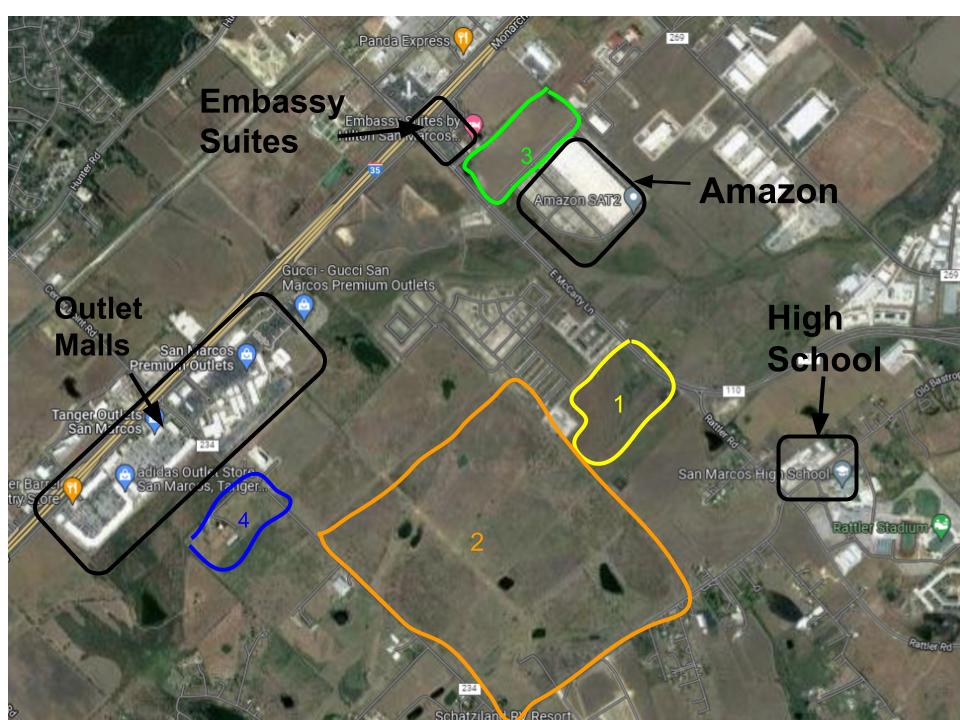
Four hours of zoning cases! There are five big cases. Oddly enough, the first four are all located very close together. It’s either a weird coincidence, or they’re connected in some way that was not made explicit.
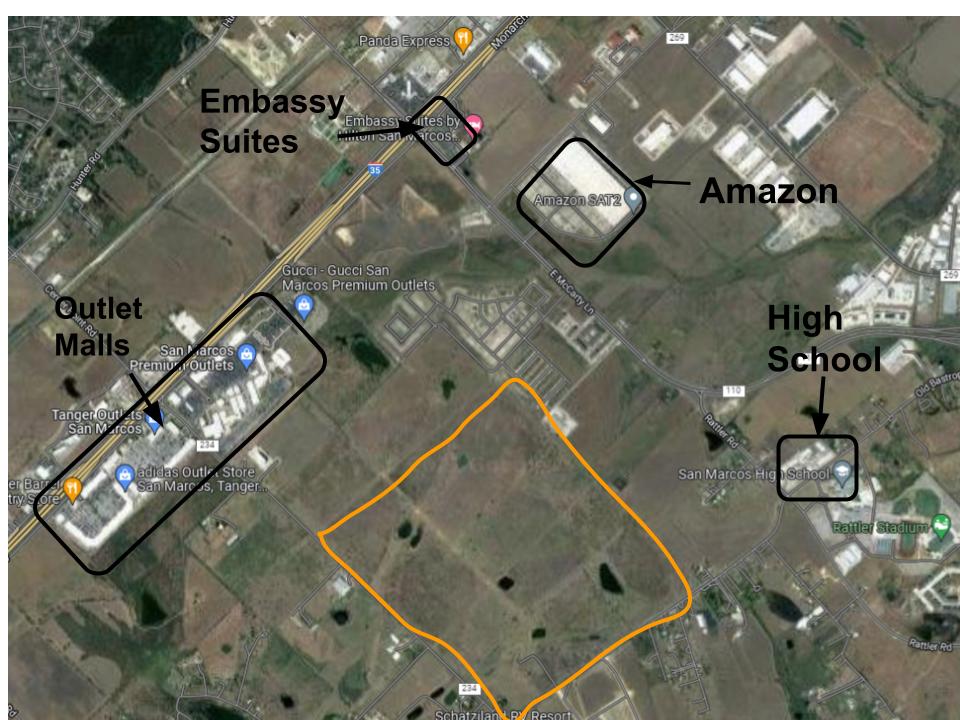
Yellow is at the intersection of East McCarty and Rattler Road. On your right, if you’re going from Amazon to the high school. They want to build apartment complexes. I think it’s okay.
Orange is huge. It stretches all the way to Old Bastrop Highway. Terrible sprawl.
Green is right between Embassy Suites and Amazon. Heavy industrial – bad idea, gets voted down.
Blue is low-income apartments with wraparound services, by the same people who run Encino Pointe and Sienna Pointe. This is complex, but on the whole I think it’s good.
Furthermore, we passed an additional little piece last summer, here:
It’s supposed to be these little rental houses, by these guys. (This is why I want to keep a running list of “what got approved but hasn’t yet gotten built”.)
Anyway. Yellow’s up first!
Items 25-26: 40 acres, at the intersection of Rattler Road and east McCarty:
So if you’re driving from Amazon towards the highschool, this is on your right, just as you get to the intersection with Rattler Road.
There’s a big housing/apartment thing going in right next to it. Amazon is near the top of that photo.
The developer wants CD-5. When City Staff promotes the category “CD-5”, they make it sound like Sesame Street:
A walkable, dense-but-not-overwhelming, charming little scene! Shops and apartments. Sounds great!
In reality, here’s what gets built:
That’s literally the apartment complex that is next door, on McCarty, to this one being proposed. (I just grabbed that photo off Google Streets.)
And listen: I am in favor of apartment complexes! They are more environmentally responsible than single family homes. They are economical. We have a lot of renters in San Marcos.
My point is just the double-speak: we’re pretending that this zoning will bring a charming row of brownstones, with bodegas on the corner, but developers do not buy in. We used to have a way to force developers to build what we wanted: PDDs. But we retired PDDs in 2018, when we redid the Land Development Code. We should not have done this! Totally unforced error.
Back to the yellow plot. Is a giant apartment complex here a good idea? I have a (different) good idea: my five criteria. Let’s do it:
1. Price Tag to the City: Will it bring in taxes that pay for itself, over the lifespan of the infrastructure and future repair? How much will it cost to extend roads, utilities, on fire and police coverage, on water and wastewater?
I’m guessing yes. It’s on roads that are already built for heavy traffic, and there’s already utilities run out in this way. Cops and fire department already cover this area. I think it’s ok.
2. Housing stock: How long will it take to build? How much housing will it provide? What is the forecasted housing deficit at that point? Is it targeting a price-point that serves what San Marcos needs?
We never have this information on hand. Nag the city planners! They need to update the housing deficit! They need to forecast these things!
3. Environment: Is it on the aquifer? Is it in a flood zone? Will it create run-off into the river? Are we looking at sprawl? Is it uniformly single-family homes?
Not the worst sprawl – it’s adjacent to an existing development, and fairly close to Amazon and Embassy Suites, and not as far out as the high school. With the high school already beyond it, it feels like a gap that should get filled in.
It’s not on the aquifer. It’s not single-family homes. I think it’s fine, environmentally.
4. Social: Is it meaningfully mixed income? Is it near existing SMCISD schools and amenities?
Not meaningfully mixed income. Not near existing amenities. Gleason asks about this – any chance of including some commercial? The developer says nope. Just apartments. So it whiffs hard on this category.
5. The San Marxist Special: Is it a mixed-income blend of single family houses, four-plexes, and eight-plexes, all mixed together? With schools, shops, restaurants, and public community space sprinkled throughout?
No, but a blogger can dream.
All in all, I think this project has merit. Affordable housing, between Amazon and the high school. Adjacent to existing housing. I would vote in favor of it.
The vote: Yes: Jane Hughson, Mark Gleason, Jude Prather, Shane Scott No: Alyssa Garza, Saul Gonzalez, Max Baker
I’m honestly not sure why those three voted against it – it makes me wonder if I’m missing something? Max had asked about emergency response times and flooding, and the answers hadn’t been particularly unusual.
Items 26-28: 400 acres, on Centerpoint road. Ie, #2, the orange one:
So first off, this thing is massive, much bigger than the last project. The last item was 40 acres, and this is 400 acres. Also, the last item is on a major road (McCarty) and this one is on dinky country roads.
Okay, the big orange square got split into three sub-projects:
Here they are together:
So the developers want it to be half Light Industrial, half houses, and then a teeny bit of really dense housing.
First up is the Light Industrial:
It sounds like it will be a bunch of warehouses. I’m thinking of the kind of thing you see way out on Hunter Road, past Posey. Max Baker is worried about us becoming a warehouse district that other towns dump their warehouse industries on.
I am not concerned about becoming a warehouse town. Warehouses are cheap to build, and cheap for local businesses to rent, and cheap to re-purpose. The ones on Hunter seem to mostly be small, locally owned businesses. Whereas building a bunch of vacant office parks is much worse: expensive to build, expensive to rent, expensive to repurpose.
However, I would vote no. Not due to warehouses, but due to 400 acres, which might be majorly inconsistent with the upcoming VisionSMTX plan, and is definitely huge sprawl. The totality of this project is not good.
The vote on this light industrial piece: No: Max Baker and Alyssa Garza Yes: Mayor Hughson, Jude Prather, Shane Scott, Mark Gleason, and Saul Gonzalez.
Part 2:
CD-3: massive single family sprawl.
We’ve got our recipe to follow here! Here we go:
1. Price Tag to the City: Will it bring in taxes that pay for itself, over the lifespan of the infrastructure and future repair? How much will it cost to extend roads, utilities, on fire and police coverage, on water and wastewater?
Huge and undeveloped. Very expensive. Thumbs down.
2. Housing stock: How long will it take to build? How much housing will it provide? What is the forecasted housing deficit at that point? Is it targeting a price-point that serves what San Marcos needs?
WE NEVER KNOW. Nag the city planners! They need to update the housing deficit! They need to forecast these things!
3. Environment: Is it on the aquifer? Is it in a flood zone? Will it create run-off into the river? Are we looking at sprawl? Is it uniformly single-family homes?
SPRAAAAAAAWWWWWL. All single family. Not good. (At least it’s not on the aquifer.)
4. Social: Is it meaningfully mixed income? Is it near existing SMCISD schools and amenities?
I doubt this will be meaningfully mixed income. This is so far from any existing amenities, unless you plan on buying groceries at Sak’s Off 5th Avenue.
5. The San Marxist Special: Is it a mixed-income blend of single family houses, four-plexes, and eight-plexes, all mixed together? With schools, shops, restaurants, and public community space sprinkled throughout?
Sigh.
This portion is 0/5. Terrible, horrible, no-good, very-bad project.
The vote on this piece: No: Max Baker and Alyssa Garza Yes: Mayor Hughson, Jude Prather, Shane Scott, Mark Gleason, and Saul Gonzalez.
Part 3: Little pockets of CD-5:
Remember, CD-5 is supposed to look like this:
But is really this:
In the top little bit, Mark Gleason makes a motion for “no residential”. It passes 7-0. I don’t really get why. An apartment complex facing the outlet mall? Spoiler alert: there’s about to be apartments right there anyway, when we get to the little blue square proposal.
He also moves that one of the other two triangles be downgraded to more CD-3: single family housing. Also passes 7-0.
The vote on the three little triangles: No: Max Baker Yes: Everyone else.
My opinion on the whole 400 acres:
It’s a bad idea to pass a sweeping decision on this giant parcel at this moment. We have a new master plan coming up. Do we even want 200 acres of warehouses and 200 acres of single family homes over here?
At one point, it was mentioned that Chief Dandridge is opposed to all this annexation, because we don’t have police staffing to cover all this extended area. When asked why he didn’t speak up, the answer was that he is waiting to discuss their needs at the upcoming budget meetings. So maybe wait for the upcoming budget meetings?
Finally, this fails the five criteria. It’s poorly planned sprawl, with no amenities. Why are we recreating mistakes that the rest of the country made 30 years ago?
………………………………….
Item 29: Heavy Commercial, the green square between Embassy Suites and Amazon:
Mayor Hughson and Max Baker think this is a terrible idea, because Embassy Suites is supposed to host all our guests. Heavy Commercial is the most hardcore industrial zoning. This sinks like a stone:
The vote: Yes: Jude Prather, Shane Scott No: Mayor Hughson, Max Baker, Mark Gleason, Alyssa Garza, Saul Gonzalez
There’s a second vote on a “hard no” or a “soft no” – essentially some fiddly technicalities with whether to make the developers wait a year or substantially re-tool their application, before coming back.
Hard no: Saul Gonzalez, Max Baker Soft no: Mayor Hughson, Alyssa Garza, Shane Scott, Jude Prather, Mark Gleason
So the developers can bring it back with less effort.
….
Items 30-31: Low income tax credit apartments, the blue square behind the outlet mall:
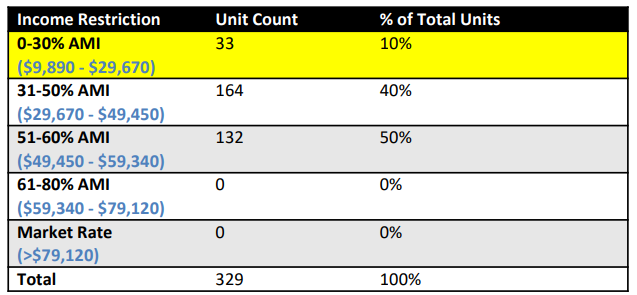
So this is complicated, but I think the good outweighs the bad. It’s going to be apartments that are priced below market rates:
(“AMI” means Area Median Income.)
You have to apply and have a sufficient income to qualify. It would be better if there were more apartments in the lowest income range – these are the most vulnerable people in our community. But: more good than bad.
The Workforce Housing Committee had a number of concerns – not near public transportation, located in a low intensity zone, a higher percentage of apartments reserved for that lowest tier of income, not close to things like grocery stores. But the people running the place were very good at sounding like they’d be happy to change and accommodate all these concerns. For example, they’re providing shuttle service two days a week, for a minimum of ten hours, and they’ll work with residents individually.
So here we go:
1. Price Tag to the City: Will it bring in taxes that pay for itself, over the lifespan of the infrastructure and future repair? How much will it cost to extend roads, utilities, on fire and police coverage, on water and wastewater?
Not relevant. This is a publicly-subsidized program intentionally built to address inequality. (We forgo all local taxes on it, and they qualify for special loans and grants.)
2. Housing stock: How long will it take to build? How much housing will it provide? What is the forecasted housing deficit at that point? Is it targeting a price-point that serves what San Marcos needs?
329 units. And committing to a price-point which is underserved.
3. Environment: Is it on the aquifer? Is it in a flood zone? Will it create run-off into the river? Are we looking at sprawl? Is it uniformly single-family homes?
Not on the aquifer. Not in a flood zone. Not particularly close to town either, but apartments are far more dense than houses, and it’s fairly close to existing development.
4. Social: Is it meaningfully mixed income? Is it near existing SMCISD schools and amenities?
Not meaningfully mixed income, but serving a public good. Not near schools and amenities, but offering transportation and a facilitator to help residents get to the grocery store, doctor’s appointments, etc.
5. The San Marxist Special: Is it a mixed-income blend of single family houses, four-plexes, and eight-plexes, all mixed together? With schools, shops, restaurants, and public community space sprinkled throughout?
Well, no. Nevertheless, I’m cobbling these together to give it a “Pretty Good”.
There’s actually two votes, one on the tax credits and one on the agreements.
Tax Credits vote: Yes: Mayor Hughson, Alyssa Garza, Shane Scott, Saul Gonzalez, Mark Gleason No: Max Baker Abstaining: Jude Prather
Development agreement vote: Everyone voted yes, besides Jude, who abstained.
(I’m not actually sure what Jude’s conflict of interest is, but I’m not concerned about it.)
So there you have it. We have talked about all the colors in the map.
This episode has been brought to you by the colors Yellow, Orange, Green, and Blue, and all the letters inside the City of San Marcos Land Development Code.
…
Items 1-2: But wait! There’s a fifth development! (After all, this part of the meeting really does take four hours.)
Remember last time, we discussed the far flung development with the power plant in the middle?
As best I can tell, it’s that little red triangle waaaaaaaaaay down at the bottom. (I even took the time to draw in the little yellow/orange/green/blue colors for you!)
This is so far away. This is insane. Do not annex this crazy little triangle and build houses on it.
The guy who owns the power plant shows up and discusses the noise and light pollution. He is exempt from city restrictions on noise and light pollution, because it’s loosely connected to maintenance needed to stay prepared for emergencies. However, he doesn’t want to deal with the legal and regulatory headaches of having a bunch of cranky home owners in his backyard.
Do we need to walk through the five criteria?
Terrible on costs to the city.
Housing stock? No idea. It’s 127 acres, so it just depends how big the lots are and how much gets eaten up with power line buffers and power plant buffers, and roads, etc.
Environment? Far from the river but terrible on sprawl.
Mixed income? Near amenities? Who knows on the income, but it’s not near anything but a lot of buzzing power lines and a noisy, brightly lit power plant.
Not my little utopia in any way.
This is a terrible idea. But here’s are how the councilmembers stake their positions:
What a terrible idea: Max Baker, Alyssa Garza, Saul Gonzalez
It’s okay, as long as home buyers are informed that the power plant is noisy AF: Mayor Hughson, Mark Gleason
This is aces! : Jude Prather, Shane Scott
In the end, it’s postponed. Staff will put together a protective covenant that satisfies Hughson and Gleason. Then, together with Jude and Shane Scott, this dumb, far-flung project will get approved.
Item 47: Reefer madness! Mano Amiga gathered over 10,000 signatures to get a measure on the ballot this November, decriminalizing weed in San Marcos.
It always sounds a little silly when politicians discuss pot, but this really is a gigantic civil rights and moral imperative. Lives get derailed all the time in this stupid, punitive state over possession of marijuana. The criminal justice system wrecks lives. That’s the serious part.
The city council has a few options:
Approve an ordinance on the spot which would decriminalize pot.
Add the ordinance to the ballot, in November.
Add the ordinance to the ballot, and in addition, add a second ordinance of their choosing.
From the beginning, Saul Gonzalez and Mark Gleason both clutch their pearls about 4 oz of marijuana being too much for personal use.
Max Baker explains that 4 oz came from the state of Texas – it’s the state’s cut-off for a “low” amount. He also reminds them that it’s the cut-off used in the cite-and-release policy. Back then, the police clarified that they can identify dealers by their possession of things like scales and other dealing paraphernalia. They’re not concerned about the 4 oz.
Still, Mark mopes around, and suggests an alternate ordinance with a cut-off of 2 oz. So he wants two nearly-identical proposals on the ballot: a proposal that got 10,000 signatures over six months, and a second proposal that makes Mark Gleason less mopey.
Everyone else thinks this will be needlessly confusing, thank god. So the second proposal goes up in smoke. (WINK.)
Jude Prather speaks up. He thinks pot should definitely be decriminalized. He thinks that city council should just approve the ordinance on the spot, tonight, and keep it off the ballot. He doesn’t want it to be politicized, since this is a big election coming up.
Let me spell this out: yes, he wants pot decriminalized. But he also doesn’t want lefty candidates to benefit from the extra voter turnout, on the rest of the ballot in November. He’s worried that the kind of voter who will show up to decriminalize pot will then vote liberally on the rest of the ballot.
Alyssa Garza responds, neatly dodging the voter turnout question. She just says that this policy will have more buy-in from the community if it gets strong support from voters, in November. To his credit, Jude graciously says that he’s convinced, and drops the issue.
Mark Gleason does make one very good point: This only binds SMPD. It does not affect Texas State campus cops or Hays County sheriffs. The public still needs to exercise caution and keep themselves safe.
Item 36: raises for City Council members
Here is the ethical position: you need to pay City Council representatives enough that any citizen can afford to run for office. If you don’t pay much, then only people with sufficient extra income can run.
At first, it can feel a little counter-intuitive and fiscally irresponsible to pay elected officials a salary. It feels weird for councilmembers to personally benefit from their positions. But that kind of thinking is a trap. Volunteer positions are mostly only feasible for people with disposable time and income, and so City Council should not be a volunteer position. It’s too important.
How much are we talking? Currently they get $17,400/year. This would bring them up to $22,200/year. And if I had to guess, most of them put in 30-50 hours/week. It’s an insane time commitment, for peanuts.
Alyssa Garza, Max Baker, and Shane Scott are all in favor. Mayor Hughson, Saul Gonzalez, and Jude Prather are all opposed.
Mark Gleason dithers back and forth. He has a new baby, and I believe they live rather frugally. He desperately wants the extra money to be foisted upon him, while he protests that it wouldn’t be right to accept it. He does not want to have to act like he’s in favor of the raise.
Unfortunately, he’s the deciding vote, so he’s in exactly that position. He votes yes, but rationalizes that he just wants it brought back for a second reading. He didn’t want to vote yes for his own benefit, see?
…
Item 48: Abortions. I assume that I’ve got a pretty sympathetic group of readers, and I don’t need to spell out the horrors of denying women health care. We’re all in this dystopia together! So what’s a city government to do?
Austin passed the GRACE act. The idea is to try to salvage parts of it for San Marcos, as best we can. There are several parts:
San Marcos should not use city funds to arrest or prosecute anything abortion-related.
No abortion-related discrimination from city employees or contractors
Information and education about birth control and vasectomies
City employees should get time off from work and help funding out-of-state trips to get abortions
Max Baker co-sponsored this with Alyssa Garza. It’s 1 am in the morning by now, and she’s coughing her brains out, and so he takes the lead. (The entire evening, Max is his best self. He’s congenial and has facts at his finger tips, and brings about collaboration instead of defensiveness.)
So let’s take these one at a time.
Police should not look into abortions.
Chief Stapp is on the call. He starts off saying that Chief Dandridge sent out a memo to all the officers, back in mid-July, saying that they should not arrest/investigate/anything to do with abortion, unless a woman has died or suffered major injury. So Chief Dandridge has pro-actively implemented this already, in a really pro-woman way.
It always feels faintly traitorous to say this, but here goes: Chief Dandridge truly seems fairly progressive (for a police chief). He supports cite-and-release. He took the initiative to not investigate abortions. Whenever he’s come and talked about school resource officers, or funding for staff, or whatever, he does not sound like a lunatic. I don’t know what the reality is on the force, and I generally have a healthy distrust of officers. But I have not yet seen negative parts of Chief Dandridge at City Council meetings.
So that one is more-or-less taken care of.
No abortion-related discrimination from city employees or contractors
Jane Hughson leads with “Why is this needed?” but comes around. To be clear: you need it so that when a woman needs to travel for an abortion, she doesn’t risk getting fired in the interim. There are other reasons as well, but that’s the most immediate one.
Mark Gleason, the whole time, keeps harping on “We shouldn’t need it” because medical information should be private and discrimination shouldn’t happen. I mean, he can fuck right off. Discrimination shouldn’t happen, so it’s not a problem?
Information and education about birth control and vasectomies.
Originally the interim city manager, Stephanie Reyes, is very cautious against this one, because we don’t have a health department like Austin does, and therefore we should stay in our lane.
Max points out that we often link our community partners and help residents find the right resources, like with Covid testing or whatever, when the service is not available through the city. Apparently Community Action offers a vasectomy fund, for example (although there’s no mention of it on their webpage). Gradually everyone comes on board.
Mark Gleason has to say, “The website should also link to adoption services!” Sure, Mark.
City employees get time off from work and help funding out-of-state trips to get abortions.
Right off the bat, Max acknowledges that Austin can do this kind of thing because it’s larger, wealthier, and so on, and that he’s not expecting San Marcos to follow in kind. Everyone voices concerns that we could get sued, because of of the Texas Bounty Hunter law against aiding women seeking abortions. It’s unlikely this will go anywhere.
At some point, Jude Prather also speaks up. His point is that abortion is a complex, nuanced topic, and the state of Texas wants to make it black and white. So he positions himself as a centrist here. Fine.
(For the record, I don’t find abortion to be a nuanced topic. Elective abortions, medically-needed abortions, party abortions? Have ’em all.)
Mayor Hughson asks if anyone is interested in putting together a committee, which would further hash these ideas out, conduct further research, and keep an eye on the state legislature.
Mark Gleason is not interested in a committee. He doesn’t see the need for it. Everyone else is okay with it.
Gleason pisses me off in this whole topic. He implies that he and his wife have had to consider or employ medical abortions, and thus he understands that sometimes they are necessary. However, at every step he’s the one to minimize the dangers to women, promote links to adoption agencies, protest the need for a committee or an antidiscrimination clause, wax on about how he’s against elective abortions, etc. Just shut up, dude. It’s not about you at all.
Let me say one last thing tactfully: there are only two women on city council, and one of them recently helped organize her 50th high school reunion. There are five guys, none of whom have uteruses. That’s not great representation regarding who is at risk of an unwanted pregnancy.
The committee will be Jane Hughson, Max Baker, and Alyssa Garza. As weak as our position is, as a small town in Texas, I appreciate them moving forward in these small-but-supportive ways.
Item 42: Quail Creek Park
San Marcos used to have a country club with a golf course, out on Highway 21, near Gary Job Core/Softball Complex:
The city is buying it for $8.5 million, and the county is putting $6.6 million towards it (as best I can tell).
In general, I’m always in favor of the city acquiring land, because I think that amenities should be publicly owned. However, we desperately need meaningful parks and investment in the east side of town, and while this is indeed east, it’s not a very useful location. Traffic on 80 is a mess. This isn’t walkable.
So: as long as no one pretends that this park meets the needs of the people who live east of 35, then yes, this is great.
Max Baker is annoyed that it might be a SportsPlex. I’m a little less opposed to this than he is. The thing is, I’m guessing this land is already landscaped within an inch of its life. So letting a lot of it go to seed and return to nature would be good, but (ideally) that would mean planting a lot of trees. Turning some of it into baseball fields is better than destroying existing nature for baseball fields.
City-run sports leagues are a different beast than private clubs. For private clubs, picture travel teams that cost parents a lot of time and money. For city leagues, picture something being run by a group of volunteers. Coaches are all volunteers. Fundraising is haphazard. Scholarships are available and costs are kept as low as possible.
It’s good for kids in middle school and high school to have an extracurricular that they care about enough that they’ll buy in to the premise of school. Think band/art/theater/sports. That can make the difference between squeaking by to graduation vs getting sucked into a downward spiral. So having city sports is a public good.
However, what you really need are fields very close to houses, or practices that happen at the schools. If you want to serve working families, activities need to be designed so that they don’t require extra transportation from working parents. This Quail Creek thing is not that.
The Parks Department will poll the community and explore different options. It could become lots of different things. I like trails and playgrounds, too. Nothing is set in stone.
Citizen comment was dominated by the film studio at La Cima. One person called it La Cinema, which I find hilarious, and will now adopt.
There was a legit community uproar after the last meeting. People are furious about developing over the aquifer. There were two protests, I believe? one last week during P&Z, and then another during the City Council meeting.
Item 48: In response, Alyssa Garza and Saul Gonzalez put the film studio discussion back on the agenda. (I think it had to come from them because they’d voted “yes” at the last meeting; “no” votes (ie Max Baker) are procedurally not allowed.)
The job of the council was to placate the angry protesters:
The existence of the film studio was not up for a vote
It was about tax breaks, in exchange for using the updated city code.
the deal has already been signed, right after the last meeting. (Literally, Alyssa Garza clarified this point.)
I will lovingly call this portion of the evening the Great Placating Tour of La Cinema. For example, Jane Hughson and Max Baker are putting an agenda item together about protecting the aquifer, for later in August. Alyssa Garza and Max Baker are putting something together about how Chapter 380 tax break deals should get two readings at council, not one.
Everyone grandstands a little bit about why they stand by their decision last week. Max is convinced that there must be some sort of conspiracy or real estate deal, but he means it in a more nefarious way than the straightforward way in which this is a real estate deal. He’s self-aware enough to acknowledge that he’s grasping at straws, but chides his councilmates for not being suspicious enough.
Max is correct that there’s a good possibility that this studio will fail. Businesses fail all the time. The thing is, we generally don’t stop people from acting on their dumb ideas. Provided you’re playing within the rules and you’re not malicious nor more destructive than the alternative, you are allowed to build a film studio. And since La Cima is going to build something, they’re entitled to pick La Cinema.
(San Marcos has had its share of bad ideas. Remember the old Mr. Gatti’s building on the corner of CM Allen and Hopkins? The next owners painted the exterior of the building black with daisies on it? Look outside at the sweltering 103° heat, and just contemplate walking into a free-standing building painted all black. It didn’t last.)(This is before it was torn down to make room for the food trucks, which then eventually left due to the food inspector drama a few years ago, I think. So now we have a beautiful slab of concrete with some gritty weeds making their way here and there.)
What have we lost, if the studio fails? Our hopes and dreams about future tax revenue and internships for students. We’d be stuck with a big old building, over the aquifer, that would have to be re-purposed. That’s not good. The $4 million in tax breaks isn’t exactly lost – it’s money we wouldn’t have collected either way, and it ensured that the building we’re stuck with complied with 2020 environmental standards instead of 2013 environmental standards. (At least, I hope that’s the case. I hope we’re not actually laying out money on this Hollywood dream.)

















 The San Marxist