There is only one topic, but there are over two hours of comments. It’s all data center, baby.
There were 14 speakers in favor. Here are the main arguments made by the people who want us to approve it:
These are all over the place already.
San Marcos needs the tax revenue.
I am the property owner, or I’m going to work in some way on this project, and it sounds great to me
There were 29 speakers opposed. Here are the main arguments made by the people who oppose it:
We’re in a drought, and data centers use a massive amount of water.
Data centers use a massive amount of electricity. Our rates will go up, this is bad for the environment, and the grid can’t handle it.
Don’t sell out the San Marcos river to greedy corporations
Cyrus One is secretive and unwilling to answer basic questions.
Anecdotally, people have stories of odd illnesses from living next to data centers.
There were another few speakers opposed at the 3 pm workshop, and then another 25 at the public hearings. (The vast majority were people speaking more than once, though.)
This will take up the vast majority of the meeting, so we’ll unpack all these points. Stay tuned.
…
Items 10-13: But first! we have the quickest little rezoning.
Have you ever been driving south on I35, towards New Braunfels, and noticed these guys?
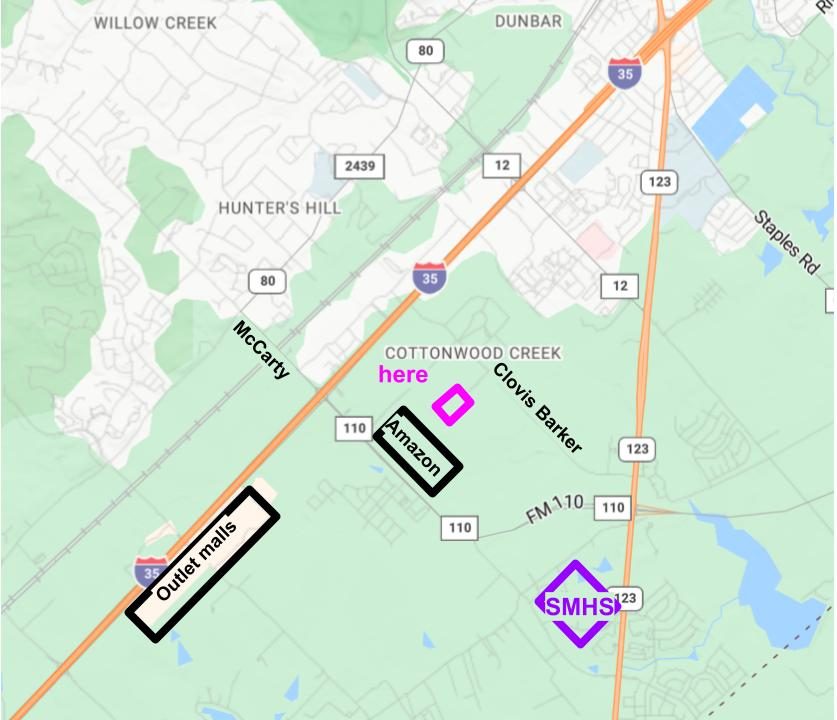
They make concrete, and they’re here:
The owner wants to zone two little blocks of land, between Heldenfels and I-35:
He wants these to also be Heavy Industrial.
No one is fussed. Everyone says okay.
…
Items 14-16: Ok, it’s time for the AI Data Center. This is a doozy.
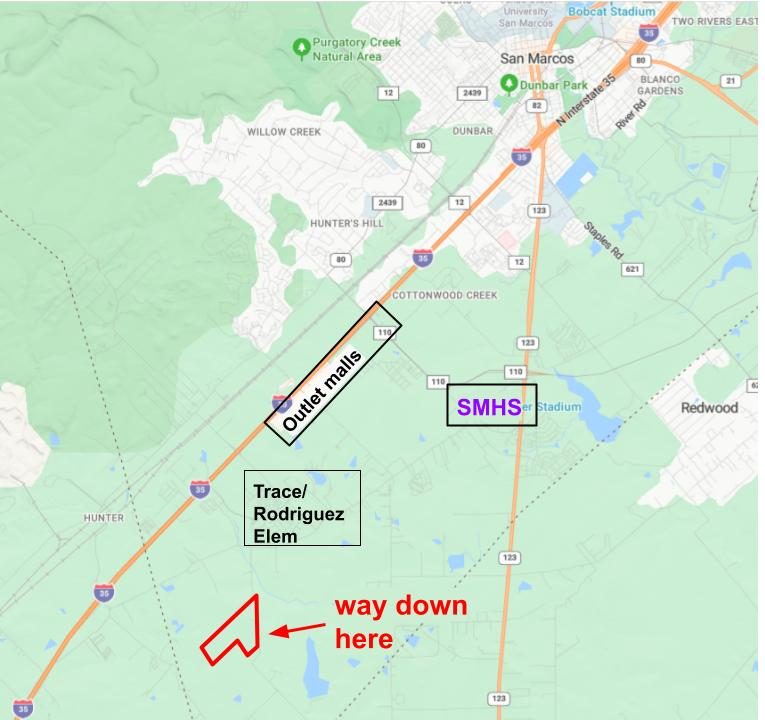
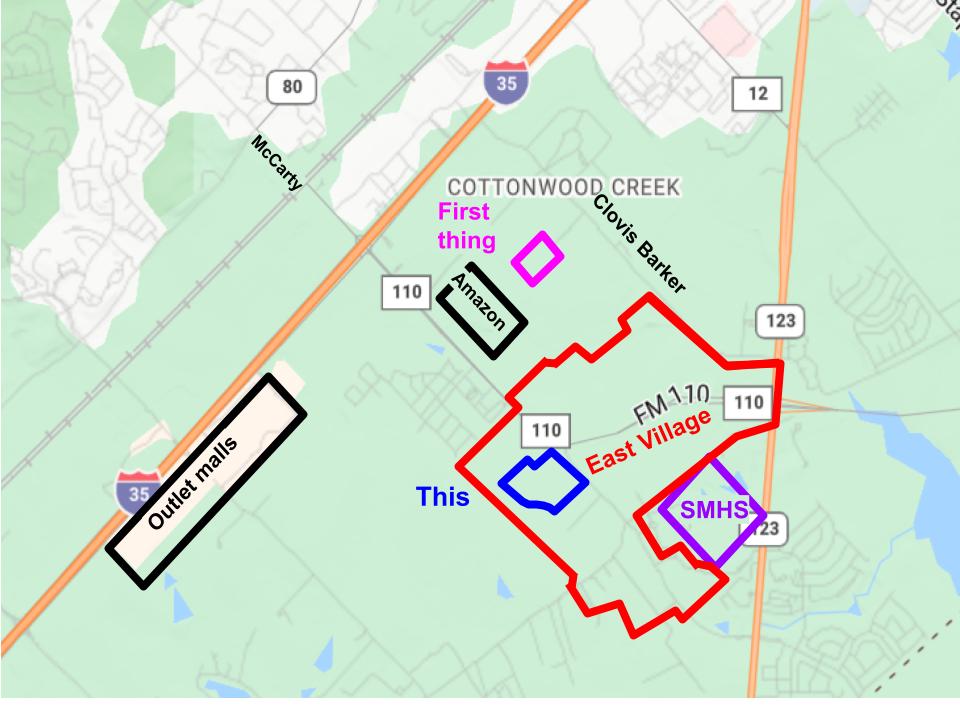
Background: We are talking about land here:
The property owner wants to zone this land Light Industrial, so that he can sell it to Cyrus One, a data center company.
Let’s talk about data centers
Apparently there are 300+ data centers already in Texas. Of those, 40 are in the Austin and 49 are in San Antonio:
Not counting the one on tonight’s agenda, there are apparently two being developed in Caldwell County and three more in Hays.
Data centers have two big problems: they use a lot of water and they use a lot of electricity. Texas makes this worse, because counties aren’t allowed to regulate use of natural resources. (Virginia Parker, director of the San Marcos River Foundation, said we’re the only state with this particular idiocy.)
So as long as data centers stay outside of cities, there is currently no way to regulate how many get built.
This specific data center
The owner is a guy named Mayberry, and the property has a funny history. (Not funny haha.)
Back in 2022, he asked the city to annex most of this land into San Marcos. He wanted to sell the land to a developer, to build single-family homes out there.
This was always a weird, terrible idea! First, the sprawl would be insane. It’s farm land out there, not close to anything.
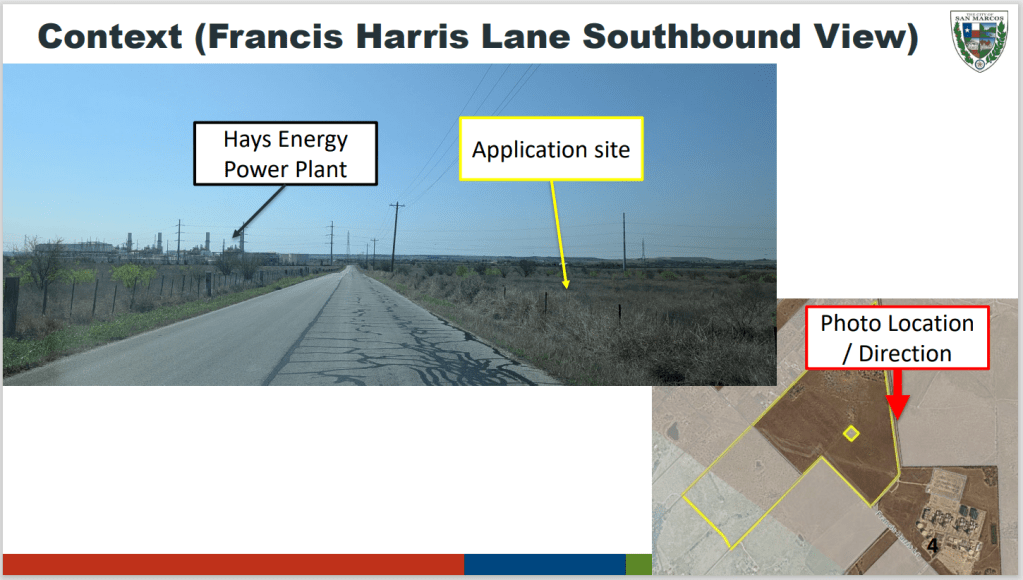
Second, there is a massive power plant next door:
Council had endless discussions about whether it was fair to build homes next to an extremely loud, bright, flashing power plant. In the end, they settled on a mandatory disclosure to potential buyers and some fencing.
It’s been three years, and clearly no one wants to build these houses. So Mayberry has moved onto the next idea, which is this Data Center.
But since most of the land has been annexed into San Marcos, he now has to get permission from the city to rezone.
In this one data center, and only this one, we now have a say.
Back in March, Planning and Zoning denied the rezoning. (In fact, this was Jim Garber’s last meeting.) Planning and Zoning had a ton of concerns.
When P&Z votes down a rezoning, it takes a supermajority at Council to overturn them. So tonight, the data center will need 6 votes out of 7, in order to pass.
We’re going to cover these topics next:
Noise and lights
Water
Electricity
Impact on San Marcos, and the Restrictive Covenant
Property taxes
Buckle up!
Noise and lights:
Staff basically says, “Look, plenty of data centers are in residential areas already and everyone seems to be chill with it. Look!”
“Isn’t that so close? See?”
“And also, what if Mayberry had built those homes! Wasn’t that an even worse idea?”
(For the record, Jane, Shane, Mark Gleason, Saul, Alyssa, and Jude Prather voted yes for those homes, in 2022. Max Baker voted no.)
The comparison to the imaginary, nonexistent homes is silly. The homes don’t exist.
…
Here’s the real argument the city should have made: this data center is next door to the Hays County Power Plant.
Seriously, the noise, lights, and weird vibes that come from this data center will be dwarfed by what’s already coming from the power plant.
2. Water:
Data centers run hot, and so they use a lot of water to keep the computers from overheating. A traditional, evaporative system uses maybe 550,000 gallons/day?
Technology has gotten better, and now they use a closed loop system. You fill up the building one time, and then it keeps re-using that water for the lifespan of the building. After that, the only water needed is for employee bathrooms and kitchens.
Mayberry says that the initial fill up will require 60K-70K gallons of water per building, and there are 5 buildings. So roughly 400,000 gallons will be needed to fill the buildings, one time.
After that, he says that each building will use about 4-7K gallons of water each day. That’s pretty normal for a business:
3. Electricity:
The electricity is insane.
Mayberry says that each building will use about 75 megawatts of power. So over five buildings, they will use 375 megawatts.
City staff says that all of San Marcos, at peak usage, is about 150 megawatts. Every single one of us, on the worst day in August! That’s insane. On a typical October day, all of San Marcos uses about 25 megawatts. So these data centers really do gobble up a ton of energy.
Two questions come up: – Will this drive up water use, indirectly? – Will this drive up rates?
Both answer are yes, sort of.
Producing electricity requires water. But it’s not using San Marcos water – it would be from any power plant, in the entire state. All the electricity from all of the power plants gets dumped in the grids, and it gets blended around. When you draw electricity, you’re getting a random blend of all those sources.
(Also, not all energy sources require water. Gas, coal, and nuclear all do, but wind and solar don’t.)
The same is true for electric utility rates: all 300 data centers are putting a huge strain on the grid. More power needs to be generated, and that is going to cost money. But that cost is going to get spread across the entire state.
4. Impact on San Marcos and the Restrictive Covenant:
This data center will not use San Marcos water or San Marcos electric. Water would be supplied by Crystal Clear water, and they’d get electricity from Pedernales.
All data centers in central Texas are harming all of central Texas. The bad effects are distributed pretty evenly. We’re all using the same water table and tapping into the same electric grid.
This specific data center does not specifically damage San Marcos or the San Marcos river.
The Restrictive Covenant: A restrictive covenant is a legal contract of all the hoops that the developer is willing to jump through, for the city.
Since getting knocked down at P&Z, Mayberry is trying to do whatever he can to get approved. Here’s his offer:
and
5. Why even do this?! (Property taxes)
Allegedly, it would bring in an enormous amount of money.
To put that in perspective: This past year, we’ve had a budget crisis, and city departments had to make cuts. Total, across all departments, we cut $100,000, and it was a huge strain. $9 million would go a very, very long way.
My two cents
I’m out of step with my readers here, and I apologize. I think we should take the money.
Data centers are run by greedy, irresponsible corporations that do not care about local resources. They will exploit and destroy all the beauty in this state, if they can. Texas desperately needs to regulate this industry and limit the number of data centers that are being built.
And yet!! I think we should hold our nose and let them pay us lots of money. There is so much need in San Marcos, and so much poverty.
Rejecting this does not move the needle on the actual problem. Take the money.
Here is what Council says:
Matthew Mendoza goes first, and he is fired up. He says:
I voted against putting houses by the power plant. Terrible idea.
We didn’t annex SMART/Axis because of local activism, and now they’re building anyway, except unregulated. I get complaints every day from people who live in Pecan Park. Annexation means regulation, and that’s good.
We cannot run this city on tax income from neighborhoods. It’s not sustainable. You all don’t pay enough in taxes for how much it costs to run a city.
We need opportunities in this town. My blood is in the river and soil! Jim Garber was my scout leader!
Jane Hughson goes next:
I have a ton of water cred. I was the first chair on the board of the Edwards Aquifer Authority, senior board member of ARWA, etc.
I’ve got some concerns, but I also am open to negotiation.
Listen up: you think you hate living next to a data center, but you would really hate living next to manufacturing. I’m trying to keep that from happening to you.
The amount of power needed is crazy. I have a lot of questions that we’ll get to.
Saul Gonzales goes next:
No. I’m a hard no. I listen to my constituents, and they know more than me. Everyone knows my reasons why. No.
I’m also a hard no. I’m not going to dismiss the voices of this many people.
…
Let’s pause and talk strategy:
This item needs 6 out of 7 votes to pass. Saul and Amanda are voting no. Therefore it can’t pass.
But everyone pretends like this didn’t just happen! We proceed to have a detailed discussion for the next hour. It was a little weird.
However: the ending is not black and white, so I’m going to force us to walk through all this slowly.
…
The nitty-gritty questions
Q: Can the restrictive covenant be changed? A: Yes. This is just a first reading. Staff can bring back changes for second reading.
Q: Is the property owner willing to make the covenant permanent, instead of expiring in 20 years? A: Sure.
Q: How can we enforce the covenant? A: A bunch of different ways:
1. The biggest items are how buildings are built. We withhold occupancy permits until it passes inspection. We have a lot of leverage there.
2. We can require them to submit their monthly water bill to the city, and make it publicly available.
3. We have an (overworked, underfunded) code compliance division who will make the rounds out there and check for things like noise violations.
4. For any other violations, we’d take them to court and get an injunction. Court orders them to stop doing whatever they’re doing.
Q: How do you end up using 4-7K gallons of water in each building, each day? A: That’s pretty standard for a regular office building with a bathroom and kitchen. Nothing major.
Q: If you ever had to drain the closed loop, what would you do with all that water? A: It’s got a ton of awful chemicals in it. It would need to be disposed of as a hazardous waste. That can’t go down the drain.
Q: Can they build their own gas power plant and get around ERCOT? A: Not if they’re in the city limits. They’d need approval from P&Z. If they’re outside the city, yes.
Q: Why does everyone have stories of how this will cause electric rates to rise? A: Electric rates will definitely rise, because of the 300 data centers across Texas. Whenever there are new grid costs, those costs are spread across the entire state. So we’re already facing this. This particular one doesn’t affect us any more than the rest.
Q: Can you use reclaimed water on all your landscaping and stuff? Will you be sustainable? A: Sure.
Q: Can you fill the original big amount of water using reclaimed water? A: Probably not worth it, to run pipe across the street for a one-time use. Q: but could we use a water truck? A: Yes, that would solve the pipe problem. We don’t know if it’s okay for a data center.
Q: Go back over the part about how much water it takes to make electricity. A: It does take water to make electricity, if you’re using non-renewable energy. But not for wind or solar. But all the electricity goes into a big mushpot. So data centers just draw a big blend of energy. It’s not coming from the San Marcos river or anything.
Also, if you’re starting a new power plant, you have to show ERCOT that you’ve purchased the water rights before you connect to the grid. You can’t just start using the Edwards Aquifer for your new power plant.
Q: Remember that KUT article about how we’re running out of water? It was factually incorrect and scared a lot of people. A: I know, right?! That was crazy. It was like the author missed the part of the presentation with the good news. We reached out to them, but they ignored us.
Q: Go back over the electricity usage again. A: Each building uses 75,000 MW of power, and there are 5 buildings. So they use 375K megawatts, altogether. On a typical day in October, San Marcos uses about 25K megawatts, and our peak usage is about 150K megawatts.
HOLY MOLY.
A: But keep in mind, they’re not on San Marcos power. But also keep in mind, the grid costs are shared by all Texans.
Q: How easy would it be for them to go through disannexation from the city, and build here anyway? A: It’s actually pretty hard to disannex. They’d end up having to sue us.
Q: So is Cyrus One backing out of the project? Why are they not here? A: No. They said they are “withdrawing from the zoning case.”
Translation: Cyrus One does not want to deal with San Marcos residents. To be super duper clear, they are 100% assholes who will screw over everyone and anyone. (I’m still okay taking their money.)
The vote
By this point, it’s well past midnight.
It’s finally time to vote:
So it fails! Remember, it takes 6 votes to override P&Z.
Remember an hour ago, when Saul and Amanda both said they were “no” votes? Lo! it hath come! As heralded.
The vote has failed.
…
SO IS IT DEAD???
No. This is where it gets murky.
Council dabbles in entertaining the notion to send it back to P&Z. The argument goes like this: “P&Z didn’t see the restricted covenant. Maybe they would have approved it, if they saw the current version! And if they approve it, then council only need 4 votes to pass this, and not 6 votes.”
However, Council cannot just send it back to P&Z. Either Saul or Amanda have to agree to reopen the issue. They both say no.
Amanda, in fact, is quite angry: “You lost a vote. Quit trying to find a workaround.”
(I mean, I’d be furious if I opposed the data center, as well.)
Council does not quit trying to find a workaround! They have a giant conversation about it. In fact, they break out the giant rule book of technicalities, to figure out what’s allowed and what’s not allowed. Will the developer have to wait 6 months or 12 months to re-apply? Or can they waltz in tomorrow with this exact paperwork, and re-apply, and go to P&Z for approval?
Answer: [This answer takes a while. Picture much shuffling of paper, scrutinizing all these detailed scenarios, double-checking what exact words were said. But eventually…] There is no waiting period. They can waltz in tomorrow.
So there you have it.
…
Bottom line: This application is dead. But Council left a trail of bread crumbs for the applicant to re-apply to P&Z and get a better outcome.
…
Item 19: Upcoming budget details!
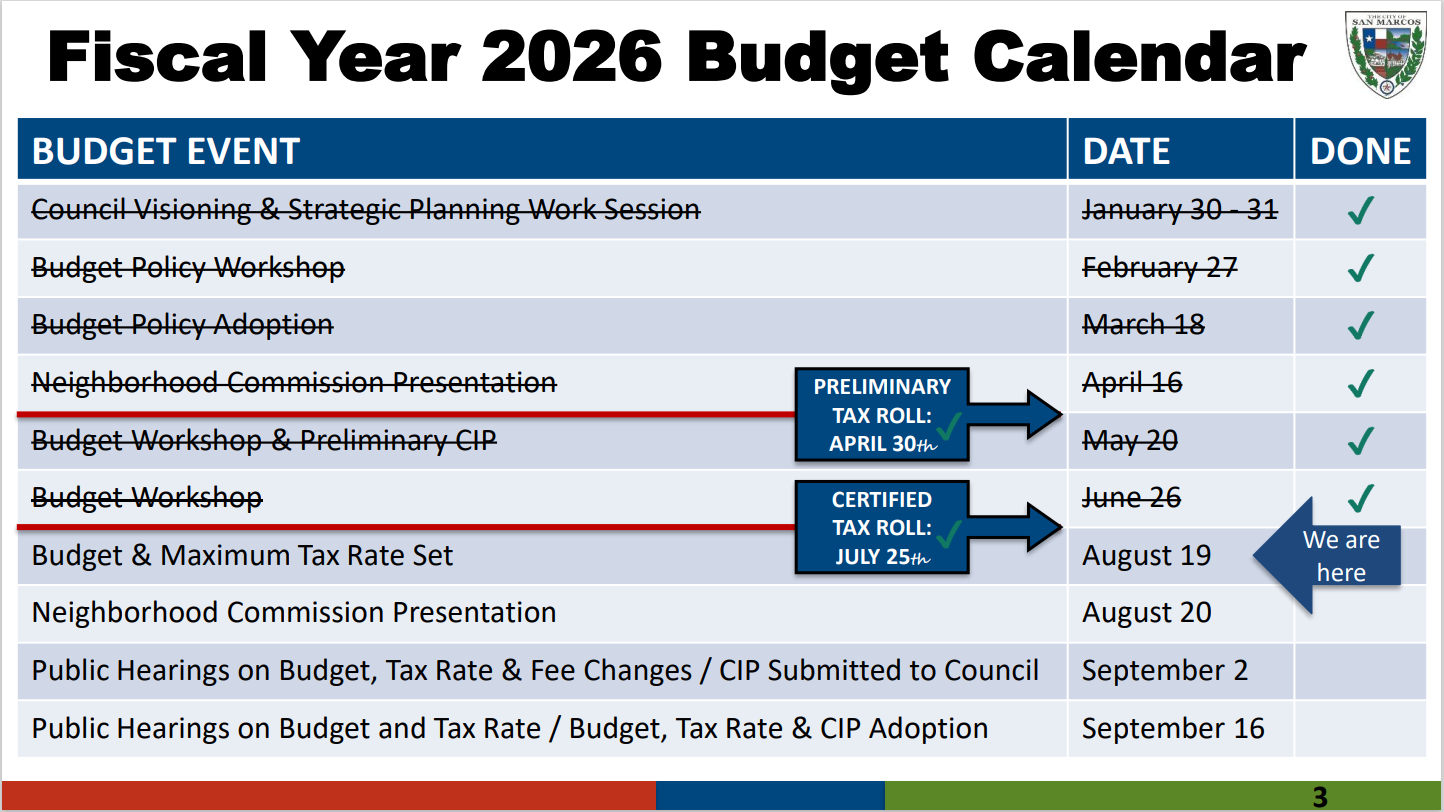
We’re beginning budget season. At this meeting, Council sets an upper bound for the property tax rate for next year.
In many ways, this is a continuation of the 3 pm workshop conversation.
Normally there would be a big presentation. But it’s 1:30 am by now. I’m just going to zip through some key details.
Our property taxes are down:
If you add in newly built property, it’s a little better, but you can still see the problem:
Here are the different property tax rates that Staff proposes for Council:
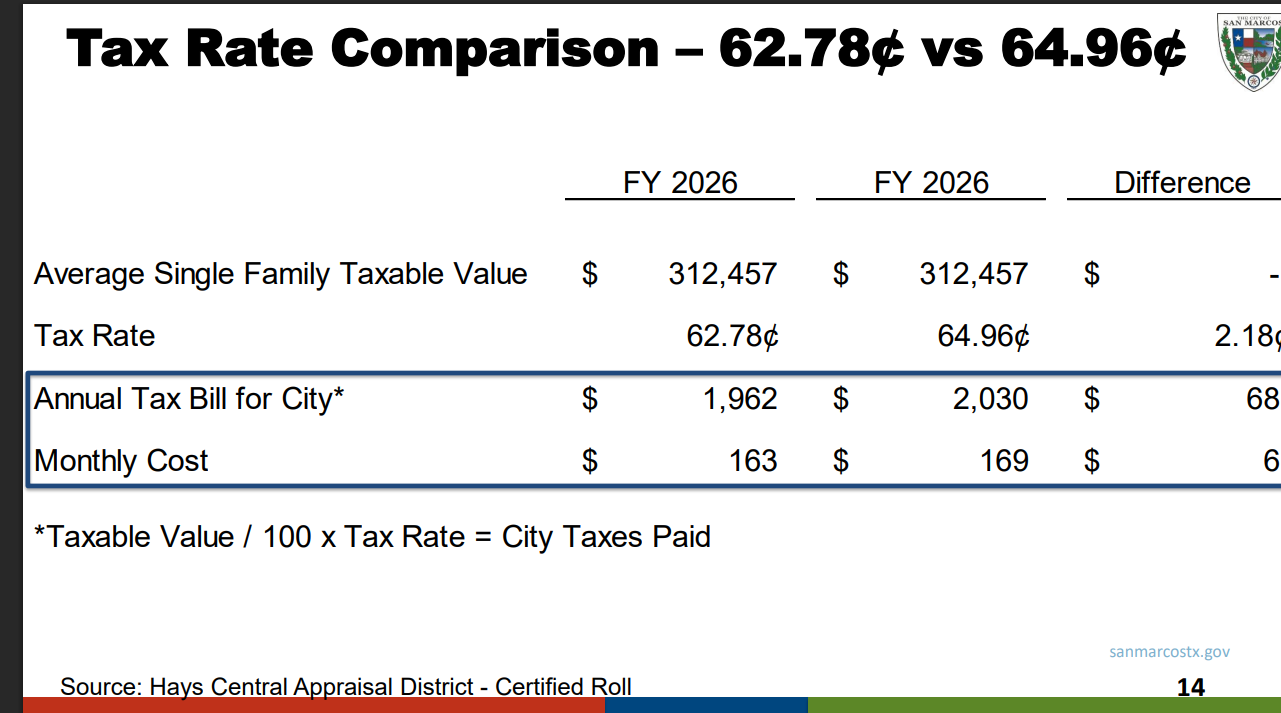
and here’s what that means in terms of your property tax bill, if you’re a home owner:
Council ends up choosing ¢67.69 as their upper bound.
There is a really long discussion of how they got to this number at the 3 pm workshops. So if you’re curious, keep reading.
…
Item 20: Changes to the LDC
“LDC” stands for Land Development Code. All year long, staff makes notes about all the little improvements that anyone ever mentions. There are also things they have to change, based on the new laws passed by the legislature.
This is a big, long complicated process that will take months.
Everyone is exhausted, and they don’t go through the details. It’s going to come around a few more times, though, so we’ll unpack it before it passes.
…
The meeting was finally over at 3:11 am.
In other words, council members just spent TWELVE HOURS sitting in those chairs, up at the dais. That’s rough!
We get money from property taxes and sales taxes. In San Marcos, we’re split pretty much 50-50 between the two:
Our property tax rate is on the higher side:
but there are some reasons for that. For example, we have a lot of tax-exempt property:
particularly because of the university. You can also see Gary Job Corp on that map.
(I always love it when I-35 is drawn East-West.)
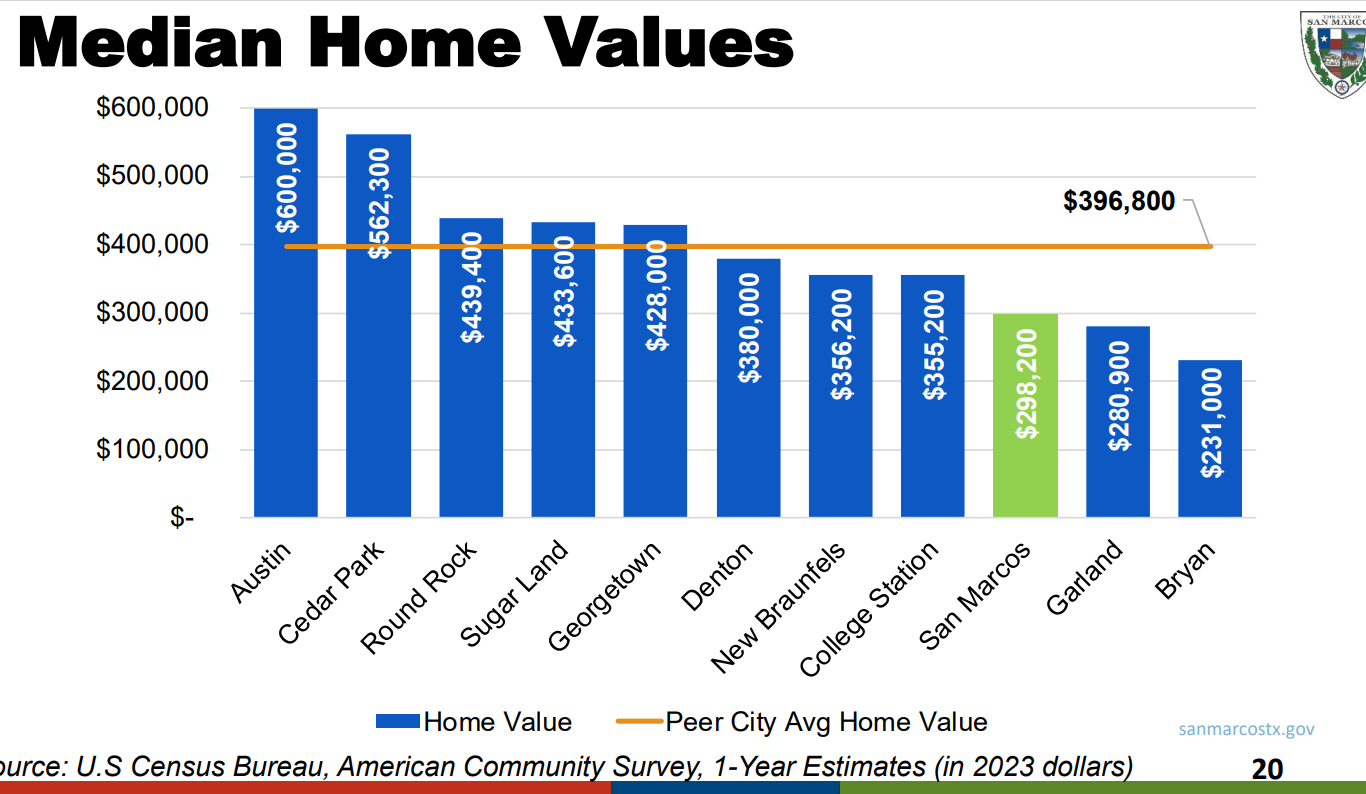
and also because our houses are less expensive on average:
and so we struggle to pull in enough revenue.
So altogether, here’s what an average person pays in property taxes:
Now if you’re a homeowner, your property taxes also include schools, county, and special roads district. So it’s actually significantly higher than that. That’s just the part that goes to the city.
Here’s how we’re doing on property taxes:
Sales tax dropped in 2024, and it sent our budget into a bit of a tailspin. But it’s working its way back up.
Here’s how much the city spends on each person, on average:
hey, that’s a bargain! $4610 worth of services for only $1798. That’s a better ROI than you’ll get from the stock market.
The state legislature is always trying to make everything harder on the cities:
because they are counterproductive twats.
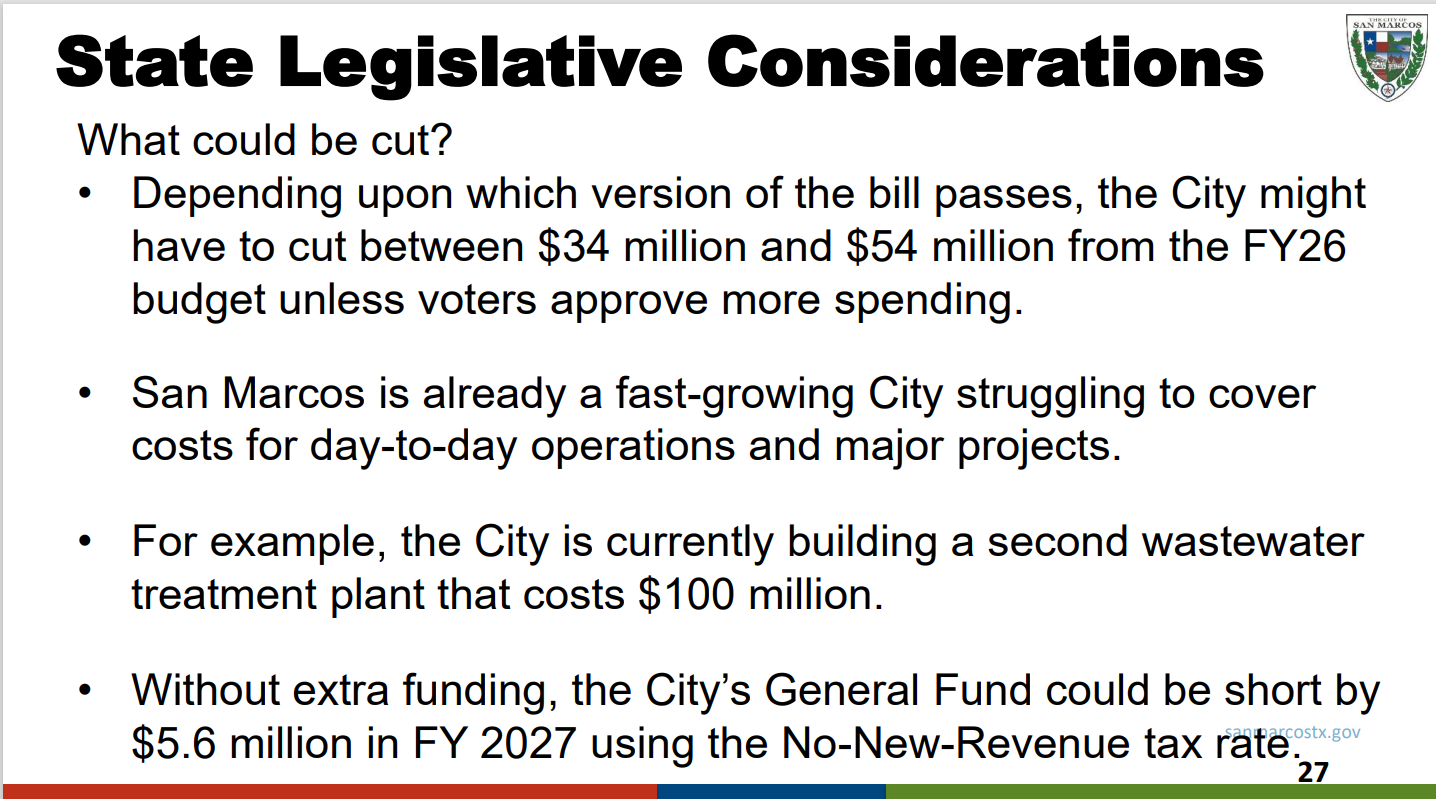
Here’s how it might affect San Marcos:
…
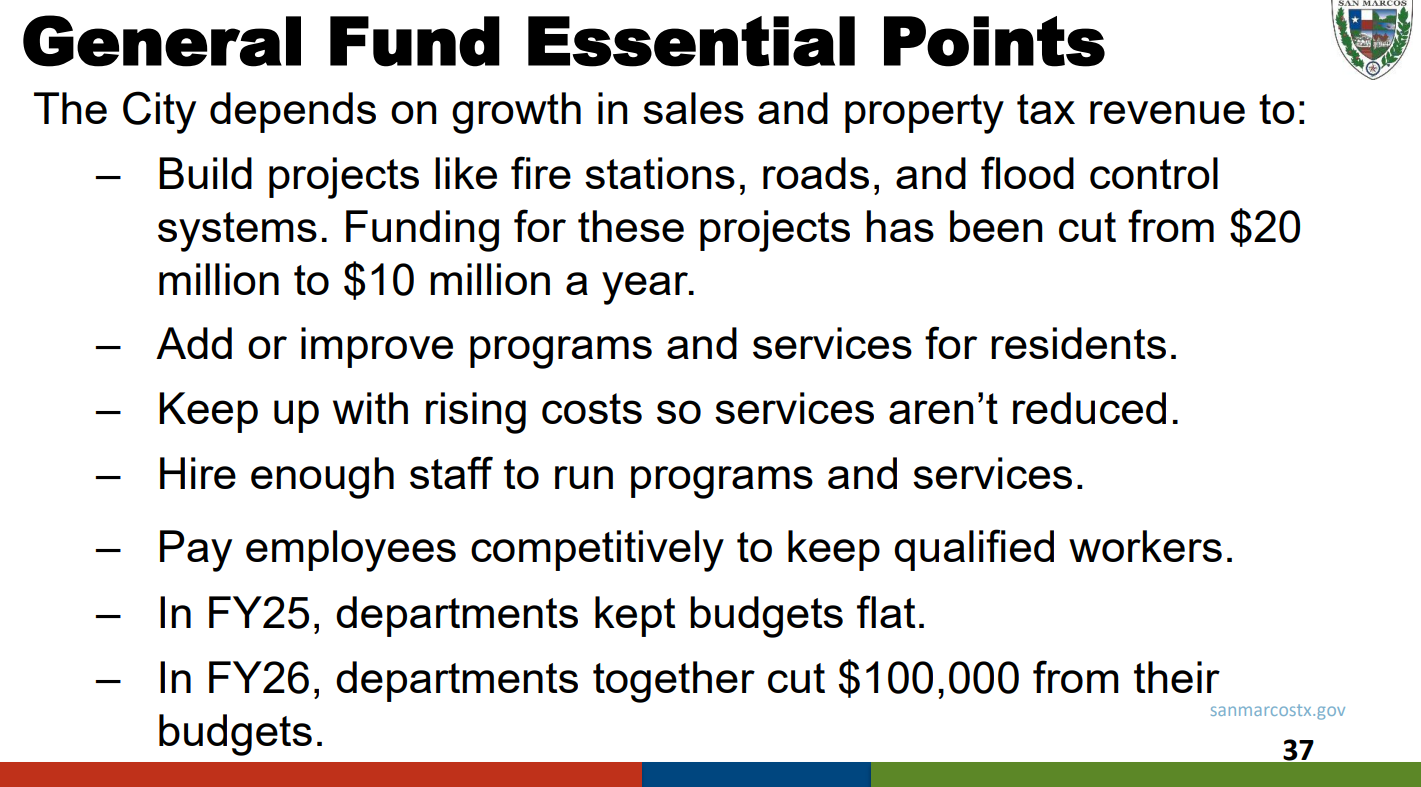
Basically, we’re in a bind. Here’s two slides describing how we’re caught between a rock and a hard place:
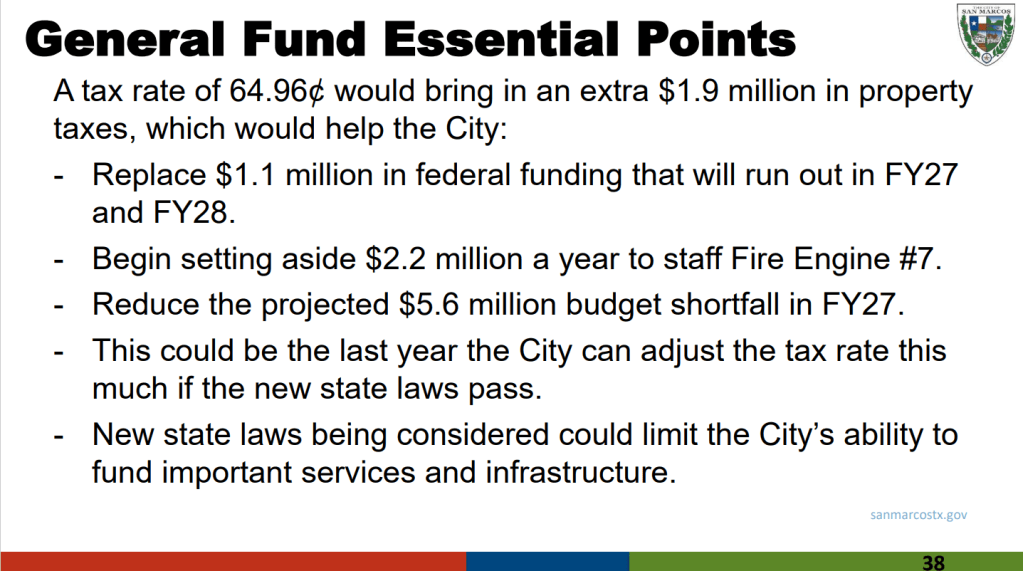
and
Especially notice those last two bullets. The city is growing and inflation has been a big thing, and yet budgets have gotten leaner. This is not sustainable.
This brings us up to the current scenario. Council has a few choices:
The first one is the “No-New-Revenue” rate. If the property tax rate is 62.78¢, the average home owner will pay the same amount they paid last year.
In this case, we can skate by this year, and we’d be in the hole next year.
The next one is the Long-Term Focused Tax Rate, 64.96¢. This helps us keep up with inflation and growing expenses, over a longer term.
The last one is the Voter-Approval tax rate, 70.47¢. They’d never go for this, but in theory it would bring in a lot of money. Anything above 70.47¢ requires voter approval at the ballot box.
[Note: The (3,000,000) isn’t what it looks like. That’s balanced out by the “Fund balance in excess of 25%” line above.]
So what would we do, if we did the middle column of 64.96¢?
It helps plan for some financial cliffs that are looming.
…
Here’s these three tax rates, again:
The middle column buys us an extra year to plan for the looming financial cliffs. (The rate in the third column ends up lasting until 2028, and then we go to the red.)
…
You can probably see why that $9 million from the data center looks so helpful. 😦
…
What does Council think?
Matthew: I’m going with the ¢64.96 rate. Saul: Same. ¢64.96
Lorenzo: If we go with the middle rate, will we be up this same creek without a paddle next year? Answer: Somewhat. The state legislature may hamstring us, yes.
Lorenzo: How does tax rates translate into revenue? Answer: Every penny brings in about $800K.
Lorenzo: I want to pick a number that heads off a projected shortfall in 2027. So I think roughly ¢67-68.
Jane: How would we prioritize cuts? Answer: It starts getting into staff, because we’re already so lean. That’s a very hard question.
Alyssa: I don’t know.. I don’t have enough information. I’m willing to lean towards the middle, but I need to know more about how we’d use that extra $1.9 million. Answer: Council can prioritize how we use it. Alyssa: Then I can go with the ¢64.96.
Amanda: The legislative damage is highly likely to pass this session. Originally I was thinking ¢64.96, but I’m open to Lorenzo’s point about the ¢68. I want to take care of our employees, and making sure we’re keeping up there.
Jane: I want to see the impact on the average voter.
Amanda: Is it possible to see the impact on the average renter, as well?
Jane: I’m comfortable with the ¢64.96. And if the state school tax exemption passes in November, I can go a little higher.
They all want to see the impact on the average tax bill. How much would these new rates increase the tax bill?
…
They also discuss utility rates and other things. The Citizens Utility Advisory Board is recommending a 4% increase in electric rates.
This is slightly less of an increase than last year. Everyone’s goal is to make slow, smooth, steady increases, because otherwise after a few years, you have to make a giant leap in rate increases. That’s much worse
Commercial rates are a little higher:
Similar for the water/wastewater rates, trash, and community enhancement.
Here’s how all these increases will impact your monthly bill:
…
I’m returning to the end of the regular meeting, now. In Item 19, city staff returned with the answers to some of the questions above.
How would these different property tax rates affect someone’s property tax bill?
2. A list of possible things Council could fund with the extra money. (I couldn’t get a clear screenshot of this, though.)
Everyone has to weigh in with their max tax rate. 67.69¢: Alyssa, Matthew, Saul, Jane 68.17¢: Shane, Lorenzo, (but not committing. Just to give wiggle room), Amanda (same)
So! 67.69¢ is the upper bound this year for the tax rate.
Fire up the press! We’re back! This week, we’re talking about the land next to El Centro, an ordinance protecting tenants, and a sketchy SMPD grant for $25K.
Let’s go!
Hours 0:00 – 3:27: the land next to El Centro, the Lions Club, and a $25K grant for SMPD.
Hours 3:27 – 4:14: Should San Marcos have a Tenants Rights to Organize ordinance? (yes.)
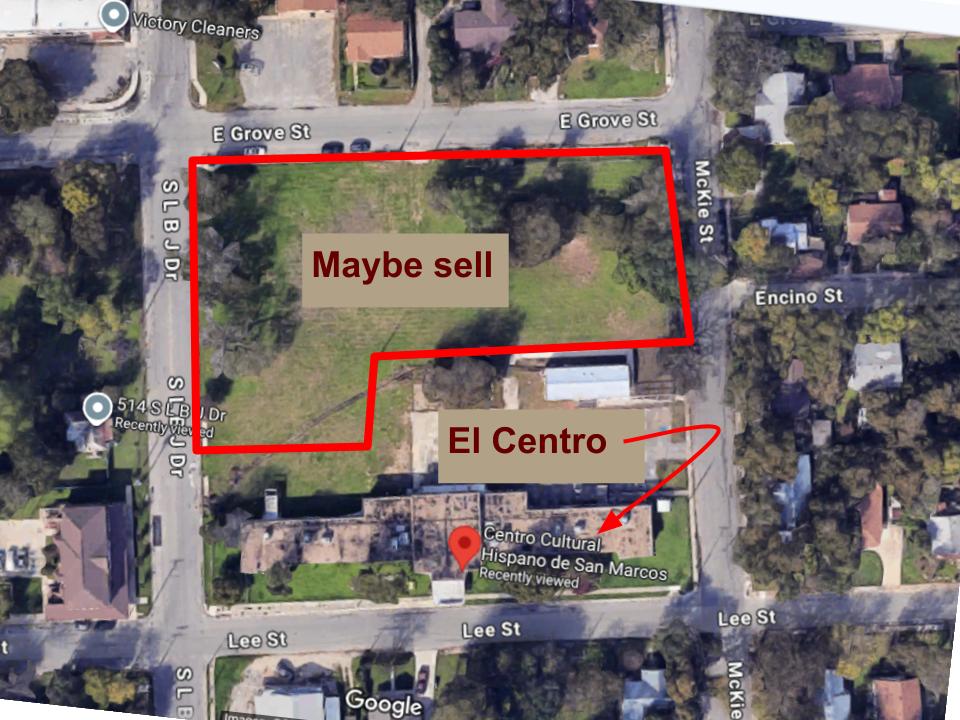
I think what’s going on is that the school board wants to sell off the rest of the property:
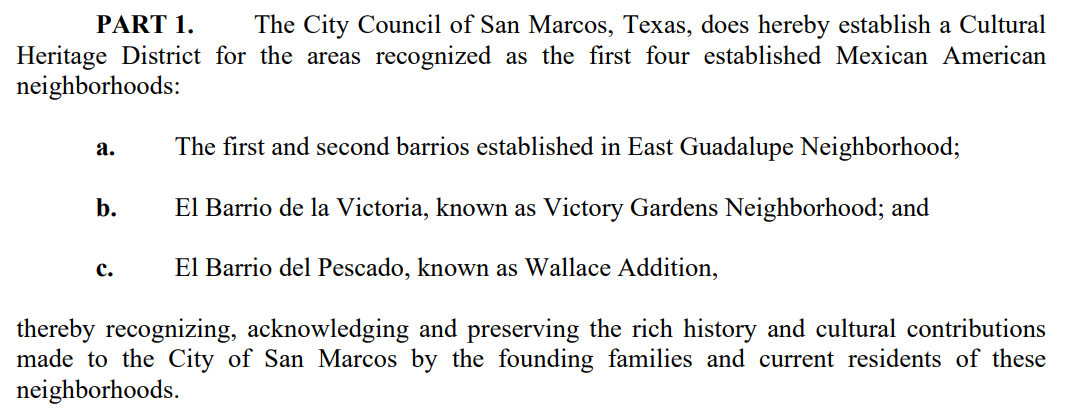
This block sits within the Mexican American and Indigenous Heritage and Cultural District. (This district was created in 2021, and then never mentioned again. Literally, I searched.)
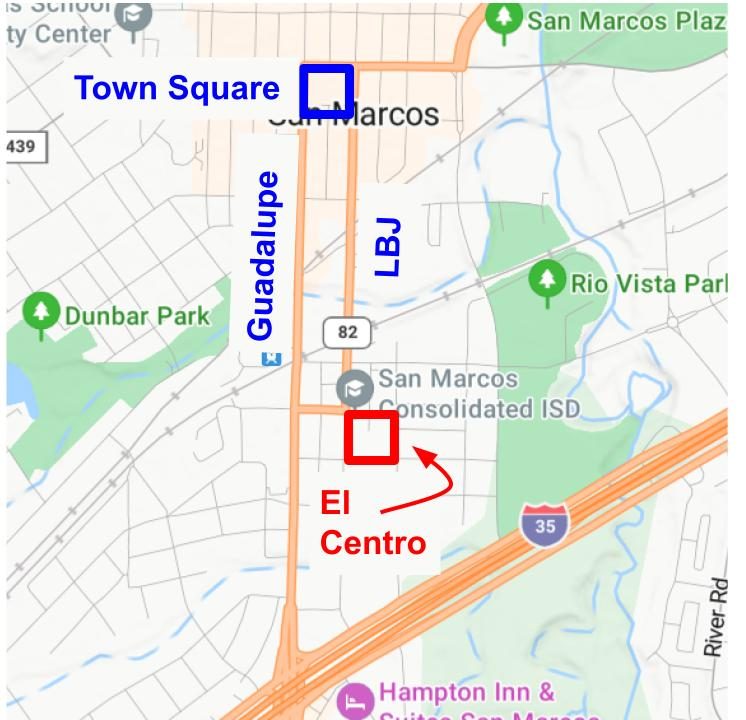
I don’t think there’s a map of the district anywhere. This is the closest thing I found:
Professor Ana Juarez started up a petition a few weeks ago to get the city to buy the land, so that it doesn’t become developer-bait. It’s got a lot of historical significance:
Over 900 people signed the petition so far! And a bunch of people signed up for citizen comment.
This brings us to Tuesday!
Purchasing this property got put on the agenda for Tuesday’s meeting. But the city put it in Top Secret Executive Session, so it wasn’t discussed publicly. It sounds like this choice riled up a lot of people? and city staff got an earful of complaints about this?
So Ms. Reyes issued this disclaimer: “Hey, we love this property too! But we have to put real estate discussions in Executive session. It’s not some weird scheming thing. Also if we want to move on this, we have to move fast, because it’s time-sensitive.” (I’m paraphrasing.)
So the city is trying to get on board! This is great news. But the school district and the county also have to buy in. If you’re so inclined, you can:
The Lions Club: ten people from a bunch of nonprofits spoke in favor of renewing their lease.
Tenant’s Right to Organize: seven people spoke in favor.
Buying the land next to El Centro: three people in favor
We’ll discuss the Lions Club and the Tenants’ rights items at length.
A few smaller topics:
three people speak against the AI data center proposal. This is supposed to be decided at the August 19th meeting
One candidate for council introduces himself: Brandon Oles. (Another candidate – Chase Norris – also spoke, but not about the election. He spoke on tenants rights, Lions Club, and El Centro.) They’re not running for the same place, though, so they’re not opponents.
…
Item 5: The Texas State Boutique Hotel
We saw this back in July. Almost everything is the same, but Amanda mentions a few important wins:
Wages will rise automatically with inflation
If you work 25 hours per week, you’re eligible for medical/dental/vision benefits.
Those are both really great for workers.
The vote:
My two cents: there’s not much downside for the city, but it’s hard to imagine this hotel turning a profit.
Here’s how it works: The city leases the building to the Lions Club, and they’re the only group that can run shuttles and rent tubes for this stretch of the river.
The Lions Club then donates all their profits to organizations around town, and also fundraises for additional money for donations. (Lions Clubs have chapters all over the world, where they fundraise and give money to nonprofits. Ours just happens to run a tubing operation.)
…
Tuesday’s question: Should we extend the Lions Club lease at the tube rental for another five years?
Alyssa has a number of questions. Basically, she appreciates the Lions Club’s good work, but her constituents want to better understand the charitable funding decisions. How does the grant selection process work?
Answer: The Lions Club accepts grants all year long. There’s no fixed due date.
Here’s how much our local chapter has given out, over the past five years:
Here’s a list of everyone they’ve funded over the past few years:
Question: What kind of outreach do you do? How do nonprofits find out about your grants? Answer: We reach out to any organization that we’ve worked with in the past, but we don’t have contact information beyond that.
My read on the conversation: I’m guessing that Alyssa hears complaints that grants keep going to the same agencies over and over again. And also: some of those organizations are politically touchy. Why these organizations, and not others?
Answer: these aren’t city grants. This is a city lease of a building to a private organization. City grants require transparency and oversight, but a private organization can give out grants however they want.
My two cents: Let’s not make the perfect the enemy of the good. The Lions Club donates to lots of great nonprofits around town, they partner with river clean-up, and they employ lots of young people. They work hard to make San Marcos better, even if they do things slightly differently than I might.
The vote to renew the Lions Club lease:
great!
…
Item 18: $25,000 from the Department of Justice to SMPD
Ok, this is fascinating.
Last year, SMPD teamed up with Hays County, and applied for a grant from the Department of Justice. Together we were awarded $37,516. The plan is to split off $25,500.00 for San Marcos, and then Hays gets the other $12,000.
So that’s why it’s on the agenda tonight – are we okay sorting out this split with Hays County?
Everyone seems okay with this!
…
Say, what are we spending this money on, anyway?
Ok, fine. Technology, and yet another camera. (Not a flock camera, though.)
What’s a JAG grant, anyway? Is it specifically about technology? It hadn’t occurred to me to wonder about that, but Amanda went and looked them up:
Indigent defense! Crime prevention and education! Drug treatment, mental health programs, behavioral programs, crisis intervention teams! Out of all those possibilities, we landed on… some new software and a pole camera?
Amanda would like to know if we could change the scope of our funding towards something a little more aligned with council priorities? and Alyssa asks how this happened?
No one has a good answer! So let me help: this grant was written last year, and this would have been totally fine with last year’s council. They liked technology and cameras! Alyssa was the only one on council last year who would have rejected this. Everyone else would have given this a big thumb’s up.
This is a new year, with two new councilmembers, and now we have a coalition of progressive voices up there! It is making a huge difference.
Jane is fine in principle with changing the scope of the grant, but she’s worried that if we have to go back to the federal government, they’ll cancel the grant altogether and we won’t get any money. (That’s a valid concern.)
It goes in circles for a long time. But eventually, they land here: staff is going to see if we can change the scope of the grant. This will come back in September.
…
Side note: What about the other half of the grant? How is Hays County spending their $12K? Are they going to fund mental health initiatives and indigent defense? Will they crusade to a more just society?
Answer: They’re buying vests!
okay then. I hope they look dapper.
…
Item 22: 100 acres south of McCarty
We’ve seen this property here before, just in July:
Nothing important happened on Tuesday. It’s going to be discussed on September 2nd. I’m really only bringing this up because I saw this news article and this other news article pop up.
I did thumb through the draft proposal, though. Supposedly it will have:
Two big apartment complexes (800 and 400 apartments)
A much smaller number of townhomes (44 townhomes)
84 houses for sale
120 houses for rent
A hotel
“Live Work Play” mystery item
Office/retail/grocery space
Everyone keeps mentioning that there will be an indoor/outdoor recreation portion, so I assume the mystery item will be some sort of Trampoline Roller Skating Splash Pad. Let’s all spread that rumor, anyway.
The Question: Should San Marcos pass an ordinance that would protect tenants’ right to organize? The Answer: yes! Done. Moving on!
Okay, now let’s get into it.
Backstory: What should you do if you’re a tenant, and there’s mold in your bedroom, or your AC goes out, or you have no hot water, and your landlord refuses to fix it?
In Texas, you have very few options besides suing. You can talk to your landlord, of course. If they start to see you as a problem, you might be evicted. Filing a lawsuit is expensive, of course, and if you try to sue, you might be evicted anyways.
What’s the alternative?
Basically, tenants should be able to talk to each other about their landlord problems, and form tenant organizations, and bring issues to their landlords as a united front, without worrying that they’ll get evicted or face retaliation.
We actually already have a great tenants organization here in town! The Tenants Advocacy Group, or TAG, has been working on all this with the San Marcos Civics Club, which is why this is here before council. (It’s part of a larger Tenants Bill of Rights that they’re working on.)
How do you protect tenants?
You pass an ordinance that protects tenants from retaliation if they want to organize. There are two parts:
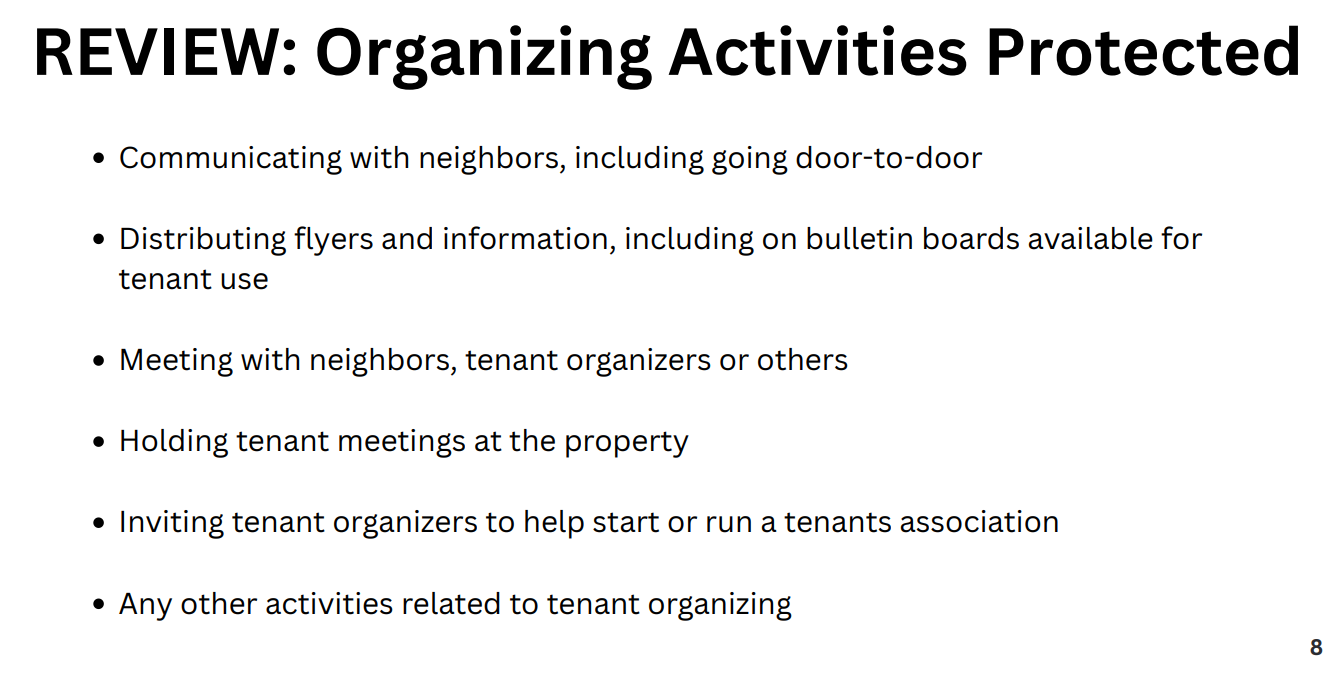
What kinds of tenant activities need protection?
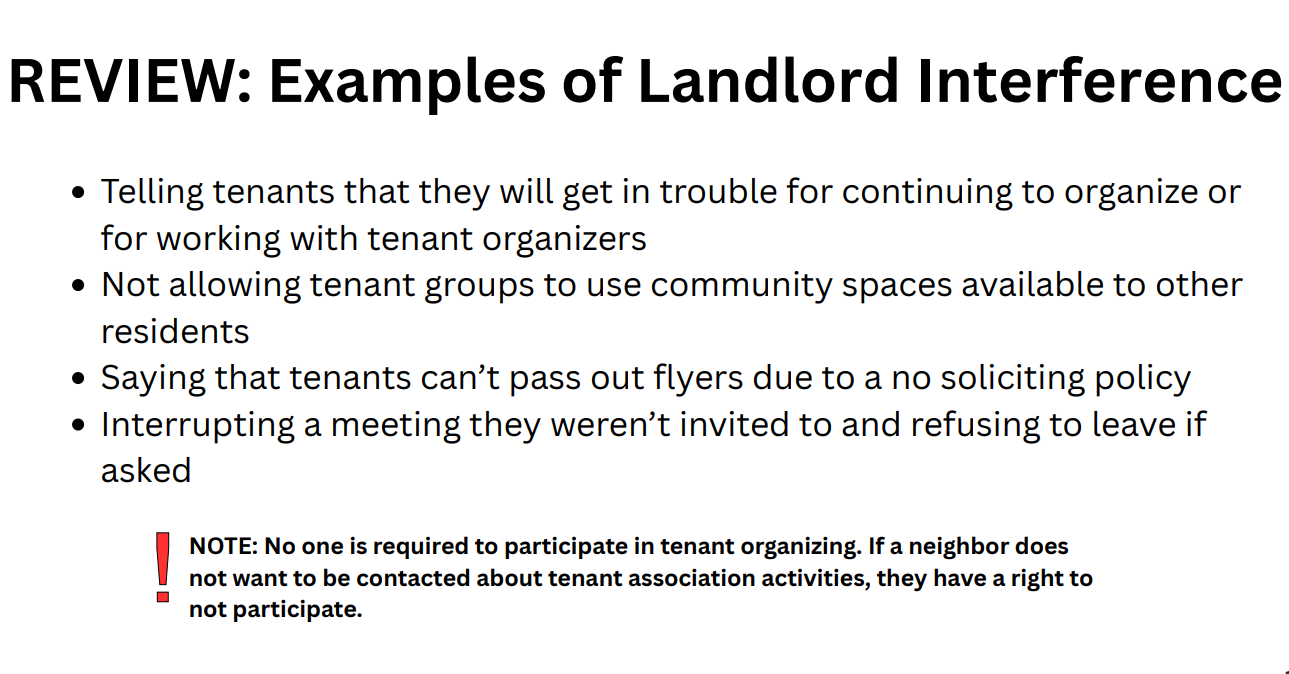
What kinds of landlord retaliation or interference needs to be banned?
Amanda prepared some helpful slides:
So that covers the tenants. And for the landlords:
The penalty would be a misdemeanor.
Are there any laws that already exist, that protect tenants?
It depends on where you live! City staff made this helpful chart:
So yes: Austin has protections. The state overall has no protections. There are federal protections, but only in subsidized housing.
The idea would be to use the Austin ordinance as a jumping-off point, and then modify it to fit San Marcos.
This brings us to Council Discussion
Jane Hughson brings up a few details – what if a property manager is interfering on behalf of the landlord? Should they be included in the language? What about trained organizers and other non-tenants who might need protection? Can we avoid having the fliers become litter?
Amanda: Great ideas! We should definitely workshop this.
Lorenzo: A Class C Misdemeanor requires a police officer. I don’t want to criminalize landlords.
Note: Historically, marginalized groups are over-policed and criminalized. Fortunately, landlords are not historically marginalized! They’re pretty much the opposite. They’re the marginalizators!
Groups that have historically held outsized power – like landlords, or wealthy people, or police officers, or elected officials – are generally under-policed. In these cases, cities need to be more consistent with enforcement, and not worry about criminalization.
Lorenzo: Can we work out the details in a subcommittee? I don’t want to modify Austin’s ordinance. I want to write ours from scratch.
Jane: I agree. Let’s get a subcommittee going, and write out something homegrown.
Note: These are both bad ideas.
Don’t bury something in subcommittees. As Alyssa puts it, “Council subcommittees are where dreams go to die.”
Don’t reinvent the wheel. If Austin has a workable model, then let’s build on it.
Amanda points out that Austin’s ordinance has also been around for years, without being struck down by the courts. So that’s a more solid foundation to build on than if we just improvised our own thing.
City staff suggests a workshop?
Eventually everyone comes around to this idea, so it will be held on September 16th.
My dear minions: Go forth and tell Council that you think tenant protections are a great idea!
Back in 2022, the city put out a community survey, to find out how happy people are with life in San Marcos and with city services. Now it’s time for the 2025 follow-up survey.
This workshop was mostly about tinkering with the five freebie questions that the city gets to individualize. It was pretty mundane, so I didn’t bother to write it up.
Keep an eye out for the survey over the next few months! And share it with people who don’t generally respond to city surveys.
…
Workshop 2: Utility late fees and reconnection fees.
This has been a discussion for the past year, most recently here. Bascially, there was a lot of money available to help people pay their utility bills, but very little of it was getting spent on people who needed help. They’ve (hopefully) fixed that by making the application form much shorter and easier.
The second issue was late fees and reconnection fees. If you already can’t pay, do we really need to charge you more as punishment? The Citizens Utility Advisory Board (CUAB) is bringing back recommendations on what we could change.
There are two main questions:
How much of a penalty do we want to charge people, once their bill is overdue?
How much does it cost the city to disconnect and reconnect someone’s water/gas/electricity?
Penalty:
We used to charge a 10% late fee. CUAB is recommending a 5% late fee.
Disconnect/reconnect:
Here we’re just trying to cover our costs. It’s not a punishment. Back in 2014, we set $40 as the fee. In 2025, it now costs $95 to reconnect the utilities.
The problem is that if you decrease the late fee by 5% and then increase the reconnection fee by $55, they kind of cancel each other out:
So Council is a little bummed out over this.
Jane: Can people get late fees and reconnection fees paid for by the Utility assistance program? Answer: Just late fees, but not reconnection fees.
Jane: That was an oversight. I wish we’d talked that out when we were dealing with utility assistance.
…
They end up going in circles for awhile – should they send it back to CUAB? Should they split out water from electricity? Should they subsidize disconnection/reconnection fees? What if the state passes restrictions affecting late fees?
In the end, they decide to accept the proposal for now, and also reduce the water disconnection fee to $40. This will come back around for final approval during a council meeting.
Happy August, everyone! It’s that time of year where I like to organize everything that’s happened over the last 12 months. A little dry, but Council resumes normal shenanigans next week.
Note: Council has not posted minutes for meetings since May 2022! (This may finally get fixed by next year.)
Amanda Rodriguez elected to Place 6, run-off for Place 5
Riverside Drive gets their non-resident weekend parking ban
New HEB deal is officially approved
Final list for steering committee of the new City Hall. (DEI recommendations were ignored, and their recommendations ended up being out-of-sync with what the public wants.)
Last bit of ARPA money redirected for rental assistance
Rezoning natural area around Hays County Government Center, in exchange for securing land for the hike-and-bike trail from Rio Vista to Purgatory Creek.
mailing parking tickets at City Park
SMPD buying seven new Tahoes
SMPD establishing a motor vehicle crime prevention unit
Shane Scott wants to double the councilmember travel budget from $12K to $24K.
It’s a city council week! Before the terrible flooding and tragedies – (feels like a million years ago) – council discussed tax breaks for a Texas State boutique hotel, Gary Job Corps, funding for veterans, and more.
My heart goes out to those affected by the flooding and tragedies. What an unimaginable nightmare.
The meeting:
Hours 0:00 – 3:03: Texas State wants a fancy-shmancy boutique hotel, and we want to give them a lot of money for it. Plus some zonings, Gary Job Corps, and funding for veterans.
(There were two workshops: rules for HSAB grant funding, and reallocating the last bits of Covid money. But I didn’t write them up.)
Finally: this is the only meeting in July. New 2025-26 season of City Council Stars starts in August!
The big topic is the Data Center. It was postponed until August, though, so it’s not actually on the agenda for the meeting.
9 people showed up to talk against it. It is deeply unpopular!
Two people spoke in favor. They both happen to work for the developer.
Smaller topics:
Two people spoke in favor of Item 22, asking council for money to help fund veterans services in San Marcos
Two people spoke in favor of the Texas State hotel, in Item 20.
Two people spoke on general national and international political events. (Palestine, Trump’s BBB disaster of a bill, Adriana Smith, and more.)
…
Item 13: The Data Center proposal
It’s been postponed until August 19th.
😦
…
Items 14-15: We’re annexing and zoning 10 acres here:
They want to zone it Heavy Commercial.
A few years ago, we signed a Chapter 380 agreement with these guys. Part of the deal was that they get annexed and zoned when they’re ready to open. This is that.
…
Item 16: This is very close to the previous item!
It’s here:
It’s supposed to be this:
I mean, that’s super vague. But okay.
This is part of a whole bigger thing San Marcos is trying to do, called the East Village. It’s supposed to go here:
It’s supposed to be a dense shopping/living/working urban area. Read all about it, if you’re curious.
…
Items 18-19: There is a new wastewater treatment plant going in here:
There have been a ton of developments approved down this way lately.
We’ve talked about this one a bunch:
here and here, because of its impact on Redwood/Rancho Vista and flooding, and sewage problems.
Apparently there are a boatload more developments coming:
These areas are all contributing money to help pay for this wastewater treatment plant.
I don’t recognize most of those names! And I don’t think most of those are built yet? My guess is that they didn’t need city approval, because they’re outside city limits.
What it really is, is a massive amount of unchecked sprawl. That’s a big bummer.
(However, it’s not like it was caused by this wastewater treatment plant.)
…
Item 20: The university wants to build a fancy new hotel.
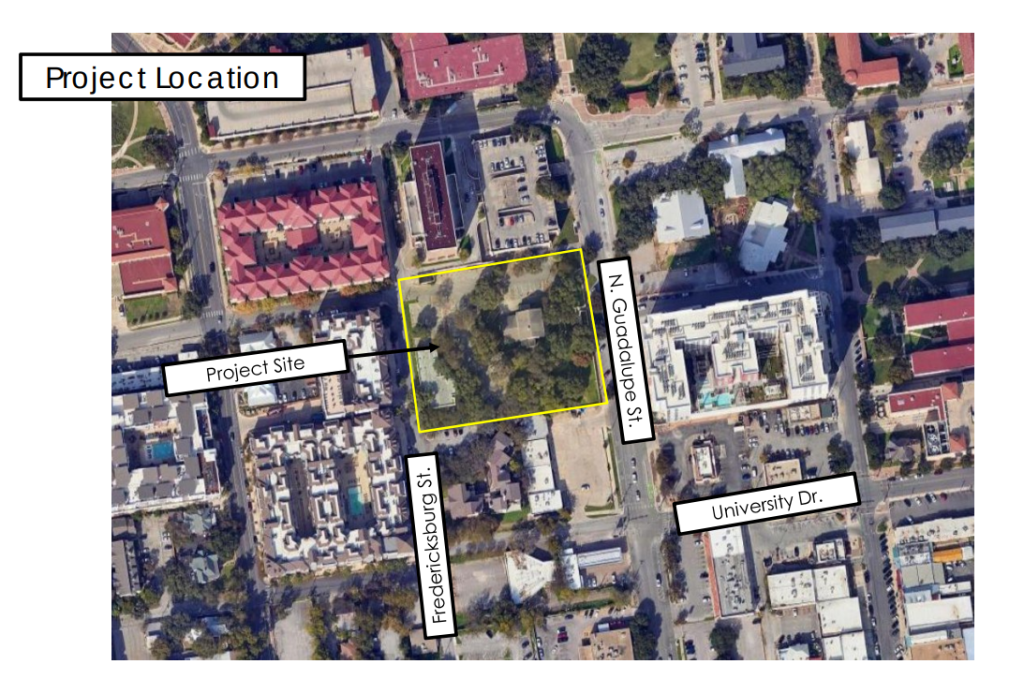
They want to put it here:
In other words, if you’re standing with Mini-Target on your right, facing the university, this location will be on your left:
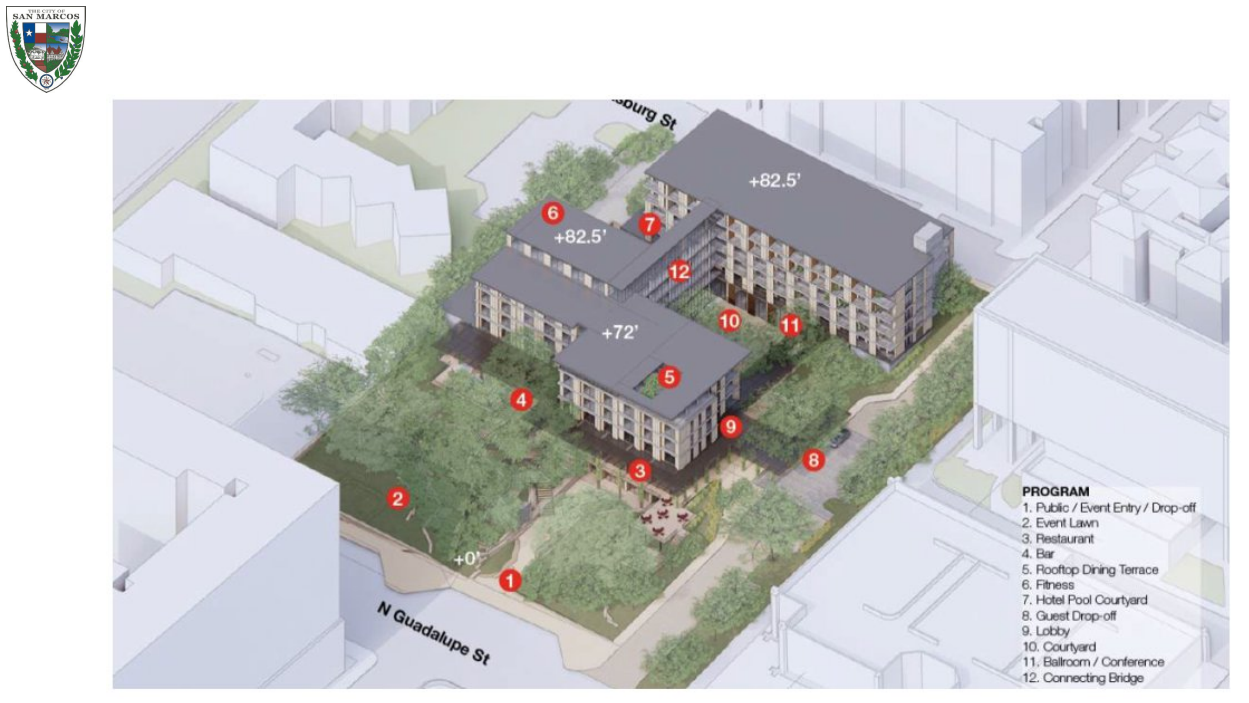
Here are a bunch of beautiful renderings from the presentation:
and
and
ooooooh! aaaaah!
Note: You should not trust beautiful renderings like these. They’re pretty pictures, not promises.
Here’s what they are willing to promise:
All this sounds great! I can see why the university wants a fancy hotel. This is also good for downtown businesses. Everything is great.
…
So why isn’t this great?
The issue is that they want a lot of tax breaks over the next ten years.
A hotel pays 3 kinds of taxes:
Property taxes
Sales taxes
Hotel Occupancy Taxes, or HOT Taxes.
Category 1: Property taxes. The actual ground under the hotel is owned by Texas State. Texas State does not pay property taxes. (This is why we lost $1.5 million in property taxes when Texas State bought Sanctuary Lofts and Vistas apartments.)
Texas State is going to lease the land to the hotel people. The hotel will pay property taxes on the physical bricks-and-mortar building, but not on the dirt underneath the building.
The estimated yearly property taxes will be $241K. We’re not offering any tax rebates in this category:
Ok, great.
My guess is that if the hotel owned the land, property taxes would be closer to $750K per year. But oh well.
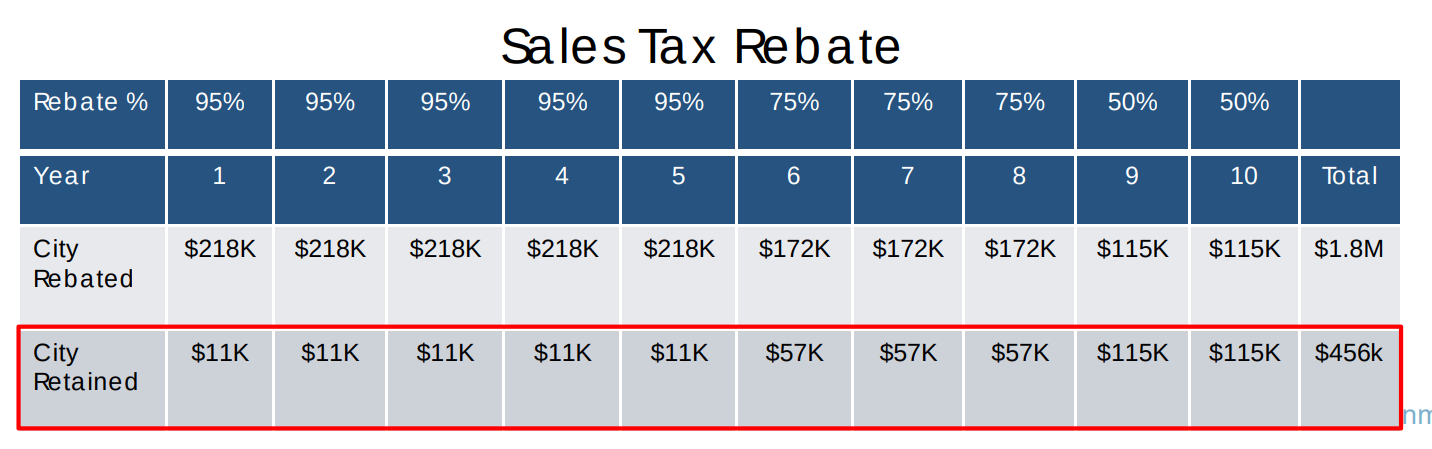
Category 2: Sales Tax: Here’s a big rebate.
For the first five years, they pay almost nothing. Then it steps up a little bit, over the next five years:
Ok, fine.
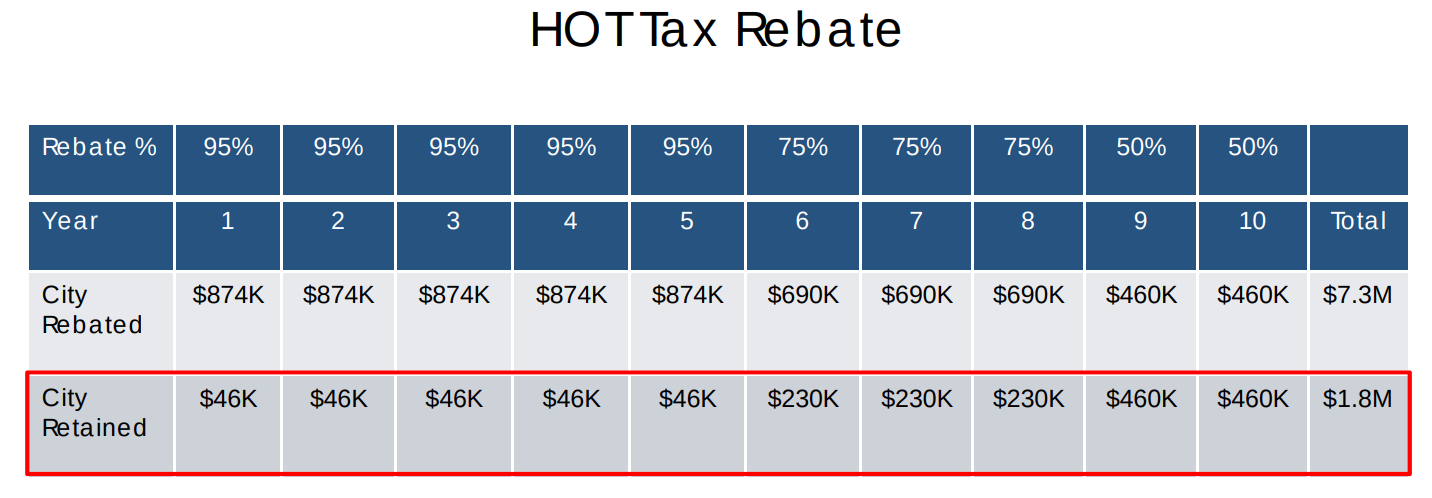
Category 3: HOT Tax: Also giving most of this category away:
Ok. This is starting to seem like a lot.
…
Total over 10 years:
If there was no deal in place, they’d pay $13.76 million in taxes.
Under this deal, they pay $4.66 million in taxes.
We’re refunding them about $9.1 million.
That seems like a terrible deal?
City staff says that unless we subsidize this hotel, they don’t have a viable business model. I think that means that… you don’t have a viable business model.
…
Listen: every time a luxury thing attempts to come to San Marcos, it goes out of business. This feels like wishful thinking. Like this bit:
In other words: “People will tube the river and then stay overnight in this hotel!”
Sir. SIR. We just spent months trying to keep the river free and affordable, because everyone who comes to tube is broke. A luxury boutique hotel is not going to keep any of them here.
I’m sure that there will be some fancy parents who pay full price, and I’m sure the University will put up lots of people (at a discount rate). Overall, I’m guessing the hotel struggles to turn a profit.
…
What’s in it for us?
Perk #1: They’re going to bring in some maybe-good jobs:
Amanda asks if these averages wages could be nudged up to $20/hour?
Answer: They’re open to running some numbers, and will come back with something definitive next time.
Perk #2: We’re protected if they sell the whole thing to Texas State. Since Texas State pays no taxes, the whole deal goes belly-up, and they have to reimburse us for the rebates:
But look: they could also just straight-up go out of business.
…
My 2 cents: There’s not much downside for the city, but I’m pessimistic anyway.
If we’re going to do this, we should:
Make the wages rise with inflation. Always. (We do this with every contract we sign with a vendor! This is common. We can extend this norm to low-wage workers.)
Get them to agree to be sustainable. Here’s some examples of sustainable University-affiliated luxury hotels.
Council votes on this, but it’s not the final vote. That will come at the next meeting.
…
Item 22: Veterans Funding
There’s a committee, the Veteran’s Affairs Advisory Committee. They undertook a big study over the past year, and concluded that there are four big needs in San Marcos:
A trained case worker specializing in veteran issues
Help figuring out transportation, especially when vets are trying to get up to Austin or down to San Antonio to the main office
Some money for the Veterans Memorial
Also ask the county to kick in money for the memorial
This item gets discussed for about an hour. Basically, the committee is making a very compelling case, but the city has very little money. It goes in circles.
…
Item 23: Gary Job Corps
What the hell is going on?!
Background: Job Corps are free job training sites, run by the federal government. You get free room and board, and get trained in some sort of vocation. You must be between 16-24 years old. Generally you’re there from 8 months to 3 years.
In general, the point is to give poor kids a path out of poverty, so that they can land a stable job.
Gary Job Corps is the one here in town:
Everyone always says it’s the oldest and biggest in the country! (I couldn’t actually verify this. This says the first job corps was opened in Maryland. This says that our site is 775 acres, which is probably the biggest because it’s an old air force base, but I can’t actually find enrollment by campus.)
On May 29th, the Trump administration announced that it was shutting down almost all of the Job Corps sites – all the ones run by contractors. This includes Gary Job Corps here in town. They gave everyone one month to shut everything down.
On June 5th, a judge ordered an injunction. Things are currently in limbo. It’s extremely hard to find good information on what’s going on. This is why Mayor Hughson wanted an update from someone involved.
There’s a representative from Gary Job Corps here today. He gives some information:
Currently there are 480 students enrolled at Gary.
When the May 29th order came, everyone was sent home.
About 400 students had somewhere to go, but the other 80 did not have anywhere to go. In other words, they were facing homelessness if Gary closed down abruptly.
When the June 5th injunction came out, Gary invited all the students back. About 25% have returned so far.
There are 99 sites nationwide, and 77 of them are being closed.
Jane’s big concern is these 80-90 students and families with nowhere to go. If Gary is shut down tomorrow, will they all become homeless? Very possibly, unless we work to secure some emergency housing.
Bottom line: they’re trying to work with the homeless emergency housing programs, in case Gary is in fact shut down, and 80 students and their families are abruptly turned on the street.







































 The San Marxist