Hours 4:00-5:08, 11/1/22

Item 19: The Pick-a-Pet problem

This is a first reading, meaning nothing sticks until the final vote next time. 

First we get a quick background on the shelter, and their efforts to move towards no-kill, or at least less-kill. Listen: it’s always a big problem when the presentation is not provided to the public. It leads to me squinting and trying to figure out what the hell is going on in a graph like this:

Wow! Over the past eight blurry marks on the x-axis, we’ve improved six blurry marks on the y-axis! What a nice upward trend that is.   (Elsewhere they said that we’re currently at 92% live outcomes.)

So now we get to the proposed changes. Let’s take the main ones one at a time.

  1. The second time an animal has been in the shelter, they have to get spayed or neutered. So if you got your dog from the shelter, and they escape and get picked up, you’d be on the hook.

Gleason proposes changing this to the third time. Your pet gets out and gets picked up one time? Fine, but the next time, you’ll have to handle their spay/neutering.

The Vote:
Yes: Mark Gleason, Jane Hughson, Jude Prather, Max Baker, Saul Gonzalez
No: Alyssa Garza

2. Stray-holds for cats: how long should they hold your cat when they pick it up?

This conversation is incredibly confusing. I actually listened to this part twice, and then I went to the actual ordinance and I’m still confused.

First, this is only about cats. Cats do much worse at shelters – it stresses them out, and they’re susceptible to illness and disease. The old rule is that all cats get held for 5 days. After that, your cat can get adopted out or euthanized.

Based on the presentation: the new proposal is to break out different cases:
– Kittens under 3 months old are basically always from feral litters. Kittens don’t escape from homes when they’re that little. So the first proposal is no stray-hold for little baby kittens. They can just be adopted out. (Everyone is fine with this.)

– The next category is cats with traceable identification. Is there a tag, or a microchip? Can we get in touch with the owner? If so, we’ll hold the cat for five days, or three days after reaching out to the owner.

It sounded like this category includes any cat that appears to have an owner – does it have out-dated microchip? Has it been spayed or neutered? But I couldn’t tell for sure.

– The third category is cats without traceable identification, who are healthy. These cats would get spayed and neutered and returned to wherever they got picked up. That way, a healthy outdoor cat does not languish in a shelter. This is Trap/Neuter/Return, or TNR. (Here’s a link I found explaining TNR more thoroughly. It sounds good.)

This third category is the contentious category. Should we hang on to cats without identification for five days?

Based on what’s in the ordinance:

– That third category, cats without traceable identification, are called Community Cats. Feral cat colonies are fine. You’re allowed to feed and love your colony of community cats. Hopefully they’re gradually picked up and spayed and neutered, and any that are injured or sick need to be tended to, and kittens should be removed for adoption.

It does not talk about TNR at all. The presentation did a little, but I don’t see it in the ordinance. What the ordinance says is that visually healthy cats should not get picked up in the first place.

So what happens if your cat gets picked up, despite that? The presentation certainly made it sound like it could happen!

According to the section on Impoundment, cats with no traceable identification will not be held for 5 days. So what happens to them? It doesn’t say! It does not say that we’re implementing TNR and will return them.

What happens to the other cats, the ones with ID? If you don’t pick up your cat, there’s a few options:
– it gets put up for adoption,
– transferred to a different rescue organization,
– fostered out
– euthanized
Nowhere does it say that your cat may be returned to where they found it.

Furthermore, here’s another problem: what happens when the line between community cats and pets gets blurry? Is your cat getting returned to where they found it, or adopted out/euthanized?

Mark and Alyssa are very concerned with a situation where someone is trying to slowly tame a stray cat, and has been putting food out for them, and befriending them, but hasn’t yet been able to catch the cat and take it to the vet for a check-up. If that cat gets picked up by the shelter, what happens?

Mark wants a 5 day hold for this pet, and it sounds like he believes that otherwise the cat will be immediately put up for adoption or euthanized. He never refers to TNR or returning the cat.

Alyssa also wants a 5 day hold. She did acknowledge that the speaker said the cats would be returned, but she was still troubled by this. So she is not on board with TNR. (I’m not sure why. Why would it be better for the cat to sit in a shelter for five days, over being returned to their familiar habitat?)

Here is my opinion: TNR is good, but the ordinance is very poorly written on this point. It should say explicitly which cats will get returned to where they’re picked up, which cats will be held for five days, and what happens to those cats at the end of the five days. TNR should be clearly stated in the Community Cat section, Impounded animals, and Disposition of animals. Right now, it’s written as though it will always be perfectly clear which cats are community cats and which cats are pets, and that bright line does not exist.

3. Finally we get to the big item: pet stores shall not sell cats and dogs unless they come from a shelter.  San Antonio has this ordinance, New Braunfels just passed this. It’s a thing that’s going around. 

The idea is that the USDA is supposed to visit breeders, and check for humane violations, but they’re massively underfunded and show up maybe once every few years.  Under the ordinance, you would still be able to buy a pure bred dog, but you have to buy directly from the breeder.  Apparently the American Kennel Club explicitly says that members shouldn’t sell their dogs to pet stores.

I cannot tell you how horrified Gleason is by this.  He starts at 4:31. 

  • He doesn’t think this will affect puppy mills.  It’s futile.
  • We’re trying to close down Pick-a-pet.
  • We’re trying to outlaw pure bred dogs.
  • We’re shutting down all breeders!!
  • When he was in High School, he saved his pennies and purchased a beloved pet for bird-hunting. You can’t believe how much he loved this dog.  His uncle has a sheep dog … for herding sheep!!
  • People should be allowed to buy a dog from a store!
  • Pet stores won’t have a functional business model.

He’s open to compromise: he wants a rule that pet stores can’t buy from any puppy mill with any infraction from the USDA.   Jude Prather is also on board with this.

It’s pretty easy to pick apart Gleason’s arguments, and mostly this occurred.  

  • Breeders can still sell pure bred dogs.
  • Buy your bird-dog and sheep-herder from the breeder. No one is stopping you.
  • PetSmart and other pet stores seem to do just fine selling supplies and not actual pure bred dogs and cats.
  • I believe you loved your dog, Mark. No one doesn’t believe you.

This was the most entertaining moment to me: Remember how the USDA may only get around to inspecting a puppy mill once every five years?

In response, Mark says, “If we don’t know anything about them, then they could be GOOD! We don’t know! Maybe they’re GOOD!”

Yes. Maybe they’re full of warm snuggles and blankies and rawhide bones. Those mean old activists just hate the snuggly love of a good puppy.  You figured it out, Mark.

I don’t want to come down too hard on Mark. I think he was very emotional, and channeling his emotions through nonsensical arguments. I think in his heart of hearts, he believes:

  • Puppy mills aren’t that big a problem
  • This is about outlawing pure bred dogs, and he loves pure bred dogs.

He’s wrong, though, and he cannot take in information to the contrary.

The vote: Do you want to stop pet stores sourcing puppies from puppy mills?
Yes: Alyssa Garza, Max Baker, Jane Hughson, Saul Gonzalez
No: Mark Gleason, Jude Prather.

There’s one last vote: delaying this part of the ordinance for a year, so that Pick-a-Pet has a chance to convert its business model.  That passes 6-0.

Again, all this has to be finalized at the next meeting. First readings are not the final story.

Hours 5:08-5:30, 11/1/22

Finally! A lighthearted item!  

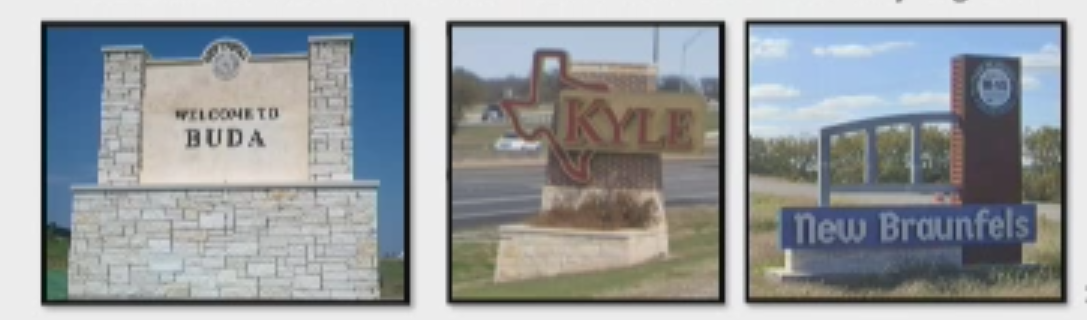
Item 22: You know how Kyle, Buda, and New Braunfels have these groovy signs introducing themselves to you?

We want one too!  And we have some TxDot money that’s begging to be used (on I-35).

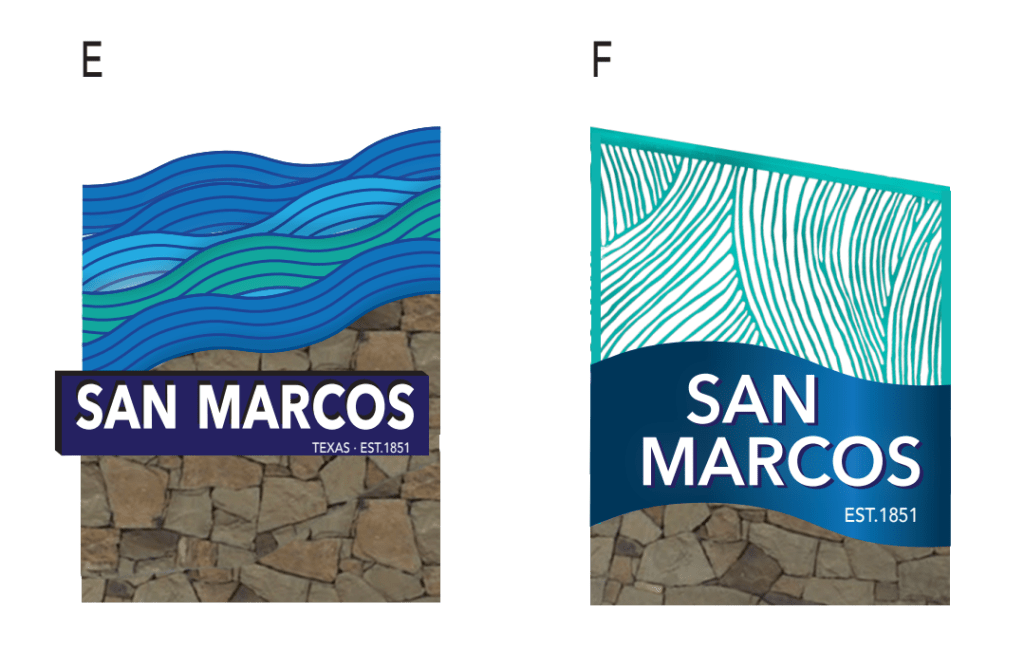
City staff want feedback on some preliminary plans, so they offer up these ideas to council as a launching off point:

Here’s what council has to say:

First is Jude: They’re all nice! I don’t know if I could pick just one. They all look sort of similar. But YES!

Then Mark goes: Well, I can certainly pick! I love E. That one is the best. The depth, the motion…yes.

Next is Max: I kinda think the whole concept is dumb. My phone tells me when I get to a city.

(I tell you, writing this blog is so much fun.)  

Then Alyssa speaks: They’re all hideous. It looks like a retirement village.

And then Saul: Could we get a mermaid on it? Or a rattler? Or a bobcat? 

(Yes! How about a mermaid wearing a rattler, while riding a bobcat?)

Finally Jane: They’re all terrible. Those don’t look like river rocks. River rocks are smooth. Why would the river be floating up in the air like that?! The words “San Marcos” should be horizontal.

Everyone likes “established 1851”. Max points out that we could go way back, and use that we’re the oldest continuously inhabited place in North America.

They decide that staff will bring back something so innocuous and bland that when the city re-brands itself, it won’t clash with this milquetoast excuse for a sign.

So what’s the official Marxist take on city welcome signs? 

We could do a whole lot worse! Bring it back!!

October 18th City Council Meeting

What a short meeting! Just the cutest, tiniest thing you ever did see.  Let’s go!

Hours 0:00 – 0:55: A quick explainer on Mystic Canyon, and EDSM and GSMP get disentangled.

Hours 0:55 – 1:05: In which we rename the Sculpture Garden, and we get excited about renaming all the other alleys in town.

Hours 1:05 – 1:26, plus the workshop: In which we take a field trip to the Edwards Aquifer, and learn all about purple pipe.

It was not even 90 minutes long!

So listen: early voting starts tomorrow. Here’s all the Hays County info on when and where to vote. Here’s my (mostly unhelpful) voting guide for city council elections.

It’s hard to imagine that anyone interested in this blog doesn’t already vote regularly. Still, make sure all your punk friends and family go do their civic duty, too.

Hours 0:00-0:56

Citizen Comment: the big topic is the humane pet shop ordinance, which is going to be coming back around, in January.  We saw this last year, with the Pick-a-Pet Problem.  It’s still a problem! Stay tuned.

Item 16: Meet Mystic Canyon:

The developers have agreed to run some sewage lines in a way that preserves a few heritage trees. 

Tuesday’s item was genuinely no big deal, but I figured we could have a brief explainer on Mystic Canyon, especially in light of the Edwards Aquifer Recharge Zone discussion (which is coming in the last part of the meeting).

So, Mystic Canyon? It was approved in 2018. Here’s how the vote went: 

(Pre-covid, the council members used to vote on little Jeopardy-click devices, so they couldn’t copy off each other’s answers.) So both your candidates for mayor voted yes, as did Saul.

And in fact, both Max Baker and Mark Gleason were on P&Z together at the time, so we also know how they voted (although P&Z did not use the little Jeopardy-clickers).

The P&Z Vote: Mystic Canyon should exist?
Yes: Mark Gleason (and also Kate McCarty, Lee Porterfield, and Jim Garber)
No: Max Baker (and also Angie Ramirez and Betseygail Rand)

In case anyone from the city staff reads this: your website lists Matt Mendoza as having voted at that meeting, which is nonsense because he only joined P&Z in 2022:

But here, you can watch the video – it’s Matthew Havriland that was on the committee back then.  Someone fix this, stat!  (The votes look screwy because that is a motion to deny. So “For” means deny, and “Against” means pro-development.) 

It’s not the sprawliest sprawl, but we still shouldn’t be developing over the recharge zone. More on the topic of the Edwards Aquifer to come.

…..

Item 15: I have no idea what’s going on here, for two reasons:

  1. Clearly there’s a lot of backstory.  Is this an Executive Session Secret?
  2. The item is an approval to say San Marcos does not consent, and then we denied it. 

Here’s the actual item:

We denied this by a vote of 6-0.  So the Hillert Tract gets their Crystal Clear water after all?  

My guess is that this was dealt with in Executive Session:

Sounds like someone got in trouble!  OooooOOO!   

So: what’s the Hillert Tract? I went down a short rabbit hole.  We acquired it in 2008. It shows up in Executive Session roughly yearly. It seems there’s some drama going on with Martindale. Finally I found a map, from 2014:

So it’s sort of next to Redwood, and next to the currently-controversial Riverbend development.

Side note: why are we drawing I-35 almost horizontally?! Check out the little compass in the top left. I mean, if that’s how you like to look at the world, knock yourself out.

….

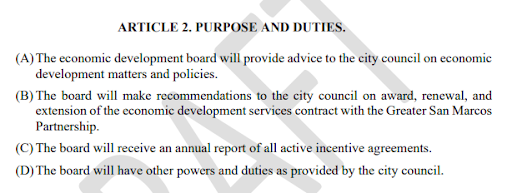
Item 20:   This one is really important!  We have a board called the Economic Development Board of San Marcos, or EDSM.  

Here’s what EDSM does:

So the EDSM is supposed to look out for the best interests of the city. Then the city turns around and contracts things out to the Greater San Marcos Partnership, or GSMP.  GSMP is a nonprofit that wants to grow and groom the business community of San Marcos.  You can imagine – or at least I can – that what’ s best for the business community is not always aligned with what’s best for San Marcos.  

Last spring, Max pointed out that it is a conflict of interest for GSMP members to serve on EDSM.  If they’re on EDSM, they’re supposed to advise council on what’s best for San Marcos. But then, whatever they approve goes straight to GSMP. It’s not a great look.  

Now, GSMP is entitled to one non-voting representative on EDSM. The problem is people serving in at-large seats on EDSM who also happen to serve on GSMP. Max also made the point that this reduces the number of EDSM seats available for the rest of the community.

The issue got sent to committee, and the committee has agreed.  So tonight, they amended EDSM to say that members can’t also serve on GSMP.  This is great!

The business community is still relatively small, and we’re still drawing on the same pool for both committees, so clearly everyone still knows each other.  But one key to having an ethically-run city is not to create opportunities for temptation.  It’s good to put some daylight between these two groups.

Also, this is a great example by Max of the kind of small-but-good thing that progressives do differently at the local level. Put activists on city council, and they’ll do good things.

Hours 0:55-1:05

Item 21: The other week we learned that we have a Sculpture Garden.  Now they want to go and upend things by renaming it as an Arts Park?!

via

I suppose I’ll allow it.

(The reason is to allow for artsy things besides just sculptures.)

Item 22: The other week we renamed that one alley “Boyhood Alley”. Now they want to go and allow all the alleys to be renamed after San Marcos-themed movies?!

Like perhaps “The Getaway“, filmed in San Marcos in 1972?

(That’s just upstream of Sewell Park, across Aquarena. You know, at Kerbey-Lane-not-the-Saltgrass-not-Joe’s-Crabshack-not-Pepper’s restaurant. This is a great list of stills from that movie, with their locations identified.)

Sure, why not.

Hours 0:55 – 1:26, and Council Workshop

Item 23 plus Workshop:  Purple Pipe and the Edwards Aquifer.

You guys.  This was all so fascinating that I don’t know where to start. Half the reason I wanted to start this blog is that I don’t feel like I’ll retain anything unless I organize my thoughts well enough to explain them to someone else. 

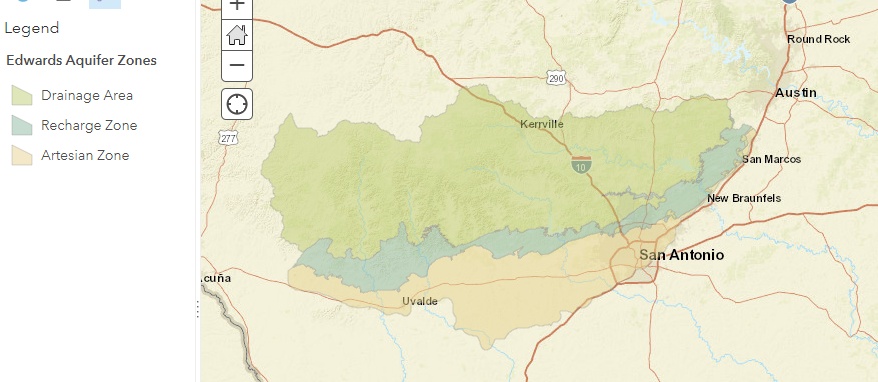
The afternoon workshop is on the Edward’s Aquifer.  First off, Edward’s Aquifer is gigantic:

via

The green part catches all the rainfall. The blue part is all the porous caves and springs, where the aquifer is right at surface.  The tan part is the storage tank of the aquifer.

It’s a little weird, because you would think that those three parts – catching rain, rocky and porous, storing rain – would be stacked on top of each other, going towards the center of the earth.  You wouldn’t think that they’d be side-by-side on a map. Why would water flow from Kerrville to Uvalde?  But it does! Or so I’m told.

It’s kind of both:

Via

The left side of that picture is north, the center is San Marcos-ish, and the right part is south.  So underground, water really is flowing from Kerrville to Uvalde.

Next!  So, we were using the aquifer too heavily in the 70s and 80s, and water-people were getting nervous, projecting that we’d exceed capacity in the future.  During droughts, things would get scarce.  In the 1950s, the Comal dried up completely at one point, during a massive drought.  Water rights for surface water – lakes, rivers, etc – have been fought in the courts for a long time, but not for ground water (or at least not in Texas). So people were allowed to enforce caps on how much water you take from lakes and rivers, but no one was allowed to enforce a cap on how much water you pump from an underground aquifer.

So in 1991, the Sierra Club files a lawsuit against Texas, because of the endangered species in the San Marcos and Comal rivers.  And they won!  Texas was ordered to do something to guarantee that the water wouldn’t stop flowing into these spring-fed rivers.  And so the state legislature created the  Edwards Aquifer Authority. 

So the EAA has legal power to protect that quantity and quality of water in our river. That’s amazing! I got legitimately nerdy-emotional, contemplating the sheer amount of effort and science and coordination across different groups of people that goes into protecting our river.  

They do a lot:

  • They issue permits for who is allowed to use aquifer water. So San Marcos has a permit, TXST has a permit, etc.  There are only 2000 permits, total.  There are 2 million people on the aquifer, but only 2000 permits.
  • They cap the amount of water that can be by someone holding a permit. During drought, they force permit holders to reduce their usage.  (Apparently Drought Stage 1-5 refers to how much you have to reduce your usage. So Stage 1 means reduce by 10%, stage 2 by 20%, etc.)  As long as the EAA enforces these caps, your river is going to keep flowing.
  • They worry about water quality: contamination from abandoned wells, chemicals from firefighters putting out fires over the aquifer, about storing other things underground, besides water. (Like gas tanks for a gas station.) So they have programs in place for all these things.  They cap the amount of underground storage under the aquifer. If someone wants to open a new gas station, they’re going to have to buy storage credits from someone else who already has them. 
  • They’ve got a big research facility in San Antonio where they’re studying all these strategies so that they can say with certainty how much each intervention helps.

San Antonio has a program where 1/8th of every cent of their sales tax goes to counties in the west, to help them protect their aquifer.  So San Marcos really is not going at this alone! We’re the tip of a large network of scientists and environmentalists who are all coordinating their action to help preserve these rivers.  I somehow find that very reassuring. 

Next: we zoomed into San Marcos at the city level.

Zooming out:

Remember: 

  • green is the part that catches the water, 
  • blue is where the aquifer comes to the surface
  • tan is where water gets stored.

Zooming in: 

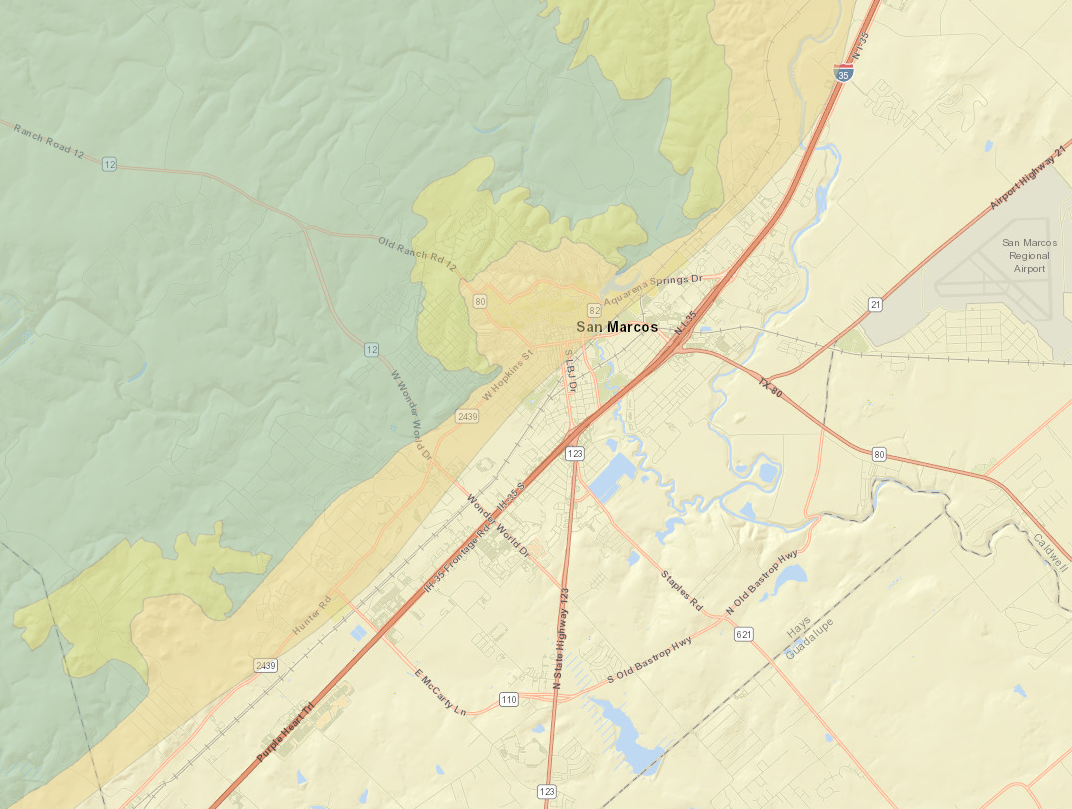
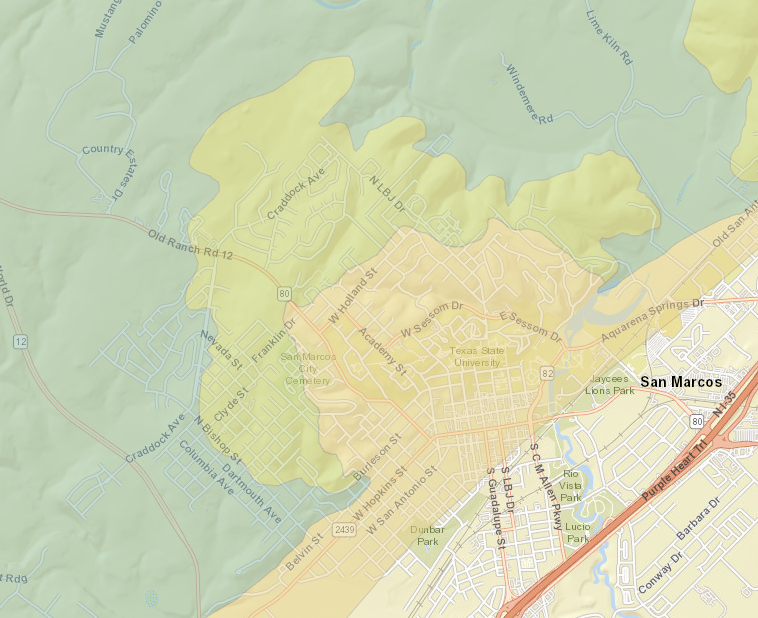
We have a lot of blue.  In total, San Marcos is about ⅓ inside the aquifer.

Zooming in to the green-blue boundary in particular:

Everything south of Bishop, or past Craddock on Old 12, or north on Lime Kiln road: all of that is extremely sensitive land.   It’s really important to fight these fights over La Cima, or Mystic Canyon, or wherever.

We actually only get about 7% of our drinking water from it.   The rest of our water comes from several different places, through a bunch of different organizations. We’re trying to diversify our sources, so that if one region gets hit by a drought, we still have other options. (It did occur to me that droughts aren’t that local. It’s not like we’re piping water in from New Orleans. Wouldn’t all our sources be hit by the same drought, if it lasted for a few years?)

Moving on! Did you know that San Marcos has a purple pipe program? 

Not like that, you dingbat.  Purple pipe is reclaimed water.  In other words, you flush your toilet, the water goes to the water treatment plant, and they get it fairly clean. Not clean enough to drink, but fairly clean.  Then they can either put it back in the river, or they can pipe it back out in specific Rattler-pride-hued pipes.  Then businesses can use it for landscaping and flushing toilets, so that we’re not using drinking water for these things.

Here is a map of the purple pipe in San Marcos:

The Kissing Tree golf course, the downtown landscaping, and some of the stuff at Texas State are all using reclaimed water.  That’s so great! 

We have the capacity to pump 5.5 million gallons of reclaimed water per day.  We’ve got it all contracted out, but they’re only using about a million gallons/day, so we need to renegotiate these contracts so that we can free up the rest of the water for use.

The water pressure is pretty terrible, apparently, enough so that it’s not really available for residential uses yet.  And there are concerns about double-piping neighborhoods, and some future plumber using the wrong water line for drinking water.  But these are being hammered out.  The future is now!

TSM official take on City Council candidates, Fall ’22

Here’s my official thoughts on candidates!

I listened to the League of Women Voters and the Hays County Democrat forum.  I don’t have recordings of anything else, but feel free to point me towards them.

Short-short version: 

  1. Jane vs John for Mayor:

 I’m actually on the fence.  I trust Jane 100% to be honest, but I disagree with her principles in significant ways.  (She’s solidly centrist on the business community, cops, and the environment.) Based on his debate answers, I’m still nervous that putting John together with Shane, Jude, and Mark is going to mean open season for developers to maximize their profits, and we will not require developers to build what’s best for San Marcos.  Developers are not your friend!

Here are two truths:

  • We need housing
  • Developers are going to prioritize profit over what’s best for San Marcos

Here are my fears: Jane isn’t going to prioritize dense housing enough, and John will let the developers get away with murder.  

Conclusion: vote for whoever you want.

2. Matt vs Max for Council Seat #1:

Matt Mendoza comes from a family that is deeply woven into San Marcos. He’s new to politics. He seems bright and eager to learn.  At the Hays Dems thing, he was forcefully pro-GRACE act (not criminalizing abortion) but lukewarm on Prop A.  My guess is that he’s left of center on some issues and centrist on others. I would love to see him grow and develop on P&Z for another year. (Perhaps he would enjoy reading this very blog for a year, idk.)

But Max knows so much, and is so clear on what he’s fighting for, and he’s fighting for the right things.  We’d be fools to vote him out.   If Max learned to cajole and charm people into buying into his ideas, he’d be unstoppable.  (At one point, Max made the case that he’s gotten less argumentative and more collaborative since the DEI workshop in August.  Could be! He needs more time to build up a track record.)  

Conclusion: Vote for Max, save Matthew for next year.

3. Saul vs Atom for Council seat #2:

I am pretty harsh on Saul for his answers below, because they are so entirely devoid of content. He is an open ear to large portions of the San Marcos Hispanic community, but I don’t think he does anything with the information that comes in.   He’s been on council for two terms, but can’t answer basic questions. I became very exasperated with him.

Does that mean you should vote for Atom Von Arndt? Look, I don’t know. He’s the outsider. He was at his best when he spoke bluntly (WINK) on Prop A: sending people to prison for possession of pot supports the private prison industrial complex.  So I think he has a general liberal bent.  And he seemed like a bright person who was willing to learn.  But he has a lot to learn. (And he’s got a thing for clown facepaint.)

Conclusion: Vote for whoever you want.

And now, the long-long answer!

The LWV debates are super short, ringing in at just under an hour.  Candidates are only given one minute to answer each question.  Also, they held it on Tuesday, and Matthew Mendoza had a P&Z meeting.  So that seems a bit unfair.

The Hays Dems forum gave each candidate plenty of time to speak at length and then field questions. But only Jane Hughson, Max Baker, and Matthew Mendoza were there.

First up is the Mayor Race:

Opening Statements:  Both candidates give basic bio details. What can you say in a minute? They’ve both lived in SM forever.  Jane Hughson worked at Texas State for decades and has been on a billion community service organizations. John Thomaides owns a business involving water somehow. They both like buzzwords about “common sense” and “being frugal” and “balance”.

The Hays County Democratic forum gave a much longer stretch for candidates to talk, but John Thomaides wasn’t there. Jane talked at length about all her experience – she’s worked with every San Marcos organization under the sun – but I didn’t exactly learn anything new. We know how she governs.

First question: Diversity/Equity/Inclusion?

I’d say both candidates give equally half-assed answers. Jane Hughson says it’s the right thing to do and we had a half-day retreat.  She defends her effort to cut the equity coordinator from a $400K/4 year position to a $200K/2 year position, saying that we need to embed the position permanently.  I guess? You still jeopardized two years of funding for the position. 

John Thomaides says all the departments should practice best practices.  And Austin has a whole DEI department, and we’re not there yet. It’s a balance.  He did not seem like this is an urgent issue to him.

Second question: Housing Density? 

This might be the question that tips the entire election towards Jane, if I know our NIMBY friends.  

John answers first: we need infill-friendly policies. We need to consider things like condos and townhomes.

Jane Hughson says: You need density to make transit work.  We allow smaller lots now.  I absolutely will not touch old neighborhoods, but maybe new neighborhoods could experiment with smaller lots?

Thomaides’ answer is closer to what I believe.  I wish he’d mentioned a sense of scale, because I’m still skittish about the giant apartment complexes that went up a decade ago while he was on council.  There’s a big difference between 4-plexes and 8-plexes integrated throughout neighborhoods, and something like The Cottages and The Retreat, forming their own entire ecosystem.

However: the old neighborhoods in town are extremely spooked by the word infill.  They are convinced that frat boys will pee on their hedges, fill the streets with Coors Light cans, and throw massive house parties that last until 3 am.  And sometimes, the unspoken part is that they just don’t want to live next to poor people. 

Third question: Homelessness?

Jane Hughson’s answer: there are many reasons people are homeless, and you have to tailor individual responses. The Homeless Coalition is working to do that.

John Thomaides’ answer: Every city is dealing with this. You can’t give every person a house. Find those people who are willing to change and work with them. It’s a difficult issue.

I’m giving this point to Mayor Hughson.  Thomaides’ answer sounded defensive and like he is going to blame homeless people for not wanting to change, and therefore they don’t deserve help.

Fourth question: Infrastructure? How to evaluate a project?

John takes this to mean “how does SM decide which city projects to work on?” He wants to re-do how we award contracts.

Jane says that you have to work with engineers, and modify how much different projects disrupt peoples’ lives.

Closing Statements

I am allergic to the kind of buzzword-heavy scripted statement that candidates are compelled to cook up here. “I will be all things to all people!”  It’s a waste of time to scrutinize these crumbs and say anything meaningful about how they’d be on the dais.

What about other topics?

The environment/river: John’s website and Facebook make it clear that he works his tail off to clean up the river and feels strongly about littering.  

Does that mean he’s willing to vote for constraints on businesses that want to develop over the aquifer?  I have no idea. What about broader measures towards sustainability? What kind of cost is he willing to impose on businesses to force them to implement sustainable solutions? I have no idea.

Jane tends to support the river, and is willing to work with businesses on greener solutions, but she’s not going to force anyone towards anything game-changing.  

My guess is they’d be roughly the same on the environment.

Cops/crime: John’s website doesn’t say anything, and Jane has been pretty centrist. She voted against cite-and-release, I think, but then came around and supported its renewal. (Which Chief Standridge also supported.)  My guess is they’d be roughly the same, here, too.

What about their past voting records as Mayor and on council? This takes so much work to properly summarize. For example, in 2011 and 2012, there was a big city fight about a proposed development over Sessom Creek. Here’s an article that says it was postponed . Here’s an article that says a previous vote was a no, and now it’s scaled down. Neither say how anyone voted. I’d have to look it up to see if Thomaides was even on council in 2012. The two main places that I go to find the council archives only go back to 2014. Oh wait! Thomaides was instrumental in its defeat. Good job, John.

What about the HEB shitshow, on the corner of Wonderworld and Hopkins? In 2016, slightly over a year past the Memorial Day floods, HEB applied to rezone the corner of Wonderworld and Hunter – right next to purgatory creek, which had just flooded the previous October. The plan was to put curb cuts on Wonderworld, west of Hunter. It was an insanely terrible location and the town was furious. Both Hughson and Thomaides voted in favor of it, though, so that’s a wash in terms of your upcoming mayoral decision. What about the Woods? Thomaides (and Jude Prather) both voted against it. Jane Hughson wasn’t on council back then.

I have a vivid memory of a controversial vote where (some? all?) the men all left the room to avoid going on record, and Lisa Prewitt, Jane Hughson, and Melissa Derrick were all left sitting there holding the bag. But I can’t place it. I thought it might have been Cape’s Dam, but it appears John and Jane both voted originally to remove it.

Since Jane’s been mayor, she voted against cite-and-release, but since then tentatively supports it. Covid hit. How should we spend $18 million in American Rescue Plan dollars? She did not apply any pressure over Ryan Hartmann. She helped rewrite the Land Development Code. I dunno – their two stints in office have been characterized by very different kinds of issues.

Here’s the thing: I didn’t watch city council meetings when John was mayor. I don’t know if he’s careful and judicious, or if he comes unprepared to meetings, or if he makes his decisions ahead of time, or if he comes with an open mind and discusses things in good faith. There were ethics complaints against Scott Gregson while John was mayor, and in my mind, I had them as friends. But again, I did not listen to the council meetings where those issues were actually discussed. There is a wealth of knowledge out there on how John governs, but I don’t have it.

The Other Council Seats

It’s kind of shitty, but they held the debate during a P&Z meeting, and so Matthew Mendoza was in a bind.  He sent over a short personal statement and skipped the debate. However, he was at the Hays Dems forum, and got to speak for as long as he wanted, and then answered questions. 

Summarizing Matthew Mendoza on his own: Born and raised here, loves this city. Some sort of IT guy.

  • Tentative Yay on Prop A, but not whole-hearted. 
  • On the river: Absolutely no development within 100 yards! Beyond that, we’ll have to work with the developer.  We need to shake down businesses like Chuck Nash for donations to help fund conservation efforts.

(This is not a great answer – I’m pretty sure there’s already no development within 100 yards. And you can’t work with developers unless you’re willing to walk away. Otherwise you’re just letting them hold all the cards.)

  • On abortion/the GRACE act: enthusiastic support for not prosecuting women.
  • On animal shelters: he’s a softie for animals and wants to support the shelter.

None of those are nitty-gritty answers that tell you that he’d hold corporations’ feet to the fire, but it would have been very hard for him to pull that off. Like I said, my guess is mostly centrist, maybe tilting to the left.

Onto the debate itself!

Note: From here on out, I’m sticking with the League debate, and mostly ignoring Max’s answers at the Hays Dems Forum. His answers were interesting and the whole thing is worth listening to, but he already has way more to say than Saul or Atom, and it just would be too lopsided.

Opening statements

Max’s keywords are sustainability, equity, and transparency. 

Saul’s new grandbaby was born today!

Atom Von Arndt is relatively new to town, and a renter, with a regular job, who keeps scratching his head at how we do things here.

Question 1: What are your priorities?

Max’s priorities are sustainability, equity, and government transparency.  He wants more town halls and more engagement.

Saul’s priorities are flooding. Work with small businesses. Housing but NOT in existing neighborhoods. Finish the projects that are midway through.

Atom’s: Roads. Why do we have bike lanes to nowhere? What the hell happened at Hopkins and 35? Affordability. More outreach.

Question 2: Homelessness

From this point on, Max is just playing a completely different game than Atom and Saul.  He can just rattle off such a more well-informed, complex answer, with specific examples and experiences he’s had to fortify it.  

It really reflects most poorly on Saul.  Of course Atom doesn’t know the details – he’s brand new and running as an outsider. But Saul is running for his third term.  He should know a lot by this point. 

Here’s what I mean – on homelessness: 

  • Saul says, “Outreach! Provide education and mental health services”
  • Atom says “Outreach and mental health.”
  • Max says “I have volunteer experience with XYZ org, we did a homeless study with the American Rescue Plan funding, I’m focused on implementing a continuum of care with all the organizations in town, which I can enumerate. Want to talk about transitional housing? A housing-first policy is important. We need to de-silo our non-profits – they’re a patchwork and not cooperating that well.”  

When Max speaks, you get the idea that he could keep going for another ten minutes with developed ideas. When Saul talks, it feels like the kid hoping that the teacher won’t notice if they increase the margins, increase the font size to 14, and triple the line spacing to get their essay up to two pages.

Question 3: How do you evaluate infrastructure? 

Atom: He’s comfortable ranting here. Why did we spend $10 million on fancy street lights for Hopkins?! [Note: we didn’t.] What’s up with these nutty bike stoplights to nowhere? What the hell is going on with I-35 and Hopkins? We should be fixing the drainage and potholes!

I mean…those are the kind of questions you get from outsiders. They’re easy to ask. The answers are slow, technical, and wonky. This doesn’t make him a bad candidate for office, but it doesn’t tell you much about what he’ll do when he gets there.  (Actually, it tells you the very first thing he’ll do: he’ll learn that those answers are slow, technical, and wonky.)

Max goes next: Equity, equity, equity! Evaluate projects through an equity lens. Bring your full understanding of historical and systemic biases. 

 It’s really a pretty good answer.

Saul: We need to have different parts of the pie. You can’t give the whole pie to one project. There need to be consequences for contractors who go too long. 

SAUL.  We do have different parts of the pie.  You just approved a budget, which is literally how you divide up the pie. What on earth are you nattering on about.

Question 4: Density?

Max: The only infill that gets financing is large scale multifamily.  Can we figure out how to do small-scale infill, like the mini-complexes on San Antonio?  Sprawl drives up everyone’s taxes and is bad for everyone.

This is fairly close to my own answer: 4-plexes should be allowed by right, anywhere. 8-plexes should be allowed very often.  Sprawl is bad.

Saul: Smaller homes on smaller lots! 

Twice Saul refers to the zonings “CF4.5” and “CF5”, and I’m pretty sure these don’t exist. My memory is that there is SF6 and SF4.5, (Single Family 6 and Single Family 4.5), and there is CD4 and CD5, (Character District 4 and Character District 5). But there’s no CF anything.  

It’s really not a big deal – people misspeak all the time. But he’s not providing other evidence that he really does know what he’s talking about.  And he was on P&Z before his two terms on council, and he was on council when they re-did the land development code. 

Atom: Mixed use apartments downtown are insanely expensive, and then that allows other landlords to raise their rents too. We’ve got to build more housing and make sure it’s affordable. 

He’s not yet plugged into the NIMBYism he’ll face, but sure, his instincts are fine.

Question 5: Yay on Prop A?

Saul: 4 oz is a LOT.  That’s 475 joints. That’s not personal use. But I voted to let the voters decide. 

Atom: YAY!  Pot possession just feeds the private prison industrial complex. We should do anything we can to keep people out of the criminal justice system.

Max: In 2019, I ran on Cite and Release. 4 oz is because that’s where the state of Texas draws the line between “little” and “lots”. It only applies to nonviolent offenders, and just possession. 

I appreciated Atom tying this into the larger human rights issues associated with our prison complex, because that’s mostly where I think the moral salience comes from, too.

Question 6: Diversity/Equity/Inclusion?

Atom: It’s everyone’s town! We need a ton of engagement/outreach.

This is both right and wrong. We do need a ton of outreach, but it’s way harder than he’s imagining. Solving the outreach problem is not just a matter of good intentions.

Max: I advocated for a 4 year DEI coordinator. Every person on the DC trip told us to keep DEI front and center. Equity lens helps us do everything better: better policing, better planning.  I want to pay people for feedback.

(I don’t think that last sentence is quite right. That doesn’t target the people that are hardest to reach. We have to do the hard work of showing up at barbershops, churches, and working with well-connected existing groups like Community Action, the food bank, the women’s shelter, etc.  It just takes a ton of labor, ultimately.) But aside from that, Max generally has a solid track record of voting to support DEI and think about issues connected to it.

Saul: You guys, you need to hear Saul’s entire answer, in his own words:

“First of all, I think everyone should be treated equally and fairly, no matter what walk of life they come from. I think something we have to remember, also, is that people have different cultures and different heritages, and we gotta take that into consideration as well.  Those are two things that I’d like to really focus on. And maybe we can someday live in that world. That’s all I have. Thank you very much.”

Read that outloud, and time yourself.  Saul manages to make it last almost 40 seconds. (It starts at 50:51 if you’re interested.)

WHAT THE HELL. There’s no there there.  

Closing statements:

Saul: I want to finish projects we started. Covid delayed everything. I’ve never seen anything like that.

Atom: I heart San Marcos.  I’m a single dad with a 10 year old.  My superpower is that I can connect and communicate with everyone really well, so I can get out there and find out what people want.

Max: The DEI workshop made me a better collaborator. I was endorsed by the Hays Women’s caucus.

And that’s a wrap!

No grand conclusions from me. BUT, if you’re feeling moved to do something, reach out to Hays County Democrats about helping on election day to make sure MAGA “poll-watchers” aren’t intimidating voters and sabotaging democracy.

October 3rd City Council meeting

It was a relatively short meeting this week. Enjoy!

Hour 1: In which we dive deep into La Cima. We also visit Blanco Gardens and El Centro.

Hour 2: Campaign finance limits, noise ordinances and binge drinking, and a discussion on the 3-month eviction notice.

Bonus Council Workshop: Might there be a new City Hall, someday? Have some old-timey photos of San Marcos from the mid-Two Thousand and Aughts.

I never did get around to fixing the errors I made in the post about the candidates last time. I still intend to do it, though.

This coming week, I’m going to write up my thoughts from the debate, and also I’ve got the recording from when candidates talked to the Hays County Democrats, so I’ll add in my impressions from that.

Hours 0:00-1:18, 10/3/22

Items 15-16:  38.5 acres is being annexed and zoned.  La Cima is growing.  

I found myself wanting to do a deep dive on La Cima. How did we get here?  I thought maybe I could try to finally wrap my head around La Cima.  (I’d also like to do this for Whisper Tract and Trace.)

So La Cima was first approved in 2013, as Lazy Oaks. Most of the city’s online archives only go back to 2014 though, so I literally can’t find a map of the original parcel. It was 1,396 acres in size.

In 2014, it grows to 2,029.023 acres (and maybe gets renamed?) It looked like so:

That’s RR12 right at the entrance of the pink part, right where Old 12 meets new 12.

Basic stats, 2014:
– 2,400 houses
– 32.4 acres parkland
– 800 acres conservation
– 2,029 total acres

I think they actually start building houses in 2017.

The second amendment appears to be May 15th, 2018.  

Now it looks like this: 

So in 2014, that tan part – all residential houses – didn’t wrap around to the left of the conservation open space, and now it does. Plus they added apartment complexes. (I’m okay with the apartment complexes being added! I don’t like developing over the aquifer, but I don’t want it to be a cloister of wealthy people, either.)

Basic stats, 2018:
– 2800 dwelling units: old 2,400 houses + 400 new apartment units
– 35.6 acres parkland
– 791 acres conservation
– 2,029 old acres + 394 new acres = 2,423 total acres

In August of 2020, it grows again:

Adding that new pink part in the lower right hand side.

Basic stats, 2020:
– Still 2800 dwelling units
– 37.66 acres parkland
– 800 acres conservation
– 2,423 old acres + 129 new acres = 2,552 total acres

In November 2021, we added amended it to allow for the film studio. The plan seems to be for it to go in that new pink section on the lower right.

Of course, the fights weren’t until the following June, when everyone was super pissed about building on the aquifer. Listen: they are absolutely correct to be mad! It’s just that the fight wasn’t held at the correct time, legally speaking. By this point, City Council was just trading environmental protections for tax credits.

The funny thing is that the really big change came just one month earlier, and no one paid any attention.

This is in May, 2022, and it’s a pretty drastic change:

It jumped clear across RR12!!  That whole tri-colored bit on the upper right is brand new!

So what happened? A lot of housing was relocated. That light green piece in the upper left used to be residential, but now it’s conservation. So there are good parts and bad parts.

Basic stats, 2022:
– 4200 houses, 980 apartments
– 37.66 acres parkland
– 792 acres conservation 1227.8 = 2019.8 acres conservation
– 2,552 old acres + 1296 new acres = 3848 total acres

So: is this a good thing? 

I don’t know. It’s a complicated thing. There’s a lot more conservation, but a lot more building and living on the aquifer. I feel weird about it.

(Wasn’t I paying attention last May? Apparently not! I listened to the entire meeting and did not have a single thing to say about La Cima! You probably shouldn’t trust me very much.)

Also, not that much of it has actually gotten built yet. They’re chipping away at it.

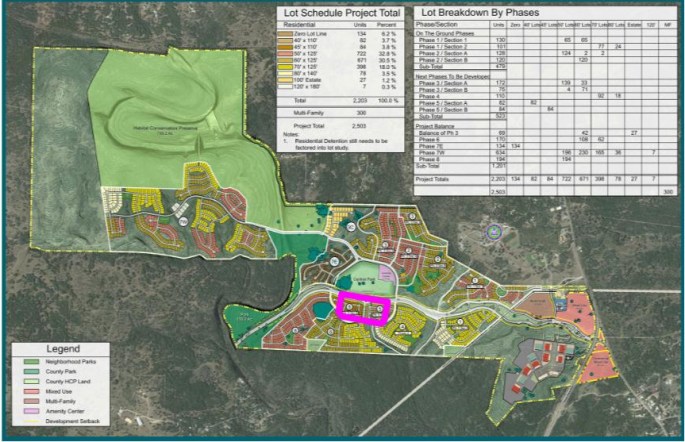
So now we’re all up to speed on La Cima. So what actually happened last Tuesday?   A very a small bit, 38.5 acres, is finally getting annexed and zoned:

That pink square is my best guess of where it is.

Max Baker attempts to persuade the developer to use something water-friendly: either purple pipe or rainwater detention. He gets brushed off for both, in a slightly condescending way.

The vote:
Yes: Everyone except Max
No: Max

………………

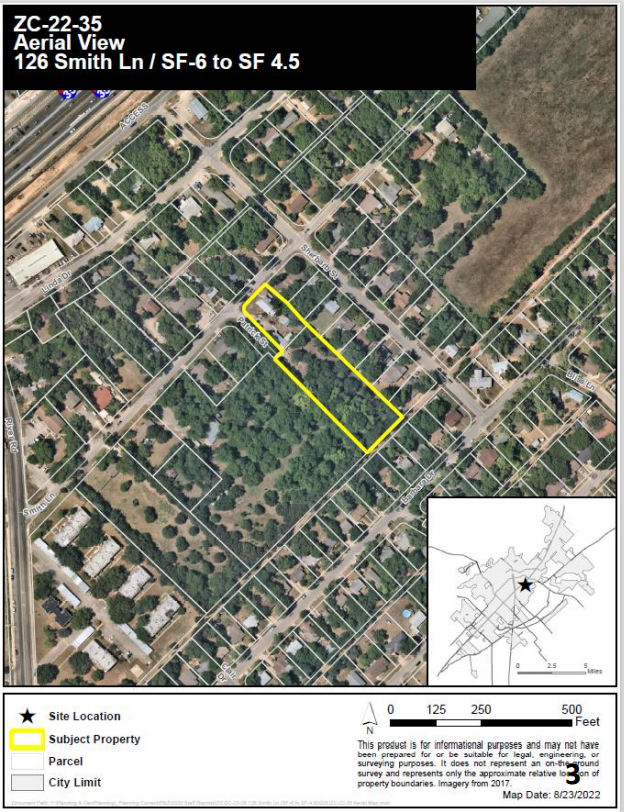
Item 17: There’s an application to rezone 1.35 acres in the middle of Blanco Gardens.

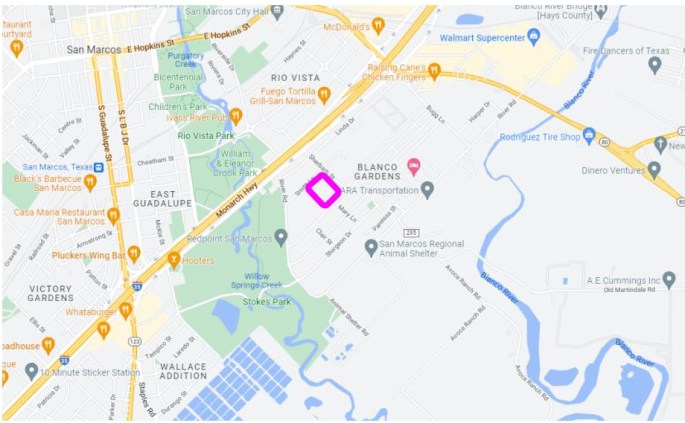
 Here’s Blanco Gardens, and they want to rezone this pink square:

So really RIGHT in the middle of Blanco Gardens.  Aren’t there houses right there already?

Yes. This is a block full of houses, but it happens to have some undeveloped land interior to it, and the developer wants to add houses inside the block.

Some important details:

  • They can already develop it, SF6, which means single family housing with lots at least 6000 sq ft big.
  • They want SF4.5, single family housing with lots at least 4500 sq ft. 

So they can fit in more houses under SF4.5 Staff estimates that they could fit 8 houses at SF6, and 11 houses at SF4.5.

Other important details:

  • WE HAD A BIG FLOOD A FEW YEARS AGO, IN THIS EXACT NEIGHBORHOOD. And a few years before that. And a few years before that. Etc.
  • P&Z denied this request! So it would take 6 councilmembers to overturn it.

City council also denies it, 7-0, so that is that.  The developer can still build their SF6 houses if they want (and if they want to piss off the neighborhood).  

Item 19: Here is El Centro:

They’re good people!

The School Board officially gave that land to El Centro Cultural recently, and then came to find out that there’s a weird alley running through the school that still belongs to the city.

So we got a charming history of this alley – before SMCISD was SMCISD, it was the San Marcos Public Free School system.  Then in 40s, it spun off.  Gradually the city gave SMCISD bits and pieces of this land, through the 70s.  But there was still this one alley on the books (but never built).  

So we have officially abandoned the alley, which can then be given to SMCISD, which can then be given to the good people over at El Centro.

Hours 1:18 to 3:50, 10/3/22

Item 20: Here are some current city ordinances:

1. City Council and P&Z members all fill out financial disclosure forms every year.

2. City Council has some caps on campaign finance:

– There is a cap on total fundraising: you can’t raise more than 50¢ per registered voter in an election cycle. (Mayor gets 75¢ per registered voter.)

– No donor can donate more than $500 to a candidate in an election cycle. Any donations over $300 trigger certain mandatory recusals for conflict of interest.

These were passed circa 2018. Since then, the Ethics Review Committee has looked these forms over and followed up with the person for clarifications/omissions/sloppiness.   However, that review is not part of their official duties.

Jane Hughson brings this up to formally add it to their duties. After all, we have these laws, someone had better be double-checking the forms, and so it might as well be the ERC.

Shane Scott dislikes the formula for the donation limit. It’s based on the number of registered voters, and Shane argues that voter registrations fluctuate substantially from year to year. 

This is true! If medical marijuana is on the ballot, you can register a whole bunch of college students, who then graduate in a few years.  Odd years have low turn out, presidential years have especially high turnout. Etc. (Now, it’s fair in the sense that all the candidates running for the same council seat have the same cap. But sure, between different council seats that come up for election in different years, the total will fluctuate.)

Anyway, good news! There is an easy fix: just take the average of the voter registration numbers over the past four years. Then every cycle always includes one presidential cycle and one off-presidential cycle contributing to their voter registration number.

Jude Prather says that the fundraising cap isn’t keeping up with the price to run a campaign.  In a way, this is true, but in a more important way, this is silly.   The point is to constrain the price tags of campaigns.

Suppose it works out that candidates are capped at $10K total contributions. And suppose further that it would be easy to spend $30K on signs and Facebook ads and whatever else.  In that sense, Jude is correct – the cap is not keeping up with the potential cost of the campaign.

But one big reason to impose a cap is to level the playing field.  You want candidates with poor friends to be able to wage a successful campaign against candidates with wealthy friends.  If everyone is capped at $10K, then great – spend it wisely.  Sure, you could spend more, but this is fair.  However, if the cap is $30K, and Matthew Mendoza can only raise $2k, then the cap serves absolutely no purpose. It hasn’t leveled the playing field at all.

Bottom line: if the cap doesn’t constrain the spending of the candidates with wealthy connections, then it doesn’t help the candidates without wealthy connections.

(But here’s the counterargument: name recognition is really expensive, and encumbents have a huge advantage. Capping the fundraising means it’s harder for an outsider to challenge an encumbent.)

Saul Gonzales asks, “how do voters get taken off the voter rolls?”

Jane Hughson gives him a detailed answer: in January of odd-numbered years, they send out a mailer to all voters.  If it bounces back as return-to-sender, they assume that the person no longer lives at that address, then the voter gets put in a limbo for a while.  In this waiting period, if the person tries to vote locally, they can hash it out. After a certain length of time, the person is removed from the voter roll. At any point, if they register and vote somewhere else, they’d be removed locally.*

Mark Gleason raises some other concerns with the cost of elections – what about voters that move out of town and mistakenly get city ballots? What about city residents who vote in Wimberly, so city candidates have to advertise at those polling locations?  I dunno, Mark.  What about them.  He also grumbles about election cycles being 3 years instead of yearly. 

In the end, this gets postponed till the end of November.  Basically, campaign finance laws are important, but there’s a fox-guarding-the-hen-house thing when Council tries to write its own laws.

The point of tonight’s discussion was that the Ethics Review Committee should keep an eye on these things, but that largely wasn’t discussed.

Item 24: Max Baker proposes a committee to talk about noise ordinances and alcohol permits.  

I guess it’s not surprising, but Council apparently gets a ton of noise complaints – people in neighborhoods mad about the downtown bars. (I always wonder how fussy people are being – are we talking about hearing music from downtown outside your house, or inside your house? Probably many complaints are completely valid, and others would make me roll my eyes.)

Either way, Max’s suggestion is that venues with repeat offenses could be required to have a sound board person when music is being played, to keep the volume in check.  

I know from watching P&Z meetings that determining decibels is a big problem for code enforcement and cops, but I’ve never understood why there isn’t a technological solution.  Surely there’s a little device that measures decibels and records the data to an app.  If an officer is called in for a noise complaint, then the business should have to produce decibel data for the evening, on the spot.  

On alcohol sales:  Max wants the committee to look at some things that lead to underage binge drinking downtown.  He gives the example of “bottle service”. I know people can buy a bottle of wine or champagne for their table, which they then can pour out as they please, but apparently you can also buy a 5th of vodka and then pour your own drinks.  (I was not aware of this, but it seems to be pretty much as Max describes.)

Mark Gleason thinks that venues have tightened up over the past ten years, which amuses me. As you’ve settled down, joined city council, and had a baby, it’s the venues that have tightened up?

Anyway, Alyssa Garza, Jude Prather, and Max Baker will be on the committee, plus a couple folks from P&Z.

Item 25: There’s a discussion about the eviction delay.  When Covid hit, San Marcos implemented a 3-month eviction delay. We’ve discussed this here before.

Today’s agenda is just for a discussion, but it ends up being a rather thoughtful discussion, and I’m not being sarcastic. Council did well.

Alyssa Garza starts off by noting how poorly the implementation has gone: landlords have strong armed tenants into moving out without going through the actual legal process.  Having an eviction on your record prevents you from being able to find anywhere to rent, and so tenants will do anything to avoid this.  Therefore many tenants aren’t being given the full 90 days to recoup their back rents. 

Shane Scott asks about people abusing the system: are they just using their three free months, skipping out on the rent, and then getting three free months at the next apartment, over and over again? (Oh, Shane. Please.)

The answer: no, they’re not. Getting evicted seriously wrecks your ability to get another place to live.

Mark Gleason argues that landlords are missing out on 7-8 months rent by the time an entire eviction plays itself out, and that dragging out the inevitable is bad for both tenant and landlord.   (I don’t know if that 7-8 months bit is accurate or not. I’m sure it occasionally is, but other landlords definitely kick out tenants on much shorter notice.)

It is true that landlords can get screwed over by tenants. But ultimately, landlords have far more power over tenants than tenants have over landlords. It’s an asymmetric power imbalance, and tenants are way more vulnerable than landlords. Therefore our job is to shore up protections for tenants.

Several people make the point that the Covid emergency is over, and it’s time to segue into a permanent solution.  I think this is correct: it’s time to look at permanent protections for tenants from abuses of power by landlords. (Evictions are part of this, but so are unsafe living conditions, loss of privacy, illegal rate hikes, and so on.)

Primarily, we need a well-funded tenants’ council, with affordable or free lawyer access.  In my fantasy, I would pay for that with a tax on rental properties. (Will that cost get passed onto tenants? Of course, but I can’t think of any other way to fund this.)

One last part of this: underlying this discussion is a lack of close, affordable housing.  If it were easy to find an acceptable place to move, then the power dynamics of landlords and tenants would be hugely transformed.

As I always say, we need some things:

  1. An ongoing, updated inventory of apartment complexes, broken out by rental cost.
  2. An ongoing estimate of the population of San Marcos, broken out by income level.
  3. An estimate of how many units are approved to be built over the next few years.

We’ve got to know how much housing we need, and then we need a plan to build it.

But also, go forth and fight for a tenants’ council, with a lawyer! We need that too.

* I just deleted a line – I thought Saul responded rudely to Jane. But I went back and listened again just now, and I misheard him. Sorry for the misunderstanding!