Citizen Comment: the San Marcos activist community is a force. It warms a blogger’s heart to have a dozen activists show up and speak passionately against the proposed curfew. (You can read about why I loathe the curfew ordinance here.) They make the right arguments – keep kids out of the criminal justice system, it’s not equitably enforced, it can be traumatizing to kids, etc. In addition, a ton of homeschool parents signed on some quick petition, worrying that their kids might get tangled up in the daytime curfew.
One speaker – Bucky Couch – did show up to talk in favor of the curfew ordinance. I believe he’s the owner/developer of lots of things in town, maybe including the Kissing Tree? His kids own Cody’s restaurant, maybe? The Couches are in on many, many profitable projects around town.
…
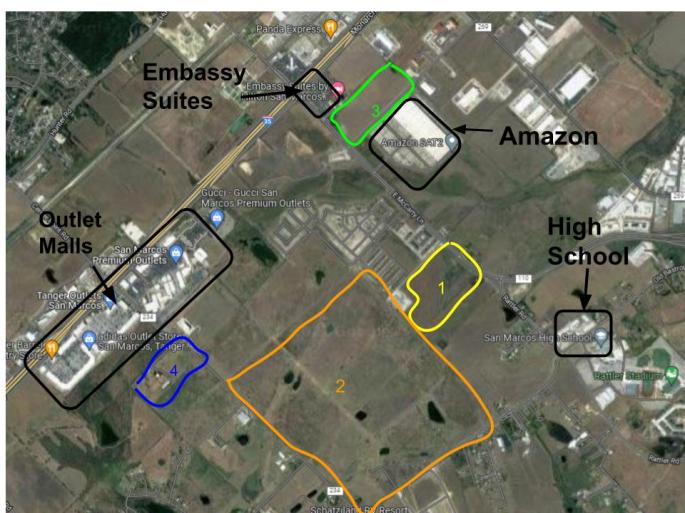
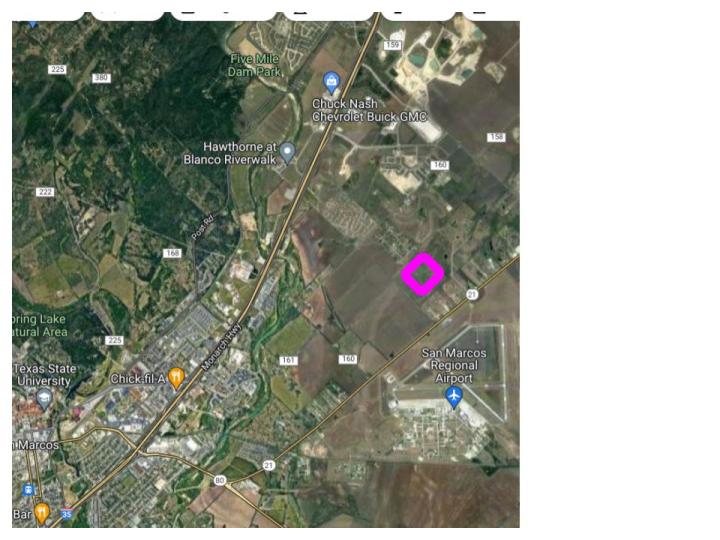
Item 9: First up is a zoning request. You may remember this, from August:
Today we’re looking at the green square, #3, again, between Amazon and Embassy Suites.
Last time, the developer wanted to rezone it from General Commercial to Heavy Commercial. P&Z approved the zoning change, but then City council swatted them down, citing the beauty of Embassy Suites. We do not want clanky old Heavy Commercial zoning next to our prized and glorious tourist conference space.
Now they’re back, changing their request to Light Industrial. This time, P&Z denied it (due to the beauty of Embassy Suites), and Council felt stuck. It would now require 6 votes to overturn P&Z.
Council would like things like restaurants and service-related businesses to go in. They don’t want a bunch of warehouses. The developers want to include restaurants, but also a bunch of warehouses.
In the end, Council decided to form a committee and punt the matter to them. Stay tuned.
Item 10: This is the big item of the night, the curfew ordinance. (Discussed previously here.)
In Citizen Comment, the speakers made all the basic arguments against the curfew: – It does not reduce crime – It creates unnecessary and negative interactions between kids and cops – It can serve as an entry point for getting a kid ensnared in the legal and criminal justice system – It’s an extra expense levied on poorer families – It requires a high degree of officer discretion, and many of us don’t trust cops to use that discretion wisely – Other interventions for troubled kids work better – It targets certain people for their age, not for any misconduct. – Plenty of cities (Austin, Waco) have done away with curfews, and it’s been fine. – (Plus some hyperbolic arguments that overstated the dangers. Maybe they helped move the Overton window a tad.)
The presentation
Objectively, Chief Standridge has a great presentation. I don’t agree with him and I didn’t change my mind, but he’s a very good public speaker.
Here’s his basic claims:
The fears are overstated. The implementation is very mild.
We can run the data and show that there is no racial bias.
The curfew is a helpful tool – both anecdotally, and based on the literature.
Here’s the longer version of the Chief’s argument:
The fears are overstated. The implementation is very mild.
There are 13 excused reasons that minors can be out and about during curfew. Many of the speakers ignored this list of acceptable reasons, and asked things like, “What if you’re coming home late from work?” Well, coming home from work is on the list of excuses.
The fines tend to be at most $100 plus court fees. Not $500.
There aren’t that many juvenile citations, and there really aren’t that many curfew citations. Pre-pandemic, there were ~15 curfew violations per year. Last year and this year, it’s about 2-3 per year. This supposedly shows good discretion by officers. It’s not being abused. Also it’s supposed to show that the police have other priorities, namely violent crime and traffic crashes.
I’ll concede part of this: as far as curfews go, this current implementation does seem to be on the milder side. However, he’s super short-staffed right now, and his focus is on violent crime and car crashes right now. Maybe next year, the focus will be elsewhere.
Is there a racial bias?
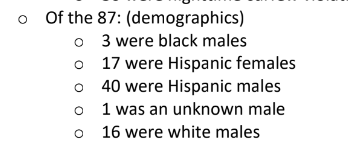
Chief Standridge wants to unpack the claim that these stops are racially biased. The numbers look racially biased. Since 2017, there have been 87 curfew citations. (There’s a lot of problems with these numbers, but I’ll tackle that at the end. For now, let’s just go with them.)
These citations break down by race as so:
3 Black males 17 Hispanic females 40 Hispanic males 16 white males Zero white females or black females
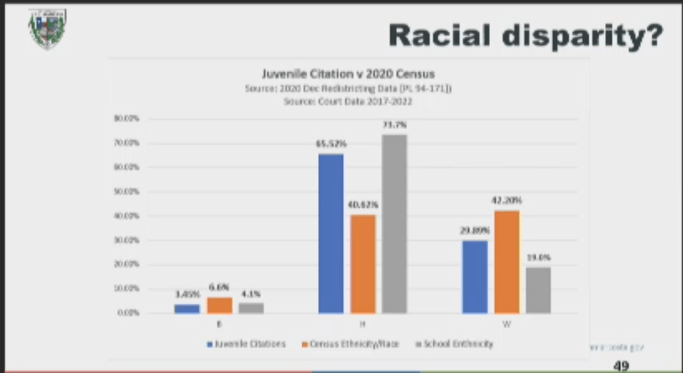
Here’s how the chief spins this: “I admit it looks bad when you compare to census data. Hispanics are only 40% of the population in town, but they’re 65% of these citations. But remember, most of these were daytime truancy tickets! The right comparison is to the SMCISD demographics. And SMCISD is 73% Hispanic, so we’re actually not targeting Hispanic students disproportionately, after all!”
Alyssa Garza goes after him for sloppy data and mixing which data he wants to use. This is a thing that public policy folks have to be extremely careful about – how exactly are you coding race? Federal data calls Hispanic people “white”, which is a choice that feels at odds with how everyone thinks about race. Is he using self-identified race? How reliable are these numbers?
I’m also skeptical of his comparison. If he wants to use SMCISD data as his comparison group, then he needs to separate out the truancy data from the overnight data. What are the demographics for the 35% that are overnight violations? Where kids live in “certain” neighborhoods, as the chief put it last time?
The curfew is a helpful tool – both anecdotally, and based on the literature.
Next, he gets some anecdotes from cops that this ordinance has caused minors to change their behavior for the better. It keeps students at Lamar/Rebound on campus. There were gang kids involved with guns and shoot outs. There was a suicidal kid who was reconnected with their parents, back in 2001.
(This gang business is problematic, but I’m leaving that alone for today.)
Last time, Alyssa Garza specifically asked what percent of violent crimes are committed by minors in San Marcos. I want to know this, too, and it should be easy to acquire. He did not provide that data, which makes me speculate that it’s negligible.
The literature: Standridge acknowledges that the evidence is thin on curfews actually reducing violent crime. However, curfews help keep kids from being victims of crimes. And possibly they end up committing less crimes later on in life.
He also discusses truancy. Truancy is entirely separate from the police department. The elementary and middle schools all have attendance committees and parent liaisons and make home visits. (He didn’t say what the high schools do. But school funding is tied to attendance, so I’m guessing they have a lot of people dedicated to it.) He has talked with Judge Moreno about the extent and outcomes of truancy cases she sees: it’s a lot.
To me, the discussion of truancy court makes the opposite point – that the schools have an established system for kids who miss school, and the world won’t fall apart if curfew is ended.
My analysis:
First, Chief Standridge is focused on “Which kids are helped by the curfew?” The activists during citizen comment were all focused on “Which kids are hurt by the curfew?” Fundamentally, they are each focused on different groups of people. And look: life is messy. Both could be true – some kids can be helped, while others are hurt. The question is how to weigh and decide which of those claims gets priority.
Are kids helped by the curfew, like he claims? I’m skeptical of his anecdotes. For the kids carrying guns around, the cops can already intervene. For the kids who want to leave Lamar campus, I suppose the threat of a $50 fine could motivate them to stay put.
Does curfew protect minors from victimization, like the literature shows? Sure! I can believe that minors are protected from certain kinds of crimes if they obey curfews. On the other hand, this is a bit close to “lock up your daughters so they don’t get raped” territory.
But also: when we say that minors are less likely to be victims under a curfew, what kinds of crimes are we measuring? Is domestic violence included in that statistic? Because when people are trapped at home – like during covid – domestic violence increases a lot.
Now on to the activists’ side: are kids hurt by the curfew? It’s not automatically traumatizing to all kids to get stopped and asked why you’re out at 3 am. But most of these kids have seen the videos of cops shooting black and brown men, and then, if you’re black or brown, it might be terrifying. I’m not sure Chief Standridge fully gets what a trust-deficit the police have. And he also glosses over the idea that he may have racist officers that are rougher with black and brown kids than with white kids. (He’d be foolish to pretend he has no chance of having MAGA police officers.)
Finally: some kids would just like to wander around at night, and they’re not going to be destructive jerks about it. We generally take civil liberties extremely seriously. You need to have a compelling reason to remove someone’s freedom.
One final thought: You maybe could probably talk me into the daytime truancy curfew more easily than the late-night curfew. I can see a clear, direct benefit to kids to making sure they get that high school diploma. But you need to be talking with the school district, and as far as I can tell, the school district hasn’t been involved at all.
So what do our councilmembers do?
Everyone is more uneasy about the curfew now. Last time, the focus was on crime in neighborhoods and how this curfew was good for everyone else. The focus was not on the kids (besides Max and Alyssa). Even Mark “gunshots every day outside my house!” Gleason is now thinking about actual juveniles, and he is worried that home schooled kids will get caught up in the truancy curfew. (The ordinance gets amended to include home schooling as a defense to prosecution.)
Saul proposes that the whole thing get sent back to committee for further drafting.
Jane Hughson says, “Back? It never was in a committee.” But nevertheless, Saul’s proposal sets things in motion.
Alyssa Garza always makes the most sense. But tonight, Shane Scott makes the second-most sense. He basically says, “The speakers were convincing and the chief was also convincing. But when I was a kid, I was allowed total freedom as long as I didn’t get in trouble. I just don’t like constraining anyone’s freedom if they’re not doing anything wrong.”
Alyssa Garza makes the best points. Basically, it’s complicated:
What about kids with informal jobs?
What about kids avoiding violent or unsafe homes?
Can we involve more players at the table?
This is exactly right. The reasons that a kid might be out at 3 am are big and complicated, and sometimes innocent and totally fine. Let’s bring social services and Community Action and the schools into the conversation, instead of being authoritarian about it.
Last time, Max Baker made an amendment to cap the citation at $50, plus court fees. Mark Gleason was the only person to vote against the cap.
This meeting, Mark Gleason tries to undo it. He makes a motion to allow penalties of up to $100 plus court fees, because he’s a jerk because he mistakenly believes that stiffer penalties are a bigger deterrent to bad decisions. (Actually, if you want to deter crime, you should have small, predictable consequences. The main problem here is that getting caught is extremely erratic, not the size of the penalty.)
But no one seconds Mark’s motion, and I enjoyed listening to the silence drag out. The malevolent little amendment gasped for breath, and died.
The curfew expired at the beginning of November. So currently, there is no curfew ordinance. (Children! Go run nuts! All hell has broken loose!) The question is:
Should this get sent to the Criminal Justice Reform Committee, and then renewed when they come back with their recommendations?
Or should this get renewed, and then sent to the CJR committee, and then revised when they come back with recommendations?
Alyssa makes a motion for the first option.
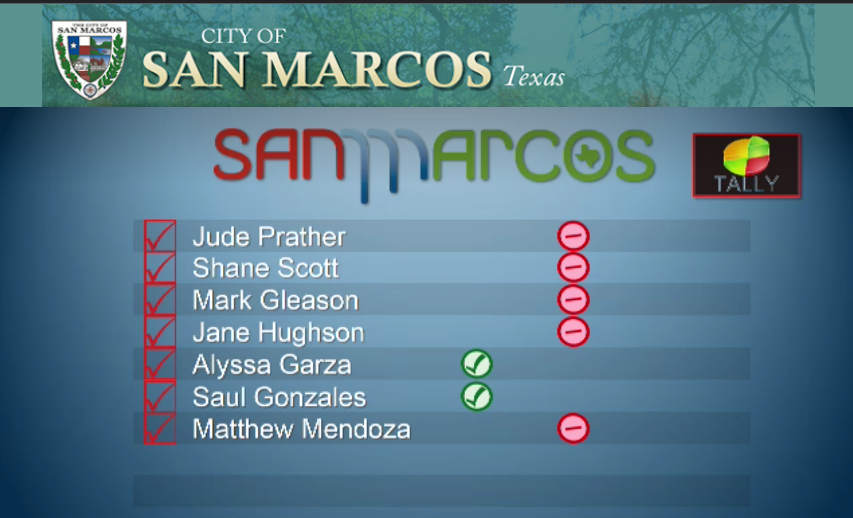
The vote to postpone without renewal:
So that fails. (Alyssa mutters “y’all are so fake” quietly.)
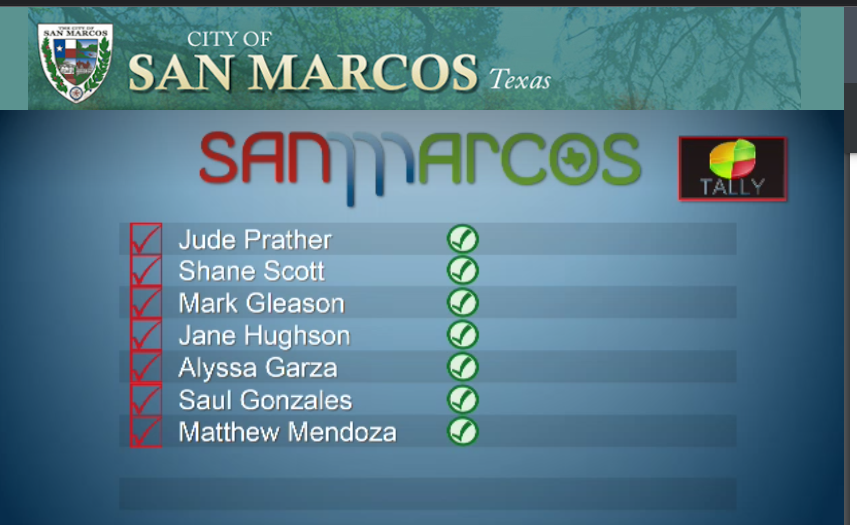
They unanimously agree to send it to the Criminal Justice Reform committee.
Should it be approved in the meantime?
One technicality: this is still the first reading. Last time, the first reading never passed. So this still has one more reading to go through.
…
Post Script #1: Just for funsies, let’s dunk on “defenses to prosecution” for a moment:
#9: Anyone between the ages of 10-17 who is married can be out past curfew. What the fuck is going on with that?
This ordinance was originally written in 1994. You know what it was intended to mean back then, of course: if an underage girl has married an adult man, and she’s out past curfew, then you wouldn’t take her home to her parents anymore. She’s married into the adult class of people now, and her husband deserves all deference on the matter. It is super-duper creepy as hell!
Furthermore, it doesn’t stand up to the barest of logic. An underage married person isn’t at risk of being a victim of crimes? An underage married person can’t commit crimes? Doesn’t need to finish high school anymore?
Honestly, show me a 17 year old married girl, and I actively want someone pulling her aside and asking if she needs help. Most likely, she either got pregnant, or she was escaping something worse at home. Either way, she could probably use a hand.
…
Post Script #2: The the data from Chief Standridge’s presentation is kinda gibberish.
Exhibit A:
Brought to you in patented squint-o-vision, because I had to take a screen shot, because it doesn’t appear in the packet.
At 1:49:45, Chief Standridge is partway through this slide, and he talks about the green area on the far right, Curfew Citations. He says “the raw number of citations for 2022 is two.” So I’m inferring that the 3rd-from-right column is the raw number of curfew citations for the past five years. Add those up: 17+14+11+3+2=47 curfew violations over the past five years.
However, no one refers to 47 as the total curfew violations. The total violations cited everywhere is 87 citations for the past five years. It’s in both the presentation, it’s used throughout the discussion, and it’s in the police memo from the packet.
Chief Standridge uses the smaller numbers to illustrate how sparingly this is used, but uses the bigger numbers to talk about demographics and how there’s no racial bias. It’s weird and I don’t understand the disparity between the two numbers.
But wait! There’s more!
Exhibit B: Here’s how the 87 breaks down racially:
Standridge computes the percentages black/Hispanic/white from this. Here’s how he gets his percents:
3 Black kids out of 87 total violations: 3/87 = 3.45% 17 females + 40 males = 57 Hispanic kids out of 87 total violations: 57/87 = 65.52% 26 white kids out of 87 total violations: 26/87 = 29.89%.
See how there are 26 white kids, instead of 16? That’s because 3+17+40+1+16=77 total citations, not 87 citations. There are 10 unaccounted kids in his racial breakdown, and so he made them all white. (And maybe it is just a typo. It could be that the true number is actually 26 white kids, not 16.)
Those are the percents for the blue bars in this chart:
I know, it’s miserable to read that chart. But the three blue bars are labeled 3.45% on the far left, 65.52% for the middle blue bar, and 29.89% for the blue bar on the right.
(That graph is supposed to be the defining argument that the curfew isn’t being administered in a racist way. He’s comparing the blue curfew citations with federal census racial demographics (orange), and SMCISD racial demographics (gray). Each cluster of three bars is a different race, with Black kids on the left, Hispanic kids in the middle, and white kids on the right.)
What’s the correct computation, then? You need to change the denominator. You only know the demographics of 76 kids, so you must compute the racial percents out of 76.
Here are the correct percents: 3 Black kids out of 76 violations: 3/76 = 3.95% 57 Hispanic kids out of 76 total violations: 57/76 = 75% 16 white kids out of 76 total violations: 16/76 = 21.05%
I don’t think this is part of some big conspiracy where Chief Standridge is intentionally massaging the data. I do think he’s spouting a bunch of gibberish, because he’s got inconsistent numbers handed to him, and he went with what was most expedient to serve the narrative he wanted to tell.
Item 13: Marijuana has now been decriminalized in San Marcos! Go nuts. But not too nuts, because you’re still in Texas and none of the other police forces (including the Tx State campus cops) are playing by these new rules.
….
Items 14/15: Reallocating money.
The Chamber of Commerce has $200K leftover Covid Relief money. The city is giving it to a few other programs:
Training members of the community to get certified on QuickBooks for bookkeeping
Training local small business owners and setting them up with bookkeepers from the first program
Childcare gap funding for families
I am hugely in favor of that last one. Childcare is wildly expensive.
There’s also some CBDG-covid money to be reallocated, $188K worth. The city staff propose that it go to two programs:
Marble Falls has a stress-healing nature program, where you’d take a bus there and spend a day or two outside. It’s ~$300 per person, which would be covered by $75K of the Covid money.
Improvements to the Kenneth Copeland Memorial Park. It used to be the El Camino park, but was renamed to honor the officer that was killed in 2017. They want to put $112K into improvements to it.
Nobody likes the Marble Falls idea. Too far away, too expensive, and we have very nice local parks.
Alyssa Garza proposes that we use the money on something that meets people’s direct needs a little better – rental assistance, utility assistance, that kind of thing. Jane Hughson, Saul Gonzalez, and Matt Mendoza all basically agree with Alyssa.
Mark Gleason and Jude Prather want to put $113K on the Kenneth Copeland park, and the other $75K on rental assistance.
Shane Scott wants to put all $188K on local parks, arguing that parks benefit everyone, while rental assistance only benefits some people.
Alyssa says, “You guys. The people are going to be living in those parks if we don’t help them cover their rent,” and tells them they’re out of touch with the needs of the community.
Jude Prather relents. But he makes some dippy comments here, “Could we call it Kenneth Copeland rental assistance?” (The park is already called the Kenneth Copeland park. We’re not disrespecting the officer by postponing new picnic tables. It’s already a nice park.) “Next September, I’m knocking on your door for that Kenneth Copeland money!” he says. Jane Hughson suggests that he doesn’t need to wait till next September. He can just go through the normal budgeting process that starts in a few months.
Anyway, five councilmembers want to direct the money towards rental assistance, so that’s how it will go.
…
Finally, they have to go through and replace Max on a bunch of committees and such. There’s probably 20 appointments or so.
Some that caught my attention:
Shane Scott has joined the Criminal Justice Review committee
Alyssa Garza has joined the Workforce Housing committee.
And a bunch more. Mostly these details are getting too into the weeds, even for me.
This week we talk about curfews and stray cats. It’s Max Baker’s last meeting, sadly. (My post-election thoughts can be found here.)
It’s a relatively short meeting. Jude Prather is absent, and Shane Scott goes home sick early on. So a lot of items get postponed until they’ve got a full house again.
Hours 0:00-2:45: In which I get fired up about curfews. They’re largely bullshit.
Hours 2:45-4:00: The cats and dogs ordinance is back up again.
Citizen Comment: Citizen Comment is mostly animal shelter experts who are politely asking us to undo the amendments that were added to the Animal Ordinance last meeting, and to trust that the experts have designed the policy to work best when you don’t throw sand in the gears.
One person also speaks up about the curfew ordinance, which ends up being the item of the night that I’m most fired up about.
Item 1: Sidewalk Maintenance and Gap Infill program
There is a quick update from the city – how do they pick which streets to install sidewalks on, what’s the process, how does it work for the landowners, etc. It seems very straightforward to me.
Your neighborhood can petition to get sidewalks added*. Max Baker asks if there is a petition process available to prevent sidewalks from being added to your neighborhood. There hadn’t been, but since all the councilmembers like the idea, there will be, now.
(I hate this idea. I want everyone to want sidewalks. They benefit people who may not live on your street! But that is not the Texas we live in, so I suppose anti-sidewalk petitions are good for the libertarians out there.)
* Although it’s not totally clear at that link where you find the petition. Maybe you have to email.
Item 17: Curfews. I actually feel really strongly about this issue!
Did you know that San Marcos has a curfew for underage residents? Neither did Chief Standridge. Apparently it’s been on the books in its current form since 2009, and it gets re-upped every three years.
There are two parts:
Curfew overnight: 11 pm – 6 am on school nights, and midnight – 6 am on weekends.
Curfew during school hours: 9 am – 2:30 pm, Monday through Friday.
Chief Standridge first says that it’s not used very often, and it was impossible to use during Covid when everyone was at home during school hours anyway. So far this school year, they’ve only used it three times.
He specifically talks about “troubled neighborhoods”, neighborhoods with violent crime. Standridge likes curfews because it gives officers an opening to stop and talk to someone who looks too young to be out and about. Otherwise they’re not allowed to just detain people walking down the street, because that is a hallmark of a police state.
I’m so frustrated by the conversation that I want to start with a rant, instead of the council discussion. We’ll get back to the council discussion.
Are curfews best for kids?
Let’s say you’ve got a kid who is jeopardizing their future by missing too much school. Is it in their best interest to entangle them with cops and the legal system? NO. Just no.
Best case scenario, it costs them or their family $150 to go to court and straighten it out. Worst case scenario, they are now tangled up with the juvenile criminal justice system, and they are starting to accumulate prior offenses. This is particularly bad for kids who are likely to get racially profiled.
We lock up an astronomical number of people in the United States. We have a moral obligation to work to keep kids out of the criminal justice system.
And remember, we’re not cruising all neighborhoods on an equal basis, looking to talk to youths! We’re cruising troubled neighborhoods, and stopping young people there. The effect is biased along race and class lines, no matter how much Chief Standridge insists that there’s no racist intent. Maybe there is no racist intent! But in effect, there is bias. Only kids from troubled neighborhoods are getting ensnared under curfew laws.
What about those kids that really are getting up to mischief overnight or during school? Most of the time, you can let the family handle it. The police are not needed to help the kid straighten out.
But other times, kids causing problems are the ones that have big problems. They are in unstable homes. They have mental health issues. They are living with poverty and/or witnessing substance abuse and/or violence and/or manipulation and/or emotional control, etc. Getting these kids ensnared in the legal system just pours fuel on the fire.
What’s the alternative? What would be in the best interests of the kid? Basically, any meaningful, evidence-based intervention. Run it through community services, rather than the cops. Cops are really not trained to handle traumatized kids! Traumatized kids will deliberately try to provoke adults and be disrespectful, and cops are the worst at handling that kind of thing!
Why don’t we do implement more of those interventions that are shown to work? First of all, we do. Notice that there was no one from Community Action or the public schools or other after-school programs there to talk about what actually works against truancy.
If kids are still slipping through, why don’t we do even more of these programs? $$$$$$$$$. Anything that works will be labor-intensive and time-intensive. You have to have programs and you have to take time to build relationships with kids. You know what’s cheap? Letting officers stop kids whenever they want and intervene.
This is absolutely not best for kids. This is cheapest for kids.
Is it best for everyone else? Does it protect the rest of us to keep kids under curfew?
No.
Do kids get up to mischief? Abso-fucking-lutely. They are absolutely capable of petty theft and vandalism and being a nuisance. But if any of those things are going on, then cops are allowed to stop people who may be involved. If someone calls in that the neighborhood kids keep stealing shit off their porch, the cops are allowed to go talk to the neighborhood kids. No curfew needed.
Do kids get up to violent crime? Maybe occasionally? But most violent crime is going to be committed by men aged 17-30, who are not affected by curfew. You can address the stray kid with a propensity for violence using the same techniques that you address the 17-30 year olds. No curfew needed.
When there is mischief or criminal activity, there are already mechanisms to intervene.
But more importantly, curfews don’t actually work. The academic studies show zero or minimal improvement when there are curfew laws in place. (What actually works? This chart summarizes the outcomes of a bunch of programs, both good programs that work, and also the dumb, authoritarian ones like Scared Straight that turn out to increase crime. This longer read is really thorough and good on programs that work.)
So how did City Council actually deal with this?
First, Shane Scott makes a motion to deny. Great! I agree.
Max Baker asks several times for data surrounding whether or not curfew is used to just stop teens randomly. What percent of stops do not result in tickets? Chief Standridge says that they don’t track that, and it would be overly cumbersome to do so.
Mark Gleason is a Chief Stan-stan, and so he’s all in. Anything that reduces truancy and violent crime (or pretends to) is good with him. His wife is an educator, and knows that truancy is a major problem. And violent crime in his neighborhood is out of control.
Alyssa asks, “How much of the violent crime is actually committed by minors?”
Chief Standridge doesn’t know this either. He openly says that the point of a curfew is to give officers cover so that they can stop minors and ask them why they’re out and about. I genuinely think he thinks it’s best for kids. (It’s not.)
Fundamentally, if you’re a hammer, you see the world as a nail. If you’re a chief of police, you think that police intervention is good for community members. (It’s not, necessarily.)
Jane Hughson asks about the list of exceptions. For example, you’re allowed to be out after curfew if you’re heading home from work or church. You’re allowed to be out and about on school holidays. Why don’t we call those “exceptions”? Instead we call them “defenses to prosecution”.
The reason is kind of creepy: If we called them exceptions, then officers would not be allowed to stop minors with exceptions. If we call them “defenses to prosecution”, then officers can stop whoever they like and give them a ticket, and the kids can use those exceptions in court to fight the ticket. It means that the cops don’t have to presume innocence. They can presume guilt, and let the kids fight it, in court.
The vote to deny the curfew ordinance: Deny: Max, Alyssa, and Shane Do not deny: Jane, Mark, Saul
Jude Prather is absent. It takes 4 votes to win a vote, so the motion to deny fails. So now there is a motion to approve the ordinance, which still needs to pass.
Max Baker asks how much the tickets cost. This is also a big consequence of over-policing poorer neighborhoods! You nickel and dime people to death!
Do you remember how much hand-wringing there was over a tax increase of $24 per year, which goes to help the entire community? The tickets here are set by the judge, with a max of $500. Plus court costs, which run $80-$100.
Max Baker makes a motion to cap the ticket fine at $50. This seems eminently reasonable to me. You’re still running up $150 in costs by being stopped by cops.
The vote: Cap tickets at $50 max: Jane, Alyssa, Max, Shane, Saul Fuck those poor people: Mark
Mark believes that punitive punishments are effective. That is a very authoritarian mindset. It drives me up the wall.
Next we go down a real rabbit hole with data. Max Baker wants the police to start recording a lot more data around these curfew stops.
I think asking for data is a waste of time, to be honest. The issue of curfews is a moral issue, and we already know, straight up, that curfews target people based on where they live. The only consequence of asking for data is to throw sand in the gears, because data is cumbersome to acquire. (Furthermore, Max’s question – are you stopping kids in a biased manner? – is not going to be answered by the data Max wants. You’d have to know which kids they just let walk by, without stopping them at all.)
Alyssa reiterates her question about wanting to know what percent of violent crime is caused by minors. This is the right question. And it’s not cumbersome at all to acquire. You’re not asking cops to fill out an extra form throughout their day, you’re asking someone to retrospectively pull a number from a spreadsheet.
Standridge balks at this. Minors records are protected by law!
Alyssa points out that she wants aggregate data, not individual data. (What Alyssa does best on the dais is respond to points like this in a soothing manner. She says, “Data is really powerful! I bet we can figure out a way to get the answer and still protect the kids!” in an upbeat, soothing way. It’s very effective.)
Max goes off on a rant about Mark Gleason being a shill for the police, because they endorsed him, and therefore he’s going to be in favor of this, no matter what!
Max is a little off here – Mark Gleason has a true authoritarian streak. Mark supports curfews because he sincerely loves heavy-handed police tactics, and believes in “good guys” and “bad guys”, and believes that the police can tell the difference. The police endorsed Mark, but Mark was always already in their corner.
Mark Gleason takes offense, and goes on a rant about the violent crime in his neighborhood. (He lives in Blanco Gardens.) He’s sick of it! He hears gunshots all the time, and kids are stealing car parts and messing up people’s yards.
Clearly Mark thinks that allowing cops to stop and talk to anyone looking young on the streets will have an effect on violent crime. That’s a very authoritarian take, and ends up hurting people who “look” like criminals.
The vote: Should cops have to collect and present a lot more data? Yes: Max, Shane, Alyssa, Saul No: Jane and Mark.
Finally, the main motion on curfews:
The vote: Should we have curfews? Yes: Jane, Mark, Saul No: Max, Shane, Alyssa
So this fails too!! What does this mean? It means that when they discuss curfews at the next meeting, it will still be the first reading. However, Max will be gone and Matthew Mendoza and Jude Prather will be back. So I’m guessing this will pass.
How can the animal shelter distinguish community cats from someone’s much-loved pet, when they pick them up?
Should we ban pet stores from sourcing puppies from puppy mills?
1. On Trap/Neuter/Release vs Stray-Holds
Here is what the animal experts proposed:
Healthy outdoor cats do not get picked up. Except that they can be picked up, and checked to see if they’ve been spayed/neutered. If they haven’t, they can be taken to the shelter, then spayed/neutered, and then returned to where they were picked up. This is Trap/Neuter/Release, or TNR.
Here is what Council is worried about: What if Fluffy the house cat escapes, and bolts and gets lost? And suppose Fluffy has no visible identification. She gets picked up, spayed, and returned to the neighborhood in which she was lost. The owner does not get a chance to find her at the shelter and reclaim her, and Fluffy stays lost.
The experts say that only 2% of shelter cats are reconnected with their owners, but councilmembers are still worried.
(I suspect that this is why mandatory micro-chipping is a vital part of the policy. But that got scrapped somewhere along the line. Without mandatory micro-chipping, there will definitely be borderline cases where it’s really hard to tell community cats from half-tamed outdoor cats from skittish indoor cats that got loose.
But mandatory micro-chipping has its problems, too: how do you publicize and facilitate it? how do you get everyone to go along with it?)
Alyssa asks if it’s possible to publicize cats that are being returned under TNR? That way I could check the website and see if Fluffy was returned to a specific location, and try to go find her there.
They say yes, they could do that.
Mark Gleason is also worried about cats being spayed/neutered against the owner’s will. He wants the cats held for 48 hours before the mandatory spay/neuter, and then held for another 24 hours to let them recover from surgery.
Here’s the moment of the night that made me laugh:
Saul says, “I’m going to throw a monkey wrench in the conversation. What if the cat has been exposed to rabies, and doesn’t show any signs of rabies?”
The animal guy answers, “Any animal that’s potentially been exposed to rabies has to go through a ten day quarantine.”
Saul says, “But you wouldn’t know that. Because they’re not showing any signs. What’s the procedure then?”
Yeah, ya wise guy! Whatsya procedure then?
The answer is, “In the case that we don’t know….then we don’t know. I hope that never happens.”
Saul says ominously, “It happened on Barbara Drive, years back. Just thought I’d throw a monkey wrench in the conversation.”
CHECKMATE, ANIMAL ENTHUSIASTS. Don’t even try to come before Saul without vetting your double-secret rabies exposure policy. His work is done.
So where does the conversation stand? Two amendments were passed last time that the experts are strongly opposed to. Everyone is worried about how loved pets will get caught up in the system. (And Mark is hyper-concerned about owners’ rights to have Quiverfull cats.)
Alyssa suggests that we revert back to the original language proposed by the professionals. She points out that the experts are devoted to animals, and are proposing policy that’s been refined over years, and we should not dispose of their expertise out of sheer hubris. That as long as the shelter is appropriately funded, they will work hard to reunite pets with families, and will act in the best interests of the animals. (This is my opinion as well.)
Mark gets fired up. He’s convinced that if we revert to the original, that they will start euthanizing cats left and right. It’s really astonishing how little Mark trusts certain people in certain situations.
The shelter people answer his euthanasia concerns: Right now, we euthanize cats immediately if there is a medical need to end suffering. The only other reason we euthanize cats is due to overcrowding. This policy lets us keep from having overcrowding. Mark, your stray-hold amendment will keep us in an over-crowding cycle.
Finally, Jane says “There’s only five of us here.” (Shane Scott has gone home sick at this point) “Can we send this back to committee, to hammer out language separating community cats from pets-cats?”
The vote to postpone until January: Yes: Jane, Mark, Alyssa, Saul No: Max
So it passes.
Onto Issue 2: The Sourcing of Puppies from Puppy Mills for Pet Stores
They voted to postpone before they ever got to the puppy mill part of the ordinance. So this got absolutely no discussion! It was very weird.
I was so confused. But keep reading! It gets one final gasp during Q&A at the end of the meeting.
Jane Hughson wants to strike one of the amendments that Max made last time, about whether or not we should lobby the state legislature to let us levy fees on Texas State.
Clearly some conversation has taken place behind the scenes. Both Chase Stapp and Fire Chief Stevens hop on and say that it’s futile and counterproductive, because other college towns have tried, and the State University lobby is ridiculously powerful. It would be better to go talk to the university directly and see if we can get them to partner with us in some new way. After all, there’s a new president.
The meeting is winding down, and Max is pissed. He calls everyone apathetic and makes some barb about for-profit universities that I don’t follow.
Alyssa tells him that she’s going to vote to remove the clause, but she offers to go to Erin Zwiener with him, and research the issue, and help draft a statement that they can give to the legislative committee. I don’t know if he accepted her offer.
The clause is removed (4-1 vote) and the main motion passes (5-0 vote).
…
Question and answer from the press and public: One community member asks “What happened to the Puppy Mill part of the animal ordinance? Is there any way you can deal with that part?”
YES! Thank you! it was bizarre that they tabled the entire motion, and did not say one word about the most controversial part!
The lawyer says they could do this. You’d have to have a motion to reconsider the item, and then you could start discussing the puppy mill part.
Alyssa makes the motion, saying she’d really like to close out this one part. ME TOO!
The vote to reconsider the item: Deal with puppy mills now: Jane, Max, Alyssa No: Mark and Saul
So that failed, because it requires four votes for anything to pass. I do not understand how Mark manages to be on the wrong side of every last single vote, but there you have it.
(What I want to know still is: can the puppy mill part be brought back sooner than January? Or does it languish for another two months? We are just left hanging!)
1. The least surprising thing is that Saul Gonzales trounced Atom Von Arndt, 75% to 25%. Saul is well-known, and he knows how to turn out voters to the polls.
2. Or maybe the least surprising thing is that Yay On A passed overwhelmingly, with 82% in favor of decriminalizing possession of marijuana, up to 4 oz.
Note that city council is way out of step with San Martians on this. If it had been put to a city council vote, Jane Hughson, Mark Gleason, and Saul would have all wanted the amount reduced to 1-2 oz. I’m not sure 4 oz would pass at all, and 1-2 oz might have only narrowly passed.
3. Max Baker lost to Matthew Mendoza. Initially I was really shocked.
But now I understand it like so: I think the election was a referendum on Max Baker. There was most likely a huge whisper campaign against Max from a lot of people (and other councilmembers, I’m guessing). I agree with his politics, but he did lob a lot of unpleasant accusations at people and made a lot of people mad with his tactics.
Matthew Mendoza is from a well-connected family, and may have benefited from Saul’s network of voter mobilization efforts. I’m still disappointed that we’re losing Max up on the dais, though, and I hope he stays active in politics and activism.
4. Jane Hughson handily beat John Thomaides, 63%-37%.
I didn’t expect it to be so lopsided. I wish it had been a little closer, so that she’d feel some impetus to govern a little more proactively. This is a pretty clear mandate that voters want her to keep doing what she’s been doing.
Onto last Tuesday’s meeting, which was extremely packed and dense. There was a lot going on this night.
Hours 0:00 – 2:54: First, an introduction to Pick-a-Pet. Then a big issue: flood victims from 2015 need homes. Sunset Acres has insanely awful sewage and drainage problems. There is a head on collision between these two issues.
Hours 2:54 – 4:00: In which Max gets councilmembers to go on record with their position on every progressive issue you’ve ever considered.
Hours 4:00-5:08: We finally tackle the Pick-a-Pet problem. Are we willing to ban sourcing from puppy mills?
Hours 5:08-5:30: A light item! Finally! What kind of welcome sign says Welcome to San Marcos in the most welcoming manner?
That’s all we got! Make sure your derelict friends and family all show up at the ballot box on Tuesday!
Citizen comment: A ton of people turned out from Pick-a-Pet to fight the puppy mill ordinance. Mostly customers, with one or two employees. Their main talking points were:
We love our pet so much!
The employees love animals so much, and the atmosphere is so nice and caring there!
Sometimes you just want a pure-breed, right?
Why do you want to close down this nice store?
These people seemed earnest, but the arguments above are all bunk. You can have really loving, sweet employees and still buy your puppies in bulk from Minnesota farms with 3000 puppies and atrocious conditions for the breeding dogs. None of these things are dispositive.
Also, under the proposal, you can still buy your favorite pure-bred dog from a small scale breeder, where you can tour the facilities and admire the happy, handsome parents of your new doggo. And this nice store with loving employees can pivot to selling pet supplies and offering pet adoptions, like PetSmart does.
Another talking point is:
We’ve been open a year, and none of our pets have ended up at the shelter, so we’re not making the stray animal problem worse!
This is also not really the point. The point is the puppy mills.
The speakers were pretty over-the-top with the mushiness. Their pups have transformed their families from bleak grayness to shimmers and sequins, and brought happiness to their little girls for the first time in their Dickensian existences. Only pure breeds from pet stores can bring little girls that kind of feels.
Stay tuned – we will hash out this ordinance thoroughly in Hours 4:00-5:08!
…
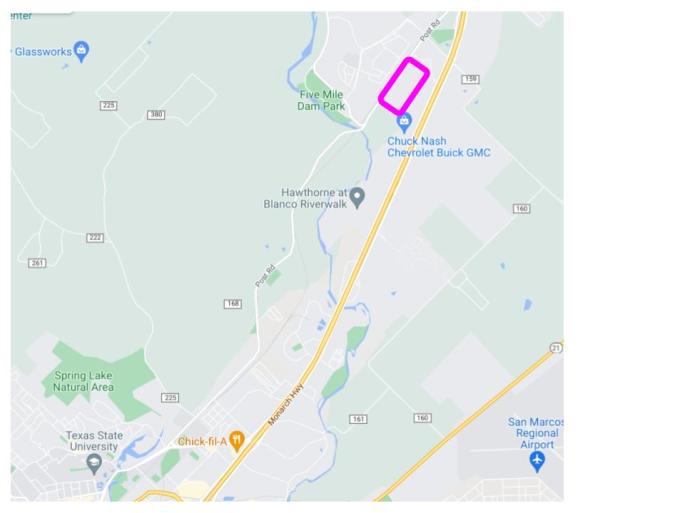
Item 16: About 40 acres near 5 mile dam:
It’s going to be apartment complexes. It had been zoned General Commercial, and now it’s CD-4, which can mean a lot of things. But they openly admitted that it’s going to be apartment complexes.
Housing stock: How long will it take to build? How much housing will it provide? What is the forecasted housing deficit at that point? Is it targeting a price-point that serves what San Marcos needs?
Pester the Planning Department directors to start providing an ongoing, updated needs assessment. We need to know this.
Environment: Is it on the aquifer? Is it in a flood zone? Will it create run-off into the river?Are we looking at sprawl? Is it uniformly single-family homes?
Not on the aquifer. Not in a flood zone.
A teeny bit of sprawl, insofar as Blanco Vista is already isolated and sprawly. But it’s not making Blanco Vista any more sprawling. It shouldn’t require much in the way of utility extensions.
Apartment complexes are pretty environmentally friendly, because they’re efficient.
Social: Is it meaningfully mixed income? Is it near existing SMCISD schools and amenities?
Not meaningfully mixed income. That’s my biggest gripe about big apartment complexes – it’s not good for a community to be economically segregated.
On the schools: Blanco Vista got a special carve out to be part of Hays CISD instead of SMCISD, even though they live in San Marcos. This kind of chafes, for a few reasons. First, because people disparage SMCISD for racist and/or classist reasons, and so Blanco Vista deserves a bit of side-eye for wriggling themselves out of district. (And whoever was on city council back then, too.)
Second, SMCISD is always weirdly close to getting forced to send money back to the state under the Robin Hood law, which is supposed to even out rich school districts and poor school districts throughout Texas. I’m not totally clear on the details, but it’s something like SMCISD needs families to balance out the university/outlet malls/non-family parts of San Marcos. So SMCISD particularly gets screwed when neighborhoods like Blanco Vista and Whisper Tract are in San Marcos but not in SMCISD.
That die is already cast, though. This particular apartment complex is in Hays CISD.
The San Marxist Special: Is it a mixed-income blend of single family houses, four-plexes, and eight-plexes, all mixed together? With schools, shops, restaurants, and public community space sprinkled throughout?
Nope, not that at all.
So is this good or bad? It’s mixed. More affordable housing is good. General Commercial would have been good as well, except developers seem to be too timid to build the retail that people need to have near their homes.
…
Item 17: I listened to this when it came through P&Z on October 11th. This one is fascinating.
The 2015 floods destroyed a lot of homes. Three years later, 12 of those families were awarded CBDG grants to build new houses. Of those, 9 families are now in new homes. The CBDG program either built new homes for them on new lots somewhere in San Marcos, or they owned the land and had their old homes torn down and built new ones, raised above the flood plain.
We’re down to the last three families. They are still in the houses that were flooded, all trailer homes. The homes are becoming quite dangerous – a kid fell through the rotten floor, two of the couples are aging and there are damaged stairs, there’s mold, and on and on. A family of six has no heat in the winter. And so on. They are still trapped in a nightmare that’s been going on for seven years.
These three families don’t own their land, and it’s in the floodway, so they have to be moved to new lots. The city has a few lots available, but they’re not ideal – over by Texas State, away from schools/family/community, etc.
So along comes this lot, in Sunset Acres, down the street from Mendez Elementary, where an old firestation used to be. It’s large enough to be redeveloped into three houses. It seems ideal.
However! At the P&Z meeting, about a dozen members of the neighborhood showed up. They are dealing with horrendous conditions on their street. Basically, raw sewage is frequently backing up into their bathrooms and up through their drains. It sounds like a nightmare. And several of them have regular flooding, as well. This has been going on for years and years.
They weren’t opposed to the houses being built eventually, but they absolutely did not want anything increasing the quantity of waste in those pipes until the sewage problems were fixed.
The city staff explained the plan to fix the sewage: TxDot is putting a larger sewage pipe under I-35, which should be done by 2025. Then the city will start the Sunset Acres drainage and wastewater project in this neighborhood. It’s a two phase project. Fingers crossed, everything will be done by 2029!
P&Z members basically gawked at City Staff and said, “Why have you handed us this utter shit sandwich?!”
It seemed like such a disaster – these three families are so desperate, and these other people are desperate in different ways, and we’re supposed to put the first group in with the second?! No. P&Z denied the zoning change 6-2.
So now it goes to Council. I am pretty impressed by the city staff. They got smacked down hard at P&Z, and they got to work. First they had a bunch of meetings with the neighborhood and with all the different engineers and utility workers, and they sent little cameras down pipes and tried to figure out what to do.
They came up with a medium-term plan and a short-term plan to supplement the long-term plan.
Medium-term: they’re going to replace one of the worst sagging, splitting pipes running down Broadway.
Short-term: They’re going to massively enlarge a detention pond, to help with the flooding. For the sewer, they’re going to add an access point to the sewage line where it gets clogged, and they’re committing to cleaning it out on a regular basis. This should go a long way to keep the pipes flowing and prevent sewage from backing up into homes. (The new houses can be built with back-flow preventors, but the city can’t pay for those to be installed in existing private houses.)
Why haven’t we already been cleaning the pipes regularly? It depends what kind answer you want. Over the past decades and generations, we haven’t been doing these things due to negligence and systemic inequity. More recently, we haven’t been doing it due to a shoestring budget. We’re not doing tons of things throughout the city that we could, if we had more money.
Everyone on City Council was both impressed and appropriately cautious with this potential solution. Sunset Acres residents are so burnt out on being ignored by the city that they are not exactly celebrating yet. A lot hinges on how well the city implements the short and medium-term solutions.
Still, I don’t want to gloss over the tremendous amount of effort that the city staff went to, to make this a win-win-win situation. It would be great to remedy the raw sewage backflow and house these three families and restore everyone’s faith in the power of a group of citizens raising a fuss.
Max: These light industrial things only get built next to marginalized groups. No.
Passes 5-1.
Next big topic of the night:
Item 15: I gather that City Council has a legislative committee comprised of Mayor Hughson, Alyssa Garza, and Mark Gleason. Max Baker wanted to be on it, but he is not. The legislative committee goes to the state capital in Austin and lobbies the state for different policy goals.
Max gave the committee a wishlist of issues that he wanted them to tackle, and they did not take his suggestions, so he’s bringing it to the entire council. (Plus a few extra.)
There’s a basic philosophic divide here: – Jane Hughson says over and over that she’s not exactly against the ideas, but she thinks they are battles that aren’t worth fighting. That the opponents are too big and organized for measly little San Marcos. – Max feels that the time for change is always now. If no one starts a movement, change will never begin.
Max has nine issues, and they take them one by one. (Boy do I love getting all these councilmembers down on record on these issues! Watch how spicy these get!)
Area Median Income – what counts as low income?
Anytime something is “affordable”, we use the Austin-Round Rock Median Income as a yardstick for what “affordable” means. But the median San Marcos resident earns way less than the median Austin-Round Rock resident, so “affordable” to San Marcos needs to be adjusted downward from “affordable” for Austin-Roundrock.
The vote: Everyone agrees with this! Add it to the list.
Is Title Insurance is mostly a scam? There’s a kernel of protection, and a whole lot of profit going to title companies who do extraordinarily little. Should we lobby for protections?
Some highlights from the Texas Observer article at that link:
Title insurance costs more in Texas than in any other state, about $1800 on average.
The loss-ratio is how much insurance companies spend on payouts to customers. The Affordable Care Act set loss-ratios for medical insurance at 80-85%. The loss ratio for title insurance is 6%.
And then there’s this gem:
“But Texas doesn’t have a system that allows price competition, like Oregon, where title insurance usually costs between $300 and $600. Nor does it have a socialized system, like in Iowa, where it’s even cheaper. Texas has the worst of both worlds: a state-mandated system that forbids competition and sets rates higher than anywhere else in the country, with all the profit flowing into private pockets.”
Free market, baby!
Jane Hughson agrees with the critique, but particularly feels like we’re tilting at windmills here. It doesn’t get any traction. Not on the list.
(I know I’ve got at least one reader who works at a title company! Hi! Sorry to take an aggressive stance against your industry!)
Should we lobby for extra money to support homelessness-related issues, like a continuum of care, transitional housing, and case management?
Apparently our local organization, the Homeless Coalition, does already work pretty closely with the Texas Housing Network.
Max Baker points out some specific legislative possibilities, like addressing how redlining, credit scores, and background checks get used to exclude people from renting available apartments. That part kind of gets ignored, though. They end up with just agreeing to pursue more funding for housing-related issues.
The vote: 6-1. So this will get added to the list.
Honestly, who could oppose lobbying for funding for people experiencing homelessness? Mark Gleason can! He doesn’t say why. (Shane Scott is absent, by the way.)
Should we look at the impact of constitutional carry of guns, as it affects the rise in violent crime?
Max Baker notes that more and more states are loosening up their firearm regulations, and violent crime is on the rise, and wants some data on this possible correlation.
Mark Gleason gets very upset. Law-abiding citizens do not commit crimes!! That’s been proven!
Max Baker points out that anyone can get a gun, not just law-abiding citizens. That’s kinda the point of constitutional carry.
Mark is pretty emotional on this point and flailing. He is very fired up over the wild notion that an endless supply of lethal weapons could end up being used in lethal ways.
Anyway, this doesn’t go anywhere.
The vote: Yes: Alyssa Garza and Max Baker No: Jude Prather, Saul Gonzalez, Mark Gleason, and Jane Hughson.
Jane Hughson says that she cares about this issue, but she just thinks it’s useless to go after issues this big. Max calls her apathetic. It’s kinda rude, but she’s also a potential ally who is too timid to sign on to big issues.
Police Accountability and Access to Records
Suppose you’re sitting in jail, and there’s police bodycam evidence that could exonerate you. Should you be able to see it? Should you be able to share it? In other states, you can. When the issue is raised here, Chief Standridge says he’s constrained by Texas Law.
The vote: Should we take lobby for citizen access to bodycam footage? Yes: Alyssa Garza, Max Baker, Saul Gonzalez No: Jude Prather, Mark Gleason and Jane Hughson, who once again points out that she would if it weren’t futile.
Tie votes count as denials. So this does not make the cut.
Abortion rights
Should San Marcos lobby for Texas to repeal its anti-abortion law?
Alyssa points out that there are a lot of city councils throughout the state to coordinate and work with. We would not be taking this on alone.
The vote: Yes: Alyssa Garza and Max Bakers No: Mark Gleason, Saul Gonzalez, Jude Prather, and Mayor Hughson.
They offer mealy-mouthed dilutions, like “I’m pro-choice but can’t speak for the city!” (Mayor Hughson) and “It’s too complicated for 10 pm” (Mark Gleason) and “This is too divisive and complex” (Jude Prather).
After the vote, Jane says, “It’s too bad that the state legislatures won’t just go with what the majority of the people want,” and Alyssa mutters, “That doesn’t happen here, either,” and Max let out a guffaw. I smirked.
Pre-emption of local code: Vacant buildings
Vacant buildings are a nuisance and a waste of valuable space. They make downtown look sad and depressed. There’s no business inside that contributes to the tax roll. They attract vagrancy and can require extra fire and police services, compared to if they were occupied. Can San Marcos charge owners of vacant buildings a registration fee that kicks in every six months or so that it sits vacant?
Jude suggests that we should just levy such a fee, but Max says that he has only found out-of-state cities which do this, so he suspects it’s not legal here. Hence something to either pursue, or lobby the state about.
Everyone likes this idea.
Another state pre-emption of local code: Texas State University
Texas State used to pay into our stormwater fund, like the rest of us do. You may have noticed that they occupy a whole lot of pavement which sits uphill of a whole lot of town.
One day, the board of regents asked what this funny-looking stormwater fee was doing on their balance sheets, and then they got mad about it. So they went to the state legislature, who agreed that they shouldn’t have to pay it anymore.
(That’s how Jane Hughson explained it – I couldn’t find anything one way or the other in a quick google search.)
They also don’t pay for the fire department, police department, nor do they have to follow municipal regulations. (They do pay for wastewater services, and they do have their own police department, so there’s that.)
Mark Gleason and Saul Gonzales are on board with lobbying for them to pay for fire department service, but not stormwater. Neither of them offer up a reason why they’d exclude stormwater fees. I’m pretty sure they’re aware that there’s a flooding problem in town.
Mayor Hughson agrees to both, despite saying she thinks it’s unlikely to go anywhere.
Alyssa supports both.
Jude abstains.
So this one will make the cut.
The SMART Terminal:
I don’t really know what the SMART Terminal is, but it has something to do with the railroad line, north east of town. Max says it’s no longer what it was originally envisioned to be, and he wants it removed from the list of lobbying criteria.
Jane Hughson agrees that it’s no longer what it was going to be, but still wants it left on the list of items that we lobby over in Austin.
Who knows. SMART Terminal stays, by a vote of 5-1.
THAT’S ALL OF THEM!
It’s important to note that this is all preliminary. The real vote is next session. So any of this could get struck down, amended, or voted out.



 The San Marxist