Hours 1:18-2:21, 1/17/23

Item 22: Fire code updates

Every six years, the fire department updates the fire codes. At the January 3rd workshop, the fire department recommended some changes. The big one: retroactive automatic sprinkler systems.

Basically, sprinklers entirely prevent mass fatality events from fires. This is great! But they’re super expensive to install.

Who will be required to install sprinklers? Big venues that serve alcohol and hold 300 people or more. Think clubs, restaurants, and banquet halls, but also things like the VFW and Cuauhtemoc Hall.

Here’s how much they cost:

  • $4-5 per square foot for the sprinkler system
  • $25K for 150 ft of underground fireline pipe
  • $5-10K for the sprinkler monitoring system, to make sure you’re maintaining water pressure and things like that.

So if your building is 5000 square feet, you’re looking at upwards of $50K. That’s really expensive. Everyone is very worried about the nonprofits like VFW and Cuauhtemoc Hall. They’re good community partners.

The plan is for the city to help with the one-time costs. The nonprofits will go get bids, and the fire department will use the revenue from inspection fees to offset the costs.  The inspection fee will be $100/year, and San Marcos is expecting to bring in maybe $100K/year.  So each year they can help out several non-profits, and plus maybe get some grant money in.  Council proposes a 3 year grace period for nonprofits to comply.

(I’m anticipating that local private businesses will also balk at spending $50,000 on sprinklers, so maybe this ends up coming around again.)

Item 23: Campaign spending limits

We finalize the campaign contribution details from this meeting. The spending cap will be set at $1 per candidate. Numbers will be based on the previous November’s registered voters.

Item 25: Decorum. 

You guys. This item was such extremely weird bullshit. Especially in light of how Jane Hughson shut down Max Baker – a private citizen now –  just one hour earlier. 

This is Jane Hughson’s item. Here is the key new bit:

To clarify: you’re allowed to identify individuals by name if you want to compliment them. You just can’t identify someone by name during a personal attack.

Jane is really hung up on “personal attacks”, and she believes deep in her soul that “personal attacks” are a well-understood, universally-agreed-upon phenomenon. She believes that “personal attacks” are worse than “personal insults” and that all of us would see eye-to-eye with her on what counts as a personal attack.

Now, this phrase is loaded. Back when Max Baker was on council, she used to accuse him of personal attacks every time they started squabbling. Max would counter that he was angry, yes, and stating his opinion, and that his opinion was grounded in fact. See? No room for ambiguity!

Jane openly says that she is talking about delivery style and not just content. You can say insulting things if you say them calmly. But if you display anger, then it becomes an attack.  (Jane has never used this phrase to describe, say, LMC, who generally keeps her composure when lobbing wildly personal insults at people like, say, Bert Lumbreras.)

Alyssa speaks up. She’s uncomfortable controlling anyone’s speech. If someone’s angry, she wants to know. She doesn’t take comments personally.  Sometimes she can then unpack how the person got there, other times it sometimes wakes her up to something she’s missing. It makes her uncomfortable when speakers come for staff, but city council can intervene and support the staff in those occasions. 

Jane says, “I know what you’re saying. But this is attacks. Not just saying things, but attacks. Tamp down the nastiness.”  She explicitly says that insults can be okay, but it’s the angry attacks that are not okay.

Tone-policing Max Baker specifically has come up before. And here’s part of what I said then:

These proposals are all attacking Max on the surface level, and trying to police his tone, word choice, and mannerisms. They are not taking issue with his ideas. This is a very old tactic – you focus on someone’s tone, and then you don’t have to engage with the content. Historically, requirements for the surface level (“professionalism”) were used to prevent anyone besides old white dudes from participating, unless they pandered to the old white dudes. Accusing someone of being unprofessional allows you plausible deniability – you weren’t against their ideas, but they were being so unprofessional!

For the past three years,  Jane has lodged this complaint at Max, that when he’s angry, he’s attacking different people.  In the past two months, Max has become a private citizen who speaks at public hearings, and Jane is now wanting to add this specific phrase – “personal attacks” – to the rules for decorum.  It feels targeted at him with extreme precision.

Alyssa: Anger is a valid feeling, and I’m not uncomfortable with people expressing their emotions.

Jude Prather says that he prefers the phrase “personal insults” over “personal attacks”.  He thinks it’s clearer. “Personal attacks” is very vague. 

YES.

Alyssa asks what the difference is, anyway?  

YES.

Jane’s answer (at 2:16:32, if you’d like to go watch):  “My motion is the word attack because to me, it’s clear. Insult is not – to me – removable [from the chambers].”

In other words, her definition is “I know it when I see it. If you get thrown out, it was a personal attack.” Clear as mud.

There’s a little discussion of alternate ways that people can communicate angry, personal attacks. They can email or leave a message on Jane’s office phone.  The problem is that then the public – namely me! – does not know what people are mad about. I would like to know when people are mad!

The vote
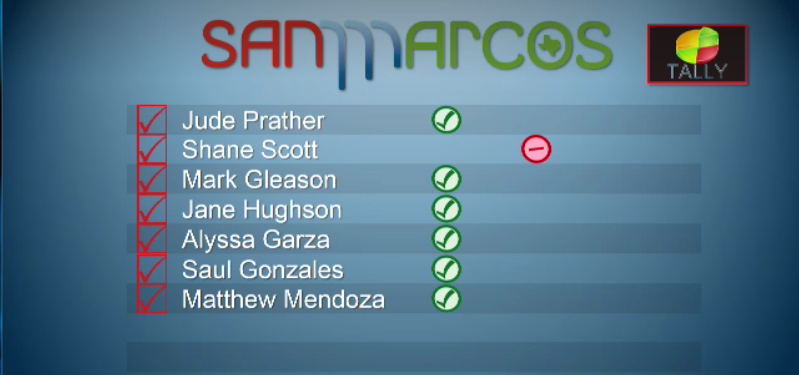
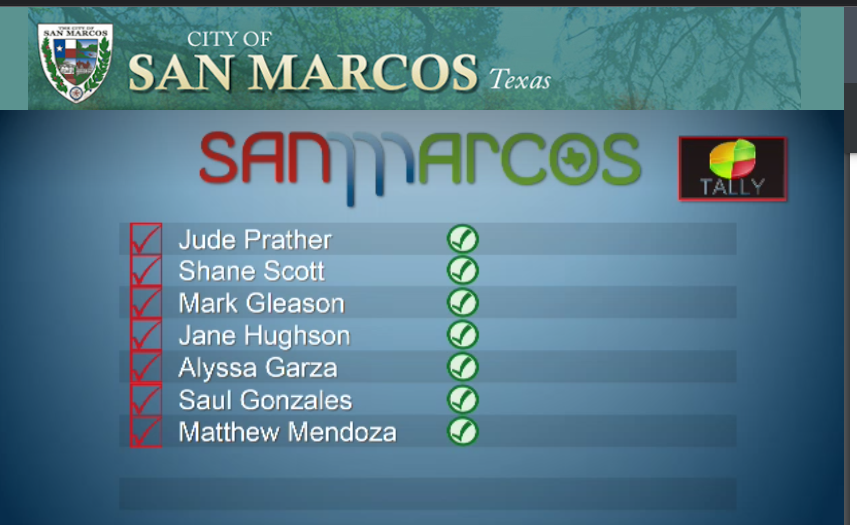
Yes: Jane, Jude, Saul, Matt, and Mark
No: Alyssa

Alyssa says, “I’m voting no because I’m not sure future mayors will be able to differentiate between personal insults and personal attacks in a responsible way.” 

HA. HA. That is so diplomatic that it’s making my teeth itch.  You, Jane, are clearly an excellent arbiter of personal attacks! We’re just worried that the next mayor may not be dripping with quite as much wisdom.

Anyway, this council (minus Alyssa) just fell in line and approved it. They are the mushiest bunch of marshmallows.  Yawn, censor Max Baker? Scratch, readjust, hmm. If we vote yes, can we go home?
Hours 2:21-3:58, 1/17/23

Item 29: Riverbend Ranch

We’ve seen this proposed development before, and after P&Z denied their cut-and-fill. Residents of Redwood mobilized like 30 people to come talk to P&Z that night. It was really amazing.

The major issue is that Riverbend Ranch will be on the hill immediately above Redwood. Redwood is home to a lot of extremely vulnerable community members and is dealing with flooding, raw sewage, and significant health challenges due to sewage contamination.

The council could force Riverbend Ranch to be developed in such a way that it helps Redwood tie in to San Marcos water and sewage. Or the council could allow them to develop in a way that increases flooding and sewage contamination. This could be done really well, or it could be a nightmare.

Matt Mendoza, Alyssa Garza, and Saul Gonzalez all volunteered to be on the Riverbend Ranch committee.  I am relieved.  You can trust Alyssa to remember to protect Redwood, and Matt Mendoza was personally the one who went down and talked to the Redwood community prior to the P&Z council meeting, so he’s also invested. And Saul is generally sympathetic to people without financial means to protect themselves from developers (although he usually takes the safe route when it comes time to actually vote).

….

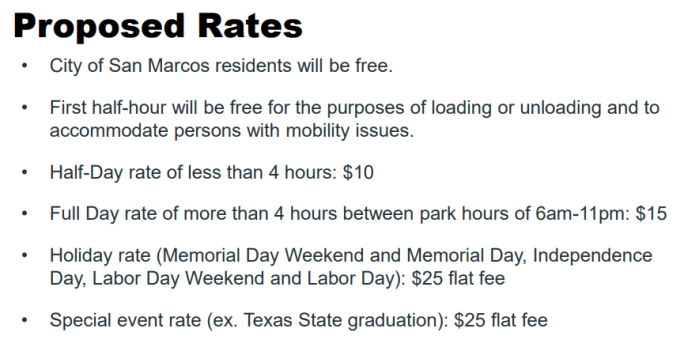
Item 30: Paid parking in the Lion’s Club parking lot. 

We have a lot of out-of-towners who come to tube the river and go to football games.  We want to recoup some costs by charging them to park in the Lion’s Club parking lot.  So we’re launching a 3 year pilot program.

It’s supposed to be free to San Marcos residents, which means that there has to be some system to tell who is a resident and who is not a resident.  It sounds like you go online and ask for a sticker to put on your car? You would either have a license or some sort of photo ID, or something with your address on it. (I might be wrong about the sticker.)

Alyssa gets them to include library cards on the acceptable forms of ID, which is good.

It’s pretty pricey for non-residents:

The biggest discussion came about whether or not the machines should be cash-less.  Mark Gleason doesn’t like cash-less machines out of general get-offa-my-lawn old man vibes. (He’s not wrong!) Alyssa doesn’t like them because poor people are less likely to have credit cards. (Also correct.) So the compromise is that there will be one machine that accepts cash, and the others throughout the parking lot will be cashless.

I share Alyssa’s uneasiness about the invisible barriers that arise when you implement cashless payment systems. At the same time, in this case, those bonkers prices are their own impediment for poor people. You can get like three eggs for that kinda money!

Item 31: One last time with the Human Services Advisory Board.

San Marcos donates money from the General Fund to nonprofits.  The funding process this year was a shitshow (apparently – I don’t really know details) and so council stepped in to give new instructions.  So now, on this third meeting on this topic,  council is nailing down the final details of how they want grant applications to be evaluated. There are two main sticking points:

  1. Grant money is only available if you’re serving San Marcos residents. The issue is what kind of track record is required. Should nonprofits from Austin and San Antonio who want to expand their service to include San Marcos be allowed to apply for city funds? Or should money be restricted to nonprofits who already serve San Marcos?

Jane wants the nonprofits to already be serving San Marcos. Saul agrees.

Alyssa makes the case that in certain categories, like mental health, we have a dire need for providers.  Nonprofits from San Antonio and Austin will be more successful finding other grant money to use on San Marcos if they can use this grant to demonstrate a need here.  

Mark Gleason and Matthew Mendoza want to give preference to San Marcos-established nonprofits, but not exclude the others from applying.  I didn’t catch what Jude preferred, but this is where Council lands as a whole.

  1. Jane Hughson feels strongly that nonprofits should not depend on this money. She doesn’t want anyone to lose their job if the city has less money one year and can’t fund as many nonprofits.  In light of this, there is a rule that no full-time employee should be funded. You can ask for money to fund a part-time employee, but not a full-time employee.

So the issue is: can you split the workload of a full time employee, and ask for partial funding? Can a grant ask for 30% of the salary of the full time employee who is assigned to work on the program for 15 hours per week? Or do they have to hire a standalone part-timer for 15 hours per week?

Jane is a strong no. You must hire a literal part-timer for 15 hours per week. No carving up the time of a full-time employee. 

Good news! We have an actual nonprofits expert on council! Alyssa has tons of non-profit experience, and is currently employed writing grants for her job. She explains that this is standard operating procedure in the world of nonprofits. Nonprofits are used to piece-mealing their employee’s salaries together across several grants. As long as the non-profit is basically competent and experienced, they will have a Plan B in place so that no one loses their job if San Marcos doesn’t offer these funds one year.

Out of everyone, Mark Gleason is the only person who seems to hear what Alyssa is saying. Weirdly, Jane keeps marking down that Mark is on Jane’s side, but Mark is persistent in correcting her.

But on the whole, it is the most infuriating goddamn conversation.  Everyone is sure that they know what’s best for nonprofits and no one is listening to Alyssa.  It comes off as paternalistic and arrogant.

Jane keeps requesting that any councilmember who wants to allow partial funding of full-time employees must give a specific numeric cap. Alyssa keeps explaining that that is arbitrary and counterproductive – the nonprofit will have to justify their request, and the HSAB can make an informed judgement.

They settle on a 20% cap: you can ask the grant to cover up to 20% of a fulltime employee’s salary. Because they know best.  

January 3rd City Council Meeting

Happy New Year! And happy one-year-of-blogging to me! Today we have the Jan 3rd city council meeting, and then I’ve got some good old self-reflections on the past year for you.

City Council business first

It was a short meeting, only two hours long. Partly because the agenda was short, but partly also because there’s much less discussion without Max Baker there. I think this is mixed.  Max probably gummed up the works overmuch at times. But the danger is that too much discussion happens behind closed doors, and the public only sees the final vote. It gives the appearance that Council is rubber-stamping whatever comes along.  

I do not exactly think that Council is rubber-stamping every item.  Some items do get some discussion. And not every item needs to be discussed.  However, without discussion, the context of a vote is opaque.  On complicated topics where no one says much, it’s very hard to tell the difference between a good vote and a bad vote.

Hours 0:00-1:01: In which we see very little discussion in two rezoning cases.

Hours 1:01-2:10: Several small items, plus the Mano Amiga petition against the SMPD meet-and-confer agreement.

Onto the self-reflection

It’s been one year since I went public with this site!  I am not frequently asked anything, but I thought it might be fun to make up some FAQs.

1. Who am I?

I promise you that when my identity (inevitably, eventually) gets discovered, it will be a giant letdown. I am incredibly boring, and the suspense is way more interesting than my actual dumb self.

2. Why am I doing this?

A long time ago, I heard Diane Wassenich talking about how she made an effort to attend every city council meeting and every P&Z meeting.  She said something like, “Well, someone needs to be watching them.”  I really admired that sentiment, that at least one person should consistently be watching. The thought stuck with me.  I noticed that there was a vacuum when she retired.

However, I’m not a social person who wants to be a part of a lot of organizations. So if I just watched all the P&Z and council meetings, the knowledge would then just die with me.  This blog is a substitute for all the conversations I’d have, if I liked having conversations. 

3. How many readers do I have?

It’s pretty tiny. There seem to be about 30-40 of you that turn out regularly. One thing that I’m particularly pleased with is that most of you all seem to actually read the entire thing.  My stats show me both the number of readers and the number of views. So, for example, on days when I post 4 links, the number of views tends to be close to 4x the number of readers. I’m humbled that this small-but-loyal group truly reads the whole, excruciating thing.

(I did get a small bump from people finding election posts via google. Most of you come over from Facebook, though.)

I’m playing a long game.  I figure that having the ear of 30-40 progressive, engaged community members in San Marcos is actually a really big deal, because you all are likely to turn up to events and have the conversations and actually make change happen.

4. What was my most popular post?

Oh my gawd: the time Shane Scott waved around a baggie of 3 oz of pot, I got 235 views. He’s the gift that keeps on giving.

5. Are you planning on expanding the blog?

I really loathe self-promotion, so I haven’t mustered anything beyond posting links on Facebook and Twitter. If anyone has an idea that requires very little time, energy, and money from me, I’m open to it.

I’ve vaguely mused about covering Hays County Commission or the SMCISD school board, but I don’t really have any additional time to spare. This is kinda time-consuming as is.

Seriously, thank you to all of you who read this thing. You make it worth writing. Cheers to 2023.

Hours 0:00-1:01

Citizen comment: The intersection of Hunter and Wonderworld is deadly and needs to be fixed. The speaker kept mentioning “new paint” as a solution, which made me think that she specifically meant that weird little island blocking what used to be the right turn lane from Wonderworld, north onto Hunter (on the corner with the CVS store.) I’m glad we’ve added bike lanes, but I also see cars bumble over that island every time I’m at that intersection. And there do seem to be a lot of accidents.

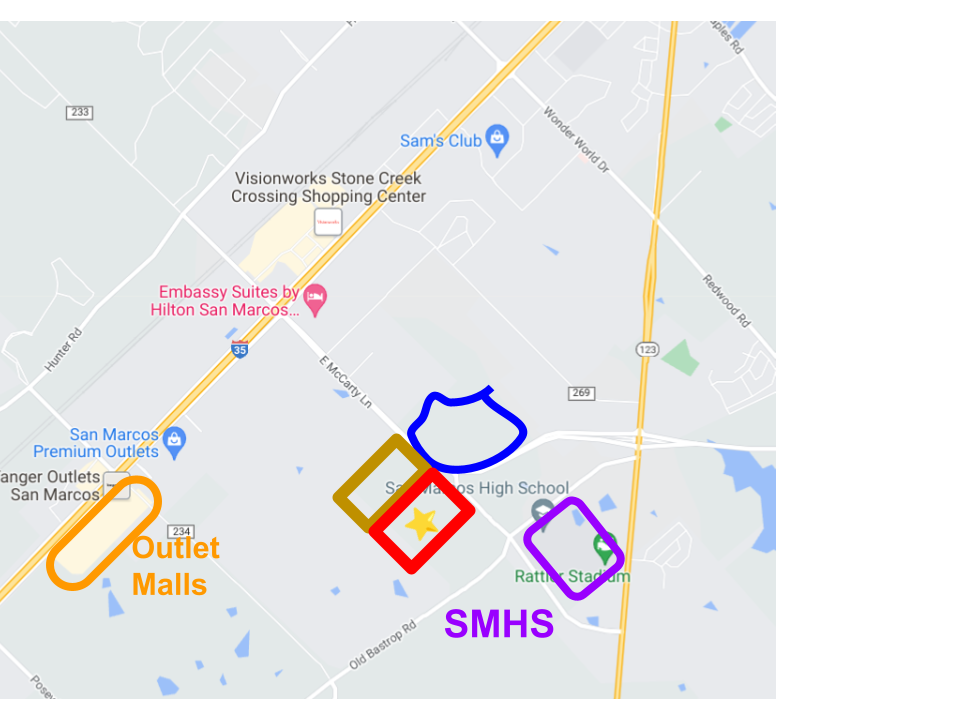
Item 11-12:  Annexation and zoning 65 acres on the corner of Rattler Road and McCarty. It’s this little red square with the star in it:

We’ve seen this area several times recently. It’s been a zoning bonanza:

  Back in September, these other folks wanted (and got) a cut-and-fill exemption for that blue region.  And back in August, the neighboring property (in that yellow-puke color) was zoned CD-5. It’s going to be apartments. (Also, a gigantic development was approved behind the outlet malls at that same meeting.)

The red rectangle is proposed to be CD-4. In that zoning, you’re allowed to build duplexes, townhomes, apartments, cottage courts, and other things that are denser than traditional neighborhoods but still feel small scale. (But you can also just build apartments, I think.)

The red rectangle and the yellow-puke rectangle are owned by the same people. So they’re selling the city on a larger vision where the yellow-puke one is dense, traditional apartments, and then this red one is more varied with all the duplexes and townhomes. Sort of transitional in scale towards single family houses.

Is this a good idea? Let’s apply our criteria:

Price Tag to the City: Will it bring in taxes that pay for itself, over the lifespan of the infrastructure and future repair? How much will it cost to extend roads, utilities, on fire and police coverage, on water and wastewater?

This is a good spot for infill. There is already infrastructure and coverage for this area.

Housing stock: How long will it take to build? How much housing will it provide? What is the forecasted housing deficit at that point? Is it targeting a price-point that serves what San Marcos needs?

Some day, the planning department will read my blog and hastily fall all over themselves in an effort to answer this question.

Environment: Is it on the aquifer? Is it in a flood zone? Will it create run off into the river? Are we looking at sprawl? Is it uniformly single-family homes?

Not on the aquifer. Not in a flood zone. No run off to the river or any other environmental hazards, as far as I can tell.

Given the duplexes, townhomes, apartments, cottage courts, and other things, it has the potential to be very good. It won’t be uniformly single-family detached houses.

Social: Is it meaningfully mixed income? Is it near existing SMCISD schools and amenities?

It is very close to SMHS, and not that far from Goodnight and elementary schools.

As for whether it’s mixed income, that depends on the developer. If the developer takes advantage of what they’re allowed to build, it could be mixed income. But just because they sell a compelling vision during the approval phase does not make it binding.

The San Marxist Special: Is it a mixed-income blend of single family houses, four-plexes, and eight-plexes, all mixed together? With schools, shops, restaurants, and public community space sprinkled throughout?

The larger region has the potential to become this. We shall see.

Final judgement: It sounds mostly good. Go for it.

So what did council do?  

There was a little discussion about including a buffer at the back of the property, as a courtesy for the homes right there, which are outside city limits. Staff will bring back a proposal at the next meeting.

And then they voted, and it passed 7-0. (Where’d the clickers go?)

I personally think this project passed all the criteria with flying colors.  But you know Max would have had a dozen questions about it.  Perhaps all the questions got settled in Secret Executive sessions – it’s just really hard to know.

Item 13: Trace PDD

A few months ago, we did a deep dive into La Cima.  Time for a Trace Deep Dive? Let’s do it.

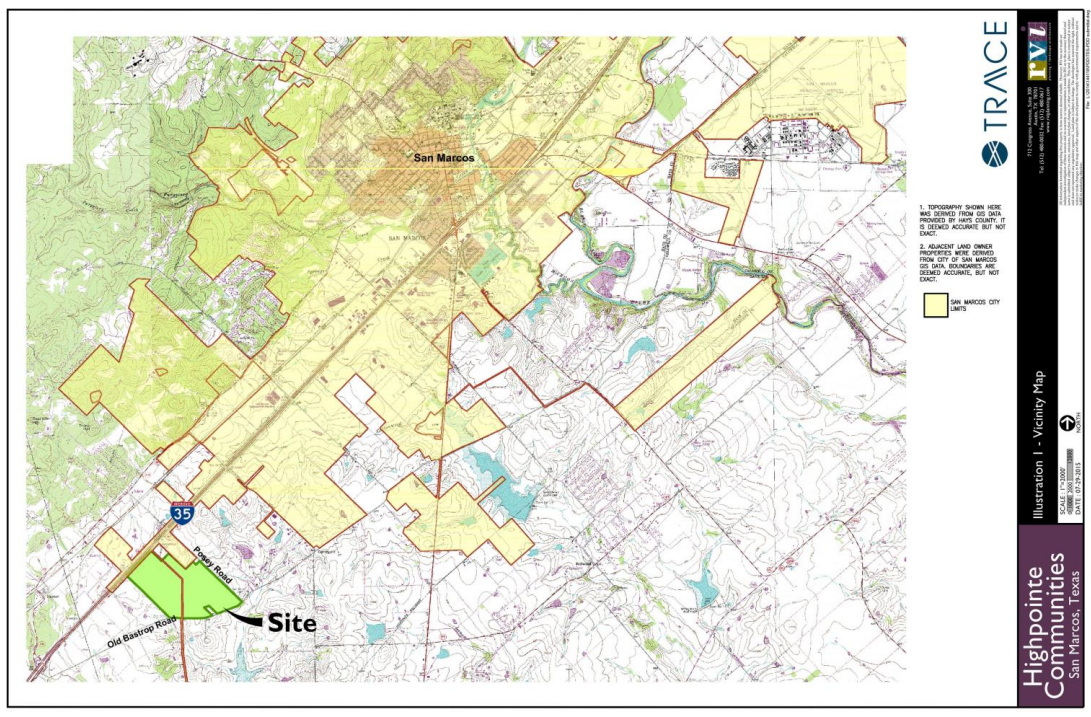
Trace was approved in October 2015.  It’s about 417 acres big: 

That’s not my usual chicken-scratch map – this is the map from the developers. I love our city staff, but their maps are truly for shit.

It’s supposed to be a whole community – houses, apartments, parks, an elementary school, some stores. Mixed income. My only real gripe is that it contributes to sprawl – you’re kinda far from everything out there.

In 2017, there was a bond election to fund an elementary school there, and Rodriguez elementary school opened in August 2019.  

 It was next amended in 2019 and 2022.  All the amendments were kind of finicky and detail-oriented – what should the heights of the apartment buildings be? Can we relocate sidewalks to this other side of the street? That sort of thing.

On the whole, it seems fine. It seems to need far fewer tweaks than La Cima or Whisper. (At some point, we’ll have to unpack Whisper Tract.)

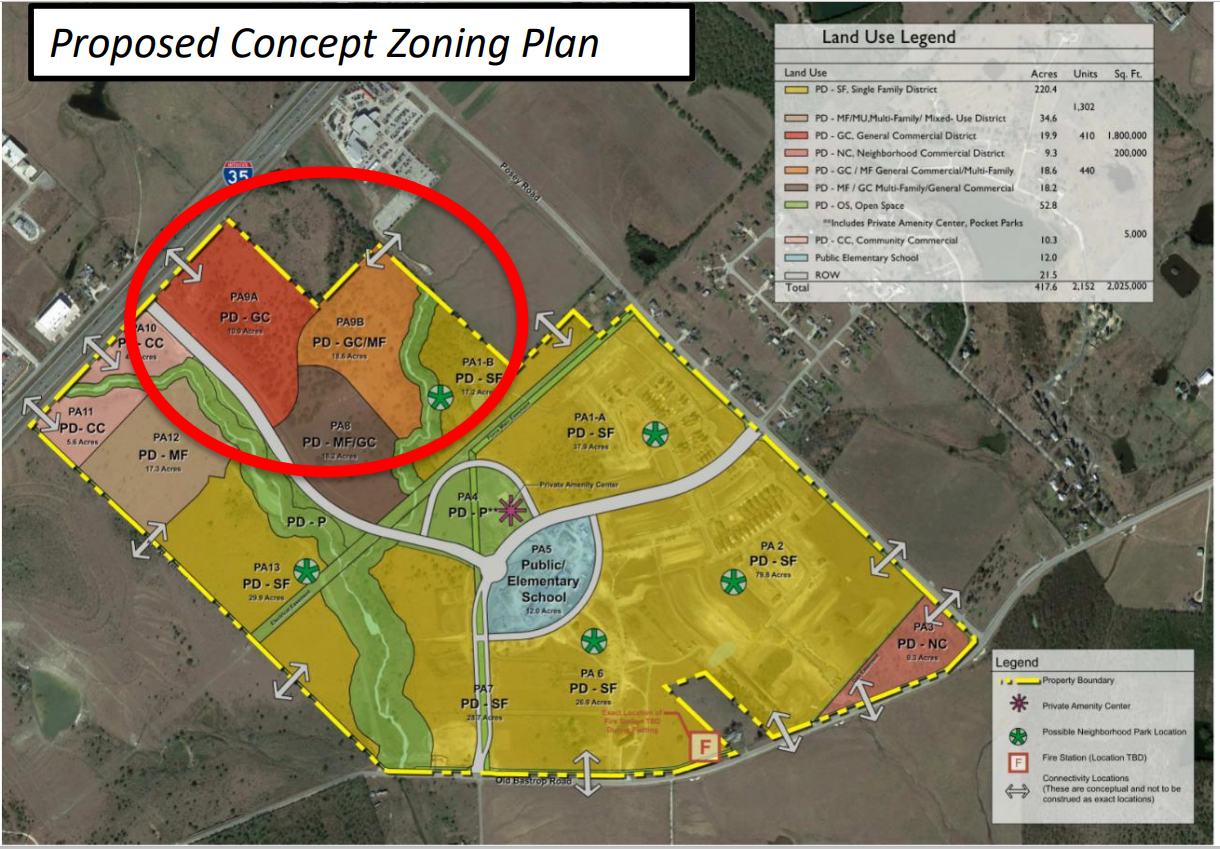
So what’s up now? It’s coming up because they want to rezone part of it. Here’s the original zoning of Trace:

The dark orange part facing I-35 is General Commercial, about 44 acres.  

Now they want to convert about 37 of those acres to apartments:

Both the light orange and brown parts of that red circle could now be apartments.  

Is this good or bad?  It’s complicated.  At the P&Z meeting in December, Griffin Spell an excellent point:  yes, we need housing. But Trace has not fully built the apartment complexes that they’re already allowed to build.

Furthermore, we also need amenities on the east side.  It is a huge problem in this town that the east side lacks an HEB and the normal sort of shopping options.  People are constantly talking to council and P&Z members about needing more commercial on the east side.

Griffin’s point is basically, “Let the developers finish building the apartment complexes that they’ve already agreed to build. If they still can’t find commercial occupants at that point, they can bring the rezoning back.”

The developer basically says, “Unfortunately, commercial is just not viable in that spot! It’s not visible from I-35!” 

To which Griffen dryly responds, “You’re the one that put it there back in 2015, and nothing has changed since it was approved.”

The developer gave a weasely answer about communities maturing. It left me with the impression that they always planned on converting it to apartments, and the original commercial zoning was just there to make it look good.

So what did council do?

At City Council, there was no discussion of this point at all. They just approved it, 7-0.   It gives the impression that they are not scrutinizing developers at all.  The issue Griffin raised is complex, and at least deserves some air time. On this item, I’m giving the stink-eye to this new Max-less council.

Hours 1:01-2:10, 1/3/23

Some quick items:

Items 16-18: Various CDBG funding.  Moving money around to fund rental and utility assistance, a project where they buy flood-prone land to keep it from being developed, and working on some ongoing flood projects for the Blanco Riverine and around Blanco Gardens.

Item 17: The Planning Department has a lot of fees for various services and permits.  How do they set these prices?

It’s been a while since they updated what fees they charge. So they had a consultant come in and analyze how much it costs the city to carry out all these services.  Then they compared fees to seven comparison cities.  Then they shared all this at the December 14th workshop, and proposed new fees.  

The city wants to balance covering at least 50% of their costs, without charging homeowners and small businesses too much or being too out of line with the other cities.  I did not dive deep into the fees, but the methodology sounds fine.  Council said it was all fine.

Item 20: The result of the HSAB drama from December.  At the 3 pm workshop, city council worked on this with city staff. Here’s the outcome:

(Note: It says “The Board should not fund all programs” but they intended “The board should not feel compelled to fund all programs.”)

All seems fine. I think they’re going to go back and re-allocate the December money according to these principles.

Item 21: Mano Amiga circulated a petition to repeal the SMPD contract. Now, I obviously live here in San Marcos. If Mano Amiga were to approach me, I would sign their petition, because I generally support their mission.

But as your local friendly blogger, I’m going to call shenanigans – the actual petition is confusing. As far as I can tell, this is the entire thing:

What’s the actual, specific gripe with the meet-and-confer contract? And what’s the specific, desired outcome? Maybe there’s another page somewhere spelling it out? (Update: It’s the Hartman Reforms. But I still don’t see anything about it on the Mano Amiga website.)

Anyway, this petition got started this fall. And then on December 12th, Joshua Wright was killed by a correctional officer at the hospital in Kyle.

Now this incident is extremely clear-cut abuse by the correctional officer. You’ve got an unarmed inmate in a hospital, wearing ankle shackles for god’s sake. He tries to escape. The officer shoots him six times. That officer had some fantasy that the only way to handle a person running away was to be judge, jury, and executioner. Joshua Wright has to die because this correctional officer can’t properly evaluate and handle the danger of an unarmed guy wearing ankle shackles. What the utter fuck.

Mano Amiga is clearly livid, and sprang into action, demanding bodycam footage and holding events and raising awareness. Of course, I wholly support their efforts for justice for Joshua Wright. This is the most just and deserving of causes to fight for.

December 14th City Council Meeting

Season’s greetings! It’s the last meeting of the year.  (Wednesday council meetings are hard. I missed having the extra day to write this all up.)

Let’s do this!

Hours 0:00-2:04: Electric cabs downtown! And the dumb curfew, for the third meeting in a row, finally passes.

Hours 2:04-2:40: The Cotton Center is going to maybe donate 600 acres to the SMART Terminal. We take a beat to figure out what these things are. Plus some money to nonprofits.

Hours 2:50-3:40: In which we discuss campaign finance, and whether councilmembers want the Ethics Review Committee double-checking their disclosures.

And that’s a wrap! 2022 is on the books. See you back here in January!

Hours 0:00- 2:04, 12/14/22

Citizen comment: equally split among a few topics:
– a smattering of anti-curfew advocates,
– representatives from nonprofits who are upset about the allocations this year.

We’ll get to both in due time.

Item 1:  Free electric cabs downtown!  The pilot program is underway. You can call them, or hail them just by waving your arm when you see one, or you can use the app. 

They’re kinda cute!

The cabs have a fixed route, but they’re allowed to go off route to pick someone up or drop them off, and then they just return back to the route.

And since you asked:

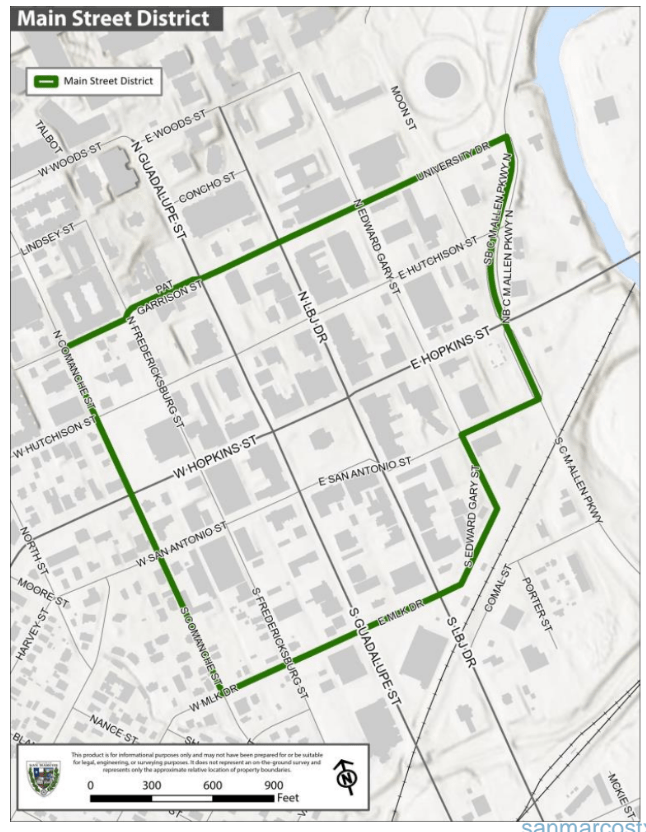
Okay, I think the route is kind of weird.
– It doesn’t go through the actual town square.
– It’s all kind of peripheral
– There aren’t any designated park-and-ride parking lots, from what I can tell.

The more I stare at it, the more convinced I am that that can’t possibly be the route. That has to just be the boundary of the Main Street district. There’s nothing on the website that can plausibly be the route, though, either. I give up.

But I’m strongly in favor of free public transit, so hopefully this will stay and grow! I would most like to use it during July/August/September, when being outside feels like Satan’s butt.

The pilot program is supposed to stay under $500K, and last for another six months. Then hopefully it will become a permanent thing.

As long as this is turning into a full-fledged PSA, I may as well post the flyer:

Ok, I tested out that QR code above. It just goes to the same San Marcos website that I linked to above. There’s just a phone number to call the cab. No link to an app, no route, just a phone number. (The presentation definitely claimed there is an app.) Oh San Marcos: so many great ideas, so many terrible websites.

Nevertheless: test it out, why dontcha?  Public transportation is a great thing!

Items 2,3, and 4: Several financial reports.
– the quarterly CBDG audit,
– the quarterly investment report, and
– the quarterly financial report.  

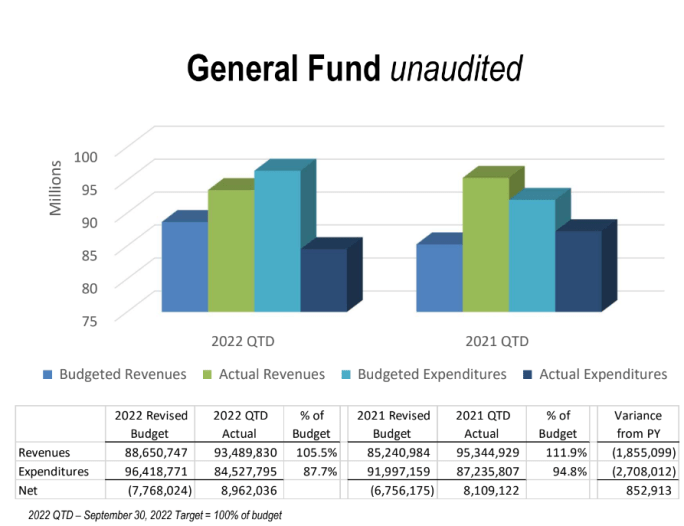
On that last one, we’re making bank. This is the most striking graph:

In other words, we planned to spend light-blue-money, but we actually spent dark-blue-money. And we thought we’d bring in medium-blue-revenue, but we actually brought in green-revenue. Wowza. Across the board, we’ve come in under budget and over revenue, in almost every category. 

On the one hand, this is good: we operated under prudent expectations and it worked out.  On the other hand, we have a community with needs, and we should not sit on a windfall of money.  (Nor should we return it via tax breaks.)  We should spend it thoughtfully, on high quality programs.

Item 5: The Stupid Curfew, for the last stupid time. (Previous discussion, and the one before that.)

Mark Gleason moves to approve, and Jude Prather seconds it.

Alyssa Garza wants everyone to please explain why they’re acting against the boatload of emails, calls, and petition signatures they’ve received.

No one really answers.

Jude Prather wants the CJR committee to look at the severity of the crime. He makes several points:
– Government should protect civil liberty, but also safety.
– he had an awful experience as a teenager, when he was strip-searched at a mall, under accusation of shop-lifting. So he understands how negative police interactions can alter someone’s point of view.
– But this is not 1998 or 1999, which was a simpler time. This is a more dangerous time with greater public safety concerns. So he’s siding with the curfew.

Jude gave the same line at the last meeting, “This is not 1999, a simpler time,” which I ignored for being dumb and bland. But the second time he says it, we have to take it more seriously, because it’s mostly wrong:

Here’s the FBI’s data:

And the murder/homicide rate:

So homicides did spike during Covid, but it’s absolutely in no way true that 1999 was significantly safer than, say, 2019.

Furthermore: on the murder spike, Chief Standridge specifically said that there have not been any murders in 2022 in San Marcos, for the first time in forever. So things are really not grim today!

(I’m guessing that Jude Prather graduated high school in 1999, and he imprinted on 1999 as a kind of The Most Generic Year yardstick for America.)

Back to Council discussion

Shane Scott brings up Max’s question from two meetings ago: How many encounters do young people have with police?  In the last few months?

Chief Standridge answers, (at 1:42): “We don’t capture data associated with nonenforcement. And contrary to anything that’s been heard before, I never said that to do so would be “draconion”. I never used that word.” He basically says it’s complicated and expensive to get that data.

Why is Chief Standridge fixated on the word “draconian”? Shane didn’t use the word. No, it’s because Max Baker has been using it, during citizen comment, and attributing it to Chief Standridge. Max has been claiming that Chief Standridge said it would be draconian to record every instance of police interactions with community members.

So what did Chief Standridge actually say? Let’s go back to November 15th. At 1:22, Max says: “There’s presumably some other data set that says this is how many times we stopped and talked to people, with this as the reason, and is that data that you all keep? Your officers presumably should be tracking every time they stop somebody, to talk to them, right?”

Chief Standridge answers, “I would hope not! I hope we don’t ever live in a police state or a police city, where we document every time we speak to a person.”

I am pretty sure that’s the line that Max refers to. Max has substituted in the word “draconian” for “police state”. So Chief Standridge is right that he never used “draconian,” but what he actually said has roughly the same meaning.

Goddamnit, I’ve got to stop getting off-track on these dumb tangents.

Back to Council discussion:

Shane Scott, continuing in good faith: “When I was a kid, the PD made friends with me and I got a degree in CJ. Most kids are good kids, and it’s hard for me to do curfews based on my experiences.”  

Shane Scott moves to postpone until after it goes to CJR. This is, of course, the same thing they voted on last week. But sounds good to me!

Saul agrees.

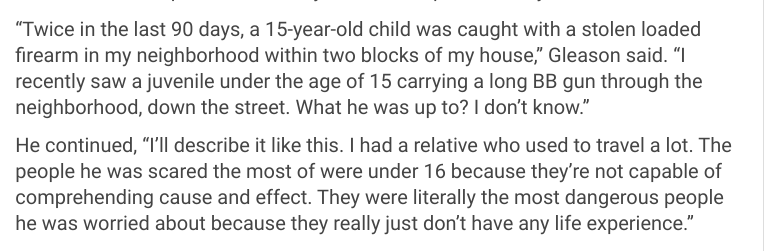
This is where Mark Gleason makes this quote that makes it into the San Marcos Record:

Please be kind to Mark. This is where he lives:

that is, on the set of Mad Max: Road Warrior.

Also, his relative is scared of 16-year-olds because he doesn’t know about drunk people yet. Don’t you dare tell him and ruin his innocence!

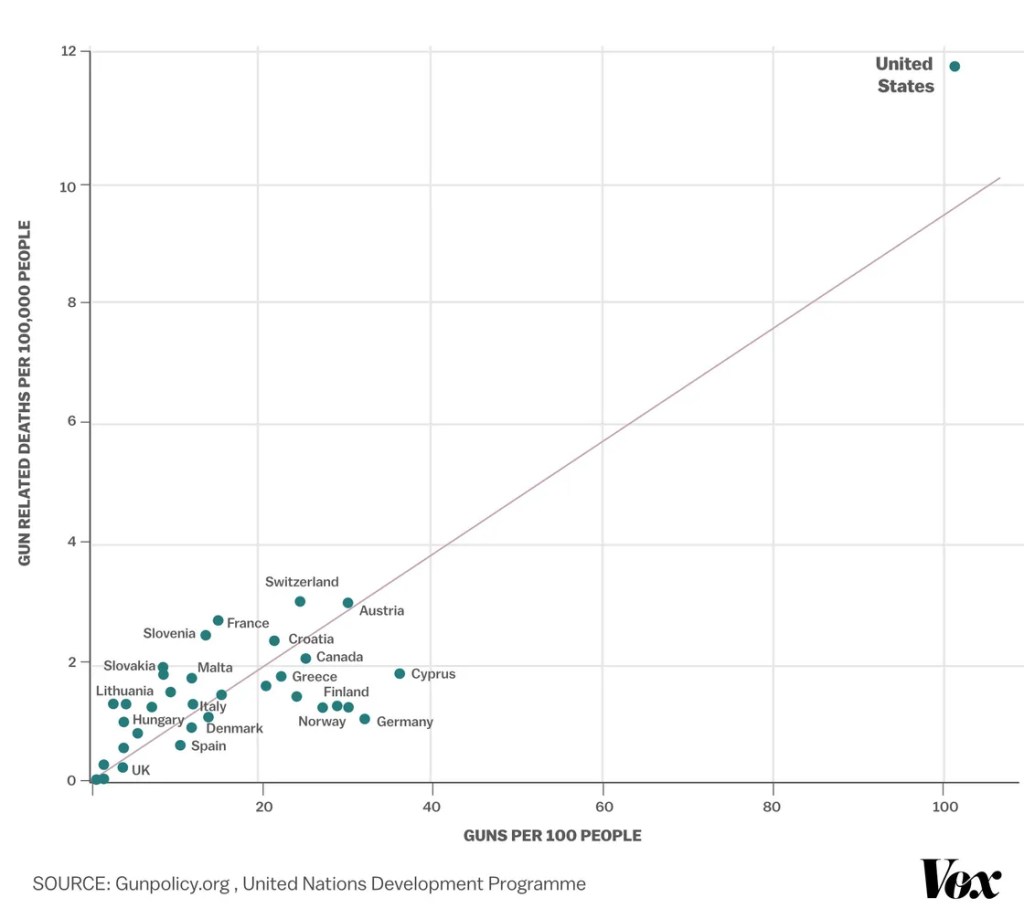
But more seriously: Mark is very worried about 15-year-olds with guns, but not at all worried about this:

It sort of makes curfews just seem quaint.

Back to Council Discussion

I’m getting bored of this whole discussion.

  • Alyssa makes a case for tabling it: Tabling this will bring a sense of haste to the CJR. Otherwise it will join the endless, non-urgent queue.
  • Jane says that over the years, she’s voted on this 4 times before with no issue.  No need to postpone.
  • Chief Standridge answers the racial data coding question from last time: SMCISD uses racial data as provided by parents.
  • Saul asks Alyssa’s question from two meetings ago: What percent of violent crimes is coming from teenagers? Unfortunately, Chief Standridge explains that the answer involves queries into several databases, and will take a little bit of time. They’ll give it to the CJR committee when they have it.

The vote to postpone:

Fails yet again.

Final vote on the whole damn thing:

So that’s that.

It will go to Criminal Justice Reform committee, and they will do whatever they do. In the meantime, the curfew is in effect.

Hours 2:04-2:50, 12/14/22

Item 15:  San Marcos puts $500K from the General Fund towards nonprofits. The Human Services Advisory Board recommends how it gets spent. Things did not go smoothly this year.

During Citizen Comment, representatives from the Hays County Women’s Shelter, Greater San Marcos Youth Partnership, and one other (I missed the name), all spoke up about the funding process. The procedure was new, they got less money than before, and the new process is problematic. In addition, each year, the money is getting spread more thinly across more and more organizations.

It sounds like the Advisory Board put a lot of effort into trying to rate each organization and be fair.  They had a rubric, came up with average ratings and ranked the organizations. They decided that the top 15 would get funded at 55% and the rest at 20% as a baseline, and then they tweaked some individual organizations from there.  But within each organization, this amount ended up seeming arbitrary and inconsistent. Some organizations got way less than they used to.

Here’s the thing: everyone is acting in good faith, and trying to get money to these nonprofits.  (The process has morphed over the past 3-5 years, it sounds like.)

Jane Hughson handled it wisely. She basically said, “It’s been years since Council gave direction to the committee. This is our fault for not issuing clear instructions.”

She moved to postpone it to January, and then have Council figure out clear instructions, and re-do the allocations.  Everyone agreed.

Way later, during Q&A, Jane added some other details:  First off, San Marcos is a little unusual to put General Fund money towards nonprofits. Similar Texas cities just include this in with their CBDG money. So good on us, for taking care of each other in our community. Second, the original plan was that this fund was supposed to scale up as the city grew.  It was supposed to be 2% of the budget eventually. But it hasn’t grown in a long time, and it’s probably time for it to do so.

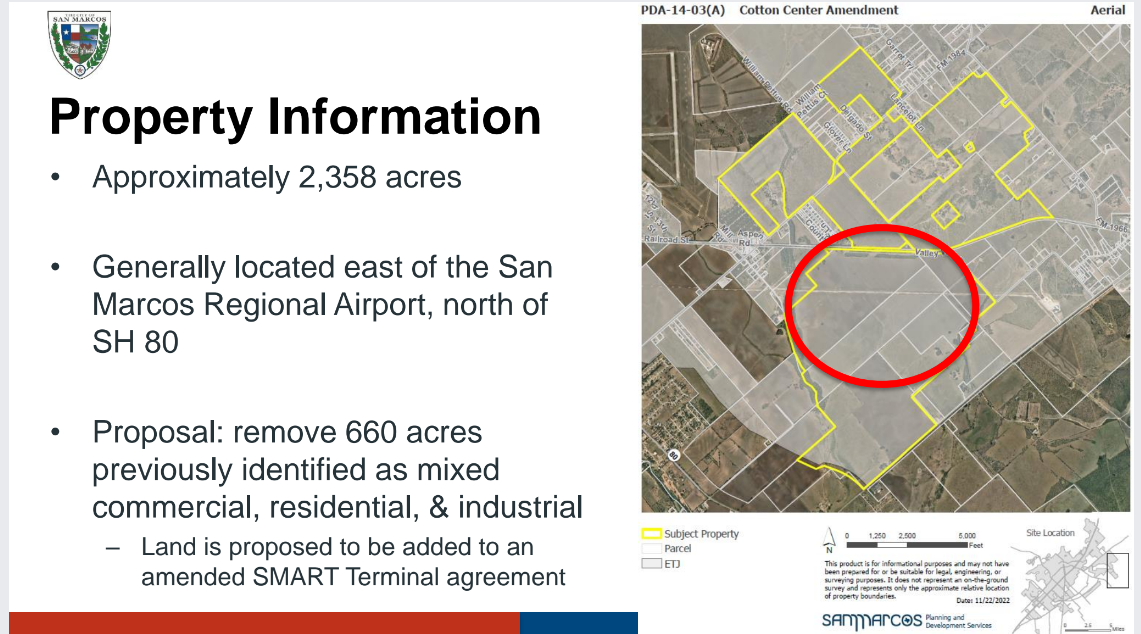
Item 17: Remove 660 acres from the Cotton Center and make it available for the SMART Terminal.

First, what on earth is the Cotton Center?!  I guess it got approved in 2016.

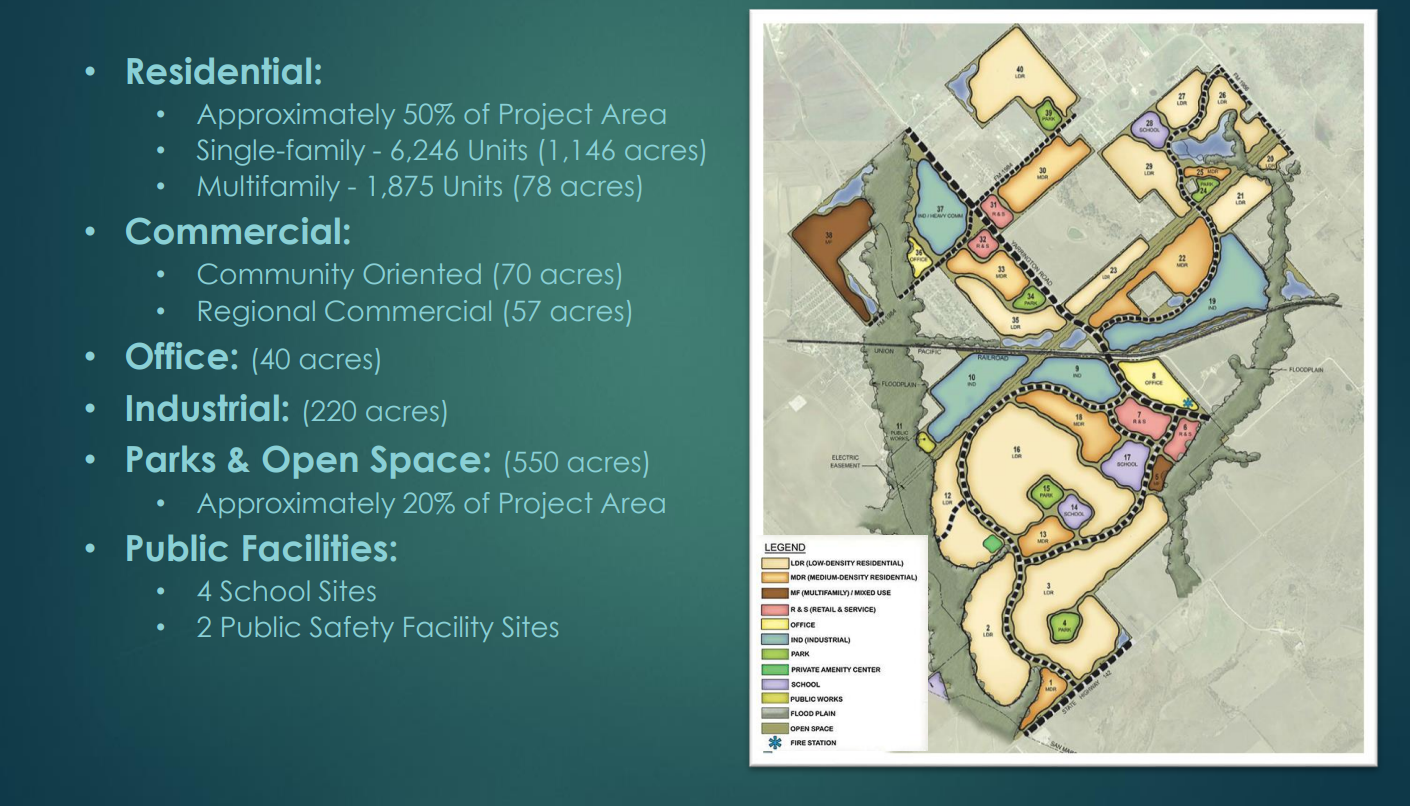
It’s supposed to be this: 

Ok, so it’s everything under the sun. Where is this gigantic thing with four schools and 8,000 housing units supposed to live?

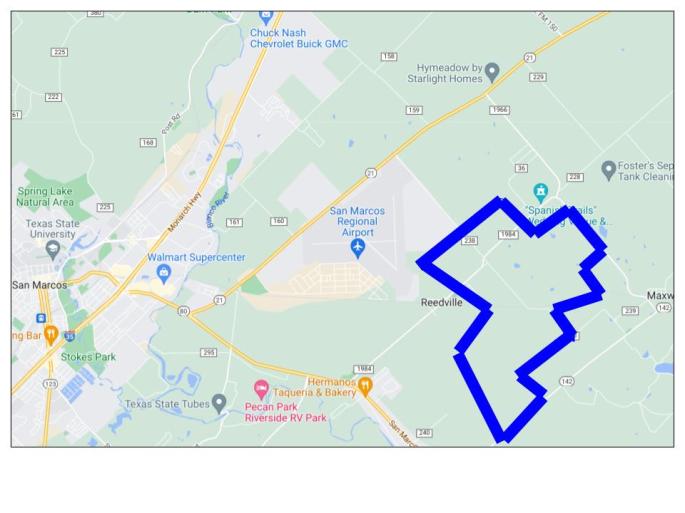
I think it’s here:

That is my best guess.

This got approved back in 2016.  This is how major things fly under the radar.

Okay, what is the SMART Terminal?

SMART Terminal was approved in 2019. It’s here:

Yellow is the SMART Terminal, nestled along the railroad tracks. The blue thing is the Cotton Center – that’s shape I tried to draw above.  (The little pink trapezoid is Katerra. I think Katerra is a specific business that was going to be part of the SMART Terminal.)

What is the SMART Terminal, anyway?  I read through the presentation and it’s very handwavey on what it actually is.  Like a regular terminal, but smarter!  (Clearly it has something to do with the proximity of railroad and airport, and smartness.)

Jane Hughson said that the SMART Terminal got dropped for awhile, and then sold to someone new, and so now it’s back.

So, which 660 acres do they want to take from the Cotton Center and add to the SMART Terminal? There’s no map anywhere I can find! There’s this vague map of the Cotton Center:

so my best guess is that they’re removing a perfect, circular red ring and leaving a bunch of disjointed chunks. I have no idea.

Is this a good idea?  San Marcos River Foundation says hard no.  Here is their issue:

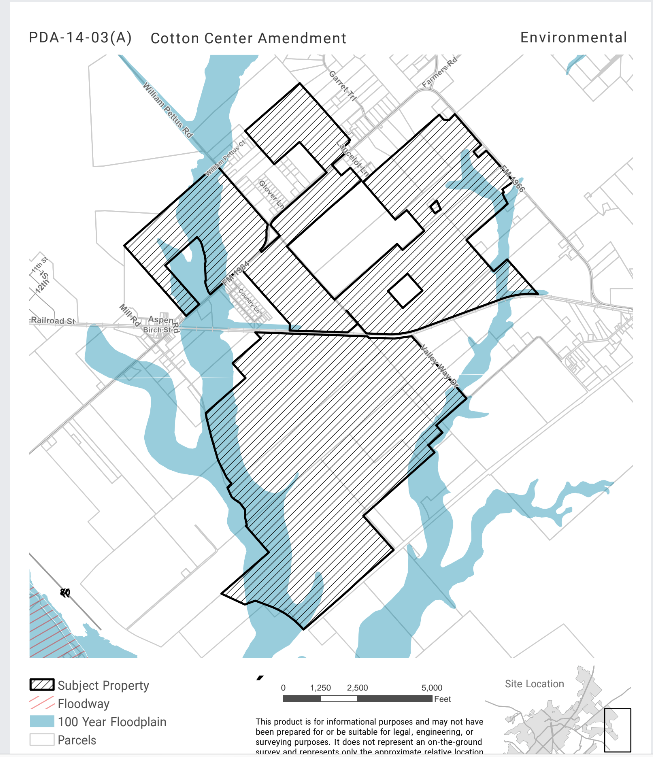
The Cotton Center has a bunch of 100 year floodplain, and some dry creek beds running through it. 

And here’s the corresponding water map of the SMART Terminal:

I believe that’s the San Marcos river at the bottom, running along the south side of Highway 80.  So this is all draining into the river and potentially increasing flooding.

Council decided to send it to committee.  Everyone acted like this was the beginning of the negotiation, and not the end of the negotiation, and that they’d be sure to talk about things like flooding, and impervious cover, and industrial run-off into the river.  Hopefully that all comes true.

Hours 2:50-3:40, 12/14/22

Item 20: Campaign Funding, redux.

So you want to raise money for your city council campaign! Right now there are a few caps:

  1.  Individuals cannot contribute more than $500.
  2. If you contribute more than $300, then your councilmember has to recuse themself when anything that you’re connected to comes up.
  3. There’s an overall limit, based on the number of registered voters.  Councilmember’s cap is 50¢ per registered voter, and mayor’s cap is 75¢ per registered voter.

Jude Prather and Shane Scott brought this issue up.

Jude Prather goes first.  “It’s not the cap that’s the issue. It’s just confusing and too complicated. Things keep getting more expensive, and we’re going to have to revisit this year after year.  Make it simpler. What if you get a lot of contributions?  There should just be a max of $300 per person.”

Jane: We currently have a limit of $500 per person.

Jude: This is just so complicated. I mean, cost per voter

Jane explains, “It’s just supposed to grow as San Marcos grows. If they just had a hard cap, the amount wouldn’t grow as San Marcos grows. We could change the scaling factor, though.”

(They keep saying “Teepo signs” when they talk about campaign costs. I have no idea what a Teepo sign is.)

Jude keeps going. He’s on quite a tear. What about ballot initiatives? And PACs? This doesn’t apply to them! What if a ballot initiative affects a race? (He was worried about this with marijuana decriminalization, if you’ll recall. What if we turn out young, liberal voters??)

Jane: I’m having trouble following what your solution is. 

Jude Prather: I want it simpler. Just $300 cap per person. Get rid of the complicated charts with different numbers and amounts.

(OH!! T-Post signs! Got it.)

Jane Hughson was my favorite councilmember of the evening. She cannot get over the accusation that the funding cap is “too complicated”.  She keeps saying things like, “I’m really trying to understand what you mean.  You take the number of voters, and multiply by 50¢.  What is the complicated part?” and “I can understand if you want to change 50¢ to $1 or $1.25.  But what is the complicated part?” 

Eventually Shane and Jude have enough dignity to stop asserting that it’s too complicated, when it’s plainly not.  (And they’re not shameless enough to just bluntly say they want unlimited campaign spending.)

Everyone weighs in on what they’d like the scaling factor to be:

Shane Scott and Alyssa Garza: $1.25 per voter, for both mayor and councilmembers
Matthew Mendoza and Mark Gleason: $1 per voter, for both mayor and councilmembers
Saul Gonzales and Jane Hughson don’t seem to care.

Everyone seems to settle on the simplicity of $1 per registered voter.  There! We did actually make it simpler!

One final note: last time, there was also griping that the number of registered voters fluctuates with different election cycle. No one really pursued that this time, which is good, because it is a pretty lame complaint.

I was surprised that Alyssa Garza is opposed to spending caps.  Her argument goes that more money means hiring more local neighbors who might otherwise be disengaged, and increase local involvement.  

I can see her point, but I don’t think that outweighs the built-in advantage for candidates with wealthy friends. I put a higher weight on making sure anyone can run a competitive campaign, regardless of economic background. (On the other hand, Alyssa has run for city council and I haven’t. So she has relevant knowledge.)

As a side note, apparently in Texas it is illegal to cap self-donations to one’s own campaign.  So wealthy candidates will always have an advantage.

Item 13:

The Ethics Review Committee seems to always be a thorn in the side of Shane Scott, and to a lesser degree Jude Prather and Mark Gleason.  I don’t know if they’ve been busted for something, or if they just don’t like the idea that they’re being watched.

Right now, councilmembers have to turn in two sets of documentation:

  1. Yearly financial disclosure
  2. Campaign contributions disclosure

The ERC looks over these, and flags anything that looks fishy.  They’ve been doing this for years, but it’s not formally city policy. Jane Hughson wanted to formally codify the practice.

Shane Scott moves to deny. “The ERC does not need to meddle,” he says, “There are state rules, and the state will get involved.”

Jane explains where it came from, “After we passed the $500 cap, there was a candidate who took $1000, not knowing about the cap, and people were asking, “What do we do? Where do we report this?” It didn’t violate state rules, so you can’t report it to the Texas Ethics Commission.”

Shane Scott: “We shouldn’t be more restrictive than the state.”

Jane: “Okay, but we are. We just discussed the campaign caps. So…?”

Shane Scott removes his motion to deny, and Mark Gleason makes a motion to approve.

Next, Shane Scott makes an amendment to remove all the parts where the ERC looks at financial disclosure statements. “The state will take care of it!” he says again.

Jane again asks, “How would the state take care of it?”

Shane says, “FOIA requests, etc.”

The lawyer, Michael Consantino, says nope.  The state would not get involved.

No one seconds Shane Scott’s amendment, and so it dies. 

The overall vote to let the ERC review financial disclosures and campaign contributions:

There you have it.

Item 21: Jane Hughson wants a new zoning.  There are a lot of applications for Heavy Commercial or Light Industrial where council has to write up a bunch of good-neighbor exceptions because there are residents living nearby. Usually they want to rule out uses based on loudness/smell/vibrations/etc. The method is to make a “restricted covenant agreement,” which sounds religious, but isn’t.

Jane is proposing something that she calls “Business Park”. Maybe not storefronts, but businesses that you wouldn’t mind living next door to.  Smaller in scale and height, regulations on where loading docks could be, cranking down on noise/smell/vibrations/etc. 

Everyone likes this idea. It’ll come back in some form.

December 6th City Council Meeting

Welcome back! It’s been an entire Sights & Sounds of San Marcos, plus Thanksgiving, since you were last here!

Exciting news:

Clickers are back! That’s right. Now all councilmembers have to vote at the same time, so they can’t cheat off each other and game their vote.

Let’s dive in:

Hours 0:00-1:40: In which we revisit the little plot of land behind Embassy Suites.

Hours 1:40-3:30: The curfew ordinance takes center stage. This is the big topic of the night.

Hours 3:30- 4:42: In which we reallocate some unspent Covid money.

This coming Wednesday – December 14th – is the last council meeting of the year. That’s right – you get two consecutive weeks of my drivel this month. And then 2022 will be on the books!