February 6th City Council Meeting

Welcome back! This week, we’ve got a gas station by the high school, details on the river can ban, PDDs, and emergency sirens. 

Don’t forget! The VisionSMTX survey is open until Friday, February 23rd! My cheat sheet of recommended language is here for your cutting-and-pasting pleasure.

Onto the meeting! 

Hours 0:00 – 1:30: A new gas station, and the can ban moves closer to the finish line.

Hours 1:30 – 2:50: Bringing PDDs back! And some emergency sirens, and P&Z re-appointments.

I just want to note: lately no one talks besides Mayor Hughson. Jane takes her job super seriously. She reads everything carefully and offers up improvements. But no one else ever has any amendments to anything, nor much discussion to Jane’s amendments.

I think there’s a number of reasons:
- General indifference to details. (Saul, Shane, Jude)
– Thinking it’s futile. (Alyssa, being the only progressive)
– Sincerely agreeing with everything Jane says (Mark Gleason and Matthew Mendoza)
– Having a full time job on top of council is too much (Probably all of them)

But even if the reasons are sympathetic, it’s not great. If you watch a P&Z meeting, everyone seems prepared to ask good questions and weigh the decisions carefully. If you watch a city council meeting, there is barely any discussion of ideas or improvements to policies. It feels like things get rubber-stamped without scrutiny. It’s not great.

Hours 0:00 – 1:30, 2/6/24

Citizen Comment:

  • We just picked land for the fire station that is supposed to cover the SMART Terminal land. Why did we go with the only choice that is outside San Marcos ETJ, and in the Martindale ETJ?
  • Hooray for can ban
  • Hooray for the can ban, but take a closer look at the No Zones and Go Zones please. On a windy day, all that trash is going to blow from the Go Zones into the No Zones.
  • Hooray for bringing back PDDs. Consider charging fees to cover staff time.

I’m also surprised that we’re moving forward with the fire station, although I guess you want to pick out land long before anything gets built. There have not been any public updates on the SMART/Axis Terminal since last summer.

Items 3-5: This little triangle at the corner of East McCarty and Rattler Road:

was annexed and zoned.

The plan is for it to be a gas station with car wash along the part facing McCarty, and then a strip mall along the back part that opens onto Rattler Road.  The developer is hoping for things like restaurants, medical offices, some commerce, etc.

There’s a larger context:

this whole dead spot between the high school and the city is supposed to someday turn into a thriving East Village city center.  (According to the Area Plans, which are in progress. This is supposed to accompany VisionSMTX.)

Point being: this is a good spot for a gas station and some commerce.  You have my blessing, Young Developer.

No one really has any questions, and the vote is 6-0. (Mark Gleason is absent for this part.)

Item 6: Here comes your can ban!

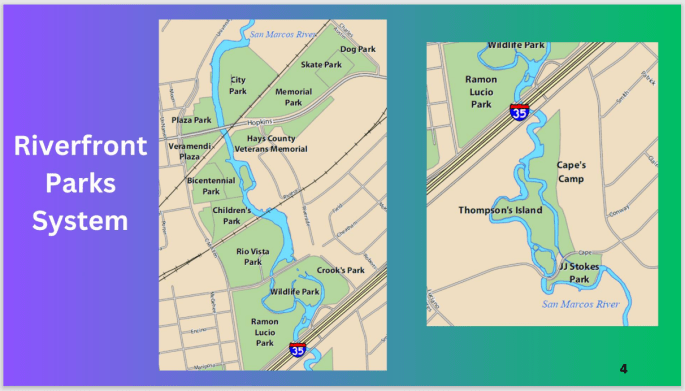
So first, here are the Riverfront Parks that we’re talking about:

The plan is to carve out “No Zones” and “Go Zones”. 

In a No Zone:
– Only reusable beverage containers
– Only coolers under 30 qts in size
– No containers under 5 oz, which is a little redundant, but we’re just doubling down on jello shots and mini-liquor bottles.

In a Go Zone:
– Go nuts. Have all the single-use beverage containers and giant coolers you want.
– Still no glass or alcohol or charcoal grills, but that’s not new.

So what are the boundaries? 

It’s fuzzy! I thought there’d be a big conversation about it, but nope. None of the councilmembers had anything to say about these boundaries.

Here’s what was provided:

There are some trails to the right of Ramon Lucio park, in the map above. Those would all be No Zones, because there are so many river access points throughout.

Loosely speaking, it sounds like the big trails along the river will be the boundary of the No Zones. If you’re beyond the trails, you can pop that tab. If you’re closer to the river, you can’t.

My 2 cents? This is probably as good a starting point as any. It allows for plenty of big family picnics. The paths are already a big, visible feature, so it makes sense to use them as a boundary.

If we do a great job with the signs and communicate this boundary loud and clear, it’ll probably work. If we half-ass it, it’ll take a lot more effort to get people to change their behavior.

More details:
– It’ll kick in on May 1st
– The first year will be focused on education. Citations, etc won’t really kick in hard until 2025.

At the January workshop, there was a lot of conversation about hiring more staffing. Specifically, are we going to hire city marshals (who dress like cops), or will we hire park rangers (who dress like park rangers)? Nobody discussed this on Tuesday. So it’s still an open question.

Jane Hughson had a few questions, but they were extremely detail oriented – definition of banks of the river, clarity of exemptions for people cleaning up the river, that kind of thing. 

The vote:

YAY for the can ban: everyone
Screw the river: no one.

This was a first vote, so it will come back around next meeting.  But most likely, it’ll be here this summer! 

Hours 1:30 – 2:50, 2/6/24

Item 7: PDDs

This might feel a bit like insider baseball, but it’s insider baseball that makes me happy.  

Here’s the issue: say a developer applies to get their land zoned. The developer says, “You’re gonna love it! I’m going to put in some cute condos, a great restaurant, and some retail.” They show us some charming sketches of what they have planned. We think it looks great and give them the zoning they want.

Then they change their mind and sell it. The new owner gets the zoning, but decides that they really want to build something that pisses everyone off. As long as the new plan is legal under the zoning, there’s no mechanism to stop them. 

(To be fair, Council and P&Z know not to trust charming sketches. But in general, there are a lot of hard calls on zoning when you’re okay with some uses and not others.)

Enter PDDs. PDD stands for Planned Development District.  This means you get to micromanage the developer.  You get to see the actual plans and say, “A few more trees over there, how about an awning on this little store, etc.”  You can be extremely heavy-handed and rigid.  Everybody signs the PDD contract and the city gets exactly what it signs up for. 

There are bad parts, too: it’s an enormous amount of work for city staff.  Sometimes it has meant sweetheart deals for developers who don’t feel like following the code. Sometimes PDDs haven’t been enforced. PDDs are only as good as the council that approves them.

Here’s the frustrating thing: we used to have PDDs, but in 2018, we threw them out! I never understood this. Why not just use them less? You’re allowed to have tools that you don’t use very often. But no: we went Marie Kondo on our tool set and completely cut them out. (There are plenty of PDDs that are still around – Trace, La Cima, etc, but we eliminated our ability to write new ones.)

Since then, there’ve been a number of occasions when it would have been nice to have them! The most obvious example is the SMART Terminal.  We were on the verge of handing over 2000 acres and saying, “Have fun with all that! Let us know what you decide to do with all that heavy industrial zoning!!” Only for massive public activism did we back away at the 11th hour. 

So now we’re bringing PDDs back!  

Jane Hughson’s main motivation is to hold developers’ feet to the fire. If they promise beautiful things, then they can put it in writing and be held accountable.  I agree – that’s a great reason to have PDDs.

Everyone else is on board. What’s not to love about micromanaging developers?

Item 8: Emergency Sirens

There are emergency sirens throughout town.  We occasionally have emergencies – floods, tornados, snow-vid, etc. (Now, I can’t recall ever actually hearing them during different emergencies we’ve had? but surely they did their job.)

If we’re going to have massive sprawl, maybe the developers should include sirens in their new developments.  Everyone agrees this sounds reasonable.

Shane Scott asks about GMRS systems?  Apparently these are fancy walkie-talkies, somewhere in between CBs and ham radios, in terms of watts of power.

Answer: they require really tall towers, so they wouldn’t piggyback on the siren towers. But maybe someday!  

10-4, good buddy.

… 

Item 9: Boards and Commissions appointments.

There are 19 different city boards and commissions with open slots. It’s appointment time. 

Last year, Alyssa Garza was super frustrated by the perpetual Oldness and Whiteness of the applicant pool.  It was never shared with the public if anything came of that? Maybe the DEI coordinator worked with the communications outreach team to get the word out more effectively?

Jane Hughson applauded this applicant pool for being the most diverse yet.  Maybe it is! I have no idea. Alyssa did not say anything good or bad either way about it.

On P&Z, there were three open slots.  All three current members – Lupe Costilla, Jim Garber, and William Agnew – were re-appointed for a second term. Jane Hughson, Saul Gonzalez, Mark Gleason, and Matthew Mendoza voted for those three reappointments.  Jude Prather, Shane Scott, and Alyssa Garza all voted for some new and some returning people.

All three of those P&Z members work hard and in good faith.  I’m totally annoyed with how P&Z handled VisionSMTX, but that’s just one part of many things they do, and they do other things well. (New appointments keep it fresh and interesting, though.)

One last thought: I recognized so many of the names from people who are friends with me on social media! You’re good people. Everyone who submits an application to be on these commissions deserves a hearty thank you.  

Item 11-12: Top Secret Executive Session.

I just want to note that one of the items is a legal discussion about San Marcos being sued by Ken Paxton for decriminalizing weed. What an goddamn asshat he is.

(Obviously I don’t know how it went, it being executive session and all.)

January 30th City Council Meeting

This week, we’re giving $800K to repair homes, we’re writing new rules for short-term rentals, and I’ve got your cheat sheet for the VisionSMTX survey. Get it all while it’s piping hot!

Hours 0:00-0:54: EV Parking Space fines, and allocating $800K of ARPA money to Mission Able and Operation Triage. It was a mini-meeting.

Bonus! 3 pm Workshop: New rules for Short Term Rentals.

Double Bonus! Cheat Sheet: My recommendations for the VisionSMTX survey. Take whatever suits your fancy!

The meeting was extremely short, but that survey cheat sheet took me forever to write up. Please feel free to share it far and wide.

Finally, next week is another Council Meeting. These are the back-to-back meetings they scheduled last December. So I will see you right back here, same time next week. Bye for now!

Hours 0:00 – 0:52, 1/30/24

Citizen Comment:

People talked about:

  • Mission Able, a nonprofit that offers home repairs for low-income residents of San Marcos
  • Being opposed to the potential Lindsey Street high rise
  • How some people online are blaming the historic district and unprotected neighborhoods for sprawl.  Watch out for AI. It’s not rich vs. poor, it’s protected neighborhoods vs. unprotected neighborhoods.

Obviously that last comment is catnip to me! I’m so excited to take it apart.

  1. “People online are blaming the historic district and unprotected neighborhoods for sprawl.”

I hope the speaker doesn’t mean me! I don’t blame the historic district for sprawl.  I blame the neighborhoods that aren’t like the historic district. I want all single-family neighborhoods to have the interesting housing options that the historic district has, like ADUs, and 3- and 4-plexes.  

I blame neighborhoods that are uniformly single-family homes for sprawl.

  1.  “Watch out for AI.”

I think this means for the VisionSMTX survey – the speaker doesn’t want someone programming a bot to bombard the survey with 2000 responses against her.

I also don’t want that!  However, I’m publishing a cheat sheet, in case any people out there want a shortcut to sharing their opinions.  But listen: I only want people. No bots.

  1. “It’s not rich vs. poor, it’s protected neighborhoods vs. unprotected neighborhoods.”

I have definitely phrased the VisionSMTX fight as “haves vs. the have-nots”, which amounts to the same thing as rich v poor.  So my ears perked up. 

What does “protected neighborhoods vs. unprotected neighborhoods” mean? My best guest is that the speaker is referring to HOAs. I think they are saying that HOA neighborhoods are protected and non-HOA neighborhoods are unprotected.

As luck would have it, I’ve been thinking a lot about HOAs as well! They’re fucking wild. There’s a kernel of truth to what the speaker is saying.  HOAs can ban things – like ADUs – even if the city says they’re allowed everywhere. 

However, I don’t want to extend HOA protections to non-HOA neighborhoods. I’d rather level the playing field by de-fanging the HOAs. HOAs operate under the pretense that nothing they do affects anyone outside the neighborhood.  But when it comes to collective action problems like sprawl and density, opting out of the solution does affect others. And so it should be banned.

Will we take bold action on HOAs? Ha. ha. No. Sorry.

Usually I don’t mention the Consent Agenda, because it’s a formality.  But it’s important this time, because:

CLICKERS ARE BACK!

But just for that one vote! Then they stopped working. 🙁

Item 3: Parking fees come up one last time

Mayor Hughson has an amendment: it will be a $50 fine if you park a non-EV vehicle in an EV spot. Seems reasonable. The amendment passes 7-0.

The vote on all the parking updates: 6-1. 

Alyssa Garza was a “no”, but didn’t say why. ¯\_(ツ)_/¯

Item 5:  Taking $800K of ARPA money and giving it to Mission Able and Operation Triage.

ARPA money is Covid money, and it has to be fully spent soon.  So we’re giving $400K to Mission Able, and $400K to Operation Triage.

Mission Able is these guys. They come in and repair people’s homes. For various reasons, they can make the application process much less painful than the CBDG application process. 

Operation Triage is these guys. They do something similar, except they focus on veterans. 

Item 6:  We’re also shuffling around CBDG money. It’s not a surprise – it’s a continuation of this plan for flood mitigation. 

That was literally the whole meeting. It was surreal!

Bonus! 3 pm Workshop, 1/30/24

All about short term rentals!  (STRs)

We are updating our rules about AirBnB type places. We used to require that they be:

  • Permitted in some places, but not others.
  • Owner-occupied (where a permit was required)
  • Parties were prohibited

Somehow in Executive Session, they decided that “owner-occupied” was no longer okay, so we’re trying to find workarounds.  Also, a court ruled that you can’t prohibit parties. 

So now:

  • All STRs would need a permit. 
  • Owners can only have one STR.
  • Only one STR on a block, or at least 600 ft apart.
  • Short-term tenants can have parties, but not excessively noisy ones, just like any other resident.
  • Everyone who lives within 400’ gets a postcard with a hotline number to call if you’re having any trouble.

So on that last point, we’re paying Granicus to be a hotline for us.  They’ll do a bunch of things:

  • Watch the websites for any unregistered STRs.
  • Staff the hotline, 24/7.  
  • If you call the hotline, they’ll track down the contact person for the STR and tell them there’s a problem. If they can’t get ahold of the contact person, they’ll reach out to SMPD. 
  • They’ll keep a running list of which properties are having recurring problems. 

If an owner keeps renting to people that cause problems, the owner can have their license suspended or revoked.

This hotline will get paid for out of STR permit fees. 

So there you have it. Staff will write all this up, and it will come before council in a regular meeting at some point.

Cheat Sheet for VisionSMTX Survey

VisionSMTX Survey can be found here. Survey is open until Friday, February 23rd.

CHEAT SHEET OPTION 1: The 30-second version:
1. Go here.
2. Click the blue circle on the left that says “Vision SMTX Poll”
3. Select “Original Draft Plan” and submit.

CHEAT SHEET OPTIONS 2 and 3: The 5-minute version and 30-minute version

Should you trust me?  Only if you agree with me!Here’s my basic position:

  1. I do not like economic segregation.  Most of the P&Z edits were made to ensure that the only people who live in quiet, residential neighborhoods are people who can afford to rent or own an entire house.  I would like small-scale rentals in quiet neighborhoods. The best ways to do this are with Accessory Dwelling Units (ADUs) and little 2, 3, or 4-plexes. You can make them look like houses, even! 
  1. I do not like traffic and pollution.  People drive less if there are stores and amenities within easy walking or biking distance. Everyone on the east side of 35 has been asking for more commerce for YEARS and YEARS. 

    A small neighborhood grocery store and restaurant doesn’t fit in the 1980s Suburbs Dream, but can’t we move past that? Wouldn’t it be nice to easily pick up a pack of diapers or some dog food?
  1. I do not like sprawl.  The changes above – small-scale rentals and nearby commerce – are both examples of “gentle densification”.  The Historic district is the best example of what the goal is. 

    Sprawl makes for higher taxes, because the city has to cover a very large footprint with utilities, SMPD, and firefighters. Sprawl is expensive and unsustainable. Gentle densification is a sustainable solution.

CHEAT SHEET OPTION 2: the quick version, the biggest topics

1. Go here.
2. Click the blue circle on the left that says “Vision SMTX Poll”
3. Select “Original Draft Plan”
4. In the first comment box, cut and paste the following recommended language:

Topic: Commerce and amenities close to residences (complete communities)

Recommended language: “Please change items #13, 14, 20, 23, 24, 26, 27, 34, 39, 40, 61, 64, 69, 72, 74, and 79 to reflect my preference for having commerce and amenities within walking distance of where people live.”

Topic: Small-scale rentals in quiet neighborhoods

Recommended language: “Please change items #8, 9, 16, 17, 33, 35, 36, 37, 38, 38A, 38B, 66, 72, 74, 79, 81, 87, and 88 to reflect my preference for having compatible, small-scale rentals available in quiet, single family neighborhoods.”

5. Then finish and submit.

CHEAT SHEET OPTION 3:  the long version, going item by item. 

The two topics above are by far the biggest topics. However, there are a bunch of topics that come up on 1-2 items:

  • Environment
  • Sprawl/Traffic 
  • Tenants rights
  • Equitable growth
  • Biking and trails
  • Housing shortage
  • Walkability
  • Layout of city

Below, I’ve organized the individual items by topic. I started with the smaller topics, and then put all the items from Commerce and amenities close to residences (complete communities) and Small-scale rentals in quiet neighborhoods at the end.

Feel free to cut and paste any of these, as much as you want!

Environment

Item 6:  Yes on adopting a dark skies ordinance. This change is good.

Item 19: Yes on language protecting water quality and preserving recharge of groundwater, and protecting environmentally sensitive areas.  This change is good.

Item 47:  Yes on language about how parking structures allow for less horizontal surface space dedicated to surface parking. Please include “Explore other ways to reduce the horizontal surface space dedicated to surface parking.”

Sprawl/Traffic

Item 20: Remove “vehicle trip” from first bullet point about 15-minute travel time

Item 45: Revert to original. Put language back in about the drawbacks of existing mixed use low areas.

Item 56: Restore 2nd sentence, about how San Marcos would have housing demands outpacing employment growth under the alternative scenario.

Item 78: Yes on the new language, giving the impact of sprawl on police response times and travel times.

Item 91: Restore definition of Transit Oriented Development

Item 92: Restore definition of Transit Supportive Development

Tenants rights

Item 10: Yes on initiatives to promote programs and provide education on tenant rights and responsibilities. 

Equitable growth

Item 21: Put “equitable” back in the sentence where it was removed. (“Provide access to parks” back to “Provide equitable access to parks…”)

Item 27: Restore sentence about the problems of incomplete communities.

Item 28: Restore the clause “and promote a more equitable distribution of mixed use places”

Item 80: This definition is terrible. It uses the word “equitable” but whoever wrote it is not clear on what “equitable” means. Specifically, this definition implies that the goal for equitable growth is to treat everyone equally.  This should be scrapped, and the original definition of “equitable” from Item 82 should be restored.

Item 82: Restore the definition of “equitable”.

Biking and trails

Item 21: Restore the phrase “and to encourage active transportation” to the first sentence.

Housing shortage

Item 58: Restore the 2nd sentence, about how higher intensity areas will accommodate a lot of housing and employment needs.

Walkability

Item 20: Remove “vehicle trip” from first bullet point about 15-minute travel time

Item 59: Restore first sentence, about ensuring a high level of walkability with places to walk near most residences.

Layout of city

Item 62: Restore map images – they are helpful for at least some of us. 

Item 93: Yes on edits – keep Guadalupe and LBJ as 1-way streets.

The two big topics:

Topic: Commerce and amenities close to residences (complete communities)

  Item 13: Revert to original, stronger language.

Item 14: Change “Consider” back to “Allow”.

Item 20: Remove “vehicle trip” from first bullet point about 15-minute travel time

Item 23: Restore “investments and” to the first sentence. Restore the last sentence about complete places and communities.

Item  24: Restore two sentences.  

Item  26: Restore first and second sentences to the original. (Edits to 4th sentence are fine.)

Item  27: Restore description of incomplete communities.

Item  34: Restore “To achieve the goal of truly Complete Communities, …” 

Item  39: Restore description of Neighbohood Medium Place Type. I don’t see anywhere else with a description this useful.

Item 40: Restore ADUs to Primary Land Use.

Item 59: Restore first sentence, about ensuring a high level of walkability with places to walk near most residences.

Item  61: Restore the deleted clause about complete communities.

Item  64:  Restore “and residential”, “that are walkable”,  “in or”, and “They should be concentrated to small geographies and distributed throughout the city”.

Item  69:  Restore the last deleted clause, “that will contribute to creating more complete communities throughout San Marcos”.

Item  72: Restore the bullet about implementing VisionSMTX goals and policies on a neighborhood scale. Allowing neighborhood plans to shut down city goals can cause NIMBY collective-action problems.

Item  74: Restore the original final sentence on Area Plans.

Item  79: This is a useful definition to include, but there is no definition of 15-minute cities in this table.  Include a conventional definition of 15-minute cities, using walking or biking but not vehicles.

Small-scale rentals in quiet neighborhoods

Item 8: Revert 2nd, 3rd, and 4th paragraphs back to original form.

Item 9: Re-included HN 2.2, and restore original language for HN 2.3 and HN 2.4.

Item 16: Keep “and incentivize” and “to accessory dwelling units”. (The edit adding “micro homes” is fine.) Delete the last sentence – I do not want neighborhoods to be able to prevent affordable small-scale housing options from being located in them.

Item 17: The new sentence will be fine if the following language is included: “but this shall not be interpreted to infringe on whether compatible infill can be subdivided into smaller, more affordable units.”

Item  33: Re-include sentence about small scale multiplex and ADUs.

Item 35: the short descriptions are fine, but should not replace the more meaningful descriptions of place types in items 38,38A, 38B, 39, 41, 43, 44, 45, 49, 51, and 53. Please restore originals in those items. 

Item 36: Area Plans and Neighborhood Character Studies should not be allowed to prevent affordable small-scale housing options from being located in them.  Large-scale, yes.  Requiring a compatible exterior is also fine.  But not effectively prohibiting them altogether.

Item 37: Graphics for Nbd Low-Existing should include ADUs and small-scale rentals, of the kind of example that exists in the Historic District currently.

Item 38: Include ADUs and small-scale multifamily in Neighborhood Low-Existing. 

Item 38A: The deleted paragraph for the old Nbd-Low should be used for Nbd-Low-Existing. The new writing in 38A should be deleted. Small multiplexes should be included under secondary land uses.

Item 38B: Since this is just for new neighborhoods, please be more assertive with what we would like developers to build. Suggested language to insert: “San Marcos recognizes the damage caused by single-family sprawl.  New residential neighborhoods should not be homogenous single-family products.  Developers should include gentle densification and economic integration by including small scale rental options intermixed with traditional homes. Commerce should also be planned within a 15-minute walk or bike from homes.” 

Item  66: Delete this sentence. Instead include, “The single-family nature of traditional neighborhoods was designed to exclude based on race and/or wealth. Renters should have opportunities to live and raise children in quiet neighborhoods. Small-scale rentals can add opportunities for affordable housing, while preserving the quiet nature of traditional single-family neighborhoods.” 

Item  72: Restore the bullet about implementing VisionSMTX goals and policies on a neighborhood scale. I do not want neighborhoods to be able to prevent affordable small-scale housing options from being located in them.  Allowing neighborhood plans to shut down city goals can cause NIMBY collective-action problems.

Item  74: Restore the original final sentence on Area Plans.

Item  81: Restore the definition of Cottage Cluster.  These are great affordable options for renters, especially with children.

Item  87: Restore definition of Middle Density

Item  88: Restore definition of Missing Middle Housing

January 16th City Council Meeting

Welcome back! It’s been awhile! We’ve got new gateway signs and parking ticket fines. Plus VisionSMTX, and we hammer out the details of the coming Can Ban.

It was a short meeting! Jude Prather and Shane Scott were both absent, and no one else was feeling particularly talkative.

Hours 0:00 – 0:52: In which we talk about gateway signs, a bit of re-zoning, and your new parking ticket fines.

Hours 0:52 – 1:43: Community surveys on VisionSMTX are coming.

Bonus! 3 pm workshops:  Let’s hammer out some can ban details.

This marks the two year anniversary of this blog. Last year I did a little Q&A about myself to commemorate the occasion. Most of it still holds true! The number of readers has grown a bit, but mostly it fluctuates depending on how hot the topics are.

I don’t have much else to say this time? Thanks for reading! 2024 is going to be a wild year…

Hours 0:00-0:52, 1/16/24

Citizen Comment

  • A few people spoke in favor of a city resolution calling for a ceasefire in Gaza
  • A few people spoke against high rises along the river

Neither topic comes up during the actual meeting tonight, but both might in the future.

Item 1: Gateway Signs

Other cities have gateway signs, like so:

So we want one, too. 

Back in November 2022, city staff brought forward a few options:

Council smiled politely and sent them back to do more work.

So in April, staff showed these options:

Council hemmed and hawed, and asked staff to bring two more final choices back.

So these are the two finalists:

I like these rocks better! These look like river rocks, not suburban masonry. But the new heron is worse. It was better off-center with the blue outline, I think. 

The one on the left reads: “State Park, but make it Business-Professional.” I’m okay with that vibe.

They will be located at these two locations:

I always enjoy it when staff draws the city sideways.  Look at that wonky compass in the corner:

What’s reality anyway, man? Time is a construct! North is an illusion! You’re not the boss of me!

What does Council think?

Mayor Hughson, with a pained expression: So these are our only two choices?

Staff: You literally told us to only bring back two.

Mayor, deep sigh, clearly repressing the urge to say, “But I didn’t mean this crap.”

Matthew Mendoza: Maybe it’s because I live in Rio Vista, but I love the heron!  It symbolizes conservation and the environment.  Option B for Bird.

Alyssa Garza: I like the bird.  Ever since I first visited San Marcos, I’ve seen those beautiful white birds. Option B.

Jane Hughson: The bird does not represent the whole city. It could be a neighborhood sign, but I don’t like it here. Option A.

Mark Gleason:  The bird is not the mascot of San Marcos. It’s distracting. Option A.

Saul Gonzalez is also for Option A.  (Jude and Shane are absent.)

So it’s 3-2. Council argues about whether to wait until Jude and Shane are back, so that one option can get a full four votes.  Alyssa weighs in: “I truly don’t care. We are spending way too much time on this. I’ll switch my vote.”

So the State-Park-But-Business sign wins with a clean four votes. And City Council gave the bird to the bird.  (Ba dum ching.)

….

Matthew: Can we cycle through different colors for the lighting? Purple on Rattler nights, Maroon on Bobcat nights, holiday colors around the holidays?

Answer: Yes! As long as it’s static. TxDOT just says no moving parts. 

So there you have it. At some point this year, these harmless little welcome signs will appear on I-35.

Item 9: Rezoning 18 acres behind the outlet malls.

This has come up before.  It’s part of a larger chunk of land:

In 2016, someone wanted to build houses there, so we annexed it and called it the Gas Lamp District. The houses were never built.

In August 2022, it got rezoned:

Mostly light industrial, but with this one little piece for apartments. These were never built, either!

The current owners want to change the yellow square to Light Industrial, to go along with the rest.

Saul is the only one who asks questions:

  1. What is the expected tax revenue for this?

Staff says, “We can’t give an estimate.”   

  1. What is the impact on the neighbors?

Answer: They’re all doing the same thing.

It passes 5-0.

Item 11:  We are fiddling with little parking details, as discussed here.

Among other things, we are raising the parking ticket fees, for the first time in 50 years:

I didn’t really know what to make of this.  Are the little cities price gouging? Or are the big cities subsidizing bad behavior? So I emailed the chair of the parking committee (Rosalie Ray), who tells me:

– By state law, your fine for illegally parking in a handicap spot must be at least $500. So those cities with cheaper fines in that category just haven’t updated their fees since 2009, when that law was passed. (We hadn’t updated ours since 1974!)

– To avoid price-gouging, the committee has a couple things in place: 

  • you can opt for community service instead of a fine,
  • you can get a payment plan, and
  • you can get your fine cut in half by responding within 14 days. (Council could extend the 50% discount to double-parking and blocking alleys, if they want.)

– The main targets are things like FedEx and delivery trucks. They’re the ones blocking alleys and bike lanes or double-parking. So we want them to pay their fair share.

There you have it. 

Hours 0:52 – 1:43, 1/16/24

Item 13: VisionSMTX

Quick recap:

We’re now three years deep in writing the Comprehensive Plan, or VisionSMTX. (Discussed here, here, here, here, and here.)
– Years 1-2: a 30 person citizen group meets and a draft is written.
– Year 3: A subcommittee from P&Z guts a lot of the important details meant to address suburban sprawl and unaffordable housing. P&Z passed the gutted version.

Council was about to pass P&Z’s version, and then decided to pause and solicit community input.

So how will council go about getting community input?

Basically, a massive outreach campaign. City staff is going to carpet bomb the city with fliers and emails.  They’re going to put a little insert in with your utility bills.  They’re going to wash social media in links.  They’re going all out.  

You’ll be able to:

  • Fill out a survey on paper, or
  • Fill it out online, or
  • Leave comments directly on the Summary of Changes table, for other people to read.

The survey opens February 2nd and closes February 23rd.  

The problem is that the actual document is long and boring, and the details are fiddly.  The summary table is 22 pages long! So it’s going to be hard to get people to wade into it.

Here is my plan: I’m going to try to provide a cheat sheet. If you care about the same things I care about, I’ll have some language that anyone can borrow, to make it easier to fill out the survey. 

What did Council think? 

Jane Hughson starts, “A common complaint is that this is all about protecting rich neighborhoods.  But this is about protecting all neighborhoods!  Not just the wealthy ones!”

That is not my complaint.  Sure, yes: the changes apply to all the neighborhoods.  My complaint is that “protecting all neighborhoods” means locking in sprawl and preventing renters from living in quiet neighborhoods. 

There is some bickering over the third survey option, where you’ll be able to write comments directly on the Summary Table.  Should comments have a “reply” feature, so that people can go back and forth in a single thread?

Jane and Mark say no.  It will disintegrate into fighting, and intimidate people who might not comment out of fear of having their comments shredded.  Plus, anyone can leave a new comment and respond to another comment – it just wouldn’t be a “reply” feature on a comment.

Alyssa feels strongly that we should be able to.  Adults aren’t kids and you don’t need to be coddling them.  Classrooms use this kind of thing all the time.  If people can’t handle this level of discourse, they should go to therapy.

Matthew Mendoza says that he’s okay with a little back and forth.  

So it’s tied 2-2.  Jane says, “Saul, you’re the tie-breaker. What do you want to do?”

Saul says, “I’ll go with the majority.”

Jane: [Eyes bug out.]

Saul: Ok, just comments. No back and forth.  

In Saul’s defense, he seems to be feeling really under the weather. Later, when asked for his opinion, he just weakly says, “I took some Advil…”

I’m with Jane, Mark and Saul here: classrooms are heavily moderated by the instructor.  Unmoderated spaces deteriorate fast. I personally would not wade into a situation if it felt like a cesspool to me.

Q&A with the Press and Public:

LMC asks about the Gateway signs. How much did we pay the consultants? How much staff time? How much will the signs cost?

Answer: The consultants were $63K.
The signs will cost $200-250K.
It takes staff about 1-2 hours per week.

That was the whole meeting! It was short and sweet.