
Citizen Comment: Five people talk.
They all talk about EMS, so I’ll put their comments down below.
…
The backstory:
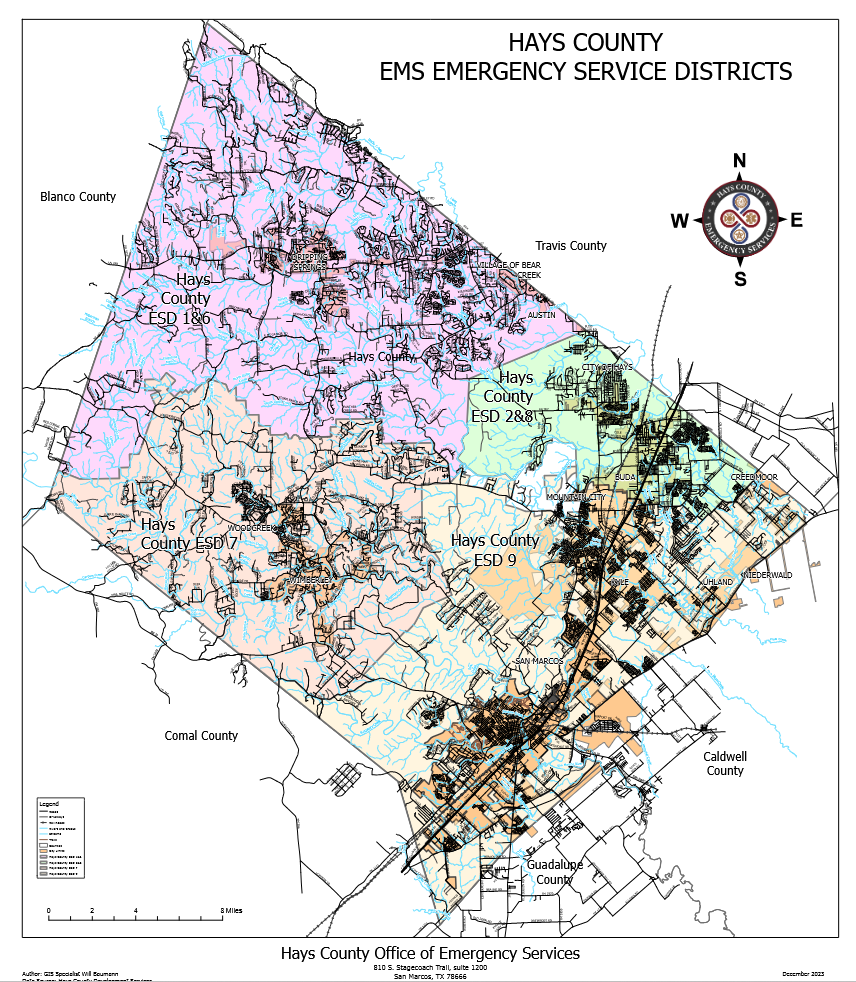
There are nine different Emergency Service Districts, called ESD #1 – #9, which make up Hays County. Some are fire, some are just EMS, and some are both.
The districts with EMS are 1, 2, 3, 7 and 9:
Hays County ESD #1: Dripping Springs, Driftwood, Henly.
Hays County ESD #2: Buda
Hays County ESD #3: San Marcos
Hays County ESD #7: Wimberley.
Hays County ESD #9: Kyle and all the country bits around those towns.
This map of the districts is hard to read, but it’s the only one I could find:
In 2020, Wimberley and Buda were running their own EMS.
The other three ESDs all shared an EMS service. We all contracted out with San Marcos-Hays County EMS, (SMHC-EMS), a nonprofit EMS.
Great!
In 2022, SMHC-EMS decides to start forming a union:
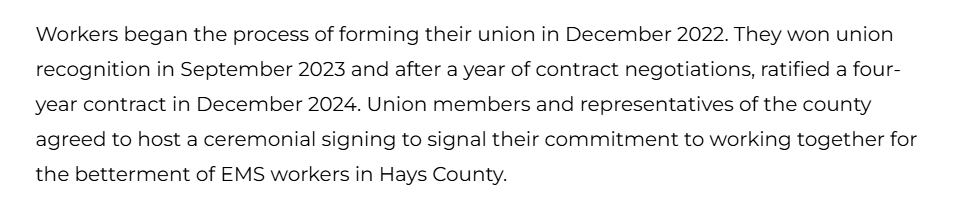
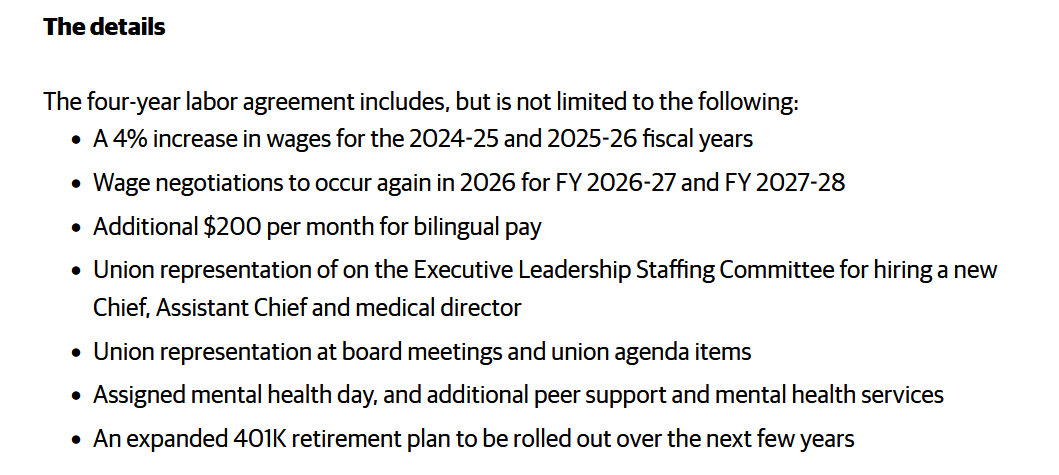
It took them about 2 years, but they finally negotiated a new contracted with their board of directors which included things like this:
Great!
About 30 seconds later, ESD #1 and ESD #9 both cancel their contracts with SMHC-EMS, and vote to open their own EMS departments. Pretty much textbook union-busting.
…
So San Marcos is stuck holding the bag, by ourselves. What do we want to do? Last August, we commissioned a study with some consultants.
January 2026: The consultants give us three choices:
- Renew the contract with SMHC EMS and just carry on.
- Roll EMS into our fire department. This is called Fire-based EMS.
- Make a new standalone City EMS department.
There’s a long conversation about collective bargaining and labor rights, and whether a City-based EMS could be granted some form of negotiating power.
A majority of council votes for Option 3, but they ask city staff to look into the laws around collective bargaining and EMS.
…
Let’s talk about union-busting for a sec.
Forming a union is a big hassle, and so my guess is that the grievances with management were significant. (I don’t have any details, though.)
Pre-union-busting, how much did EMS cost everyone? Here’s what I found from 2022:
ESD #1: $3.3 million in taxes (here)
ESD #9: $3.84 million in taxes (here)
San Marcos: $4.22 million in taxes (here)
Total: $11.36 million of taxpayer money to SMHC-EMS.
Post-union-busting, we now have three separate departments. Here’s what tax-payers are paying in 2026:
ESD #1: $8 million in taxes (here)
ESD #9: $10.2 million in taxes (here)
San Marcos: I can’t locate this for the life of me. Let’s ballpark $9 million in taxes, for our City EMS, based on the consultant study from January.
Total: $27.2 million of taxpayer money, to three separate EMS departments.
Bottom line: Way to go, asshats. You’re spending $16 million extra of taxpayer dollars, but at least you’re screwing over the people who keep us alive in an emergency.
…
Which brings us to tonight!
The point of the workshop is to update Council on how it’s going, planning for a new City EMS department.
The staff presentation
First off: city staff say there is absolutely no way to give EMS collective bargaining power under state law.
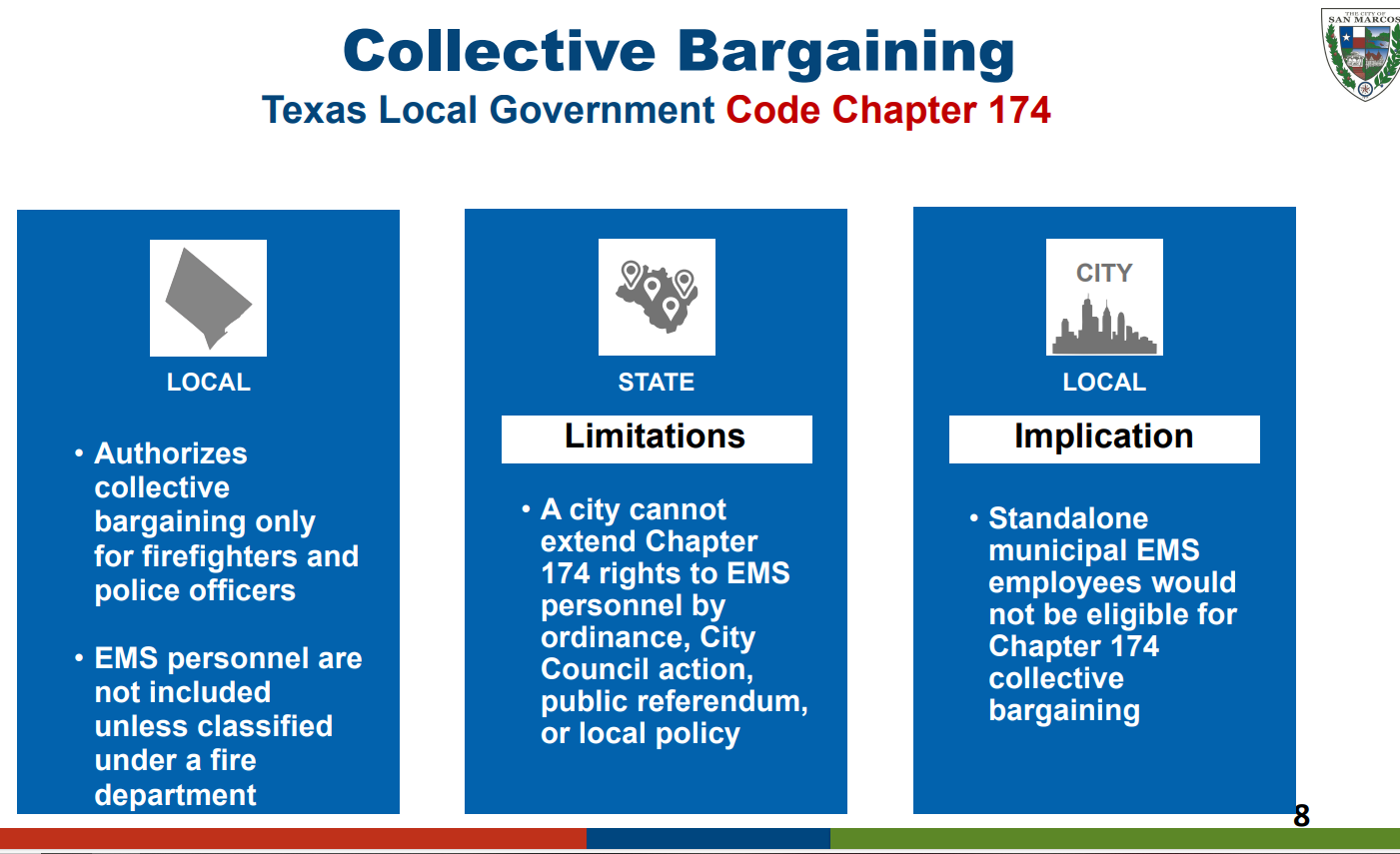
Police and Fire Departments can unionize, which is known as “Civil Service”.
But EMS doesn’t qualify as Civil Service, because San Marcos is too small:
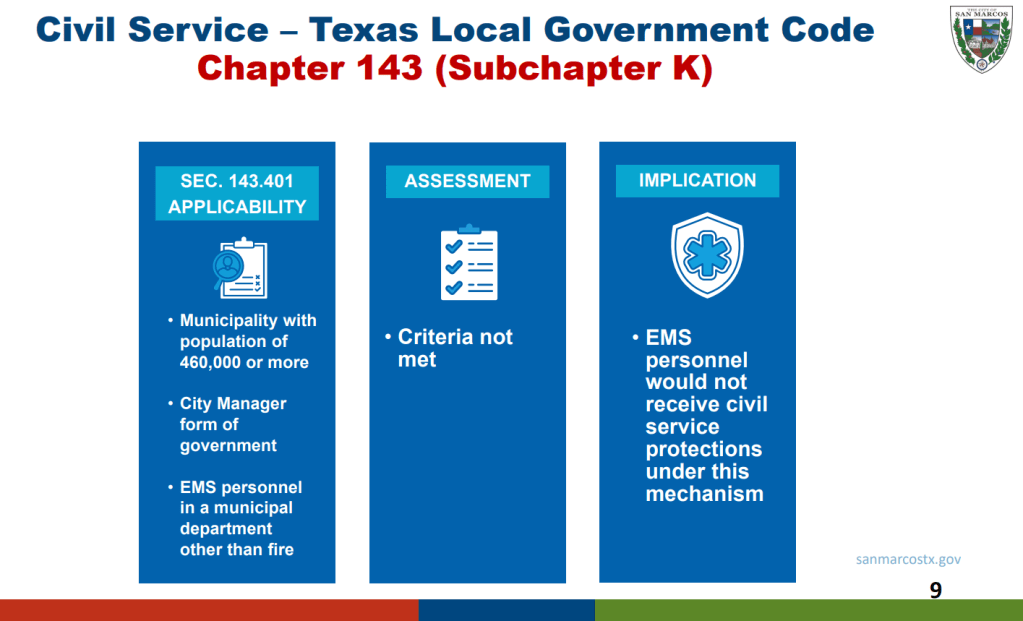
You have to have 460K people or more. So Austin can do this, but not us.
…
The first step is to hire an EMS Chief:
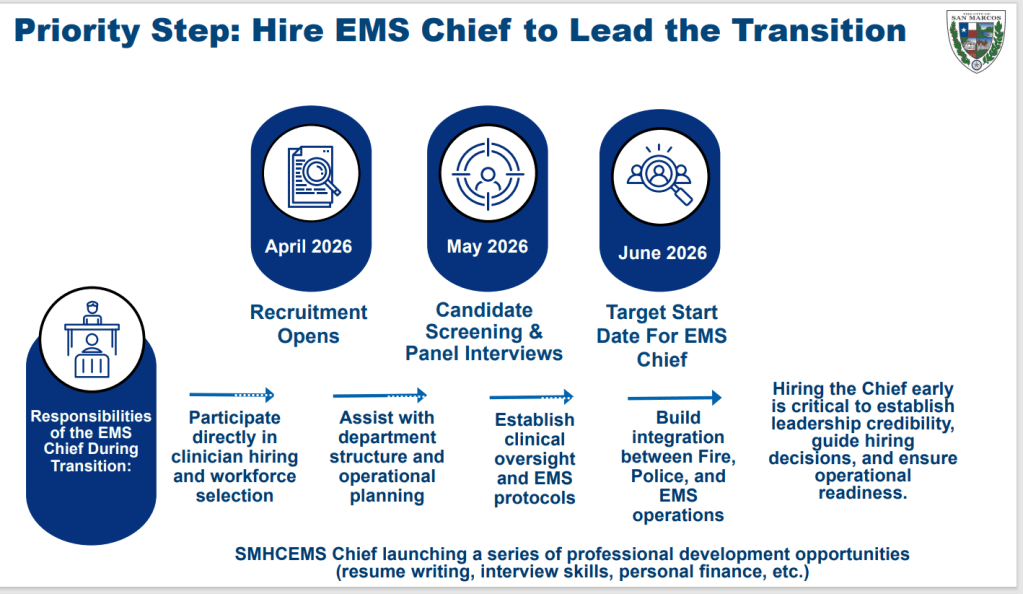
After this, we’d start hiring everyone else. Current SMHC-EMS workers would have first dibs on applying, and then we’d open it up to anyone else.
There’s a whole lot of medical mumbo-jumbo about credentialing, medical directors, clinical operating guidelines, physician consultations, etc, which I honestly do not have the background to follow.
…
What do people say at Citizen Comment?
Five people speak:
- Former SMPD commander: This is great! City EMS services are the way to go. State of Texas has bad laws around civil service, but the EMS workers are okay letting collective bargaining go.
- Citizen rep on Hays County EMS Board: Same!
- Two longterm field workers: This is the best of a bad situation. City EMS is the way to go.
- Zach Philips, president of the EMS union: you don’t need to rush this process. Our contract runs until 2028. Why not finish the contract and carefully plan your new City EMS to start in 2028?
…
What does Council say?
Alyssa: How did you build the job description for the EMS Chief? What’s the timeline?
Answer: We looked at other city EMS chiefs, and based it on those. We want someone who can build an EMS department from scratch, and also build lots of partnerships. Maybe down the road, we can do mobile community healthcare or something. The hiring process will probably take two months, but it’s flexible.
Amanda: Austin uses a process called “Consultation” instead of collective bargaining. Can we do that?
Answer: Austin has a special bracketed carve out in state law. We may be able to do something called “Voluntary Consultation”.
Note: What is Voluntary Consultation?
It sounds like a soft version of collective bargaining. Here’s an explanation about how it’s used in school districts:
While the law explicitly prohibits collective bargaining, many school districts have adopted consultation policies allowing school boards to meet and confer with educators about educational policy and employment conditions. These consulting agreements are related to the concept of collective bargaining but constructed in such a way that the input given is considered advisory rather than legally binding, and therefore does not qualify as a collective bargaining agreement by law. The school districts are not required to act on the input received from the employees and final decisions on matters discussed through the consultation process are decided by school board members.
So it’s not binding, and it would be voluntary by the city. At best, it’s a good-faith effort to foster communication. At worst, it’s thoughts-and-prayers.
City Manager Reyes: this means that certain city employees would get a perk not offered to the rest of city employees. Something to consider.
(Note: We could offer Voluntary Consultation to everyone. Just saying.)
…
Amanda: Is it viable to keep the current contract in place to 2028?
No one really answers this, but this is the central question. Should we build an EMS department from scratch in 5 months? Or should we see whether it works to just keep our contract with SMHC-EMS?
There’s this chart:
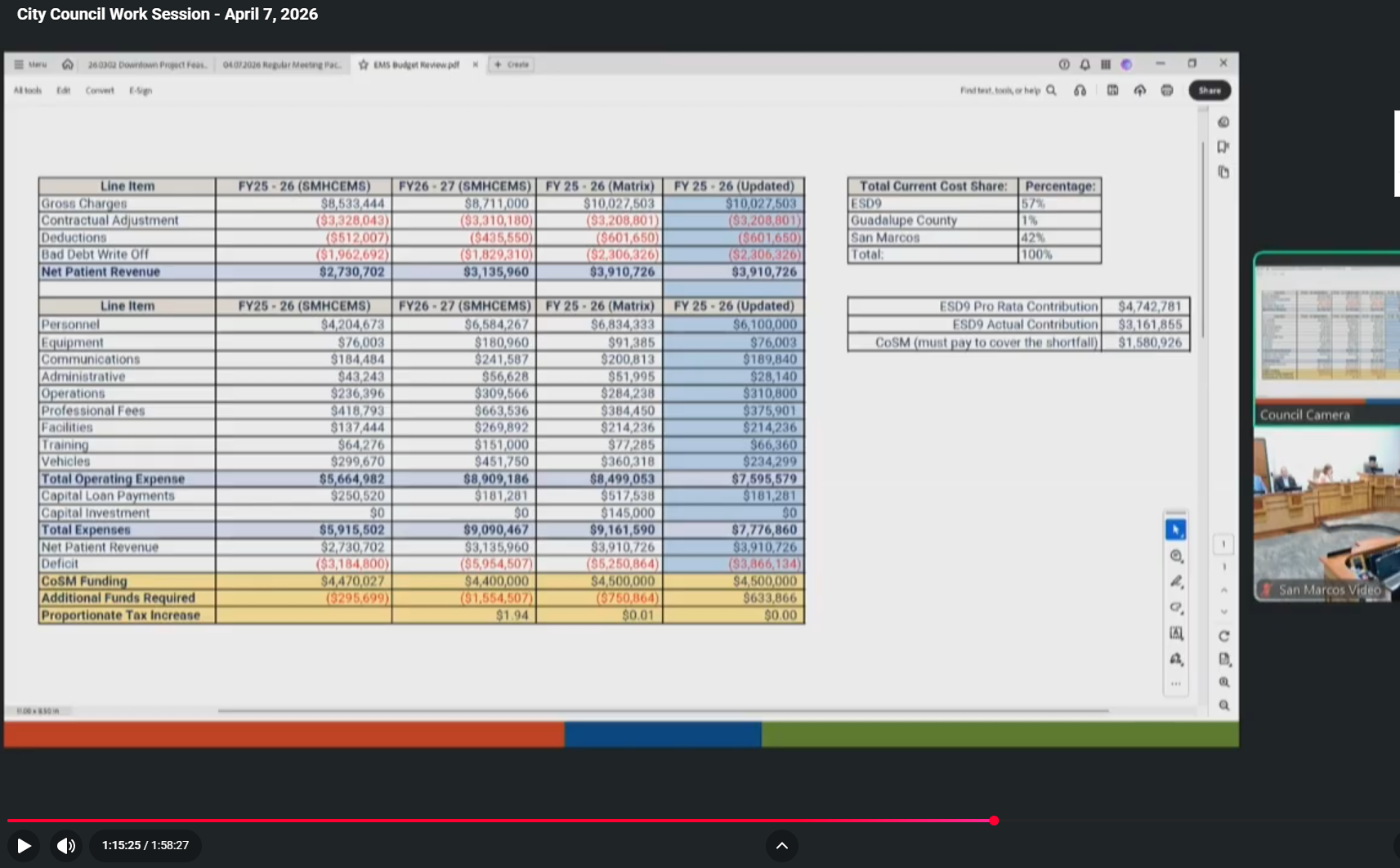
Sorry about the screenshot. I know it’s tiny and hard to read. (It wasn’t in the packet, because it was only requested the day before.)
I think this chart is supposed to show that it saves more money to build our own EMS department by October. But it really doesn’t.
Lorenzo makes an excellent point: this chart supposedly compares City EMS and SMHC-EMS. Some of the numbers should be identical either way – for example, the amount of revenue from ambulance rides should be the same. But they’re not – they’re off by $1.3 million. (This is the first row of the chart, comparing the 1st entry and the 4th entry.)
In several places, numbers that should match don’t actually match. This is probably because nobody actually knows the real estimates, and they used different sources to get projections in the different columns.
Point being: no one can really say which will be cheaper, the current contract or a City EMS.
Amanda: This is not solely about revenue. I’m focused on the quality of care and taking care of our community, not taking the cheapest option.
But Lorenzo wasn’t arguing that we should go for the cheapest option. He was arguing that we haven’t really thought through just staying with the current contract. It is a viable option, but we’re acting like it’s off the table.
My read is that staff came in with a lot of momentum towards building a new EMS department. There just isn’t a lot of oxygen in the room to discuss continuing the current contract.
…
Josh: I value people and communication more than I value the nitty-gritty details!
Josh is both right and wrong. He’s correct that when people with power operate in good faith, and value their employees and value communication, you have the best possible scenario. But he’s also wrong: when people with power stop operating in good faith, the only leverage that employees have are the details that are spelled out. When things go sideways, the devil is in the details.
I think Josh believes “Look, I have good intentions and I like being a good boss. That’s enough to make sure we’re in the good scenario!”
…
So what’s the timeline?
If everything was put in motion today, it would take 6 months for the state license to come through. Then we’d coordinate with Medicare, Medicaid, DEA, etc etc.
Matthew: Where would we put city EMS?
Answer: We’d talk to their landlord and try to rent out their current building.
Hopefully everything would be ready to go on October 1st, but otherwise we’d have a contingency plan, which we also would build out.
Jane: How long did ESD 1 and ESD 9 take to create their own plan?
Answer: ESD 1 took 6-8 months, ESD 9 was a bit longer.
Jane: can we compare benefits plans?
Answer: We’re working on it.
Note: It’s not just benefits. At the January meeting, they also mentioned looking to make sure seniority transfers over. Otherwise you are going to lose your most experienced EMS workers.
Alyssa: This is big and complicated, and there are so many ways for it to go disastrously wrong if we rush it.
Fire Chief Les Stevens: The Medical Practitioner oversees these transitions and would not allow care to lapse for one second.
Amanda: In the next legislative session, maybe we can lobby for fixing the Civil Service rules?
….
Ok Council:
1. Who wants to stick with City based EMS?
Yes: Matthew, Shane, Jane, Josh, Amanda
No: Lorenzo and Alyssa
Alyssa says that she is just not yet satisfied with the open questions about labor protections.
2. Who wants to look into Voluntary Consultation as a lite-collective-bargaining?
Yes: everyone.
No: no one.
So there you have it.
…
At the very end, the union rep Zach Phillips weighs in again:
- I still have concerns about the timeline and labor protections
- EMS will absolutely not generate revenue. Do not look at this as a revenue source, I promise.
- Yes on lobbying the state legislature. We think we can make progress on this by 2028, which is one reason to wait.
- You all will be the 2nd largest city based EMS, after Austin. What’s the rush?
Alyssa: Will we put a union rep on the hiring committee for the EMS chief?
Answer: Absolutely. Yes.
…
Final notes: How are we going to pay for this? We’re already looking at a $4 million budget hole. As Zach said, this will not generate revenue.
My guess is that that will be a big, messy conversation, and so there just wasn’t time to roll that conversation into the this workshop.
What a mess! Sure do wish we hadn’t done this last year:
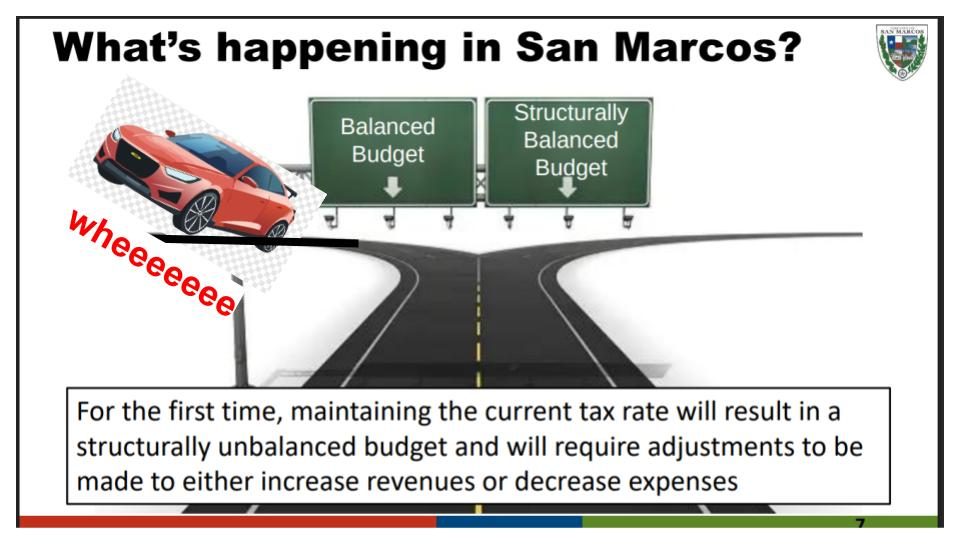
But here we are.
 The San Marxist