Hello everyone! Ahead of time, it sounded like Council might have a big fight night, but it ended up being pretty mellow. We didn’t kill citizen comment nor give data centers a fast track. Read all about how it all fizzled out!
Jump in:
Hours 0:00 – 4:32: The biggies: the land development code and the citizen comment thing. Also city-run childcare and CDBG grants.
Bonus! 3 pm workshops: Covid money has to be spent by December. We’re going to spend every last cent that we can.
Note: the next meeting isn’t until March 31st. They rearranged the calendar to avoid Spring Break. Try not to miss me too much!
It’s very hard to speak concisely when you’re new to citizen comment
Emailing council is no substitute for citizen comment, because other people don’t get to read the emails, and council can ignore emails. This is how the public informs each other.
The nationwide average is 3 minutes per speaker.
Main points on Topic 2:
Are we making it easier for Data Centers by allowing them in the Business Park zoning?
Are we making it easier for Data Centers by giving the permitting decision to P&Z?
Why aren’t we proposing regulations on their water use, air quality and waste water quality, power usage, and other things like that?
We will get to this! Sit tight.
Finally, that last 41st speaker, on his own topic: Clearly last meeting, everyone said they love the river. Can we monetize the river? There aren’t any billion-dollar industries besides data centers. How are we going to bring businesses to this town?
…
One last comment that’s worth noting:
At the 3 pm meeting, Max Baker asked: Hey, the executive session was all about “Confidential Utility Competitive Matters” with the Lower Colorado River Authority. Is this a data center thing?
City Lawyer: Legally we cannot say, but no, this was not a data center thing.
Good to know!
…
Item 7: Youth Standards of Care
This is a yearly item. San Marcos runs a bunch of affordable camps for kids. The big one is Summer Fun, which is $40 for the entire week, including meals. This is really a lifesaver for lots of families. There’s also a discovery camp, and a spring break camp, and other helpful camps.
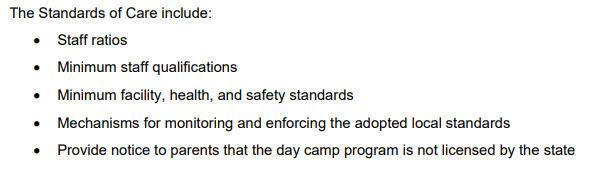
City run camps are exempt from state licensing the way other childcare centers are licensed. Instead, they have to pass a Standards of Care. So this is that.
SiEnergy is a natural gas company. They are not in San Marcos. They’re in Houston, Dallas-FortWorth, and Austin.
If they want to come to San Marcos, they have to get a franchise agreement with the city. Then they’d have to pay the city a surcharge once they’re operating.
The franchise agreements last five years. They’ve had one for the past five years, which they got one back in 2021. They’ve just been sitting on it. Now it’s 2026, and they want another one, for another five years.
Everyone says fine.
…
Item 9: CDBG Money
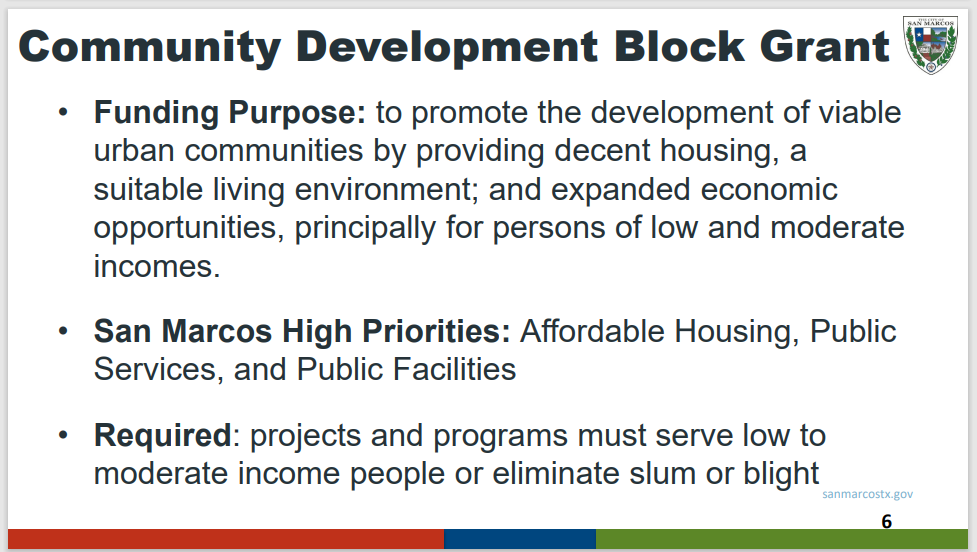
CDBG stands for “Community Development Block Grants”. This is money from the federal Housing and Urban Development (HUD) department. San Marcos gets about $740K every year.
Applications from nonprofits were due last week. City staff are about to wade through them. So tonight is to find out if there’s anything specific that Council wants staff to think about while reading applications.
Max Baker speaks up during the public hearing: Hey, the Civics Club has been working on the Tenants Bill of Rights. Can we steer some funding towards those efforts?
The Tenants Bill of Rights dovetails nicely because it can keep housing decent. They say they’ll look into this.
…
Item 10: The LDC
This is the first hot potato of the night!
Background
“LDC” stands for Land Development Code. The Land Development Code is where all the planning and zoning rules are spelled out in excruciating detail.
Because it’s so weedy, it requires lots of revisions. If a law gets changed, you have to change the LDC. If you change one thing, you have to change 20 other details that are all connected. People find typos or extraneous details that didn’t need to be there. New situations arise and we need new rules to deal with them. Council has new ideas about how to do things better. Etc.
The planning department takes notes, and stockpiles all of these changes for two years. Then they take the pile out and implement all the changes, all at once. This is that.
There are 320 proposed changes. They range from boring and insignificant to exciting and controversial.
What does the public say?
Everyone’s worried that this is a stealth maneuver for data centers. (Thirteen speakers.)
What does staff say?
Data Centers: Let’s start here. The staff proposal is terrible and I promise that it is not going to happen. Multiple council members said they had amendments to fix this. They know everyone hates it.
So what was it? The proposal was to require a permit for the Business Park zone and the Light Industrial zone, and automatically allow data centers in Heavy industrial.
My $0.02: Is there any way to put standards on water and electric use, as part of the permit process?
…
Here are a bunch more of the LDC changes, mentioned in the staff presentation:
Revising the Valid Petition rules for protesting a rezoning, to match the new state law.
My personal favorite: the state struck down Occupancy Restrictions.
Occupancy Restrictions are the city rules that say things like “No more than two unrelated people may live in the same house”. It’s micromanaging what people do in their own homes, and it’s very classist. It’s never enforced unless you’re hunting around for a reason to harass someone.
We’ve had big fights about it here and here and here. We loosened it from two unrelated people to three unrelated people. And now it’s gone! Haha. Good riddance.
Mellow out on when a historical property needs a Certificate of Appropriateness
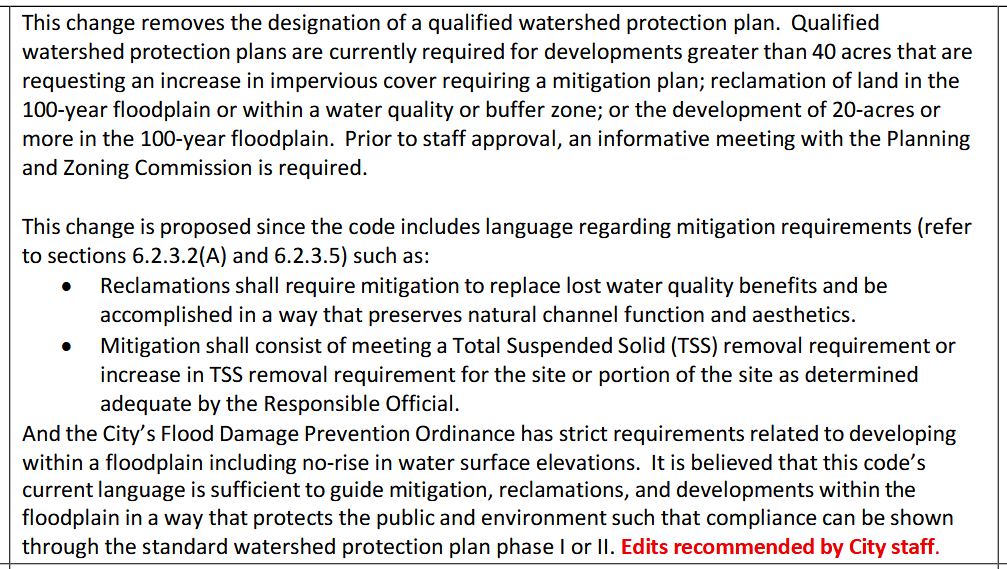
Modifies when a Qualified Watershed Protection Plan is required:
Tinkering with lot widths and irregular shaped lots
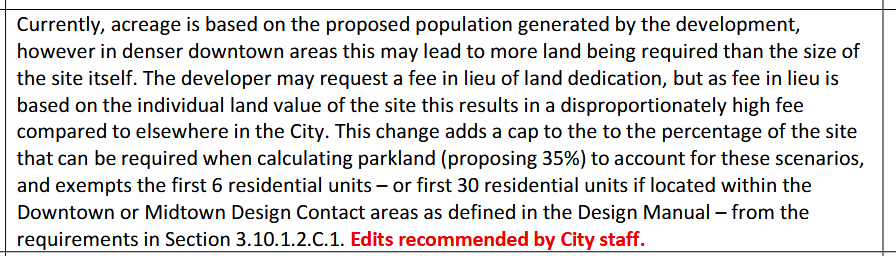
Weird caps on parkland dedication:
I’m not clear on how generous this is.
Zero lot line houses and cottage courts in CD-3 (this is good!)
Including microbreweries into the possible land uses
Add “sensitive features protection zones” around Environmental Protection Zones
Allow street parking to count towards parking requirements downtown. This is good for walkability and density.
Require bike parking racks to be provided with parking lots. (This is good!)
Add pollinator plants to what can be planted downtown. (yay for butterflies!)
Instead of the city putting up signs about public hearings, the applicant is responsible for putting up signs. The city has to supervise, so I don’t know if this helps much, though.
We used to have something called PDDs, where the city could micromanage what a developer built, and developers could get all kinds of breaks. Then we got rid of them. Now we’re bringing a lite version back: you can put constraints on developers, but no freebies. Note: Maybe this is a good place to put water and power use considerations?
Formalizing what we mean by amplified sound and background sound, so that P&Z can put restrictions on downtown bars.
Add in Demolition Delays to one of the tables
Eliminate number of rooms from hotel categories.
Tree surveys required any time someone wants to develop around a heritage or protected tree
Require downtown businesses to clean 100 feet out from their exits instead of just 50 feet.
It’s a lot.
I didn’t go through the other 250 changes to verify that they were all minor. There’s always a judgement call on whether something is a big deal or not.
What does Council say?
It takes about 2 seconds for Amanda to motion to postpone. This is such a gigantic topic that no one has properly vetted all 300+ changes.
Note: The data center thing will definitely be changed. Several council members said this. But feel free to weigh in with your preference!
The SMART/Axis terminal never really had an epic meeting, because it was withdrawn before the rezoning came for a vote. But there was six months of people showing up to comment.
So this is not a new thing. (But I went and looked up some old controverseys – Cape’s Dam, and the Sessom Creek apartments, and the Woods Apartments, and the HEB on Wonderworld – all of these citizen comment periods were at most an hour. So things are getting longer.)
Which brings us to today
So the last meeting was a doozy. This meeting, Jane proposes that we should cut people off after 1 minute.
DUDE JANE. What the hell? This idea monumentally dumb in so many ways:
Don’t restrict people’s participation. Citizen Comment is heavily utilized because it holds so much value.
The timing is tone-deaf – are you trying to come off like you’re retaliating?
If you don’t like going until 3 am, then focus on that. Your policy should address your problem. Right now, it sounds like you think the problem is people having three minutes to talk.
Jane speaks first! Here’s her argument:
She’s not trying to remove Citizen Comment altogether!
She’s willing to go to 2 minutes, to avoid the Austin lawsuit.
You can say if you’re a Yes or a No on an item in 1 minute.
If you have more to say, send an email. (Preferably before 5 pm the Friday before the meeting.)
Right now, the 100th speaker speaks at 11 pm. This way, the 100th speaker would speak at 8 pm. This is good for the public citizens who want to speak!
Alyssa claps back hard: Absolutely not. Give our neighbors every opportunity to speak. Organizing is hard and stressful and we’re not going to create more obstacles.
But Alyssa does also admit: it’s true that none of us are at our best at 1:00 am.
Amanda goes next: Hard no on reducing citizen comment time. But there is a problem with these ultra long meetings. Why don’t we brainstorm creative solutions for that?
Lorenzo: – I’m open to brainstorming other creative solutions. – I’m open to reducing citizen comment. – And also, have you all heard yourselves ramble? Maybe some limits on council monologues?
Oh Lorenzo. You drag things out during council meetings!
But Lorenzo also brings good ideas to council discussions! He notices details and is good at brainstorming creative solutions. But he’s not quick about it. He sometimes gets hung up on tiny details and goes down rabbit holes trying to hash them out.
Josh: When people aren’t sure what they’re walking into, it sparks fears and leads to citizen comments that drag on. If we’re more prepared, it leads to more clarity and better-run meetings.
…
Bottom line: they’re going to have a future council discussion on how to shorten meetings.
My $0.02: you’re going to have to meet more often. Clearly San Marcos has outgrown two meetings per month.
Either:
Cut meetings off at 11 pm and come back on Wednesday?
Meet weekly occatsionally?
Special sessions for hot topics?
I personally do not like the last option, because my schedule for cranking out these posts hangs by a thread sometimes. But I guess the world doesn’t revolve around me. Sadly.
By the end of 2024, it all had to be contracted out. We did that.
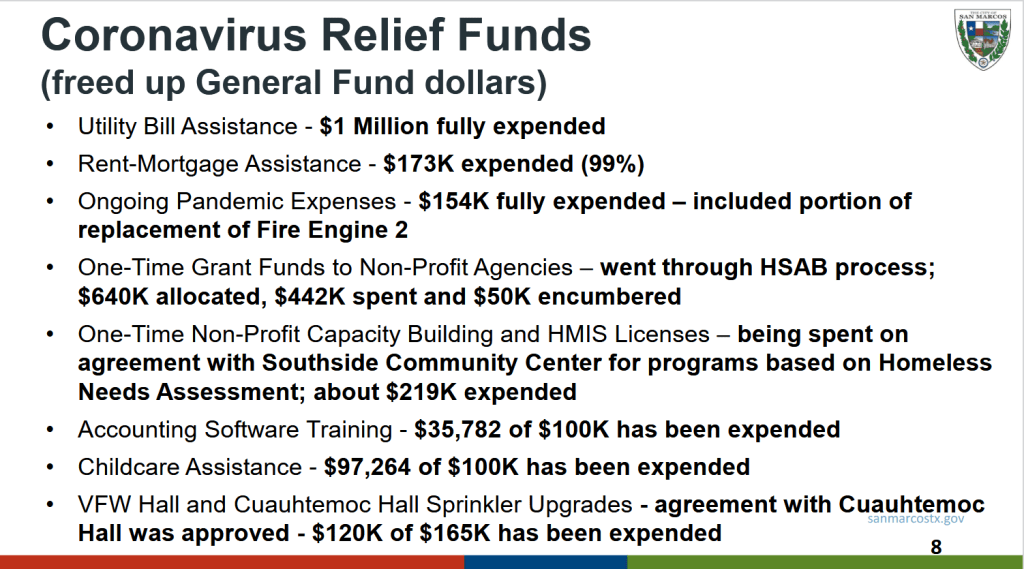
Here’s what the Covid Relief money went to:
(Note: For the Covid Relief money, they only mention $2.67 million of the $6 million in today’s presentation. I assume the rest got spent years ago.)
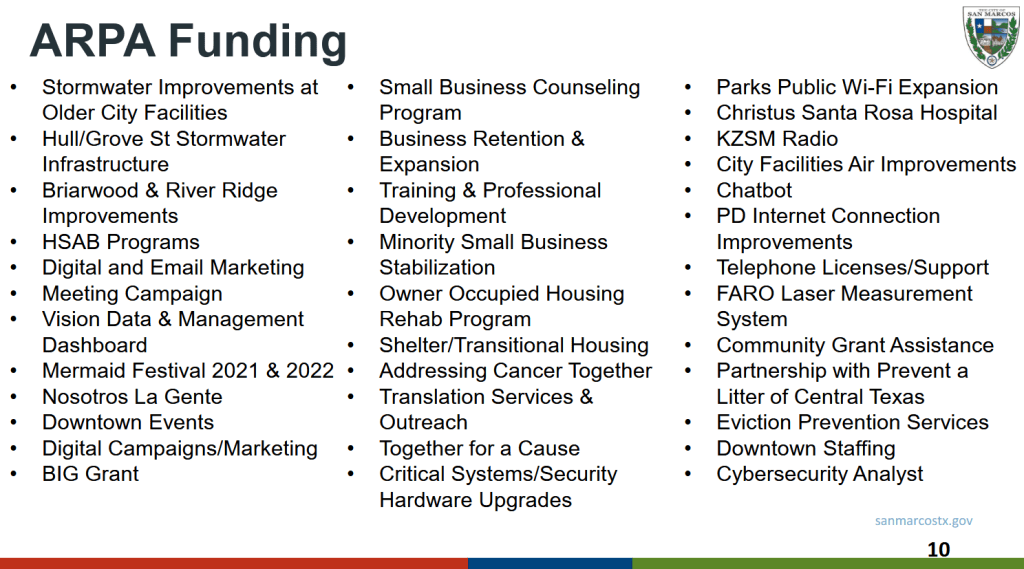
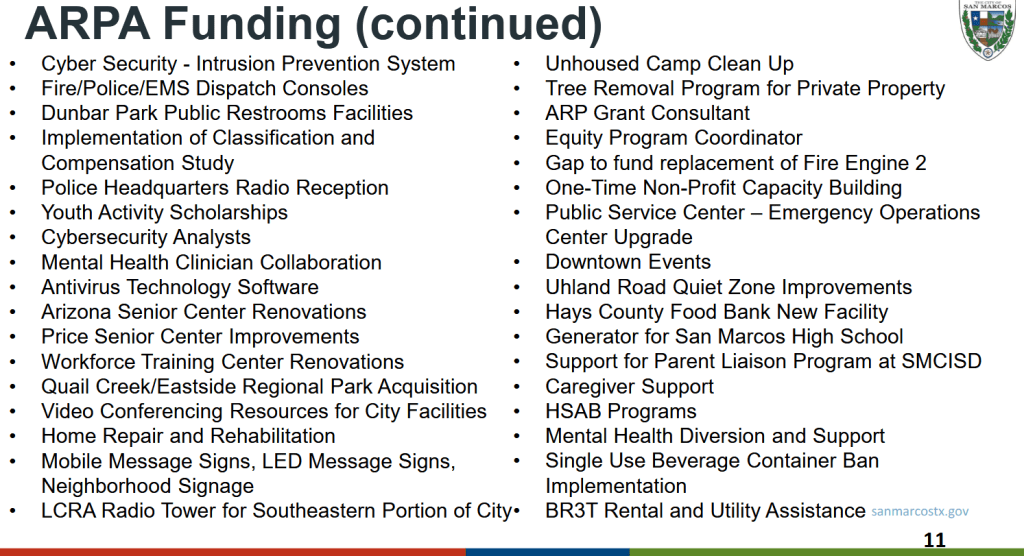
Here’s what we’ve spent the $18 million ARPA money on:
It has to all be spent by the end of 2026. So everything is wrapping up.
Which brings us to today
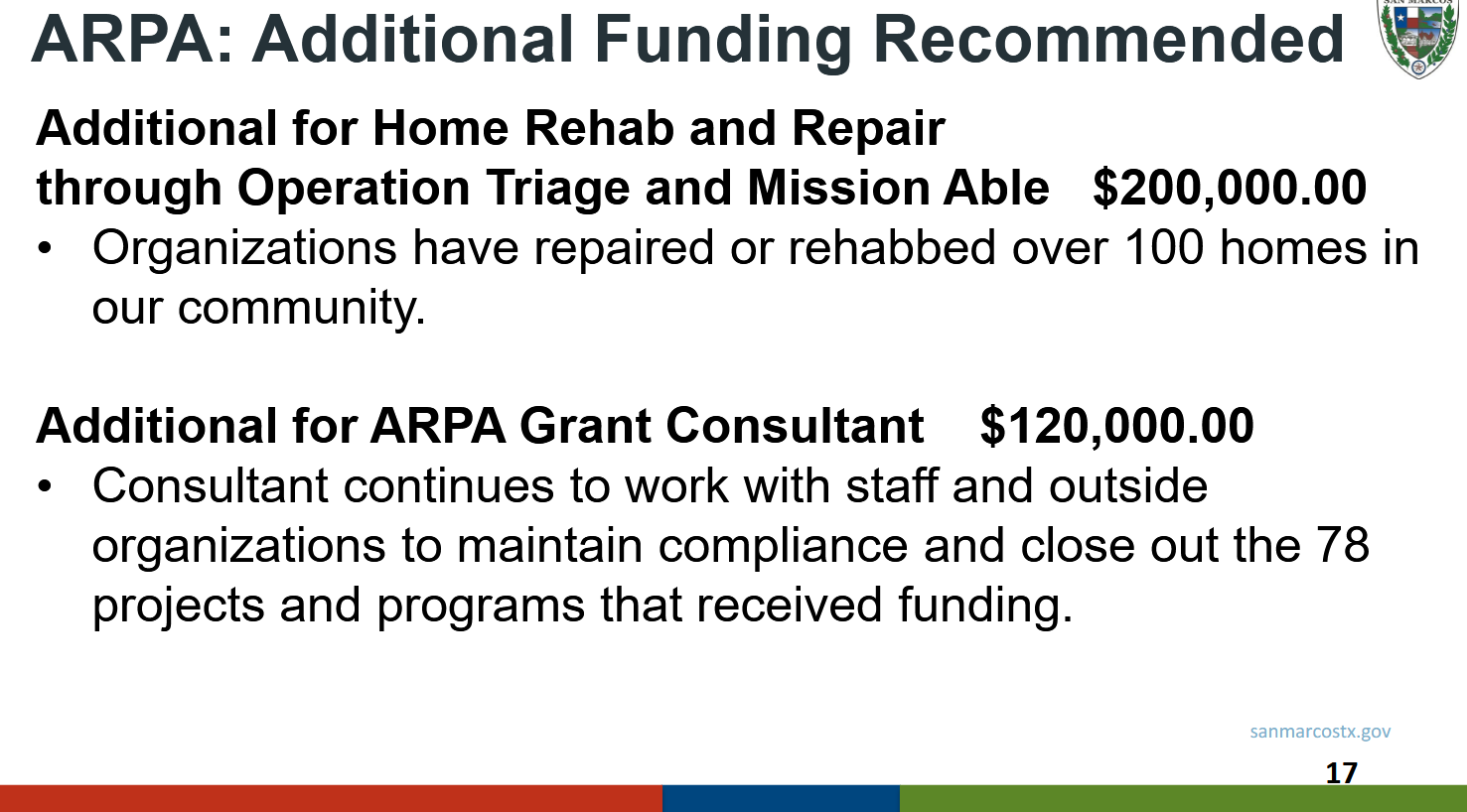
As projects finish up, there’s often a little bit of money left over. We’re allowed to put that towards one of the existing contracts, but you can’t start anything new.
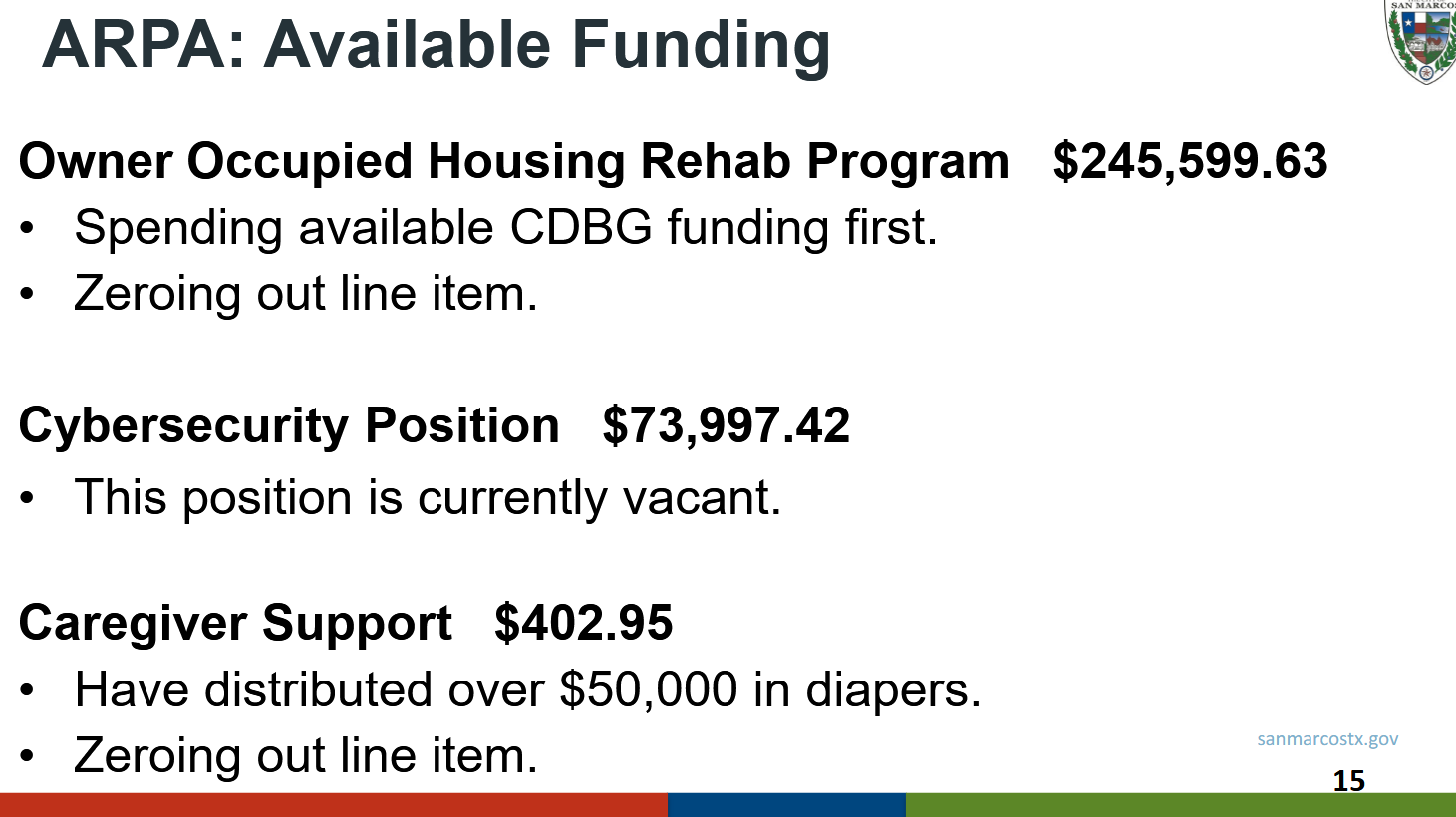
We’ve got about $320K freed up from these projects:
In other words: suppose you’re 70 and you bought your house in 1980, and you’ve worked low-wage jobs your whole life, and now you’re in danger of being homeless because your house needs $50K in repair so that it’s not condemned. This is the kind of program that comes in, fixes your foundation and your air conditioning, so that you can safely and happily stay in your home.
The grant consultant is the person who understands all the federal rules, so that we don’t risk losing this money due to mismanagement. We were going to have to pay this $120K either way.
What does Council say?
Jane: How about $5K to buy pet food for the PALS pet food drive program? That’s allowed because we had a covid contract with them already.
Alyssa: I need way more information. What are the deliverables? What’s the selection process? What’s the socioeconomic status of the recipients? Is this equitable? Where in the city do the recipients live? Do our neighbors trust them? I have so many questions.
Amanda: I’d like the extra info, but I’m good with Mission Able and Operation Triage.
Lorenzo: How about the food bank and BR3T?
(Note: BR3T is rent assistance and homelessness prevention.)
Alyssa: Can we get info on those, too? I want info on everything. BR3T funding is evaporating.
Jane: Maybe the consultant will come in under budget, and we can find $5K for PALS pet food from there.
Josh: I’m fine with the staff recommendations.
Shane: Me too.
Matthew: Me too.
Bottom line: This will come back at a city council meeting. Staff will bring back lots of information on Mission Able, Operation Triage, PALS, the food bank, and BR3T.

 The San Marxist