
Citizen Comment:
There is only one topic, but there are over two hours of comments. It’s all data center, baby.
There were 14 speakers in favor. Here are the main arguments made by the people who want us to approve it:
- These are all over the place already.
- San Marcos needs the tax revenue.
- I am the property owner, or I’m going to work in some way on this project, and it sounds great to me
There were 29 speakers opposed. Here are the main arguments made by the people who oppose it:
- We’re in a drought, and data centers use a massive amount of water.
- Data centers use a massive amount of electricity. Our rates will go up, this is bad for the environment, and the grid can’t handle it.
- Don’t sell out the San Marcos river to greedy corporations
- Cyrus One is secretive and unwilling to answer basic questions.
- Anecdotally, people have stories of odd illnesses from living next to data centers.
There were another few speakers opposed at the 3 pm workshop, and then another 25 at the public hearings. (The vast majority were people speaking more than once, though.)
This will take up the vast majority of the meeting, so we’ll unpack all these points. Stay tuned.
…
Items 10-13: But first! we have the quickest little rezoning.
Have you ever been driving south on I35, towards New Braunfels, and noticed these guys?

They make concrete, and they’re here:

The owner wants to zone two little blocks of land, between Heldenfels and I-35:

He wants these to also be Heavy Industrial.
No one is fussed. Everyone says okay.
…
Items 14-16: Ok, it’s time for the AI Data Center. This is a doozy.
Background: We are talking about land here:
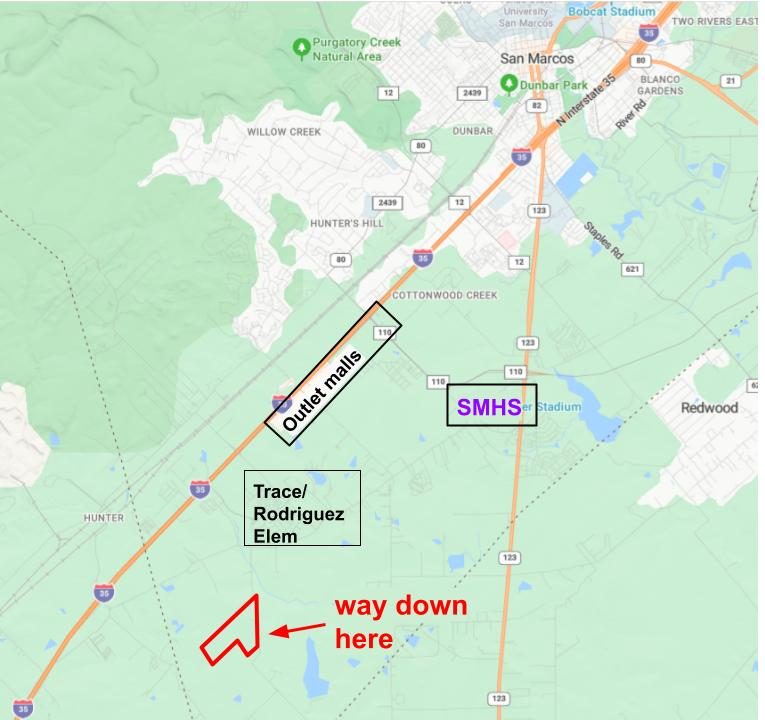
The property owner wants to zone this land Light Industrial, so that he can sell it to Cyrus One, a data center company.
Let’s talk about data centers
Apparently there are 300+ data centers already in Texas. Of those, 40 are in the Austin and 49 are in San Antonio:

Not counting the one on tonight’s agenda, there are apparently two being developed in Caldwell County and three more in Hays.
Data centers have two big problems: they use a lot of water and they use a lot of electricity. Texas makes this worse, because counties aren’t allowed to regulate use of natural resources. (Virginia Parker, director of the San Marcos River Foundation, said we’re the only state with this particular idiocy.)
So as long as data centers stay outside of cities, there is currently no way to regulate how many get built.
This specific data center
The owner is a guy named Mayberry, and the property has a funny history. (Not funny haha.)
Back in 2022, he asked the city to annex most of this land into San Marcos. He wanted to sell the land to a developer, to build single-family homes out there.
This was always a weird, terrible idea! First, the sprawl would be insane. It’s farm land out there, not close to anything.
Second, there is a massive power plant next door:
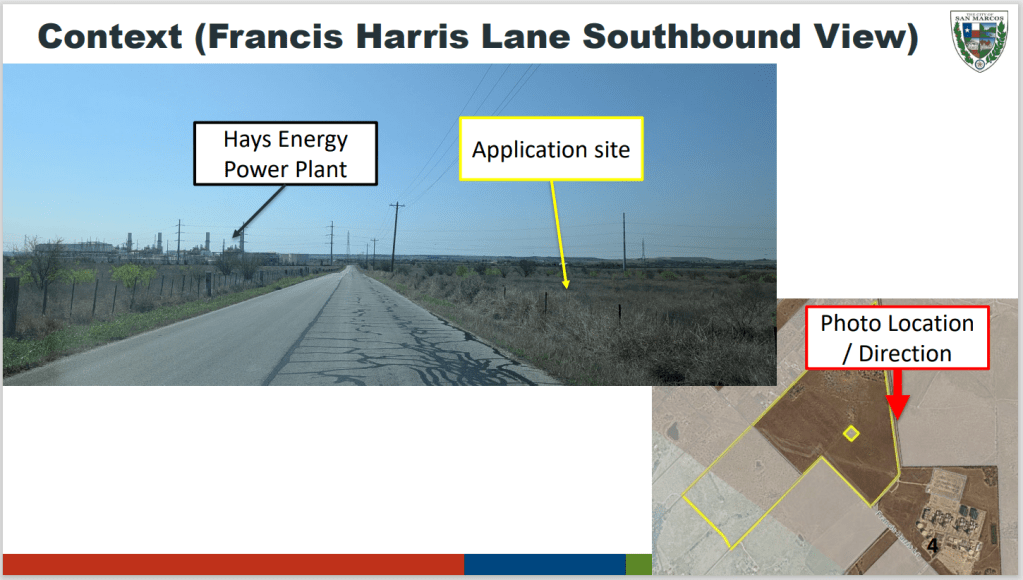
Council had endless discussions about whether it was fair to build homes next to an extremely loud, bright, flashing power plant. In the end, they settled on a mandatory disclosure to potential buyers and some fencing.
It’s been three years, and clearly no one wants to build these houses. So Mayberry has moved onto the next idea, which is this Data Center.
But since most of the land has been annexed into San Marcos, he now has to get permission from the city to rezone.
In this one data center, and only this one, we now have a say.
Back in March, Planning and Zoning denied the rezoning. (In fact, this was Jim Garber’s last meeting.) Planning and Zoning had a ton of concerns.
When P&Z votes down a rezoning, it takes a supermajority at Council to overturn them. So tonight, the data center will need 6 votes out of 7, in order to pass.
We’re going to cover these topics next:
- Noise and lights
- Water
- Electricity
- Impact on San Marcos, and the Restrictive Covenant
- Property taxes
Buckle up!
- Noise and lights:
Staff basically says, “Look, plenty of data centers are in residential areas already and everyone seems to be chill with it. Look!”

“Isn’t that so close? See?”
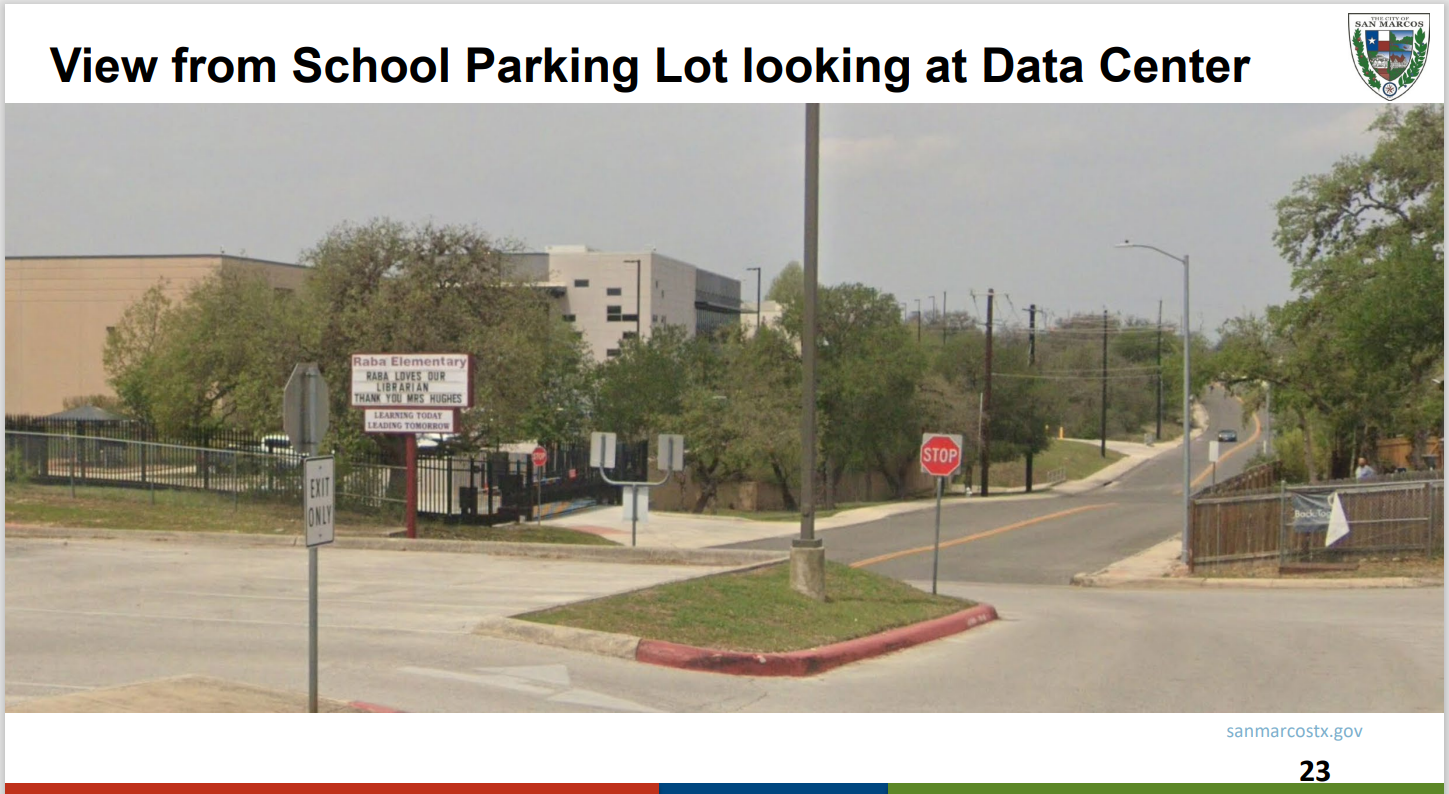
“And also, what if Mayberry had built those homes! Wasn’t that an even worse idea?”

(For the record, Jane, Shane, Mark Gleason, Saul, Alyssa, and Jude Prather voted yes for those homes, in 2022. Max Baker voted no.)
The comparison to the imaginary, nonexistent homes is silly. The homes don’t exist.
…
Here’s the real argument the city should have made: this data center is next door to the Hays County Power Plant.

Seriously, the noise, lights, and weird vibes that come from this data center will be dwarfed by what’s already coming from the power plant.
2. Water:
Data centers run hot, and so they use a lot of water to keep the computers from overheating. A traditional, evaporative system uses maybe 550,000 gallons/day?
Technology has gotten better, and now they use a closed loop system. You fill up the building one time, and then it keeps re-using that water for the lifespan of the building. After that, the only water needed is for employee bathrooms and kitchens.
Mayberry says that the initial fill up will require 60K-70K gallons of water per building, and there are 5 buildings. So roughly 400,000 gallons will be needed to fill the buildings, one time.
After that, he says that each building will use about 4-7K gallons of water each day. That’s pretty normal for a business:

3. Electricity:
The electricity is insane.
Mayberry says that each building will use about 75 megawatts of power. So over five buildings, they will use 375 megawatts.
City staff says that all of San Marcos, at peak usage, is about 150 megawatts. Every single one of us, on the worst day in August! That’s insane. On a typical October day, all of San Marcos uses about 25 megawatts. So these data centers really do gobble up a ton of energy.
Two questions come up:
– Will this drive up water use, indirectly?
– Will this drive up rates?
Both answer are yes, sort of.
Producing electricity requires water. But it’s not using San Marcos water – it would be from any power plant, in the entire state. All the electricity from all of the power plants gets dumped in the grids, and it gets blended around. When you draw electricity, you’re getting a random blend of all those sources.
(Also, not all energy sources require water. Gas, coal, and nuclear all do, but wind and solar don’t.)
The same is true for electric utility rates: all 300 data centers are putting a huge strain on the grid. More power needs to be generated, and that is going to cost money. But that cost is going to get spread across the entire state.
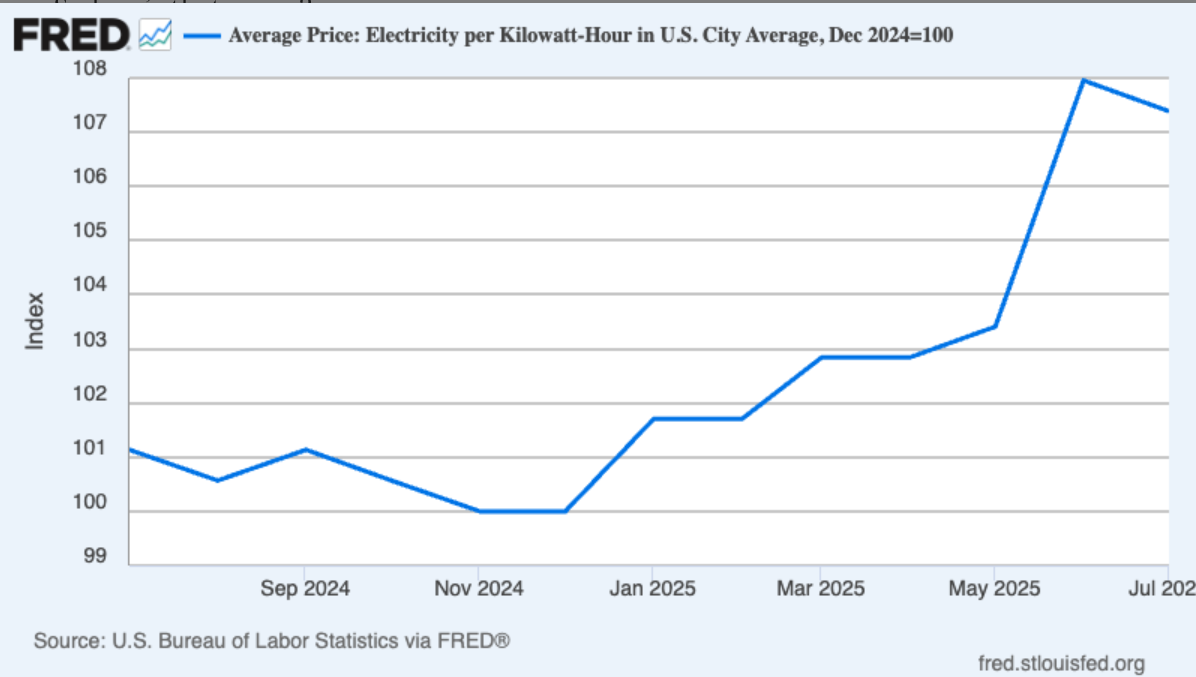
Electric rates are spiking and will continue to spike, over the entire state.
4. Impact on San Marcos and the Restrictive Covenant:
This data center will not use San Marcos water or San Marcos electric. Water would be supplied by Crystal Clear water, and they’d get electricity from Pedernales.
All data centers in central Texas are harming all of central Texas. The bad effects are distributed pretty evenly. We’re all using the same water table and tapping into the same electric grid.
This specific data center does not specifically damage San Marcos or the San Marcos river.
The Restrictive Covenant: A restrictive covenant is a legal contract of all the hoops that the developer is willing to jump through, for the city.
Since getting knocked down at P&Z, Mayberry is trying to do whatever he can to get approved. Here’s his offer:

and

5. Why even do this?! (Property taxes)
Allegedly, it would bring in an enormous amount of money.

To put that in perspective: This past year, we’ve had a budget crisis, and city departments had to make cuts. Total, across all departments, we cut $100,000, and it was a huge strain. $9 million would go a very, very long way.
My two cents
I’m out of step with my readers here, and I apologize. I think we should take the money.
Data centers are run by greedy, irresponsible corporations that do not care about local resources. They will exploit and destroy all the beauty in this state, if they can. Texas desperately needs to regulate this industry and limit the number of data centers that are being built.
And yet!! I think we should hold our nose and let them pay us lots of money. There is so much need in San Marcos, and so much poverty.
Rejecting this does not move the needle on the actual problem. Take the money.
Here is what Council says:
Matthew Mendoza goes first, and he is fired up. He says:
- I voted against putting houses by the power plant. Terrible idea.
- We didn’t annex SMART/Axis because of local activism, and now they’re building anyway, except unregulated. I get complaints every day from people who live in Pecan Park. Annexation means regulation, and that’s good.
- We cannot run this city on tax income from neighborhoods. It’s not sustainable. You all don’t pay enough in taxes for how much it costs to run a city.
- We need opportunities in this town. My blood is in the river and soil! Jim Garber was my scout leader!
Jane Hughson goes next:
- I have a ton of water cred. I was the first chair on the board of the Edwards Aquifer Authority, senior board member of ARWA, etc.
- I’ve got some concerns, but I also am open to negotiation.
- Listen up: you think you hate living next to a data center, but you would really hate living next to manufacturing. I’m trying to keep that from happening to you.
- The amount of power needed is crazy. I have a lot of questions that we’ll get to.
Saul Gonzales goes next:
- No. I’m a hard no. I listen to my constituents, and they know more than me. Everyone knows my reasons why. No.
(Ahem… everyone knows his reasons why)
Amanda Rodriguez goes next:
- I’m also a hard no. I’m not going to dismiss the voices of this many people.
…
Let’s pause and talk strategy:
This item needs 6 out of 7 votes to pass. Saul and Amanda are voting no. Therefore it can’t pass.
But everyone pretends like this didn’t just happen! We proceed to have a detailed discussion for the next hour. It was a little weird.
However: the ending is not black and white, so I’m going to force us to walk through all this slowly.
…
The nitty-gritty questions
Q: Can the restrictive covenant be changed?
A: Yes. This is just a first reading. Staff can bring back changes for second reading.
Q: Is the property owner willing to make the covenant permanent, instead of expiring in 20 years?
A: Sure.
Q: How can we enforce the covenant?
A: A bunch of different ways:
1. The biggest items are how buildings are built. We withhold occupancy permits until it passes inspection. We have a lot of leverage there.
2. We can require them to submit their monthly water bill to the city, and make it publicly available.
3. We have an (overworked, underfunded) code compliance division who will make the rounds out there and check for things like noise violations.
4. For any other violations, we’d take them to court and get an injunction. Court orders them to stop doing whatever they’re doing.
Q: How do you end up using 4-7K gallons of water in each building, each day?
A: That’s pretty standard for a regular office building with a bathroom and kitchen. Nothing major.
Q: If you ever had to drain the closed loop, what would you do with all that water?
A: It’s got a ton of awful chemicals in it. It would need to be disposed of as a hazardous waste. That can’t go down the drain.
Q: Can they build their own gas power plant and get around ERCOT?
A: Not if they’re in the city limits. They’d need approval from P&Z. If they’re outside the city, yes.
Q: Why does everyone have stories of how this will cause electric rates to rise?
A: Electric rates will definitely rise, because of the 300 data centers across Texas. Whenever there are new grid costs, those costs are spread across the entire state. So we’re already facing this. This particular one doesn’t affect us any more than the rest.
Q: Can you use reclaimed water on all your landscaping and stuff? Will you be sustainable?
A: Sure.
Q: Can you fill the original big amount of water using reclaimed water?
A: Probably not worth it, to run pipe across the street for a one-time use.
Q: but could we use a water truck?
A: Yes, that would solve the pipe problem. We don’t know if it’s okay for a data center.
Q: Go back over the part about how much water it takes to make electricity.
A: It does take water to make electricity, if you’re using non-renewable energy. But not for wind or solar. But all the electricity goes into a big mushpot. So data centers just draw a big blend of energy. It’s not coming from the San Marcos river or anything.
Also, if you’re starting a new power plant, you have to show ERCOT that you’ve purchased the water rights before you connect to the grid. You can’t just start using the Edwards Aquifer for your new power plant.
Q: Remember that KUT article about how we’re running out of water? It was factually incorrect and scared a lot of people.
A: I know, right?! That was crazy. It was like the author missed the part of the presentation with the good news. We reached out to them, but they ignored us.
Q: Go back over the electricity usage again.
A: Each building uses 75,000 MW of power, and there are 5 buildings. So they use 375K megawatts, altogether. On a typical day in October, San Marcos uses about 25K megawatts, and our peak usage is about 150K megawatts.
HOLY MOLY.
A: But keep in mind, they’re not on San Marcos power. But also keep in mind, the grid costs are shared by all Texans.
Q: How easy would it be for them to go through disannexation from the city, and build here anyway?
A: It’s actually pretty hard to disannex. They’d end up having to sue us.
Q: So is Cyrus One backing out of the project? Why are they not here?
A: No. They said they are “withdrawing from the zoning case.”
Translation: Cyrus One does not want to deal with San Marcos residents. To be super duper clear, they are 100% assholes who will screw over everyone and anyone. (I’m still okay taking their money.)
The vote
By this point, it’s well past midnight.
It’s finally time to vote:

So it fails! Remember, it takes 6 votes to override P&Z.
Remember an hour ago, when Saul and Amanda both said they were “no” votes? Lo! it hath come! As heralded.
The vote has failed.
…
SO IS IT DEAD???
No. This is where it gets murky.
Council dabbles in entertaining the notion to send it back to P&Z. The argument goes like this: “P&Z didn’t see the restricted covenant. Maybe they would have approved it, if they saw the current version! And if they approve it, then council only need 4 votes to pass this, and not 6 votes.”
However, Council cannot just send it back to P&Z. Either Saul or Amanda have to agree to reopen the issue. They both say no.
Amanda, in fact, is quite angry: “You lost a vote. Quit trying to find a workaround.”
(I mean, I’d be furious if I opposed the data center, as well.)
Council does not quit trying to find a workaround! They have a giant conversation about it. In fact, they break out the giant rule book of technicalities, to figure out what’s allowed and what’s not allowed. Will the developer have to wait 6 months or 12 months to re-apply? Or can they waltz in tomorrow with this exact paperwork, and re-apply, and go to P&Z for approval?
Answer: [This answer takes a while. Picture much shuffling of paper, scrutinizing all these detailed scenarios, double-checking what exact words were said. But eventually…] There is no waiting period. They can waltz in tomorrow.
So there you have it.
…
Bottom line: This application is dead. But Council left a trail of bread crumbs for the applicant to re-apply to P&Z and get a better outcome.
…
Item 19: Upcoming budget details!
We’re beginning budget season. At this meeting, Council sets an upper bound for the property tax rate for next year.
In many ways, this is a continuation of the 3 pm workshop conversation.
Normally there would be a big presentation. But it’s 1:30 am by now. I’m just going to zip through some key details.
Our property taxes are down:

If you add in newly built property, it’s a little better, but you can still see the problem:

Here are the different property tax rates that Staff proposes for Council:

and here’s what that means in terms of your property tax bill, if you’re a home owner:
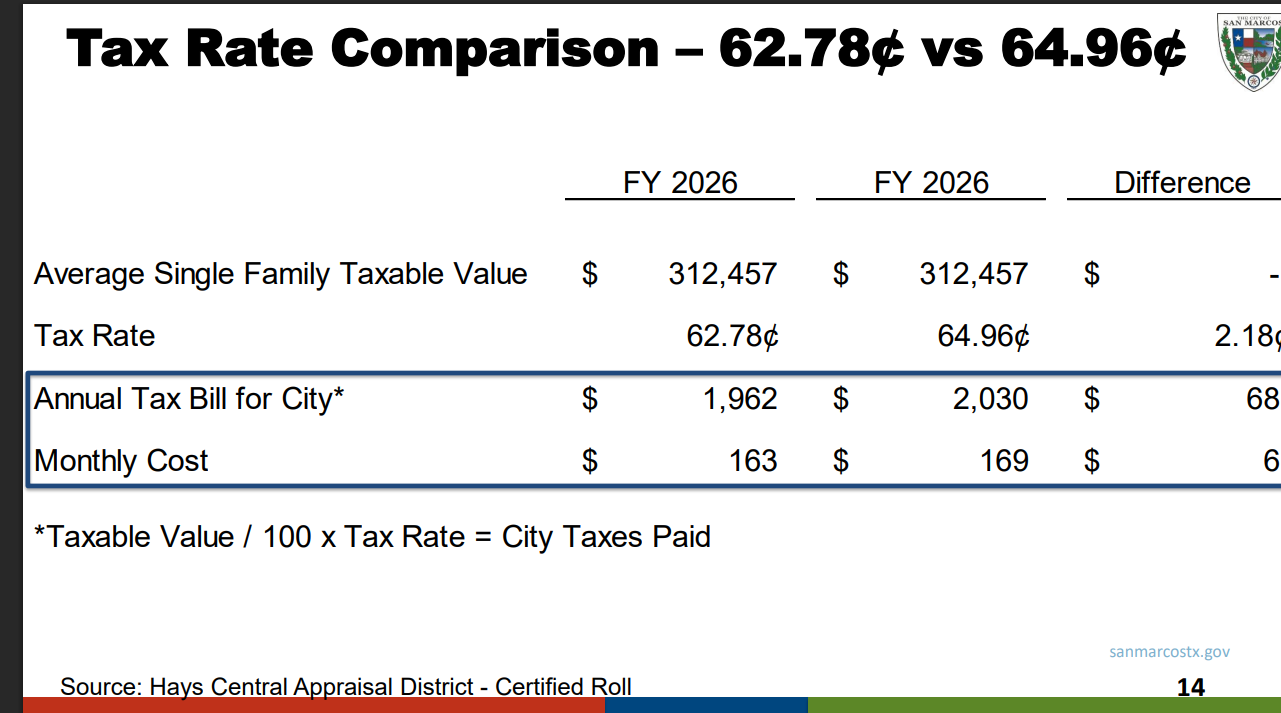
Council ends up choosing ¢67.69 as their upper bound.
There is a really long discussion of how they got to this number at the 3 pm workshops. So if you’re curious, keep reading.
…
Item 20: Changes to the LDC
“LDC” stands for Land Development Code. All year long, staff makes notes about all the little improvements that anyone ever mentions. There are also things they have to change, based on the new laws passed by the legislature.
This is a big, long complicated process that will take months.
Everyone is exhausted, and they don’t go through the details. It’s going to come around a few more times, though, so we’ll unpack it before it passes.
…
The meeting was finally over at 3:11 am.
In other words, council members just spent TWELVE HOURS sitting in those chairs, up at the dais. That’s rough!
 The San Marxist