
Workshop #1: Utility Payment Assistance
Here’s the situation: We’ve got city-owned water, electric, and wastewater. (Most of the people here are on city utilities, although some people are on Pedernales or Bluebonnet electric.)
When people can’t pay their utility bills, we offer them a two week delay. But we also give $120K to Community Action, to help pay people’s utility bills when they fall behind and can’t afford to catch up.
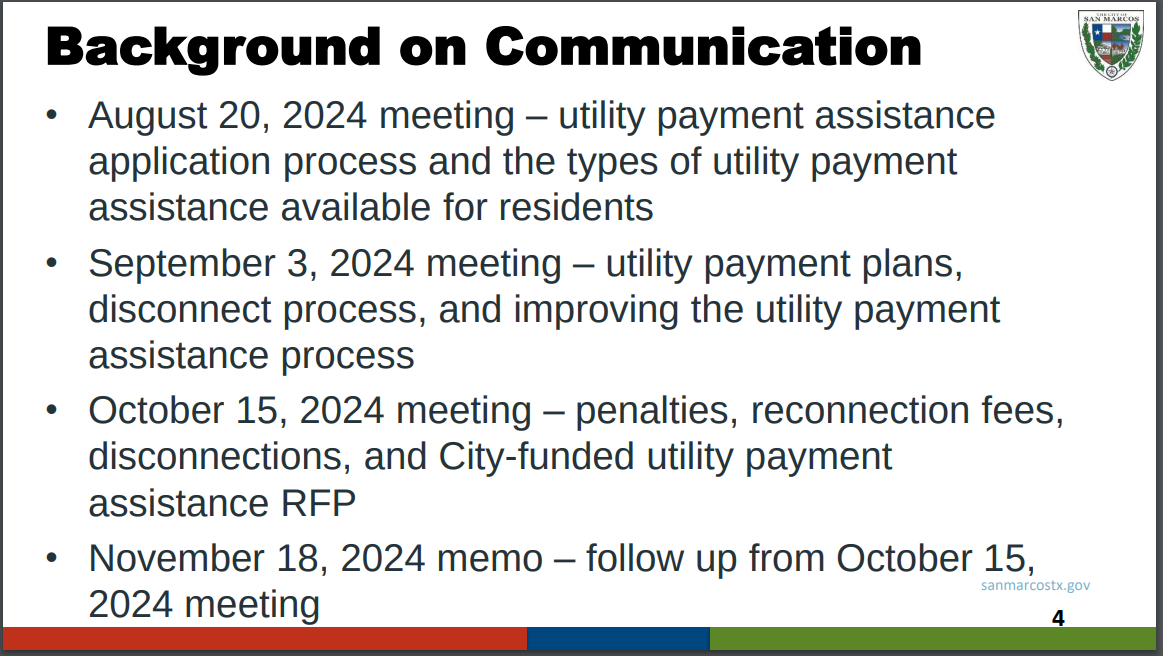
This has been an ongoing topic of conversation:
The problem is that most of the $120K we set aside for utility assistance isn’t getting used. There’s a ton of need out there in the community, and we’re not getting the money to the people that need it.
Why??
Community Action gets money from us. They also get grant money from the state and feds. So they use that state and federal money first, and then only use the city money if that money’s not available. That is good!
The problem is that their application process is long and a giant pain in the butt, because they’re trying to give out federal money. So people are being asked to provide all kinds of crazy paperwork documenting their employment or residence or whatever, and it takes weeks, and the person just needs their water turned back on so that they can cook dinner. This part is bad.
…
So the city is working on how to get the funds out faster. Would any other organizations like to also hand out utility assistance? (RFP means “Request for proposals”)

No one wanted to apply! They kept advertising and reaching out and extending the deadline.
Eventually they got three more applicants. Here’s what’s being recommended:

The “donated funds” bit means that San Marcos residents have an option to donate when they pay their bill. There’s about $45K in accumulated donations right now.
(Community Action spoke up on Tuesday and said their capacity is actually $30K, so that extra $10K will get re-distributed.)
Discussion points:
Question: How long will the turnaround time be for people needing assistance?
Answer: Different agencies have estimated 3-5 days. Some a little longer. We’ll nail it down for sure in the contract with each agency.
City Manager Stephanie Reyes proposes having a universal application that all the agencies could use for city funds. Everyone likes that.
…
There’s a lot of discussion about how customers can find out about utility assistance.
- If your bill is overdue, you get an automatic robo-call on the 16th day.
- On the 18th day, your bill is delinquent.
- After that, the delinquency notice goes out.
Right now, we don’t mention the utility assistance on the phone call or on the delinquency letter. The person has to call into the city first.
Everyone wants to know, “Why don’t we tell people about the funds earlier?!”
City Manager Stephanie Reyes says tactfully, “It hasn’t always been the philosophy of Council to make this information available at this stage.”
What she means is this: Previous councils have been more obsessed with the random person who might cheat the system than they were with actually connecting people in need with assistance.
This council – thank god – is more obsessed with connecting people to assistance. They want to have the utility assistance mentioned in the robo-call, and put in the delinquency letter.
…
Late Penalties and Reconnection Fees
Suppose you can’t pay your utility bill. This would make it even harder:
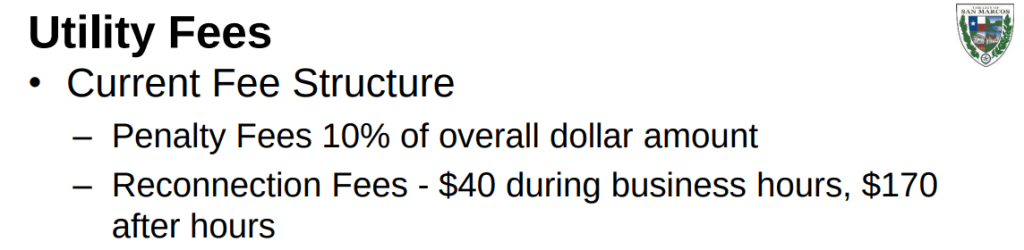
In other words, if you’re $140 behind on your utilities, it will cost almost $200 to get everything turned back on. This is pretty typical.
Council looks at each of these individually.
Penalty Fees: on average, people pay about $14 in penalties – a little higher for houses, a little lower for apartments.
They debate capping it at different amounts – $10? $15? $20? – so that you’d pay either 10% or the cap, whichever is less. (This is Lorenzo’s suggestion.)
(This is for residential, not commercial.)
Reconnection Fees: This cost is based on a 2013 estimate of fuel plus labor to go to the house and turn it back on.
Staff is planning on recalculating these fees and see if they can bring it down.
…
Question: If we did away with all fees altogether, how much would rates go up?
Answer: about 0.5 %. Now, we always have rate increases, because costs go up. But if you want to do away with fees, we’ll need to tack on 0.5% on top of that.
…
Q: Can we change how many times they can get assistance per year?
Answer: Right now it’s twice per year. It might be hard to track among different agencies.
Most councilmembers want to change it to four.
Bottom line: This will come up at a future council meeting, along with some of the answers to questions that Council asked tonight.
…
Workshop #2
Update on American Rescue Plan dollars:

A few programs have a little money leftover:
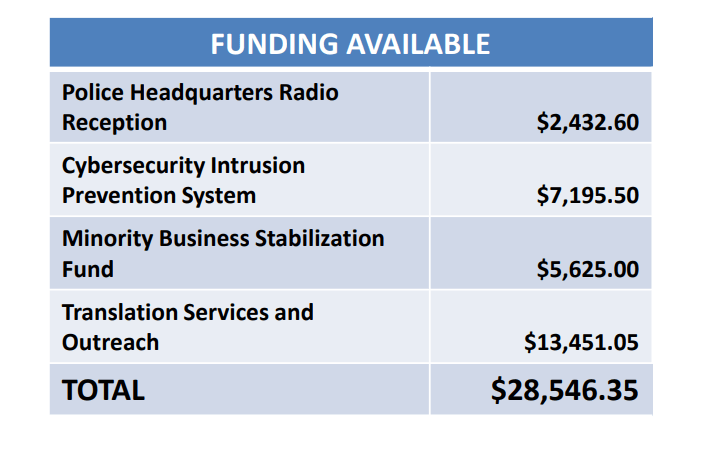
Here’s where we want to re-allocate it:
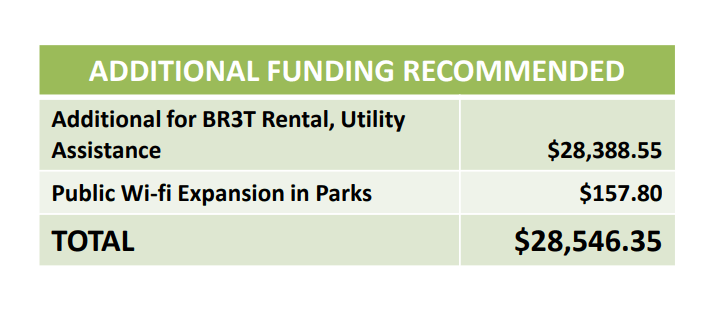
Alyssa fought long and hard for us to provide rental service, and to use an agency that doesn’t take weeks and weeks in turnaround time. (Same issue as with the utility assistance – federal money comes with a wild amount of paperwork.) It’s nice that this is now becoming the norm.
Any further money that becomes available will also go to Rental Assistance.
 The San Marxist