
Citizen Comment
No one spoke this week.
Moving on!
…
Item 9: Rezoning some land.
A developer wants to develop this stretch:
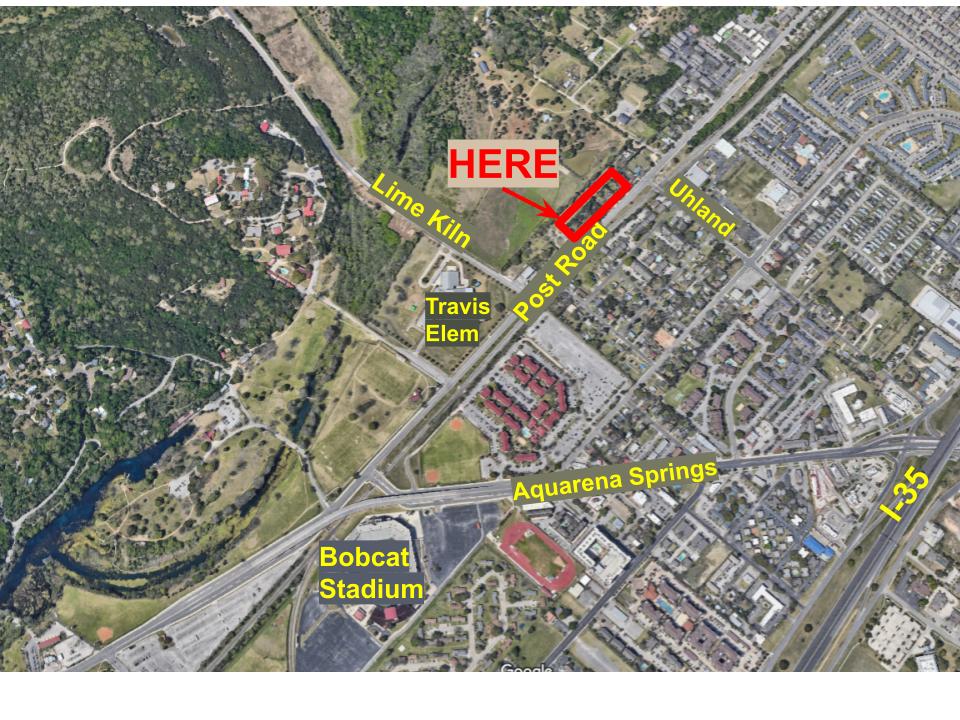
and turn it into townhomes.
Up close, it looks like this:

It includes the old Bismark filling station:

I went hunting for photos of the old Bismark Filling Station back in its heyday, but came up empty handed. I did find this deep dive on the history it, though.
…
Q: Are there any concerns about flooding?
Answer: It’s partially in the floodplain, and it is near the headwaters, which is very sensitive. But the land is actually angled so that the water runs away from the sensitive stuff. The water runs away from other houses on Post Road, and towards the stadium.
Q: Are there any concerns about buried gas tanks?
Answer: no, the station is too old. They checked the records. They didn’t bury tanks back then.
Q: Are you going to preserve the gas station?
Answer: We are working with the Historical Preservation Committee on this! Hoping to save the facade and columns, and put it somewhere where it can be memorialized.
Note: This is how you make best friends with Council. Who knows if it will actually happen or not, but Old San Marcos is happy to hear this guy say the right things.
One other note:
The developer is asking for CD-4 zoning. He’s saying he wants to build townhomes:

Ok, maybe not quite that beautiful. But maybe like these, near Wonderworld:
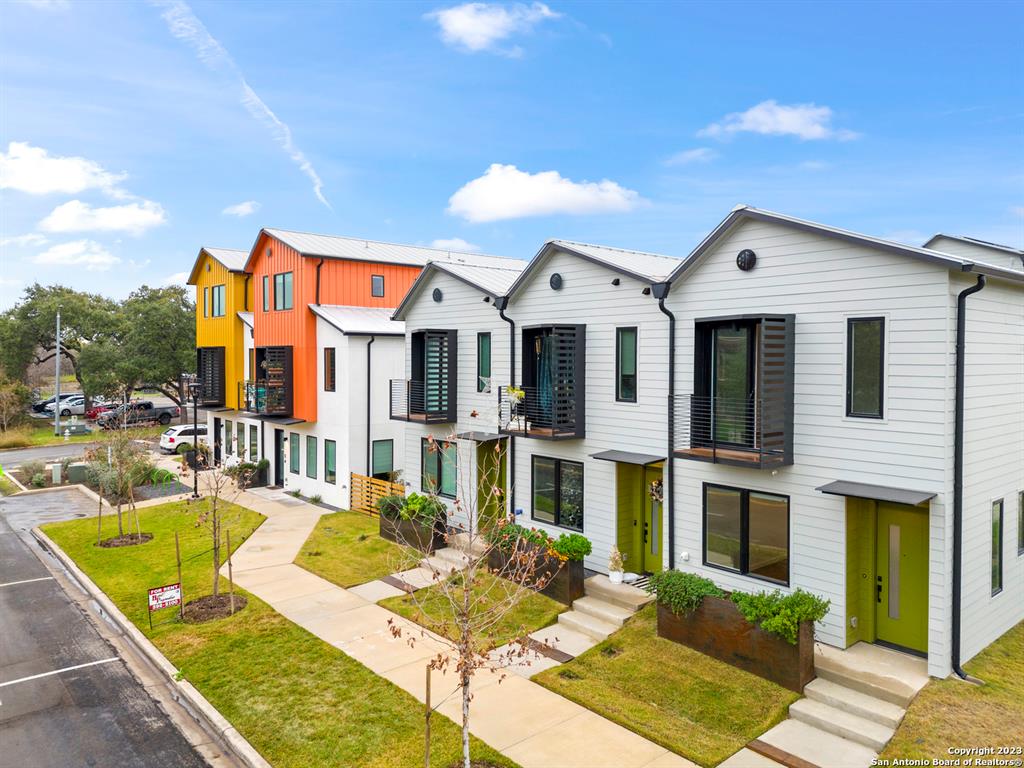
which are also pretty cute. (via)
But CD-4 zoning can also mean large scale apartment complexes like so:

When you zone land, you don’t get to pick and choose which use the developer ends up doing. The developer can do anything included in the zoning.
Now, this particular lot isn’t very big:

So my guess is that he will probably build townhomes or condos. But he is allowed to sell it to someone else, and that other person can do anything allowed under CD-4 zoning.
The vote:
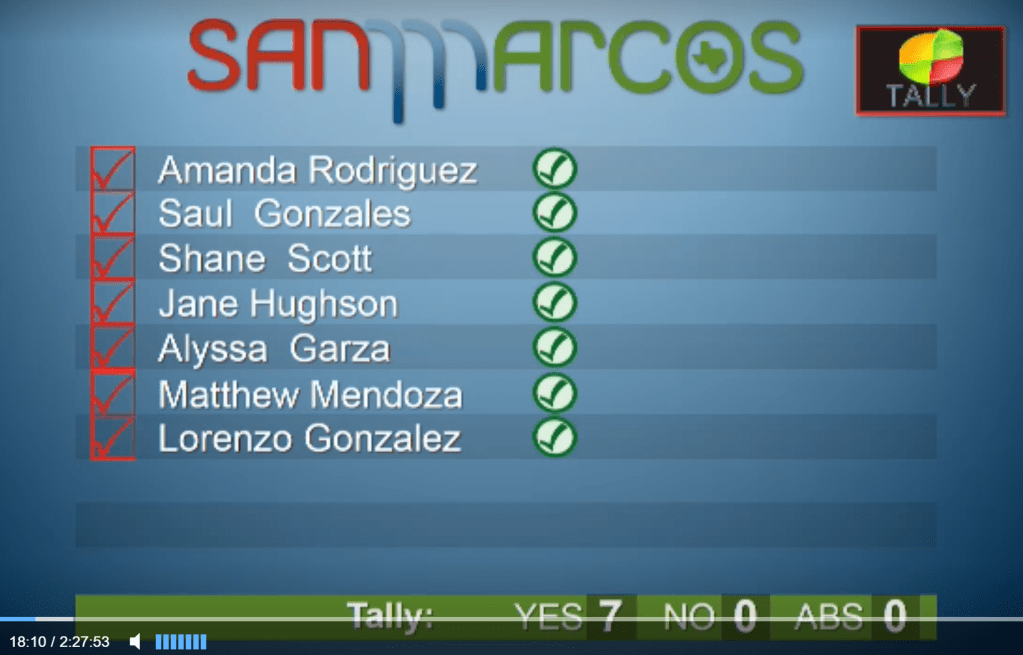
Great! That’s how I would have voted, too.
…
Item 6: License plate recognition cameras.
Should the city spend $124K for SMPD to have cameras that read license plates for one year?
Maybe! We need to unpack some stuff first.
Backstory:
Budgets get approved in September. But the planning starts nine months earlier. So at the end of January, Council had a two day workshop where they started laying out big ideas.
They go into great detail on the strategic goals:

Under each goal, Council decides what they want to prioritize for the next year.
On Day 2, they tackled Public Safety. Amanda proposed the following outcome:
- Establish clear guidelines and protections governing the use of technology to ensure transparency, accountability, and respect for the personal privacy and civil rights of the public.
(Around 3:05 if you want to watch.)
Everyone was in favor of this! It sounds great!
Next: let’s talk about license-plate cameras:
So these cameras that SMPD wants to buy. They are Automatic License Plate Readers, and they read your license plate when you drive by.
The ACLU does not like them one bit:
A little-noticed surveillance technology designed to track the movements of every passing driver is fast proliferating on America’s streets. Automatic license plate readers—mounted on police cars or on objects like road signs and bridges—use small high-speed cameras to photograph thousands of plates per minute.
The information captured by the readers—including the license plate number and the date, time, and location of every scan—is being collected and sometimes pooled into regional sharing systems. As a result, enormous databases of innocent motorists’ location information are growing rapidly. This information is often retained for years, or even indefinitely, with few or no restrictions to protect privacy rights.
Although they do say there are some appropriate uses:
We don’t find every use of ALPRs objectionable. For example, we do not generally object to using them to check license plates against lists of stolen cars, for AMBER Alerts, or for toll collection, provided they are deployed and used fairly and subject to proper checks and balances, such as ensuring devices are not disproportionately deployed in low-income communities and communities of color, and that the “hot lists” they are run against are legitimate and up to date.
Now, what the ACLU really doesn’t like is this particular company, Flock Safety:
Unlike a targeted ALPR camera system that is designed to take pictures of license plates, check the plates against local hot lists, and then flush the data if there’s no hit, Flock is building a giant camera network that records people’s comings and goings across the nation, and then makes that data available for search by any of its law enforcement customers. Such a system provides even small-town sheriffs access to a sweeping and powerful mass-surveillance tool, and allows big actors like federal agencies and large urban police departments to access the comings and goings of vehicles in even the smallest of towns.
And yes, Flock is exactly the company we’re buying cameras from. And it’s not just the ACLU: other folks also don’t like Flock Safety one bit.
Look, ICE raids have already started. (Not as intensely as Trump would like, but they’ve started.) Do we really think this universal surveillance data will be off-limits? It wasn’t off-limits back in 2019.
Sure might be nice to have a clear policy! Maybe we should “Establish clear guidelines and protections governing the use of technology to ensure transparency, accountability, and respect for the personal privacy and civil rights of the public.”
This brings us to Tuesday’s meeting
Amanda makes a motion: Postpone the purchase of the cameras until we’ve established the policy that focuses on privacy and civil rights when it comes to the public. (After all, it was literally five days earlier that Council agreed this is a priority!)
Chief Standridge says, “No worries! We already have such a policy! It’s four pages long and follows all the best practices in Texas! This is what all the departments across Texas are doing.”
I think he’s referring to this: Policy 5.4: Automated License Plate Readers.
Amanda: “I’ve read the policy. Those may be the best practices in Texas, but they’re not the best practices nationwide. Things like data usage, data retention, data sharing – we should address those things, and then we can bring back the vote on the cameras.”
They get into it a little bit, over how long data should be stored. Is 30 days too long? Just right? (That same article on Flock Safety has recommended legal language specifically for this kind of situation.)
“Furthermore,” Chief Standridge says, “this is already underway. We got the first batch of cameras in 2022, and then we got a grant for some more…” he kind of trails off.
Amanda: “The cameras have already been purchased? The cameras that require council approval?”
Chief Standridge: “The Flock representative is here online, they can confirm or deny if the cameras have been purchased.”
Jane tries to smooth it over: “It was probably something like it was initiated because they thought they’d be under 100K, and then it turned out to be over 100K, so they need needed approval!”
Standridge: “Close enough!”
Note: I think it was because of this:

The original contract was not discussed when Council approved it, in April, 2022. Later on, SMPD applied for some grants, and Council didn’t discuss those, either. My guess is that since the grants were in motion, SMPD assumed it was fine to move forward with the cameras.
(This also happened with the Total Bullet Containment System. It had been purchased before Council actually authorized the purchase.)
…
Back to the conversation:
Jane: I’m game to have a work session on this policy, but I don’t want to hold up the purchase of the cameras in the meantime.
No one else (besides Alyssa) weighs in.
The Vote: Should we postpone the purchase of these cameras?
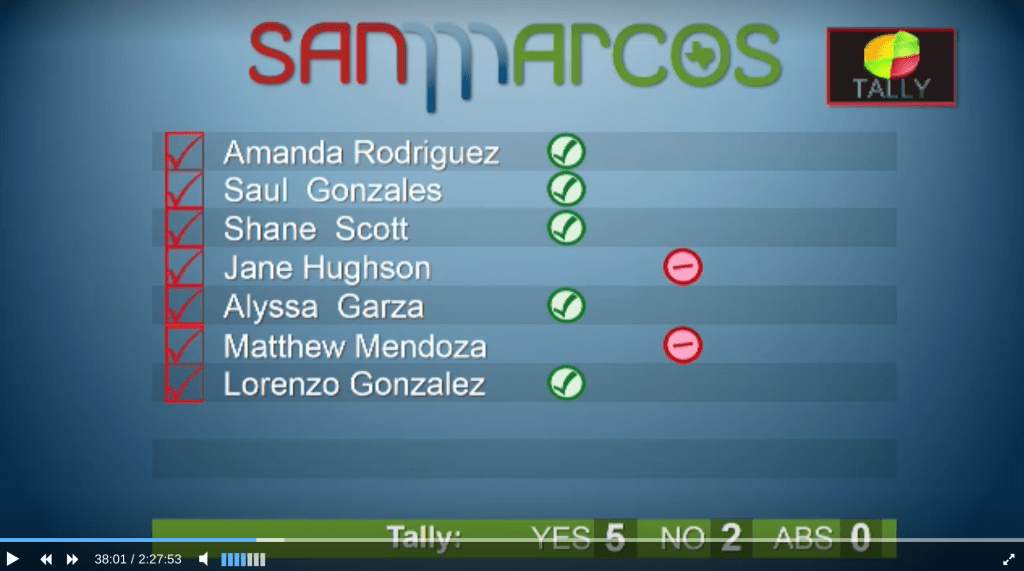
WHOA! I was not expecting that, but I’m thrilled to see it!
…
Items 10-13: An enormous number of appointments.
The vast majority of the meeting was spent making appointments:

Those are all boards where they appoint community members.
The most public of these is P&Z. P&Z had three open spots. David Case and Maraya Dunn were both re-upped for a second term, and “Rodney” got the last spot.
No one in the meeting ever used Rodney’s last name, and I don’t have access to the applications, so I guess we’ll all find out which Rodney in a few weeks, when he starts attending the meetings.
…
Item 14: Attendance on External Boards
There are a bunch of committees in the city and county that have a representative from city council.
Sometimes you have one of these external boards with a city council rep, but that council member never shows up to any of the meetings, and sometimes his name is Shane Scott.
(Specifically at the January 7th council meeting, where Shane found out that he’s been on the Convention and Visitor’s Bureau Board for the past year, and had missed all of the meetings. Shane was kind of sheepish about the whole thing.)(Around 4:18 in this video. It’s pretty funny.)
Jane: Do we want some sort of attendance policy for these situations? Like you can’t have more than three unexcused absences in a row? That’s the policy for the rest of our boards and commissions.
Everyone is on board. So this will come back around.
 The San Marxist