
Item 13: Demolition time.
This is 734 Valley Street:

It’s tucked behind Dunbar Park.
It’s really impossible to see from the street, but it’s this blue L-shaped building:

At least, it used to be blue. This is what the building looked like in 2019:

I’m unclear on the following order of events:
- Squatters moved in and were kinda trashing the place
- The owners purchased it and began demolition without getting proper permits.
In some way, we end up with it looking like this now:

Definitely not blue anymore. Not much left.
How does demolition work in San Marcos?
In order to know what’s going on, you have to know a little about demolitions of historic buildings in San Marcos.
In 2019, the old telephone building was demolished:

to make way for The Parlor apartments.
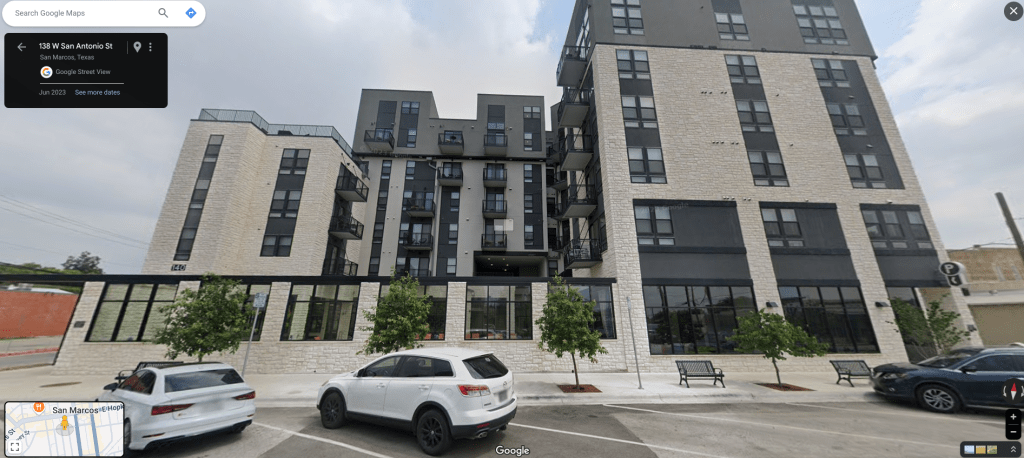
People were told 3 days ahead of demolition, and they were upset. Protests, etc.
(I personally think the little telephone building was extremely cute, and felt sad over the whole thing.)
After that, the city put a demolition ordinance in place. The ordinance builds in delay and notification, but it doesn’t really prevent anything from being demolished:
- For buildings with potential historical significance, there is now a 90 day demolition delay. This gives people time to research the building and figure out if it can be moved, or saved somehow.
- If someone is trying to save the building, the Historical Preservation Commission can delay for another 90 days. But that’s it. After that, the owner can go through with the demolition.
“Saving the building” means making a deal with the owner. The owner can say no.
Basically, Texas state law means the city’s hands are mostly tied. There’s usually not much way to actually prevent a demolition. You can just stall a little bit.
…
So the owner applied for demolition, and the first 90 day clock started.
Here is the historical merit, as far as we know:
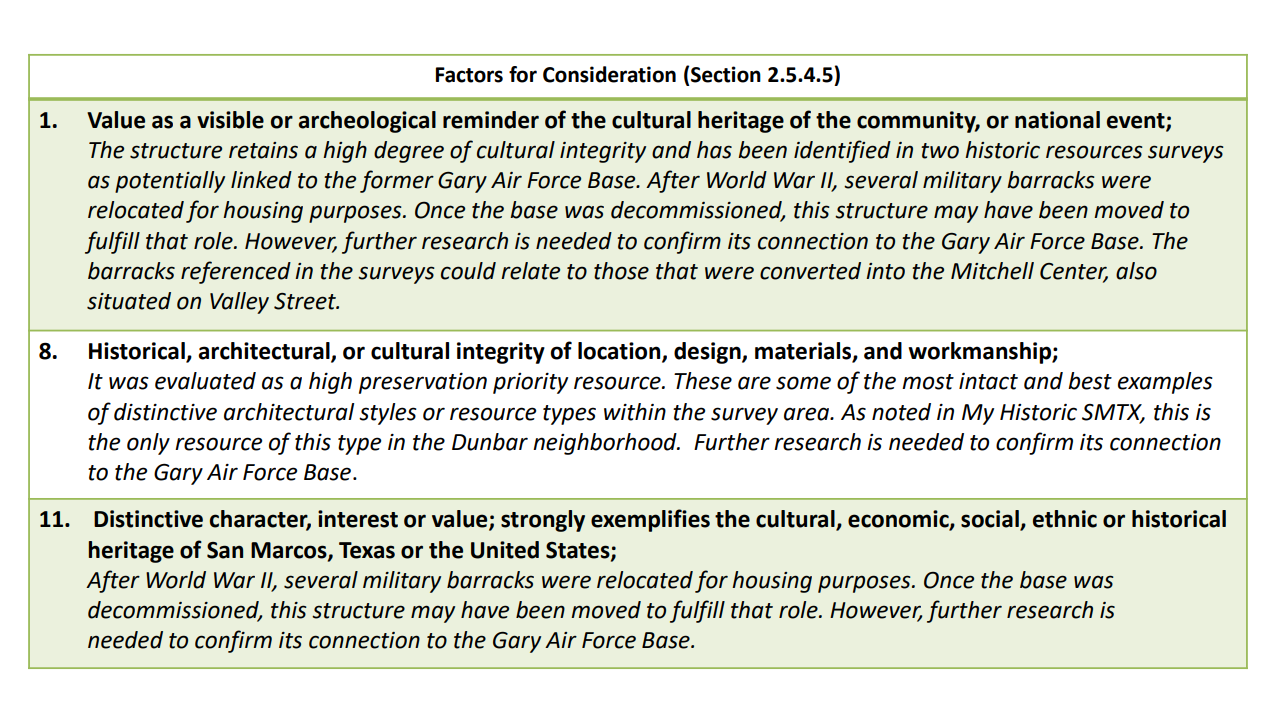
So this blue building was probably barracks from Gary Air Force base? It sounds like it was moved to Dunbar by the Armstead family to rent out as apartments.
It went to the Historical Preservation Commission, and HPC decided to extend the demo delay for another 90 days.
Which brings us up to speed!
The owners are appealing the demolition extension. They’d like to tear it down now, instead of waiting until April. They plan on building a small apartment building there, maybe 4 or 8 units.
Matthew Mendoza had some useful points. First, he reached out to Ms. Armstead. Apparently her parents are the ones that brought the barracks over from Gary Air Force? He asked her about the historical significance of the building.
She very clearly told me she does not feel that this particular complex needs to be associated with that family. In the last six years that they were in possession of this, they were only able to rent out a third of the rooms there, because they were so dilapidated…She feels that that her mom and dad bought this property just for making money. She made that very clear. They didn’t purchase it for any historical significance. They bought this because they wanted to make some money off it, and that’s also why they sold it. They got so far into debt as far as being able to replace the flooring, be able to add sprinkler systems, to make it up to code, which is when they said “We can’t do this.” And again, we all know the Armstead family and how strongly respected they are in this city of San Marcos. And for them to say “hey we don’t want this property” and not wanted it associated with their name says a lot. She was insistent that there is no historical value at all to this building and no historical value at all to this property.
(lightly edited for clarity)
And then Matthew gets to the best part:
And I can tell you: I partied in that place for like ten years back in the early 2000s. I fell on my fat ass right through that floor. I’m sorry to say it, but I fell through that bathroom floor in that place, and now I’m not the smallest guy in the world, but I shouldn’t be falling through there.
Honestly, that’s the most endearing thing I’ve ever heard Matthew say. He even lowered his voice and half-whispered “fat ass”, and I melted a bit.
He went on for awhile more, but that’s the gist of it. At the end, he said, “I will sit here and say that I am a huge preserver of historical anything here in this city, but this unfortunately this is something the owners are telling me we don’t want it. And that’s the reason why I was on the fence until I spoke with her.”
Overall, I basically agree with Jane Hughson on this one:
As much as I like historical preservation, I’m going to vote to not extend and let these folks who are trying to do something with the property move ahead. If this were something with a more historic appearance and in a place that people could actually see and appreciate, but in this particular case, I’m not seeing that there’s an upside to 90 more days. There’s been 90, and you say there’s not been any activity, nobody has come in with the superman cape to save the day, so that’s why I’m going to support not extending the delay.
The vote:
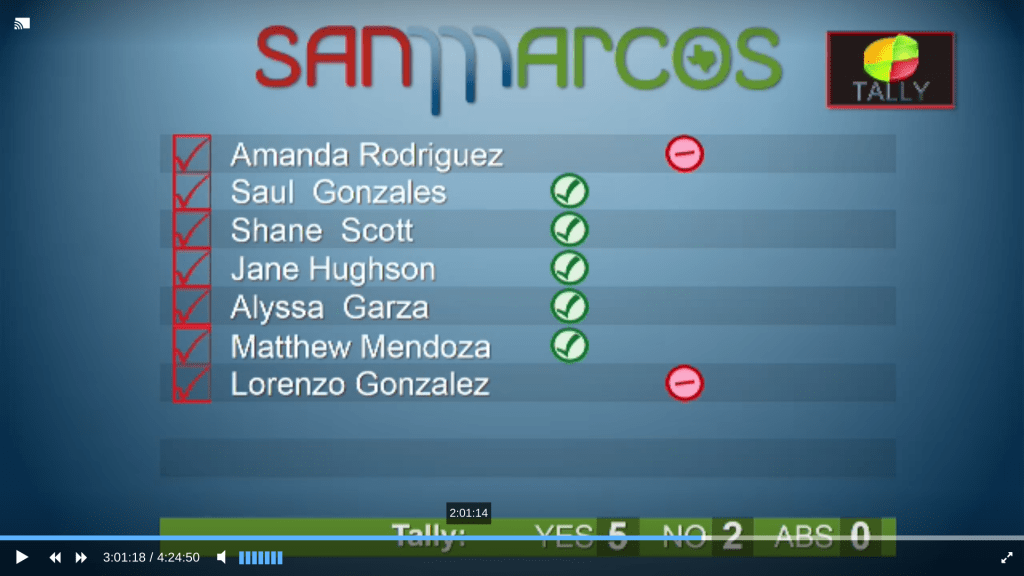
The argument for voting no – Amanda and Lorenzo – is that it doesn’t hurt anything to wait three months and let the local community get their due process to save the building.
In this particular case, I’m with the pro-demolition folks.
…
Item 15: Charter Review Commission
Every four years, council appoints a committee to go over the City Charter with a fine tooth comb. This is that magical night!
First off, do any council members have any pet topics that they want the committee to discuss?
Note: none of these are guaranteed. Council is just asking the committee to discuss these items.
- Jane: drop the minimum required number of council meetings from 22 per year to 20 per year.
Sometimes it gets hairy trying to have meetings working during election week and New Year’s Day – this would build in some flexibility.
Everyone likes this.
- Shane Scott: You should have to be a resident for at least five years to be on council.
(Saul, Jane, and Matthew are all enthusiastic about this.)
Look, this is clearly about newbie Lorenzo Gonzalez. Seems a little rude to me!
But more importantly, it is super undemocratic. The whole point of an election is to let voters choose! If they don’t want a newbie, they don’t have to vote for that person.
I do not like this one!
- Alyssa: We should have single member council districts.
This is a complicated topic. How should voters elect councilmembers? Right now, every council seat is an at-large seat. Should we carve up the city into sections, and have each section vote for its own single representative?
There are arguments for and against this.
For:
- It takes fewer resources to run a campaign in a district than in the entire city. This means that more people can afford to run for council.
- Historically, at-large council districts have been used to block minority groups from having representation on city councils. If a city is 30% black, for example, and if white people won’t vote for a black candidate, then a black candidate can never win a city-wide election.
Historically, single-member districts have been the solution. Lawsuits would be filed and judges would force towns to switch from at-large seats to single-member seats. (This is what happened to SMCISD in the 90s.) The idea is that you must draw minority-majority districts, and then within that district, minority groups form a majority and can elect a candidate of choice.
Against:
- Single-member districts only somewhat solve the problem of underrepresented minority groups. Drawing the boundaries becomes a politically contentious issue, with people weaponizing it to work in favor of specific groups.
- At times, there can be issues that pit a district against the whole city. Amanda reports this happening at the state level: representatives vote against a program that is good for the entire state, because their district doesn’t want to pay the taxes for other people to benefit. Right now, all councilmembers answer to all of San Marcos.
I’m pretty torn. I wrote a whole thing in favor of single-member districts in San Marcos, back in 2022. But I’m also sympathetic to the idea that single member districts can pit parts of the city against each other.
Council floats the idea of having a non-binding referendum on the ballot, so that they could find out what people think.
- Amanda: Suppose council passes a shitty ordinance, and you’d like to petition to repeal it. Right now you have 30 days. Let’s extend this to 60 or 90 days, so that people have a little more time to organize.
Sounds great!! Would this only apply to ordinances, or also things like Chapter 380 agreements? (I’m thinking of things like the SMART Terminal/Axis developer agreement.)
5. I think Saul brings up rolling back the drinking hours in San Marcos again. It’s very hard to hear him.
Backstory: it used to be that bars closed at midnight in San Marcos. This means that all the kids got drunk here, and then at 11:30, drove up to Austin, and drank for two more hours on 6th Street. Then at 2 am, they all drove home. This always seemed like a terrible policy for keeping kids alive!
It got changed in 2009. Now bars can stay open until 2 am, and hopefully fewer kids are driving drunk on I-35. Great! (I’m sure the local bars prefer it this way, too.)
I think Saul wants to change it back to midnight? What a terrible idea! Keep kids alive. Don’t give them reasons to drive drunk.
This is not a charter item, so it will come back as a discussion item. Stay tuned.
6. Lorenzo: the language around petitions is inconsistent between initiatives and referendums.
Jane Hughson reminisces about the Great Fluoride Debacle of 2015, when the good citizens of San Marcos got a little muddled on the science, and voted to stop adding fluoride to the water.
The citizen wrote the initiative in a way that made it impossible for the city to carry out. Something like “no fluoride in the water!” when there’s some level of fluoride that occurs naturally in all water. The city had to negotiate in court with the author to get better wording. (They settled on “no added fluoride”.)
Basically it’s really difficult to write clear ordinances. This makes things tricky.
7. Amanda mentions reversing the fluoride charter amendment in passing, but no one stops and weighs in.
But guys: the ban on adding fluoride to the water is terrible. The science is really clear. We’ve got a lot of people in this town who can’t afford to see the dentist, and we could be helping save their teeth.
8. Shane: Mayor and council should move to 4 year terms, and council elections should be held in odd years, so that they’re not drowned out by presidential and governor elections.
This is about who your base is. Are your voters the old guard in town, who will reliably show up to vote when nothing else is on the ballot? These are the voters that have held the power in San Marcos since always.
Or are your voters less plugged in, because they are younger, or newer, or less well-connected, or generally low-information? These are the voters that generally don’t have power, and are less likely to show up to vote in odd years.
9. Amanda: Right now, P&Z terms are 3 years long. After two terms, you have to take a year off. Amanda proposes reducing P&Z to 2 year terms, and extending the length of the break before you can come back again. The goal is to increase turnover.
The rest of council does not buy into this. Part of the problem is that all the boards and commissions are on the same set of rules.
10. Matthew: zoom and attendance options for all boards and commissions
This gets ditched due to not being a charter issue. Also, Amanda and Alyssa are hard NOs, due to accessibility issues.
11. Amanda: Right now, P&Z gets the final vote on plats. A plat is the paperwork where a developer carves up a neighborhood, and says where the streets will go and where the boundaries of the properties will go. Amanda wants people to be able to appeal the decision to Council.
We’re kinda stuck with the current system, for a few reasons:
- State law mandates 30 day approval for plats. If you add in City Council as a second appeals procedure, you’re going to run out of time.
- There’s not actually any decision or judgement when it comes to platting. Legally, you’re not allowed to deny a plat, if it checks all the boxes. It’s not like zoning, where you’re allowed to make a judgement call. This is more black and white. So it doesn’t matter very much.
So this did not get traction.
12. Revoke or suspend CUP may not be appealed: remove this.
Yes: Shane, Jane, Lorenzo,
[I wrote this down in my notes, and now I can’t find it in the meeting anymore. So I can’t remember who proposed it or any other details. whoops]
Final note: These are all just suggestions for the Charter Review Commission. Nothing is binding here.
…
Item 16: Each councilmember picks their special person for the Charter Review Commission.
The picks: Michelle Burleson, Jim Garber, Rob Roark, Daniel Ayala, John Thomaides, Yancy Arevalo, Amy Meeks
I will just note that three of those – Michelle Burleson, Jim Garber, and Amy Meeks – are on P&Z. There’s nothing exactly wrong with that, but it’s most likely going to preserve the status quo.
…
Item 17: Boards and commissions
Now that Jude Prather and Mark Gleason are off council, there are a bunch of vacancies to fill. I’m not going to go through this, because it’s tedious and you can find most of the subcomittee memberships here.
I mostly just want to include this bit:
Jane: I’m going to volunteer to be on the Alcohol Committee. The reason being that I’ve got more experience with this than probably all y’all put together. I was on one once before, and I think I can provide a lot of benefit to this committee.
Shane: Plus you’re a solid drinker.
The room erupted into giggles. Jane didn’t sweat it, and just said mildly quipped “Yeah. That’s the important part.”
I mostly include it because it made me laugh. The vibe of this new council is much lighter and jokier than the last one. I’m here for it.
 The San Marxist