
Citizen Comment
These were very interesting!
Topic 1: Two speakers (Noah Brock and Annie Donovan) unpack part of Item #16 for us.
Item #16 is about the Texas State Legislature. San Marcos lobbies the state government on various municipal issues. So we have a list of guiding principles.
Here’s one of those items on the list:

I’m going to start with quoting Noah, because this is gold. First he reads that bullet point above. Then he says:
“This is a very specific location that’s called out in this guiding document. The wording sounded familiar. So I looked up what the last principles document said, in November 2022:

“They just replaced the words “SMART Terminal” with the location. So I went a little bit further, back to 2020. The document said the following:
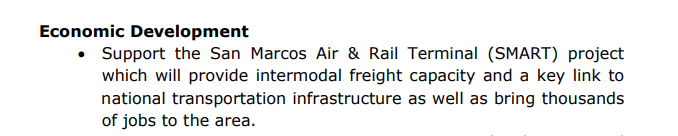
“Then I went even further, to 2018, where I found the origin statement:
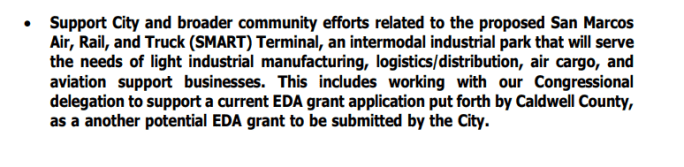
“Is it the city’s goal to develop an intermodal freight facility at this location? It appears that the original idea was to support light industrial manufacturing with a connection to the airport. Now we have a heavy industrial park that can stack containers 80 ft high, with no connection to the airport.
Why does the wording keep changing to fit a developer’s current project? Isn’t a guiding principle supposed to come from the city, and not a developer?
Do you remember when the city council voted unanimously to approach the developer of this project and change the development agreement, because the people did not support it, on May 2, 2023? I would like to see a motion to remove this item from the document in its entirety. Thank you.”
So yes! In our packet of “what’s best for the city” we have a line item which is carved out specifically to be “what’s best for SMART/Axis Logistics”. Verrrrrrry interesting. Stay tuned.
Topic 2: HSAB is the Human Services Advisory Board. The city allocates $550K in grants to nonprofits, and the HSAB awards the amounts. There are a few comments here:
– The chair of the HSAB pleading that this amount of money is nowhere close to the need in the community
– A speaker on behalf of the Salvation Army, about how they weren’t funded as they’ve been in the past.
This will be unpacked in Item 15.
Topic 3: This place:

It’s on LBJ, at the train tracks, across from Toma Taco.
The city leases the property to Ruben Becerra, the Hays County Judge (which is not a “judge” so much as being like the mayor of Hays County.) This speaker is super angry about this!
We’ll get to the backstory on this property – Item 10 – but I still have questions.
…
Item 5: Return of Evoke Wellness, for the final $50K of Covid Money.
This last bit of Covid money is going to the mental health program partnership between SMPD and Evoke Wellness, for people needing substance abuse treatment. (The county also works with Evoke Wellness. This is part of a larger, semi-coordinated program to keep people with mental health crises and/or substance abuse out of jail.) We discussed this last time, too.
Amanda: How does this program work? Walk me through it.
She basically wants to know all three parts:
1. how do people in crisis end up at Evoke Wellness?
2. What happens when you’re there?
3. What happens after discharge?
Part 1: how do people in crisis end up at Evoke Wellness?
First, SMPD responds to a call for someone in crisis. First, if they need medical help, SMPD will take them to the hospital. (Probably Christa Rosa).
If the person is stabilized but having a mental health crisis, SMPD tries to try to find out if the person has insurance or not. If so, then we try to find a facility that accepts their insurance. They’ll take the person to the treatment facility. It might not be in San Marcos – could be Austin or San Antonio.
If they have no insurance or financial means, then once they’re stabilized, we give a mental health evaluation, and figure out what they need. Then we take the person to Evoke Wellness (for substance abuse) or Hill Country Mental Health.
Part 2: They’re at Evoke Wellness
No one from Evoke Wellness was on the line at the meeting, to talk about the services they offer there. Amanda asked if we could have a workshop from them to hear about what their services are. Everyone is on board with this.
Part 3: Discharge after Evoke Wellness
When they get to the treatment center, they start meeting with a case manager. They’re working on a discharge plan from day 1.
There are a few options for after they’re discharged:
- Reconnect with safe support system, if that exists. Either the center, family, or mental health officer will give them a ride there.
- Longterm treatment: may discharge to Sober Living, they may go to partial in-patient, several different places to go.
Amanda asks: What if someone has zero support services and zero resources?
Answer: Then the case manager has to get to work. Find shelters available. For example, Hill Country has an in-patient crisis stabilization unit in Kerrville. They’re in-house and have a big list of resources. We make sure there’s a bed available at a destination shelter. The case manager is going to put together a plan to try to make sure the person does not end up homeless.
…
How many people are we helping?
Total, San Marcos is putting $150K towards Evoke Wellness, and Evoke Wellness is also providing 5 scholarships this year.
Chief Standridge says that costs vary wildly, depending if the person needs in-patient or out-patient treatment. But on average, $17K/person is a reasonable estimate.
So we can ballpark this: $150K plus the 5 scholarships helps about 10-15 people per year.
Alyssa asks: What kind of metrics do we have to assess how this is working?
Answer: We’ve got tons of internal statistics, but we’re not yet coordinating well on the county level, in order to get stats on the full scope of the issue. This is one of our big goals, though.
….
Just a quick soapbox: It is a moral obligation to help the most vulnerable people in society. It does not matter if they made bad choices. Someone living on the streets with mental illness and/or substance abuse problems is being failed by society. And big problems cost a lot.
But big problems can also be prevented! If we invested more heavily in prevention – early childhood support, family support, increase the living wage, increase housing, effective addiction prevention programs – it would be cheaper than working to solve big problems once they take root, on an individual basis. (And that’s not even counting the value added to people’s lives, for not being derailed by catastrophe.)
Can San Marcos afford to do all this properly on our own? Of course not. But the state could! Texas had a $33 billion dollar surplus in 2023, and we’re projected to have a $20 billion surplus this coming year.
Will Texas spend it on making a fair and just society??? (no.) Stay tuned!
…
Item 10: We’re back to this cutie little place:
I think right now it’s called Las Dos Fridas.
Before that, it was Katz’s On the Go Cafe:
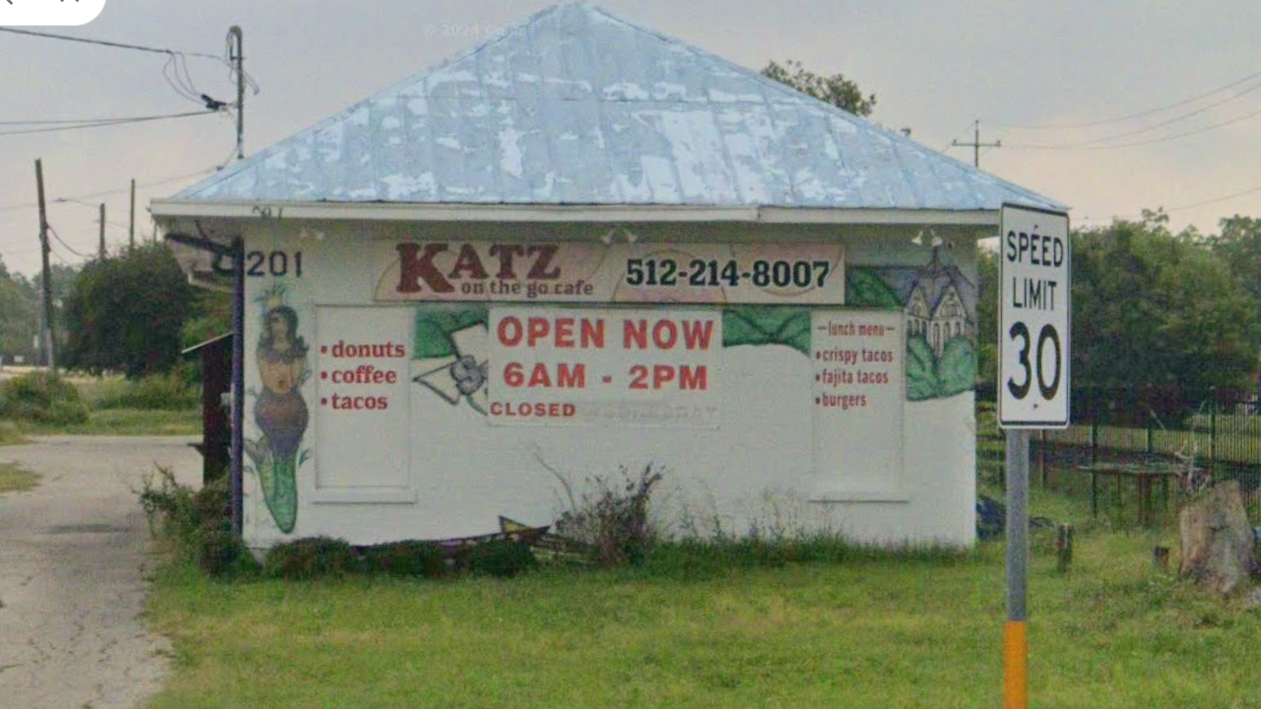
Before that, it was Santi’s Tacos:

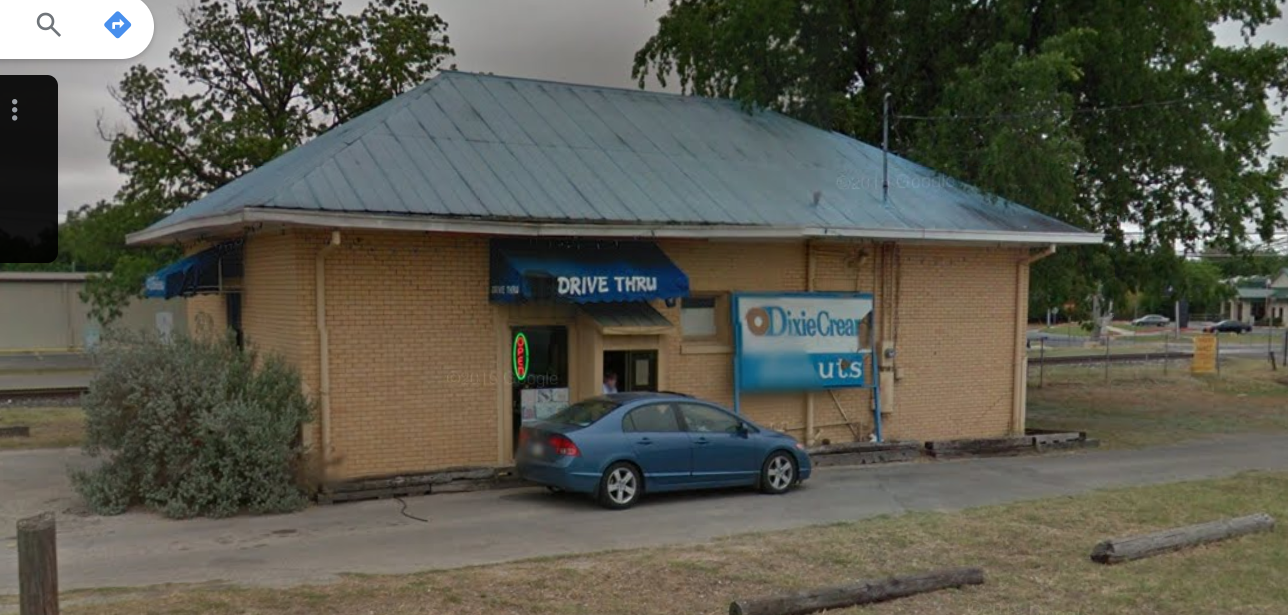
And before that, Dixie Cream Donuts:
Ok. Back in 2013, Union Pacific railroad offered to sell San Marcos four properties:

We agreed. (We hoped this property might someday be a good train station on the Lonestar Light Rail connecting San Antonio to Austin. That’s what I dream about at night, at least.)
Now, Union Pacific sold the land to San Marcos in 2013, but not the physical little building. The building was owned by Dixie Cream Donuts.
Furthermore, look at that red border – the border runs right through the building! So weird. They carved the Dixie Cream Donuts building, half on Union Pacific land, and half on San Marcos land. (We even asked them about it at the time: “why not run the border around the building? It can be all UP, or all SM. We don’t care.”
Union Pacific said, “nope. We do this all the time.” Okay then!)
At some point, Dixie Cream Donuts sold the building to Ruben Becerra. So Becerra now owns the building, and leases the land underneath it from both Union Pacific and San Marcos. He then sublets it to Las Dos Fridas.
…
No one is very excited about extending this lease to Becerra. This would just be a mini-extension, to match the sublease to Las Dos Fridas. It would expire in January 2026.
Council decides this is very thorny, what with Becerra being the Hays County Judge and all. Council says cryptic things like, “I need to be able to give an answer when my constituents ask me what on earth is going on.”
They decide to postpone until January.
What happens if we don’t renew this lease? It’s not clear! Becerra still owns the building, he could in theory move it, although it’s probably not structurally sound.
The vote:
Yes, postpone until January: Everyone except Matthew Mendoza.
No! Let’s settle this now! Matthew.
I have no idea why Matthew wanted to settle it now. I don’t even know which way he wants it to go!
…
Item 14: New flood maps.
Ok, FEMA has been working on our flood maps since the 2015 floods. The old flood maps were based on 1990 data, so this is very much needed. The new maps are called Atlas 14.
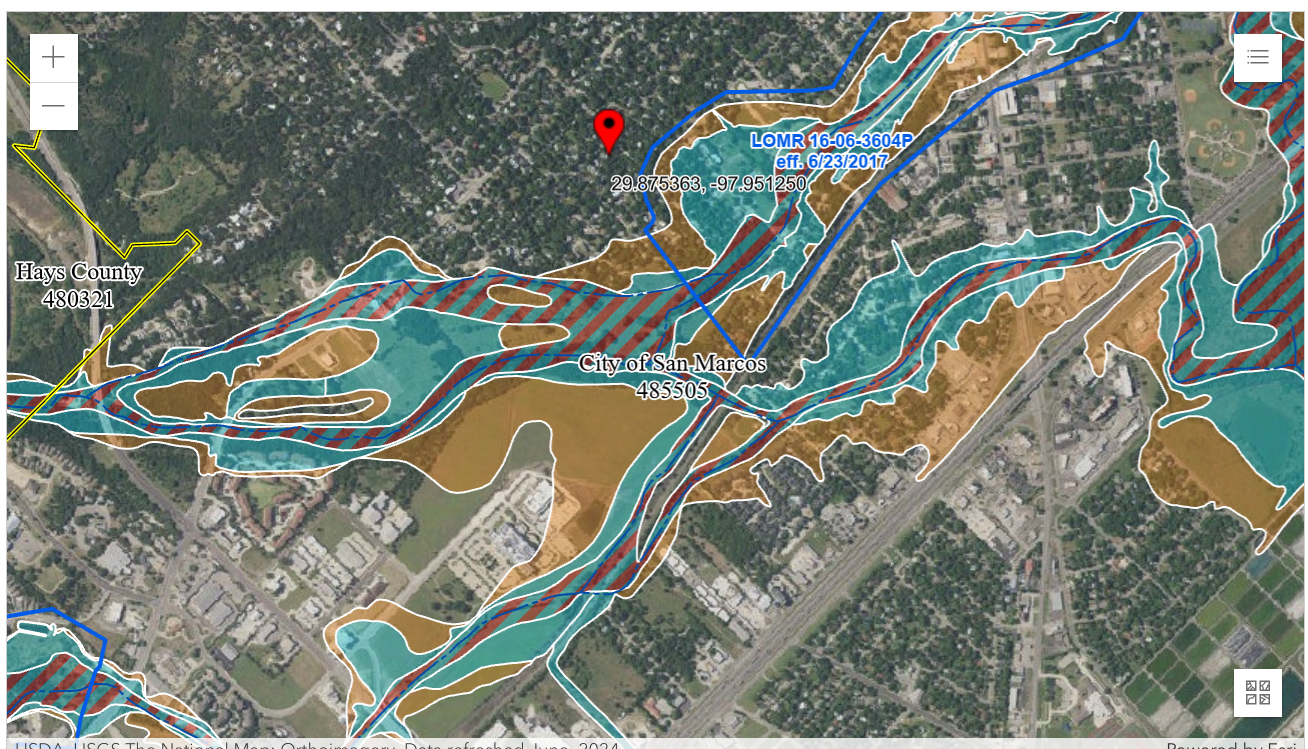
Here’s how much city land is now in a flood plain:

So about 800 new acres of San Marcos are now in the floodplain. We don’t know how many homes and businesses that is, though.
So if you’re now in the floodplain, what changes? There are two main things:
- Building codes: the city has stricter ordinances if you’re building in a flood plain.
Old buildings don’t have to be retrofitted, but any new buildings or additions have to meet flood plain standards. (Like being raised off the ground.)
This isn’t actually a new change – the city has been using the Atlas-14 data since 2017 in our ordinances.
2. Flood insurance rates for home owners.
This is part of a much bigger, larger problem. “Flooding is the most frequent severe weather threat and the costliest natural disaster facing the nation.” Even when insurance providers pull out of high risk places like Florida and California, everyone can get insurance because there’s a federal program called the National Flood Insurance Program.
The problem is that floods are really, really expensive. So flood insurance rates for people in a flood plain are very expensive. Many people can’t afford it, and go without. This causes two more problems:
- Rates go up even more for everyone else
- NFIP still doesn’t have enough money to give out in case of flooding.
It’s a giant mess. It’s even worse when you think of the historical context in a place like San Marcos: wealthy people built their homes uphill, and left the downhill places for poorer neighborhoods. So it’s the people in Blanco Gardens and Victor Gardens and Dunbar that live in floodplains and have to debate flood insurance, not the University or the Historic District.
So how much are rates going up?
Amanda Rodriguez cites a study from Rice University about flood rates rising. (I think it’s this one.)
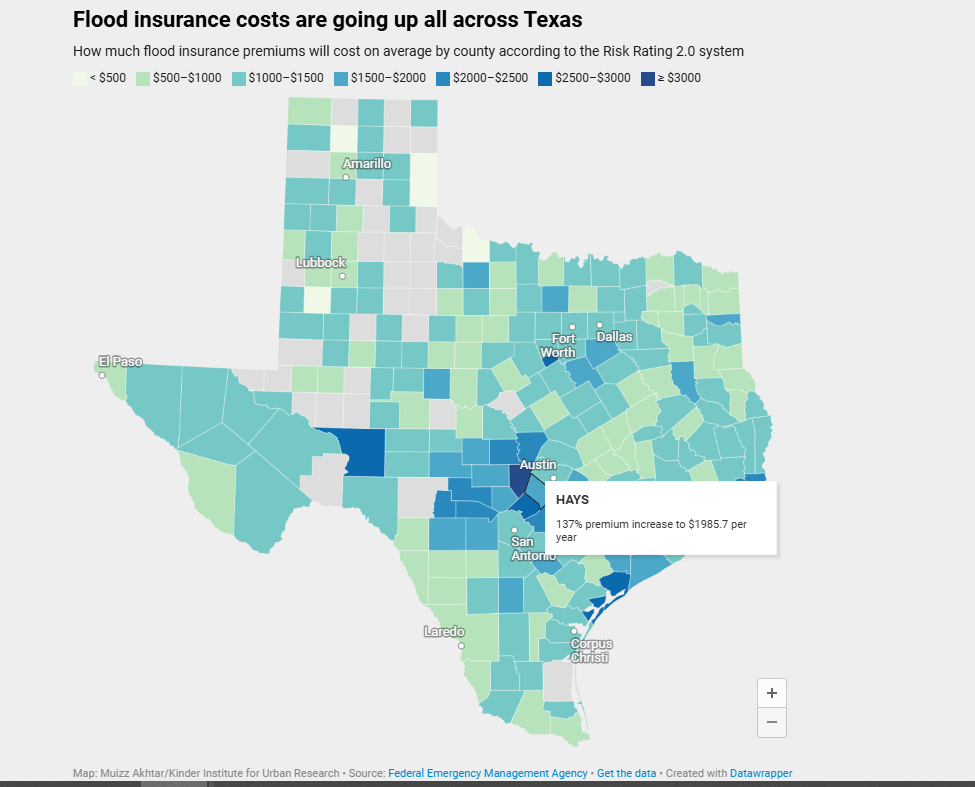
So rates in Hays County are projected to go up 137% increase. (Legally, the increase is capped at 18% per year. So over the next 5-10 years, your premiums would step up to cover the increased risk.)
Mark Gleason weighs in. He has a lot of lived experience with floods, particularly because he got hit hard in Blanco Gardens in 2015.
His main points:
- The National Flood Insurance Program is broken.
- San Marcos is a member. This gets us a 15% discount, but subjects us to FEMA rules about rebuilding.
- Premiums are unaffordable so people go without. Then disaster hits and they can’t afford to rebuild, and sell at low prices, and fancier housing gets built. (Yes.)
- If you’re in the floodplain now, you don’t have to retrofit your current home or business. But anything new, or an addition, has to conform to floodplain development standards
- If you own your home outright, you’re not required to purchase flood insurance.
- But everybody SHOULD get flood insurance. It’s very cheap if you’re not in the flood zone
Mark’s solution: Feds need to come in and fix the Blanco River. It needs some sort of flood control. It’s cheaper to fix the Blanco than it is to raise homes.
Jane: What about the San Marcos river and Purgatory Creek? Historically, those flood, too. It’s not just the Blanco.
Basically, no one could possibly have any good answers. Mark certainly doesn’t know what it might take to fix the Blanco. None of us know what it would take to fix the flooding. None of us know the extent to which climate change will make things worse. We are all just kind of holding our breath and hoping.
 The San Marxist