Last meeting of the year! New flood plain maps, giving out HSAB money, the old Dixie Cream Donuts building, and we unpack that mess in September with the housing vouchers waitlist. And Lorenzo wins the run-off election! Congrats to him.
The Council Run-off Election
Well, well, well! Lorenzo Gonzalez squeaked through!
As of Saturday, he was ahead by TWELVE VOTES. Then 40 more votes arrived in the mail this week. (They just have to be postmarked by the 14th. And you know how local San Marcos mail gets re-routed up to Austin and takes twice as long as it should. Why is that?!)
Those last 40 votes were counted on Friday. Roland would have needed to win them 26-14 in order to pull ahead. But in the end, Lorenzo prevailed, winning the election by 9 votes. Wowza. Congrats to Lorenzo!
Now it comes time to closely watch and see how he actually does up there on the dais!
Onto the meeting!
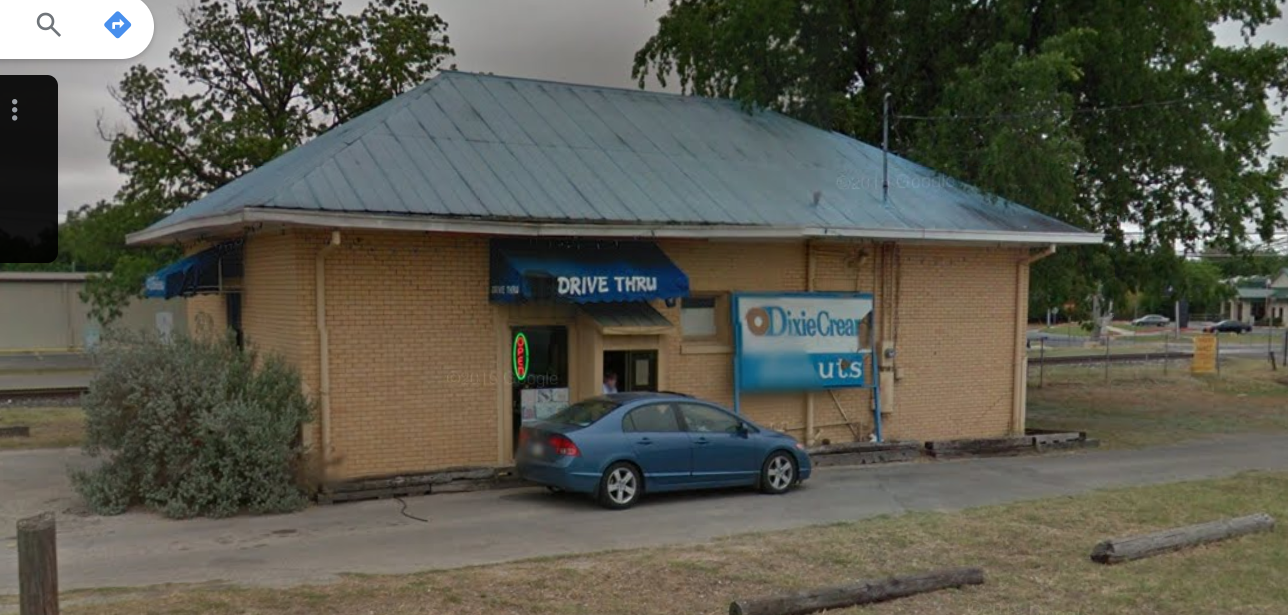
Hours 0:00 – 1:56: New flood plain maps, and a deep dive into the old Dixie Cream Donuts building, next to the railroad tracks.
Hours 1:56 – 3:47: Human Services recommends how we give out $550K in grant money, and council starts chopping. Also, what do we want the Texas Legislature to do this session?
Bonus! 3 pm workshops: What exactly happened in September, when so many people waited for hours, hoping to get housing vouchers from the Housing Authority, and no one did?
Note: when this meeting occurred, those last 40 votes were still arriving in the mail. There was a real possibility that the council seat was still open. This matters because Roland Saucedo was actually at the meeting in person, advocating for one of the HSAB applications. Hijinks ensued.
And that’s a wrap for 2024! See you all next year!
Topic 1: Two speakers (Noah Brock and Annie Donovan) unpack part of Item #16 for us.
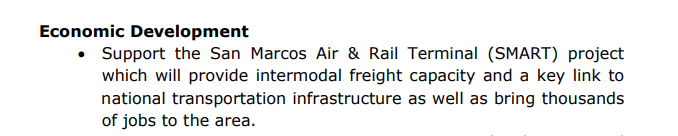
Item #16 is about the Texas State Legislature. San Marcos lobbies the state government on various municipal issues. So we have a list of guiding principles.
Here’s one of those items on the list:
I’m going to start with quoting Noah, because this is gold. First he reads that bullet point above. Then he says:
“This is a very specific location that’s called out in this guiding document. The wording sounded familiar. So I looked up what the last principles document said, in November 2022:
“Is it the city’s goal to develop an intermodal freight facility at this location? It appears that the original idea was to support light industrial manufacturing with a connection to the airport. Now we have a heavy industrial park that can stack containers 80 ft high, with no connection to the airport.
Why does the wording keep changing to fit a developer’s current project? Isn’t a guiding principle supposed to come from the city, and not a developer?
Do you remember when the city council voted unanimously to approach the developer of this project and change the development agreement, because the people did not support it, on May 2, 2023? I would like to see a motion to remove this item from the document in its entirety. Thank you.”
So yes! In our packet of “what’s best for the city” we have a line item which is carved out specifically to be “what’s best for SMART/Axis Logistics”. Verrrrrrry interesting. Stay tuned.
Topic 2: HSAB is the Human Services Advisory Board. The city allocates $550K in grants to nonprofits, and the HSAB awards the amounts. There are a few comments here: – The chair of the HSAB pleading that this amount of money is nowhere close to the need in the community – A speaker on behalf of the Salvation Army, about how they weren’t funded as they’ve been in the past.
This will be unpacked in Item 15.
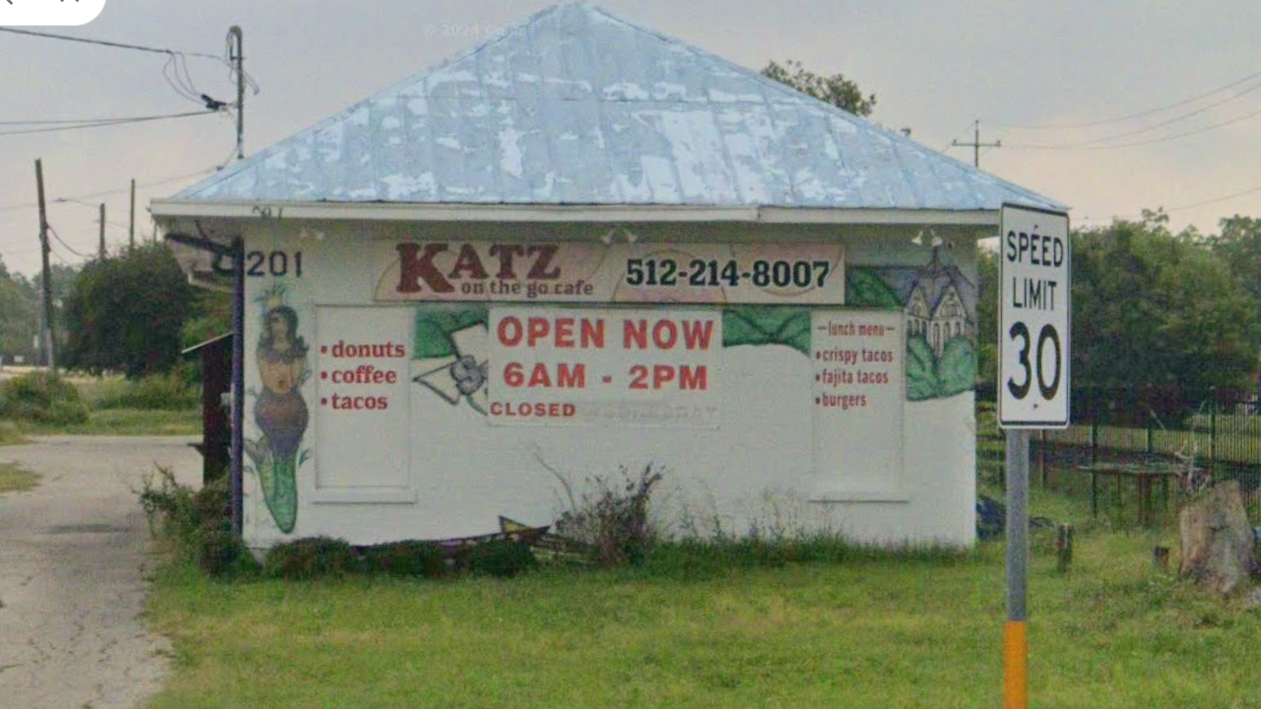
Topic 3: This place:
It’s on LBJ, at the train tracks, across from Toma Taco.
The city leases the property to Ruben Becerra, the Hays County Judge (which is not a “judge” so much as being like the mayor of Hays County.) This speaker is super angry about this!
We’ll get to the backstory on this property – Item 10 – but I still have questions.
…
Item 5: Return of Evoke Wellness, for the final $50K of Covid Money.
This last bit of Covid money is going to the mental health program partnership between SMPD and Evoke Wellness, for people needing substance abuse treatment. (The county also works with Evoke Wellness. This is part of a larger, semi-coordinated program to keep people with mental health crises and/or substance abuse out of jail.) We discussed this last time, too.
Amanda: How does this program work? Walk me through it.
She basically wants to know all three parts: 1. how do people in crisis end up at Evoke Wellness? 2. What happens when you’re there? 3. What happens after discharge?
Part 1: how do people in crisis end up at Evoke Wellness?
First, SMPD responds to a call for someone in crisis. First, if they need medical help, SMPD will take them to the hospital. (Probably Christa Rosa).
If the person is stabilized but having a mental health crisis, SMPD tries to try to find out if the person has insurance or not. If so, then we try to find a facility that accepts their insurance. They’ll take the person to the treatment facility. It might not be in San Marcos – could be Austin or San Antonio.
If they have no insurance or financial means, then once they’re stabilized, we give a mental health evaluation, and figure out what they need. Then we take the person to Evoke Wellness (for substance abuse) or Hill Country Mental Health.
Part 2: They’re at Evoke Wellness
No one from Evoke Wellness was on the line at the meeting, to talk about the services they offer there. Amanda asked if we could have a workshop from them to hear about what their services are. Everyone is on board with this.
Part 3: Discharge after Evoke Wellness
When they get to the treatment center, they start meeting with a case manager. They’re working on a discharge plan from day 1.
There are a few options for after they’re discharged:
Reconnect with safe support system, if that exists. Either the center, family, or mental health officer will give them a ride there.
Longterm treatment: may discharge to Sober Living, they may go to partial in-patient, several different places to go.
Amanda asks: What if someone has zero support services and zero resources?
Answer: Then the case manager has to get to work. Find shelters available. For example, Hill Country has an in-patient crisis stabilization unit in Kerrville. They’re in-house and have a big list of resources. We make sure there’s a bed available at a destination shelter. The case manager is going to put together a plan to try to make sure the person does not end up homeless.
…
How many people are we helping?
Total, San Marcos is putting $150K towards Evoke Wellness, and Evoke Wellness is also providing 5 scholarships this year.
Chief Standridge says that costs vary wildly, depending if the person needs in-patient or out-patient treatment. But on average, $17K/person is a reasonable estimate.
So we can ballpark this: $150K plus the 5 scholarships helps about 10-15 people per year.
Alyssa asks: What kind of metrics do we have to assess how this is working?
Answer: We’ve got tons of internal statistics, but we’re not yet coordinating well on the county level, in order to get stats on the full scope of the issue. This is one of our big goals, though.
….
Just a quick soapbox: It is a moral obligation to help the most vulnerable people in society. It does not matter if they made bad choices. Someone living on the streets with mental illness and/or substance abuse problems is being failed by society. And big problems cost a lot.
But big problems can also be prevented! If we invested more heavily in prevention – early childhood support, family support, increase the living wage, increase housing, effective addiction prevention programs – it would be cheaper than working to solve big problems once they take root, on an individual basis. (And that’s not even counting the value added to people’s lives, for not being derailed by catastrophe.)
Now, Union Pacific sold the land to San Marcos in 2013, but not the physical little building. The building was owned by Dixie Cream Donuts.
Furthermore, look at that red border – the border runs right through the building! So weird. They carved the Dixie Cream Donuts building, half on Union Pacific land, and half on San Marcos land. (We even asked them about it at the time: “why not run the border around the building? It can be all UP, or all SM. We don’t care.”
Union Pacific said, “nope. We do this all the time.” Okay then!)
At some point, Dixie Cream Donuts sold the building to Ruben Becerra. So Becerra now owns the building, and leases the land underneath it from both Union Pacific and San Marcos. He then sublets it to Las Dos Fridas.
…
No one is very excited about extending this lease to Becerra. This would just be a mini-extension, to match the sublease to Las Dos Fridas. It would expire in January 2026.
Council decides this is very thorny, what with Becerra being the Hays County Judge and all. Council says cryptic things like, “I need to be able to give an answer when my constituents ask me what on earth is going on.”
They decide to postpone until January.
What happens if we don’t renew this lease? It’s not clear! Becerra still owns the building, he could in theory move it, although it’s probably not structurally sound.
The vote:
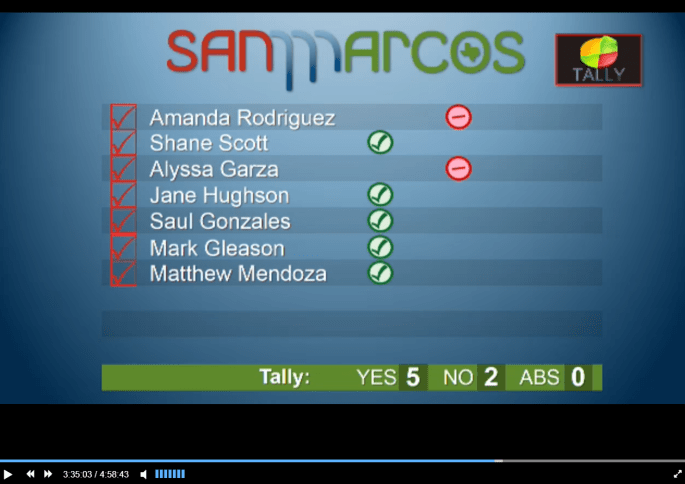
Yes, postpone until January: Everyone except Matthew Mendoza.
No! Let’s settle this now! Matthew.
I have no idea why Matthew wanted to settle it now. I don’t even know which way he wants it to go!
…
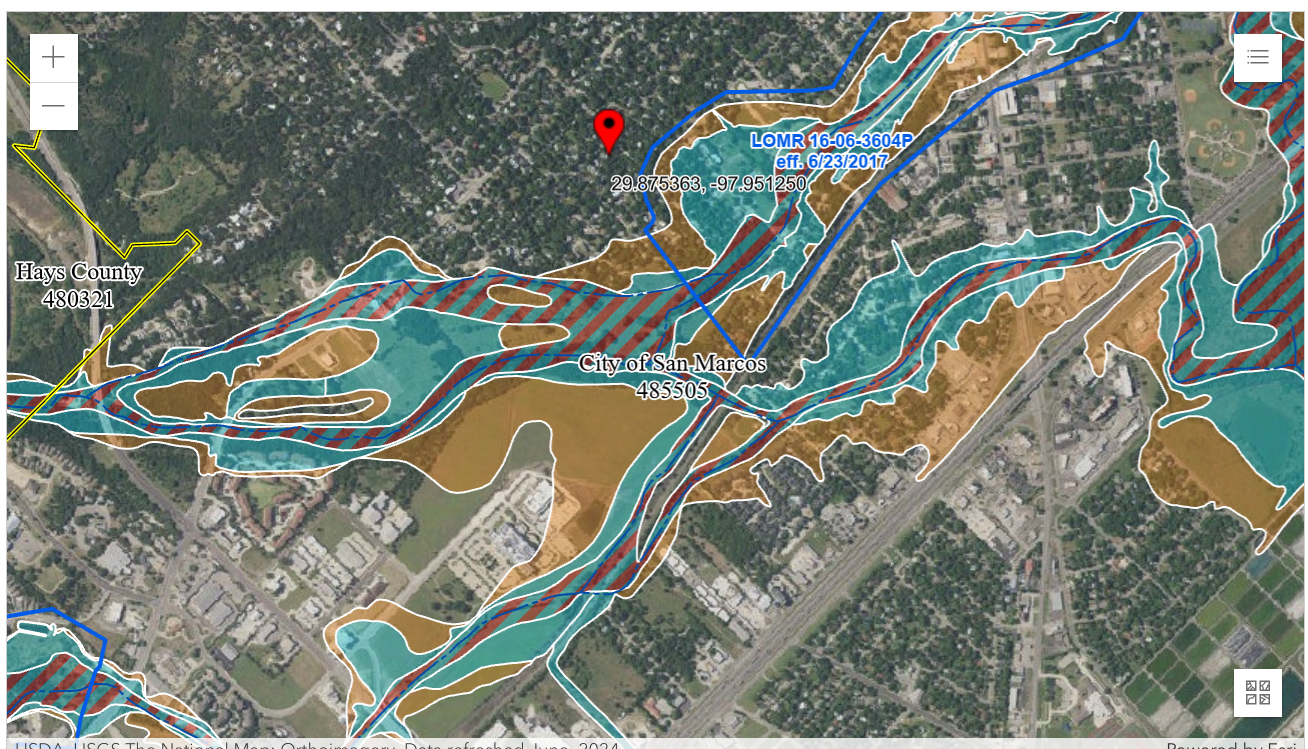
Item 14: New flood maps.
Ok, FEMA has been working on our flood maps since the 2015 floods. The old flood maps were based on 1990 data, so this is very much needed. The new maps are called Atlas 14.
Here’s how much city land is now in a flood plain:
So about 800 new acres of San Marcos are now in the floodplain. We don’t know how many homes and businesses that is, though.
So if you’re now in the floodplain, what changes? There are two main things:
Building codes: the city has stricter ordinances if you’re building in a flood plain.
Old buildings don’t have to be retrofitted, but any new buildings or additions have to meet flood plain standards. (Like being raised off the ground.)
This isn’t actually a new change – the city has been using the Atlas-14 data since 2017 in our ordinances.
The problem is that floods are really, really expensive. So flood insurance rates for people in a flood plain are very expensive. Many people can’t afford it, and go without. This causes two more problems:
Rates go up even more for everyone else
NFIP still doesn’t have enough money to give out in case of flooding.
It’s a giant mess. It’s even worse when you think of the historical context in a place like San Marcos: wealthy people built their homes uphill, and left the downhill places for poorer neighborhoods. So it’s the people in Blanco Gardens and Victor Gardens and Dunbar that live in floodplains and have to debate flood insurance, not the University or the Historic District.
So how much are rates going up?
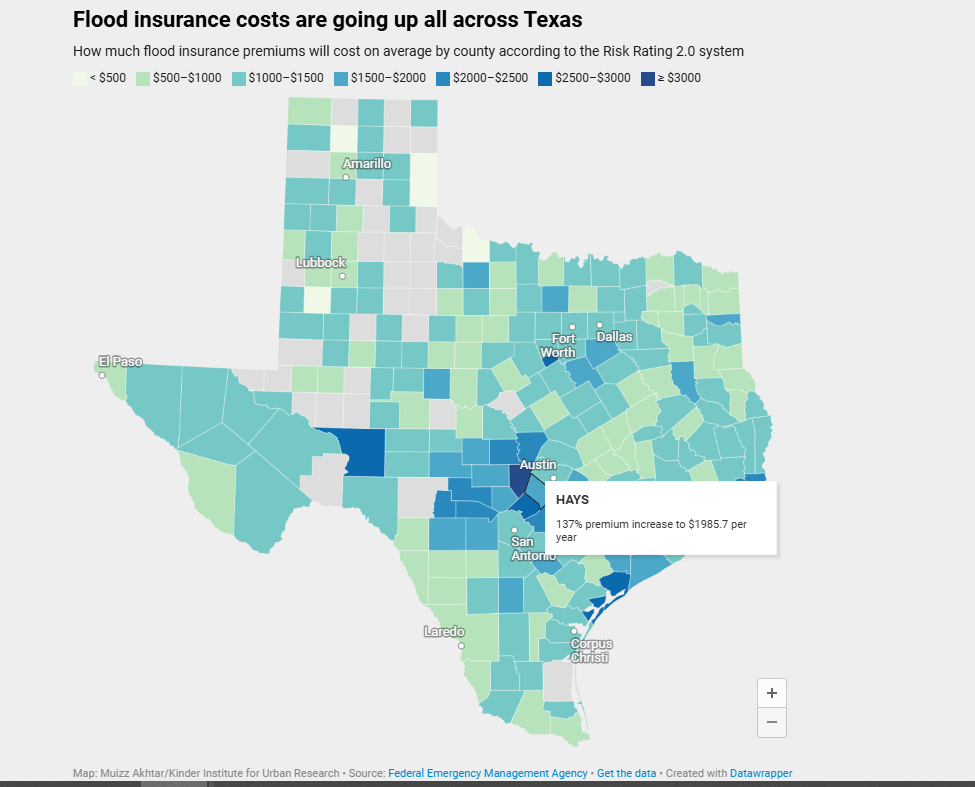
Amanda Rodriguez cites a study from Rice University about flood rates rising. (I think it’s this one.)
So rates in Hays County are projected to go up 137% increase. (Legally, the increase is capped at 18% per year. So over the next 5-10 years, your premiums would step up to cover the increased risk.)
Mark Gleason weighs in. He has a lot of lived experience with floods, particularly because he got hit hard in Blanco Gardens in 2015.
His main points:
The National Flood Insurance Program is broken.
San Marcos is a member. This gets us a 15% discount, but subjects us to FEMA rules about rebuilding.
Premiums are unaffordable so people go without. Then disaster hits and they can’t afford to rebuild, and sell at low prices, and fancier housing gets built. (Yes.)
If you’re in the floodplain now, you don’t have to retrofit your current home or business. But anything new, or an addition, has to conform to floodplain development standards
If you own your home outright, you’re not required to purchase flood insurance.
But everybody SHOULD get flood insurance. It’s very cheap if you’re not in the flood zone
Mark’s solution: Feds need to come in and fix the Blanco River. It needs some sort of flood control. It’s cheaper to fix the Blanco than it is to raise homes.
Jane: What about the San Marcos river and Purgatory Creek? Historically, those flood, too. It’s not just the Blanco.
Basically, no one could possibly have any good answers. Mark certainly doesn’t know what it might take to fix the Blanco. None of us know what it would take to fix the flooding. None of us know the extent to which climate change will make things worse. We are all just kind of holding our breath and hoping.
Every year, we give money to nonprofits. The HSAB sorts through the applications and gives out money.
This year, they are giving out $550K.
HSAB has a tumultuous past. In addition, they used to have a bunch of Covid money to give away in 2022 and 2023, and now they don’t. So this is a tough spot to be in.
This year, they got 37 applications for a total of $1.1 million dollars requested. So that’s also a tough spot to be in!
The HSAB Process
First, some useful guiding principles:
The whole decision process takes months.
Here’s how they evaluate the applications:
(“Council priorities” always drives me fucking nuts. It’s all about Council ego, and not what’s best for those in need.)
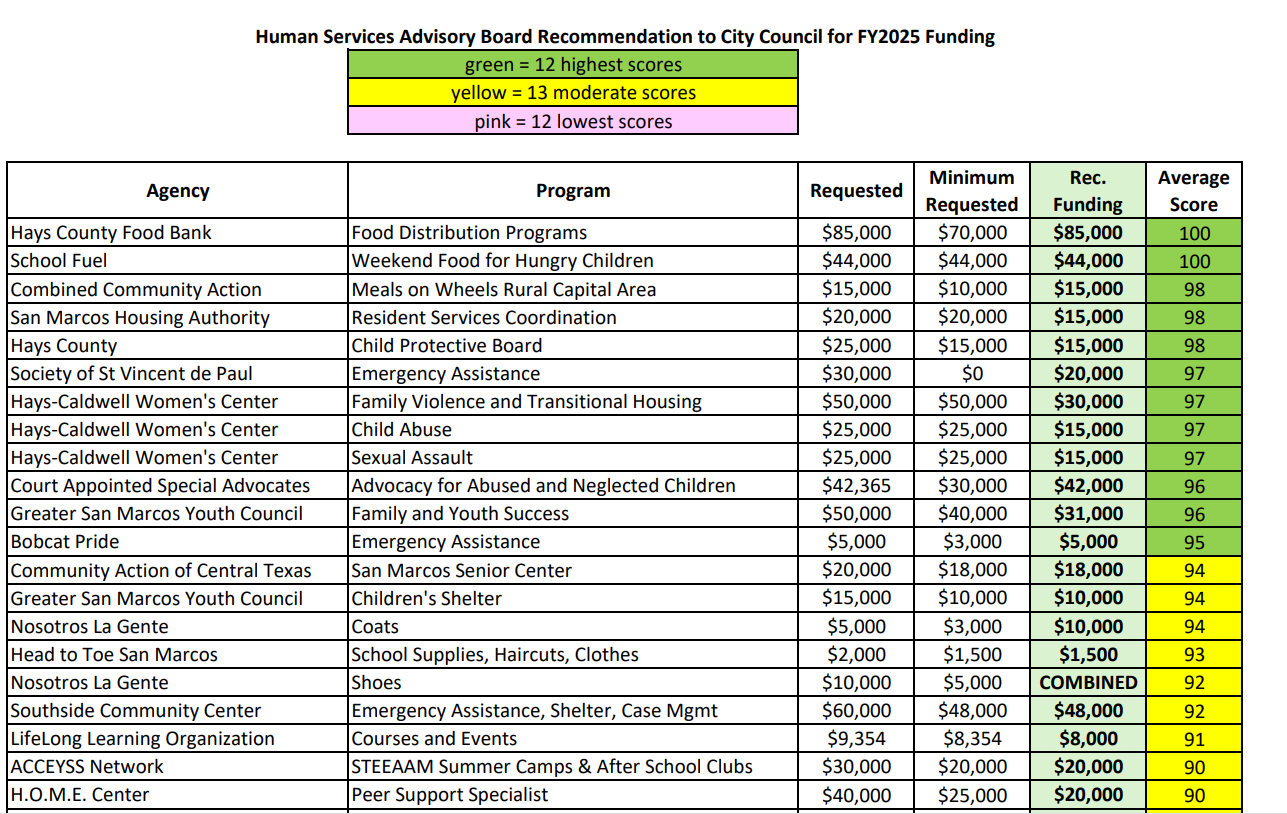
Here’s how HSAB ranked the applications:
(I know that’s tiny, but I think you can click on it and make it bigger.) Green is highest score, yellow is medium, pink is lowest.
Then the board discusses each application individually. They consider:
Rankings
Amount of money requested
Need in San Marcos
At the end of all that, here’s what the board recommends:
They talk a little bit about why they chose not to fund the agencies at the bottom. Some of them are hard to measure, and they wanted programs that can measure results. Some of them were not aligned with which needs the board wanted to focus on this year. Some are not local.
Summary by category:
What does Council have to say?
OH LORD, YOU GUYS, THIS WILL GET INTERESTING.
Matthew Mendoza kicks things off. He wants to remove $10K from ACCEYSS, and give it to the Salvation Army.
What is ACCEYSS?
Ok, summer camps and after school programming in Dunbar. They were awarded $20,000 to do this.
Here’s what the Salvation Army wants to do:
They were awarded no money.
Jane asks why? The answer is that one of Council’s priorities is to support locally grown organizations. Since Salvation Army isn’t local, they lost points for that. [Jane deeply sighed, “Ok.”]
Jane explains this away: this is a local chapter of the Salvation Army. They are extremely local.
Note: Roland Saucedo – the council candidate that Jane campaigned for and supports – shows up to speak on behalf of the Salvation Army. That’s how local they are!
Council talks to the Salvation Army representative for a long time, about the Salvation Army budget, and whether or not we could partner with the Salvation Army on utility assistance, which is also an ongoing conversation. Maybe we could direct some utility assistance money over to them?
The vote:
Move $10K from ACCEYSS to Salvation Army: everyone
Keep things as they are: No one
So that money is shifted over.
…
Next, Jane brings up the HOME Center.
HOME Center is these guys. They do individual case management with homeless people to get them into stable, longterm housing. It is exceedingly difficult work and they do an outstanding job.
I frankly don’t know how to sugarcoat this: the city has a history of being vindictive and retaliatory towards HOME Center. This is because historically, the city has not always been on the up-and-up regarding the homeless community, and HOME Center advocates on behalf of the homeless people who have gotten the raw end of things.
Jane proposes moving $15K from HOME Center, and giving $10K to Salvation Army, $5K to Nosotros La Gente. This would bring the Salvation Army up to $20K, and put HOME Center down to $5k. (Actually, her first proposal is to bring HOME down to zero. Matthew gently chides her to leave HOME Center with $5K.)
Keep in mind that Jane openly endorsed and campaigned for Roland Saucedo, who is loosely affiliated with the Salvation Army. He was present at Tuesday’s meeting and advocated for the Salvation Army.
I like to stick to cut-and-dried facts, but you absolutely have to know that this is a very tense topic. Jane is not a neutral party here, and her proposal feels like a shot across the bow.
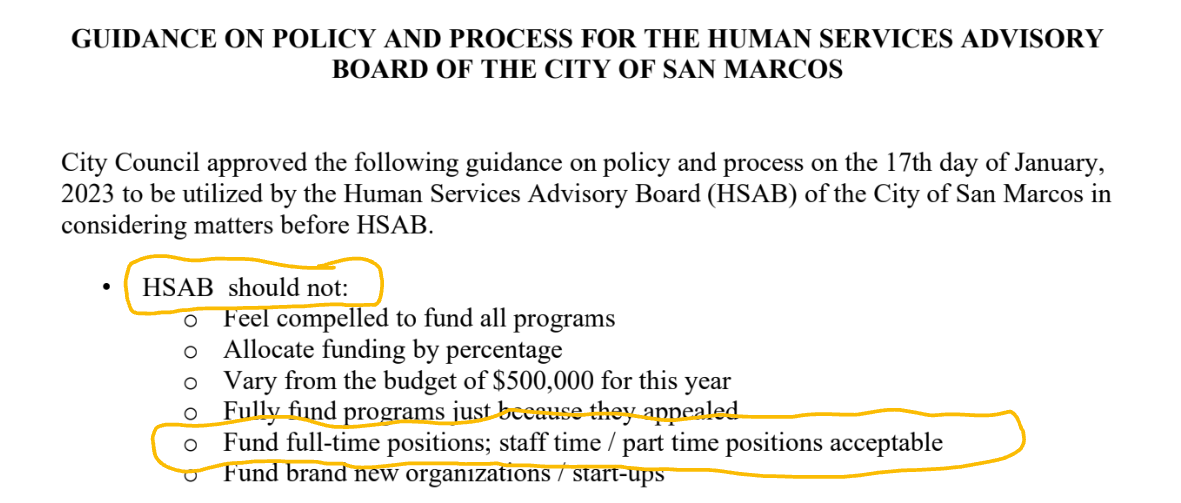
Jane’s stated reason is that HOME Center is requesting money for a case manager salary. She says, “We don’t want to fund salaries, because we don’t want someone to be laid off if we don’t fund them.”
The staff member says, “In the application, we said Board can allocate up to 20% of a fulltime position or fully fund a part-time app.”
Jane argues this point, but she is wrong here. Here is the policy from January 2023:
And in the actual discussion, they settled on 20% of a fulltime position is okay, and funding a parttime position is okay.
So first, Jane is technically wrong. But more important, she’s morally wrong. The staff, Alyssa, and Amanda all point out to her that many of these applications asked for staff funding, and yet she’s singling out HOME Center to slash.
Jane: We have given a LOT of money to Southside. They are hiring. So that’s an issue that I have with HOME Center in particular.
She is referring to the $800k of Covid money that the city recently gave Southside Community Center, to implement our Homeless Action Plan. She is somehow making the case that Southside’s funding works against HOME Center?
Alyssa comes in hard: Absolutely not. We gave Southside an obscene amount of money. Initially, there were community concerns and Council concerns about Southside’s capacity. We had grace and did a trust fall. We need to extend that to HOME Center. They do boots on the ground hard work. The service and case management they do is unmatched.
She continues: “I know this is not your intention, Mayor, but I need to name this. Within different groups that do homeless outreach, there is a perception that HOME Center continues to face retaliation because they use their platform to bring to light some historic concerns and trends regarding homeless outreach in general in our community. And so I know that’s not your intention, but the community had a very thorough process with feedback and open meetings. It is not a good look, without any process or notification, to be making these moves.”
There’s some continued hectoring from Mark and Jane – they could have asked for money for different costs! They could have shown up to this meeting and defended themselves!
Amanda is furious: “This is not the only organization that asked for staff funding! So many of these organizations are funding staff! I’ll be honest: I’m losing my patience, because as someone who has volunteered with HOME center, as someone who has spoken to the clients that receive what they do: our community benefits in ways that we will never understand…. The reasons you’re giving are not strong enough for me, and this just feels wrong.”
Jane, sweetly, “Then you can vote against it!”
Amanda, coldly: “I will.”
Jane: “I just wish they’d asked for money for something else!”
Alyssa, “Well, I wish you weren’t nitpicking, but sometimes we don’t get our wishes granted. We need to meet the moment where it’s at.”
(I’m abbreviating all this hugely. Feel free to listen yourself. HSAB item starts at 2:00, and Council discussion starts at 2:19ish.)
Eventually Alyssa makes a motion to postpone. She says, “We need space for community feedback. We’re overstepping and moving things around without rhyme or reason. We need to let our neighbors know.”
The vote to postpone:
Yes: Alyssa, Amanda, Shane, Saul No: Mark, Jane, Matthew
So the postponement squeaks through. This will come back around in January.
…
Let’s zoom out for a moment on the HSAB funding:
The committee spends months on these applications. All of the agencies provide metrics and ample documentation of how they spent previous money – literally over 2000 pages of applications in the Council packet this week. Council argues passionately about whether $5000 is better spent on kids in Dunbar, or emergency funding from the Salvation Army.
Here is a list of things that received zero discussion on Tuesday:
$45,000.00 to McKimm & Creed, for Leak Detection Services
$241,036.36 to Cunningham Recreation, for various playground and outdoor fitness equipment
$573,458.79 to Nueces Power Equipment, for the purchase of a Wirtgen Asphalt Milling Machine
$2 million (annually) for McCoy Tree Surgery Company, for tree trimming
$6 million for Techline, Inc, for materials and supplies for San Marcos Electric Utility
$8.6 million for the Lower Colorado River Authority, for various goods and services concerning electrical transmission, control and substation facilities
$765 reimbursement to Tantra
Was Jane Hughson worried about us paying someone’s whole salary at McKimm & Creed? Was she worried that the company might become too dependent on us?
Did a committee meet for months, and have a scoring system? Why do we scrutinize $20,000 to HOME Center, and not $6 million to Techline, Inc?
We also give homestead exemptions of $15,000 to all homeowners, and $35,000 to seniors and people with disabilities. We have an estimated 10,295 owner-occupied homes in San Marcos. The tax rate is 60.3 cents per $100. So ballpark, we’re giving homeowners $904,500 yearly in homestead exemptions.
Why don’t we include this $900K in an application to HSAB? We could call it “Subsidies to Home-owners Program” and see if it scores higher than ACCEYSS on the evaluation criteria. We don’t think of this as charity, but we should. And we don’t even make the home owners provide metrics, measurable outcomes, nor turn in performance reports for how they spend their extra charity dollars each year. Isn’t that nice?
(And finally, I will never get sick of reminding you that we’re giving $1.2 million yearly to Kissing Tree. No metrics, no scrutiny, no gnashing of teeth. Just a nice, gated community that’s not for you.)
…
Item 16: Guiding Principles to lobby the Texas Legislature.
The Texas legislature only meets once every two years, for 140 days. This is to minimize the damage that they can do.
Or as Molly Ivins put it, “The Texas Legislature consists of 181 people who meet for 140 days every two years. This catastrophe has now occurred 63 times.”
Or, as the old joke goes: “The Texas legislature meets every two years for 140 days. Many citizens believe that the law was incorrectly transcribed and that the legislature was meant to meet for two days every 140 years.”
Anyway! San Marcos lobbies the state legislature on behalf of our interests. So we have a Guiding Principles document, to determine what we’ll lobby.
Amanda comes in with a ton of amendments. Keep in mind that she’s worked with the state legislature for the past few years. It quickly becomes clear how much expertise she’s bringing to the table.
The first batch is all under the mental health section. Here’s the original:
Amanda #1: Suggested add: Support legislative action to establish a school mental health allotment fund.
Why? The Legislature passed a School Safety Bill last time, but it doesn’t fund mental health. So this asks the state to create line item funding to address mental health funding.
Everyone loves this. The vote: 7-0
Amanda #2: Support legislative action to increase in funding for Local Mental Health Authorities (LMHAs) to provide early intervention services to prevent crises.
The vote: 7-0
Matthew Mendoza is so happy. He says, “Yes, because it will go to SMPD!!” when he casts his vote.
Amanda #3: Support legislative action to expand access to maternal mental health support throughout pregnancy and the post-partum period.
The vote: 7-0
Amanda’s on a roll! Everyone loves these!
Amanda #4: Support legislative action that expands eligibility for Medicaid.
Mark has finally had enough of this nonsense! “I’m going to be a no on this. Those are conversations for the state and federal government to have.”
He has a deep moral conviction about staying neutral on healthcare coverage. Should uninsured diabetics die for lack of insulin? Mark refuses to have an opinion, and you can’t make him!
The vote:
Yes, the state should accept Medicaid funding: Everyone but Mark No, this is none of my business: Mark
Amanda #5: Support legislative action to increase funding for permanent supportive housing programs. (Housing First programs.)
There is a fake-debate among homelessness experts. Should you provide housing and then treat the mental illness and/or substance abuse? This is Housing First. Or, should you withhold permanent housing until the person gets their issues solved? This is Treatment First.
Mark: I’m a no. Housing First isn’t always the best!
Mark is wrong. (If that link gets scrubbed under Trump, then we can use this one.) Housing First works better, and it’s more humane. It’s better all around.
The vote:
We support Housing First: Amanda, Alyssa, Jane, Shane, Saul
We don’t: Mark, Matthew
Amanda #6: There is no section on Housing in our Guiding Principles. We should have a Housing section.
In the Housing Section, Amanda recommends:
That we support legislative action that prevents unnecessary evictions
To promote housing stability and protecting tenants from undue hardships
The vote: 7-0
Mark is deeply suspicious, though.
Amanda #7: Support legislative action that seals a tenants eviction records in the event that a court rules in their favor
Mark and Matthew are both gobsmacked that this is not already the case. A tenant can win in court, but landlords can still use their eviction against them? Yes, currently.
The vote: 7-0
Mark is so suspicious! He literally says, “How is this not already the case?! WHATEVER. Yes.”
Amanda #8: Support budgetary measures to increase state funding for low income housing in Texas, especially for the most cost-burdened households that are at or below 50% of the AMI.
The vote: 7-0.
Amanda #9: Remove the whole carve-out for SMART/Axis.
Mark: Hard no. We have to increase and diversify our tax base! People don’t realize what that development could mean to this community! All the jobs! This is PRIME for development! I-10, Toll road, railroad, and airport! JOBS! JOBS! Major mistake! In 50 years, this will be the most important bullet point in this whole document!
Matthew: We just postponed due to second-guessing HSAB board and here we are, second-guessing this board! There aren’t smokestacks. This is environmental protection! Do you really want SMART/Axis to go to Caldwell county? Plus Gary Job Corp is right there.
(This is the weakest argument I’ve ever heard.)
Amanda: I’m not opposed to diversifying and growing our tax base. This is a very specific major development that arose through shady means. The entire city is not behind this development. Nowhere else in this document are we so specific.
Mark: Because it’s 3000 acres! Nowhere else in the COUNTRY has this opportunity! DC wants to hear how we’re diversifying. This is amazeballs!
The vote:
Remove the carve-out for SMART/Axis: Alyssa, Amanda Keep it: Jane, Shane, Mark, Matthew, and Saul
So that stays.
That’s all of the amendments!
…
After this, we have a series of little items:
the $2 million on tree-trimming
the $6 million to the LCRA
we officially the money back to Tantra
an appointment to the Animal Shelter Advisory Committee
You might have heard about a giant clusterfuck with vouchers and waitlists, back in September? This workshop is that. Council is attempting to figure out what the hell happened.
Background
SMHA is funded by the Housing and Urban Development Agency. (HUD). So it runs on federal dollars and doesn’t have any formal partnership with the city.
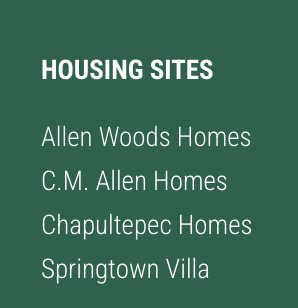
SMHA owns about 200 properties, at these sites:
as well as some individual rental houses around town. In addition, they have 251 Section 8 vouchers. This means that SMHA subsidizes your rent, so that you’re only paying according to your income.
To be eligible for a Section 8 voucher, you must earn under 30% of the median income for our region:
The median income in San Marcos is $47K/year and the poverty rate is 27%, so I’m going to ballpark that there are about 19,000 people in San Marcos who would qualify for housing assistance.
Anyway! We’ve got 451 apartments and vouchers total, to spread out over those 19,000 people. What could go wrong?
….
Naturally, there’s a super long waitlist. Once you get a voucher or an apartment, you can keep it as long as you qualify. So the waitlist moves very, very slowly.
None of this is SMHA’s fault so far. It’s basically the fault of voters and federal elected officials, who don’t properly fund HUD.
SMHA has an internal policy that everyone on the waitlist should get a voucher within 12-18 months. So they cap the waitlist. It’s very rare that they open up the waitlist and let people on.
The last time they opened up the waitlist was in 2016. They had 500 pre-applicants join the waitlist. That was too many – it took 8 years to whittle it down. Over that time, half the people dropped off the waitlist. There are still 30 people remaining, from that 2016 batch.
…
Ok, we’re getting to the September mess now.
So back in September, they finally decided to open up the waitlist. They ran this notice in the newspaper:
Nothing in that posting is faulty or misleading. But listen: it is so, so hard to get clear messages out to the public. This is not that.
Here’s how it was supposed to work:
Between Sept 9th and Sept 22nd, 250 people stop by and pick up a pre-application.
On Sept 14th, all 250 people drop off their completed pre-application, between 8:30 am-5 pm.
Those 250 people are now on the waitlist.
That’s just not a realistic plan, when it comes to guiding actual people? Organizing people to follow a game plan is really difficult! People are not good at paying attention and following detailed rules. You have to build a lot of redundancy and safeguards into systems.
Here’s what happened:
250 people did successfully pick up a pre-application.
Tons of people showed up on September 14th. They were hoping for actual vouchers. Chaos reigned and the rumor mill picked it up. People were sent away. People were incredibly frustrated and heartbroken. There was an air of chaos and disorganization.
In the end, about 180 of those original 250 got on the waitlist.
Listen: The biggest failure is having 451 subsidized housing units for 19,000 people who qualify. When you have that kind of massive scarcity, every mistake that follows takes on epic proportions. So yes, their roll-out had lots of problems, but it’s magnified because of the huge need.
…
What is Council’s take on all this?
Council takes three basic approaches:
What the hell?! How was this so poorly planned? [Jane Hughson]
Gingerly asking, “Is there any way we can help? Are there major obstacles that are preventing SMHA from running smoothly?” [Alyssa, Amanda]
There are a lot of broken elevators, broken cameras, and generally crappy living conditions in these apartments [Saul]
What the hell?! How was this so poorly planned?
Jane just cannot get over the fact that they intended to accept 250 people onto the waitlist, but then required a drop-off between 8:30-5 pm on a single Wednesday. “Why not open it up all week? You controlled the number of pre-applications that were out there! You knew for sure that you wouldn’t go over 250.”
There’s not really a good answer, no many how times Jane tries. (And she tries.)
Many towns in Texas only open their waitlist for a day.
By 3 pm, they weren’t getting people anymore.
You could also fax it in! You don’t have to come in, in person!
All of these just make Council’s head spin.
“But what if someone works? Or has childcare issues?”
“Who the hell has a fax machine in 2024?! Why can’t they email their pre-application paperwork in?”
When they ended with only 180 applications, why didn’t they give out more pre-applications to get up to 250?
Ultimately, there are not any satisfying answers. A lot of these are SMHA policy, and the speakers don’t have the power to change the policy. Only the SMHA board can change the policy.
They do plan to do things differently next time:
Give away preapplications to all
Allow online preapplications
Select people for the waitlist by lottery.
Again: Yes, the roll-out was poorly done. But the scarcity is the real problem. If we had 19,000 low-income housing options for 19,000 people, then this would be a hassle, but not a catastrophe. But 451 housing units is just crumbs.
….
“Is there any way we can help? Are there major obstacles that are preventing SMHA from running smoothly?”
Alyssa and Amanda ask variations on this several times, but never get a clear answer.
They also ask:
What’s the best way for community feedback?
What is the best way for Council and SMHA to partner? Whose lane is whose?
None of these have particularly good answers. Alyssa encourages them to put email and phone numbers on their website.
…
“There are a lot of broken elevators, broken cameras, and generally crappy living conditions in these apartments”
They have four maintenance workers for the public housing units. They try to do all repairs on vacant apartments within 30 days.
Like with everything else, they’re underfunded and understaffed. (That’s my language, not theirs. They most repeat their policies.)
…
Going forward, the plan is to have a joint meeting between City Council and the SMHA Board, probably in February, to iron all this out.
Want to talk about the big open natural area around the Hays County Courthouse, and if it should be housing? Want to get into the weeds on some very detailed decisions about mailing parking tickets, buying new Tahoes for SMPD, and more? I’ve got all your weedy deets right here, kid. Hit me up.
But first, it’s City Council Run-off Election time!
Go vote for Lorenzo Gonzalez. He’s a police officer who has some clear-headed criticisms of how police departments work. He gave solid progressive answers at the debate held by the Primrose Advocacy Council.
The other candidate is Roland Saucedo. His answers were fine, but his background is troubling. (Like I mentioned before, after my initial take, a lot of people reached out to inform me that he does not operate in good faith. Some details here, but not all.)
Why don’t you and me go vote? Let’s get Lorenzo Gonzalez across the finish line. Voting details here.
Onto the meeting!
Hours 0:00 – 2:39: There’s a lot of open space in the middle of town right now, around the Hays County Courthouse. Should it all be housing? Should Dunbar connect to Wonderworld?
Hours 2:39 – 4:58: Lots of little details. So many little details. Do you love passionate arguments over tiny little details? Then you are in for a treat. (I mean, I obviously do.)
Bonus! 3 pm workshops: Sneak peak into what Texas State is doing on campus over the next ten years.
See you next time, for the last meeting of the year!
Salvation Army was denied some grant funding, they’d like it restored.
Demolition notices on Valley Street
Rio Vista incident with SMPD that we heard about last time
One person in favor of the Purgatory Creek rezoning, and one person opposed.
Ok, this last one is fun. This guy wants to build a Glidescape in town, which is a solar powered roller rink, with vertical farms that grow fresh food, immersive STEM workshops, virtual reality tournaments, and planetarium, which can transform into a disaster-resistant facility when the community needs a shelter. He wants a Chapter 380 agreement and maybe some tax breaks to bring this vision to San Marcos.
I honestly assumed the speaker was maybe someone on a manic phase. But he seems to be an active person with a lot going on on this website and also this one? I still am not sure if San Marcos can support a planetarium-vertical-farm-roller rink, but we can’t know for sure until we try.
…
Item 1: San Marcos got a bunch of federal money after the 2015 floods, to help with recovery.
As of December 2024, the grants are all done. We’re officially done with flood recovery funds, and hopefully the community feels restored.
…
Items 2-3: Fiscal reports for April-May-June 2024 and July-August-September 2024.
We had ample warning that sales tax was coming in low, and we adjusted and pulled things back.
This is April-June:
The striped green and blue is what we thought we’d have. But then the solid green and blue are what we ended up having. But the solid blue is still less than the solid green, so our budget stayed balanced.
Then July-September looks even more back to normal:
Our sales tax was down because one specific business had their revenue way down. That’s supposed to go back to normal next year.
…
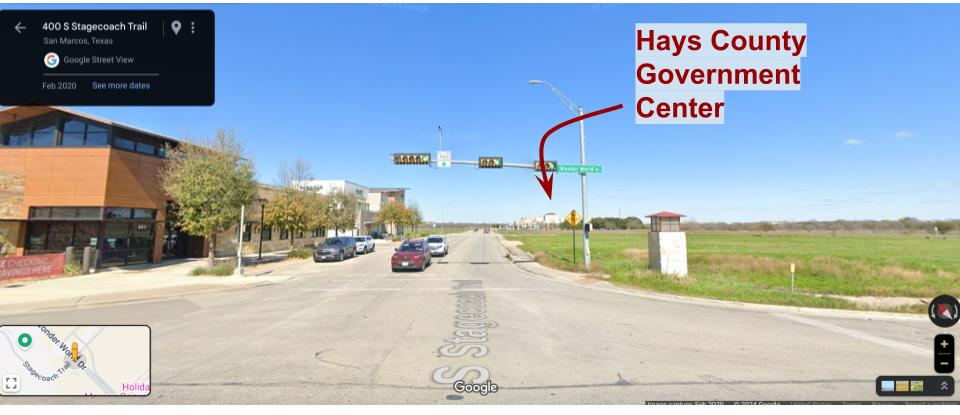
Items 19-21: The Hays Government Center is off Wonderworld, on Stagecoach:
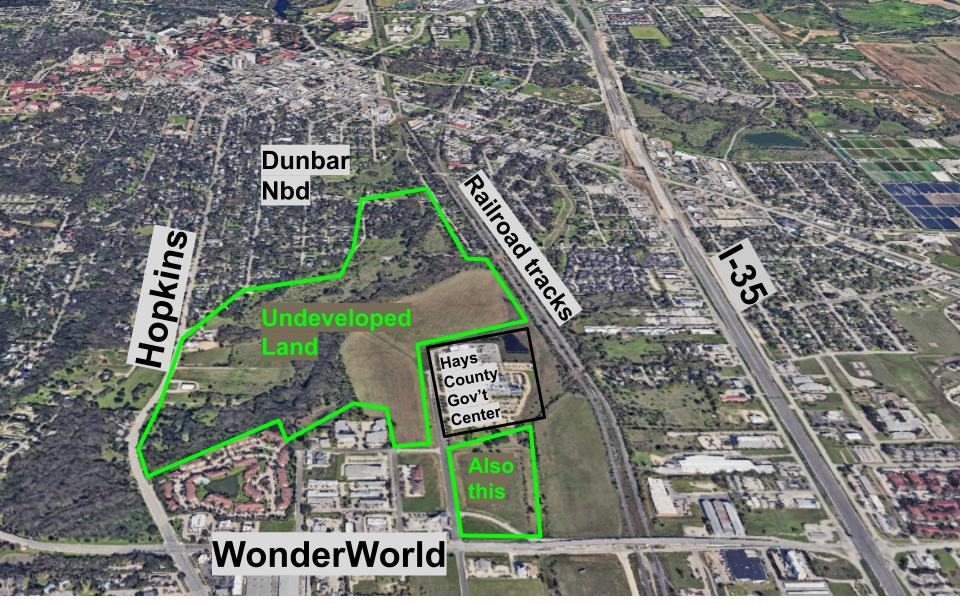
All around it is a big chunk of undeveloped natural land:
It separates the Dunbar neighborhood from Wonderworld.
It’s never been developed, mostly because Purgatory Creek and Willow Springs Creek both run through it:
So it can get very wet and marshy in there.
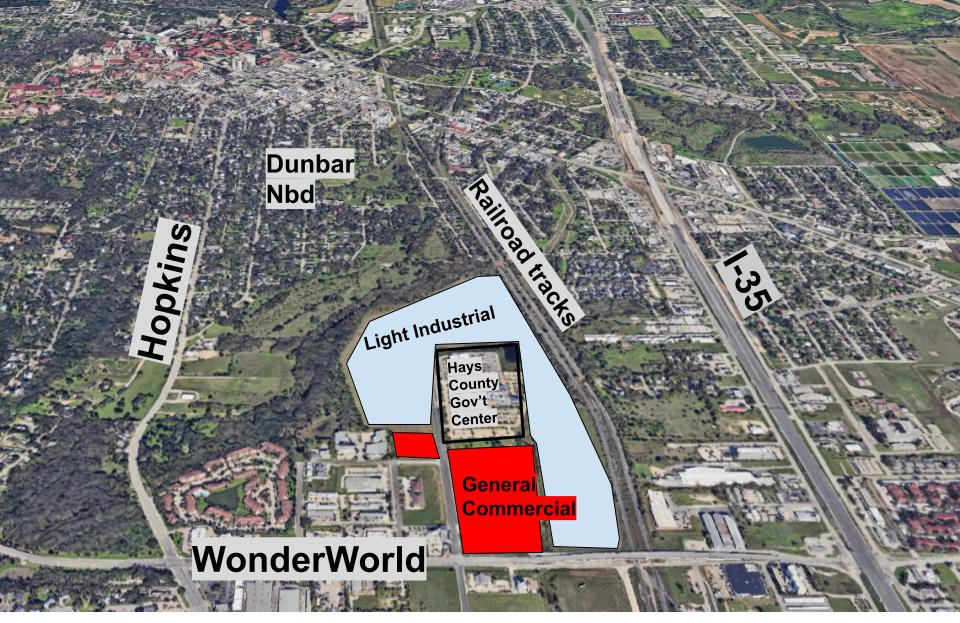
Way back in the 1980s, this land was all zoned Light Industrial and General Commercial:
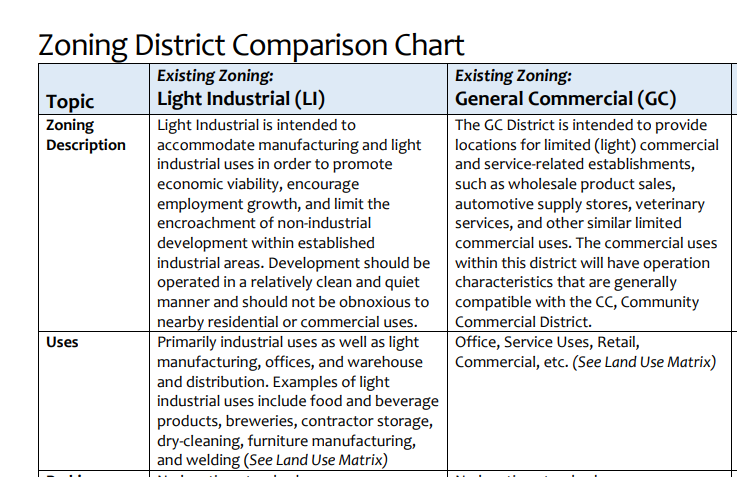
Here’s what General Commercial and Light Industrial mean:
So the owner, currently, is allowed to build anything in that chart, without getting permission from the city.
Honestly, back in the 1980s, this area was basically outside of town. And the people in charge did not worry about Dunbar neighborhood flooding.
Fastforward to 2024
Now we do care about Dunbar flooding! How we’ve grown.
The city is working on the Purgatory Creek Mitigation Project, stretching from the river out to Purgatory:
It’s going to be a big trench to help with flooding, with a big hike-and-bike trail running through it:
and the trail will connect the the river, through Dunbar, and over to Purgatory Creek Natural Area on Hunter and Wonderworld.
This trail cuts across the land that we’re talking about:
They’re calling this part of the trail “Hun-Dun” because it connects Hunter Road and Dunbar. Very cute, you all.
So the city approached the owner and asked about acquiring this land for that part of the trail:
The owner of the land said, “Well, as long as we’re looking at this land, what if we change it all around?” He is proposing the following zonings:
The green part will contain the Hun-Dun trail.
So what about the pink and blue parts?
First off, both are down-zoning. They are less intensive than Light Industrial and General Commercial. So that’s good, but it’s also pretty weak, because the old zonings were kind of ridiculous.
Blue will be CD-5. Mostly this means large apartment complexes. Pink will be CD-4, which usually means slightly smaller complexes, or things like townhomes.
What did Council say?
There are two main themes to the conversation: flooding and new roads.
Flooding. If all this housing is built, will it increase flooding in Dunbar? After all, it’s going to displace a bunch of water. That’s basically why this area hasn’t been built out yet.
Answer: According to our Land Development Code, you aren’t allowed to build something that makes flooding worse for people downstream.
Jane Hughson kind of laughs darkly, saying “We know how well that works.”
Amanda Rodriguez asks exactly how this gets enforced?
Answer: It’s prepared and checked by engineers.
Note: “Prepared and checked by engineers” is all well and good, but that’s not enforcement. What happens if the builder cuts a bunch of corners? Enforcement has to come after that. Will city staff actually withhold their building permit and require them to fix it? Or will we just good-naturedly punch them on the shoulder and say, “Bro! You know better! Try not to do this again, but here’s your permit.”
The answer is: who knows! That step is invisible.
The second enforcement comes with maintenance: if you have a retention pond, do you check the drain and pumps regularly? Does the city? What happens if the drains get clogged and no one pays to have them cleaned? Will the city actually remove your permit? Or will they just wring their hands and say, “I hope this gets fixed!”
2. The roads
Which roads should connect into this new neighborhood?
Councilmembers talk in particular about Gravel Road and Bintu road:
Gravel Road is a sleepy little dead-end with some houses on it. Bintu is a sleepy little road with a Holiday Inn on it.
Here’s the Transportation Master Plan:
So you can see that in theory, MLK and Gravel are both going to be extended across Purgatory Creek, into this new neighborhood. And Bintu is supposed to be extended across the tracks, to connect the I-35 frontage road into the neighborhood.
Is this a good idea?
It depends!!
Bintu Road extension: Yes, I think this is a great idea. No one lives there. Another way to get across the tracks would be great. Let’s do it.
Gravel Road and MLK extensions:
If you have two sleepy neighborhoods that are back-to-back, it is generally a good idea to connect them. You want the people in these neighborhoods to have multiple ways to leave in case of flooding, for example. Connectivity is good.
However! If you connect two sleepy neighborhoods and Gravel Road becomes the New I-35 Workaround, then that’s a whole lot of traffic that these neighbors didn’t bargain for. All of a sudden, cars are zooming down Gravel Road at 50 mph.
At the same time, the city does need more roads running parallel to I-35, aside from just Hopkins. Maybe MLK? (My vote is also for Leah Drive, on the east side, and to extend the road that runs by Target, Barnes Drive, all the way to Wonderworld.)
Answer: Stay tuned! This will be a fiery debate when the Transportation Master Plan comes up for revision in the next 1-2 years!
…
Here’s the bottom line: currently, the developer is allowed to build all kinds of nasty things. Our hands are tied here. We’re not zoning new, rural land. We’re re-zoning land where the owner has current rights to build all sorts of things. This is a least-bad-decision.
Each part – blue, pink, green – gets its own vote:
The Blue Vote: Should the blue part be big apartment complexes?
The Pink Vote: Should the pink part be smaller scale dense housing, like townhomes?
I probably would have voted yes. It’s a good place for town homes and moderately dense housing. We just have to be thoughtful about the Transportation Master Plan.
The Green Vote: Should the green part be set aside for the trail?
That last one is easy.
One final note: The developer says he doesn’t actually have any plans right now. This is not going to be immediately developed in the next 2-3 years.
Now we get into the weeds. These next five items are pulled from the Consent Agenda by Amanda Rodridguez. This means that Staff guessed that no one would want to discuss anything, and Amanda said, “Not so fast!”.
(Alyssa and Jane also pulled items, but just had a quick question on each one.)
The five items are: – Mailing parking tickets directly to people – New bathrooms at Dunbar park – Covid money for mental health collaboration between SMPD and a mental health treatment center. – SMPD buying seven new Tahoes for $350K – SMPD applying for a grant to start a Motor Vehicle Crime Prevention Unit
A few observations:
First, Amanda is thorough. Holy moly. She is reading everything with a fine tooth comb.
Second, what is Amanda’s point?
Her larger point is that these are the kinds of things we approve automatically. Taken together, these five items add up to $709K. (For perspective, keep in mind that we budget $550K yearly on social services.)
We just aren’t this generous – both in dollars and spirit – in other areas. Recall how it took Alyssa years of banging on about it to get $115K extra Covid money set up for emergency housing. Why is $350K for police cars so easy, and $115K for emergency housing so difficult? What Amanda is doing in these next five items is scrutinizing items that usually pass uninspected.
Honestly, I would vote in favor of all five items. I don’t actually think they are abusing city dollars.
It’s just that this level of generosity should be the standard, and it’s not. When it comes to my pet issues – homelessness, holding landlords accountable, transit, the parks department, etc – we should be as quick and gracious to fully fund them, as we are when it’s time to spend $350K on new police cars.
“BUT WAIT!” you cry, “We can’t afford to spend a million dollars all over the place like that! We’re broke!”
The parking lot next to the Lion’s Club is going to become a pay lot. Supposedly it’s going to be free for residents (but the details are murky). Out-of-towners will get their parking tickets mailed to them. (We discussed this last time.)
The first issue: In general, there’s an Early Bird discount – 50% off! – if you pay your tickets off early. You get 14 days to get the discount.
But if you’re mailing tickets out, you’d want to extend that window to account for the mail. Staff said 17 days. Amanda wants 30 days.
This is a little tricky because there’s also a late fee that kicks in at 30 days. Council decides to extend the Early Bird discount to 29 days on tickets-by-mail. The very next day, the late fee deadline will kick in.
Amanda Rodriguez has a number of other notes:
She wants to fully fund the parks department, but not through fees and fines. (This is a big issue, nationwide. Map here showing that San Marcos is not a big offender, though.)
There’s a bunch of murkiness in the policy language: operators versus car owner? Standing vs parking? Are robots writing tickets here?
They clean up the ordinance a little bit. Robots are only scanning license plates as you enter or exit the parking lot. The rest of tickets are being written by people, and the system mails them automatically.
You’re supposed to be allowed to load and unload for up to 30 minutes in this lot. But right now, the ordinance is ambiguous:
The Vote: Should we clean up language to allow for lawful loading and unloading?
Yes, of course: Jane, Amanda, Alyssa, Saul, and Mark HELL NO! Ticket them to smithereens: Matthew Mendoza.
Okay Matthew, if you think that’s best.
…
Amanda’s next point: Paid parking for out-of-town residents reflects an “Us vs. them” mentality. We should welcome our visitors, not shake them down.
The counter argument to this is put forth by Mark Gleason and the city manager, Stephanie Reyes:
San Marcos residents don’t use the river, because they’re too full of out-of-towners.
The out-of-towners aren’t spending money in our downtown, or hotels, or restaurants. They pack in a cooler and leave town after they get out of the river.
The parks and river are getting trashed and destroyed, and there’s a lot of drunken fights and medical problems. San Marcos is stuck paying for this unless we can collect some money from the out-of-towners.
Jane also has a good point: why is this ordinance so narrow? Right now, it’s only city park. Why not write it to include future paid parking lots? (This does not get fixed.)
More points from Amanda:
This is 6 am – 11 pm every day. No free parking after 5 pm? Holidays or something?
Registration process for San Marcos residents – how will that work? It’s supposed to be free for them.
Answer: there will be a big education campaign! We’ll hold events at the library.
Alyssa chimes in: San Marcos has a big problem with roll outs. How many people have microchipped their pets? How many people have signed up for the Enhanced ID at the library? How did the can ban PSA go?
All of those public information campaigns sounded great in paper, but in practice, we just don’t connect with people.
(Note: good public outreach is extremely time-intensive. It’s not enough just to translate everything into Spanish and promote things on social media. You basically need to maintain close and healthy relationships with a lot of community leaders who are in close contact with your hard-to-reach populations. What church does your population go to? What barbershop? Etc.)
Finally: This is just a pilot program. If Council wants to shut this down next year, there will be an opportunity.
As Parks and Rec director Jamie Lee Case says, “City Council will have a chance to decide if the juice is worth the squeeze.” She wins my most-favorite line of the night, hands down.
The final vote: Should we mail parking tickets from the City Park parking lot?
Amanda and Alyssa are both no, mostly due to lack of details on how the registration process will work.
I probably would have voted for it? It seems like a pretty cautious step.
…
Note: The vast majority of conversation these days is between Alyssa Garza, Amanda Rodriguez, and Jane Hughson. Just because I’m a shit-stirrer and this made me laugh:
At 3:01: Shane Scott, Mark Gleason, and Matthew Mendoza are all clearly on their phones. I guess someone does not find the intricacies of parking violations as thrilling as I do? Talk about a violation of Municode Chapter 23.46, Section 3.0045, paragraph 8.243.
…
Item 6: We’re spending some Covid money on installing new bathrooms at Dunbar.
Amanda Rodriguez is thorough. Like thorough.
She catches that the contract does not include baby changing tables nor little trashcans for used period products, and asks that those be added in.
Everyone agrees that this is a good idea.
….
Item 8: Oh, so confusing.
Here’s the caption:
But here’s what was originally posted, back in November:
The problem is that there’s no such thing as “the City Mental Health Court Program”. So they changed it on the agenda to SMPD. (Currently this is how the program works: SMPD mental health unit identifies people who need mental health or substance abuse treatment, and refers them out to Evoke Wellness for treatment. Then Evoke Wellness provides in-patient and out-patient substance abuse and mental health treatment.)
What Amanda brings up, though, is that there’s an entire contract in the packet between the City, the treatment center, and the non-existent City Mental Health Court Program.
No one seems to know what’s going on.
This gets postponed. However, this is Covid money, which expires on December 31st. So it absolutely has to get squared away at the next council meeting.
…
Item 9: SMPD wants $371K to buy seven new shiny Chevy Tahoes.
Ideally they like to replace police cars every five years. But due to Covid shortages, these are more like 7-8 years old.
Amanda Rodriguez points out that plenty of people drive cars much longer than that.
Chief Standridge explains that the game is to optimize resale value. The Tahoes we’re selling are 7-8 years old, have about 80-85K miles on them, and about 6500 idle hours. (Reddit tells me each idle hour is equivalent to 25 miles driven.) If they wait any longer, repair costs go up and resale costs go down, and everyone gets bummed out.
Each car is $52K, plus each car gets its own fancy Police costume. Installing the costume on the Tahoe, inside and out, is about $20K per car.
Alyssa Garza follows up: SMPD officers use police cars to do their off-duty work. So they’re putting wear and tear on these cars. Can the private companies pay to offset the cost of the vehicles?
(Max Baker and Alyssa actually first brought this up back in 2021. )
Chief Standridge says he actually just met with someone about this just last month! Nothing happened. One of the off-duty employers is SMCISD, and we don’t want to spring it on them.
(I mean, it’s been over three years.)
They also say that we should be leasing SMPD vehicles instead of buying them. This is cheaper in the long run. But because of the tax shortfall this summer, we couldn’t budget for an ongoing expense, so we have to use special one-time money to purchase them.
The vote:
…
I warned you that these items were weedy! There’s still one more to go.
…
Item 14: Autocrimes Unit
SMPD is applying for a state grant for $177K. This would pay for establishing a Motor Vehicle Crime Prevention Unit, with one full-time officer and a bunch of license plate cameras.
It’s not free – the city pays $35K in matching funds.
Amanda points out that there were 157 stolen cars last year. Out of 70,000 residents, that’s 2.2 vehicles per 1000 people. Her point is that this is inflated in people’s minds. Everyone acts like it’s a giant issue, but that’s actually fairly small.
Here are some other problems, for perspective:
27.7% of San Marcos residents live under the poverty line. That is 277 per 1000 people.
I don’t know how many jobs pay minimum wage, but it is definitely more than 2.2 per 1000 people. We could raise the minimum wage.
As of 2017, we needed almost 6000 more low-income housing units. Obviously housing prices have gone up, but let’s use the 6000: that works out to 85 units needed per 1000 people.
The uninsured rate in San Marcos is 16.1%. That works out to 161 uninsured people per 1000 people.
Chief Standridge is a hard no on any mitigating context! He wants zero crime!
Amanda grills him on the value of education, and why is it deprioritized in this grant application?
Chief Standridge argues that they do tons of other education! Also, out-of-towners come in to take cars. We can’t educate out-of-towners. Education is only one piece of the larger approach.
Mark Gleason is furious. This is an epidemic! There is a 50% increase in stolen vehicles from 2023 to 2024! These stolen vehicles get used for crimes!
Mark and Amanda have an angry exchange. If you want to listen, it goes from 4:30:49 – 4:34:15.
Mark is furious that others aren’t taking car theft seriously. He sees a stolen car as derailing someone’s livelihood, and he’s furious that Amanda is challenging Chief Standridge’s plan to reduce this epidemic.
Amanda is furious that we don’t take other problems as seriously as we take car theft. Yes, it’s super shitty if your car gets stolen. But here we are, prepared to drop $35K to match a grant without any discussion, and we don’t apply this same eagerness and dollar amounts to issues that affect a lot more people. As policy makers, council’s job is to figure out how to compare apples and oranges and apply some consistency across many different issues. Right now it’s wildly inconsistent.
Alyssa and Matthew Mendoza also get snippy with each other – if you want to listen, it’s at 4:29-4:30.
Saul doesn’t get snippy with anyone! But he does ask: How do we pay for this two years from now, when the grant runs out?
Answer: It’s a recurring grant. We expect to get it again.
The vote:
…
Phew! That’s it for the items pulled from the consent agenda.
…
The rest of the meeting is extremely short.
Item 24: Tantra is going to get reimbursed the $750 fee for appealing the noise violation. Yay!
…
Item 25: Right now each councilmember gets $12K to travel to conferences.
Shane Scott wants to double this to $24K. City Manager Stephanie Reyes gets a little faint at the notion of magically locating $84K extra dollars in the budget for this.
This will come back around, with more details. Like do all the council members even spend all their money? Maybe they can share the pool a little bit amongst themselves.
This is new! I can’t ever recall someone from the university giving this kind of presentation before.
(That said, the speaker did not supply his slides to the city, and so all I could get were crappy screenshots of the interesting slides. )
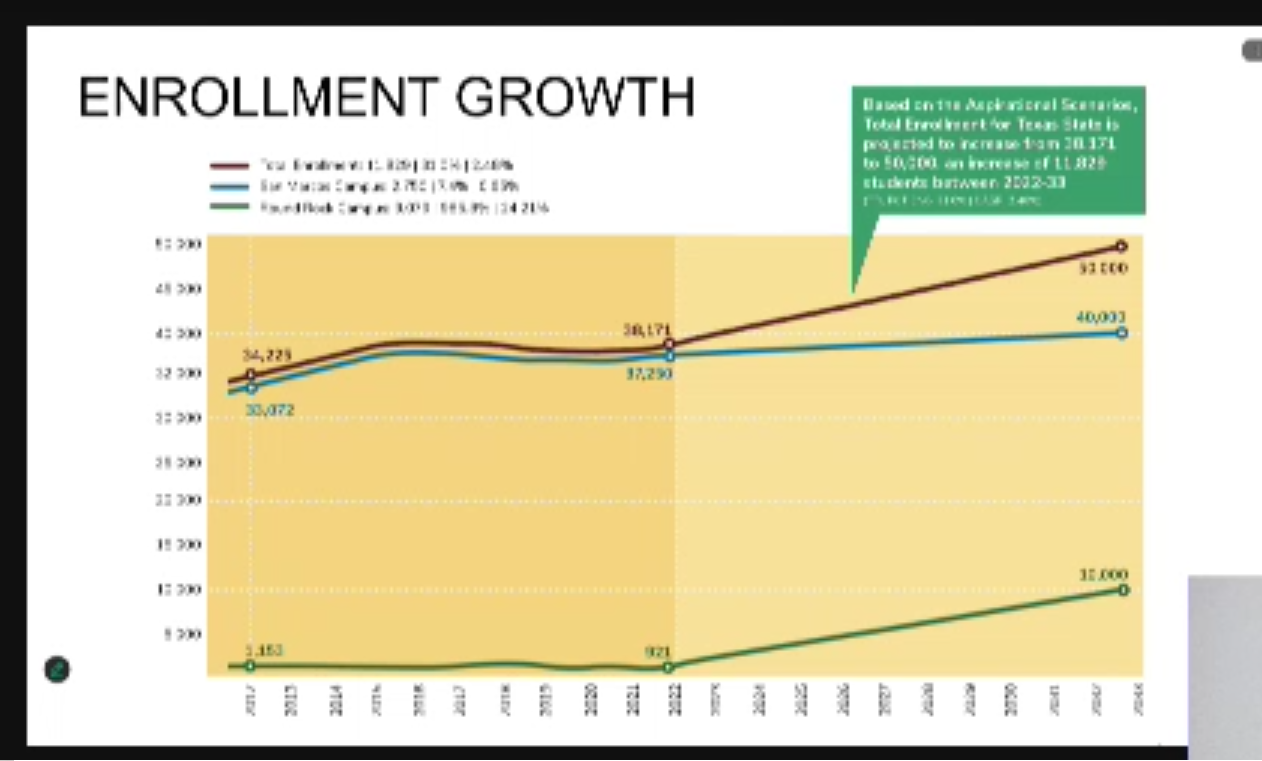
Enrollment Growth
Uh, yeah. Sorry about the quality! I bet it looked great in person!
They’re projecting to grow from 40K to 50K students, but most of that is at the Round Rock campus and online.
The green line at the bottom is Round Rock. The blue line in the middle is San Marcos. The San Marcos campus is projected to grow from 37K to 40K over the next ten years.
Housing need
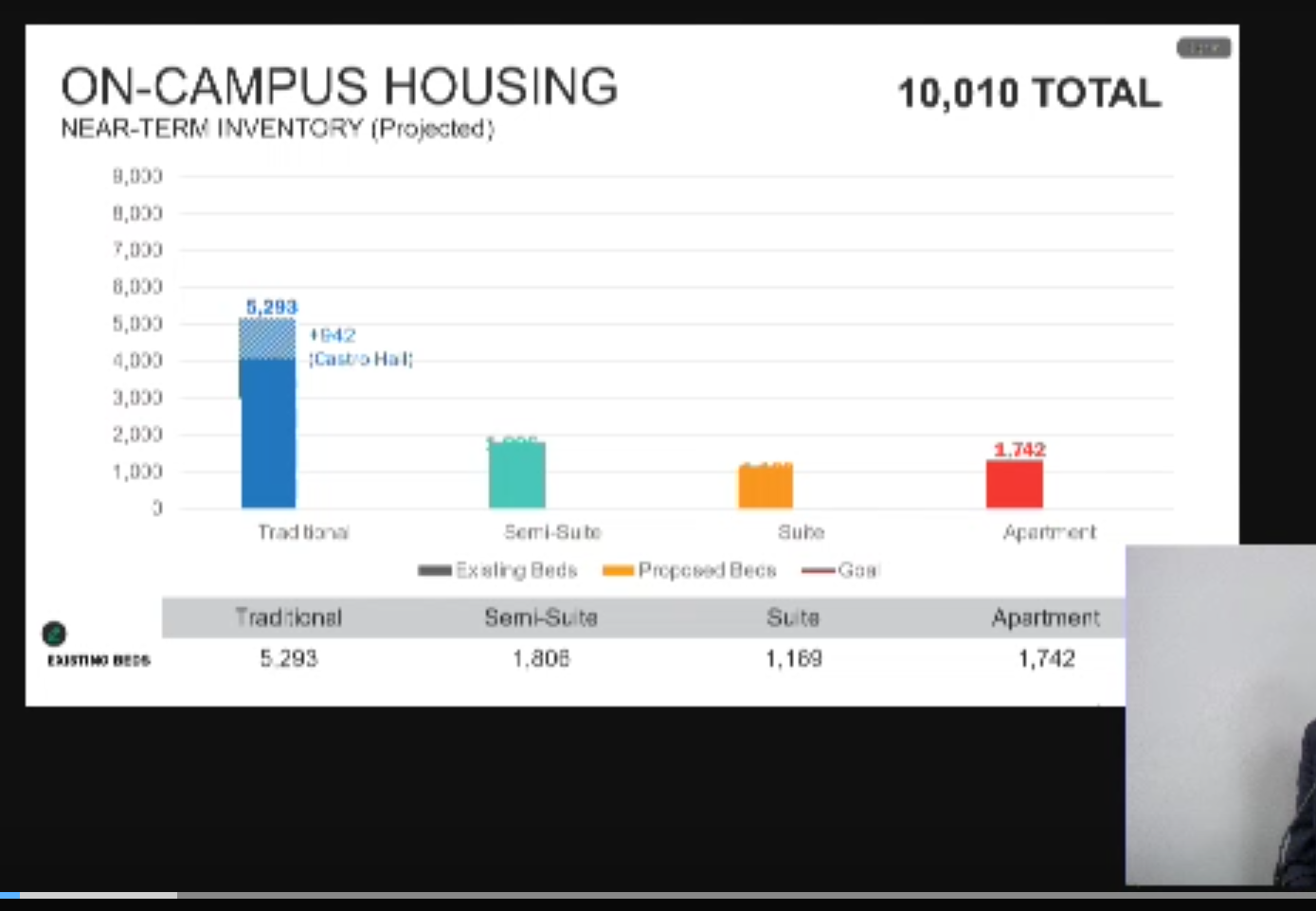
They’ve got about 10K beds on campus right now.
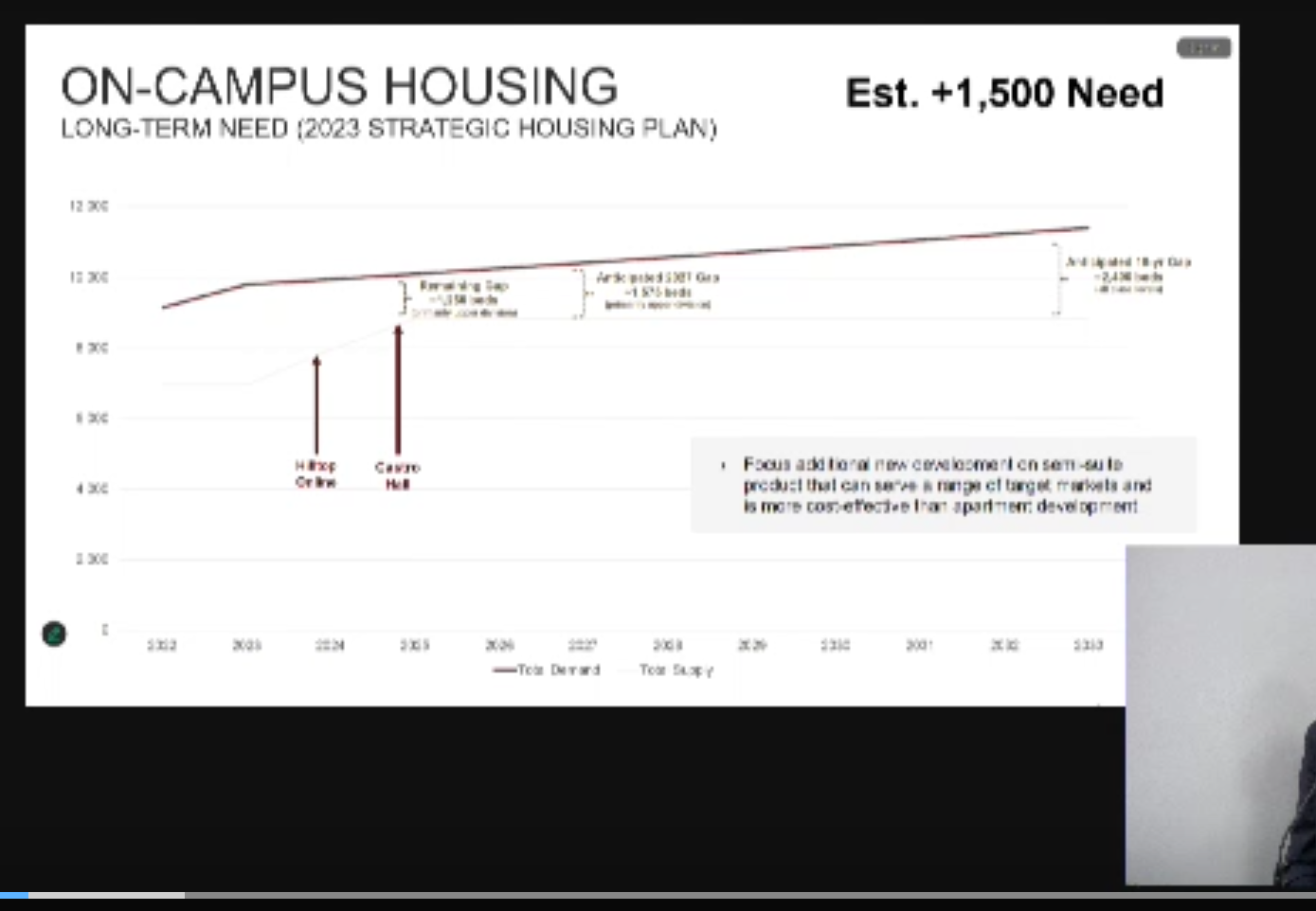
They’re going to need about 1500 more beds by 2027. They’re building more dorms to cover that.
Construction, etc:
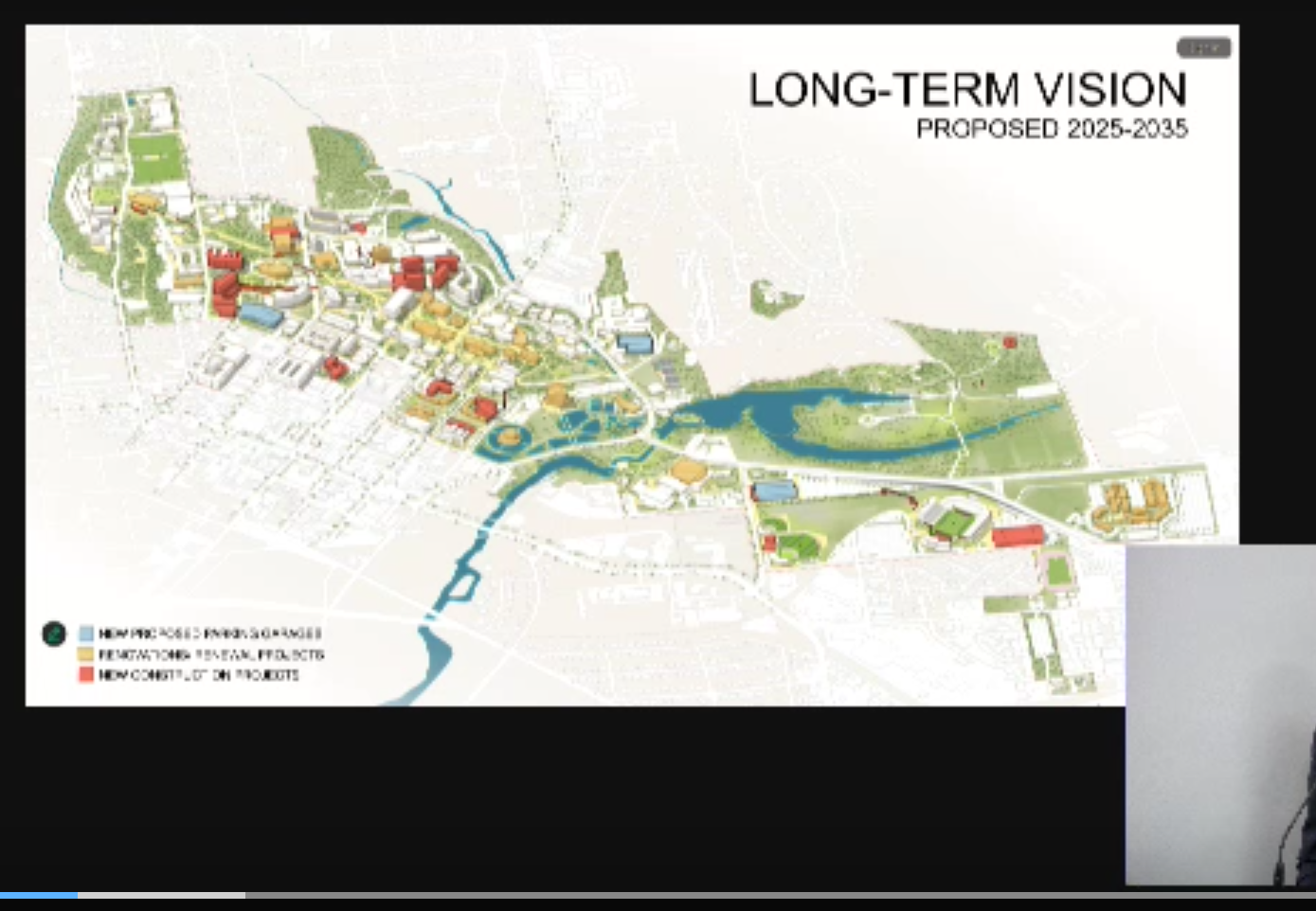
The dark red are new buildings that are under construction or are planned.
The light orange are getting major renovations.
So they’re not really planning to acquire any more land. Aside from those red buildings, they’re mostly going to reconfigure existing buildings to handle more capacity.
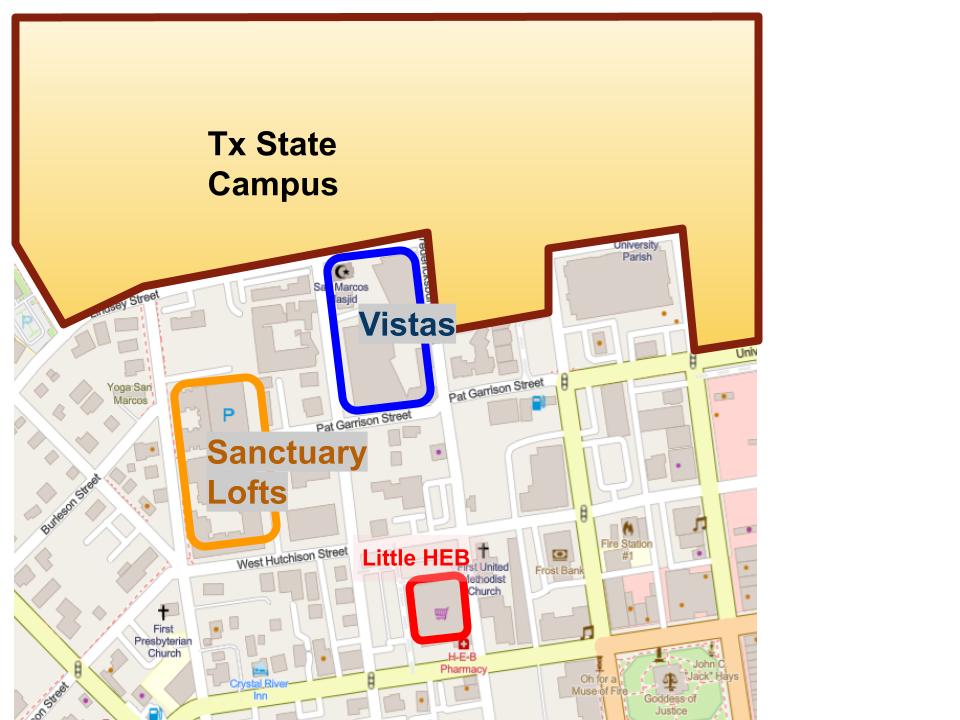
Note: This is supposed to comfort city council. The city is mad that the university purchased two downtown apartment buildings, in order to convert them into dorms:
Texas State doesn’t pay local taxes. And downtown apartment buildings are worth a lot of money. So the problem is that when Texas State bought those buildings, San Marcos lost a lot of tax revenue.
Light blue boxes might end up being parking garages. Bottom right is Thorpe Lane.
They’ve got 48 busses, 90,000 weekly ridership. It’s a pressure point for the university.
The plan is to merge the city and university bus system. This benefits San Marcos hugely. When the university started reporting their ridership to the feds, San Marcos got about $13 million in funding.
The speaker talks about having an app showing all busses, at any moment, all free for everyone in San Marcos. That sounds amazing!
Spring Lake:
There will be a lot more trails and improvements coming to Spring Lake:
but again, the slides are so murky. It’s hard for me to provide details.
Council questions:
Amanda: Is there any talk about capping growth at 40K?
Answer: That’s as much capacity as we can accommodate. But the regents want to grow all the universities to handle 60% of Texans by 2030. They tell us what they want, and they want to grow.
This is all taken from the next Master Plan, which will be approved in 2025.
Affordability: Recently, UT went free for families earning up to 100K. Can we do that?
Answer: Right now we’re free for families up to 50K. We’re asking to see if we can get funding to be free up to 100K, like UT. We expect that would be similar – 5-10% of our student body would fall in that 50K-100K range. (That is WILD. 85% of their student body comes from families making more than 100K?)
This plan has not been finalized yet. I think the master plan gets voted on next year.
Workshop #2:
Every four years, San Marcos has to review the City Charter.
Council will appoint seven people to the charter review commission. They only have six months to do a ton of work, because it has to be done in time for the fall election.
The community can also add charter amendments to the ballot, like when we outlawed fluoride in 2015. (We were RFK junior before RFK junior even had a brainworm.) Maybe we can undo that!
If you would like to be considered, they will be opening up for applications.

























 The San Marxist