
Workshop #2: LIHTC projects: This stands for Low Income Housing Tax Credits.
There are two kinds:
- Developers can get tax credits from the state
- Sometimes they get tax credits from both the city and the state.
Both kinds have to get approved by Council.
Backstory:
Blue are the developments that get just state tax breaks. Green gets both state and local:

This past spring we approved five developments (2 blue, 3 green) and Mark Gleason panicked that we were being too generous. We can’t help this many people! It’s fiscally irresponsible!
Hence this workshop! Let’s find out if we can afford to help vulnerable residents. (Spoiler: we can.)
More Background:
San Marcos is booming!
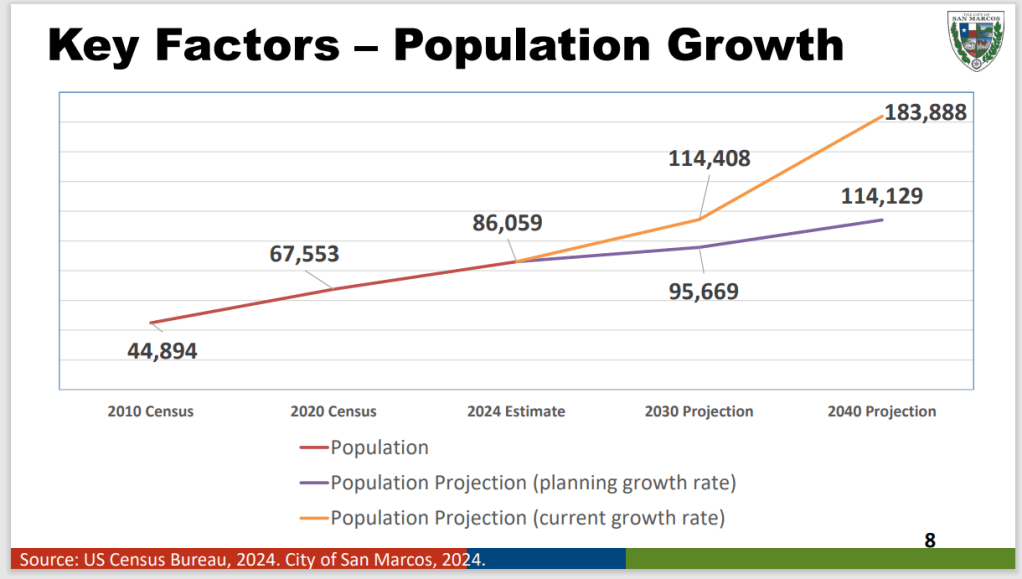
So we’ll end up somewhere between the purple and the orange, most likely.
You can look at it this way:

The blue parts are our new sprawl.
San Marcos has a good employment rate, but high poverty rate:
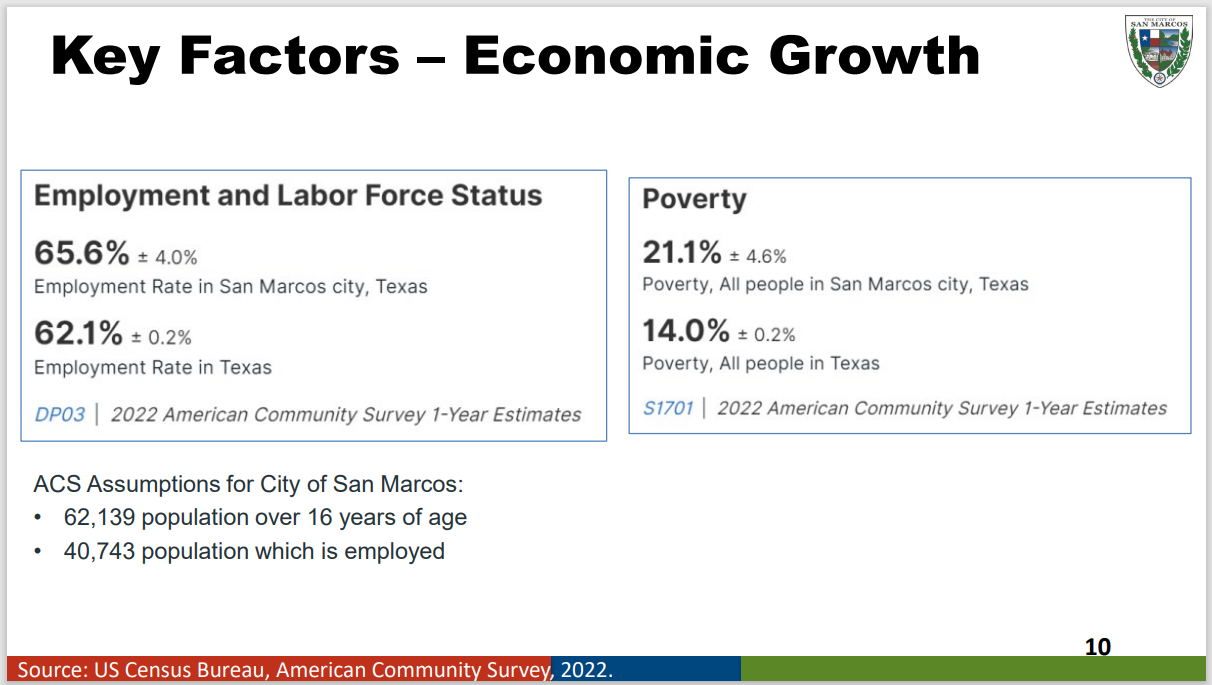
This means that our jobs are not good jobs. The cure for this is raising the minimum wage. (Raising the minimum wage does not cause inflation. Paying a living wage turns a bad job into a good one!)
Anyway!
Here’s where the jobs are:

This is fascinating:

In other words:
- Only 6700 of us actually live and work in San Marcos
- 18K of us live in San Marcos, but we work outside of town.
- 28K people commute into San Marcos, but live elsewhere.
In my humble opinion, this is two things:
- people who live here can’t find good jobs here, and
- the University has good jobs, but parents who work for Tx state are scared of SMCISD for problematic reasons. (I have lots of opinions on that. Support SMCISD!)
Anyway, those are my own conclusions. City staff did not lob those accusations.
…
So are LIHTC projects breaking our budget?
The city gets both sales tax and property tax.
When it comes to property tax, there’s a lot of tax-exempt property:
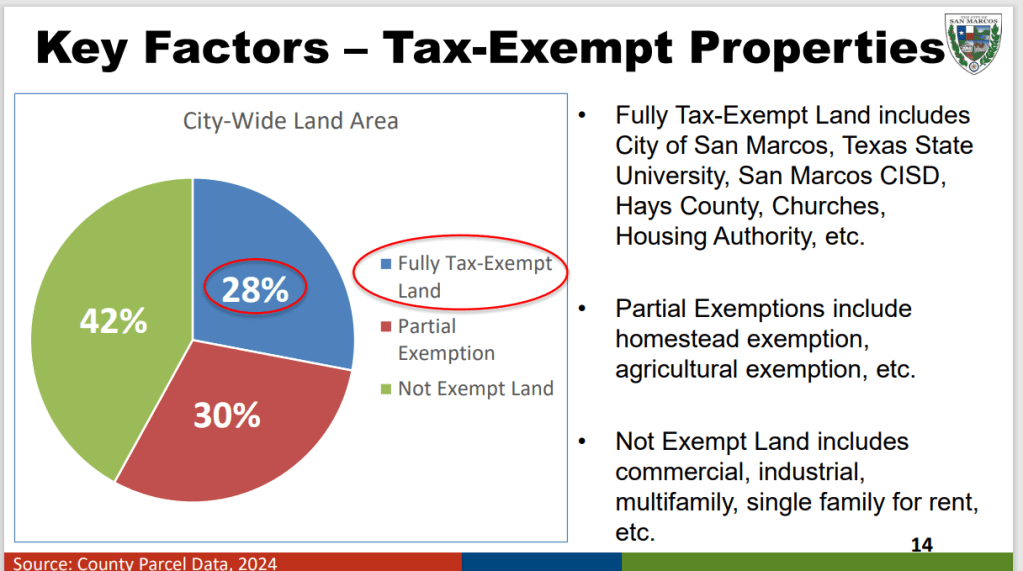
So some LIHTC projects don’t pay city taxes, but neither does city land, Texas State land, SMCISD, County land, Churches, Housing Authority, and others.
(One difference is that most of those are nonprofits. LIHTC developments aren’t necessarily nonprofits.)
So how bad is the dent in our budget??
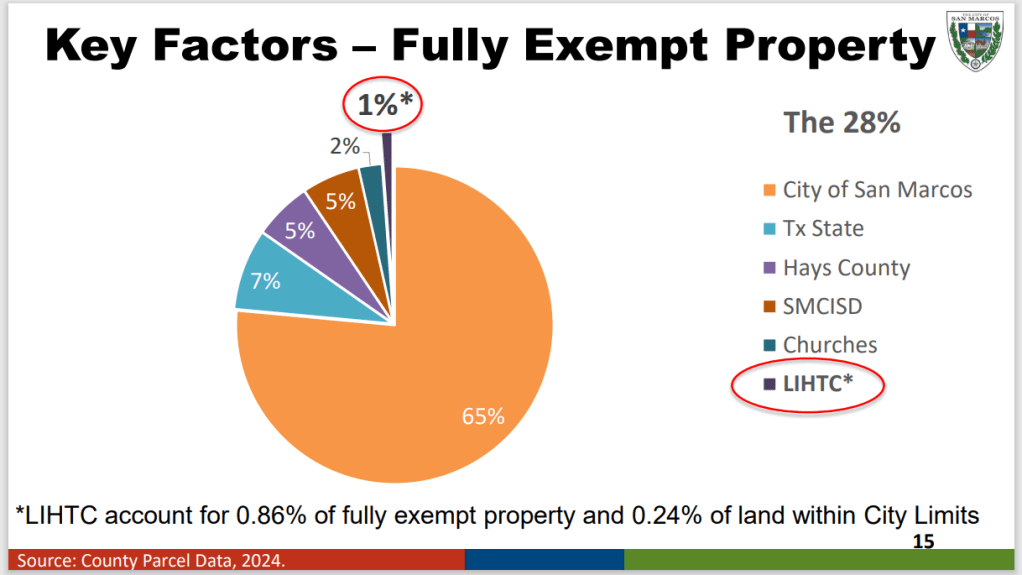
Not very bad!
You are allowed to ask for a lump sum payout. (Payment In Lieu of Taxes = PILOT). So we do this sometimes:

LIHTC apartments are still full of people, so you still have some fire and SMPD costs. But not particularly different than any other apartment complex.
In general, apartments are much cheaper infrastructure for the city than single family housing.
This is a great illustration of why:
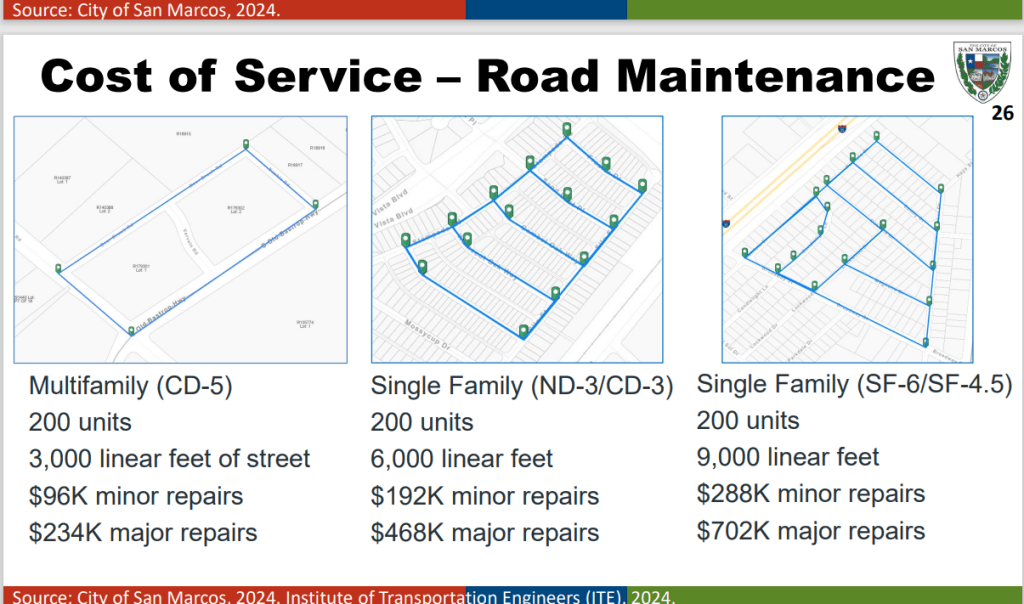
I want to love this graphic, but I can’t. The scale is all off.
- A 3-4 story apartment building is about 20-30 units per acre. The diagram on the left should be 7-10 acres.
- Single Family (ND-3/CD-3) are things like town homes and smaller lots – at most 10 units per acre. So that middle diagram is 20 acres big.
- Single Family (SF-6/SF-4.5) are big traditional lots – at most 7 houses per acre. So that right hand diagram is over 28 acres big. That’s three times as big as the one on the left!
Fixed it:

(I am so smug and insufferable. It’s a miracle you all put up with me.)
Anyway: there are also some city costs for things like libraries and transit. Same as for any residents.
…
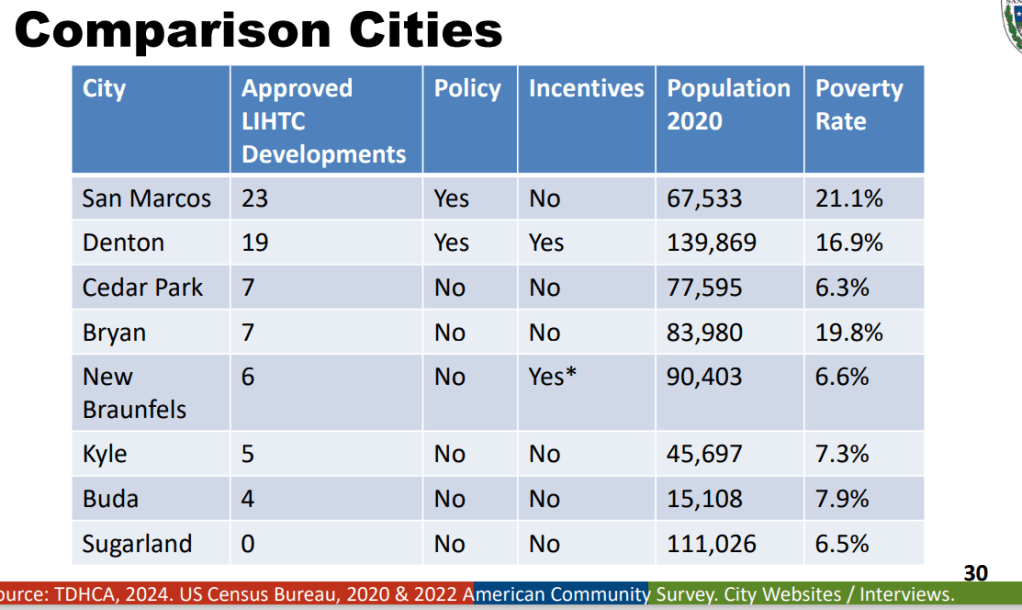
How much need is there in San Marcos?
More than elsewhere:
…
Onto the state requirements for their tax credits.
The state organization is TDHCA. (Texas Department of Housing and Community Affairs.)
They care about:
- Location. You can’t put your low income housing in a crappy location.
- Clustering – you can’t put them too close together
- Flood plain – nope
- They must have at least 15 hours each week of an after-school learning center
- They must supply a shuttle if they’re not on a bus route
- Free support services, a mix of amenities
- ADA apartments
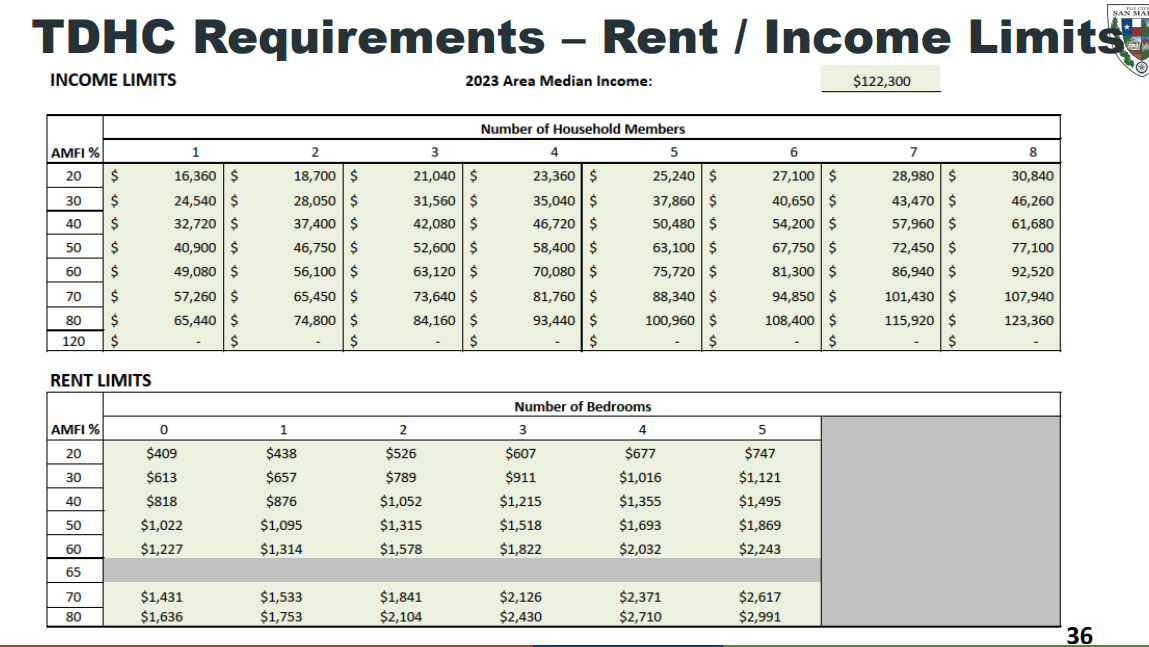
How cheap are these apartments?
First off, “AMI” is Area Median Income. We’re in the Austin Metropolitan area, so we use Austin incomes, even though San Marcos incomes are roughly half of Austin’s. (San Marcos median household income is $47K, whereas Austin median household income is $86K.)
Here’s the key feature:
The state also monitors the complexes:
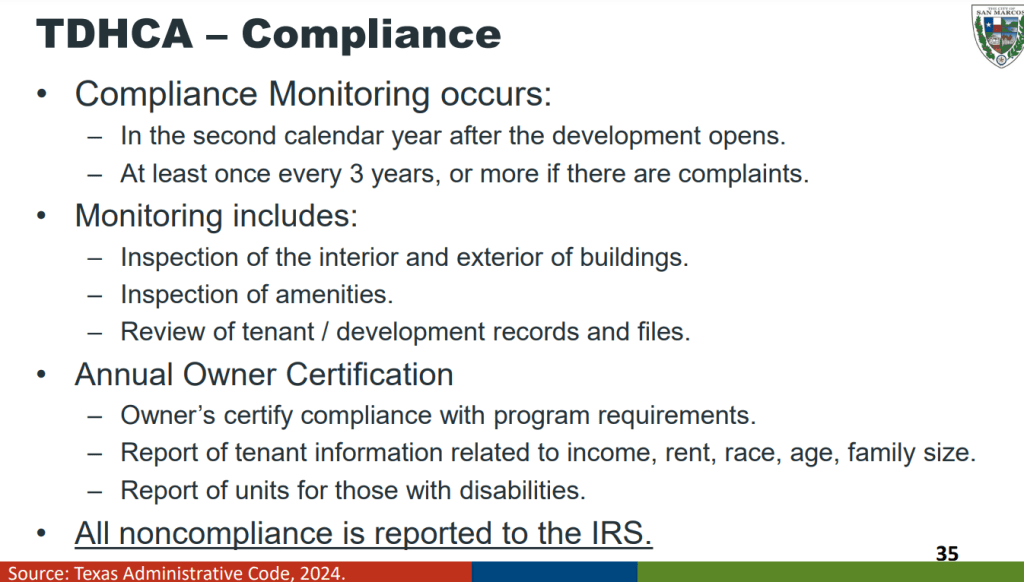
San Marcos does not get those reports, currently. It would be nice if we did.
…
If you’ll recall, we did a big Housing Needs Assessment back in 2019, and came up with a housing plan to work on housing affordability. This is great! And…. council then buried it six feet underground.
Housing affordability has not been a major priority of this council for the past five years. (Except Alyssa Garza.) In the budget we passed in October – two months ago! – our Strategic Plan Goals were:
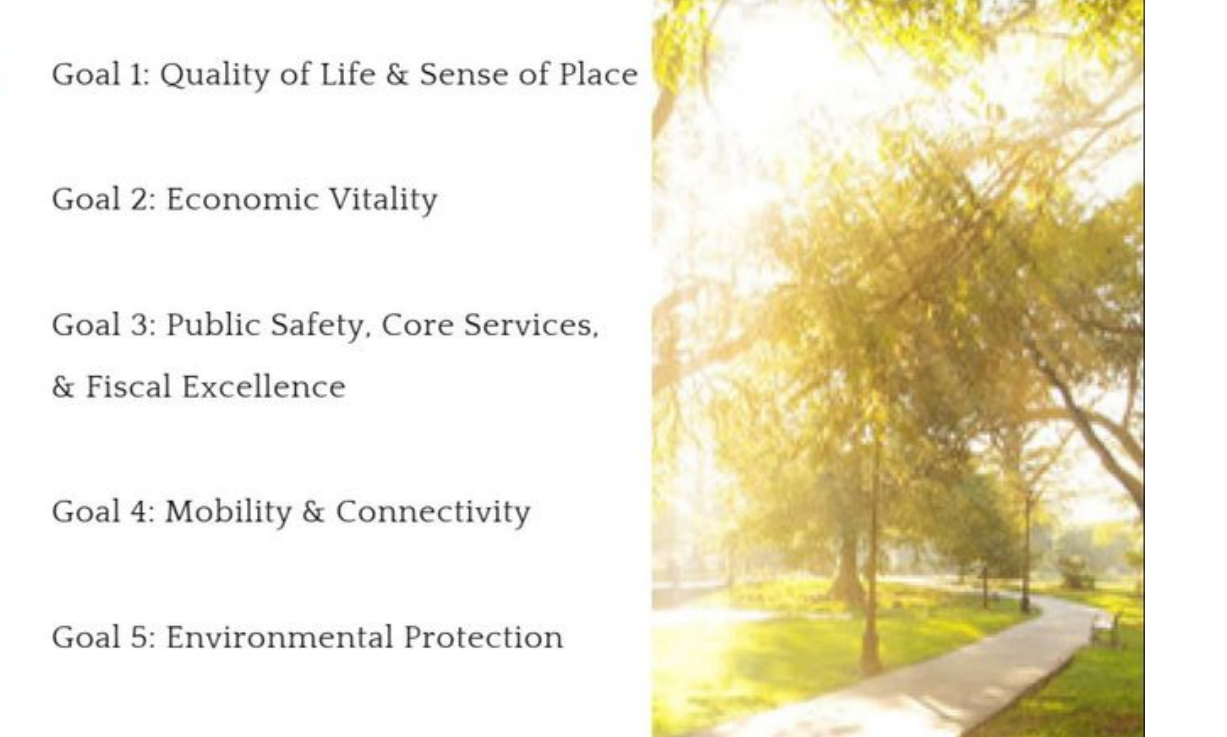
None of those are affordable housing.
Council did not care until this election cycle, when it became clear that you could lose your election if you didn’t hear the clamor for affordable housing. It was suddenly the #1 issue.
Anyway: We’re finally doing it, five years late. The first step is updating the data for the Housing Needs Assessment, which is almost ten years out of date.
Listen: this workshop was fascinating, and councilmembers asked good questions. I’m not doing it justice. But it was a 5 hour meeting and a 2 hour workshop, and your poor little marxist is tired.
 The San Marxist