You all: we are breaking our river. The most important thing at Council this week was the workshop on the river and river parks. We might have to fence the park in and charge admission. (Also we approved the new budget, zoned some stuff, etc. The usual.)
Here we go:
Hours 0:00 – 2:10: More on the City Hall steering committee, some parking, some zoning, and the budget for next year is approved.
Bonus! 3 pm workshops: All about the river parks. We might have to fence them in and charge admission.
Election season!
There was a debate hosted by the real estate agents this past Thursday. The League of Women Voters council and mayoral debates will be on October 17th. If you know of any other debates, let me know!
I will try to write everything up before early voting starts on October 21st. (That’s a tight turnaround, though.)
Don’t forget to make sure you’re registered to vote! Check here to see if you’re registered, or find out how to register, or update your registration. Last day to register is October 7th.
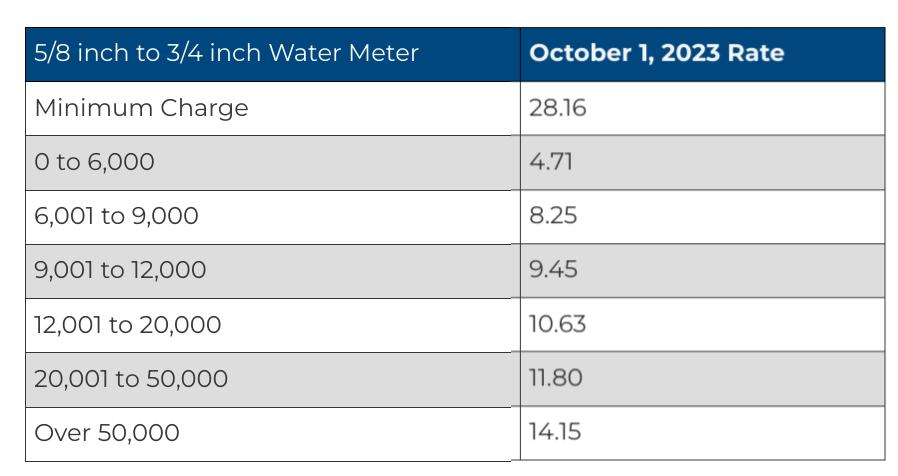
As you use more water, the water gets more expensive. This is good! It incentivizes people to use less water.
Right now, we’re raising utilities 5% across the board. If Council had wanted to, they could have tinkered with these marginal rates. But I bet it gets complicated, fast.
Not exactly Citizen Comment, but a general concern from a community member: the San Marcos Housing authority put out a statement saying that they were going to open up the waitlist for housing vouchers on Wednesday morning.
So everyone showed up! Apparently something like 250 people turned in pre-applications for housing vouchers that were supposed to open up on Wednesday morning. A bunch of people even spent the night outside the Housing Authority, in order to be there when the doors opened at 8:30. There was supposed to be a lottery to accept new applications.
And…. it just didn’t happen. The Housing Authority did not actually accept any applications. All the people needing housing just got sent away.
I don’t know what went wrong, but I guarantee there’s a throughline between having chronically underfunded housing assistance for decades, and this kind of mess. And Texas especially relishes underfunding programs for the poor.
….
Item 1: New City Hall steering committee
Last time we had a big song and dance about the composition of the committee. Should we do things the way we always do them? Or should the DEI coordinator steer us in a more equitable direction?
Here’s what the DEI coordinator says at the beginning of the conversation:
A good general principle is that the composition of your committee should match the composition of San Marcos. So you look at things like race, gender, ethnicity, and try to match the overall population of San Marcos. (As your friendly marxist blogger, I’d toss wealth on that list, too. Socioeconomic status is should be included in DEI initiatives. Poor people are underrepresented!)
Here’s what Council settles on:
Each councilmember will pick two community members to be on the committee
The mayor and two councilmembers will be on the committee
The committee will have some specific roles filled:
Someone from P&Z
From the library board
Someone representing the disability community
SMRF representative
Texas State representative
Downtown association rep
Chamber of commerce rep.
Two people from Rio Vista neighborhood
So depending on how much overlap there is between 1 and 3, there could be as few as 17 members or as many as 26 members.
The DEI coordinator tentatively pipes up: “The more prescriptive we are with roles, the harder it will be to achieve the DEI goals.”
What she means is that the Library Board, P&Z, Texas State admin, SMRF, the Downtown organization, and Chamber of Commerce are generally less diverse than San Marcos as a whole. The more you stack your steering committee with folks from these organizations, the harder it will be to make the composition of your steering committee match with the composition of San Marcos.
Jane misunderstands what the DEI coordinator means, and says, “Inclusion of these partners doesn’t mean exclusion of others! We’re not excluding anyone.”
She also says (tellingly), “This just follows the pattern of how we do appointments in San Marcos.”
It does follow the pattern! Councilmembers pick people they know and put them on committees. This is how power perpetuates itself. This is why you have to deliberately not follow the pattern of how we do appointments in San Marcos, if you want change.
The plan is to collect applications, and then have councilmembers select their two special besties from the pool.
Anyone can apply! Would YOU like to give your two cents on the new city hall? Submit an application here, why dontcha? They’re due in 30 days. (The application is not up yet, but I’ll edit this when it goes live.)
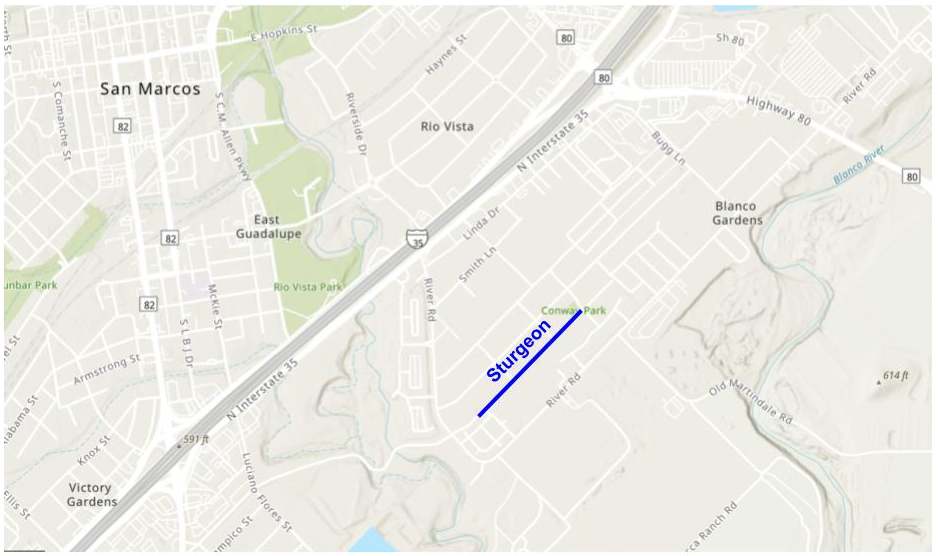
The good people of Sturgeon are fed up with non-residents parking on their street.
Sturgeon is this street, in Blanco Gardens:
They filed a petition to make the street permit parking, so only residents could park there. This is the area they want permitted:
My guess is they’re either sick of college students or river-goers parking there.
To be honest, I hate this kind of thing. Everyone pays for roads! We don’t own the curb in front of our houses. It’s not yours.
Occasionally, there is an extreme situation puts an undue burden on residents. I can understand that. But here? Seven of those parcels are empty! Why are we banning the public from parking in front of empty lots? It makes me cranky. (All the tan lots are empty in the diagram above.)
I just don’t like the privatization of something that’s public. Public spaces belong to the public, end of story.
…
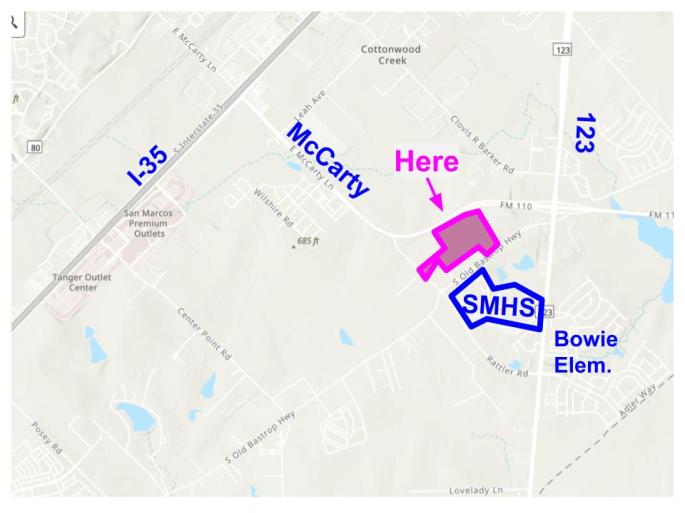
Items 21-23: 51 acres off McCarty and 123
This bit is getting annexed and zoned:
It’s right by the high school, here:
Everybody knows we need more commerce on the east side of town. For years, residents have asked for this.
(Quick sidebar: But don’t forget! Council removed commerce from Cottonwood Creek here, and then two months later Council removed commerce from the giant future development on 123 here. For Cottonwood Creek, residents wrote letters and showed up to say that they wanted to keep the commercial! And yet Council killed it anyway, because the developer asked nicely.)
Anyway, in general there’s very few stores east of I-35. These guys are committing to putting commerce on this corner:
It’s being zoned Commercial.
The rest of it is being zoned CD-4:
CD-4 is a Character District. That means that city staff is really hoping it will look like this:
Little shops mixed with apartments, and oodles of charm.
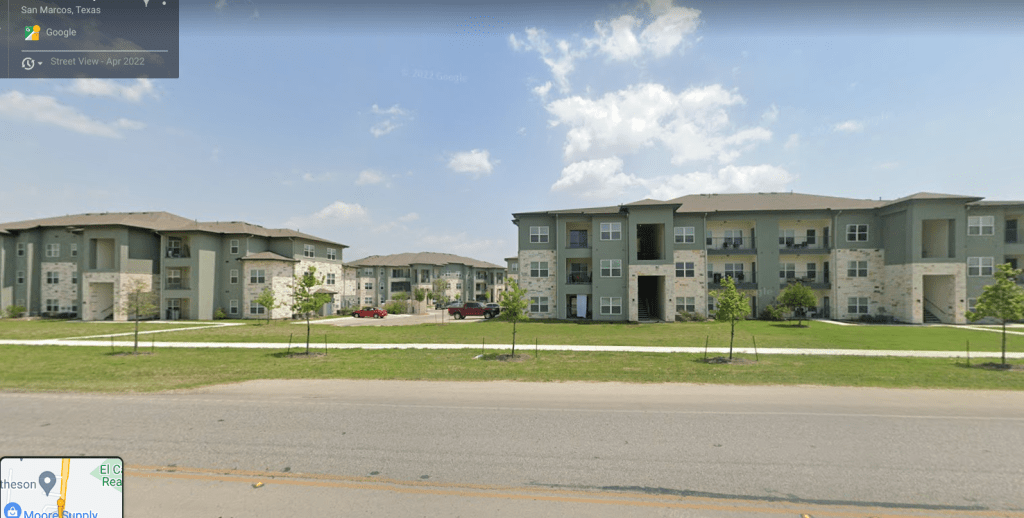
But it actually usually looks like this:
Not terrible, and the housing is needed, but not quite as charming as Sesame Street.
….
You know what would be fun? Dusting off our five criteria for zoning! C’mon, guys, let’s see if we agree with our councilmembers.
1. Price Tag to the City: Will it bring in taxes that pay for itself, over the lifespan of the infrastructure and future repair? How much will it cost to extend roads, utilities, on fire and police coverage, on water and wastewater?
Who knows! No one ever provides this information!
But my educated guess is yes. The main problem is with single family detached homes – they don’t pay enough taxes to cover their roads and services. Since this will have apartments and commercial, it should be fine. It’s also along existing roads with existing utilities and coverage areas.
2. Housing stock: How long will it take to build? How much housing will it provide? What is the forecasted housing deficit at that point? Is it targeting a price-point that serves what San Marcos needs?
We also have no info here! But it doesn’t sound like giant $500K McMansions. It sounds like apartments plus stores.
3. Environment: Is it on the aquifer? Is it in a flood zone? Will it create run off into the river?Are we looking at sprawl? Is it uniformly single-family homes?
Environmentally sound. Not near the river. Not sprawl. Not all single family homes.
Social: Is it meaningfully mixed income? Is it near existing SMCISD schools and amenities?
I doubt it will be mixed income. It is near schools, and hopefully near amenities.
The San Marxist Special: Is it a mixed-income blend of single family houses, four-plexes, and eight-plexes, all mixed together? With schools, shops, restaurants, and public community space sprinkled throughout?
I don’t know how charming this will be. We can hope.
So overall: I approve. It seems more good than not.
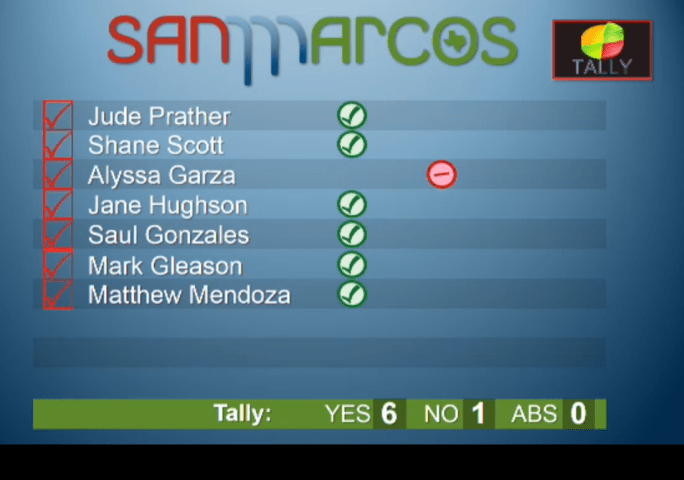
Council does, too. It all passes 6-0. (Shane Scott is absent.)
“YAY COMMERCE!” council cheers.
…
Items 24-27: All the budget and tax rate final details. (Discussed here and here previously.)
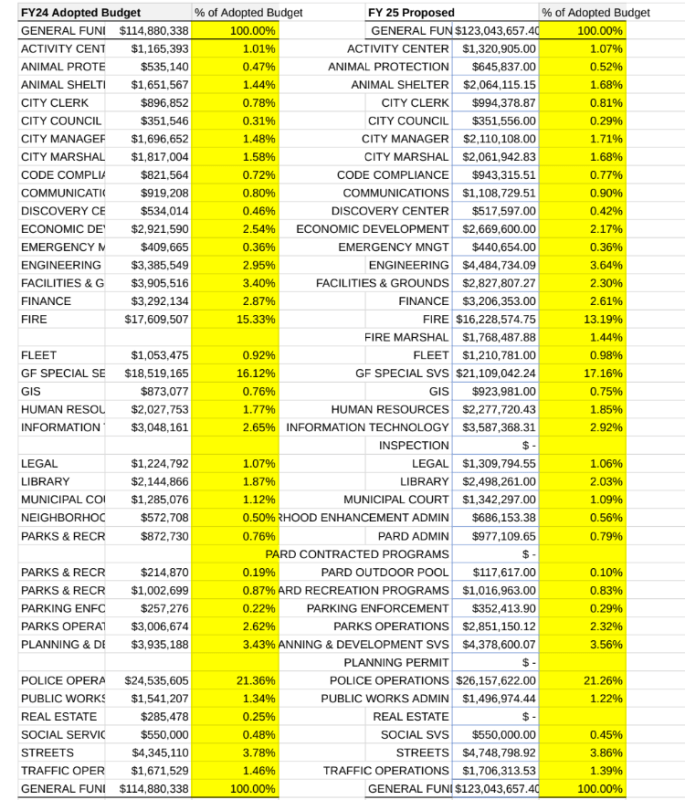
First things first! The good people at City Hall were able to give me the General Fund breakdown.
I put together this side-by-side comparison for last year and this year:
Budgets are complicated. I don’t have any great takeaways here.
…
Next: We’re taxing ourselves less than we thought we were. We made an error in an obscure tax computation, and just now fixed it.
Here’s the quick version: You’ve got your existing taxable buildings, and you’ve got your new builds. Texas state law cares about the total amount you’re getting each year from the existing taxable buildings. (So you’re ignoring tax revenue from new buildings, for now.)
Is the total revenue from existing buildings going up or down? Sometimes it goes up because you raised taxes. Other times it goes up because your housing prices are going up. Either way, you’ve got to jump through some extra hoops if that total is going up.
We drew up our budget, and we thought it was going up, but…. <drumroll> it turns out it’s going down! Hooray? Since we didn’t change our tax rate, that means home values are falling.
(Jude: THIS IS A REALLY BIG DEAL! THIS NEVER HAPPENS!
Mark: IT’S THE GROWTH!)
….
You know me: I just always have to rant a little bit about taxes. (I swear this will be a very tiny soapbox. Two minutes, tops.)
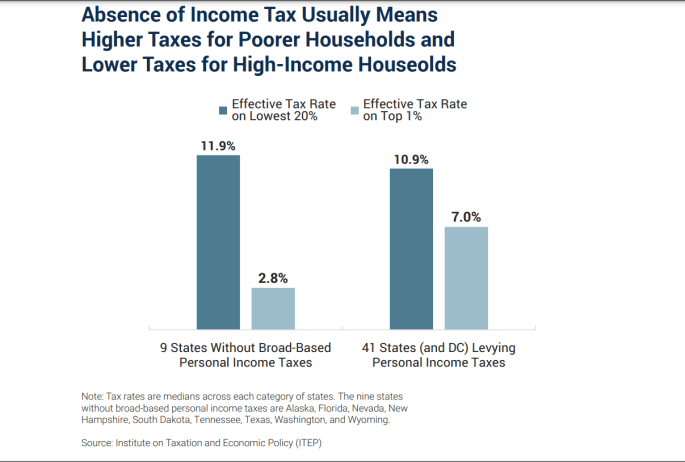
Taxes are good! That’s how you fund your government, and take care of your community. The problem is that we won’t tax wealthy people in Texas. First off, the poorest people are paying the most taxes:
And this is worse than in other states!
Notice that Texas is one of the states on the left part of that graph.
People complain about high property taxes, but those aren’t the unfair part. The unfair part is the sales tax. (Both state and local.) Sales taxes really are the worst! Poor people end up paying a much higher percentage of their income than wealthy people. Literally, it’s capitalism for the poor and socialism for the wealthy.
End rant! I promised you I’d keep it short.
…
Anyway: only one person speaks at citizen comment and nothing gets debated. The end! We have a new budget and next year’s tax rate.
The vote: 5-1. Alyssa Garza votes against everything, presumably because of the utility rate hikes.
…
Item 28: Mowing, landscaping, and litter around city buildings. It is a giant task.
We contract out parts of it to Easter Seals of Central Texas, to the tune of $1,432,702.54.
…
Item 29: Purgatory Creek Channel improvements
We had a whole workshop all about the Purgatory Creek channel improvements last time! This meeting, we’re kicking off $3,281,773.35 towards engineering for Phase 1.
Saul Gonzales asks, “There’s a bunch of stagnant water in the side channels through Dunbar. Will this help with that?”
Answer: Sort of yes! Part of the project is raising some of the low-water crossings. That is a major reason why water can’t drain downstream. But also sort of no! This is supposed to recreate natural channels, and they do pool some.
The city applied for grants to cover a lot of the costs. We should find out next month if we get them. If we get them, we’ll start construction next year.
….
Item 32: Filling a bunch of vacancies on different committees.
There was one moment that ticked me off. There’s a vacancy on the Animal Shelter Advisory Committee. We only had one application.
Matthew Mendoza pointed out that on the application, this volunteer stated that they have only lived in San Marcos for two months. Matthew is uncomfortable with this, and Jane agreed. Matthew likes it when people have lived here longer. They decided to re-open applications and see if anyone else applies.
GUYS! Stop this rudeness. First off, you should be welcoming to new people.
Second off, if this were a vacancy on P&Z or the new City Hall steering committee? Sure, require 5 year residency. You want people with some roots and community background. (I guess.)
But that’s not this. This is the ANIMAL SHELTER. A new person moved to town and wants to volunteer their time to help the doggos! We should be appreciative, but instead we’re crapping on them for not having roots in the area. That’s dumb.
…
Item 33: What night will city council meet, on election week?
The election is on a Tuesday. You don’t want to hold a council meeting the same day as an election. We don’t want to get in the way of anyone voting.
So should the council meeting be shifted to Monday or Wednesday? Historically we switch to the Monday. But Jane Hughson is suggesting that this year, council should meet on the Wednesday instead.
I want to emphasize two things:
When I say that Jane is good at details, this is a perfect example of what I mean. She explained her thinking: “Suppose I am a community member who doesn’t know that the meeting was moved, and I show up on Tuesday. If the meeting already passed on Monday, then I’m out of luck. But if the meeting is not till Wednesday, I can come back tomorrow.”
This is really thoughtful and detail-oriented. Jane Hughson is unusually good at this sort of thing.
It’s worse for me, your friendly blogger. I need every last minute to crank out these posts! If the meeting is on Wednesday, then I get crunched, which gives me a sad. But in my heart of hearts, I know Jane is right.
This week’s workshop was all about the river and parks. It was both so interesting and so depressing.
The big question is: How’d the can ban go?!
The big answer is: We broke our river. We were so overwhelmed with record-breaking crowds that we couldn’t even get to the can ban. The river got really damaged.
Out-of-town crowds were too big. Bad behavior was high. There was more trash and destruction than ever before. We might have to fence in the river parks and start charging admission. It’s all very depressing!
Let’s dive in.
Preparations. We planned on doing the can ban! (There was a can ban plan.)
Here’s what we did ahead of time to prepare:
We tried to promote the ban every way we knew how, ahead of time.
We put these signs up in the park:
There were also sidewalk stickers, pointing towards the Go Zones and the No Zones.
You could quibble that the signs and stickers weren’t great at demarcating the Go Zones and No Zones, but this was supposed to be the trial year, where we try things and see what works. ♫ Life’s a dance you learn as you go ♪, and all that.
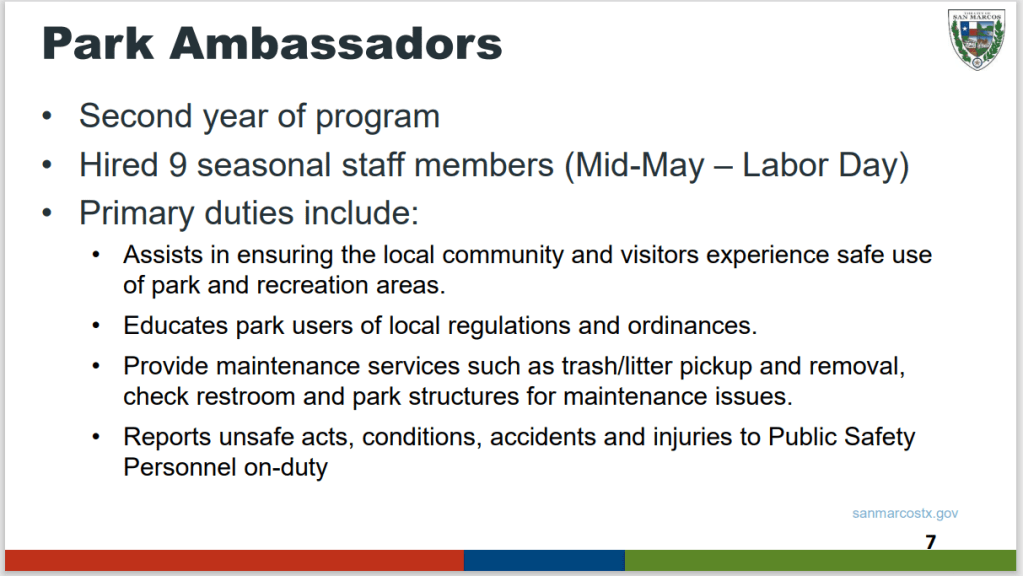
Generally there are both marshals and park ambassadors at the park:
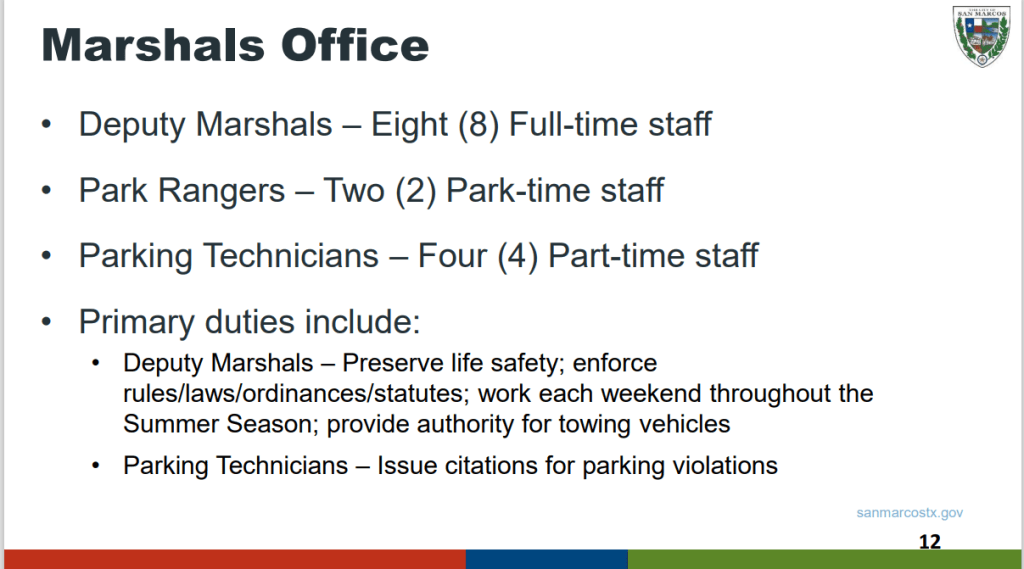
And marshals:
(The can ban plan began.)
But things went really badly:
The big problem is drunk people – they fight, they trip and fall and hurt themselves, they get heatstroke or other medical issues from the heat. Just lots of safety issues that preoccupy city marshal attention. No one has any bandwidth to get to the can ban.
Overparking is a problem, too. And there’s lots of litter that gets left wherever people go to find parking.
Memorial day was a particular disaster:
So in response to Memorial Day, they changed things up for 4th of July weekend and Labor Day weekend.
Mainly, they shut down Cheatham street. This helped with the drop-off and pick-up mess, and the aggressive U-turns that cars make. They had to staff both ends of the street, so that used up more staffing.
The other big thing was contracting with off-duty police officers. We pulled $100K out of Covid money and spent it on extra staffing.
Finally, they blacked out the dates for the baseball fields, so we weren’t hosting a baseball tournament at the same time. This freed up some parking for the rivers.
…
So how bad did things go?
Deputy Marshals have a dashboard:
This is the total for the whole summer. Highlights:
329 park evictions.
48 citations. You can see that the most common one is alcohol, by far, and next is parking violations.
Only 2 arrests! But that’s because a marshal has to then leave with the person, which leaves the park even more understaffed. So ususally they just kick the person out of the parks.
69 medical incidents. Most of those are drunk people who succumb to the heat.
It sounded pretty grim. They were so understaffed. All the marshals and park ambassadors worked every single weekend, no exceptions, all summer long, no vacations.
Staff also said that most of the behavior problems are out-of-towners. Local residents are less likely to cause problems.
This is the main reason the can ban kinda died – we were in survival mode for making sure that everyone stayed alive and safe.
3.Sowhy???
Why is all of this happening? What changed in the past few years?
The problem is all the other river parks. The other cities have fenced in their parks and started charging admission. We’re the only free river park left, in the San Antonio-Austin general region.
I hate all of this so much. It pits two things I care deeply about against each other:
Recreation should be available to all people.
You must take care of your river.
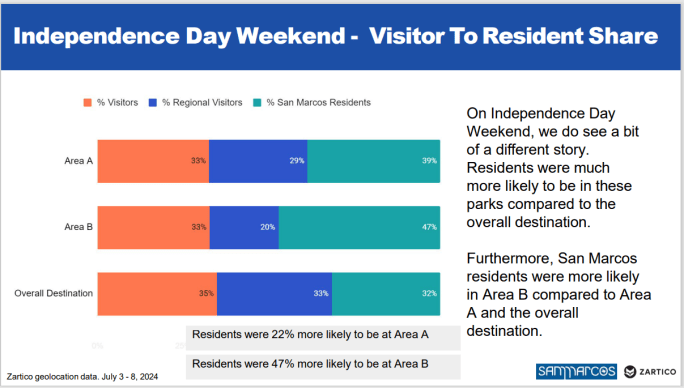
So who exactly uses the river parks so much? We hire these guys to track cell phone data. Here’s what they tell us:
First:
Area A is downstream – the falls, near the baseball fields, near the children’s park. Area B is upstream – near the Lion’s Club and the general Sights and Sounds part of the park. (I don’t know what Overall Destination means.)
Next, the colors:
Teal means they are San Marcos residents. Blue means they come from this radius:
Orange means they’re from outside of that circle.
So roughly 60% out-of-towners. I’m kinda surprised by how many people drive in from Houston:
So how many people actually are showing up on these busy weekends? It wasn’t in the presentation, so I emailed city staff to see if we knew.
They kindly answered: Nope, unfortunately, we don’t. You can’t get that data from this company, because they’re just sampling cell phone data. To know the total number of people, you’d have to have staff literally out there counting by hand.
Crowds looked a little different on the 4th of July weekend, but you get the picture:
Anecdotally, the speakers said the vast majority of the drug/alcohol/behavior problems were out-of-towners. Also depressing!
…
4. Onto the poor river.
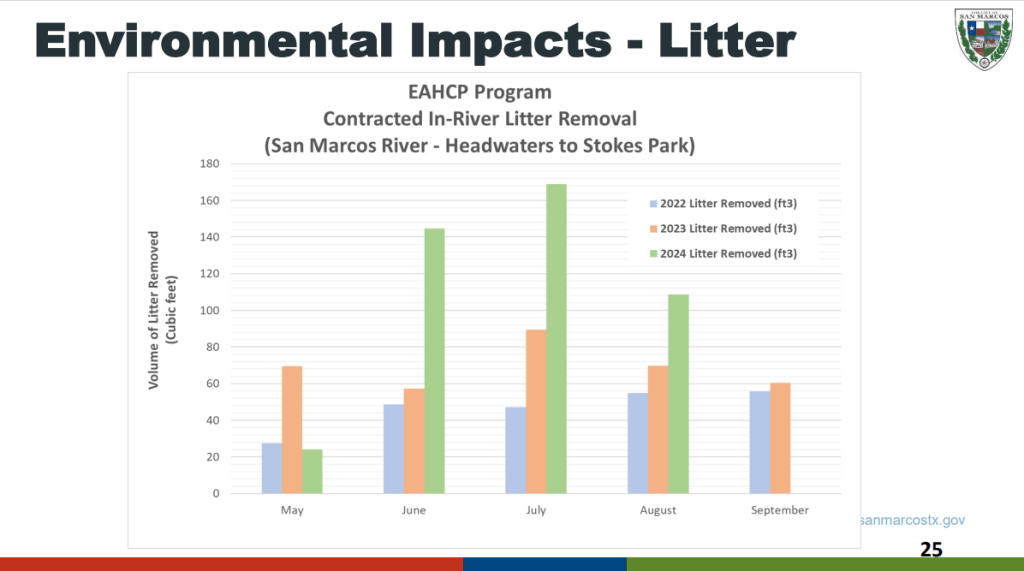
First up, litter:
It looks like it went through the roof. But staff said that this graph is misleading, because we doubled our clean up efforts to twice weekly instead of once a week. Some of that is old trash from years past.
So maybe some of the tubers were bringing re-usable containers after all? And the can ban helped? Who knows.
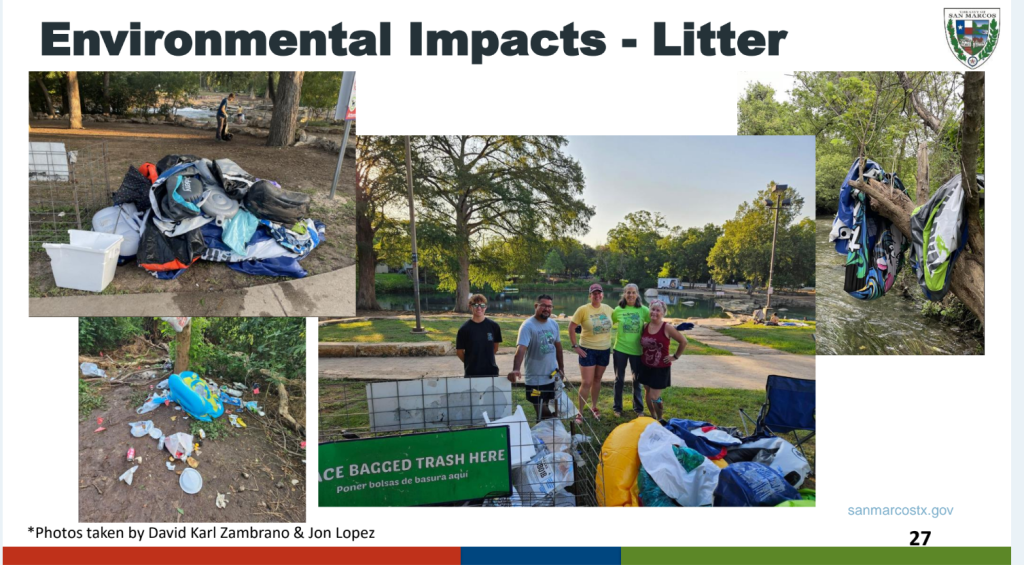
Look at this stuff. Ugh ugh ugh.
They said that usually on Saturdays and Sundays, they pulled about 50 old dead tubes out of the water each day.
Apparently Lion’s Club rentals were way down, too. Two years ago, they rented 48,000 tubes. This year they rented 36,000 tubes. Same with shuttle service. People are buying tubes from stores and walking back up to the top of the river, instead.
…
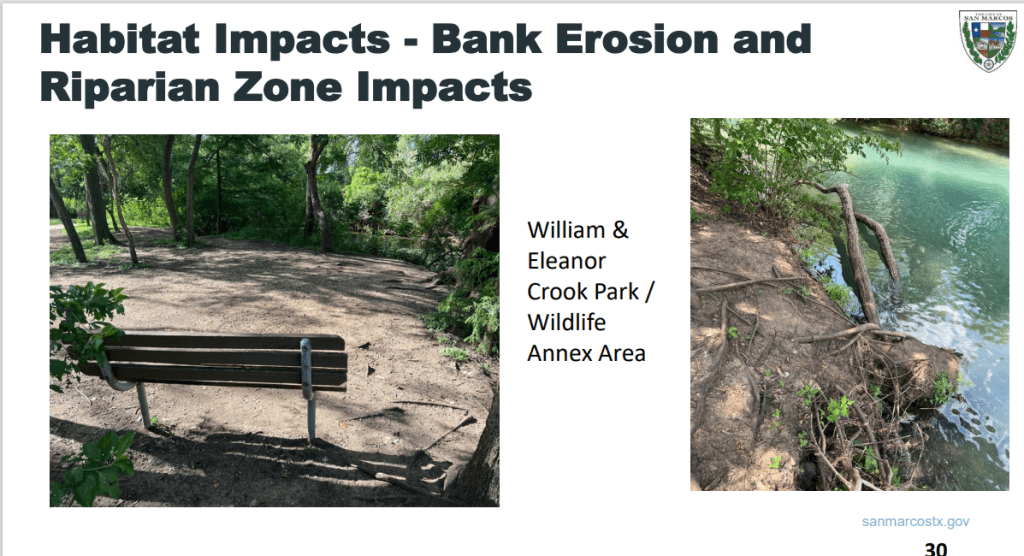
A really big problem is that people find new ways to get into the river, and then they destroy the river at these access points.
The bank erosion looks like this:
And the wild rice, ecosystem, etc everything gets destroyed.
I told you it was depressing.
They put lots of photos in, so I’ll pass them along:
This presentation was a major bummer. You only get one river!
Staff only has one proposal: You fence in your parks, you charge nonresidents for admission, and you use the revenue to hire more staff.
Apparently New Braunfels brings in enough money to pay for it’s entire parks system. That’s a lot more financially sustainable than redirecting $100K of Covid money to contract out with off-duty police officers.
Here’s the thing: inevitably, it will limit access poorer people with fewer resources more than it limits access for wealthier people. Even if you make it free for residents, there will be hoops to jump through.
But what else can you do? I have no other good ideas, either.
So now we turn to Council discussion.
(Only Mark, Matthew, Saul and Jane were here.)
Mark Gleason goes first: he has serious reservations about fencing in the park and charging admission.
There’s no such thing as “aesthetically pleasing” perimeter fencing.
It might be inevitable, but it’s got such a cost associated with it.
Can we fully implement paid parking and the can ban first, and see if that helps?
Fences become dams in a flood! They clog with leaves and debris and prevent water flow.
I am really sympathetic to him here. I also want anything but blocking off the parks.
Staff responds to some of these: paid parking is not going to generate the kind of income stream we need to staff these crowds.
Jane Hughson: “Yes on managed access. This is breaking my heart.”
What would a perimeter fence and managed access look like?
There’s nothing concrete to talk about yet. Staff wanted to check with Council before beginning research. So we can’t say where the fences would go, or where the entrances would be, or anything.
How far up would it start? Texas State is having problems at Sewell and the headwaters, and so they want to coordinate with us on this.
How far down would it go? Probably to I-35, at first. Mark Gleason points out that this will drive people to over-use the river on the east side of 35. Staff responds that they’ll have more staff available to cover these other areas, once we get a stable revenue stream.
Apparently New Braunfels does have a problem with people slashing the fence, to sneak in. They have to constantly pay for repairs. So we’d probably have that problem, too.
Some possibilities to explore:
Free for residents
Free during the week
My read on the mood in the room was that this is inevitable. We will have to fence off the river parks and charge admission.
…
Top Secret Executive session: Another ridiculous code name: Project Jolly Rancher!
This week’s meeting was just zip, zip, zip. All these topics that sometimes get tons of deep, gritty discussion – the budget, the tax rate, Axis/SMART Terminal – just sailed through. (The workshops are great, though! Lots of good pictures.)
Here we go:
Hours 0:00 – 3:38: The new budget, tax rate, and utilities. Also the end of the (Axis) road, the end of a useless MUD, more on School Resource Officers, and a little about the new city hall.
Bonus! 3 pm workshops: These were great! The Purgatory Creek project, a $2 million bridge, and the state of utility assistance in San Marcos.
Five people spoke against the SMART/Axis road annexation.
A guy from the airport asked about his lease rate for his hangar
That was about it.
…
Items 2-3: Quarterly financial and investment report.
This is the official report for Jan 1st – March 31st went. Back in May, we got a sneak preview: sales tax was tanking below projections and we were scrambling to reign in spending.
This is more re-hashing of that same news. Sales tax was down, so everything got pulled back.
…
Item 19: It takes two public hearings to approve the budget. This is the first, and then final approval will be on September 17th.
Here’s the big picture:
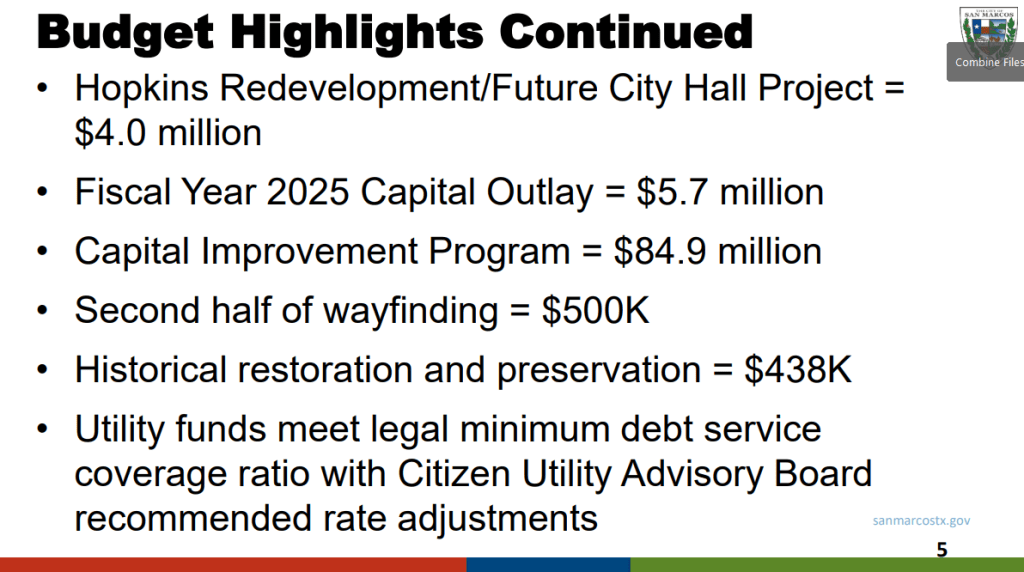
With highlights:
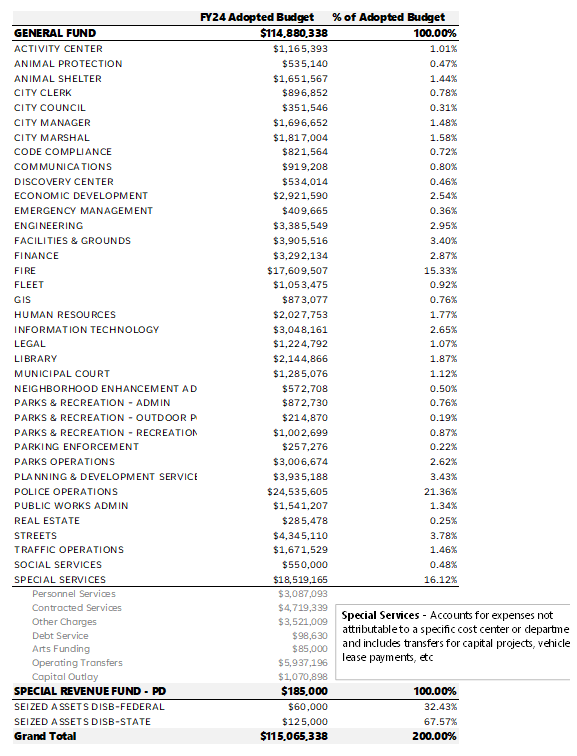
For me, the highlights are only somewhat helpful. I need context in order to makes sense of these notes. What helps me most is a breakdown of the general fund, by department.
Last year’s breakdown of the General Fund, by department:
I got that by submitting a FOIA request last year. I’ve requested this year’s General Fund breakdown, but haven’t yet gotten it.
[Let me put on my tinfoil hat for just a moment. Indulge me in the dullest conspiracy theory of all times:
– The 2024 draft budget has the General Fund breakdown by department, starting on page 82. – But the 2024 adopted budget has no General Fund breakdown anywhere! – the 2023 draft budget has the General Fund breakdown by department, starting on page 88. – But 2023 adopted budget also has no General Fund breakdown anywhere!
For the past two years, it’s disappeared from the actual budget, once it was approved. What on earth.
Finally, even the 2025 proposed budget does NOT have the General Fund breakdown included. This annoys me, hence the FOIA request mentioned above.
I submitted the request back on August 22nd, so we’re past the normal FOIA response time. The information is in the budget, but it’s scattered. It would take hours of work for a layperson to extract it from the online budget, one department at a time.
END OF MY MILDLY EXASPERATING CONSPIRACY THEORY!]
…
Back to budget discussions. Utility rates are going up:
The average home-owner will pay $13.46 more per month. There’s a big discussion in the workshops about utility assistance, so I’ll cover some details later on.
We’re using the same tax rate as last year, 60.3¢.
…
Listen: I cannot stress enough how little conversation there is about any of this. Partly this is because there have been a lot of budget workshops already. Partly this is because the community didn’t show up to complain. (Although they have one more chance.) But mostly because this council is so used to each other that they all know exactly where they all stand. There’s nothing left to say.
…
Matthew Mendoza asks a great question. During the section on the Water and Wastewater Fund, he asks: “These contract costs keep increasing every year. Why do we keep contracting out? There’s like 4 water and wastewater contracts. Why not do these things internally?”
The answer has a few parts:
Some contracts are management contracts, others are infrastructure and CIP
The contracts for the surface water plant and the wastewater treatment plant both have automatic inflation adjustments built in
On the wastewater treatment plant, we’re at the end of a 20 year contract. We’re putting a provision in the new contract to have an exit clause, so we could convert staffing to in-house in a few years if we want. When it was built in the 90s, it actually was operated by city staff. We started contracting it out in the 2000s.
This is SUPER interesting! Let’s highlight some things:
It’s so common for contracts to have built-in, automatic inflation adjustments! You know what doesn’t? The minimum wage. Failure to peg the minimum wage to inflation is one of the most underappreciated policy failures of the 20th century.
The wastewater treatment plan used to be city-run! We privatized it in the 2000s! What. Privatization is not your friend. Let’s get that back.
Mark Gleason asks if trash and recycling contracts also have automatic inflation adjustment?
Answer: Yes on refuse collection.
Alyssa still votes no on the utility fund votes, because of the rate increases. But she acknowledges the workshop on emergency utility assistance. (We will cover this below.) If it were working as it should, she says she’d be able to vote for the regular rate increases.
Backstory. The giant Axis Logistics/SMART company:
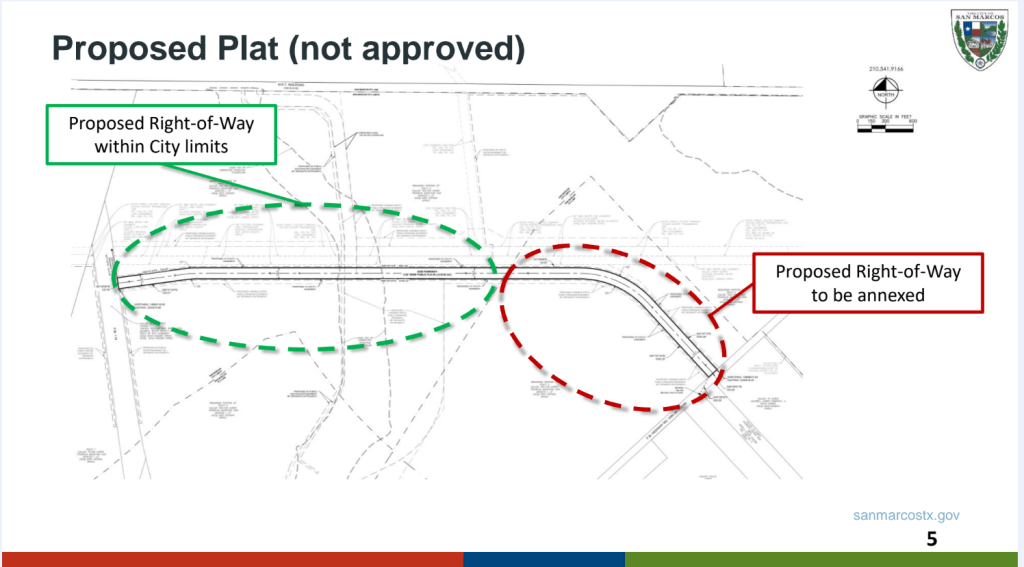
wants Council to annex city land for a road:
However, the company has made total enemies of the surrounding community, by always being super secretive about their plans. In this case, the road has jumped locations. Originally it was further from houses and now it’s closer to them.
At the August 5th meeting, there was a fair amount of discussion. Everyone seemed concerned. Nothing was resolved.
Time for the exciting conclusion! So much drama! Buckle up for…
…zip, zero, zilch. Literally, Council spends four minutes total on this item.
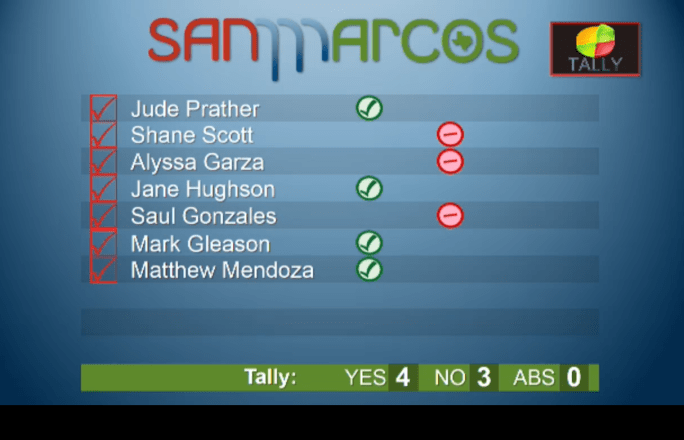
The vote:
No one ever asked in public about whether the road could be moved back to the original location. No one explained whatever Mark needed more time to research since the last meeting.
This is what I mean when I say this council is stale. Everyone knows where everyone stands on everything, and so no one bothers to say anything outloud.
…
Item 24: School Resource Officers are back, baby! (School Resource Officers = SROs)
The SRO contract should be two years instead of one
The contract can be renewed administratively, without Council approval.
Council renewed the contract, but nixed those two changes. They wanted to see the contract, in person, every year.
Since then, the school board met: they really want the two year contract and admin renewal. So they held the line on those two details, and punted it back over here.
Remember last time how I pointed out that Jude Prather should really recuse himself, because his wife is the director of the organization that oversees all SROs, statewide?
He didn’t recuse himself this time, either.
He actually was the one who made the motion to approve
Superintendent Cardona even mentioned that Prather’s wife wrote the officer training.
At Q&A at the end, a community member (LMC) asked about this conflict of interest.
By that point, Prather had gone home. LMC said it was a question for the city lawyer, but Jane Hughson ended the meeting without giving the lawyer a chance to answer the question.
This is getting into more egregious territory! Jude certainly knows better. He recuses himself over absurdly flimsy pretexts all the time.
ANYWAY. Chief Standridge says he could include SROs in his yearly update to Council. Superintendent Cardona talks about how closely everyone meets and supervises the SROs.
Mark Gleason politely says “I told you so! Stability. Safety. Etc.”
The vote: Should we switch to two year SRO contracts and administrative renewal?
…
Item 25: This was a little confusing.
Gather ‘round, children. Once upon a time, there was a little Municipal Utility District, on the north end of town:
That’s east of I35, on Yarrington road. The year was 2014.
It was actually kind of gigantic if you zoomed out:
But none of the townspeople ever did.
Here’s what the developers pretended it would look like, some day:
Look at all that water! What the hell is going on here. Here’s the satellite photo of this area:
So much less water!
(Were those lunatics planning on a great new lake? Were they going to tap the Blanco, where it runs underground, to create a watery playground for rich people? Maybe!)
Back to our story.
The village council elders put a weird clause in the development agreement that allowed landowners to opt out. Usually council elders wouldn’t do such a thing, but in this case they did.
By 2023, these owners had opted out:
The red parts had opted out.
In 2023, the rest of the land owners opted out:
So at Tuesday’s council meeting, the little village dissolved the Municipal Utility District altogether. There’s no development agreement. There’s no lake.
THE END!
The moral of the story is: there is no moral.
…
Item 26: New City Hall and Hopkins Redevelopment project
Back in July, we saw some pretty pictures about what the new City Hall could look like, and what Hopkins could look like, maybe someday:
Today’s task: we’re going to form a steering committee, to help shape the vision.
Who does Council want to be on the steering committee?
Jane: We could have each councilmember pick a person, and then have a representative from some key constituents – Texas State, River Foundation, Downtown Association.
Alyssa: Before we have this conversation, we need the DEI coordinator. Otherwise we’ll do what we always do. That leads to the status quo, and the same old people still have the same old power.
Mark Gleason: I like each councilmember picking two people, plus the key organizations should all have representatives.
Alyssa: Hey! You guys. We need to stop and get input from the DEI person, before we have this conversation.
Jane: And councilmembers themselves. What about the mayor?
Alyssa: Listen. Stop. The DEI coordinator is not here.
Matthew Mendoza: Why should Texas State get a seat on the committee?
Jane Hughson: It’s just part of being good neighbors. They also have a representative on the downtown committee.
Alyssa: Hello? Anyone? Bueller?
Shane Scott: You know how councilmembers get their names in the building? I think we should have little bobbleheads of ourselves, instead.*
Alyssa: LALALALALALA AM I SHOUTING INTO THE VOID HERE?
Matthew: We should require that members have lived in San Marcos for at least five years!
Alyssa: [mumbles to self about DEI coordinator]
Jane: How about a P&Z representative? How about a library representative?
Alyssa: [draws pictures of a council consulting the DEI coordinator, and holds them overhead, in the style of Lloyd from Say Anything.]
Saul: Should we require that they be caught up on their taxes?
Jane, dryly: We don’t require that for elected officials.
Alyssa: [Launches little confetti cannons. Sends in carrier pigeons with tiny notes tied to their legs, which read “Let’s consult with the DEI coordinator”. Does an interpretive dance for the letters “D”, “E”, and “I”.]
In the end, everyone agrees to come back next time with their final ideas for the composition of the steering committee. City staff is going to talk with the DEI coordinator and get best practices from her, and they’ll share those next meeting.
Here’s the thing: You have to get the DEI coordinator to talk to everyone before the brainstorming. Otherwise the brainstorming will perpetuate the same old power imbalances as always. The point of the DEI coordinator is to gently get everyone to cut that shit out, and redirect them into new territory.
Purgatory Creek runs from the Purgatory Natural Area over to the San Marcos river. Basically, we’re going to geo-engineer Purgatory Creek to flood less.
So that’s Wonderworld Extension on the far left, where the yellow and blue meet. Then they cross Hopkins and run behind Dunbar, along the railroad tracks, and then cross the edge of downtown, over to the river.
90 buildings are going to have to be removed, because they’re at risk for flooding:
That’s a lot of buildings! Are these houses with people living in them? Are they historic? I could have used more details here.
Correction: I’m an idiot. The structures are being removed from the floodplain. Not removed altogether. It’s safer now for the people living in them.
But on the plus side, it’s going to have a neat little hike-and-bike trail through it.
I love that.
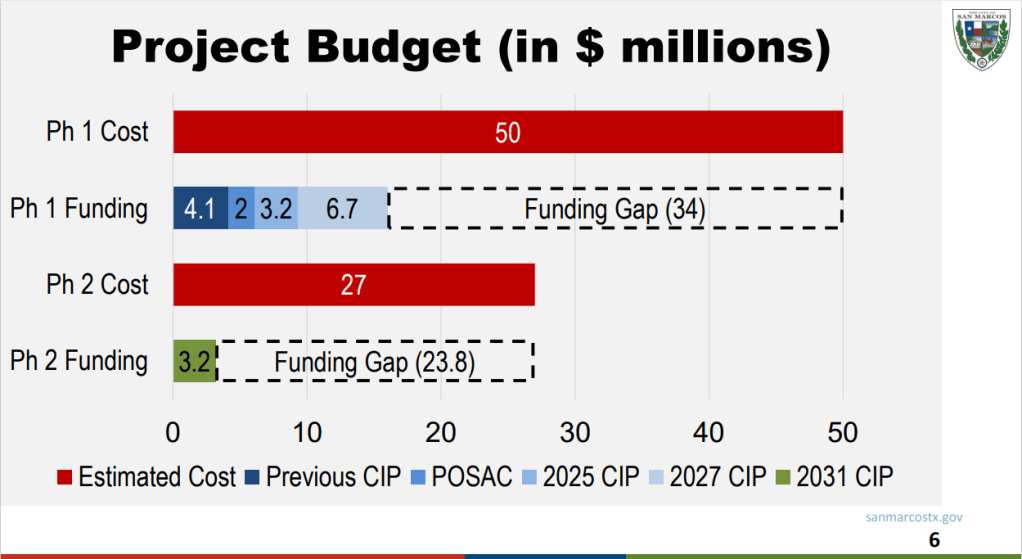
It’s gonna be hella expensive, and we don’t yet have the money:
We’re going to apply for a bunch of grants.
If we get grant funding, we could begin construction in 2026. If we don’t, we could maybe begin construction in 2030. It’ll take about two years to finish.
One last detail: On the far right, you can see where Purgatory Creek meets the San Marcos river:
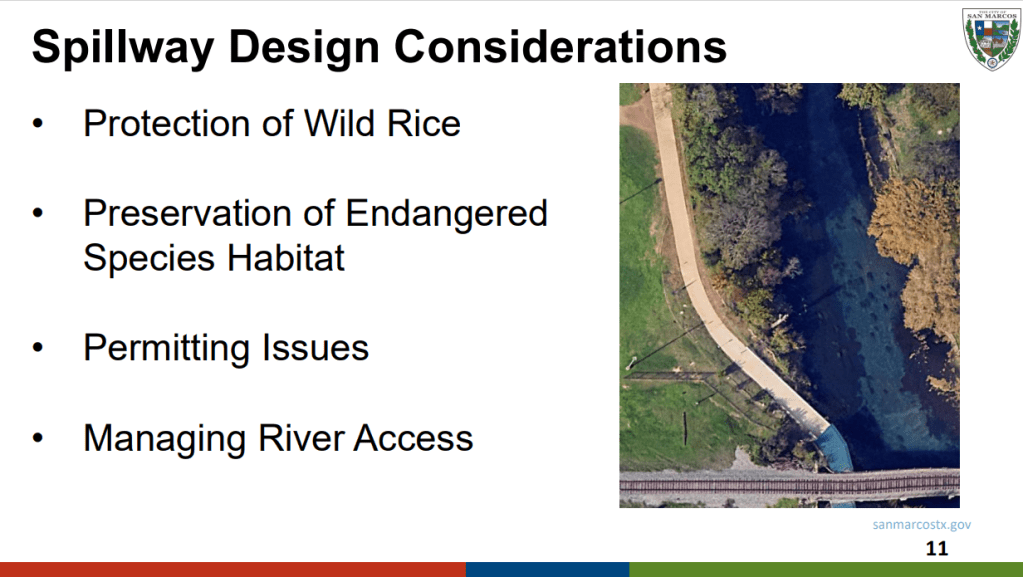
There’s a pale green Spillway, for when it floods. The spillway is in between the Children’s Park and the railroad tracks, so it’s letting into the river right where the sidewalk goes under the railroad tracks.
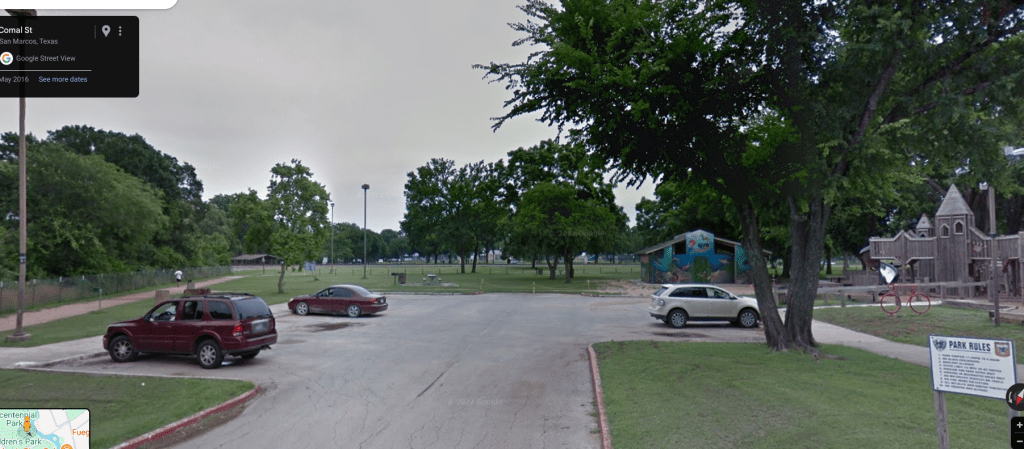
In other words, you’d see it from here:
This photo from Google Streetview is so old that the Children’s Park is still the old wooden structure!
Awwww. Makes me a little nostalgic.
Anyway! In the original plan, they were going to use this spillway as an access point for people to easily get in and out of the river.
But the people from the Parks Department and the river experts are all saying this is a terrible idea, please don’t do this.
There’s a big patch of endangered wild rice there and endangered species that live in the wild rice. And also it’s deep with a brisk current, so it’s not that safe for little kiddos, either. Just leave this area alone, please.
So the spillway will still end up there, but they’ll make it uninviting for people.
….
Presentation 2: Capital Improvement Projects (CIP)
These are all the major city repairs going on around town. The Purgatory Creek project that we just heard about is one. They get approved alongside the budget. Council saw the current list of projects back in May. (I didn’t really say much about it at the time.)
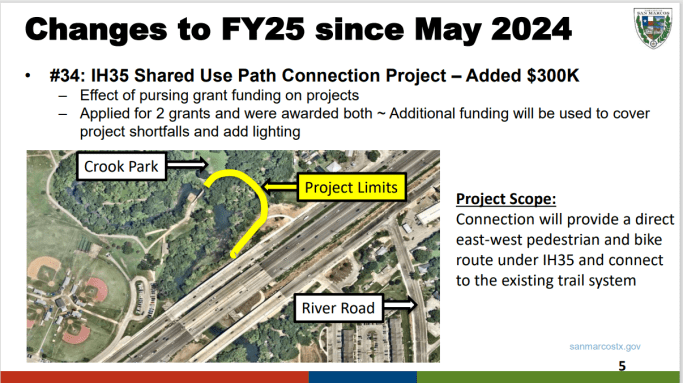
There’s only one major change since May – we’re adding one new project:
What are we looking at here? Let’s back up.
…
So, I35 has been torn up around the river for years now. TXDoT redid both the access roads, they’re adding I35 lanes across the river, it’s a whole thing.
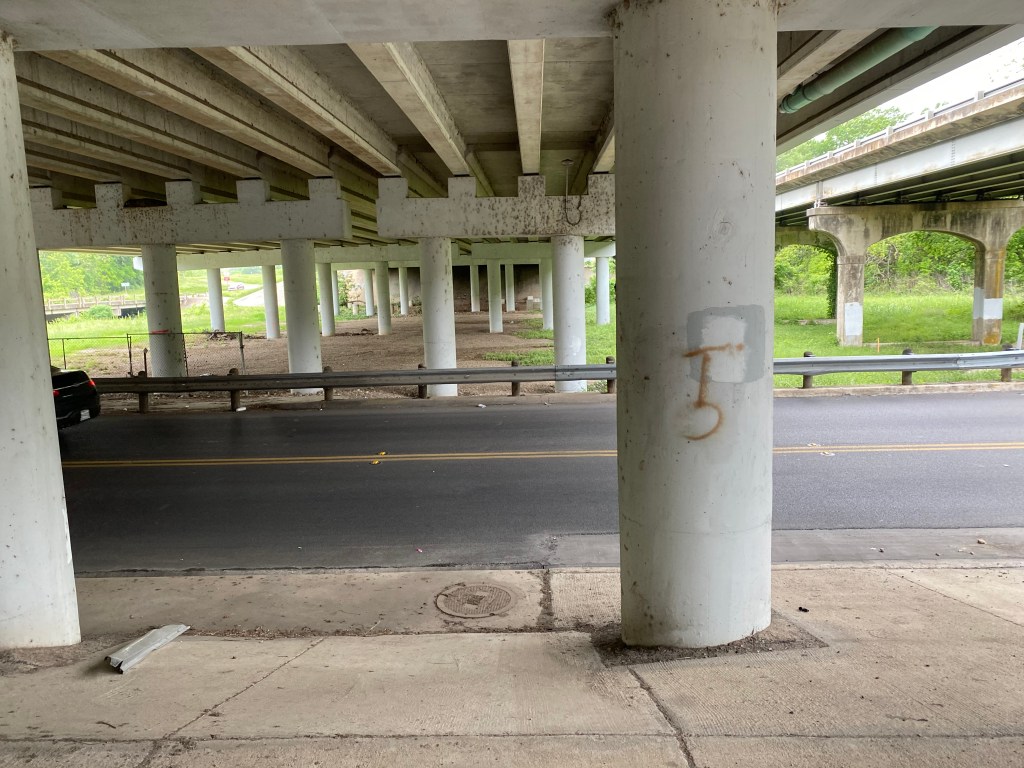
One part of that is that they removed the old underpass along the river:
TxDot photo
So on the right hand side, you can see where they’ve torn up the road that used to go under I35, along the river.
Here’s a photo I took, back in 2020, during lockdown:
So that’s what the underpass looked like at peak pandemic.
Removing it was a major bummer for the good people in the Blanco Gardens neighborhood. They lost their best connectivity across I35. Now they have to go up to Hopkins-80, or down to Guadalupe-123, and deal with a big, busy intersection.
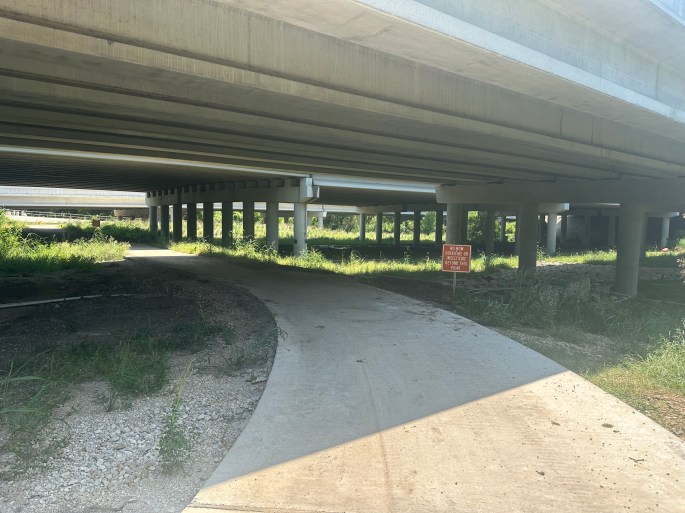
Since then, TXDot has replaced it with a hike and bike trail.
It looks like this:
So you can easily bike from Blanco Gardens over to Riverside, and you end up by Herberts. That part is great!
So what are we doing now? Pink is the route you can currently take on your bike:
Yellow is what’s being proposed. It would connect the east and west sides of the park trails. Great!
This was not in the budget back in May. But since then, we’ve been awarded two grants to cover the cost. The total cost for that little yellow sidewalk is $2 million dollars.
TWO MILLION DOLLARS? Well, yes. Here’s why:
Blue is the main river that you swim in. But there’s this little side channel, in purple, from an old dam built in 1904:
In fact, here’s some of the machinery from the mill:
So that tiny little yellow sidewalk is $2 million dollars, because you have to build a bridge to get across this little side channel.
Now, San Marcos is not paying $2 million for that bridge. What we did was apply for a bunch of grants, and we got almost all the money covered. We just have to pay $300K for that bridge in matching funds. Great!
Mark Gleason is uncomfortable with this $2 million. He lives in Blanco Gardens and actually walks and bikes all over the place, so he’s constantly using this path. He’s just not sure if the cost justifies the increased connectivity that you get. Even though the $2 million is mostly federal money, he just feels weird about it.
I see his point. It’s such a disproportionate cost, compared to the shoestring that San Marcos usually runs on.
But then I just tell myself, “Hey, don’t forget we’re spending $1.2 million on Kissing Tree this year!” Then the $2 million bridge for everyone doesn’t seem so bad. Especially since most of it is covered with federal money.
Plus, once the east side of the river parks gets built out, the parks system will need to be connected, so we might as well do it now.
We’ve got a big utility assistance program in San Marcos, but it doesn’t always work very smoothly. Let’s talk about it.
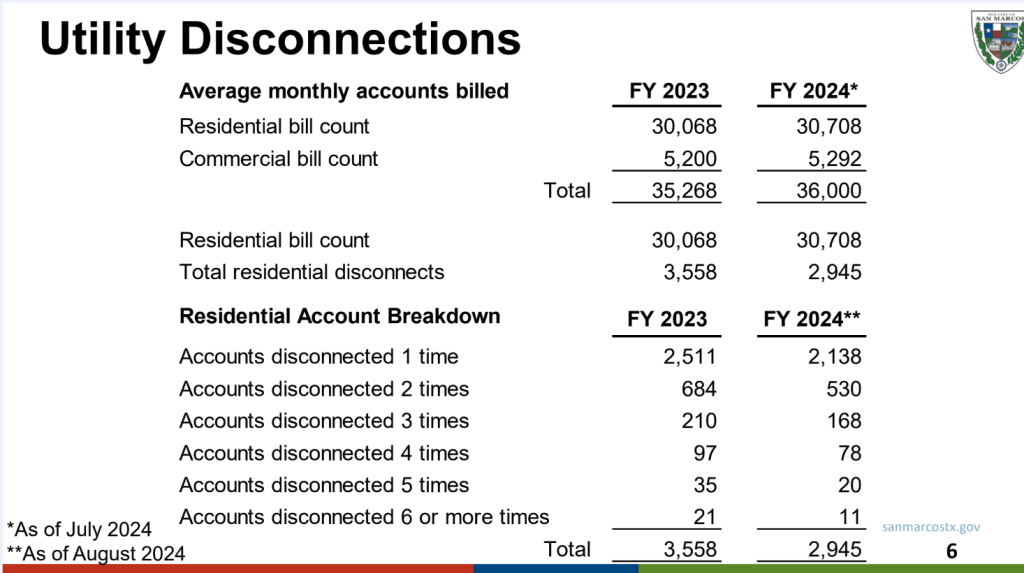
How many people are we talking about?
So there are about 30,000 residential accounts, and almost 3000 accounts have been disconnected so far this year. (Some multiple times.)
Here’s how it’s supposed to go. Suppose you get a disconnect notice on your electricity or water. You call the city. The city does two things:
Offers you a late payment plan
Connects you with the nonprofits that offer utility assistance.
How often does it work like that?
So far this year, we’ve given 580 accounts utility assistance, but 107 of those were still disconnected anyway. There have been 1,948 accounts that have gotten extensions – some of them multiple times – and 586 have still been disconnected.
So out of the 3000 disconnections this year, most people aren’t getting into the system to get help ahead of time. For the people who get in the system, about 75% avoid disconnections.
…
Ok, so let’s talk about the assistance side of things. San Marcos kicks in $231K to utility assistance. The biggest chunk of that goes to Community Action:
But Community Action also gets some federal money, so there’s actually about $435K available for assistance:
Community Action gets $120K from the city. But when someone comes in for assistance, Community Action tries to spend federal money first. So only $14K of the $120K was spent. However, the federal water assistance program has ended, so Community Action will need to spend more city money to cover that need.
The biggest problem is that federal money is slow. You have to fill out a ton of paperwork. But people need money immediately – cars need to be repaired, babies need diapers, the lights need to stay on, etc – or else small crises spiral into giant crises. So we need a way to get money to people fast.
A few things get discussed:
Do we have to charge a 10% fee on late payments? Can we just make it a flat $10 fee instead?
Should we spread out city money among different agencies?
Would the other agencies actually have enough staffing to get the money out quickly?
What about San Marcos residents that are on Pedernales electric? Answer: they can get federal assistance, but agencies can’t use the credits from San Marcos electric specifically.
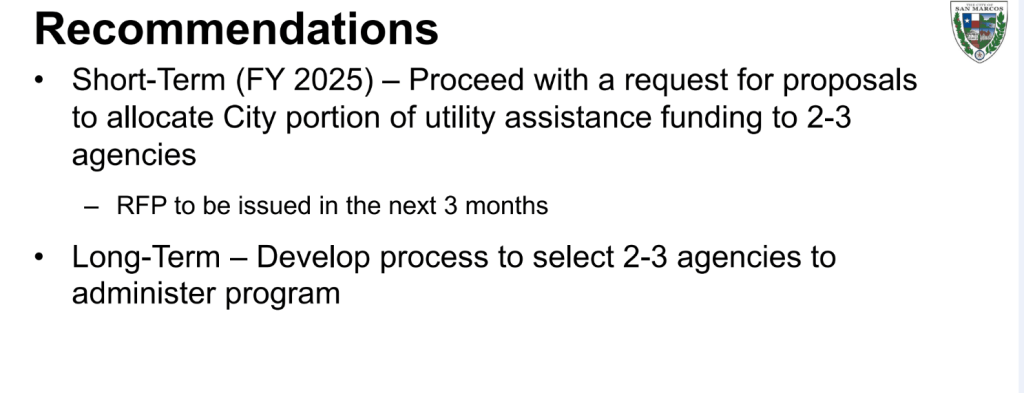
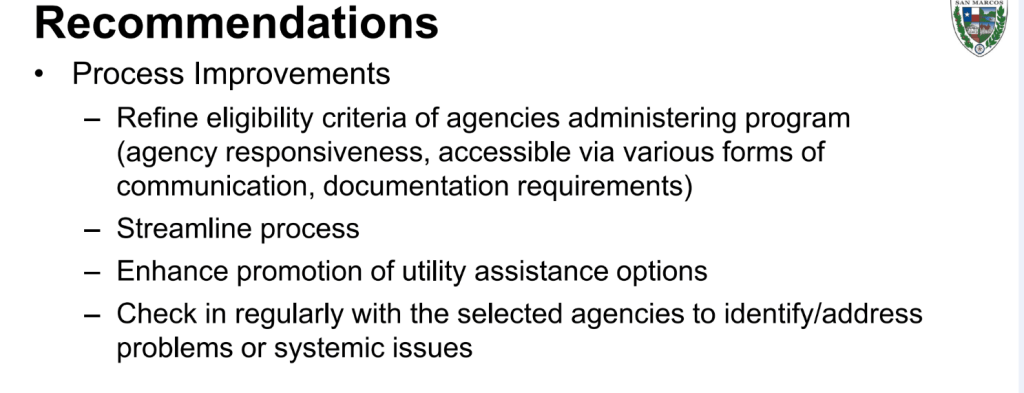
Here’s what we’re talking about doing:
We’re also going to look at our fees and see if we can afford to reduce them.
Here’s my two cents: It is really hard to administer programs to the public well. It’s hard to find people, get their ear, get them to respond, get them to bring in paper work, find funding, and connect all the dots to get the assistance to people.
We tend to see overhead spending as wasteful, but it’s really not. Thoughtfully designed programs that aren’t running on fumes can serve people better.
Finally: if spending $231K of tax dollars on utility assistance gives someone heartburn, just remind them that we’re spending $1.2 million dollars on Kissing Tree this year.




























 The San Marxist