Hello from the dregs of summer! Council meets once in July, and you lucky duck: it was this week. Lots of talk about low-income housing, we hear from the city on Malachi Williams, Dunbar is getting some new pipes, and Mano Amiga is taking on Civil Service. Plus some new City Hall details are materializing.
Let’s do this:
Hours 0:00 – 1:32: Malachi Williams, a new LIHTC project, and some smaller items
Hours 1:32 – 2:23: Mano Amiga submits an unsuccessful petition to repeal Civil Service, and we talk about LIHTC projects a lot.
Bonus! 3 pm workshops: Where are we going to build the new city hall? And fixing the sidewalks.
That’s it for July! Regular meetings resume in August. Enjoy your summer.
First off: it was Laurie Moyer’s last meeting, after 36 years with the city. Mostly she’s done engineering-ish things, but also some City Manager-ish things. She took all these great City Hall photos on her road trip last year. Congrats to her!
Citizen comment:
Two people – Noah Brock and Annie Donovan – talked about the latest iteration of SMART/Axis hijinks. I’ll save their comments for that section.
Two people called for a resolution for a ceasefire in Gaza.
The San Marcos Civics Club, and how Council passively assumes they can’t solve city problems
Mano Amiga’s petition to repeal Civil Service. I’ll save these details for later, too.
Finally, the killing of Malachi Williams by the SMPD officer on April 11th. (Discussed previously here, here, and here.)
To recap, the family of Malachi Williams has been asking for: 1. Release the name and badge ID number of the officer that killed Malachi Williams 2. The officer should be placed on leave while the investigation is ongoing. 3. The family should be able to view all officer and storefront footage, with a lawyer present.
Malachi’s grandfather spoke eloquently. This has happened before. But then the City Manager Stephanie Reyes spoke, which is new.
Here’s what Stephanie Reyes says: – Video material is available for the family to view along with their attorney. It’s at the Hays District Attorney’s office. – The DA says that neither the family nor their attorney has reached out to view the footage. – The DA is waiting to discuss how much of the video the family can watch. – Because this has been so awful, Chief Standridge is putting together an SMPD Crisis Communication Policy for future incidents. – the DA Kelly Higgins weighed in on the policy. He has concerns about any public release of video while the investigation is ongoing. He wants videos to be withheld until after a grand jury has reviewed the matter. – the DA knows that the family needs answers. State code authorizes the DA to let the family watch the video. He’s open to conversation with the family.
(I would like a universal policy that applies to all situations. When an officer is killed by a civilian, how quickly does the family see the videos?)
Next Malachi Williams’ grandfather speaks again, which is usually not allowed. “What we have been offered has not had much substance to it. We have not had a fair offer. There’s been an offer, but it’s not fair.”
Alyssa Garza asks, “Was the family offered the entire videos? All the body camera footage?”
Chief Standridge comes up. “The DA and I are offering the family all the body cam footage. But we are not offering the store’s videos. The DA has not agreed to release that. The DA and I will let them see still photos from the store. But the DA has not agreed to store footage.”
After that, the grandfather has a lot of questions and frustration. Council was not really allowed to respond, legally. They redirect him to the DA. He’s already interacted with the DA and is entirely fed up with him.
It ends in a tense place.
…
Item 23: Another LIHTC project!
LIHTC projects are low-income apartment complexes which don’t pay local property taxes. We’ve seen two others recently here. (LIHTC stands for Low Income Housing Tax Credits.)
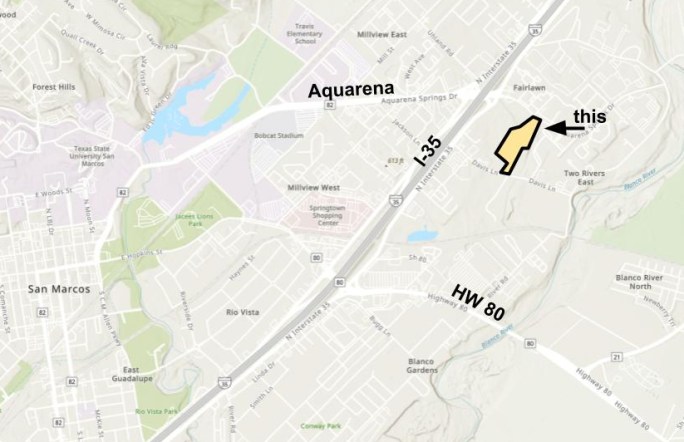
Where’s this one?
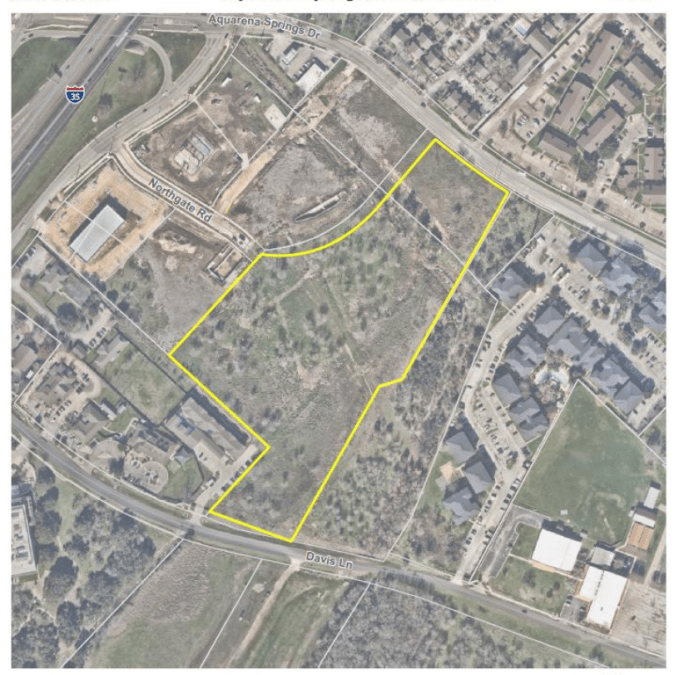
And here’s a close up:
They’re planning on having 304 units. How affordable will these be?
In other words, this is 46 units for low-income community members, and 258 for regular community members. (The median income in San Marcos is $47,394 a year, so 85% of these units are regular old market rate apartments.)
Okay, fine. How much is this costing us?
The estimated loss in tax revenue is $3 million over 15 years, or $200K per year. They’re softening that by giving us a one-time $400K payment.
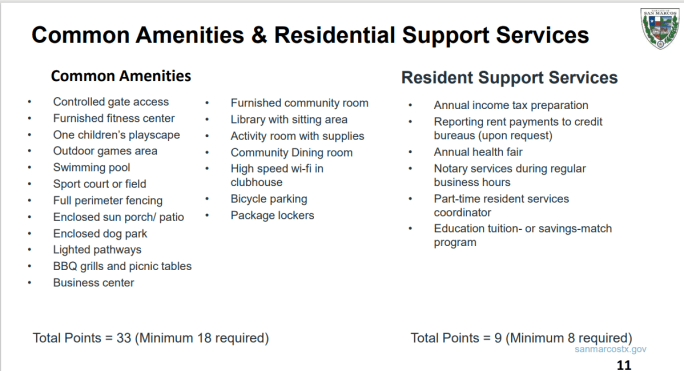
What other services are there going to be?
[Technical note: There’s some mucking about with the number of 3-bedroom apartments. This complex only has half as many as the city San Marcos requires for LIHTC developments. However, there’s a letter from the Housing Authority about the different waitlists for 1, 2, and 3-bedroom apartments, and 3 bedroom apartments are not in demand as much as 1 and 2, so it’s fine.]
Jane Hughson has some questions: – Did this area flood in 2015? Answer: yep. But the buildings weren’t TOO badly damaged. – Will the complex provide residential shuttles? Answer: nope. It’s right on a bus line. – Will the units have individual washer and dryer units? Answer: yep. – Will they have education, services, and after-school tutoring? Answer: yep.
Alyssa: I’ve heard complaints about restrictions and racially biased access to facilities. How do you make sure that doesn’t happen? Answer: We partner with Asset Living. They staff everything and report to us monthly. If something isn’t getting used, we ask them to advertise it.
[I am extremely curious about the complaints of racially-biased access to facilities.]
The vote: Passes 7-0.
However: Council is going to have big conversation about LIHTC projects in general, at the end of this meeting. Stay tuned.
….
Items 23-24: Kissing Tree
Kissing Tree is the senior community, way down on Hunter Road and Centerpoint.
Kissing Tree is a TIRZ. This means they pay taxes, but the taxes don’t go to the city’s General Fund. Instead they get funneled to side projects that benefit Kissing Tree – mostly building out the public roads and utilities that run through Kissing Tree. It’s not wasted money, but it doesn’t go to libraries, parks, firefighters, etc.
Costs have gone up and the assessed value of Kissing Tree has gone up, so they’re re-jiggering all the TIRZ numbers:
This is probably all fine! Before we had estimated that we were sending $32 million over to the Kissing Tree for roads and pumps and parks, and now we’re sending $46 million over.
Over 15 years, we’re keeping $5 million and giving $46 million back.
Let’s compare this to the LIHTC Project above! In that one, we’re keeping $400K and sending $3 million back.
So to be stark about it:
The LIHTC project is giving us 13% of their estimated property taxes and using the rest to subsidize rents on low-income apartments.
Kissing Tree is giving us 10% of their estimated property taxes taxes, and using the rest on local roads and utilities.
Guess which project makes Mark Gleason uncomfortable? The big reveal later on will not surprise you at all.
….
Item 2: SMART Terminal/Axis Logistics
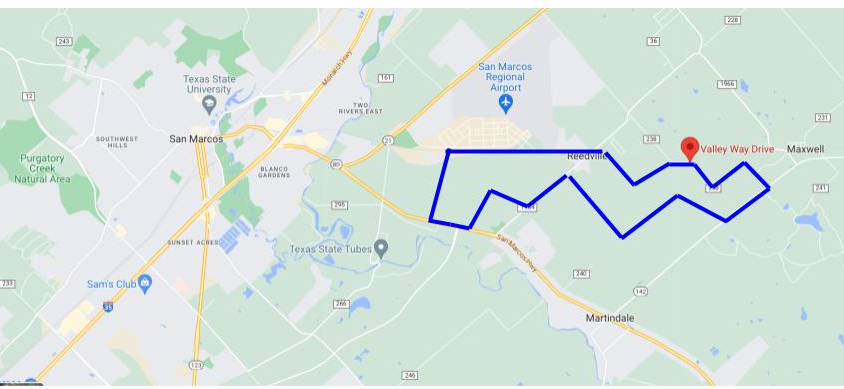
The SMART/Axis people want San Marcos to annex about 7.5 acres of land for a road and right-of-way.
In January 2023, Council signed a development agreement with SMART/Axis people. Back then, these agreements happened in one single council meeting, and barely anyone had to be notified. So Council approved a gigantic fucking 2000 acre industrial park without public input and barely any details, and everyone got super angry about it.
2000 acres is very big:
Like, REALLY big:
The people who live out this way were absolutely livid. But the development agreement was already signed.
The next step of the process was for SMART/Axis to apply for a zoning change to Heavy Industrial and get annexed into the city.
What they could have done was meet with the neighborhoods nearby, provide details of the project, build relationships and be good neighbors. Instead, they met with the neighborhoods and generally acted like supercilious pricks who couldn’t be bothered. The surrounding community got more and more furious, and launched a major activist campaign against the project.
Eventually SMART/Axis withdrew their zoning and annexation request. That was last summer. Since then, it’s been quiet.
Here’s my best guess: SMART/Axis didn’t want to share any details because they didn’t have any yet. They literally want free reign to do whatever they want on this land. They came off as supercilious pricks because they are supercilious pricks. They assumed San Marcos is a backwater rural town that will fawn over fancy business men and give them whatever they want, in hopes of some dollar bill scraps. City Council was happy to play their role!
…
That brings us to today – should San Marcos annex some land and build a road along the side of the land?
First off: Nothing happens today. We are just picking dates for the public hearing and final vote.
However, let’s do some speculation! This is brought to you by Noah Brock and Annie Donovan, during Citizen Comment. (They spearheaded the public campaign against SMART/Axis last year.)
Here’s the case that Noah and Annie are building:
Is this a major change or a minor change? If it’s a major change, the development agreement needs to be amended. That’s a much bigger deal. (The city is saying this is a minor change.)
Originally, the roads lined up with the end of Quail Run. That was the edge of the whole project. But since then, the developer has bought more property, and asked Caldwell County to move some roads over.
It seems clear that they’re expanding the project beyond the development agreement, and this new land is right next to a residential area.
This new ROW annexation is consistent with a bigger, changing project.
The basic problem is that SMART/Axis people are super secretive and seem to want to walk all over us. Maybe they’re sweet little bunnies at heart, or maybe they want to do some toxic battery mining or who knows what. They act like shitty neighbors every time they have a chance to right the narrative.
…
Today’s vote was just to set the dates, and here they are:
Public hearing will be on August 5th
Final vote will be on August 20th
….
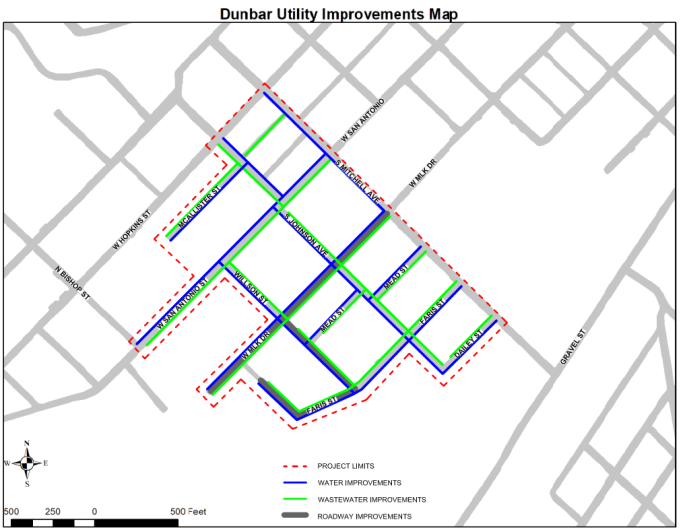
Item 25: Dunbar is getting some new pipes!
We’re spending $6 million on water and wastewater improvements here:
If you go here and scroll to Dunbar Water and Wastewater Improvements, you can keep an eye on the project.
Supposedly will be done by August 2026. So at least two years of dug up streets and annoying construction, but with a worthwhile payoff.
…
Item 27: Installing sports lighting on six soccer fields at Five Mile Dam.
This money was authorized awhile ago, this is just the contract to make it happen. It’s about $1.3 million.
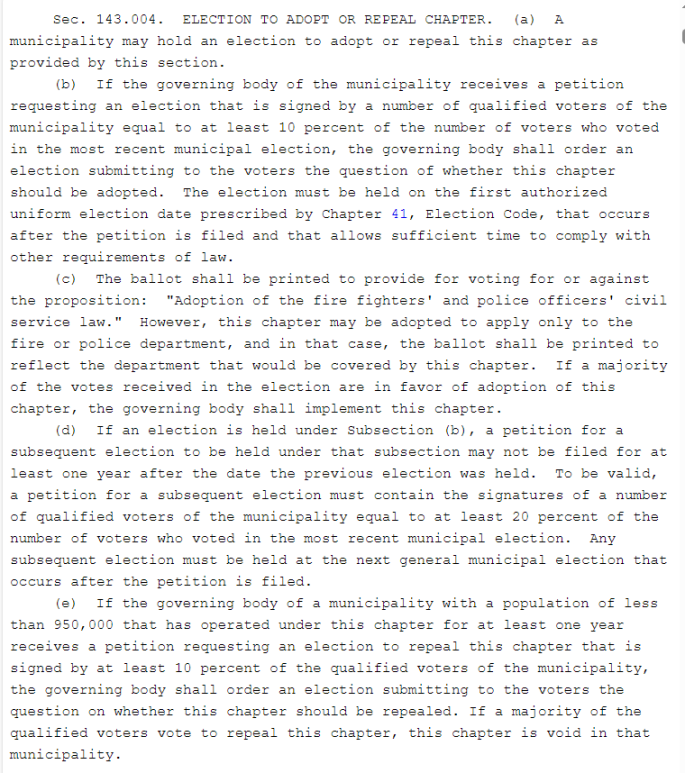
However, cities don’t have to start with Civil Service. You can repeal it and start some other way. So this is what Mano Amiga wants to do. (I don’t know what their strategy or end game is here. I’m sure they’d explain when they launch a public campaign, though.)
And what happened is that the city rejected the petition. Mano Amiga submitted a petition with 850 signatures, which is enough to adopt Civil Service (per Part B), but not enough to repeal Civil Service (per part E).
Mano Amiga is angry because they say the city waited until the last minute to tell them their petition wasn’t valid. But they vowed to fire it up again, and get enough signatures for the next cycle.
…
Item 29: Funding for low-income housing. (LIHTC tax credits)
Mayor Hughson and Mark Gleason had a conversation. Mark went to Jane and said, “We’re spending all this money on LIHTC Housing, and it’s not just this year. It’s not just the next 15 years. It’s decades and decades to come! This is fiscally irresponsible!” Are we being too helpful to poor people?!?
Jane thought he had a good point. We need money for core services! What if the LIHTC tax credits are ruining everything? It’s worth taking a look at.
Hoo boy. Okay, we have to unpack this. Here’s our plan:
How much money are we spending on low-income housing?
Is this a lot, or a little?
How much more low-income housing do we need?
What did Council have to say?
What are we doing next?
Here we go!
1. How much money are we spending on low-income housing?
In 2022, we started requiring LIHTC applications to include a tax estimate. The first application that includes this is in February 2024. So let’s start there.
February 2024: Existing LIHTC housing in Blanco Gardens reapply for state funding. Cost to city: $0. Not asking for local tax exemptions. Units provided: 40 of 54 units are Section 8 housing.
May 2024: Behind Target, by the railroad tracks Estimated tax credit: $7,262,589 over 18 years. (I’m going to scale this to $6,052,158 over 15 years.) Units provided: 34 low income units
May 2024: By Centerpoint, on the railroad tracks Estimated tax credit: $4,000,000 over 15 years One time rebate: $400K Units provided: 55 low income units
Summary: Three developments have applied for tax credits for the city. The total cost is $13,259,157.5 over 15 years, for 135 low-income apartments in those three developments.
This works out to $883K per year. Per apartment, we are knocking $550 off of the monthly rent.
Next question!
2. Is $883K in tax credits a lot, or a little?
Kinda both? Here’s some context from our yearly General Fund budget:
Yearly General Fund budget: – The total General Fund budget is $109 million this year. – SMPD get $24.5 million – Fire Dept gets $17.6 million – Economic Development gets $2.9 million – Library gets $2.1 million – Animal Shelter gets $1.6 million – Parks Department get $850K [Parks Dept gets $6.8 million. I misread the budget at first! Sorry about that.] – Social services get $550K. – The arts get $85K
I just grabbed a few useful categories. You can read all you want here.
So we are spending more on the LIHTC projects than we are on the arts or social services. Those combined are about 0.5% of the yearly budget.
We are spending much less on LIHTC projects than we do on SMPD, the Fire Department, and economic development. Those three categories combined are about 41.2% of the yearly budget.
My guess is that LIHTC projects come out of the $2.9 million for economic development. That money is supposed to create jobs. The thing that bothers Mark Gleason is that LIHTC projects don’t create jobs the way Buccee’s creates jobs. (Kissing Tree also doesn’t create jobs the way Buccee’s creates jobs. Kissing Tree is more like a LIHTC project in this way.)
Next! The three LIHTC projects just kind of came up spontaneously during the last couple meetings, and took everyone by surprise. What are some similar comparisons?
The other things that Council approved at this meeting alone:* – $46 million over 15 years on roads and utilities in Kissing Tree. That works out to $3 million per year. – $6 million on water and wastewater for Dunbar over 2 years. That works out to $3 million per year. – $1.3 million on lighting for soccer fields at Five Mile Dam. – $330K to update the Airport Master Plan – $430K in a wastewater treatment agreement with McCoy’s – $125K with Titan Utilities – Two different Utilities trucks totalling $660K – Energy management contract for $135K – $480K for lawns and beds of city buildings – $439K for Hull Street Stormwater improvements – $215K on tree removal from the storm – $432K on health care contracts
So those are the kinds of amounts we spend all the time, and Mark Gleason does not clutch his pearls.
Look, $883K is a fair amount of money! It is worth planning in advance and being intentional with how we spend it, so that we can best serve our community. Right now we’re approving projects on an ad hoc basis, and so there is room for improvement.
However: Kissing Tree is not put under a microscope. There are never any 5 or 10 year updates for Development Agreements where we give tax credits to private companies. SMPD’s budget is not put under a microscope.
It is always, always the programs that help poor and vulnerable people that make Council say, “I dunno, they might be wasting this shiny nickel we’re giving them. Let’s do a deep dive!”
As of 2017, this was the housing need in San Marcos:
In 2019, Council killed the whole thing off. Years of effort and nothing was ever adopted to help create affordable housing.
In 2023, city staff gave Council a workshop on housing, and recommended that Council resume this project. As far as I know, they have not done this.
Bottom line: in 2017, we had a shortfall of 4233 rental units for all households earning under $35K. This whole conversation is about 135 apartments. We need a lot more affordable housing than that.
LIHTC projects really are too expensive to be the only way we build affordable housing. (Fortunately, there are cheaper things that San Marcos could do! Like allowing ADUs and duplexes everywhere. But I digress.)
….
4. What did Council have to say?
Jane Hughson: – We are not receiving enough tax dollars to support the services (library, police and fire, etc) going to these projects. – We need the housing, though. – Are these San Marcos residents? Or outsiders? I’m frustrated with outsiders.
Shane: How much sales tax revenue do they bring in? Jane: The people would be paying sales tax either way.
Jude: – We should update the formula for the proportion of 1,2, and 3 bedroom units that we require. – We should require cash back, and make a formula for the cash back amount they owe us – But LIHTC projects are still good, they increase housing!
Stephanie Reyes: I’d like to get a demographer to look at how much low income housing we need.
Saul: These LIHTC projects make taxes are higher on everyone else!! We should have a moratorium on LIHTC projects.
Matthew: Can a development be half-LIHTC? Answer: not really.
Jane: Other cities give density bonuses and have inclusive housing incentives. Can we do that? Answer: We already offer these. Since 2018. But we can’t get anyone to take us up on them. Jane: Not to say I told you so, but we could have done this on Lindsey Street.
Mark Gleason: I have so much budget angst. It’s not just this year – we’re giving away tax dollars for decades to come! It’s not just 15 years. It’s 20! And 30! Decades to come!
[Mark! No. That last bit is nonsense. Nothing automatically extends more than 15 years. Everything will be renegotiated at the end of the contract. Stop hyperventilating.]
More Mark: We have to diversify the economy here! We need more data! I cannot approve any more of these without data!
Alyssa, speaking the truth: Can we do this conversation more productively? Instead of focusing on revenue loss, let’s focus on maximizing benefit to community members.
Jane: I just want clarity on how much we’re spending. And also, how can we bring in more jobs?
Shane: The housing waitlist is like a year long. Doesn’t that establish residency?
…
5. What are we doing next?
In the end, they decide that the housing committee will look closely at the housing policy, and then they’ll hold a workshop. They’re particularly concerned with:
How many total LIHTC projects do we have, and what’s the estimated taxes on all of them?
How many low income projects do our peer cities have, per capita?
Can we re-evaluate how many 1,2,3-bedroom apartments are required?
Can we formalize the rebate formula? Can we require rebates?
Can we do a needs assessment survey?
Rebate money should not go to the general fund. Can it be used in an intentional way?
Alyssa requests that our DEI Coordinator be present at the committee meeting. This is a very smart idea. She also recommends this resource for background reading.
…
Look: There is nothing wrong with those actual bullet points. It is good to review our LIHTC policy and see how it can be improved.
But the whole vibe is, “ACK! We’re spending so much money on poor people housing!” and it sets my teeth on edge.
If Council were serious about housing affordability, they would dust off the Housing Action Plan, update it, and implement it. Instead, we get Mark Gleason huffing over $13 million dollars to poor people, while sweetly handing Kissing Tree $46 million without blinking.
* NOTE: I updated this list because I forgot about the Consent Agenda. Originally I pulled amounts from the most recent few meetings, but I realized there were way more examples than I originally thought.
The city needs a new City Hall. (Discussed here and here.)
Laurie Moyer was handling the new City Hall project, but she is retiring. The new person basically gave a presentation to introduce herself and pitch how she sees things unfolding.
Here’s what she was handed:
In other words, City Hall is going here:
across the street from Old City Hall.
So apparently this location is settled? I don’t know how I feel about this. I also have concerns about what might happen to the old site.
However: they’ll need voter approval in 2025 to re-purpose park land as City Hall, so I guess we’ll be hearing some sales pitches. In the end, the voters will decide whether or not it sounds ok.
The new person is imagining making a whole Hopkins Project out of it:
Parts of this sound good to me!
I like the idea that Hopkins could look more like CM Allen.
P3 means “Public-Private Partnership”. This part is inevitable because the city doesn’t think that the voters would pass a bond in an election. So they want to bring in private partnerships. (More things that I feel weird about.)
This whole thing will take forever to complete. If the stars align, it will take seven years.
…
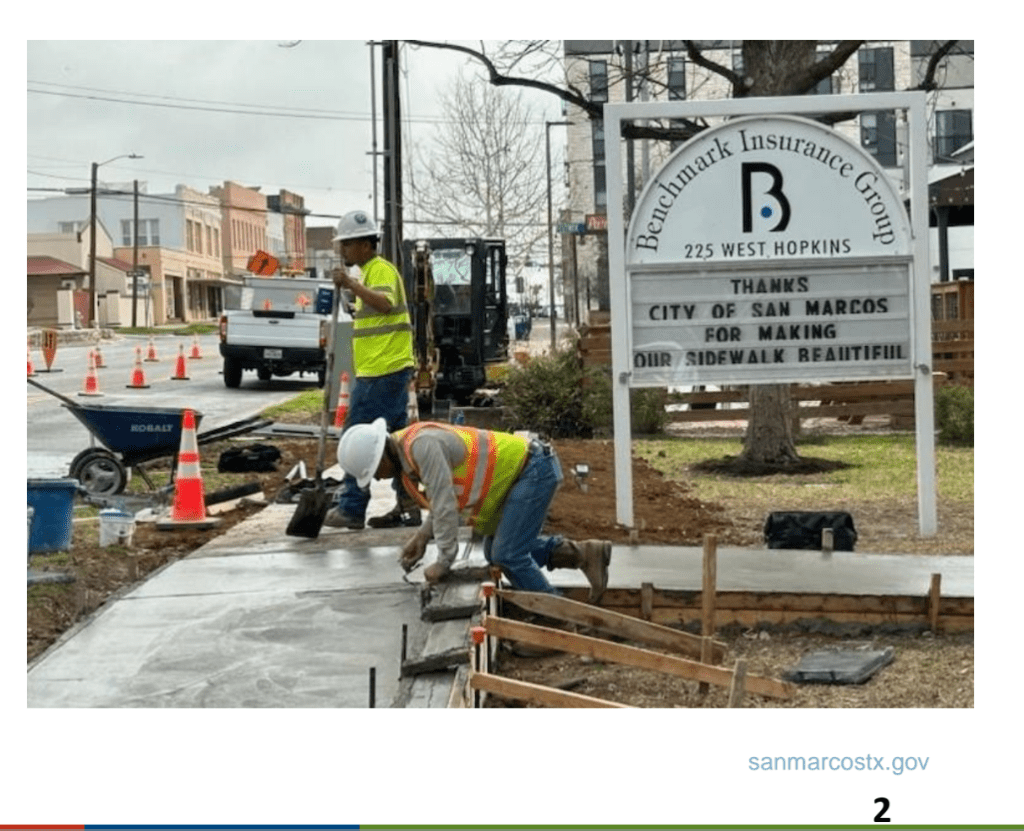
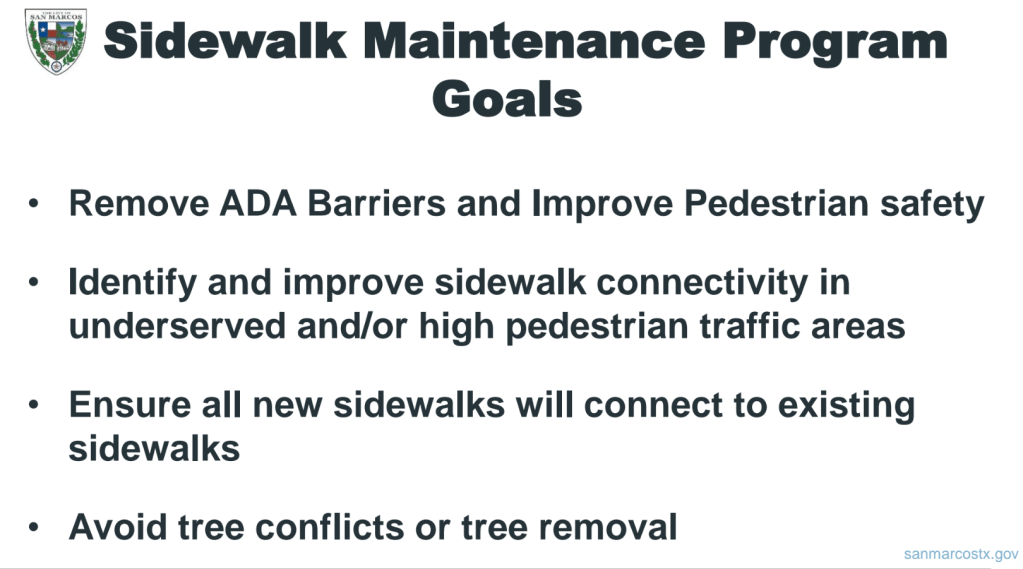
Presentation #2: It’s Sidewalk Maintenance time!
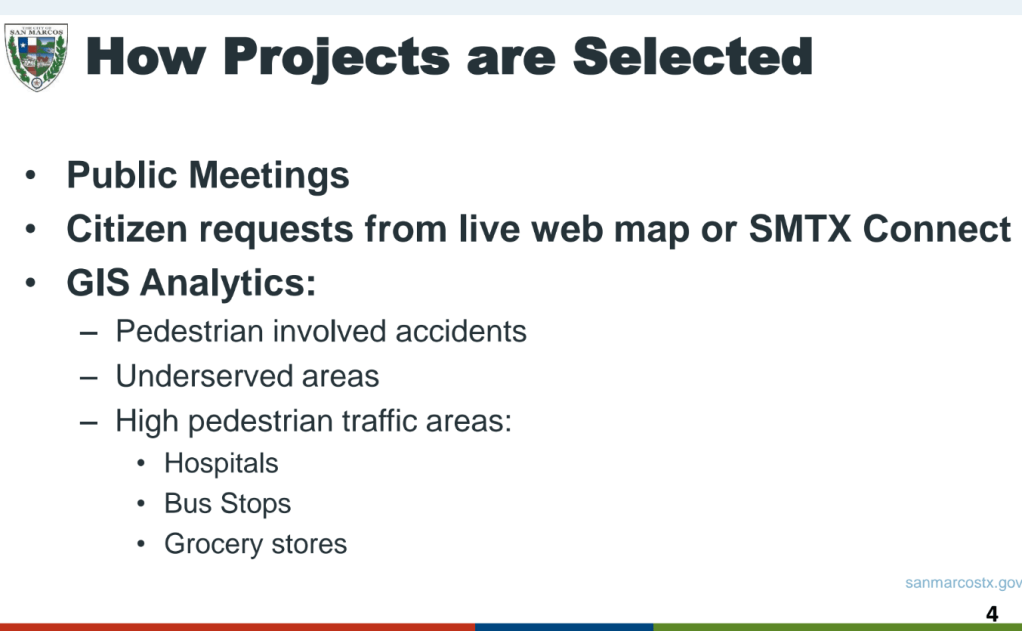
Here’s the game plan:
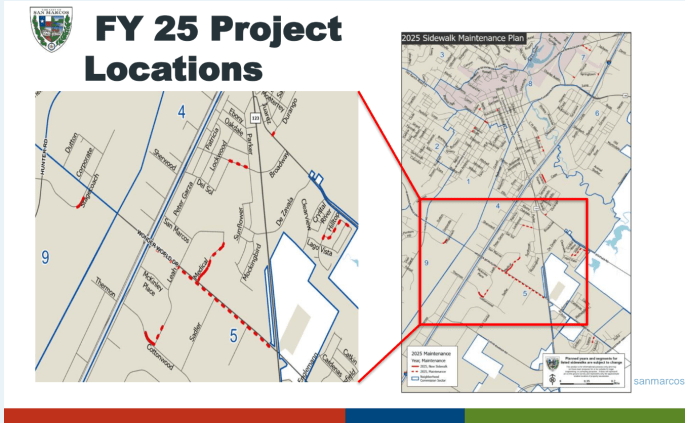
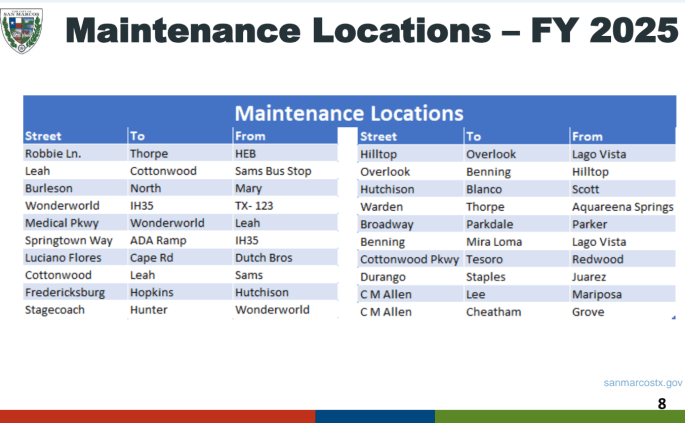
Here’s what’s coming up in 2025:
or if you prefer a chart:
Would you like to play along at home, over the next year? Go here:







 The San Marxist