
Citizen comment: The two main topics are the Can Ban and HSAB grants.
Can Ban:
– A bunch of people speak in favor, many who have spent years cleaning up the river
– Can it be a restriction on single-use beverages but not single-use food containers? Texas Water Safari folks need some single-use food containers,
– City Council member from Martindale describes how well their can ban has worked.
– The Eyes of the San Marcos River does regular clean ups just past where city contractors stop picking up trash. It’s a lot.
Speakers promoting their nonprofits for HSAB Grants:
– Outsiders Anonymous representative describes their free addiction recovery program.
– PALS for free spay/neutering and low cost pet care
All these things in due time!
…
Item 9: We are rezoning about 1 acre here:

Currently it looks like this:

That is the restaurant Sakura.
Sakura is staying, but it’s gaining a bunch of little apartments behind it. They can put up to 9 apartments there. This seems like a good place for apartments! Infill does not need to be scary.
…
Item 10: There’s a little road you’ve never heard of here:

called Flustern Road. It’s up in Whisper Tract:

Whisper tract is gigantic, and slowly getting built out.
Flustern Road has exactly one resident, a company called Manifest Commerce. They asked if they could get the name changed from Flustern Road to Manifest Way.
However, Flustern Road will eventually cross Opportunity Blvd, and connect with Celebration Way:
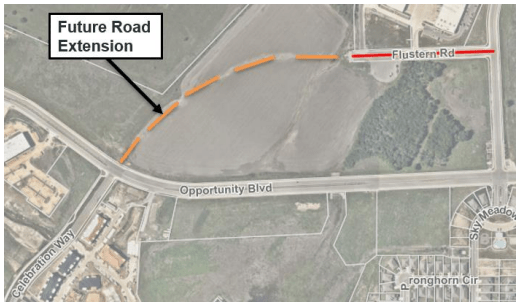
From the POV of the fire department and EMS, it’s better to have roads that don’t change names. So as long as we’re changing the name anyway, we’re going to go with Celebration way.
Also, don’t the names all sound like someone from the 1960s was dreaming of a brighter tomorrow? Celebration Way, Opportunity Blvd, Technology Way, Manifest Way… Flustern never really fit in, did it.
Nevertheless: would you like to know what Flustern means? [drum roll] ….it means “to whisper.” And it was in Whisper Tract. Aww, very cute. But over!
…
Item 11: Consolidated CBDG funding report.
All of our CBDG money originates with the Federal Housing and Urban Development (HUD) department. We have to regularly write reports to them, documenting that we’re using the money according to the rules.
Alyssa Garza feels like the report isn’t widely circulated enough. Maybe fewer neighbors would harass her about wasting money if they saw how meticulously nonprofits have to account for every last nickel.
I’m more cynical than she is. People just like to gripe.
…
Item 5: We’re buying a generator, for $445K:

Technically, we’re buying a 600-kilowatt diesel generator, automatic transfer switch, electrical installation, and associated engineering services.
Technically, it’s Covid money that’s paying for it.
And technically, it will be located in San Marcos High School, so that the high school can serve as an emergency shelter in the future.
…
Item 12: Citizen Comment will now be called Community Perspectives. (Mentioned before here.)
- We’re getting rid of “Citizen” because you do not have to be a citizen to have a comment. This is good!
- We didn’t want to name it “Public comment” because we already have “public hearings”, and those might sound too similar.
- Not sure why we didn’t go with “Community Comment”. “Community Perspectives” sounds a little bit like a hokey small town newspaper op-ed column, but hey, sometimes we are a hokey small town. Did you have a chance to stop by Sights & Sounds this weekend?
…
Item 13: Human Services Advisory Board (HSAB) Grants.
We put $550,000 of our city budget towards grants to nonprofits. This year, we also have $100,000 of the last bit of Covid money to distribute as well. HSAB is the committee that meets, looks over applications, and recommends to council who should get money.
Last year – for reasons I was never quite clear on – the process was deemed a shitshow. Council made HSAB go back and do it all over again. Then Council tinkered with the results anyway. After all that, HSAB thoroughly revised their process for evaluating grant applications.
It seems everyone likes the new process! You can read all the applications yourself here, as well as a bunch of other reports and information.
So this year:
- 34 nonprofits applied.
- 5 board members rated them independently on a huge matrix of things:
- All the nonprofits pass the Risk Assessment
- One nonprofit needed to get their nonprofit status back
- They were ranked according to some evaluation criteria
Here’s the evaluation criteria:
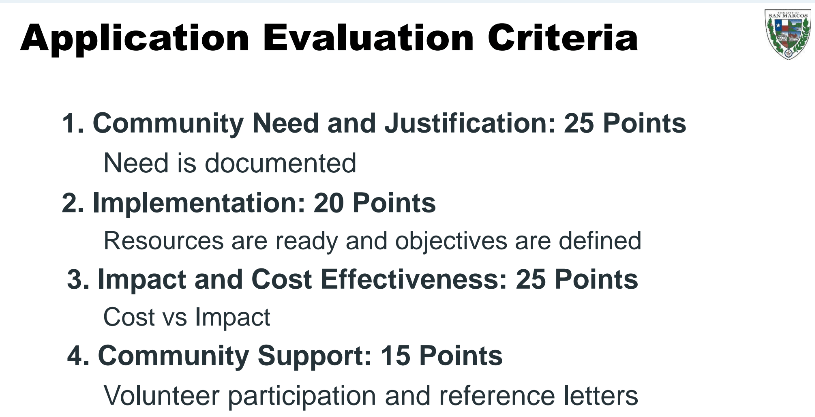

The committee met weekly, all fall long, and discussed all of the nonprofits individually. They heard presentations from all the nonprofits. It sounds like a massive amount of work.
Here’s the full scoring matrix on the Evaluation Criteria, if you’re so inclined:
(I know it’s tiny, but you should be able to zoom in and scroll around.)
And here’s the summary table of the scores:
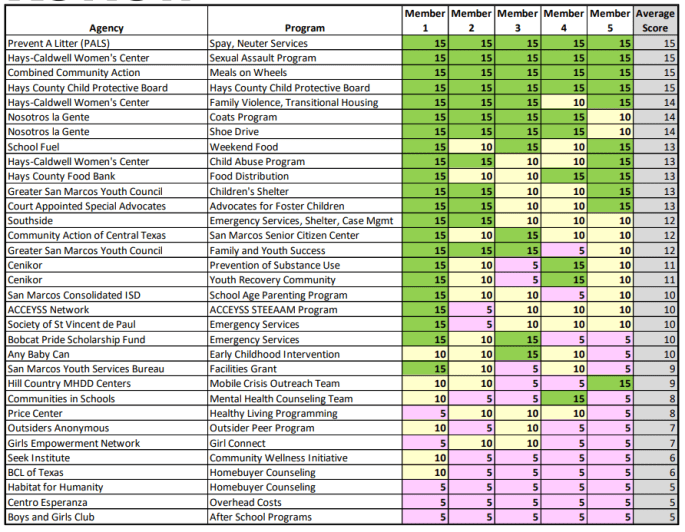
(scores were re-centered across committee members, for consistency.)
Finally, here’s HSAB’s complete funding recommendations:
So what does Council think? Let’s dive in.
Council Discussion
Alyssa Garza: Last year, Council deviated from the recommended HSAB funding in a really haphazard way. I’m glad to see a really systematic process. This is good work, I support the recommendations.
Matthew Mendoza: Great job! But I want to tinker with it. Any Baby Can is centered out of Austin. Let’s deduct $7K from them and give it to the San Marcos Youth Services Board, because that’s centered in San Marcos.
Jane Hughson: Any Baby Can has an office here in San Marcos. Make it $5K and I’ll support it.
The Vote: Should we take $5K from Any Baby Can and give it to SMYSB?
Yes: Shane Scott, Mark Gleason, Jane Hughson, Matthew Mendoza
No: Alyssa Garza (who explains that she just wants to stick with HSAB process)
Abstain: Jude Prather, because his wife serves on the board of the food bank.
So now:
– Any Baby Can requested $30K, recommended $25K, and will get $20,000.
– SMYSB requested $39K, was recommended $20K, and will get $25,000.
This is a good example of haphazard meddling. They’re both good organizations!
But let’s take a moment anyway:
Any Baby Can is providing early childhood intervention for birth-3 year olds, for kids with medical diagnoses, developmental delays, or any impairments. (Getting interventions in early is huge. This majorly redirects the trajectory of kids’ lives.) According to their application, they served 159 children and families in San Marcos last year, over 29,600 hours. They expect to serve 165 children in San Marcos this next year.
SMYSB is an afterschool program for 11-17 year olds in San Marcos. They’re asking for rent for their new facilities, which is $2700/month. Their application doesn’t say how many kids they’ve served, but looking at their progress report from last year, SMYSB got $10,000, and served 16 kids in the spring and summer. They used to be located at Southside Community center, so I’m guessing that they’re working with kids dealing with housing instability or homelessness. This is a super vulnerable population! They need this kind of one-on-one care to navigate what they’ve gotten handed to them.
Both are good programs, staffed by hard-working, underfunded organizations! But the committee took their job seriously when they evaluated the benefit to San Marcos.
I guess I’m harping on this because it’s, well, haphazard. It didn’t feel like Matthew Mendoza read all the applications super closely and then felt compelled to shift this money around. It felt like someone from SMYSB picked up the phone and asked him if he couldn’t find a few more dollars for them. He did, but it comes out of someone else’s funding.
The vote on the entire thing:
Yes: Everyone but Jude
No: No one
Abstain: Jude Prather
…
Because I’m an insufferable prig, may I make a comparison?
- Just now, we generously gave out HSAB grants which cost the city $550,000.
- We also give all homeowners a $15,000 homestead exemption on their property tax.
How much does that cost the city?
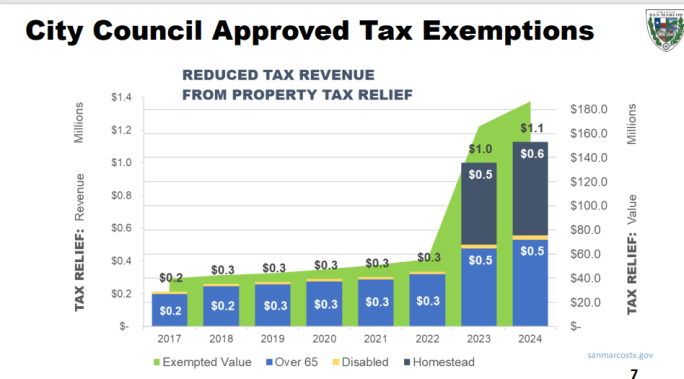
Basically, the city is donating of $1,100,000 towards the worthy charity of home owners.
- The elderly and disabled people get a tax exemption of $35,000. This works out to a $211 discount on their tax bill.
- Everyone else gets a $15,000 tax exemption. This works out to a $90 discount on their tax bill.
This is fine! I’m not mad about this. But it’s invisible. And we don’t call it “charity”, we call it a tax break.
Bear with me for a moment more:
- We’ve got about 7000 owner-occupied houses (as of 2021) who get to share that $1.1 million. There’s a tiny bit of paperwork, but that’s it. Each person gets either $211 or $90, no strings attached.
- There are 22,219 people below the poverty line (as of 2021). The HSAB money isn’t exclusively for poor people, but it’s a good place to start. That works out to $25 per person.
And there are SO MANY STRINGS attached. Thirty-four nonprofits fill out extensive paperwork. A six person committee meets for weeks and scrutinizes the applications. Council scrutinizes the recommendations further. Afterwards, each nonprofit writes ongoing grant reports on each person they helped. It’s an extremely labor-intensive, highly visible process. Someone has to maintain the website charting all these details.
To recap:
- $1,100,000 on charity for 7000 homeowners.
- $550,000 on charity for at least 22,000 people in poverty.
Haha, weird, right! [hard stare at city council.]
 The San Marxist