
Next up!
Item 9: Updates to the Land Development Code.
We discussed this in August and in September. There are just a few remaining issues to hash out. Here we go:
- Should staff be able to approve the most mild, least controversial restaurant alcohol permits, or should they all go to P&Z?
For now, all restaurants and all bars will go through P&Z to get their permit. (Discussed here before.)
A subcommittee will look at carving out some exceptions. For example, hotel bars generally aren’t close to neighborhoods, and aren’t generally rowdy. Maybe City Staff can just renew those on their own.
2. Developers have to donate land for parks, or pay a fee instead. If you’ve got just a little infill development of 4 to 8 units, should you have to pay a fee towards the park system?
No one on council really felt strongly about this. They compromised at 6 units: if you’re building a little development with 6 or more units, you need to pay a fee towards the park system.
3. If houses are only allowed to be 2 stories in your neighborhood, and you’ve got a little rooftop patio, does that count as an extra story?
It used to be 25%. If 25% of your roof has a structure on it, it counted as an extra story. Now it’s any structure at all counts as an extra story.
(Discussed here and here before. I accused them of being killjoys.)
4. Should we continue beating a dead horse on this occupancy restriction thing?
Yes, yes we should.
Quick background: San Marcos has restrictions on how many unrelated people can live together. It’s been two. Back in May 2022, Council agreed to loosen them from 2 to 3.
Matthew Mendoza balked at this in August, and then tried to roll it back to 2 in September. The vote failed 4-3. But he’s still all heated up about it, and makes another motion to amend it back to 2.
So first, some facts:
- In San Marcos, it’s only certain housing that has occupancy restrictions. Basically, single family neighborhoods.
- In these neighborhoods, you can have any number of people, but only up to two unrelated people.
- Here’s how we define unrelated: “A family is defined in the Land Development Code as any number of individuals living as a single housekeeping unit who are related by blood, legal adoption, marriage, or conservatorship.”
Here’s what city staff say:
Whenever neighbors complain, they’re not actually mad about the number of unrelated people. It’s always noise, or parking, or the trash, or yard not being kept up. We can deal with the noise/parking/yard complaint. It’s not literally the marital status of any of the tenants that’s the issue, so this ordinance is not needed.
Here’s what Matthew and Jane Hughson say:
Landlords want to be able to rent to three tenants. So if you increase this, landlords will buy up housing stock and let it crumble into shitty, ill-maintained housing that exploits tenants. It’s bad for renters, and decreases the available housing stock for people who want to purchase a home.
Here’s what I say:
Actually, I want to say two things. I want to refute Matthew’s argument, and I also want to make a separate argument on why you should get rid of occupancy restrictions all together.
Look at Matthew’s argument:

When your chain of cause and effect becomes really long and stretched out, that is often a sign that you are writing bad policy.
If you’re worried about those Bad Consequences – low housing stock and shitty landlords – this would not make it onto the top 100 of effective things to do.
What you’d do is:
- Build more housing. (All sorts.)
- Hold landlords accountable. Enforce code violations and fund a city lawyer to send letters to landlords on behalf of tenants.
Furthermore, his facts aren’t right. Letting bedrooms go unfilled reduces available housing. Occupancy restrictions decrease housing, which is the opposite of Matt’s Bad Consequence #1.
So I have yet to see a compelling argument for these restrictions.
Arguments against – and here’s where I get pissed off:
- Why is the city meddling with whether people are married or not? A married couple can take in a tenant, but an unmarried couple cannot? Three friends can’t rent a house? This is gross.
- There is a serious housing shortage. You should be able to put people in bedrooms. You should be able to flexibly problem-solve to provide housing on the fly, when someone you care about is in a pinch.
- We just talked at length for two meetings about the burden of property taxes on Grandma. Grandma should be allowed to take in her friend’s grandkids as tenants. Grandma’s primary asset is her house, and she doesn’t want to move, but it’s more house than one person needs. Let her share.
The common thread is non-traditional living situations. Why should non-traditional living situations be banned? A few people want to live together, and they can’t, because the city can’t crack down on shitty landlords? That’s dumb as fuck.
Bottom line:
- Hold landlords accountable for providing safe, well-maintained housing.
- Build a variety of housing in neighborhoods, not just 3- and 4-bedroom houses. Build four-plexes alongside houses so that people can rent apartments in quiet neighborhoods.
- Stop micromanaging who is married and who isn’t.
One final point: Yes, landlords buy up housing stock. But listen: being a good landlord is a lot of work. Make bad landlords be good landlords, and some of them will decide it’s not worth it. Hold landlords accountable for maintaining safe and well-maintained properties, and their profit margins will go down, and they’ll be less likely to buy up your housing stock, and it’s better for tenants, and neighbors. Win-win-win.
Here’s how the conversation goes, after Matthew makes his basic argument:
- Shane Scott points out that letting someone rent a room may help them afford their property taxes.
- No one knows the occupancy restrictions in other cities more generally, but College Station sets it at 4 unrelated people.
(I went hunting, and couldn’t find much. Austin puts it at 6 unrelated people.)
- Jude Prather: I’ve been in this situation. I know plenty of respectable, good neighbors who have had three unrelated people living together at various times. How do you tell people they can’t do this, when housing is unaffordable?
- Matthew: but Minneapolis got rid of their occupancy restrictions and they went to hell in a handbasket!!
- Jude: Actually, Minneapolis went the other way. Their housing costs actually resisted inflation. What about a compromise, where you can take in extra tenants if it’s owner-occupied?
- Alyssa: Let’s remember that occupancy restrictions are rooted in racism and classism.
- Jane Hughson: NOT IN SAN MARCOS, IT’S NOT! The history here is NOT racist!
In San Marcos, its origins are mostly anti-college students. But the folks in power did not shed a tear that it was also disproportionately impacting poor and non-white community members.
Also, confidential to Jane: I wouldn’t go betting the farm on San Marcos being a bastion of anti-racism.
- Matt: I’m trying to protect renters!
(Ahem. Establish a tenant’s council, then.)
- Mark Gleason: My worry is keeping people in their homes. So I’m in favor. I think people should be able to rent out a room or two. I don’t think it affects whether or not investors buy up houses. I’m okay with owner-occupied only, though.
- Jane: Let’s postpone the whole thing for two weeks!
- Matthew: I’m just sad about the historic district.
- Jude: San Marcos is clearly an outlier. We’re not trying to get rid of the rule altogether. 3 unrelated people seems like a good compromise.
The vote:
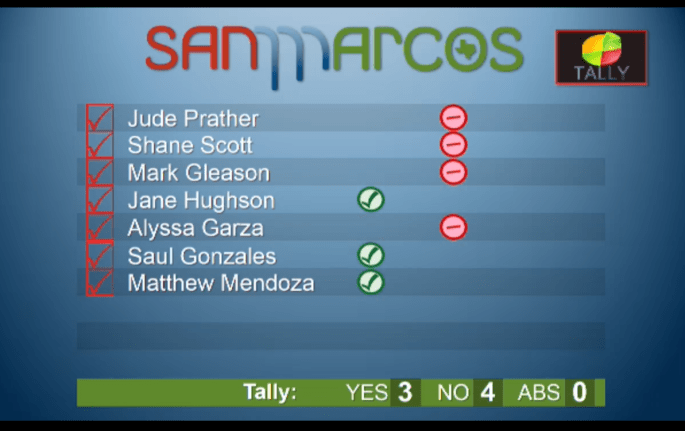
Jane keeps talking about creating a subcommittee and postponing it for two weeks. It feels like she’s just unwilling to recognize that she’s lost this vote. Both Jude and Alyssa gently say that they would be fine just letting it go.
She forms a committee anyway – Matthew Mendoza, Alyssa Garza, and Mark Gleason – and Alyssa says if there’s a committee, she at leasts wants to be on it.
When actually forced, 6-1 vote in favor of committee. The committee will consider whether three unrelated people should only be allowed when one of them owns the house. (We really only want to micromanage the marital status of renters, I guess.)
…
5. Should the notification radius for a giant ungodly thing like the SMART Terminal be bigger than for a dinky little development?
Yes. The notification radius should be proportional to the size of the development. We’ve been over this multiple times.
Staff says no, and gives this as their reason why not: “If we made the cutoff at 500 acres, then developers will just come it at 499 acres!”
In other words: it can’t be done because developers will game the system.
Give me a fucking break. How about this: “For every 25 acres, you have to notify 400 ft out.” Not to brag, but that took me all of ten seconds to write down. I bet someone can spend 10 more seconds and come up with something even better.
Thankfully, Jane is also not satisfied with staff’s lame evasion, and says, “I don’t know the best way to do it, but there’s gotta be a way.”
So this will go to committee.
…
In the end, the whole set of revisions will be postponed until December 5th, to give all these committees time to meet
 The San Marxist
If we are to maintain a representative democracy, then some self examination should be done here at our local government. The concept of policy in the context of making rules and planning guide the implementation of rules and planning. These policies are the domain of community. They include the Comprehensive Plan, the Preferred Scenario Map, and many other policy decisions. Staff shouldn’t weigh in on these for their’s is the domain of procedure, for the most part. Policy is Community’s vision not Staff’s. We the Community should define the rules that we will live under locally using ordinance. Community should also weigh in on and review how implementation is working so as to see how procedures align with policy. Comp plan is 100% Community’s vision or it should be.
LikeLike
I agree. The Jane Hughson-P&Z subcommittee though meddled more in the community vision for the comp plan than staff did. I generally am inclined to give city staff the benefit of the doubt? When they put their thumb on the scale, I assume it’s because it creates extra work and they’re trying to keep their workload in balance, as opposed to push an agenda on the city. But it’s not always easy for me to tell from the outside.
LikeLike