
Citizen Comment:
- Landlords are mad about the Eviction Delay still being in effect.
- Community members rooting for good SMART re-negotiations
Both of these will come up tonight.
Item 1: Presentation on Meet and Confer negotiations
Background: After the whole mess leading up to Ryan Hartman’s termination, Mano Amiga called for five police reforms. The city negotiated the new SMPD contract and ignored the five reforms. So Mano Amiga circulated a petition to overturn the contract. Legally, City Council had two choices: either re-open the contract, or let the voters decide. Council decided to renegotiate the contract. The negotiation process is called Meet and Confer.
So, We Meet (and confer) Again
Here are the five Hartman Reforms from Mano Amiga:

City staff has met and conferred with SMPOA. They have a new contract they are proposing. At this past Tuesday’s Council meeting, there’s a presentation on the new contract. Then City Council will vote to adopt (or not) the new contract on May 16th. (They will definitely vote to adopt.)
Here’s the short version:
- End the 180 Day Rule: “We’re already doing the compromise position!”
- End Delay of Interview Rule: “No.”
- Public Transparency: “I’m pretending my hands are tied, legally. But we will incorporate reprimands into promotions.”
- End 3rd party arbitration: “We’ll tighten up a few situations where the 3rd party can’t overrule us.”
- End Vacation Forfeiture: “No.”
City Manager Stephanie Reyes made a point to say that Chief Standridge was not part of the negotiation team, because it would put him in such an awkward position. He was only there as a neutral resource. (Who all actually was doing the negotiations? I couldn’t figure it out. It wasn’t on the agendas of the Meet and Confer meetings. I watched a little bit of the videos – April 7, April 19, April 23 – but didn’t see any introductions, and I could only recognize Stephanie Reyes. There are no documents besides the presentation in the packet. So I have no idea.)
It’s a weird situation, where the police union (SMPOA) is on one side, and city staff are supposed to be on the other side, advocating for these five reforms on behalf of Mano Amiga that they don’t necessarily believe in. So it’s mildly amazing that they moved the needle at all.
In other words, my expectations were low, and they successfully cleared my low expectations.
The main presentation
I found myself getting pretty mad, listening to Chief Standridge. We’re going to unpack what he said, but there’s a couple main themes:
- He acts deliberately obtuse about the reason activists are requesting a reform. “Why on earth would you not want to support our valiant officers?”
- He is mushy about the difference between holding an employee accountable in their job, and someone’s legal rights in a criminal investigation. These are very different things, but he switches back and forth as if they’re the same.
- He acts like something is legally forbidden, when he means “Well, we have the power to change the law in these negotiations. But until we do, it’s forbidden!”
He organizes his presentation according to the five Hartman reforms, so I’m going to do the same here.
So here we go.
- The 180 Day Rule:
What Mano Amiga says about it:

What Chief Standridge says about it:
Before San Marcos negotiates a contract, there are some background Texas laws in effect. These are the Civil Service laws. If an officer does something wrong, Chief Standridge has 180 days to investigate, meet with all parties, and dispose of an investigation.
Last summer’s Meet and Confer agreement made it stronger. Now Chief Standridge has 180 days to file a complaint, and then another 180 days from the complaint to carry out the investigation and draw a conclusion or punishment or whatever.
Standridge gives some other contexts:
- If it’s not a criminal offense, the 180 day clock starts running at the incident. If it’s criminal, the 180 day clock starts running when the crime is discovered.
- Federal law mandates 300 days statute of limitations for sexual harassment
- Statute of limitations for misdemeanors is 2 years, for run-of-the-mill felonies is 3 years.
Mano Amiga wants to end the statute of limitations altogether.
Standridge’s argument against this is basically:
- That’s absurd! The statute of limitations for most crimes is only 2-3 years!
- It’s really hard to get good evidence as more time passes! For example, a lot of video footage auto-rewrites every 30 days or so. It’s hard to collect old evidence. “An unlimited time span is unreasonable if we believe in evidence.”
This is Chief Standridge at his worst. He’s completely ducking the issue. The issue – which he is well-aware of – is that nationally, we have a big problem with police department protecting abusive cops and shielding them from investigations. One good way to do this is to circle the wagons and run out the statute of limitations. Then shrug your shoulders and say, “oops! Too late to do anything!”
Does SMPD do this? Clearly Chief Standridge thinks not. I genuinely have no idea. But Chief Standridge is being a jerk by not acknowledging that this is a broader problem among police departments in general.
The next thing that Standridge is doing is switching back and forth between the employment rules for police officers versus the actual law for civilians during a criminal investigation. When it comes to employment rules, there’s no statute of limitations at your job. Your boss can pull you in and say, “Wait a minute. What were you doing back in 2017?” It doesn’t mean that your boss can file criminal charges against you, but they can certainly open an investigation with HR.
The fact that the statute of limitations is 2 years for misdemeanors and 3 years for low-key felonies is 100% irrelevant. Who cares, Chief. You’re their boss. If you have a bad cop and something comes to light from 2019, don’t you want the option of looking into it?
Which brings me to my final point: some crimes have no evidence, and it’s just the end of the road. If the incident was a year ago and there’s no evidence, then you’ve done what you can do. End of matter. Why do you need to decide preemptively that all crimes from a year ago have no merit? None of them could possibly be investigated? Even if someone was deliberately obfuscating and hiding the matter?
Outcome: nothing changed.
Hartman Reform #2. 48 hour delay of interviews and video review.
Here’s what Mano Amiga says:

Here’s what Chief Standridge says:
Suppose an officer is accused of misconduct. That officer is given 48 hours advance notice and shown the video before they are interviewed. Community members are not. You may think this is unfair towards community members, but it’s actually unfair in the opposite way! It’s unfair for officers, because they can’t plead the 5th like you can. You’re allowed to ask for a lawyer before you talk to the cops. The officer is forced to give a statement and answer questions by Internal Affairs. They can be fired if they don’t cooperate!
Again, Chief Standridge is drawing a false equivalence, and it’s bullshit: if you’re being hauled in for questioning, you’re a civilian being questioned by the cops. You’re entitled to rights under the constitution. Whereas if the cop is hauled into Internal Affairs, he’s an employee being questioned by his job. That is not a criminal investigation.
Chief Standridge almost acknowledges this, because he cites Garrity, which is a court decision that says that a cop’s compelled testimony for Internal Affairs can’t be used in a criminal proceeding. In other words, everything is completely fair:
- You can be forced to talk to your boss at work, but you can’t be forced to talk to the cops in a criminal investigation.
- A cop can be forced to talk to Internal Affairs at their job, but that testimony can’t be used against the cop in a criminal investigation.
Nothing of substance was said regarding the 48 hour delay. It was just glossed over.
Then Chief Standridge talks about why officers are allowed to watch the video before they testify: studies prove that it improves officer recall by 11% when they watch the video before they testify! Isn’t that amazing?
It is a wild misreading of the situation. He is literally explaining the point that watching a video helps you remember what happened. No shit, Sherlock. That’s not the issue.
The issue – just to be painfully explicit here – is that watching the video allows a cop to get their story straight. Does the video show you planting evidence? Did the video catch something that makes you look bad? Wouldn’t you like time to prepare for that?
If we take Chief Standridge at his word – that he literally believes that showing someone a video is best practices because it improves their memory – then he ought to extend that practice to community members. Everyone should get to watch the video! If you haul in a burglary suspect, you should show them the grainy ambiguous video footage before asking them any questions. It might help jog their memory. RIGHT CHIEF? BEST PRACTICES!
This would have been a respectable answer from Chief Standridge:
“Eye witness testimony is notoriously inaccurate. Showing a video to a witness has pros and cons. It can solidify someone’s memory of what happened, but it also reveals to someone the extent of what the investigator knows. If a person has nothing to hide, it helps them give better testimony. If a person does have something to hide, then it allows them to sharpen what they hide in the testimony.”
But that is not what he said.
Outcome: nothing changed.
Hartman Reform #3: Transparency
Here’s what Mano Amiga wants:

(I know, Chief Standridge went out of order. This is 3rd in his presentation, even though Mano Amiga’s graphic has a 4. Ignore it.)
Here’s what Chief Standridge says:
By law, there are two files on every cop, an “A” file and a “G” file.
The A File:
– Anything good that happens to the officer (a commendation, congratulation, or honor)
– Any misconduct that ended in a suspension, firing, or demotion
– Regular formal evaluations
The G File:
– Soft things, like coaching and mentoring and job improvement things. Letters of reprimand go here.
Here’s what the Austin Chronicle says about it:
The G files contain complaints by citizens, testimony from fellow officers, body-cam video, written reprimands and memos, and other details that justice advocates think should be accessible to the public.
Chief Standridge tells us that legally, he can’t release anything in the G file. His hands are tied.
But he’s misrepresenting the situation (and by this point I’m pretty irritated with his whole presentation). Here’s the thing: It’s illegal under Civil Service Laws, yes. But Meet and Confer contracts override Civil Service laws. So it’s only illegal until we pass a contract that says we want the G file released.
This exact issue is currently being debated in Austin:
Subsection (g) applies to Texas municipalities whose police officers (or firefighters) are civil service employees – that is, ones that don’t have unions that negotiate the terms of officers’ employment. Here, the city and the Austin Police Association, through what’s called the “meet-and-confer” process, do hash out a contract that could preempt Subsection (g) should the parties so agree. Both APD and APA leadership insist the G file must remain secret – that it will contain frivolous accusations that officers can’t defend themselves against, particularly under Austin’s current procedures that allow such claims to be made anonymously. However, during this year’s negotiations for a new police contract, the city’s Labor Relations Office is proposing to do away with G files.
In other words: It’s only illegal until your meet-and-confer agreement overrides it. Let’s file the G File in the Chief-Is–Misleading-the-Public File. (Or the circular file.)
(In fact, this is part of what Austin is voting on, on Saturday:
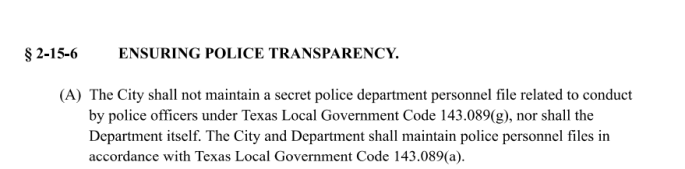
And it passed! Unfortunately, San Antonio’s Prop A, also including some police reform, did not pass.)
Anyway! Chief Standridge says that they found a compromise position: G-files and reprimands should play a bigger role in promotions. Or rather, if you’ve got a bunch of reprimands, you’ll get “negative points” and won’t be able to earn a big promotion quite so fast.
Kinda shocking that this wasn’t already happening, but better late than never!
Outcome: Letters of reprimand and suspension will be included in the promotion process.
Hartman Reform #4: End 3rd Party Arbitration
What Mano Amiga says:
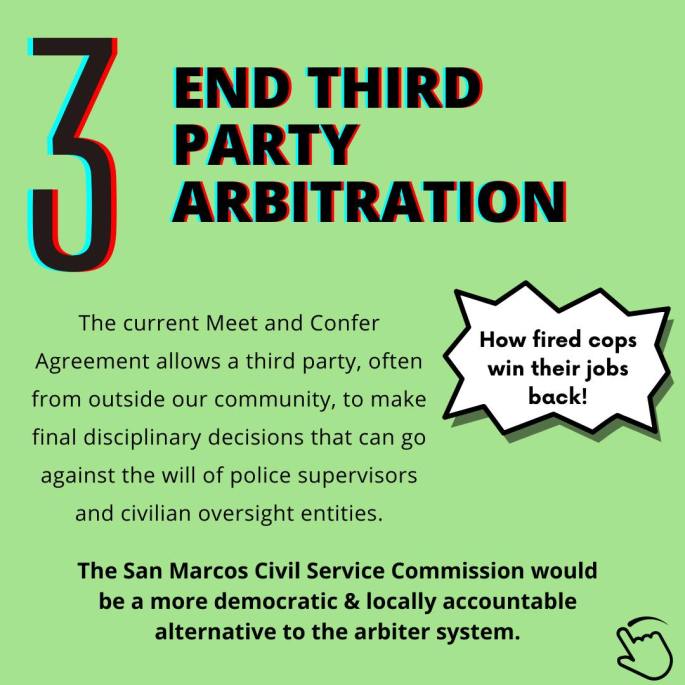
(I know, still out of order. It’s the least of our worries.)
Here’s what Chief Standridge says:
Suppose an officer gets in trouble. There are three kinds of discipline:
– you get fired,
– you get suspended, or
– you get demoted.
If one of those happens and the officer doesn’t like it, they have two options:
- Civil Service Commission
Three commissioners hear the appeals. I think they’re local citizens - Hearing Examiner hears the appeals. This is 3rd party arbitration.
What I remember from back in January is Karen Muñoz saying that 3rd party arbitration almost always lightens the discipline, and that arbiters have a motivation to stake out a middle position.
Here’s where Standridge ticked me off in this one: he goes back to Ryan Hartman and says, “Now, Ryan Hartman appealed his discipline to a Hearing Examiner, and the Hearing Examiner upheld the punishment. We prevailed! The system worked! So why would we want to change something that works?!!”
In other words: these dumb, irrational activists! They don’t even realize that their poster child Ryan Hartman was such a shitheel that even the arbiter upheld his punishment! Aren’t they silly?
Okay, you got me? I’m glad that Hartman wasn’t let off with a lighter sentence? Woo-hoo? Now what about the rest of the cases, where they do get a lighter sentence from the arbiter?
Anyway: there’s something called a Dishonorable Discharge on an F5. This means you got fired for criminal conduct, lying, or insubordination.
Standridge proposes using that as a standard: if the appeal is filed for one of those three things – criminal conduct, lying, or insubordination – then the arbiter can’t overturn the chief’s judgment.
Standridge also says this is very progressive. It would be 1st in Texas! Unfortunately I’m too irked by this point to celebrate.
Outcome: Unless there’s evidence that the Chief is violating some ethical conditions, the arbiter can’t override the Chief’s punishment in the most serious cases.
Hartman Reform #5: Vacation Forfeiture.
Mano Amiga:
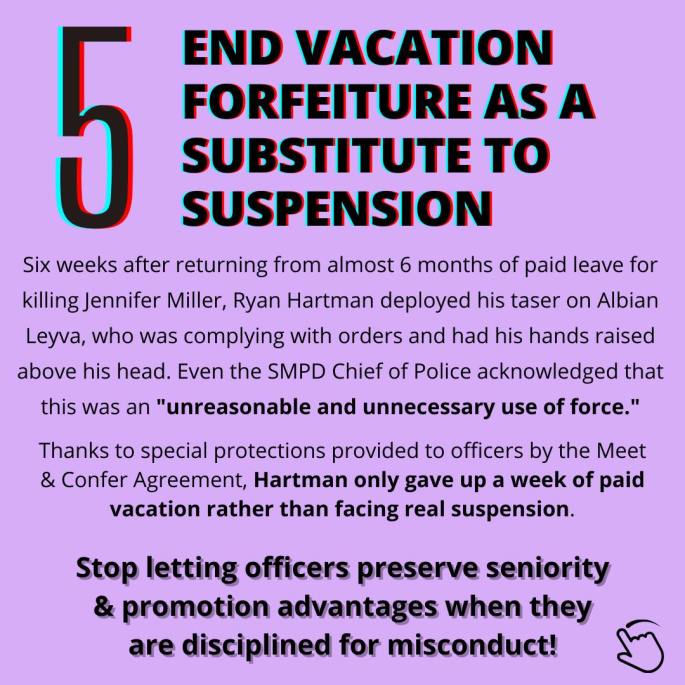
Using your vacation allow you to avoid a “break of services for promotion”.
Chief Standridge: “I’ll do a pros and cons list.”
Pros of vacation forfeiture :
– We avoid a costly appeals process, because they admit wrongdoing.
– It helps with understaffing because we’re not down yet another police officer
– They still lose those hours of pay, and we don’t have to pay overtime to someone else, so it’s cheaper for us
So it’s a huge win!
Cons: he never got around to this part. (In fact, even in the slide presentation there’s a “pros” slide but no “cons” slide.)
He says the vacation forfeiture will show up on your G-file. So since G-files are now being used in promotions, it will show up there.
Outcome: Double-dipping on the G-file outcome again. Gets used in promotions.
Thus concludes his presentation.
……
There are some outcomes that didn’t show up in my recap above. Here is the full list:

We only discussed bullet points 1, 2, and 5. (And the 5th really isn’t a change.) The 3rd bullet – streaming future meet-and-confer meetings – is a good thing.
So the last bullet: why did SMPOA agree to this? What’s the carrot in it for them?

They make more money. Which, fine.
Both City Manager Stephanie Reyes and Chief Stan chime in about the violent crime rate some more, and their desire to focus on other things beyond this contract. The end!
The Council Discussion
Alyssa asks if the Chief could explain about Ryan Hartman and vacation forfeiture.
Chief Standridge’s answer:
Hartman’s situation is totally different than what’s being discussed here. In the contract, we’re talking about suspension. You can substitute vacation time for suspension.
“Administative leave” is a totally different thing, which means “we don’t trust you with a gun and a badge right now”. Hartman was placed on administrative leave for six months.
…
One moment that I want to highlight:
Chief Standridge gives a very sincere statement on the early part of the Hartman investigation. It wasn’t exactly an apology, but he did show remorse. It was something like, “The early part of the investigation did not live up to SMPD standards. We’re not going to look in the rearview, we’re going to look through the front windshield and move forward, and moving forward, we’ll have higher standards.”
It’s not exactly groveling for forgiveness, but he delivered it with sincerity and I believed him.
…
So what did the rest of Council say?
Jude Prather: This will make us safer!
Mark Gleason: Let’s move on! (And he uses the phrase “so-called Criminal Justice Movement”. I use the phrase “rolling my eyes at him”.)
Saul Gonzalez: Thank you thank you! Win-win. My son is a cop.
Matthew Mendoza: I have faith in this new agreement.
Alyssa Garza: Staff devoted a lot of time. Improvements have been made. It took a ton of work from our neighbors. Town Halls and conversations would help.
Jane Hughson: Thank you to everyone. Everyone worked hard to come up with an agreement that everyone likes.
….
Bottom line: This contract has some legitimate improvements to it. I think the Chief’s presentation was cagey and semi-deceptive, but there are actual improvements to the contract.
There is also still a lot left to fight for!
So there you have it. It will be signed on May 16th and that will be that.
….
Two final notes
1. There was a funny moment at the beginning when Chief Standridge says, “I want to dispel any rumors. I’m not going anywhere. We’ve bought a house here. Abilene is our home.”
Then he waits a couple beats and says, “I just said Abilene, didn’t I. SAN MARCOS! San Marcos is our home!” It was pretty funny.
2. Chief Standridge goes off on a tangent at 1:14 that is very confusing. He seems to think that the activists are being hypocritical by simultaneously believing two things:
– there’s a lot of police misconduct
– there’s no accountability
Standridge believes these contradict each other. You can’t have a lot of police misconduct and no accountability!
Here’s his reasoning: the public doesn’t find out about misconduct until the police department makes it available. Therefore, any time you hear about police misconduct, you’re also seeing evidence of accountability. If there was no accountability, the misconduct would all be invisible. Ta-da!
This is idiotic, of course. Misconduct is not invisible. People seem to notice when they were tazed, or searched, or intimidated, or stopped and harassed, even if the police try to hide and suppress it. Gossip spreads, reputations get formed.
It’s possible that Chief Standridge really does open an honest investigation into every complaint he hears about. But he’s naive if he believes he hears a complaint about every incident that occurs.
 The San Marxist