
Items 6/7: The dreaded SMART Terminal
If you’re new here: Giant industrial park going up for zoning, out towards Martindale. Everyone very mad. Read the whole sordid backstory here.
Here’s the basic sketch of what happened Tuesday night:
- A ton of community members showed up in and drowned council in a mountain of information, concerns, data, suggestions, and so on.
- Council got the message loud and clear.
- Council is going to revisit the Development Agreement
- Then they’ll revisit the zoning in July.
Just a passing thought: these community members with these careful, well-researched, passionate statements to council? perhaps would make really great progressive potential future candidates for public office!
I’m just putting this out in the universe. Granted, a lot of the speakers live outside city limits, but maybe they were just annexed on Tuesday.
The City Staff presentation:
There was a small bit of new information given on Tuesday from the city:

(Crappy quality because it was not in the packet, so I had to screenshot.)
This fiscal analysis is supposed to happen before every annexation. I can’t remember ever seeing one of these before, and there have been a lot of small annexations. What happened here is that the community members noticed and spoke up repeatedly about it. In response, city staff put this together.
However, Noah Brock (one of the community members) independently did his own revenue estimate, using Amazon Warehouse tax revenue rates as a model. His estimates:
- Year 5: $1.4 million annually
- Year 10: $4.3 million annually
- Year 20: $8.1 million annually
The city’s estimates favor the developer, and Noah’s is less rosy. Draw your own conclusions.
(You know what I’d LOVE to see? The fiscal projections from the Amazon warehouse in 2016, or the Outlet Malls, or Embassy Suites, and how those have panned out. I’m sure they’re sitting in some prospectus, aging like milk. I found the Chapter 380 agreement for Amazon, but not the fiscal projections, which leads me to suspect it was never made public.*)
Seeing the writing on the wall, the developer made some small concessions in the days leading up to the meeting:
- Double the buffer zone required by San Marcos code (around creeks I think?)
- They will only pile shipping containers 80 feet high in certain areas (in the yellow circle below)
- At the purple arrows, they’ll put a 100 foot buffer between the SMART Terminal and residential homes.
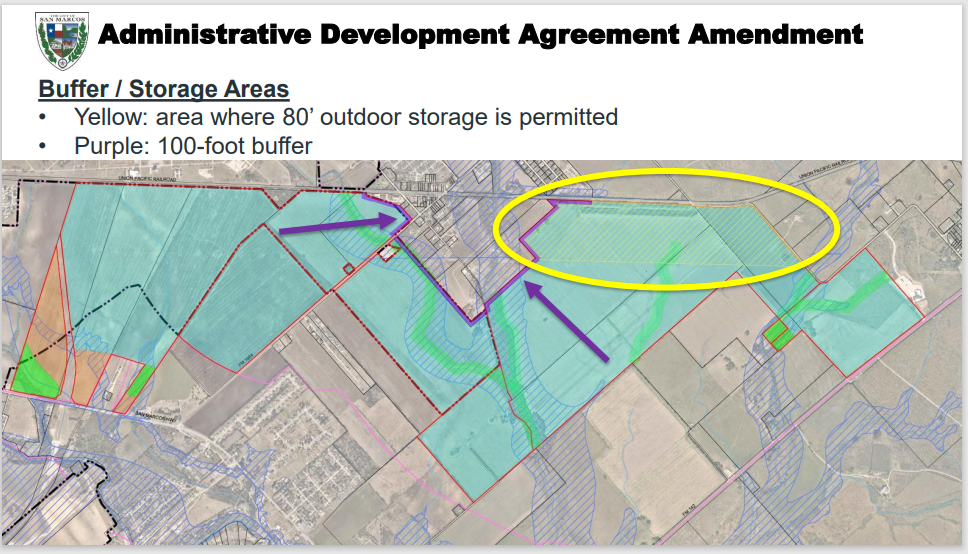
100 feet is tiny. A typical house sits on 1/5th of an acre. If that lot is square, it’s roughly 92’x92′. I’ve probably made you read 100 feet of my blathering already, and it’s only Sunday morning.
The idea that these two concessions would mollify the community is pretty arrogant. This developer keeps rubbing me the wrong way.
(Who is this developer anyway? Two of the community members filled us in: Franklin Mountain is an investment conglomeration owned by Paul Foster, an oil baron who is the current chair of ERCOT and part of lots of GOP committees, boards, etc.)
What do community members want?
At P&Z, the question was “If we turn this down, will the developer build in the county, with zero environmental protections?” San Marcos River Foundation director Virginia Parker thinks this is definite. However, this is a convenient threat that developers levy all the time, to spook communities into concessions. Maybe both can be true.
Either way, the SMART Terminal fight has morphed. Community members probably still wish it could be shut down altogether, but they recognize that that ship has sailed. On Tuesday, the conversation was no longer about whether it’ll happen, but instead about how to mitigate the damage. They’re fighting for the least-bad option now.
Seven of the community members (Noah Brock, Annie Donnovan, Ana Juarez, Ramona Brown, Ezra Reynolds, Bruce Jennings, and Rocco Moses) put together this list of recommended changes:
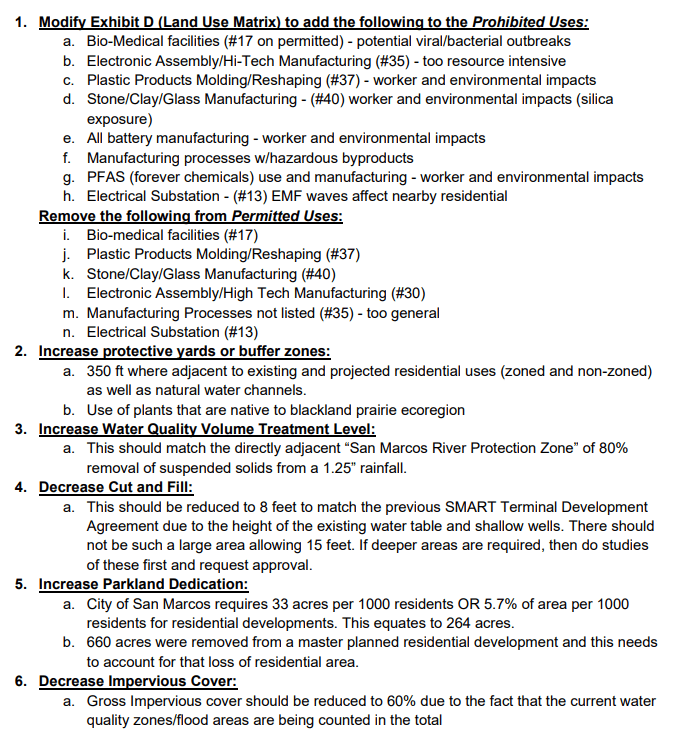
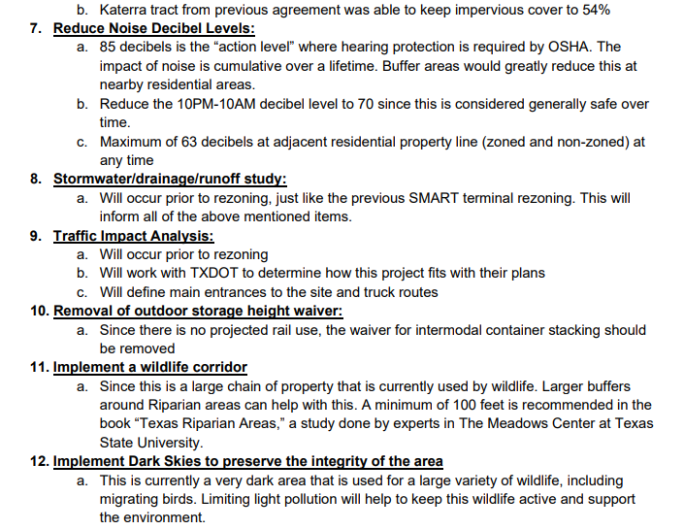
To the list above, I’d add:
13. Labor Protections
We keep being told that the point of the SMART Terminal is:
- to increase tax revenue without raising property taxes
- to bring good jobs to the community.
There needs to be some labor protections in the development agreement. Otherwise you will get shitty, exploitative jobs.
In 2016, we passed an amendment that any company receiving money from San Marcos should pay minimum $15/hour, plus benefits. This is a good start, but there’s one crucial detail missing: it must be pegged to inflation. You should never set a safety net without planning for inflation-adjustment.
(Honestly, this is one of the most underappreciated near-misses of federal policy of the 20th century: not pegging the minimum wage to inflation.)
Other labor protections: regular schedules with advance notice, no drug testing, and there’s a bunch more here. But mandating that the minimum wage keep up with inflation would be a good start!
Other recommendations: Ed Theriot is a local developer who is usually trying to build the things that make neighbors mad. But this time he’s the neighbor, and also one of the Caldwell County Commissioners, to boot. So his perspective is particularly useful.
However, I don’t have his recs yet. He’s writing up a list of recommended changes to the Development Agreement, and I’ll include it here when he sends it to me.
One more thing:
There was one more very interesting thing in Citizen Comment, which doesn’t fit neatly anywhere. Bruce Jennings offered the following history of the land next to Gary Job Corp:
Let me tell you a story about the land you are about to annex. The area in question has significant history of prior pollution. Some of you may be old enough to recall that the airport and the Gary Job Corp property was Camp Gary, a military installation from 1942 to 1956. Now, one of the duties of the base was aircraft maintenance; engines had to be maintained, parts cleaned, fluids changed, detergents, oils, and degreasers disposed of. But in the 40’s and 50’s few knew about the potential of pollution. Camp Gary personnel dumped these chemicals into a landfill and creek at the back of the property…for years.
Those fluids ran downstream to a earthen detention pond before entering the San Marcos river, where they settled as heavy metals on the bottom of that pond. Later, in the 1970’s and 80’s most people had forgotten and the land was developed for residential use. People started fishing for bait in the pond fed by 2 creeks and springs from the hillside. One day I was approached by an elderly gentleman who told those fishing to NEVER eat what they catch in that pond. I was alarmed to say the least, and began to look for information.
We had city, county, state, and federal representatives on site multiple times. It was suggested that the property be identified as a superfund clean up site. Jake Pickle came out one day and walked the property with us.
The price tag for cleanup in 1981 was 5 million dollars. Options were discussed and a decision was made…to leave the contaminants in the soil. The contaminants were left under a 12 foot cap of mud. And instead, let’s improve the sewage treatment and close the landfill that followed, by the ownership of San Marcos, who owned the landfill out on the back end of Camp Gary. Where 69% of it was on two lots, where Camp Gary became Gary Job Corp. That cost about 1 million dollars. So if I remember correctly, you all had to build about 10 test wells out there, and run them for several years!
Now, at the time, the southeast part of the property, where the San Marcos Municipal Landfill was, encompassed an area of approximately 353 acres, of which two Gary Job Corps Center tracts comprise about 69 percent. Hazardous chemicals found included volatile organic compounds (VOCs), polychlorinated biphenyl (PCB), cadmium (Cd), iron (Fe), Ph, and manganese (Mn). Now these chemicals are in the soil out there.
If you do allow the cut and fill, you need to be testing the soil every time you penetrate for a slab out there, because what I understand is that you will be releasing PCBs that have been trapped in the compressed soil, and it will be leaching in the soil and then therefore go into the shallow water system that transfers through those creeks. I know this for a fact because I live two miles from that old landfill, and the pond at the beginning of my street is horribly contaminated! And y’all didn’t want to clean it up. Y’all wanted to just have a cap on it, and y’all went and did improvements over at Camp Gary, did your test wells for several years, y’all came and did tests at my pond for two full years. That shallow water feeds the creeks and the rivers. Any destruction of the soil could release the chemicals that were stored in the soil as hazardous chemicals. There would be a detriment to all of the flow of the water that seeps into and nourishes the river.
(That’s an amalgamation of his spoken and written comments, which he was kind enough to email to me.)
Here is the punchline, an environmental assessment on the land, prepared for the Department of Labor:
The San Marcos Municipal Landfill was once listed as a Texas Superfund Site in Reedville, Texas with the EPA Site # TXD980625222 (USEPA 2021). The landfill is not listed on the National Priorities List (NPL). It is currently registered as an Archived Superfund site by the USEPA (Homefacts.com 2021).
(Link and quote also from Bruce’s email.)
Just think, our very own Archived Superfund Site! With hard work and a fair wind, we could really double down on the legacy of environmental damage here.
Last thoughts:
The point of city planning is to share decision-making with the residents of the city. Developments affect residents, so residents ought to have some decision-making power over what gets built where.
We are giving away our power. Franklin Mountain isn’t an industry, it’s a middle man. They want the power to decide what gets built there.
The SMART Terminal is phenomenally big:

Decision-making power is worth a lot of money on something that big. Franklin Mountain would like to make a lot of money, and so they are working very hard to wrest it from us.
The decision-making power will go to this middle man company. (Specifically, a company owned by a rich oil baron named Paul Foster, as mentioned above.) Then they will hold the power, and they’ll get to decide what happens there, and we’ll be stuck with it.
…
*On the Amazon Chapter 380 agreement, the lack of concrete details is amazing. Here’s the hilariously useless Official Payment Plan:

Have you ever seen an amortization schedule without any, y’know, numbers? Or even percents? Just “yes” or “no”? Me neither.
 The San Marxist
I found another version of the Amazon agreement here :
https://www.documentcloud.org/app?q=City%20of%20San%20Marcos
LikeLike
That’s a useful site! Hadn’t seen it before. It looks like someone from the San Antonio Express is the one uploading San Marcos documents?
LikeLike