
Citizen comment: The big topic for citizen comment is the SMART terminal. Residents of the area are worried about:
- Flooding
- River pollution
- Litter
- Traffic
- Noise and smells
Representatives from the San Marcos River Foundations also spoke, but they got super specific about policy proposals, so I’m going to save that for actual item.
Max Baker was the last speaker, and he railed against the community survey results and lack of trust in city staff. He also spoke out against the Riverbend Ranch, saying that HK real estate people operate and negotiate in bad faith. Finally, he says, “I’ll have more to say about the SMART Terminal, but I’ll save that for the public hearing.”
That last sentence is supposed to be me foreshadowing for you. Hey everybody, <waves hands>, for no particular reason, note that Max has said that he is planning to speak during the public hearing for the SMART Terminal.
…
First up is the SMART Terminal!
Items 20-21: A few meetings ago, we got introduced to the Cotton Center and the SMART Terminal:
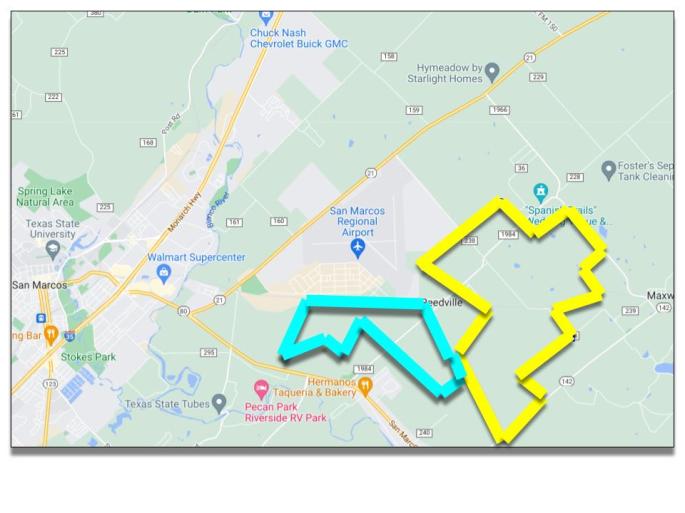
Yellow is the Cotton Center, the gigantic master planned community that was approved in 2016. Aqua blue is the SMART Terminal. The SMART Terminal is supposed to bring together the magic of a tiny airport, all our trains, and Highway 80.
How big are these things? The SMART Terminal blue bit up there is 900 acres. The Cotton center yellow bit is 2500 acres. The issue is that the SMART Terminal wants to take 600 acres from the Cotton center, and then also three more packets of extra land.
So here is the proposed future of the SMART Terminal:

The aqua blue is the old SMART Terminal. Yellow is getting taken from the Cotton center. Green is brand new.
San Marcos River Foundation is concerned because there are two creeks running through the property to the river. You can sort of see the creeks above, and in the map with my janky drawing, you can see the San Marcos river at the bottom.
First is a staff presentation. We learn that “SMART” stands for:
San
Marcos
Air
Rail, &
Transportation
So that’s a good start!
One detail is this little green box with the yellow highlighting:

That little yellow box lives in Martindale’s ETJ, instead of San Marcos’s ETJ. So we’re not allowed to make a development agreement for that little bit. (I’m guessing maybe that’s part of the mysterious Martindale fuss alluded to here.)
The total acreage of this new, SMARTER Terminal is 2,017 acres. That is huge. Google tells me that 2,017 acres is 3.15 square miles. Google also tells me that Martindale is 2.09 square miles. So the SMART terminal is going to be 150% larger than Martindale. (More like SMARTindale, right?? …I’ll show myself out now.)
Environmental standards
The developers want Heavy Industrial and Heavy Commercial. Here are the creeks that run to the river:

The blue striped parts are floodplain. The green is the creeks themselves. That’s a pretty direct channel to the river.
Here’s what the developer worked out with the planning department:
- 70% impervious cover, overall. This is stricter than the regular city code, which would allow up to 80% impervious cover.
- Impervious cover can be patchy – up to 90% in some places, less in others, as long as it averages out to 70%
- Total Suspended Solids (TSS): Here’s my shaky understanding of TSS: when it rains, rainwater is nasty because it carries all the surface pollution with it. So you retain rainwater in retention ponds to prevent flooding, but then you want to clean it before you release it. So you either want to let it settle, or filter it, or whatever. TSS is how much you have to clean it.
They’ve agreed to 70% TSS. I don’t know what our code requires. (The developer claims their sand filtration basin system actually captures up to 89% TSS, but they’re only obligated to maintain 70% that by the contract.)
- Water retention: what kind of flood do we want it to be able to handle? They’ve agreed to 1.25” rainfall. My memory is that this should be given as a rate: 1.25″ per hour, or 1.25″ per eight hours, or 1.25″ per day, or whatever. Not just a 1.25″ without any time frame. But in this agreement, there’s no time window given.
My uneducated read is that 1.25″ without a specified time window will get overwhelmed any time we have a mildly disasterous rain, let alone one of the massively disastrous rains that we’re known for.
- Run-off: they have to reduce run-off by 10%. This is stricter than the code – code says you can’t make run-off worse than it was before the development, but you don’t have to improve it. So that is good.
San Marcos River Foundation weighs in
Earlier, during Citizen Comment, SMRF made their case. They’ve had good conversations with SMART. They want:
- Half of the floodplain acreage should be removed when calculating total gross impervious cover.
In other words, say you’ve got 100 acres, and 20 acres is super sensitive land where you can’t build on it. Suppose you’ve agreed not to pave over more than 70% of it. Should it be 70% of the 100 acres, or 70% of the 80 buildable acres?
SMRF is proposing to split the difference – allow them to compute the 70% based on 90 acres, in this analogy.
- The setback to the floodplain should be wider than 30 feet. SMRF observes that 30 feet is really pretty slim.
- Any acreage using 90% localized impervious cover be placed farthest away from the river. In other words, the most-paved parts should be furthest from the river.
Council Discussion
Council begins asking questions, and then this very weird thing happens: Jude Prather speaks up and says: “I think we have one more public speaker…”
There is some fumbling around. Over zoom, you hear Max Baker say, “Is it my turn to speak now?” (Remember the foreshadowing, when he said he would be speaking during the SMART Terminal? This is that.)
Jane Hughson says no, Max can’t speak, because he didn’t sign up to speak the day before. She adds, “If you’re in person, you can just get in line to speak. But over zoom, you have to sign up the day before.”
What she means is that back in March of 2020, council had to set up zoom rules. How will citizens get the zoom number? How will they get moved from the waiting room to the main room? Etc. So they said that you have to sign up to talk the day before, to help with logistics.
Now: Max clearly did sign up the day before, because he spoke during Citizen Comment, and so someone gave him the zoom link. Jane is arguing that Max should have signed up for each item that he wanted to speak on, even though it’s the same zoom link. And even though that was really not the intent of the original rule.
Alyssa points out that we’ve revisited Covid-era rules many times, and this one just hasn’t come up, but Jane is firm. “He’s allowed to speak, he just had to sign up yesterday.”
Here’s the thing: generally Jane extends a lot of courtesy and grace to ordinary private citizens who take the time to show up and speak. It seemed like this was a maliciously strict standard that only applied to Max Baker. It felt kinda vicious.
…
Back to the SMART Terminal: So what did our council do?
The whole thing was very, very cordial. Everyone emphasized continuing dialogue with SMRF and other stake-holders. That makes me nervous, because the only thing that is legally binding is the Development Agreement being voted on. Dialogue is very nice, but it doesn’t compel any action. Acting like you believe the developers are our friends is not reassuring when you’re negotiating a contract on behalf of San Marcos residents.
First, Jane Hughson asks about the added truck traffic. The answer seems very thorough: you make some assumptions and do a traffic study before anything else. If they exceed the assumptions, then they have to do more mitigation. Widening roads, adding traffic lights, etc. They’ll keep updating and mitigating. (Fine.)
Matt Mendoza asks about retention ponds. They’re required to have them, so the developer just sort of explains what they are. They talk about the 10% reduction in run-off, which is admittedly an unusual standard for San Marcos. They commit to having more dialogue with stake holders.
Here’s the thing: environmental standards are very wonky and nerdy and specific. Every time Council asks an environmental-ish question, the staff answers in a very narrow, reassuring way. “Oh yes! We already did part of that!” and then the councilmember lets it go.
Example 1: Jane Hughson asks about the list from SMRF. She seems to have this SMRF list in front of her:

She just references the list and says it includes a lot of things, like lift stations.
The engineer, Richard Reynosa, only answers about the lift stations, and nothing else. He says the lift stations haven’t been placed yet, but if they were in the flood plains, you’d have to meet stricter standards.
No discussion of the other nine bullet points.
Example 2: Jude Prather also vaguely tries to get at the environmental standards. He says, “Dialogue is really great and all, but should these environmental things from SMRF be put into the contract? Like the Dark Skies thing?”
In other words, he’s waiving his hand at the long list of technical standards, and the only one that’s coming to mind is the Dark Skies one. (Which was mentioned briefly during the SMRF comments, but is clearly not their primary concern.)
The planning department person, Amanda Hernandez tells him that he can definitely add any provisions that he wants! And says that the Dark Skies one is basically already in the code.
Jude asks, “What about the other environmental features?”
Amanda Hernandez answers that they worked with the developer, and in fact, many of these standards are from the 2019 agreement with the original SMART terminal. (This is at 1:11, if you’d like to go watch this bafflingly useless non-answer.)
And Jude drops the issue. He doesn’t raise any specific line item from SMRF.
Example 3: Mark Gleason’s turn to act environmental-ish is next: on the 1.25” capture, he exclaims, “That’s above and beyond code, isn’t it!” (In other words, he’s just praising the developers.)
Mark does specifically ask about one of SMRF’s concerns: “On the setbacks being 30′: is it longer in the recharge zone?”
Richard Reynosa, the engineer, answers, “There’s not a specific setback in the recharge zone. You have a water quality zone requirement there, based on the size of the tributary.”
Mark says, “Thanks, that’s what I wanted to clarify!”
That’s what I mean: Everyone talked near the SMRF amendments and sounded like they liked them, but no one was willing to actually make a motion and require them.
What the fuck? Every person up there claims to be in favor of the river. SMRF hands you a list of recommended asks from the developer. SMRF highlights the three most important ones, during citizen comment. No one proposes a single one as an amendment, or even discusses them in a meaningful way.
The vote:
Yes: Jane Hughson, Mark Gleason, Jude Prather, Saul Gonzalez, Matt Mendoza
No: Alyssa Garza
(Shane Scott was absent)
So the SMART Terminal is coming. City Council asked some softball questions and approved it. It was kind of gross.
Now, Alyssa Garza also didn’t offer up the SMRF recommendations, but she voted against the entire project. You could argue that maybe she should have tried to get the amendments passed anyway, but in the end, she is one councilmember and the other five councilmembers wanted the SMART Terminal, and any of them could have pressed for the SMRF recommendations.
Does your friendly local Marxist blogger like the SMART Terminal?
I’m wary of it. I can see why business people might see an opportunity what with the railroad and the airport being right next to each other. (Full disclosure: I guess don’t see it. Why would you ever need your cargo to go from train to plane, or plane to train? I’m sure I’m just lacking enough business sense to understand.)
Anyway, surely it makes logistical sense to business folks. But here came SMRF with three specific amendments, and they were all roundly ignored. That’s enough to undermine my trust in anyone advocating for it.
Item 20: By the way, what happens to the Cotton Center planned community? Here’s the old 2,500 acre version from 2016:

Here’s the new 1900 acre version:

Wow, kind of a fragmented mess!
Okay, it’s making me laugh, the longer I look at it. What a soothing place to raise your kids. Ignore that gaping industrial black hole, please and thank you.
 The San Marxist